
Average Salary in Italy 2026: Complete Employer Guide
The average salary in Italy in 2026 is €2,600-€2,794 (USD 2,860-3,073) per month gross per ISTAT, with no statutory minimum wage and 97% of workers covered by CCNL collective bargaining. This guide covers wages by sector, city (Milan, Rome, Turin, Bologna), and experience, plus the new 2026 IRPEF brackets (23%, 33%, 43%), INPS contributions, the mandatory 13th month, TFR severance, and impatriate regime.

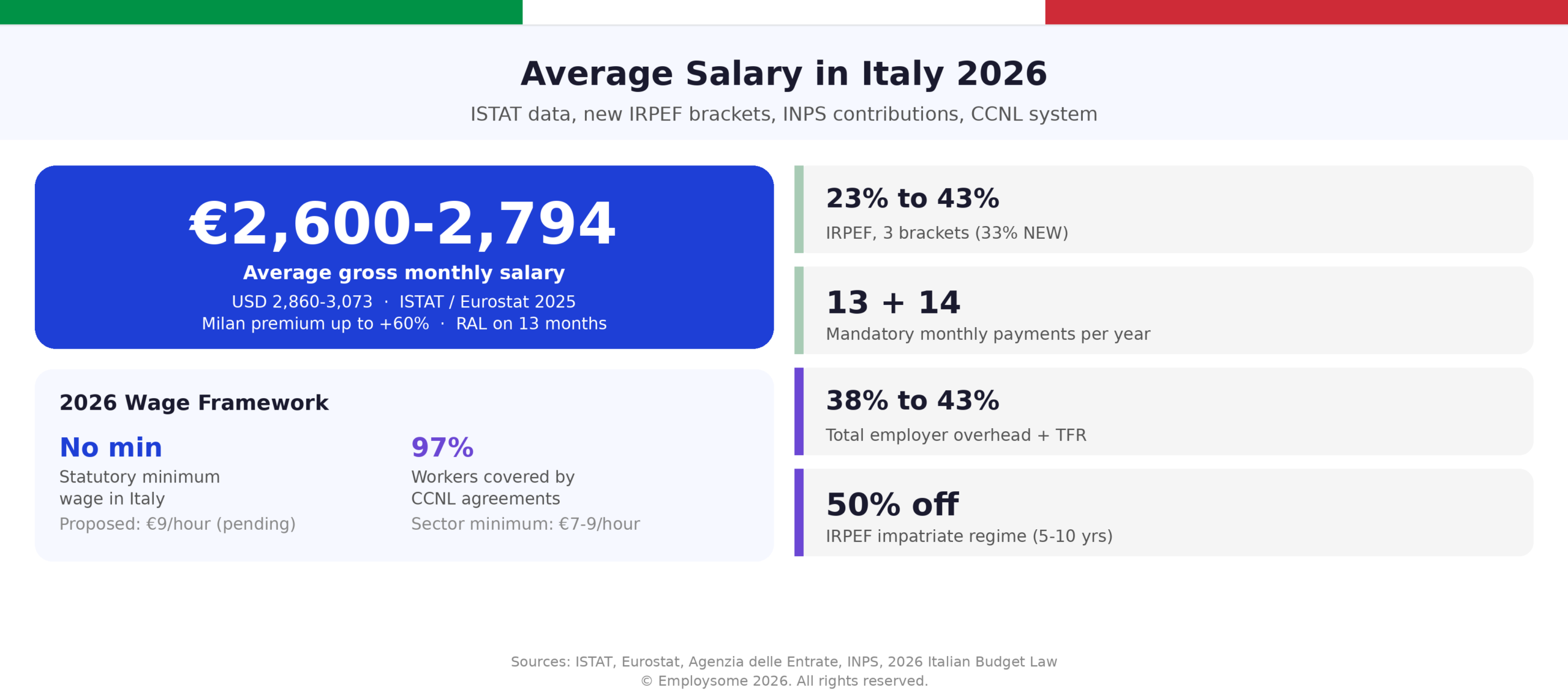
The average salary in Italy in 2026 is approximately €2,600 to €2,794 (USD 2,860 to 3,073) per month gross for full-time employees according to ISTAT and Eurostat, equivalent to approximately €33,523 per year. Italy sits below the EU average of €39,808 per year, ranking 21st out of 50 European countries on average wage despite being the EU’s third-largest economy. Italy is also one of only six EU countries without a statutory national minimum wage, instead relying on collective bargaining agreements (CCNL) that cover approximately 97% of the workforce.
For 2026, Italy implemented a significant tax cut for middle earners: under Law No. 199 of 30 December 2025 (the 2026 Budget Law), the second IRPEF income tax bracket was reduced from 35% to 33% effective 1 January 2026. The progressive system now applies three brackets: 23% up to €28,000, 33% on €28,001 to €50,000, and 43% above €50,000, plus regional (1.23% to 3.33%) and municipal (up to 0.9%) surcharges. Combined with INPS social security contributions of approximately 9.19% (employee) and 30-35% (employer), Italy remains one of Europe’s higher-tax labour markets.
This 2026 guide to average salary in Italy covers everything employers and HR teams need to budget compliantly: official ISTAT and Eurostat wage data, salary breakdowns by region (Lombardy, Lazio, Campania, Sicily), city (Milan, Rome, Turin, Bologna), industry, and experience level, the new 2026 IRPEF income tax brackets, mandatory INPS social security contributions, the unique 13th and 14th month payments (tredicesima and quattordicesima), TFR severance accrual, the impatriate tax regime for foreign workers, and what international companies hiring Italian workers through an Employer of Record (EOR) need to budget in 2026.

Average Salary in Italy 2026: Latest ISTAT and Eurostat Data
Salary data for Italy varies somewhat depending on the source and time period. According to ISTAT (Istituto Nazionale di Statistica) and Eurostat, the most recent benchmarks for full-time employees in Italy are:
| Wage Indicator (2026) | Value (EUR) | Approx. USD |
| Average gross monthly salary (full-time, all sectors) | €2,600 to 2,794 | USD 2,860 to 3,073 |
| Average gross annual salary | €33,523 (Eurostat 2024) | USD 36,875 |
| Median gross monthly salary | €2,700 to 3,720 (regional spread) | USD 2,970 to 4,092 |
| Median household net annual income | €31,400 | USD 34,540 |
| EU average gross annual salary (comparison) | €39,808 | USD 43,789 |
| Italy net annual income (single, no children) | €24,207 | USD 26,628 |
| Statutory minimum wage | None (CCNL-based) | — |
| CCNL minimum wage range (estimated) | €7 to 9/hour | USD 7.70 to 9.90/hour |
Italy is one of only six EU member states without a statutory national minimum wage (joining Denmark, Austria, Finland, Sweden, and Cyprus). Instead, sector-specific minimum pay rates are determined through Contratti Collettivi Nazionali di Lavoro (CCNL), national collective bargaining agreements negotiated between unions and employer associations. Approximately 97% of Italian workers are covered by a CCNL, ensuring sector-specific minimum standards even without a statutory floor.
Constitutional protection: Article 36 of the Italian Constitution guarantees workers the right to fair remuneration proportionate to the quantity and quality of their work, sufficient to ensure a free and dignified existence. Italian labour courts use CCNL rates as the benchmark for adequate wages, providing legal protection even where collective agreements do not explicitly apply. A long-debated minimum wage bill proposing €9 per hour has been before Parliament since 2023 but has not yet been enacted.
13th and 14th month payments: A unique and important feature of Italian compensation is the tredicesima (13th month bonus, mandatory across all sectors and paid in December) and the quattordicesima (14th month bonus, common in many CCNLs and paid mid-year). Most published Italian salary figures are quoted as 12-month averages, but Italian employees receive 13 or 14 monthly payments per year, raising the effective annual gross salary by 8.3% (13 months) or 16.7% (14 months) above the headline monthly figure.
💡 Employsome Insight: Always Work in RAL Terms (Including 13th and 14th Month Payments)
When comparing Italian salaries to UK, US, or German benchmarks, always confirm whether the figure is RAL (Retribuzione Annua Lorda — gross annual salary on 13 or 14 monthly payments) or a simple 12-month equivalent. A €30,000 RAL on 13 monthly payments equals roughly €2,308 per month gross, but on 14 payments it equals only €2,143 per month. For international employer benchmarking, always work in RAL terms, then convert to monthly using the actual number of CCNL-mandated payments for the relevant sector. Failing to account for the 13th and 14th months is one of the most common mistakes international employers make when budgeting Italian hires.
Average Salary in Italy by Industry and Sector
Industry differences in Italy are significant, particularly between industrial / manufacturing sectors and services. The most recent ISTAT earnings data shows industrial sectors as the highest-paying segment of the formal economy, with construction at the lower end. Tech and finance roles concentrated in Milan and Rome command meaningful premiums above the national average.
| Sector / Industry | Average Gross Annual Salary 2026 (EUR) |
| Banking, finance, and insurance | €45,000 to 80,000 |
| Information technology and software | €38,000 to 70,000 |
| Pharmaceuticals and life sciences | €38,000 to 65,000 |
| Energy and utilities | €38,000 to 60,000 |
| Industrial and manufacturing (overall) | €38,760 |
| Automotive (Stellantis, Ferrari, Lamborghini) | €35,000 to 60,000 |
| Aerospace and defence (Leonardo) | €35,000 to 58,000 |
| Luxury fashion (Gucci, Prada, Armani, Versace) | €32,000 to 55,000 |
| Telecommunications | €32,000 to 50,000 |
| Healthcare and education | €30,000 to 45,000 |
| Public administration | €28,000 to 42,000 |
| Construction | €32,202 (avg, ISTAT) |
| Tourism and hospitality | €22,000 to 30,000 |
| Retail trade | €22,000 to 28,000 |
| Agriculture and primary sector | €20,000 to 26,000 |
Specific role benchmarks (gross annual, 2026): a software engineer in Italy earns €35,000 to 65,000 depending on city, level, and employer, with senior software engineers in Milan reaching €60,000-90,000 at multinational firms; a financial analyst earns €32,000-55,000; a marketing manager €38,000-65,000; an HR manager €38,000-60,000; and a customer service representative €22,000-32,000. Executive roles at large Italian corporations (Intesa Sanpaolo, UniCredit, ENI, Generali, Stellantis) and multinationals can reach €150,000-500,000+ including bonuses and equity.
Italy is particularly strong in luxury fashion, automotive engineering, food and beverage, machinery, and pharmaceutical manufacturing. These sectors export globally and pay competitive wages relative to Italian averages, although still below equivalent roles in Germany, France, or the Nordic countries.
Average Salary by City: Milan, Rome, Turin, Bologna
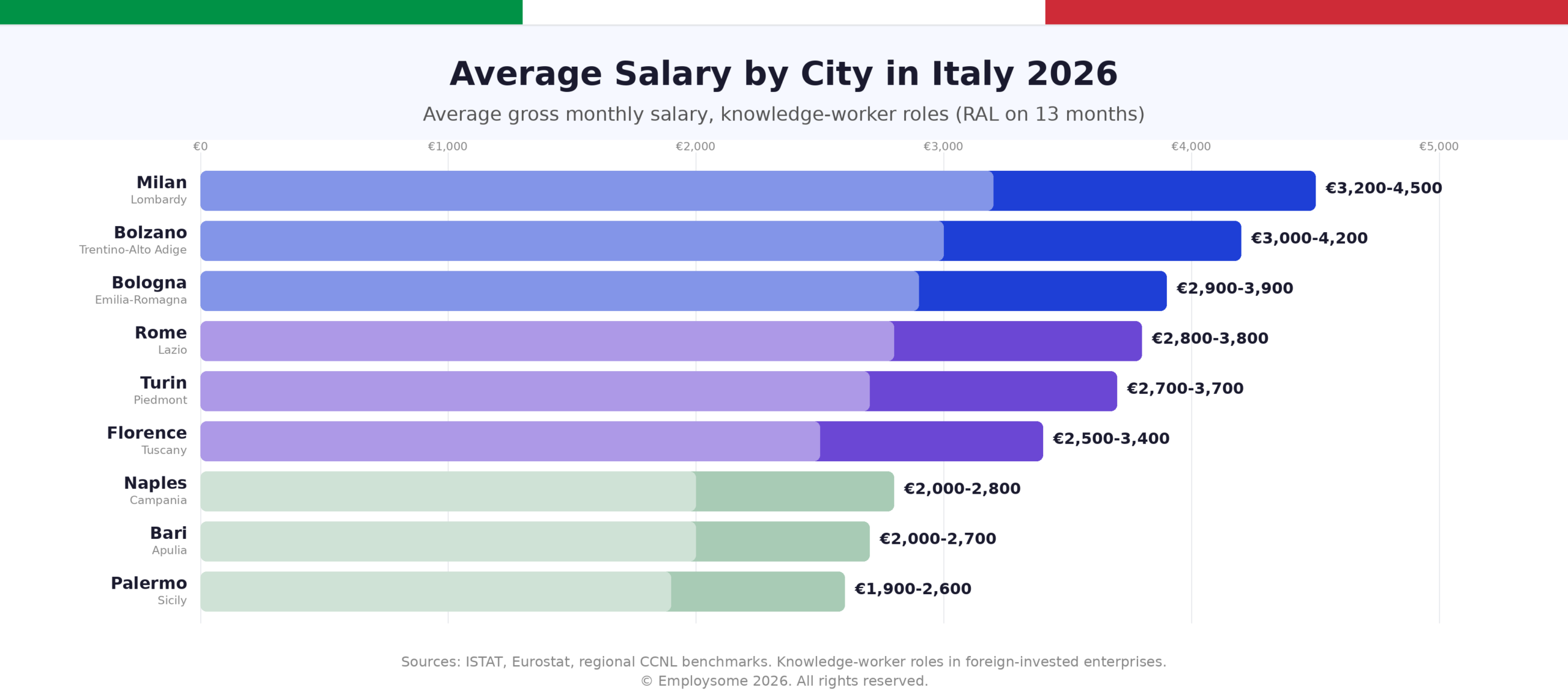
Salaries in Italy show some of the largest regional disparities in Western Europe. Northern Italy (Lombardy, Veneto, Emilia-Romagna, Piedmont) commands the highest wages, driven by industrial concentration, financial services, and multinational headquarters. Central Italy (Lazio, Tuscany) sits near the national average. Southern Italy and the islands (Sicily, Sardinia, Calabria, Campania) report the lowest wages, often 25-40% below northern levels.
| City / Region | Average Gross Monthly Salary 2026 (EUR) | Notes |
| Milan (Lombardy) | €3,200 to 4,500 | Financial capital, multinational HQs, fashion, tech |
| Bolzano (Trentino-Alto Adige) | €3,000 to 4,200 | Highest household income (€45,931 net), German-influenced economy |
| Bologna (Emilia-Romagna) | €2,900 to 3,900 | University city, motor valley (Ferrari, Lamborghini), packaging |
| Rome (Lazio) | €2,800 to 3,800 | Capital, public sector, tourism, growing tech |
| Turin (Piedmont) | €2,700 to 3,700 | Automotive (Stellantis), aerospace, growing tech |
| Venice and Veneto | €2,600 to 3,500 | Manufacturing, luxury goods, tourism |
| Florence (Tuscany) | €2,500 to 3,400 | Fashion (Gucci, Salvatore Ferragamo), tourism, services |
| Genoa (Liguria) | €2,400 to 3,200 | Shipping, logistics, energy |
| Naples (Campania) | €2,000 to 2,800 | Lower wages, large informal economy |
| Palermo (Sicily) | €1,900 to 2,600 | Lowest formal wages, tourism, agriculture |
| Bari (Apulia) | €2,000 to 2,700 | Growing tech and logistics hub in the south |
| Cagliari (Sardinia) | €1,900 to 2,600 | Tourism, agriculture, IT outsourcing |
Net household income by region (ISTAT): Bolzano tops the list at €45,931 per year, followed by Lombardy and Emilia-Romagna. Campania reports the lowest at €26,603, with the difference between top and bottom regions exceeding €19,000 per household. Lombardy alone has annual gross salaries approximately €6,400 higher than Basilicata.
Cost of living context: In Milan, average monthly rent for a one-bedroom apartment in central districts (Brera, Centro, Porta Nuova) is €1,200-2,000+; mid-range districts €800-1,300. In Rome, central rents are €900-1,500. In southern cities like Naples or Palermo, the same apartment costs €500-800. A salary of €3,000 monthly in Milan is comfortable but not spectacular; the same salary in Naples or Palermo provides substantially more discretionary income, which partly explains the wage differential.
💡 Employsome Insight: Southern Italy Is Becoming Europe’s Next Near-Shoring Frontier
Italy’s southern regions are increasingly attractive for international employers pursuing near-shoring or remote-first strategies. Wages in Bari, Cagliari, and Catania are 25-40% below Milan levels for the same skills, while Italy’s impatriate tax regime offers a 50% IRPEF exemption for 5 years (extended to 10 years for those who buy a home or have children), making the southern Italian labour market unusually competitive on a fully-loaded basis. Combined with broadband investments under the National Recovery and Resilience Plan (PNRR) and growing tech ecosystems in Bari and Catania, southern Italy is positioning itself as Europe’s next near-shoring frontier.
Average Salary by Experience Level and Education
Earnings in Italy rise predictably with experience and education, although the country has a documented “wage compression” issue at junior levels driven by high youth unemployment and slow real wage growth. Italian universities like Bocconi (Milan), Politecnico di Milano, La Sapienza (Rome), Bologna, Padova, and Politecnico di Torino are well-regarded internationally, particularly in engineering, finance, and design.
| Experience Level | Average Gross Annual Salary 2026 (EUR) |
| Entry-level (0-2 years) | €22,000 to 30,000 |
| Junior (2-5 years) | €28,000 to 40,000 |
| Mid-level (5-10 years) | €38,000 to 60,000 |
| Senior (10-15 years) | €55,000 to 95,000 |
| Lead / management | €75,000 to 140,000 |
| Executive / C-suite | €120,000 to 500,000+ |
Educational level has a meaningful effect on Italian earnings, particularly mid-career. According to ISTAT, master’s graduates earn approximately 30-40% more than bachelor’s-only peers ten years post-graduation. PhD holders typically earn 50-70% more than master’s graduates in research, pharmaceutical, and engineering roles. The gender pay gap in Italy is approximately 5-10% on raw figures but widens significantly when adjusting for sector and seniority, with women underrepresented in higher-paid roles.
The impatriate tax regime (regime impatriati) is one of Europe’s most attractive expat tax incentives. Foreign workers (or Italians returning after 3+ years abroad) who become Italian tax residents can exempt 50% of their employment or self-employment income from IRPEF for 5 years. The benefit extends to 10 years for those who buy a home in Italy or have dependent children, and the exemption percentage rises in southern regions. The regime does not reduce INPS contributions, which remain calculated on full gross pay.
Italy IRPEF Income Tax 2026: New 33% Middle Bracket
Italy operates a progressive 3-bracket income tax system called IRPEF (Imposta sul Reddito delle Persone Fisiche), governed by the Italian Tax Code and administered by the Agenzia delle Entrate. The 2026 Budget Law (Law No. 199 of 30 December 2025) introduced a meaningful change: the second bracket was reduced from 35% to 33%, saving middle-income earners up to €440 per year. The new 2026 brackets are:
| Annual Taxable Income (EUR) | 2026 Marginal IRPEF Rate | Change from 2025 |
| Up to €28,000 | 23% | Unchanged |
| €28,001 to 50,000 | 33% | Reduced from 35% |
| Above €50,000 | 43% | Unchanged |
Regional and municipal surcharges: On top of national IRPEF, Italian taxpayers also pay regional surtaxes (addizionale regionale) between 1.23% and 3.33% depending on the region of residence, plus municipal surtaxes (addizionale comunale) up to 0.9%. The combined effective top marginal rate can reach approximately 47-48% in high-surtax regions like Lazio (Rome) and Campania (Naples). Lower-tax regions like Veneto and Friuli-Venezia Giulia offer effective top rates closer to 45%.
IRPEF is withheld at source by the employer on a monthly basis through the busta paga (payslip) and remitted to the Italian Tax Agency. Annual reconciliation occurs through the Modello 730 or Modello Redditi tax return, due by 30 September of the following year. The Italian tax year follows the calendar year (1 January to 31 December).
Employee tax credits and deductions: Italian taxpayers benefit from a detrazione per lavoro dipendente (employee tax credit) of up to €1,955, which directly reduces tax owed for incomes below approximately €50,000 and phases out above. Mortgage interest, healthcare, education, gym membership, and insurance premiums qualify for a 19% tax credit. From 2026, taxpayers earning over €75,000 face a spending cap on these deductions, and those earning over €200,000 face an additional flat €440 reduction.
Special tax regimes for foreign workers:
- Regime impatriati: 50% income exemption from IRPEF for 5 years (extendable to 10 years), available to foreign workers and Italians returning after 3+ years abroad
- HNWI flat tax (regime dei neo-residenti): €300,000 annual flat tax on all foreign-source income for new Italian residents who haven’t lived in Italy for 9 of the prior 10 years (raised from €200,000 from 1 January 2026; €50,000 per family member, raised from €25,000)
- 7% flat tax for foreign pensioners: Available to retirees moving to qualifying southern Italian municipalities (population under 20,000)
INPS, INAIL, and TFR: Italian Social Security Contributions
Italian social security is administered by INPS (Istituto Nazionale della Previdenza Sociale), the country’s national social security fund covering pensions, unemployment, sickness, maternity, and disability. Employer contributions are among the highest in Europe, while employee contributions are relatively moderate. Italian social security is fully integrated with the EU totalisation framework, allowing portability across member states.
| Contribution Component (2026) | Employer Rate | Employee Rate | Notes |
| INPS pension and social insurance | ~23-25% of gross | 9.19% | Capped at €120,607 per year (2025); 2026 cap set by INPS |
| INPS additional contribution (above cap) | ~5% | 10.19% (above €56,224) | Reduced employer rate above social security ceiling |
| INAIL (work injury insurance) | 0.4-3% (sector risk) | 0% | Employer-only, varies by occupational risk |
| Sickness, maternity, unemployment funds | ~3-5% | Included in 9.19% | Sector and CCNL-specific |
| TFR (Trattamento di Fine Rapporto) | ~7.4% accrual | 0% | Severance accrual, paid at end of contract |
| Total typical employer contribution | ~30% to 35% of gross | ~9.19% to 10.49% | Plus 7.4% TFR = ~37-42% total |
Total mandatory employer overhead in Italy is approximately 30% to 35% of gross salary for INPS, INAIL, and supplementary contributions, plus roughly 7.4% TFR severance accrual, bringing the total fully-loaded employer cost to approximately 38-43% above gross. This places Italy among the higher social-contribution jurisdictions in the EU.
TFR (Trattamento di Fine Rapporto): A unique Italian feature, TFR is a mandatory severance payment that employers accrue at approximately 7.4% of annual gross salary each year. TFR is paid to the employee at the end of their employment contract (resignation, dismissal, or retirement) and accrues tax-deferred. Employees can opt to redirect TFR contributions to a private pension fund (fondo pensione integrativo). For international employers, TFR is a real cost that must be provisioned annually, even though it is not paid until contract termination. Review our comprehensive TFR in Italy Guide.
Social security earnings cap: INPS contributions are subject to a massimale contributivo (contribution ceiling) of €120,607 per year (2025 figure; 2026 set by INPS). Above this cap, only a reduced employer contribution of approximately 5% applies to the excess salary. This is particularly relevant for senior executive hires above €120,000 annual gross.
Total Employer Cost in Italy 2026
For companies hiring in Italy, the gross salary is only the starting point. Mandatory INPS, INAIL, TFR severance accrual, plus the legally required tredicesima (13th month) and often quattordicesima (14th month), add a substantial overhead. Below is an indicative breakdown for an employee on a €35,000 RAL (gross annual salary) in Milan, a typical mid-level professional:
| Cost Component (2026, Milan example) | Rate / Amount | Annual Cost (EUR) |
| Gross salary (RAL, on 13 monthly payments) | — | 35,000 |
| INPS employer contribution | ~24% | ~8,400 |
| INAIL work injury insurance (office worker) | ~0.5% | ~175 |
| Other mandatory contributions (sickness, unemployment, etc.) | ~5% | ~1,750 |
| TFR severance accrual | ~7.4% | ~2,590 |
| Quattordicesima (14th month, where CCNL applies) | 1 month gross | ~2,690 |
| Meal vouchers (buoni pasto, common) | ~€8/day x 220 days | ~1,760 |
| Supplementary health insurance (optional, common) | ~€600-1,200/year | ~900 |
| Total fully-loaded annual cost | ~37% mandatory + ~16% benefits | ~€48,575 to 53,265 |
For a €35,000 gross annual salary, the true fully-loaded annual employer cost in 2026 ranges from approximately €48,575 (mandatory only) to €53,265 (with typical Italian benefits package), a 39-52% uplift depending on optional benefits and CCNL-mandated 14th month payments. Italy’s mandatory employer overhead is among the higher rates in the EU, particularly when including the TFR accrual.
The largest employer cost variables are CCNL-mandated payments (13th and sometimes 14th month, plus sector-specific bonuses), TFR severance accrual (7.4% per year, payable on exit), and supplementary benefits (meal vouchers, transport allowances, supplementary health insurance, company cars), which are essentially expected for white-collar roles in Milan and Rome.
How International Companies Hire in Italy
For international companies hiring in Italy without a local entity, there are three practical options: establish an Italian S.r.l. or S.p.A., engage workers as freelancers under a Partita IVA, or use an Employer of Record (EOR).
Option 1: Establish an Italian legal entity
Setting up an Italian company (S.r.l. for limited liability or S.p.A. for larger operations) requires incorporation through a notary, registration with the Camera di Commercio, tax registration with the Agenzia delle Entrate (codice fiscale and Partita IVA), INPS and INAIL registration, opening an Italian corporate bank account, and establishing monthly busta paga (payslip) processing. Total timeline: typically 4 to 10 weeks. Ongoing costs include accounting (€3,000-12,000+ per year), audit for larger companies, and IRES corporate tax at 24% plus IRAP regional business tax at 3.9%.
Option 2: Freelancers (Partita IVA / regime forfettario)
Engaging Italian workers as independent freelancers under a Partita IVA is common for project work and short-term engagements, but carries misclassification risk. The Italian regime forfettario offers a flat tax of 5-15% for freelancers earning under €85,000 per year, making it attractive for genuine freelance arrangements. However, ongoing roles with regular hours, integration into the client’s business, or exclusivity can trigger reclassification as employment, with retroactive INPS, IRPEF, and severance liability.
Option 3: Employer of Record (EOR)
An EOR is an Italian-registered entity that formally employs the worker on your behalf. The EOR handles compliant Italian employment contracts (in Italian, aligned to the relevant CCNL), monthly busta paga payslip processing, IRPEF withholding, INPS and INAIL contributions, TFR accrual management, mandatory tredicesima and quattordicesima payments, and ongoing compliance with the Italian Civil Code and sector-specific CCNL. Typical setup: 2 to 4 weeks. Typical cost: USD 500 to USD 800 per employee per month on top of gross salary, mandatory contributions, and benefits.
For hiring 1-15 Italian employees, or for short to medium-term projects, an EOR is almost always the faster and lower-risk option. For longer-term operations with 15+ Italian employees, establishing a local S.r.l. eventually becomes more cost-effective.
What International Employers Need to Know
2026 average gross salary in Italy is around €2,600-2,794 per month
According to ISTAT and Eurostat data, Italy’s 2026 average gross monthly salary for full-time employees is €2,600 to €2,794 (€33,523 annual), placing Italy below the EU average of €39,808 and 21st out of 50 European countries. Always factor in 13th and sometimes 14th month payments when comparing to other countries’ salaries.
Italy has no statutory minimum wage
Italy is one of only six EU countries without a national minimum wage. Approximately 97% of workers are covered by sector-specific Contratti Collettivi Nazionali di Lavoro (CCNL) that set minimum pay rates, typically equivalent to €7-9 per hour. A statutory €9/hour minimum wage bill remains under parliamentary debate but has not been enacted.
2026 IRPEF reform cut the middle bracket from 35% to 33%
Effective 1 January 2026 under Law No. 199 of 30 December 2025, the second IRPEF bracket on income between €28,001 and €50,000 was reduced from 35% to 33%, saving middle earners up to €440 per year. The 23% (up to €28,000) and 43% (above €50,000) brackets remain unchanged. Regional and municipal surtaxes add 1.23% to 4.23% on top.
Northern Italy pays 30-50% more than southern regions
Lombardy (Milan), Bolzano, and Emilia-Romagna command the highest wages, while southern regions (Campania, Sicily, Calabria) pay 25-40% less. Bolzano leads household income at €45,931/year vs Campania at €26,603. Cost of living differences partially offset the wage gap.
Total employer overhead is approximately 38-43% on top of gross
Mandatory employer contributions (INPS ~24-25%, INAIL 0.4-3%, sickness/unemployment ~5%) plus 7.4% TFR severance accrual total approximately 38-43% on top of gross salary. Including voluntary benefits (meal vouchers, supplementary health insurance), total fully-loaded cost reaches 45-55% above gross. CCNL-mandated 13th and 14th month payments are additional.
The impatriate regime offers 50% IRPEF exemption for 5-10 years
Italy’s regime impatriati provides foreign workers (and Italians returning after 3+ years abroad) with a 50% IRPEF exemption on employment income for 5 years, extendable to 10 years for those who buy a home or have dependent children. The regime does not reduce INPS contributions but makes Italy unusually attractive for senior international hires.
Always work in RAL terms when comparing Italian salaries
Italian salary figures are typically quoted as RAL (Retribuzione Annua Lorda) on 13 monthly payments. International benchmarks must account for the tredicesima (mandatory 13th month) and often quattordicesima (14th month) to be accurate. A €30,000 RAL on 13 payments equals roughly €2,308 monthly, not €2,500.
When budgeting for Italian hires, the gross salary is only part of the picture. Italy’s mandatory employer overhead of approximately 38% to 43% above gross (INPS plus INAIL plus TFR severance accrual), combined with mandatory tredicesima and often quattordicesima payments, places it among the most expensive European labour markets on a fully-loaded basis. For context against other European hiring destinations, Romania has the lowest employer overhead in the EU at just 2.25% under its CAM system, followed by Ireland at approximately 11% to 12% via PRSI, Poland at 19% to 22% under ZUS (see average salary in Poland), Croatia at 22% to 25%, Portugal at 23.75% TSU, and Spain at 30% to 33% via Seguridad Social. Italy sits at the upper end of this spread, alongside France and Belgium. International employers comparing European hiring markets should always benchmark on fully-loaded annual cost rather than gross salary alone.
Consider an EOR for compliant Italian hiring
For international companies without an Italian S.r.l., an Employer of Record handles INPS registration, IRPEF withholding, busta paga issuance, TFR accrual, tredicesima and quattordicesima payments, CCNL alignment, and Italian Civil Code compliance automatically. See our Best EOR in Italy guide for verified provider rankings.
Hiring in Italy?
Italian employment requires CCNL alignment, INPS and INAIL registration, monthly busta paga issuance, IRPEF withholding, mandatory tredicesima and quattordicesima payments, TFR severance accrual, and compliance with the Italian Civil Code and sector-specific collective bargaining agreements. Compare the top Employer of Record providers for Italy in 2026 – verified pricing, compliance scores, and expert rankings from Employsome’s independent research team.
Frequently Asked Questions
According to ISTAT and Eurostat, the average gross monthly salary in Italy in 2026 is approximately €2,600 to €2,794 for full-time employees, equivalent to €33,523 per year. The median monthly income is €2,700 to €3,720 depending on region. Italy sits below the EU average of €39,808 and ranks 21st out of 50 European countries on average wage. When comparing internationally, always note that Italian salaries are typically quoted as RAL (Retribuzione Annua Lorda) on 13 monthly payments, not 12.
No, Italy is one of only six EU countries without a statutory national minimum wage (joining Denmark, Austria, Finland, Sweden, and Cyprus). Instead, sector-specific minimum pay rates are determined through national collective bargaining agreements called Contratti Collettivi Nazionali di Lavoro (CCNL), which cover approximately 97% of Italian workers. Article 36 of the Italian Constitution guarantees workers the right to fair remuneration, with labour courts using CCNL rates as the benchmark. A proposed €9/hour statutory minimum wage bill has been under parliamentary debate since 2023 but has not been enacted.
Effective 1 January 2026, the Italian Budget Law (Law No. 199 of 30 December 2025) reduced the second IRPEF bracket from 35% to 33%. The 2026 progressive IRPEF brackets are: 23% on income up to €28,000; 33% on income from €28,001 to €50,000 (reduced from 35%); and 43% on income above €50,000. Regional surtaxes (1.23% to 3.33%) and municipal surtaxes (up to 0.9%) apply on top, with effective combined top rates reaching approximately 47-48% in high-surtax regions like Lazio and Campania.
The 13th month payment, called tredicesima, is a mandatory annual bonus equal to one month of salary, paid by 25 December each year to all Italian employees regardless of sector. Many CCNLs (collective bargaining agreements) also mandate a 14th month payment called quattordicesima, typically paid in June or July. These additional payments raise effective annual gross salary by 8.3% (13 months) or 16.7% (14 months) above the simple 12-month equivalent. International employers must account for these when budgeting Italian hires.
Italian employers contribute approximately 30% to 35% of gross salary to INPS (Istituto Nazionale della Previdenza Sociale), covering pension, sickness, maternity, unemployment, and disability insurance. Employees contribute 9.19% on earnings up to €56,224 and 10.19% above that ceiling. Combined with INAIL work injury insurance (0.4-3%, sector-dependent) and 7.4% TFR severance accrual, total mandatory employer overhead reaches approximately 38-43% of gross salary. The social security earnings cap (massimale contributivo) is approximately €120,607 per year, above which only a reduced 5% employer contribution applies.
TFR (Trattamento di Fine Rapporto) is a unique Italian severance payment system. Employers must accrue approximately 7.4% of annual gross salary each year as a deferred payment to the employee. TFR is paid out at the end of the employment contract (resignation, dismissal, or retirement) and accrues tax-deferred. Employees can opt to redirect TFR contributions to a private pension fund (fondo pensione integrativo). For international employers, TFR is a real cost that must be provisioned annually, even though it is not paid until contract termination.
Milan, Italy’s financial and business capital, commands the highest salaries in the country. Average gross monthly salaries in Milan range from €3,200 to €4,500 for knowledge-worker roles, with senior tech, finance, and consulting roles at multinationals reaching €6,000-10,000+ per month. Milan hosts most multinational HQs in Italy, the Milan Stock Exchange (Borsa Italiana), and major fashion houses. Cost of living is correspondingly higher: average rent for a one-bedroom apartment in central districts is €1,200-2,000+, with most professionals spending 30-40% of gross income on housing.
The regime impatriati is one of Europe’s most attractive expat tax incentives. Foreign workers (or Italians returning after 3+ years abroad) who become Italian tax residents can exempt 50% of their employment or self-employment income from IRPEF for 5 years. The benefit extends to 10 years for those who buy a home in Italy or have dependent children. Higher exemption percentages apply in southern Italian regions. The regime does not reduce INPS contributions, which remain calculated on full gross pay. Employees must remain with the Italian employer for at least 2 years to qualify.
The highest-paying sectors in Italy are banking, finance, and insurance (€45,000-80,000 per year), information technology and software (€38,000-70,000), pharmaceuticals (€38,000-65,000), and energy/utilities (€38,000-60,000). Industrial and manufacturing sectors average €38,760 per year per ISTAT. The lowest-paying sectors are tourism and hospitality (€22,000-30,000), retail trade (€22,000-28,000), and agriculture (€20,000-26,000). For international employers, IT and finance roles concentrated in Milan and Rome command meaningful additional premiums.
An Employer of Record (EOR) handles all Italian employer compliance on behalf of international clients. The EOR maintains an Italian S.r.l. or S.p.A. entity, registers employees with INPS within prescribed deadlines, drafts compliant Italian employment contracts aligned to the relevant CCNL (collective bargaining agreement), processes monthly busta paga (payslips) with proper IRPEF withholding and INPS contributions, manages mandatory tredicesima and quattordicesima payments, accrues TFR severance, files INAIL work injury insurance, and ensures compliance with the Italian Civil Code. For companies hiring 1-15 Italian employees without a local entity, an EOR is almost always faster and more cost-effective. See our Best EOR in Italy guide for provider rankings.
Copywriter
Christa is a Copywriter at Employsome with 17 years of professional writing experience across global brands, startups, and online publications. A native English-Finnish writer, she brings strong editorial skills and a versatile background in business, SaaS, and finance. At Employsome, Christa focuses on clear, practical content about HR, payroll, and Employer of Record topics.
Our content is created for informational purposes only and is not intended to provide any legal, tax, accounting, or financial advice. Please obtain separate advice from industry-specific professionals who may better understand your business’s needs. Read our Editorial Guidelines for further information on how our content is created.