
Average Salary in Croatia 2026: Complete Employer Guide
The average salary in Croatia in February 2026 is €2,139 gross and €1,527 net per month, according to the Croatian Bureau of Statistics, with year-on-year growth of 8.9% nominal. This 2026 guide covers wages by industry (pharma €4,281 to clothing €988), city (Zagreb premium), and experience level, plus the 2-bracket income tax system, mandatory HZMO pension and HZZO health contributions, and total employer cost in Croatia.

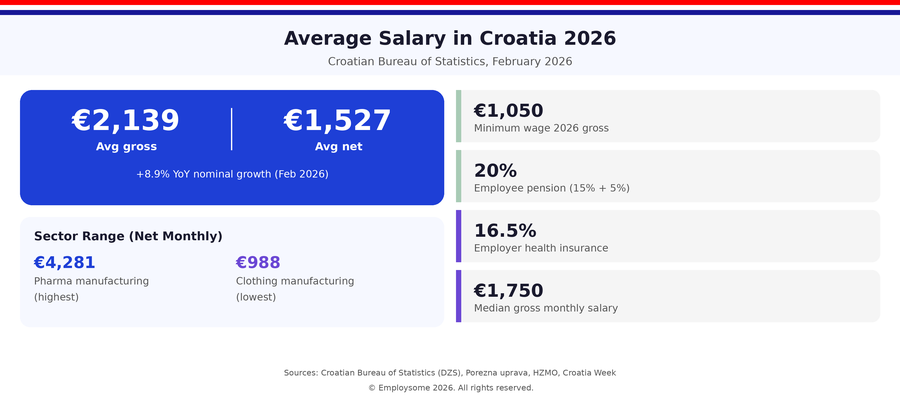
The average salary in Croatia continued its upward trajectory into 2026, with the average monthly gross salary reaching €2,139 and the average monthly net salary reaching €1,527 in February 2026, according to the latest data released by the Croatian Bureau of Statistics (DZS). On an annual basis, gross wages rose 8.9% nominally and 4.9% in real terms compared to February 2025, marking one of the strongest wage growth periods Croatia has seen since adopting the Euro on 1 January 2023.
Croatia became the European Union’s 27th member in 2013 and the 20th Eurozone member in 2023, and its labour market has been benchmarked against EU averages ever since. The country’s GDP per capita reached approximately $49,551 (PPP-adjusted) in 2026, unemployment held at around 5%, and labour force participation hovered near 70%. The 2026 minimum wage was raised to €1,050 gross per month from €970 in 2025, reflecting Croatia’s ongoing strategy to close the gap with Western European wage standards.
This 2026 guide to average salary in Croatia covers: the latest official wage data from the Croatian Bureau of Statistics (DZS), salary breakdowns by industry, city, and role, the progressive 2-bracket income tax system, mandatory employee and employer social contributions including the new 2026 cap of €11,958 on the pension base, total employer cost calculations, young worker and returning emigrant tax incentives, and what international companies hiring Croatian workers through an Employer of Record (EOR) need to budget in 2026.

Average Salary in Croatia 2026: Latest DZS Data
According to the most recent official figures from the Croatian Bureau of Statistics (DZS / Državni zavod za statistiku) released in April 2026, the average wage figures for early 2026 are as follows:
| Wage Indicator (2026) | January 2026 | February 2026 | Year-on-Year Growth (Feb) |
| Average gross monthly salary | €2,114 | €2,139 | +8.9% nominal / +4.9% real |
| Average net monthly salary | €1,511 | €1,527 | +7.8% nominal / +3.9% real |
| Median gross monthly salary | €1,789 | €1,750 | +10.5% nominal |
| Median net monthly salary | €1,304 | €1,304 | +8.7% nominal |
From January 2026, all DZS data is presented according to the updated National Classification of Activities (NKD 2025), reflecting changes in how economic activities are categorised. The figures confirm continued strong wage growth in Croatia, particularly when measured year-on-year, with median gross salary rising 10.5% over the previous twelve months.
The gap between average and median salary is significant: the average gross of €2,139 sits well above the median gross of €1,750, indicating that higher earners pull the average upward and that more than 50% of Croatian workers earn below the average. For salary-benchmarking purposes when hiring in Croatia, the median is generally a better representative figure than the mean.
The 2026 minimum wage was set at €1,050 gross per month (approximately €830 net), an increase of €80 over the 2025 minimum wage of €970. This represents a 153% cumulative increase in the Croatian minimum wage since 2016, reflecting rapid economic development and the government’s commitment to closing the gap with EU wage averages. Penalties for non-compliance with the 2026 minimum wage range from €1,000 to €10,000. For a complete breakdown including hourly rates, sectoral exceptions, and enforcement guidance, see our 2026 Croatia minimum wage guide.
Average Salary by Industry and Sector
Significant differences exist between Croatian industries. The most recent DZS data shows pharmaceutical manufacturing at the top of the wage scale and clothing manufacturing at the bottom, with strong representation from finance, IT, and air transport in the upper range:
| Sector / Industry | Average Net Monthly Salary 2026 (EUR) |
| Pharmaceutical manufacturing | €4,281 (highest) |
| Air transport | €2,352 |
| Information & communication technology (IT) | €2,200 to €2,800 |
| Financial services & banking | €2,100 to €2,700 |
| Telecommunications | €2,000 to €2,400 |
| Energy & utilities | €1,900 to €2,300 |
| Public administration | €1,500 to €1,900 |
| Education | €1,300 to €1,700 |
| Healthcare | €1,400 to €1,900 |
| Manufacturing (general) | €1,300 to €1,600 |
| Tourism, hospitality & food service | €1,200 to €1,500 |
| Retail trade | €1,100 to €1,400 |
| Agriculture, forestry, fishing | €1,100 to €1,300 |
| Clothing manufacturing | €988 (lowest) |
According to private salary survey data from MojaPlaca.hr, the top-paid positions in Croatia are IT Director, Leasing Director, Anesthetist, Country Manager, and Air Traffic Controller. The lowest-paid positions are clothing-presser/ironer, cobbler, survey interviewer, seamstress, and clothing/textile technologist. The aggregate gross average salary across all surveyed roles is €1,690.
The gender pay gap in Croatia stands at 11.06%, meaning that across all roles and sectors, women earn 11.06% less on average than men. This is below the EU average gender pay gap of approximately 12.7% but remains a focus of Croatian government policy and EU-aligned equal pay directives.
💡 Employsome Insight: Croatia Is a Top Near-Shoring Destination for Tech and Finance
Croatia is one of Europe’s strongest near-shoring destinations for tech, finance, and pharmaceutical roles. The combination of EU membership, Eurozone currency (since January 2023), competitive salary levels, English fluency in tech and finance hubs, and proximity to Western European headquarters has driven a significant rise in foreign hiring. Multinational firms hiring software engineers and data scientists in Zagreb routinely pay 30-50% above the local median to compete with Western European employers offering remote work. Budget for tech roles in the €3,000-€5,500 gross monthly range to attract senior talent, even though local averages would suggest lower numbers.
Average Salary by City and Region
Salaries in Croatia vary meaningfully by city. Zagreb, as the capital and commercial centre, commands the highest wages, followed by coastal cities like Split, Rijeka, and Zadar where tourism and shipping sectors drive demand for skilled workers. Smaller inland cities and rural regions generally pay 15-25% below Zagreb levels.
| City / Region | Average Net Monthly Salary 2026 (EUR) | Notes |
| Zagreb | €1,800 to €2,200 | Capital city; tech, finance, headquarters concentration |
| Split | €1,400 to €1,700 | Tourism, shipping, growing tech sector |
| Rijeka | €1,400 to €1,700 | Port city, manufacturing, maritime |
| Zadar | €1,300 to €1,600 | Tourism, services, IT growth |
| Osijek | €1,200 to €1,500 | Eastern Croatia, lower cost of living |
| Pula | €1,250 to €1,550 | Tourism-driven, Istrian peninsula |
| Dubrovnik | €1,300 to €1,650 | Premium tourism, hospitality |
| Slavonia / inland regions | €1,000 to €1,300 | Agriculture, lower-wage regions |
Zagreb premium: For knowledge-worker roles in IT, finance, and consulting, Zagreb commands a clear premium over the rest of Croatia. International employers should expect to pay 20-40% above the national average to attract experienced engineers, product managers, and finance professionals based in the capital. The gap narrows significantly for remote-only roles, where salary expectations are increasingly aligned with national medians plus a moderate skill premium.
Average Salary by Experience Level and Education
Earnings in Croatia rise predictably with experience and education. Croatia has a highly educated workforce, with literacy exceeding 99% and a strong concentration of STEM graduates from major universities including the University of Zagreb, University of Split, and University of Rijeka. Graduates from these institutions are particularly sought after by multinational employers in IT and finance.
| Experience Level | Average Net Monthly Salary 2026 (EUR) |
| Entry-level (0-2 years) | €850 to €1,250 |
| Junior (2-5 years) | €1,200 to €1,700 |
| Mid-level (5-10 years) | €1,600 to €2,400 |
| Senior (10-15 years) | €2,200 to €3,400 |
| Lead / management | €3,000 to €4,500+ |
| Executive / C-suite | €4,500 to €10,000+ |
Educational level also has a strong effect on earnings. University graduates (bachelor’s and master’s degree holders) earn approximately 40-60% more than those with secondary education only. PhD holders typically earn 60-80% more than the national average, particularly in pharmaceutical research, academic medicine, and engineering. Croatia also offers significant tax incentives for young workers: workers under 25 receive a 100% income tax exemption on the lower bracket, while workers aged 26-30 receive a 50% exemption. These reliefs meaningfully increase take-home pay for younger employees.
Croatian Income Tax 2026: Brackets and Allowances
Croatia operates a progressive 2-bracket income tax system governed by the Income Tax Act (Zakon o porezu na dohodak). The national government sets the legal rate ranges, but cities and municipalities (jedinice lokalne samouprave / JLS) choose their specific rates within those bands. The local surtax (prirez) was abolished in 2024 and replaced with the current decentralised approach where each city and municipality sets its own rates each year.
| Income Tax Bracket (2026) | Annual Income Threshold | Rate Range | Zagreb Effective Rate |
| Lower bracket | Up to €60,000 per year | 15% to 23% (city-dependent) | 23% |
| Higher bracket | Above €60,000 per year | 25% to 33% (city-dependent) | 33% |
Maximum rates by jurisdiction type are: 20% (lower) / 30% (higher) for municipalities, 21% / 31% for smaller towns, 22% / 32% for larger towns and county seats, and 23% / 33% for Zagreb. Minimum rates remain 15% (lower) and 25% (higher).
A personal allowance (osobni odbitak) of €600 per month (€7,200 per year) applies, reducing the taxable base for all employees. Additional allowances are available for dependants: a coefficient of +0.7 for the first child, +1.0 for the second child, +1.4 for the third child, and progressively higher for additional children. Spouse and dependant parents may also qualify for additional allowances.
Tax incentives for special groups:
- Workers under 25: 100% income tax exemption on income in the lower bracket
- Workers aged 26-30: 50% income tax exemption on income in the lower bracket
- Returning emigrants: Croatian citizens returning after living abroad for at least 2 years receive a 5-year income tax exemption on wages
- Pensioners: 50% income tax exemption on pension benefits
- Digital nomads: Generally exempt from Croatian income tax on income from foreign employers (under the Foreigners Act)
Total Employer Cost in Croatia 2026
For companies hiring in Croatia, the gross salary is only the starting point. Employer health insurance contributions, statutory benefits, and severance reserves add a modest overhead. Below is an indicative breakdown for an employee on a €2,500 monthly gross salary (€30,000 annually), a typical mid-level professional in Zagreb:
| Cost Component (2026) | Rate / Amount | Annual Cost (EUR) |
| Gross salary | — | 30,000 |
| Employer health insurance (HZZO) | 16.5% (no cap) | 4,950 |
| Christmas bonus (typical, optional) | ~1 month gross | ~2,500 |
| Vacation allowance (regres, optional) | Up to €331 tax-free | ~331 |
| Meal allowance (optional, tax-favourable) | Up to €1,800/year tax-free | ~1,800 |
| Voluntary pension contribution (Pillar III, optional) | Up to €804/year tax-free | ~804 |
| Total fully-loaded annual cost | ~16.5% mandatory + ~5-15% benefits | €34,950 to €40,400 |
For a €30,000 gross annual salary, the true fully-loaded annual employer cost in 2026 ranges from approximately €34,950 (mandatory only) to €40,400 (with typical Croatian benefits package), a 16-35% uplift depending on optional benefits. Mandatory employer contributions are limited to the 16.5% health insurance contribution to HZZO; everything else (Christmas bonus, vacation allowance, meal allowance, Pillar III pension top-ups) is optional but commonly offered to remain competitive.
Many Croatian employers offer tax-favourable non-cash benefits that significantly improve total compensation without proportional tax cost. The most common tax-free benefits include:
- Reimbursement of travel expenses for commuting (actual public transport cost or monthly ticket)
- Daily allowances for business trips (up to €30/day domestic, plus travel and accommodation)
- Meal expense reimbursement up to €1,800/year (€1,200 without invoices)
- Voluntary Pillar III pension contributions up to €67/month (€804/year)
- Supplementary health insurance premiums up to €500/year
- Lump-sum benefits for separate workplace work (€4/day, max €70/month)
- Newborn baby payments up to €1,500
- Mileage reimbursement for personal car business use up to €0.50/km
How International Companies Hire in Croatia
For international companies hiring in Croatia without a local entity, there are two practical options: establish a Croatian limited liability company (d.o.o.) or use an Employer of Record (EOR).
Option 1: Establish a Croatian d.o.o. or j.d.o.o.
Setting up a Croatian limited liability company (d.o.o.) requires incorporation through the commercial court, registration with the Tax Administration (Porezna uprava), enrolment in the social security system through HZMO and HZZO, opening a Croatian corporate bank account, and establishing payroll processing capability. Total timeline is typically 4 to 8 weeks. Ongoing costs include accounting (€300 to €1,000 per month), audit (for larger companies), and the JOPPD monthly payroll reporting required by Croatian tax law.
Option 2: Employer of Record (EOR)
An EOR is a Croatian-registered entity that formally employs the worker on your behalf. The EOR handles Croatian employment contracts in compliant Croatian (or bilingual Croatian/English), monthly payroll with proper income tax withholding and JOPPD filing, pension contribution remittance to HZMO, health insurance contribution remittance to HZZO, and ongoing compliance with the Labour Act and Income Tax Act. Typical setup: 1 to 2 weeks. Typical cost: USD 350 to USD 600 per employee per month on top of gross salary, mandatory contributions, and any voluntary benefits.
For hiring one to five Croatian employees, or for 6 to 24 month projects, an EOR is almost always the faster and lower-risk option. For longer-term operations with 5+ Croatian employees, incorporating a local d.o.o. eventually becomes more cost-effective.
What International Employers Need to Know
Average gross salary 2026 is €2,139, average net is €1,527
According to February 2026 Croatian Bureau of Statistics data, the average monthly gross salary in Croatia is €2,139 and the average net is €1,527. Year-on-year growth is 8.9% nominal and 4.9% real. The median net is €1,304, which is generally a more representative benchmark for typical Croatian workers than the mean.
Use the median, not the average, for salary benchmarking
The gap between average gross (€2,139) and median gross (€1,750) is substantial because higher earners pull the average up. For benchmarking pay against typical Croatian workers, the median is more representative. For competitive talent markets like tech and finance in Zagreb, expect to pay 30-50% above the median.
Total employer overhead in Croatia is among the lowest in the EU
Mandatory employer contributions are limited to 16.5% health insurance to HZZO with no cap. Pension contributions of 20% are paid entirely by the employee. Total fully-loaded cost is typically 16.5-18% on top of gross, rising to 25-35% with typical Croatian non-cash benefits (Christmas bonus, meal allowance, voluntary pension top-up).
Take advantage of young worker tax exemptions
Workers under 25 receive 100% income tax exemption on the lower bracket; workers aged 26-30 receive 50% exemption. Employers hiring workers with no prior employment history are exempt from health insurance contributions for one year, extending up to 5 years for workers under 30 on permanent contracts. These reliefs can reduce both gross-to-net and employer cost meaningfully.
Returning emigrants get 5-year income tax exemption
Croatian citizens returning after living abroad for at least 2 years receive a 5-year income tax exemption on wages. This is a strong tool for international employers looking to attract Croatian diaspora professionals back to the country.
2026 minimum wage is €1,050 gross per month
The minimum wage rose from €970 (2025) to €1,050 (2026), an €80 monthly increase. Penalties for non-compliance range from €1,000 to €10,000. The minimum wage applies to all Croatian workers regardless of region, with sectoral collective agreements potentially setting higher minimums.
Consider an EOR for compliant Croatian hiring
For international companies without a Croatian entity, an Employer of Record handles HZMO pension setup, HZZO health insurance enrolment, JOPPD monthly payroll filings, and Tax Administration compliance automatically. See our Best EOR in Croatia guide for verified provider rankings.
Hiring in Croatia?
Croatian employment requires HZMO pension and HZZO health insurance enrolment, monthly JOPPD payroll filings, and compliance with the 2026 minimum wage of €1,050. Navigating local benefits, the personal allowance system, and young worker exemptions requires local expertise. Compare the top Employer of Record providers for Croatia in 2026 – verified pricing, compliance scores, and expert rankings from Employsome’s independent research team.
Frequently Asked Questions
According to the most recent Croatian Bureau of Statistics (DZS) data from February 2026, the average gross monthly salary in Croatia is €2,139 and the average net monthly salary is €1,527. Year-on-year, gross wages rose 8.9% nominally and 4.9% in real terms. The median gross salary is €1,750 and the median net is €1,304, generally a more representative figure for typical Croatian workers than the mean. Wages have grown rapidly since Croatia adopted the Euro on 1 January 2023.
The Croatian minimum wage for 2026 is €1,050 gross per month (approximately €830 net), an €80 increase over the 2025 minimum wage of €970. This represents a 153% cumulative increase since 2016, reflecting Croatia’s strategy to close the gap with EU wage averages. Penalties for non-compliance range from €1,000 to €10,000. The minimum wage applies nationally, with sectoral collective agreements potentially setting higher floors. See our 2026 Croatia minimum wage guide for the full breakdown.
Pharmaceutical manufacturing pays the highest average net salary in Croatia at €4,281 per month. Other top-paying sectors include air transport (€2,352), information & communication technology (€2,200-€2,800), financial services and banking (€2,100-€2,700), and telecommunications (€2,000-€2,400). The lowest-paying sector is clothing manufacturing at €988 net per month. Top-paid roles include IT Director, Leasing Director, Anesthetist, Country Manager, and Air Traffic Controller.
Croatia operates a progressive 2-bracket income tax system. The lower bracket (income up to €60,000 per year) is taxed at 15-23%, with Zagreb applying the maximum 23%. The higher bracket (above €60,000) is taxed at 25-33%, with Zagreb at 33%. The local surtax (prirez) was abolished in 2024 and replaced with the current decentralised approach where each city and municipality sets its own rates. A personal allowance of €600 per month (€7,200 per year) reduces the taxable base.
Croatian social security contributions are split distinctly: employees pay 20% pension (15% to Pillar I, 5% to Pillar II) up to a monthly base cap of €11,958. Employers pay 16.5% health insurance to HZZO with no cap. Total mandatory employer overhead is approximately 16.5-18% on top of gross salary, which is among the lowest in the EU. Croatia is unusual in that employers do not contribute to the pension system; only employees do.
Yes. Croatia offers significant tax incentives for young workers: those under 25 receive a 100% income tax exemption on income in the lower bracket, while workers aged 26-30 receive a 50% exemption. Employers hiring workers with no prior employment history are exempt from paying health insurance contributions for one year, with the exemption extending up to 5 years for workers under 30 on permanent contracts. Returning emigrants who have lived abroad for at least 2 years receive a 5-year income tax exemption.
Zagreb commands the highest salaries in Croatia, with average net monthly wages of €1,800-€2,200 across most sectors. Coastal cities like Split and Rijeka average €1,400-€1,700, Zadar €1,300-€1,600, and inland regions like Slavonia €1,000-€1,300. For knowledge-worker roles in IT, finance, and consulting, Zagreb commands a 20-40% premium over the national average. International employers competing for senior talent in Zagreb should budget at the higher end of these ranges.
Croatia’s 2026 average gross salary of €2,139 places it in the lower-middle range among EU member states, broadly comparable to Slovakia, Hungary, and Poland but below the EU average of approximately €3,000-€3,500. Croatia’s minimum wage of €1,050 is around 75% of the EU average, prompting the government’s ongoing strategy to close the gap. GDP per capita on a PPP basis is approximately $49,551 in 2026, broadly aligned with most Central and Eastern European EU members.
The gender pay gap in Croatia stands at 11.06% according to MojaPlaca.hr salary data, meaning that women earn 11.06% less on average than men across all roles and sectors. This is below the EU average gender pay gap of approximately 12.7% but remains a focus of Croatian government policy and EU-aligned equal pay directives. The gap varies significantly by sector, with smaller gaps in public administration and education and larger gaps in finance, manufacturing, and senior management roles.
An Employer of Record (EOR) handles all Croatian employer compliance on behalf of international clients. The EOR maintains a Croatian d.o.o. and registers employees with HZMO (pension) and HZZO (health), drafts compliant Croatian employment contracts, processes monthly payroll with proper income tax withholding, files JOPPD reports with the Tax Administration, manages all social contributions, and ensures compliance with the Labour Act. For companies hiring 1-5 Croatian employees without a local entity, an EOR is almost always faster and more cost-effective than incorporating a Croatian company. See our Best EOR in Croatia guide for provider rankings.
Copywriter
Christa is a Copywriter at Employsome with 17 years of professional writing experience across global brands, startups, and online publications. A native English-Finnish writer, she brings strong editorial skills and a versatile background in business, SaaS, and finance. At Employsome, Christa focuses on clear, practical content about HR, payroll, and Employer of Record topics.
Our content is created for informational purposes only and is not intended to provide any legal, tax, accounting, or financial advice. Please obtain separate advice from industry-specific professionals who may better understand your business’s needs. Read our Editorial Guidelines for further information on how our content is created.
Social Security Contributions: HZMO Pension and HZZO Health
Croatian social security is administered by two main institutions: HZMO (Hrvatski zavod za mirovinsko osiguranje) for pension insurance and HZZO (Hrvatski zavod za zdravstveno osiguranje) for health insurance. Contributions are split distinctly between employer and employee, with employees paying pension and employers paying health insurance:
A key feature of the Croatian system is that employers pay only health insurance contributions, not pension. This is unusual compared to most European countries where employers contribute to both. As a result, total employer overhead in Croatia is approximately 16.5% to 18% on top of gross salary, which is among the lowest in the EU.
Employee pension contributions are subject to a maximum monthly base of €11,958 (six times the average salary), introduced for 2026. This caps the maximum monthly pension contribution at approximately €970 (or €12,095 annually). Above this income level, additional gross salary attracts no further pension contributions, only income tax.
Special exemptions for young workers and new entrants: