
Minimum Wage in Croatia 2026: What Employers Actually Pay
Croatia’s minimum wage increased to EUR 1,050 gross per month from January 2026, up from EUR 970 in 2025. This guide covers the gross-to-net calculation, employer costs (16.5% HZZO), historical growth, how Croatia compares to EU neighbours, and what international companies need to know when hiring at or above the minimum wage.

Croatia’s minimum wage is EUR 1,050 gross per month from January 1, 2026. That is an EUR 80 increase from the 2025 rate of EUR 970, continuing a decade of consistent annual increases that have seen the minimum wage rise by over 150% since 2016.
For international companies hiring in Croatia, the minimum wage matters beyond entry-level roles. It sets the baseline for social contribution calculations, influences collective bargaining agreement minimums in certain sectors, and determines the minimum monthly base for contribution calculations (EUR 757.34 for 2026, set at 0.38x the average gross salary). Most professional roles in Croatia pay well above the minimum, but understanding how it works is essential for compliant payroll, competitive compensation planning, and accurate budgeting when using an Employer of Record in Croatia.
This guide covers the 2026 minimum wage in Croatia, the gross-to-net calculation, total employer cost, how the minimum has evolved over time, how Croatia compares to other EU countries, and what employers need to know.
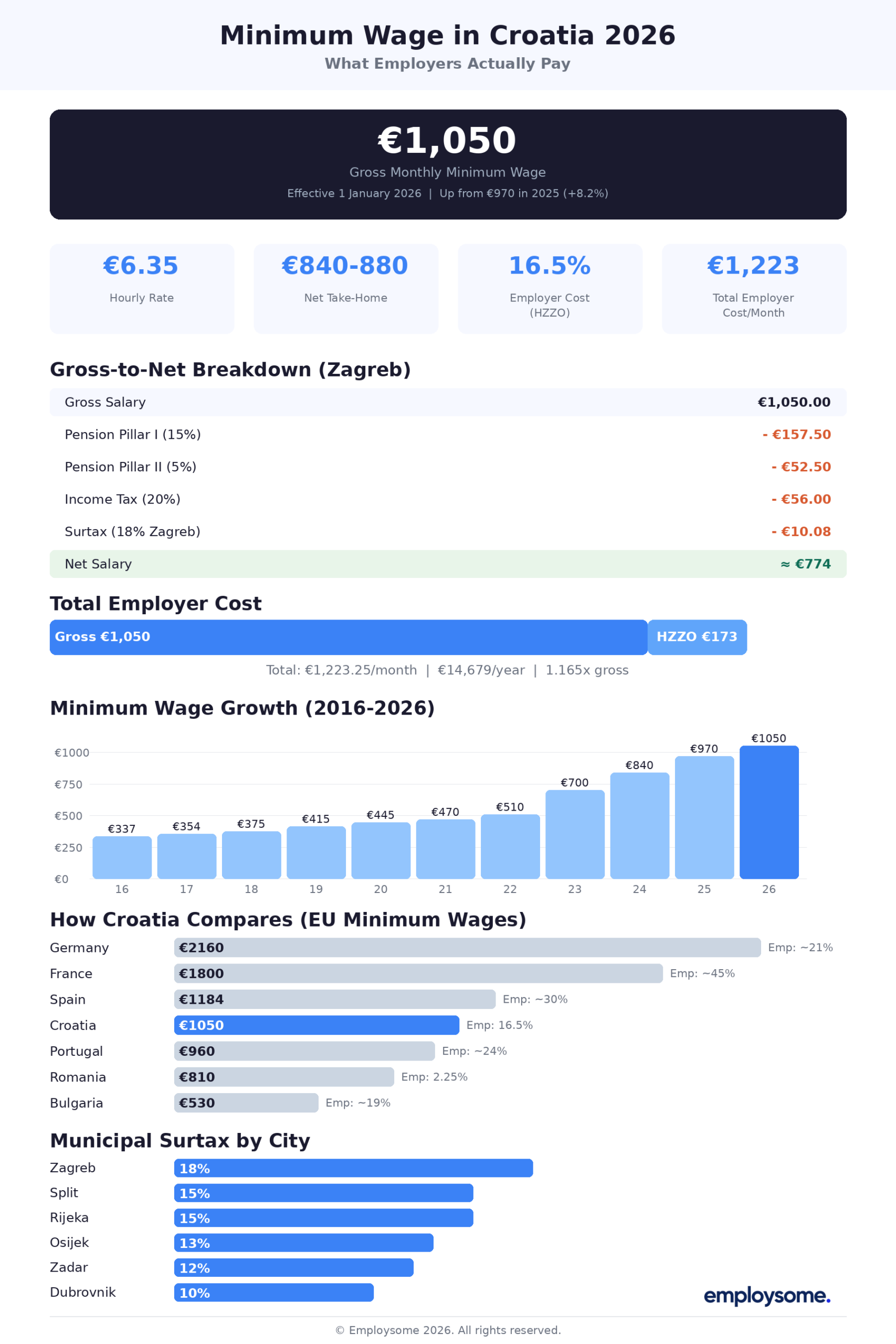

Minimum Wage in Croatia: 2026 Overview
| Minimum Wage in Croatia (2026) | |
| Gross minimum wage | EUR 1,050/month |
| Gross hourly rate | ~EUR 6.35 (based on 165.33 average hours/month) |
| Net minimum wage (approx.) | EUR 840-880 (varies by municipality) |
| Effective from | 1 January 2026 |
| Previous rate (2025) | EUR 970/month |
| Year-on-year increase | EUR 80 (+8.2%) |
| Legal basis | Minimum Wage Act (Zakon o minimalnoj placi), Government Decree NN 132/2025 |
| Currency | EUR (adopted January 2023) |
The minimum wage in Croatia is set annually by the Croatian Government through a decree, based on a formula that considers average gross salary growth and GDP performance. The Minimum Wage Act (Zakon o minimalnoj placi) defines it as the lowest gross monthly salary for a full-time employee working a standard 40-hour week. For part-time workers, the minimum is proportionally reduced based on working hours.
The minimum wage does not include additional compensation for overtime, night work, Sunday work, or work on public holidays. These are paid separately on top of the minimum, at premium rates defined by the Croatian Labour Act.
💡 Employsome Insight: The Minimum Wage Is Gross, Not Net
When the Croatian government announces a minimum wage of EUR 1,050, this is the gross amount before employee deductions. After 20% pension contributions (HZMO), income tax, and municipal surtax, the net take-home pay is approximately EUR 840-880 depending on the employee’s municipality. The employer pays an additional 16.5% (EUR 173.25) for health insurance (HZZO) on top of the gross, making the total employer cost approximately EUR 1,223 per month for a minimum wage employee.
Gross-to-Net Calculation for Minimum Wage
Understanding the gap between gross and net pay is critical for companies hiring in Croatia. Employee deductions are significant, and the net amount varies by municipality due to the surtax system.
| Minimum Wage: Gross-to-Net (Zagreb, 2026) | |
| Gross salary | EUR 1,050.00 |
| Pension Pillar I (15%) | – EUR 157.50 |
| Pension Pillar II (5%) | – EUR 52.50 |
| Income after pension | EUR 840.00 |
| Personal deduction | EUR 560.00 |
| Taxable income | EUR 280.00 |
| Income tax (20%) | – EUR 56.00 |
| Surtax (18% in Zagreb) | – EUR 10.08 |
| Approximate net salary | EUR 773.92 |
| Total Employer Cost for Minimum Wage Employee | |
| Gross salary | EUR 1,050.00 |
| Health insurance HZZO (16.5%) | + EUR 173.25 |
| Total monthly employer cost | EUR 1,223.25 |
| Total annual employer cost | EUR 14,679.00 |
Municipal surtax rates directly affect the employee’s net pay without changing the employer’s cost. Key cities:
| City | Surtax Rate |
| Zagreb | 18% |
| Split | 15% |
| Rijeka | 15% |
| Osijek | 13% |
| Zadar | 12% |
| Dubrovnik | 10% |
💡 Employsome Insight: Municipal Surtax Is the Hidden Variable
Two employees earning the same gross salary in Croatia can have different net pay depending on where they live. Zagreb’s 18% surtax is the highest in the country. An employee in Dubrovnik (10% surtax) takes home more net pay than an identical employee in Zagreb, even though their gross salary and employer cost are identical. Companies using an Employer of Record in Croatia should ensure their provider correctly applies surtax based on the employee’s registered municipality, not the employer’s address.
Minimum Wage for Directors and Board Members
Croatia has a separate, higher minimum salary for company directors, board members, liquidators, and self-employed craftsmen who keep business books. For 2026, this minimum is approximately EUR 1,295.45/month gross, calculated as 0.65x the average gross salary in legal entities for the first three quarters of the previous year.
This means that foreign companies establishing a Croatian entity with a local director must pay at least EUR 1,295.45/month gross, regardless of actual working hours. Even a director employed for 20 hours per week must meet the annual contribution threshold equivalent to this full-time amount.
Historical Minimum Wage Growth in Croatia
The minimum wage in Croatia has increased every year for over a decade, reflecting the country’s economic growth, EU convergence, and tightening labour market.
| Year | Gross Monthly (EUR) | Change |
| 2026 | EUR 1,050 | +8.2% |
| 2025 | EUR 970 | +10.2% |
| 2024 | EUR 840 | +20.0% |
| 2023 | EUR 700 | +10.2% (euro adoption year) |
| 2022 | ~EUR 510 (HRK 3,840) | +8.5% |
| 2021 | ~EUR 470 (HRK 3,540) | +5.7% |
| 2020 | ~EUR 445 (HRK 3,350) | +7.7% |
| 2019 | ~EUR 415 (HRK 3,120) | +9.8% |
| 2018 | ~EUR 375 (HRK 2,830) | +6.2% |
| 2017 | ~EUR 354 (HRK 2,665) | +5.3% |
| 2016 | ~EUR 337 (HRK 2,536) | – |
The minimum wage in Croatia has more than tripled in EUR terms since 2016, representing one of the fastest growth rates in the EU. The shift to the euro in January 2023 simplified cross-border salary comparisons and eliminated currency conversion risk for international employers.
💡 Employsome Insight: Budget for Annual Increases
Croatia’s minimum wage has increased every year without exception for over a decade, with average annual growth of approximately 8-10%. Companies planning multi-year hiring in Croatia should budget for continued increases. Any employment contracts at or near the minimum wage will require annual updates.
How Croatia Compares to Other EU Countries
| Country | Minimum Wage (EUR/month, 2026) | Employer Cost Above Gross |
| Luxembourg | ~EUR 2,570 | ~12-15% |
| Germany | ~EUR 2,160 | ~21% |
| France | ~EUR 1,800 | ~45% |
| Spain | ~EUR 1,184 | ~30% |
| Croatia | EUR 1,050 | 16.5% |
| Portugal | ~EUR 960 | ~23.75% |
| Romania | ~EUR 810 (RON 4,050) | 2.25% |
| Bulgaria | ~EUR 530 | ~19% |
Croatia’s minimum wage of EUR 1,050 places it in the middle tier of EU minimum wages, above Romania, Bulgaria, and the Baltic states, but well below Western European markets. Combined with the moderate 16.5% employer contribution, Croatia offers a competitive total cost for companies building European teams.
What Employers Need to Know
The minimum wage applies to gross pay only
The EUR 1,050 figure is gross, before employee deductions of approximately 20% pension plus income tax and surtax. Net take-home for a minimum wage worker is approximately EUR 775-880 depending on municipality. Employers must also add 16.5% HZZO on top, making total cost approximately EUR 1,223/month.
Overtime, night work, and Sunday premiums are separate
The minimum wage covers standard working hours only. Overtime (minimum 150% of hourly rate), night work (10 PM to 6 AM), Sunday work, and public holiday work all carry premium rates that are paid on top of the minimum. These premiums cannot be included in the minimum wage calculation.
Collective bargaining agreements may set higher floors
While Croatia does not have the extensive CBA system of Austria or Germany, certain sectors (construction, hospitality, metalworking, retail) have active collective bargaining agreements that may set minimum wages above the statutory floor. Employers must verify whether a CBA applies to their sector and region.
The minimum also sets contribution calculation floors and ceilings
The minimum wage in Croatia is used as a reference for calculating the minimum monthly contribution base (0.38x average salary = EUR 757.34 for 2026) and the maximum monthly contribution base (6.0x average salary = EUR 11,958 for 2026). These thresholds affect payroll calculations for both very low and very high earners.
Foreign hire exemption reduces employer cost
Since January 2025, employers hiring a foreign national on their first indefinite contract in Croatia are exempt from the 16.5% HZZO contribution for the first year. For a minimum wage employee, this saves approximately EUR 173/month or EUR 2,079/year. Companies hiring non-EU talent through an Employer of Record in Croatia should confirm their provider applies this exemption correctly.
💡 Employsome Insight: Most Professional Roles Pay Well Above the Minimum
While the minimum wage in Croatia is EUR 1,050, the average gross salary is approximately EUR 2,000/month (EUR 2,002 for Jan-Oct 2025 per official statistics). In IT, engineering, and finance, entry-level salaries typically start at EUR 1,300-1,600, with mid-level roles at EUR 1,800-2,500 and senior roles exceeding EUR 3,000. Companies using the minimum wage as a benchmark for professional hiring in Croatia will struggle to attract qualified candidates. To learn more about hiring in Croatia, including employer costs, public holidays and employment law, see our complete [LINK: hire/croatia] Croatia hiring guide. For EOR provider comparisons, see our [LINK: employer-of-record/best-croatia-eor] Best Employer of Record in Croatia guide.
Frequently Asked Questions
The minimum wage in Croatia is EUR 1,050 gross per month from January 1, 2026. This was set by government decree (NN 132/2025) and represents an EUR 80 increase from the 2025 rate of EUR 970.
The net minimum wage in Croatia varies by municipality due to the surtax system. In Zagreb (18% surtax), the approximate net is EUR 774. In cities with lower surtax rates like Dubrovnik (10%), the net is slightly higher at approximately EUR 800-830.
Total monthly employer cost for a minimum wage employee is approximately EUR 1,223 (EUR 1,050 gross + EUR 173 HZZO at 16.5%). The employer’s only mandatory contribution is the 16.5% health insurance payment to HZZO.
No. The minimum wage covers standard working hours (40 hours/week) only. Overtime, night work, Sunday work, and public holiday work are compensated separately at premium rates on top of the minimum wage.
Yes. Company directors, board members, and self-employed craftsmen keeping business books have a higher minimum of approximately EUR 1,295.45/month gross for 2026, calculated as 0.65x the average gross salary.
The minimum wage in Croatia is reviewed and adjusted once per year, effective January 1. It has increased every year for over a decade, with average annual growth of approximately 8-10%.
At EUR 1,050/month, Croatia’s minimum wage ranks in the middle tier of EU countries. It is above Romania (EUR 810), Bulgaria (EUR 530), and the Baltic states, but below Spain (EUR 1,184), France (EUR 1,800), and Germany (EUR 2,160).

Written by
Courtney Pocock is a Copywriter & EOR/PEO Researcher at Employsome with 15+ years of experience writing for the HR, corporate, and financial sectors. She has a strong interest in global business expansion and Employer of Record / PEO topics, focusing on news that matters to business owners and decision-makers. Courtney covers industry updates, regulatory changes, and practical guides to help leaders navigate international hiring with confidence.
Our content is created for informational purposes only and is not intended to provide any legal, tax, accounting, or financial advice. Please obtain separate advice from industry-specific professionals who may better understand your business’s needs. Read our Editorial Guidelines for further information on how our content is created.