Average Salary in Poland 2026: What Employers Pay
The average salary in Poland is approximately PLN 8,700-8,900 gross per month in 2026, with a median closer to PLN 7,000-7,300. Poland has become one of Europe’s most attractive hiring markets, combining a highly skilled workforce (particularly in IT, finance, and engineering) with employer costs that are 50-70% lower than Western Europe. The minimum wage is PLN 4,806 per month from January 2026. This guide covers average salaries by sector, city, and experience level, the full employer cost breakdown including ZUS social security (19-22% employer-side), income tax brackets (12%/32%), take-home pay calculations, and how Poland compares to Germany, the UK, and other EU markets for international hiring.

Table of Contents
- Average Salary in Poland by Sector
- Average Salary in Poland by City
- Average Salary by Experience Level
- Minimum Wage in Poland 2026
- What Employers Actually Pay: ZUS and Total Cost
- Income Tax in Poland
- How the Average Salary in Poland Compares in Europe
- Cost of Living Context
- Why International Companies Hire in Poland
- What This Means for Companies Hiring Through an EOR
- FAQs
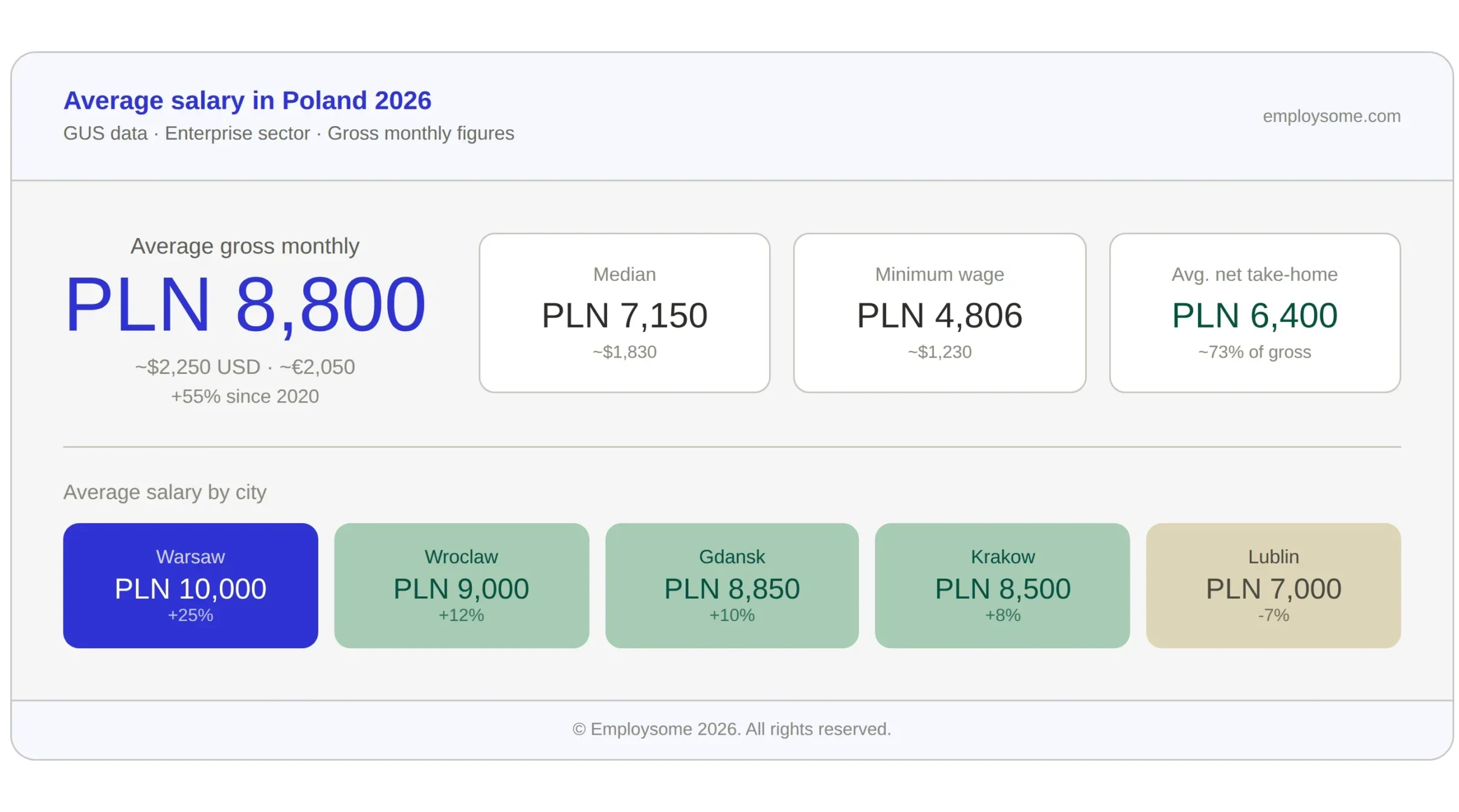
The average salary in Poland is approximately PLN 8,700 to PLN 8,900 gross per month in 2026, based on Central Statistical Office (GUS) data and industry estimates. That is roughly $2,200 to $2,250 USD or EUR 2,050 to EUR 2,100. The median salary, which is a more representative figure because it is not skewed by high earners, sits lower at approximately PLN 7,000 to PLN 7,300 gross per month.
These figures represent a significant increase over recent years. The average salary in Poland has risen by approximately 55% since 2020, driven by a tight labour market, EU-funded investment, rapid growth in the technology sector, and consecutive minimum wage increases that have pulled the entire wage distribution upward. Poland’s economy is the largest in Central Europe and the sixth largest in the EU, and its labour market reflects that scale.
For international companies, the average salary in Poland tells a compelling story. A senior software developer in Warsaw earns PLN 18,000 to PLN 25,000 gross per month, roughly 40-60% less than the same role in London, Berlin, or Amsterdam. A finance professional earns PLN 10,000 to PLN 15,000, similarly discounted. When combined with a well-educated, English-proficient workforce and EU membership that simplifies employment and data protection compliance, Poland has become one of the most popular nearshoring and remote hiring destinations in Europe.
But the average salary in Poland is only one piece of the cost equation. Employer-side ZUS social security contributions add approximately 19 to 22% on top of gross salary. Income tax, health insurance, and mandatory employee capital plans (PPK) create further layers that international employers must understand before setting compensation budgets.

Average Salary in Poland by Sector
Salaries in Poland vary significantly by industry. Technology and finance consistently pay the highest wages, while education, hospitality, and agriculture sit at the lower end. The following figures represent approximate gross monthly salaries for mid-level professionals in 2026.
|
Sector |
Average Gross Monthly Salary (PLN) |
Approx. USD |
|
IT / Software Development |
14,000-22,000 |
$3,500-$5,500 |
|
Finance / Banking |
10,000-16,000 |
$2,500-$4,000 |
|
Pharmaceuticals / Life Sciences |
10,000-15,000 |
$2,500-$3,750 |
|
Engineering / Manufacturing |
8,000-13,000 |
$2,000-$3,250 |
|
Marketing / Communications |
7,500-12,000 |
$1,875-$3,000 |
|
Accounting / Audit |
8,000-12,000 |
$2,000-$3,000 |
|
Logistics / Supply Chain |
7,000-11,000 |
$1,750-$2,750 |
|
Healthcare (non-physician) |
6,500-10,000 |
$1,625-$2,500 |
|
Customer Service / BPO |
5,500-8,500 |
$1,375-$2,125 |
|
Retail / Hospitality |
5,000-7,500 |
$1,250-$1,875 |
|
Education |
5,000-7,000 |
$1,250-$1,750 |
|
Agriculture |
4,800-6,500 |
$1,200-$1,625 |
The IT sector stands out. Poland has one of the largest developer communities in Europe, with over 500,000 IT professionals. Warsaw, Krakow, Wroclaw, and the Tri-City area (Gdansk-Gdynia-Sopot) are established tech hubs with strong ecosystems of startups, shared service centres, and multinational R&D operations. Senior developers specialising in AI, cloud infrastructure, or cybersecurity can command PLN 25,000+ gross, and contract-based (B2B) arrangements are common in the sector, often paying 15-25% more than permanent employment due to the lack of employer-funded benefits.
Average Salary in Poland by City
Location has a major impact on the average salary in Poland. Warsaw consistently pays the highest wages, typically 20-30% above the national average. Krakow, Wroclaw, and Gdansk follow, driven by large multinational shared service centres and tech companies. Smaller cities and rural areas pay closer to or at the national average.
|
City |
Average Gross Monthly Salary (PLN) |
Premium vs National Average |
|
Warsaw |
9,500-10,500 |
+20-30% |
|
Wroclaw |
8,500-9,500 |
+10-15% |
|
Gdansk |
8,500-9,200 |
+10-15% |
|
Krakow |
8,000-9,000 |
+5-15% |
|
Poznan |
7,800-8,800 |
+5-10% |
|
Katowice |
7,500-8,500 |
+0-10% |
|
Lodz |
7,000-8,000 |
~average |
|
Lublin |
6,500-7,500 |
-5-10% |
Warsaw’s premium reflects its status as the capital, the centre of Poland’s financial sector, and the largest concentration of multinational regional headquarters. Krakow has established itself as a BPO and shared services powerhouse, with over 200 service centres employing tens of thousands. Wroclaw has a strong technology and engineering presence, while Gdansk benefits from its position in the Tri-City metropolitan area and growing fintech and gaming sectors.
Average Salary by Experience Level
Experience is one of the strongest determinants of the average salary in Poland. Junior professionals earn significantly less than their mid-level and senior counterparts, with the steepest salary jumps occurring between the 3-5 year and 5-10 year experience bands.
|
Experience Level |
Average Gross Monthly Salary (PLN) |
Approx. USD |
|
Entry-level (0-2 years) |
5,000-7,000 |
$1,250-$1,750 |
|
Junior (2-5 years) |
7,000-10,000 |
$1,750-$2,500 |
|
Mid-level (5-10 years) |
10,000-15,000 |
$2,500-$3,750 |
|
Senior (10-15 years) |
14,000-20,000 |
$3,500-$5,000 |
|
Director / Executive (15+ years) |
18,000-35,000+ |
$4,500-$8,750+ |
The average Polish employee receives an approximately 8% salary increase every 17 months, compared to the global average of 3% every 16 months. The annual salary increment rate in Poland currently stands at around 6%, reflecting the country’s tight labour market and continued economic growth.
Hiring in Poland?
Poland offers one of Europe’s best combinations of talent quality and cost efficiency. If you are looking to hire Polish professionals without setting up a local entity, see our Best Employer of Record comparison for providers ranked on compliance execution and in-country infrastructure.
Minimum Wage in Poland 2026
The minimum wage in Poland from 1 January 2026 is PLN 4,806 gross per month (PLN 31.40 per hour), approximately PLN 3,500-3,600 net after deductions. This has risen 85% since 2020, pulling up wages across the entire economy and compressing the gap between entry-level and mid-level roles in lower-paid sectors. For a full breakdown of rates, take-home pay calculations, employer costs, and how Poland’s minimum compares across Europe, see our minimum wage in Poland guide.
What Employers Actually Pay: ZUS and Total Cost
The average salary in Poland does not reflect the total cost to the employer. Poland’s ZUS social security system adds approximately 19 to 22% on top of the gross salary, making it one of the most significant employer cost components in Central Europe.
Employer-side ZUS contributions (2026):
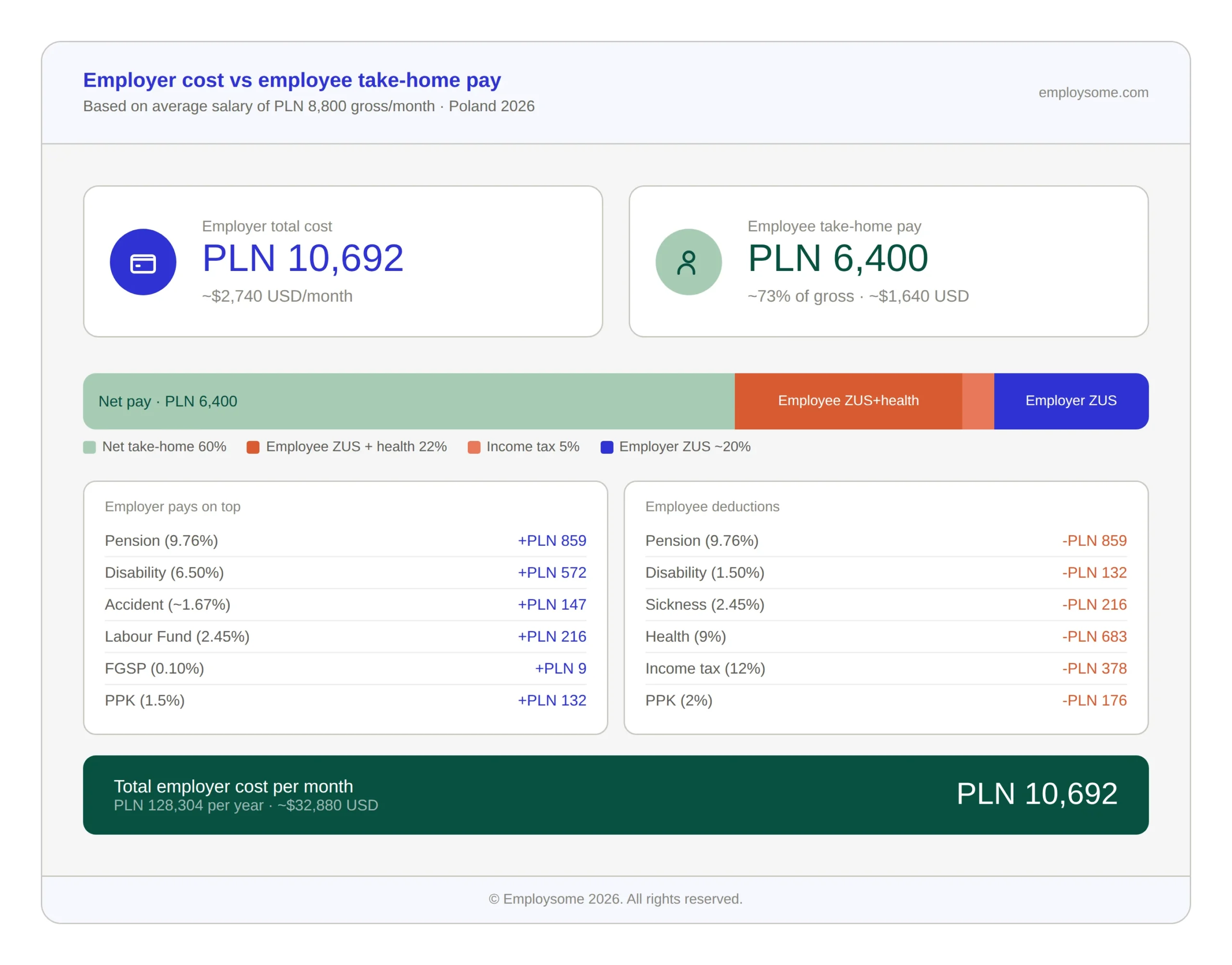
Pension insurance: 9.76% of gross salary (up to the annual cap of PLN 282,600). Disability insurance: 6.50% of gross salary (up to the same cap). Accident insurance: 0.67% to 3.33% depending on industry (foreign employers pay a flat 1.67%). Labour Fund: 2.45% of gross salary. Guaranteed Employee Benefits Fund (FGSP): 0.10% of gross salary. Total employer ZUS: approximately 19.21% to 22.41% of gross salary.
Employee-side deductions:
Pension insurance: 9.76%. Disability insurance: 1.50%. Sickness insurance: 2.45%. Health insurance: 9% of gross after social security deductions (not deductible from tax since the Polski Lad reform). Total employee deductions: approximately 22.71% of gross salary.
PPK (Employee Capital Plans):
The mandatory PPK retirement savings programme requires a minimum employer contribution of 1.5% of gross salary and a minimum employee contribution of 2% of gross salary. Employees can opt out but are automatically re-enrolled every four years.
For an employee earning the national average of PLN 8,800 gross per month, the approximate employer cost breakdown is: gross salary PLN 8,800, employer ZUS (approx. 20%) PLN 1,760, employer PPK (1.5%) PLN 132, total employer cost approximately PLN 10,692 per month. The employee’s take-home pay after all deductions (ZUS, health insurance, income tax) is approximately PLN 6,300 to PLN 6,500 net, roughly 72-74% of gross.
Income Tax in Poland
Poland operates a progressive income tax system with two brackets and a generous tax-free allowance.
The first PLN 30,000 of annual income is tax-free (the kwota wolna od podatku). Income above PLN 30,000 up to PLN 120,000 is taxed at 12%. Income above PLN 120,000 is taxed at 32%.
The tax-free allowance effectively reduces tax by PLN 3,600 per year (PLN 300 per month), which is applied automatically through payroll. For the average salary in Poland of approximately PLN 8,800 gross per month (PLN 105,600 annually), the employee falls entirely within the 12% bracket after the tax-free allowance, resulting in an effective tax rate of approximately 8-9%.
Poland also levies a solidarity surcharge of 4% on income exceeding PLN 1 million per year, which applies only to very high earners.
For workers under 26, Poland provides a full income tax exemption (PIT-0) on employment income up to PLN 85,528 per year. This makes Poland particularly attractive for hiring young professionals, as their take-home pay is significantly higher relative to gross salary.
How the Average Salary in Poland Compares in Europe
|
Country |
Average Gross Monthly Salary |
Approx. USD |
Employer SI |
Min. Wage (Monthly) |
|
Poland |
PLN 8,800 (~EUR 2,050) |
~$2,250 |
~20% ZUS |
PLN 4,806 (~EUR 1,120) |
|
Germany |
~EUR 4,500 |
~$4,950 |
~21% |
EUR 2,162 |
|
France |
~EUR 3,500 |
~$3,850 |
~45% |
EUR 1,802 |
|
Netherlands |
~EUR 4,100 |
~$4,510 |
~18% |
EUR 2,070 |
|
Czech Republic |
~CZK 45,000 (~EUR 1,850) |
~$2,035 |
~34% |
CZK 20,800 (~EUR 855) |
|
Romania |
~RON 7,500 (~EUR 1,500) |
~$1,650 |
~2.25% |
RON 4,050 (~EUR 810) |
|
Spain |
~EUR 2,600 |
~$2,860 |
~30% |
EUR 1,323 |
|
UK |
~GBP 3,200 (~EUR 3,700) |
~$4,050 |
~15% NIC |
GBP 1,872 (~EUR 2,160) |
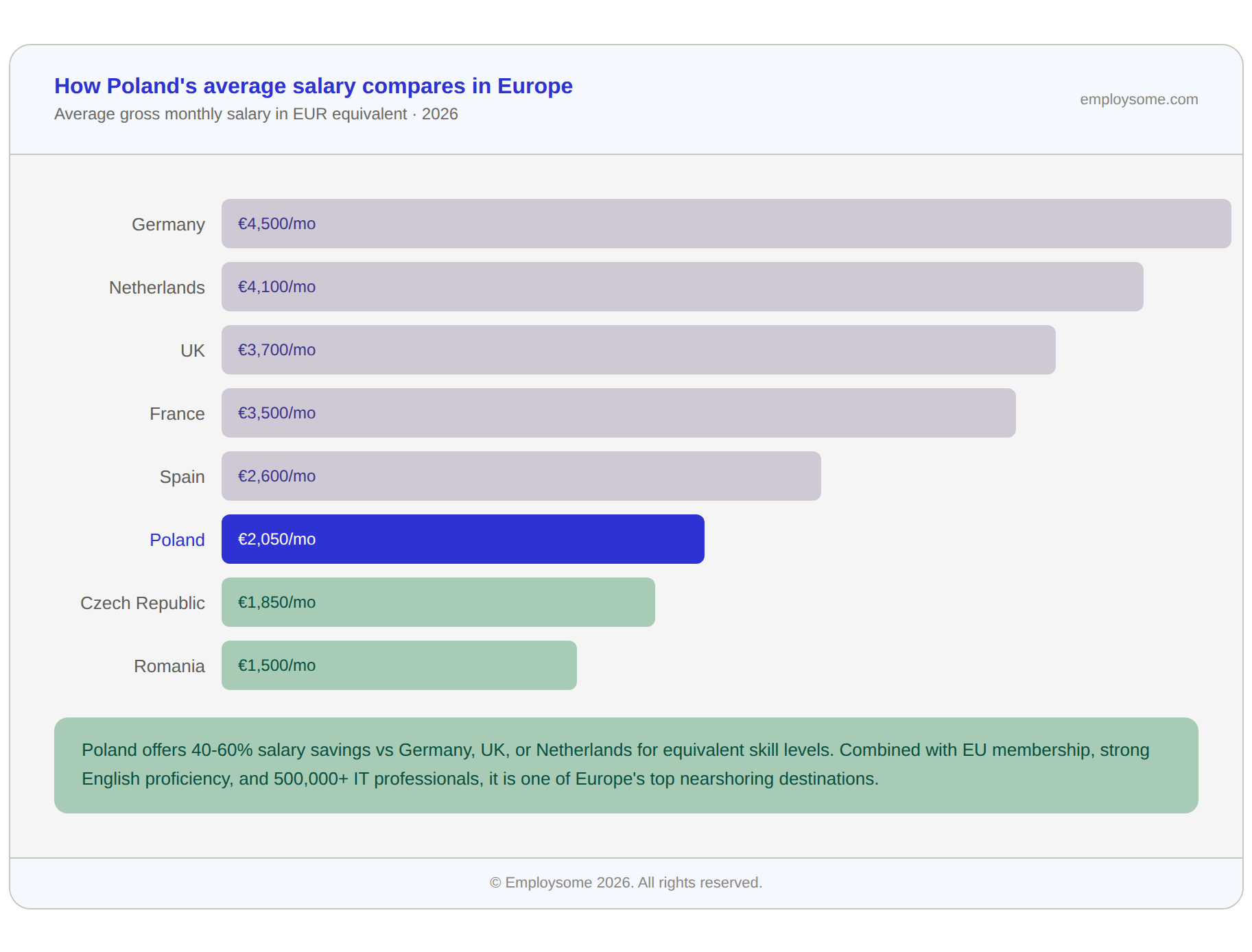
Poland occupies a strong middle ground in Europe: salaries are significantly lower than Western European levels, but the workforce quality, particularly in IT, finance, and engineering, is comparable. When total employer cost is considered (salary plus ZUS of approximately 20%), Poland remains 40-60% cheaper than Germany or the UK for equivalent roles. This cost advantage, combined with EU membership, GDPR compliance, and strong English proficiency among professionals, is the primary driver of Poland’s growth as a nearshoring destination.
Cost of Living Context
The average salary in Poland must be understood alongside the cost of living, which remains substantially lower than Western Europe. According to Numbeo, the average monthly cost of living for a single person (excluding rent) is approximately PLN 2,969. Including rent, total monthly costs in major cities are approximately PLN 4,500 to PLN 5,500 in Warsaw, PLN 3,800 to PLN 4,800 in Krakow, PLN 3,500 to PLN 4,500 in Wroclaw, and PLN 3,000 to PLN 4,000 in smaller cities.
This means an employee earning the average salary of PLN 8,800 gross (approximately PLN 6,400 net) can maintain a comfortable standard of living in most Polish cities and still save. Housing is the largest expense, but rents in Poland are roughly 50-70% lower than in London, Berlin, or Amsterdam for comparable properties.
Why International Companies Hire in Poland
Poland has become one of Europe’s leading destinations for international hiring and outsourcing, and the average salary in Poland is a significant part of the attraction. Over 1,800 shared service centres and BPO operations employ more than 430,000 people in the country. Major multinationals including Google, Goldman Sachs, Credit Suisse, HSBC, and Samsung have established significant operations in Polish cities.
The key factors driving international hiring in Poland include cost efficiency (40-60% savings versus Western Europe for equivalent skill levels), a large and well-educated talent pool (over 500,000 IT professionals, strong university system producing 400,000+ graduates annually), EU membership (simplifying employment, data transfers, and regulatory alignment), strong English proficiency (particularly among professionals under 40), time zone compatibility with Western Europe (CET, one hour ahead of London), and a stable political and economic environment with consistent GDP growth.
What This Means for Companies Hiring Through an EOR
For companies hiring in Poland without a local entity, an Employer of Record handles all aspects of compliant employment: ZUS registration and monthly social security contributions, PAYE income tax withholding and remittance, PPK auto-enrolment and contribution management, employment contract issuance under the Polish Labour Code, statutory leave administration (26 days annual leave for employees with 10+ years of experience, 20 days otherwise), and termination compliance including notice periods and severance calculations.
Poland’s payroll system is well-structured but complex, particularly around the interaction between ZUS contributions, health insurance (which is no longer tax-deductible since the Polski Lad reform), and income tax. The ZUS contribution cap (PLN 282,600 in 2026) creates a payroll planning consideration for higher earners, as pension and disability contributions stop once the cap is reached, reducing employer costs for the remainder of the year.
Frequently Asked Questions
The average salary in Poland is approximately PLN 8,700 to PLN 8,900 gross per month (roughly $2,200-$2,250 USD). The median salary is lower at approximately PLN 7,000 to PLN 7,300 gross.
PLN 4,806 gross per month from 1 January 2026, with a minimum hourly rate of PLN 31.40 gross. After deductions, net take-home is approximately PLN 3,500-3,600.
Employer-side ZUS contributions add approximately 19-22% on top of gross salary, plus 1.5% mandatory PPK pension contribution. For an employee earning PLN 8,800 gross, total employer cost is approximately PLN 10,700 per month.
Progressive: 12% on income up to PLN 120,000 per year, 32% above that. The first PLN 30,000 is tax-free. Workers under 26 are exempt from income tax on employment income up to PLN 85,528 per year.
Polish salaries are approximately 40-60% lower than equivalent roles in Germany, the UK, or the Netherlands. When combined with lower employer social security rates and a substantially lower cost of living, Poland offers significant cost advantages for international employers.
IT and software development (PLN 14,000-22,000+), finance and banking (PLN 10,000-16,000), and pharmaceuticals (PLN 10,000-15,000) consistently pay the highest salaries.
Warsaw pays approximately PLN 9,500 to PLN 10,500 gross per month, roughly 20-30% above the national average. It is Poland’s highest-paying city across virtually all sectors.

Written by
Courtney Pocock is a Copywriter & EOR/PEO Researcher at Employsome with 15+ years of experience writing for the HR, corporate, and financial sectors. She has a strong interest in global business expansion and Employer of Record / PEO topics, focusing on news that matters to business owners and decision-makers. Courtney covers industry updates, regulatory changes, and practical guides to help leaders navigate international hiring with confidence.
Our content is created for informational purposes only and is not intended to provide any legal, tax, accounting, or financial advice. Please obtain separate advice from industry-specific professionals who may better understand your business’ needs. Read our Editorial Guidelines for further information on how our content is created.
Other posts
Review other blog posts