
Minimum Wage Australia 2026: Hourly Wage + Modern Awards
The National Minimum Wage in Australia is approximately AUD $24.95 per hour from 1 July 2025, but most employees are covered by a modern award with sector-specific minimums typically running AUD $25 to $34 per hour. This guide covers the dual-floor structure (NMW vs Modern Awards), the annual Fair Work Commission review cycle, casual loading at 25 percent, weekend and public holiday penalty rates, junior and apprentice rates, and the 12 percent superannuation guarantee.

Australia operates one of the most carefully calibrated minimum wage systems in the OECD, with two distinct legal floors that foreign employers routinely confuse. The National Minimum Wage, set annually by the Fair Work Commission, applies as the absolute floor for employees not covered by a modern award. The modern award minimum, set sector by sector across approximately 120 industry and occupation awards, applies to the vast majority of Australian workers and is typically higher than the National Minimum Wage. The relevant floor for compliance purposes is whichever is the higher of the two for any given employee, which in practice means the modern award minimum binds for most foreign-employer hires.
From 1 July 2025, the National Minimum Wage is approximately AUD $24.95 per hour (~$948 per week for a standard 38-hour week, ~$49,300 annual gross), following the Fair Work Commission’s annual review decision in June 2025. The figure is indexed annually each 1 July based on FWC review of inflation, productivity, employment, and cost-of-living factors. Modern award minimums for entry-level positions in most professional sectors range from approximately AUD $25 to $34 per hour as of the 2025-2026 wage year. Casual employees receive an additional 25 percent loading on top of the base hourly rate to compensate for the absence of paid annual leave, sick leave, and notice protections.
For foreign employers, three things matter most. First, every Australian hire must be classified against the relevant modern award (or confirmed as award-free under specific exemptions), which determines the actual binding minimum wage. Second, casual loading and penalty rates (weekends, public holidays, overtime) apply in addition to the base hourly rate under most awards, materially raising effective hourly cost. Third, superannuation guarantee contributions of 12 percent (from 1 July 2025) sit on top of all wages and accrue separately to the employee’s superannuation fund. This guide covers the National Minimum Wage and modern award structure, the annual FWC review cycle, casual loading and penalty rates, junior and apprentice rates, superannuation requirements, the practical compliance workflow for foreign employers, common compliance mistakes, and how Australian minimum wage compares with regional peers. Official guidance is published by the Fair Work Commission (FWC) and the Fair Work Ombudsman (FWO).

Two Australian Minimum Wages: National vs Modern Award
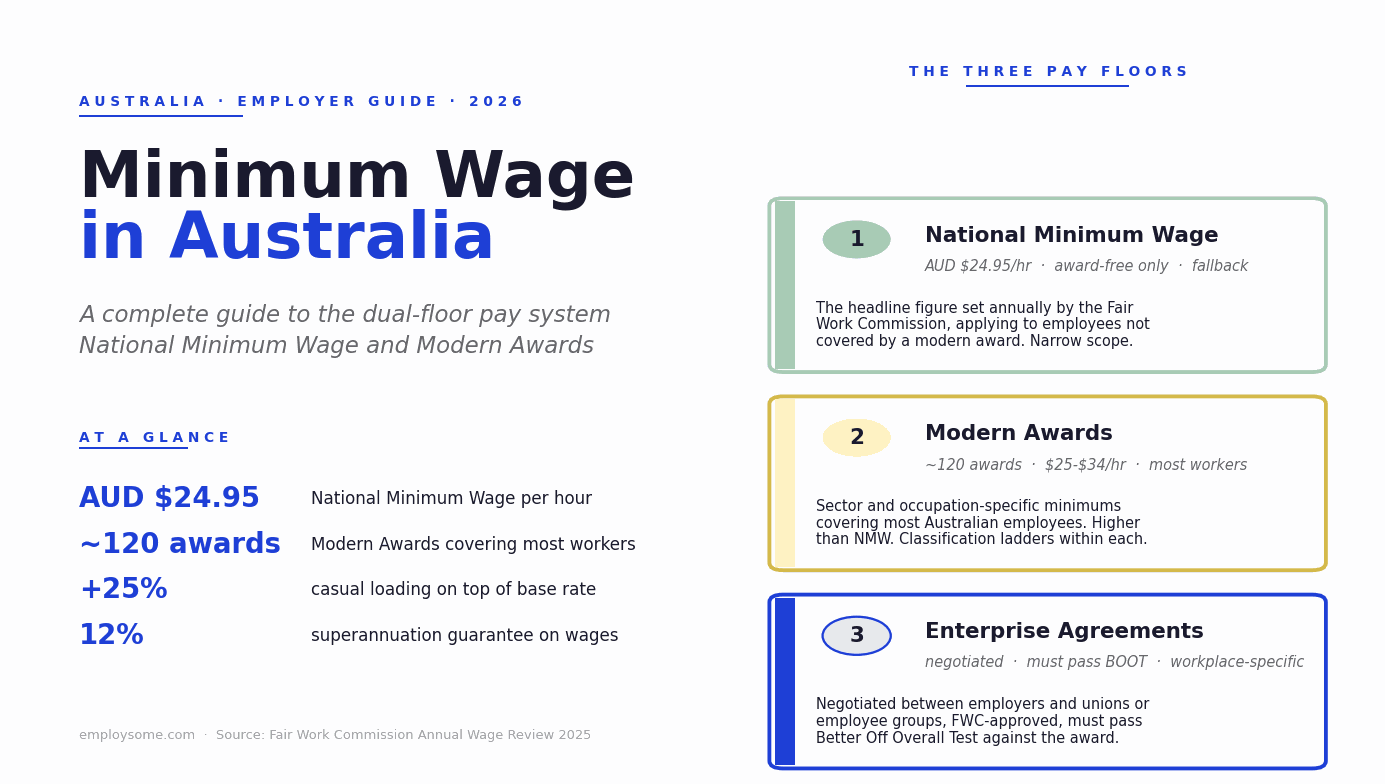
The single most important compliance concept for foreign employers in Australia is the dual-floor structure of minimum wages. The National Minimum Wage is the headline figure that gets quoted in news coverage and government summaries, but it is not the binding floor for most employees. The relevant figure for compliance is whichever is the higher of the National Minimum Wage and the relevant modern award minimum for the employee’s role.
The National Minimum Wage (NMW) is set annually by the Fair Work Commission and applies as the legal floor for all employees not covered by a modern award or registered enterprise agreement. The 2025-2026 rate is approximately AUD $24.95 per hour (~$948 per week for a standard 38-hour week). The NMW applies primarily to award-free workers in narrow categories: certain managerial roles outside award scope, specific senior executives, and some technical and professional roles where no modern award applies.
Modern Awards are sector-specific and occupation-specific minimum wage instruments covering approximately 120 industry awards. Each award sets a hierarchy of classifications and pay grades for the relevant industry, with hourly rates that are typically higher than the National Minimum Wage. Most Australian employees, including the majority of foreign-employer hires for technology, finance, professional services, manufacturing, retail, and hospitality roles, are covered by a modern award. The relevant award must be identified for each role based on the work performed (not the job title or the employer’s industry, although these inform the classification).
Enterprise Agreements are negotiated between employers and unions or employee groups and provide an alternative pay floor that must be at least equivalent to the relevant modern award would have provided (the “Better Off Overall Test” or BOOT). Most foreign employers do not have Australian enterprise agreements unless they have inherited them through acquisition. For greenfield foreign-employer hiring, the modern award is almost always the relevant minimum wage instrument.
| Pay Floor | Coverage | Typical Hourly Range (2025-2026) | Set By |
| National Minimum Wage | Award-free employees only | ~AUD $24.95 | Fair Work Commission, annual review |
| Modern Award (entry-level) | Most Australian employees | ~AUD $25 to $34 | Fair Work Commission, ~120 separate awards |
| Modern Award (senior classifications) | Most Australian employees | ~AUD $30 to $55 | Fair Work Commission, classification ladder within each award |
| Enterprise Agreement | Specific covered workplaces | Variable, must pass BOOT | Negotiated, FWC approved |
For foreign employers, the practical workflow is: identify the relevant modern award for the role, identify the correct classification level within that award based on duties and seniority, apply the corresponding hourly rate as the binding minimum, then layer on casual loading (if casual employment), penalty rates (weekends, public holidays, overtime), and superannuation. Skipping the modern award identification step and defaulting to the National Minimum Wage is the most common Australian compliance failure, and it can result in back-pay obligations stretching over 6 years (the standard limitation period for wage underpayment claims).
The Annual Fair Work Commission Wage Review Cycle
The Fair Work Commission conducts an Annual Wage Review each year, with the decision typically announced in early June and the new rates taking effect from the first full pay period on or after 1 July. This predictable cycle is unusual internationally and is one of the most useful features of the Australian minimum wage system for employer planning. The 2025-2026 review (announced in June 2025) increased the National Minimum Wage by approximately 3.5 percent and applied a similar percentage uplift to most modern award minimum rates.
The FWC review considers a defined set of statutory factors: prevailing economic conditions including inflation and productivity, the relative living standards and needs of the low-paid, promoting social inclusion through workforce participation, and the impact on businesses (particularly small and medium enterprises) and on employment levels. The decision is made by an Expert Panel comprising the FWC President, a Deputy President, and three FWC members with relevant expertise. Submissions are received from unions, employer associations, government bodies, and academic researchers.
For foreign employers, the timing of the annual review has practical implications. First, hiring decisions made in May-June should incorporate the upcoming July rate change rather than the current rate. Second, payroll system updates must be applied across all classifications during June, with effective dates aligned to the first full pay period from 1 July (which can vary by 1-13 days depending on each company’s pay cycle). Third, employment offers extending across the 30 June / 1 July boundary should specify the rate change explicitly to avoid disputes. Fourth, the annual increase typically applies retrospectively to the start of the first full pay period, not to mid-cycle work, so employees do not receive partial-week back-pay for the late June period.
Employsome Insight: Modern award identification is where Australian compliance most often fails.
Foreign employers default to assuming a senior professional role is “award-free” and therefore covered only by the National Minimum Wage. This is wrong in approximately 80 percent of cases. Modern awards cover the vast majority of Australian employees, including most professional, technical, and managerial roles below executive level. The relevant award depends on the duties performed, not the job title, the employer’s industry, or the employee’s salary level. A senior software engineer working for a tech company is typically covered by either the Professional Employees Award or the Information and Communication Technology Award, with classification levels matching seniority and responsibility. Defaulting to the NMW in such cases creates back-pay liability across the relevant 6-year limitation period if a Fair Work Ombudsman audit or employee claim establishes the correct award. The Fair Work Ombudsman runs a free Pay and Conditions Tool (P.A.C.T.) that helps identify the relevant award. For foreign employers without Australian HR expertise, working with a payroll provider or Australian Employer of Record that handles award classification is the safest approach.
Casual Loading and Penalty Rates
Beyond the base hourly minimum, two structural premiums apply under most modern awards: casual loading and penalty rates. Both materially raise effective hourly cost above the headline minimum.
Casual loading is a 25 percent premium added to the base hourly rate for employees engaged on a casual basis. The loading compensates for the absence of paid annual leave, paid sick leave, paid carer’s leave, paid public holidays, and notice of termination protections that apply to permanent employees. A casual employee on the National Minimum Wage receives approximately AUD $31.19 per hour (~$24.95 + 25 percent), and a casual employee on a modern award rate of $30 per hour receives $37.50 per hour. Casual loading is built into the headline casual rate and is not a separately calculated bonus. The 2024 amendments to the Fair Work Act tightened the legal definition of “casual employment,” limiting employer ability to characterise long-term regular workers as casual.
Penalty rates apply to work performed at non-standard times, with rates varying by modern award. Typical penalty rate structures include:
| Work Period | Typical Penalty Rate | Effective Hourly Rate (on $25 base) |
| Saturday work | +25% to +50% | $31.25 to $37.50 |
| Sunday work | +50% to +100% | $37.50 to $50.00 |
| Public holidays | +150% (effectively 2.5x) | $62.50 |
| Overtime (first 2-3 hours) | +50% | $37.50 |
| Overtime (beyond first 2-3 hours) | +100% | $50.00 |
| Night work shift loading | +15% to +30% | $28.75 to $32.50 |
Penalty rate structures vary considerably across the approximately 120 modern awards. Hospitality, retail, and healthcare awards have particularly extensive penalty rate provisions. Office-based professional awards have lighter penalty rate structures, often limited to overtime and public holiday provisions. For foreign employers operating shift-based or weekend operations, penalty rates can effectively double the base hourly cost during certain working periods.
Junior, Apprentice, and Trainee Rates
Australian minimum wage law includes separate rate scales for junior employees (typically under 21), apprentices, and trainees. These sub-minimum rates are calculated as percentages of the adult minimum wage for the relevant award, with the percentage rising progressively with age or training year.
Junior rates apply to employees under 21 years old in most modern awards, with the percentage rising each year. Typical junior rate scaling under most awards is approximately:
| Age | Percentage of Adult Rate | Effective Hourly (on $25 adult rate) |
| Under 16 | ~36.8% | ~$9.20 |
| Age 16 | ~47.3% | ~$11.83 |
| Age 17 | ~57.8% | ~$14.45 |
| Age 18 | ~68.3% | ~$17.08 |
| Age 19 | ~82.5% | ~$20.63 |
| Age 20 | ~97.7% | ~$24.43 |
| Age 21+ | 100% (full adult rate) | $25.00 |
Apprentice and trainee rates apply during recognised training periods under formal apprenticeship or traineeship arrangements registered with the relevant state training authority. Rates rise progressively each year of the training period, typically over 3-4 years for trade apprenticeships, with full adult rates payable on completion. Specific rates vary considerably by industry and training pathway.
For foreign employers, junior and apprentice rates are typically not relevant because most foreign-employer hiring is for senior professional roles with adult employees. The exception is foreign employers operating large-scale Australian retail, hospitality, or fast-food operations, where junior rates substantially affect total wage cost.
Employsome Insight: Superannuation guarantee 12 percent sits on top of all wages and is mandatory.
Foreign employers calculating Australian total compensation often forget the superannuation guarantee, which is the mandatory employer pension contribution paid in addition to wages. The rate has risen from 9.5 percent in 2020 to 12 percent from 1 July 2025, completing a multi-year scheduled increase. The 12 percent applies to ordinary time earnings (base salary, commissions, paid leave, but typically not overtime) and is paid into a complying superannuation fund of the employee’s choice (or the employer default fund if the employee does not nominate). For an employee on AUD $25 per hour working 38 hours per week, the superannuation guarantee adds approximately $114 per week (~$5,930 per year) on top of wages. Failure to pay the superannuation guarantee on time triggers the Superannuation Guarantee Charge, which includes the unpaid amount, interest, and administrative fees, and is non-deductible (unlike normal super contributions). The Australian Taxation Office actively audits superannuation guarantee compliance, and underpayment is one of the most common Fair Work and ATO enforcement targets. Foreign employers should treat superannuation as a non-negotiable 12 percent addition to all Australian wage budgets.
Compliance Workflow for Foreign Employers
For foreign employers, Australian minimum wage compliance follows a defined sequence that must be completed for each new hire. Skipping any step risks back-pay liability, Fair Work Ombudsman enforcement action, or both.
| Step | Action | Tool / Authority |
| 1 | Identify relevant modern award based on duties | Fair Work Ombudsman P.A.C.T. or HR adviser |
| 2 | Identify classification level within the award | Award classification ladder + duty matching |
| 3 | Confirm full-time, part-time, casual, or fixed-term | Employment type definitions in the award |
| 4 | Apply base hourly rate from award | FWO Pay Calculator or P.A.C.T. |
| 5 | Apply casual loading if casual | +25% on base rate |
| 6 | Determine penalty rate exposure (weekends, holidays, overtime) | Award-specific penalty rate schedule |
| 7 | Add 12% superannuation guarantee to ordinary time earnings | ATO superannuation rules |
| 8 | Document the classification reasoning in writing | Internal HR file |
| 9 | Review and adjust annually after FWC June decision | FWC annual review schedule |
For foreign employers without Australian HR or payroll expertise, completing this workflow correctly for each hire is operationally challenging. The two practical alternatives are engaging an Australian employment law firm or HR consultant for ongoing classification advice, or using an Australian Employer of Record that handles modern award classification, payroll, and superannuation as part of standard service. The EOR approach typically costs $400-$1,200 USD per employee per month and removes most of the classification burden from the foreign employer entirely.
Common Australian Minimum Wage Mistakes
Foreign employers running their first Australian payroll cases routinely encounter several specific issues. Each can result in back-pay obligations, Fair Work Ombudsman enforcement, or in serious cases, civil penalties of up to AUD $93,900 per breach for serious contraventions of the Fair Work Act.
1. Defaulting to the National Minimum Wage instead of identifying the modern award. The most common error, accounting for the majority of underpayment claims and FWO audit findings. Modern awards cover most Australian employees and typically pay above the NMW. Defaulting to NMW for award-covered employees creates back-pay liability across the 6-year limitation period.
2. Misclassifying employees as casual to avoid leave entitlements. The 2024 Fair Work Act amendments tightened the casual employee definition, making it harder to classify long-term regular workers as casual. Employees engaged on regular shifts over an extended period are increasingly likely to be reclassified as permanent, with retrospective entitlement to annual leave, sick leave, and notice protections.
3. Forgetting penalty rates for weekend or public holiday work. Foreign employers operating shift-based, retail, or hospitality businesses sometimes pay flat hourly rates regardless of when the work is performed. Penalty rates apply automatically under most awards and create significant back-pay liability when omitted.
4. Underpaying superannuation guarantee. The 12 percent SG applies to ordinary time earnings and must be paid quarterly to the employee’s nominated complying super fund. Late or underpaid SG triggers the Superannuation Guarantee Charge with non-deductible interest and administrative fees, and the ATO audits this aggressively.
5. Failing to apply the annual FWC increase from 1 July. Foreign employers running global payroll systems sometimes miss the Australian rate change because their HQ payroll calendar does not align with the Australian fiscal year. Effective dates are tied to the first full pay period from 1 July, which varies by 1-13 days depending on each company’s pay cycle.
6. Treating salary set above the award rate as award-exempt. Paying above the award minimum does not exempt the employer from other award obligations including penalty rates, overtime provisions, leave entitlements, and notice periods. The award still applies even if the headline salary is well above the classification minimum.
7. Not documenting the modern award classification reasoning. If a Fair Work Ombudsman audit or employee claim later questions the classification, the employer must demonstrate the basis for the decision. Failing to document the classification at the time of hire makes it harder to defend retrospectively.
Frequently Asked Questions: Minimum Wage Australia
The National Minimum Wage in Australia from 1 July 2025 is approximately AUD $24.95 per hour, or AUD $948 per week for a standard 38-hour week (~$49,300 annual gross). However, this is not the binding floor for most employees. Most Australian workers are covered by a modern award with sector-specific minimum wages typically running AUD $25-$34 per hour for entry-level positions, often higher than the National Minimum Wage. The relevant minimum wage for compliance is whichever is the higher of the National Minimum Wage and the modern award rate for the role.
The National Minimum Wage (NMW) is the absolute legal floor for employees not covered by a modern award, set annually by the Fair Work Commission. Modern awards are sector-specific and occupation-specific minimum wage instruments covering approximately 120 industry awards, with hierarchical pay grades for different roles within each industry. Most Australian employees are covered by a modern award rather than the NMW, and the modern award rate is typically higher. Foreign employers must identify the relevant modern award for each role and apply the corresponding classification level rate.
The Fair Work Commission conducts an Annual Wage Review each year, with the decision announced in early June and the new rates taking effect from the first full pay period on or after 1 July. The 2025-2026 review increased the National Minimum Wage by approximately 3.5 percent. The 2026-2027 review is expected to be announced in June 2026 with new rates effective from 1 July 2026. Foreign employers should adjust payroll systems annually in late June to apply the new rates from the correct effective date.
Casual loading is a 25 percent premium added to the base hourly rate for employees engaged on a casual basis. The loading compensates casual employees for the absence of paid annual leave, paid sick leave, paid carer’s leave, paid public holidays, and notice of termination protections that apply to permanent employees. A casual employee on the National Minimum Wage receives approximately AUD $31.19 per hour (~$24.95 + 25 percent). The loading is built into the headline casual rate, not paid as a separate component.
Yes. Penalty rates apply under most modern awards for work performed at non-standard times: weekends (typically +25 to +100 percent), public holidays (typically +150 percent or 2.5x base rate), overtime (typically +50 to +100 percent), and night shifts (typically +15 to +30 percent). Specific rates vary by award. Hospitality, retail, and healthcare awards have particularly extensive penalty rate provisions; office-based professional awards have lighter penalty rate structures. Foreign employers operating shift-based or weekend operations face materially higher hourly costs during these periods.
No. The superannuation guarantee (12 percent from 1 July 2025) is paid by the employer in addition to wages, not deducted from them. Superannuation accrues to the employee’s nominated complying superannuation fund and is paid at least quarterly. For an employee on AUD $25 per hour working 38 hours per week, the superannuation guarantee adds approximately $114 per week (~$5,930 per year) on top of wages. Failure to pay superannuation triggers the Superannuation Guarantee Charge with non-deductible interest and ATO enforcement.
Junior rates apply to employees under 21 years old in most modern awards, calculated as percentages of the adult minimum wage for the relevant award. Typical scaling: under 16 at ~37 percent of adult rate, age 17 at ~58 percent, age 18 at ~68 percent, age 20 at ~98 percent, and age 21+ at 100 percent (full adult rate). Specific percentages vary slightly by award. Apprentices and trainees have separate rate scales that rise progressively each year of formal training. Most foreign-employer hiring is for adult professional roles where junior rates do not apply.
Underpayment of wages, casual loading, penalty rates, or superannuation can result in: back-pay obligations across the 6-year statutory limitation period, Fair Work Ombudsman enforcement action including civil penalties of up to AUD $93,900 per breach for serious contraventions, ATO superannuation guarantee charge for unpaid super, employee Fair Work Commission claims, and reputational damage. Wage theft has been criminalised in some Australian states (Victoria, Queensland) for serious or systematic underpayment. Foreign employers should treat Australian payroll compliance as a high-priority area requiring qualified local advice or EOR support.
Copywriter
Christa is a Copywriter at Employsome with 17 years of professional writing experience across global brands, startups, and online publications. A native English-Finnish writer, she brings strong editorial skills and a versatile background in business, SaaS, and finance. At Employsome, Christa focuses on clear, practical content about HR, payroll, and Employer of Record topics.
Information in this guide is current as of May 2026 and reflects the Fair Work Commission Annual Wage Review decision of June 2025 (effective from 1 July 2025), the superannuation guarantee rate of 12 percent (from 1 July 2025), and the modern award framework as of the 2025-2026 wage year. Hourly rates are quoted as approximate figures; exact rates vary by modern award and classification level and should be confirmed via the Fair Work Ombudsman Pay and Conditions Tool (P.A.C.T.) or the Fair Work Commission. The next FWC Annual Wage Review is expected in June 2026 with new rates effective 1 July 2026. This guide is for informational purposes only and does not constitute legal, tax, or compensation advice. Foreign employers should engage qualified Australian employment law counsel, payroll provider, or Employer of Record before structuring Australian compensation.