
Employer of Record (EOR) Belgium: 2026 Rankings
Compare the 10 best Employer of Record Belgium providers for 2026, ranked across joint committee compliance, RSZ/ONSS payroll, Single Status notice handling, and Single Permit immigration sponsorship. This independent guide covers Multiplier, Deel, Remote, SD Worx, Workwell, Atlas HXM, WorkMotion, Leap29, Parakar, and Lano, with a weighted methodology giving 60% weight to Belgium-specific execution and 40% to global EOR performance.


Table of Contents
Hiring an Employer of Record in Belgium lets foreign companies employ workers compliantly without setting up a Belgian legal entity. The right Belgium EOR handles the Loi du 3 juillet 1978 (Employment Contracts Act), RSZ/ONSS social security registration, joint committee classification across the approximately 180 paritair comités, double holiday allowance, end-of-year bonus, and Single Status notice calculation under the framework administered by the Federal Public Service Employment, Labour and Social Dialogue, while you retain full control of the day-to-day work.
Belgium is one of the most structurally complex EOR markets in the EU. The Loi du 24 juillet 1987 restricts third-party labour leasing, the Single Status framework (statut unique / eenheidsstatuut) replaces the abolished probation period with notice in weeks scaling sharply with tenure, and contracts must be drafted in the language of the region of work — Dutch in Flanders, French in Wallonia, German in the Eastern Cantons. With Belgian employment running at historically high levels per Statbel labour market data, competition for skilled professionals is significant. Choosing the right Employer of Record in Belgium is therefore as much about structural compliance fit as it is about pricing or platform polish.
This guide ranks the 10 best Employer of Record Belgium providers for 2026 across two weighted dimensions: a 40 percent Global EOR score (coverage, pricing, contract terms, customer experience, platform) and a 60 percent Belgium EOR score (entity ownership, onboarding speed, on-site HR support, immigration sponsorship, in-country compliance, local add-ons). For comparison with neighbouring markets, see our Best Employer of Record in France, Germany, and Netherlands guides.

Quick Verdict: Best Employer of Record in Belgium

Ø price p.m.
4.5/5
4.4/5

Ø price p.m.
4.6/5
4.3/5

Ø price p.m.
3.8/5
4.8/5

Ø price p.m.
4.3/5
4.4/5

Ø price p.m.
4.5/5
4.2/5

Ø price p.m.
4.2/5
4.3/5

Ø price p.m.
4.0/5
4.4/5

Ø price p.m.
3.7/5
4.1/5

Ø price p.m.
3.5/5
3.8/5

Ø price p.m.
2.4/5
4.3/5
✅ Why Teams Use Employsome
Employsome is an independent Employer of Record comparison platform built to help companies choose the right Employer of Record in Belgium based on real execution, not paid placements or marketing hype. We verify entity ownership structures, RSZ/ONSS registration handling, joint committee classification accuracy, payroll compliance under the Loi du 3 juillet 1978, language-of-region contract drafting capability, and actual in-country delivery so you can confidently shortlist the strongest Belgian EOR providers before speaking to sales.
Why Trust Our Best Employer of Record in Belgium Comparison
100% independent rankings. Employsome is not owned by, affiliated with, or funded by any Employer of Record provider. No company can pay to appear higher in our rankings. We highlight both strengths and weaknesses so companies can make a genuinely unbiased decision when choosing an Employer of Record in Belgium.
Data-driven EOR scoring model. Every provider is evaluated using our two-layer scoring system combining the Global EOR Score with our Belgium EOR Score. We assess pricing transparency, contract terms, platform quality, support responsiveness, entity ownership structure, joint committee handling, language-of-region capability, visa and Single Permit support, and real delivery performance in the Belgian market.
Verified Belgium EOR data. We independently validate each provider’s Belgium setup, including local entity ownership versus partner reliance, RSZ/ONSS social security registration handling through the Dimona declaration system, occupational health enrolment with external prevention services (IDEWE, Mensura, Cohezio, Premed), payroll execution standards under the Loi du 3 juillet 1978 (Employment Contracts Act), joint committee classification accuracy across the approximately 180 paritair comité sectors, compliant termination and notice calculations under the Single Status, double holiday allowance handling, language-of-region contract drafting (Dutch in Flanders, French in Wallonia, German in the Eastern Cantons, bilingual in Brussels-Capital), and Single Permit (combiné / gecombineerde vergunning) and EU Blue Card sponsorship capability. This ensures each listed provider is structured to operate compliantly under Belgian employment law.
Built by former EOR operators. Employsome was created by former EOR and global payroll operators who have managed complex Belgian hiring projects at scale. We have seen firsthand where EOR models fail in the Belgian market, including incorrect joint committee classification, language-of-region contract violations, missed double holiday allowance calculations, errors in Single Status notice computations, partner-chain risk through unlicensed sub-providers, and contractor misclassification under Belgium’s strict false self-employment doctrine. Our mission is to bring transparency and practical expertise to one of Western Europe’s most compliance-driven EOR markets.
In-Depth Reviews: Top Employer of Record Providers in Belgium
Multiplier is a global Employer of Record and payroll platform founded in 2020, designed to help companies hire and manage international employees without establishing local entities. The company supports compliant employment, payroll processing, benefits administration, and contractor management across more than 150 countries, including Belgium.
In the Belgian market, Multiplier facilitates compliant hiring under the Loi du 3 juillet 1978 (Employment Contracts Act), including language-of-region employment contracts, RSZ/ONSS social security registration through the Dimona declaration system, joint committee classification, double holiday allowance administration, and payroll execution aligned with Belgian regulations. The platform is recognised for its modern, tech-first interface, competitive pricing model, and streamlined onboarding workflows that enable efficient cross-border hiring.
Global
Ø Fee per Employee per Month, First Year
✓ Global Coverage & Services (5.0/5): EOR services across 120+ countries, including contractor management, global payroll outsourcing, statutory compliance, benefits administration, and immigration support in selected jurisdictions.
✓ Pricing & Transparency (4.0/5): Generally clear pricing and competitive for scaleups at $505 per EOR employee, though FX markups apply (stated ~2%, reported higher in some cases up to 8%) and country-level cost breakdowns are not always fully transparent upfront. Sales staff at Multiplier is eager to sell so they have lots of room for negotiations!
✓ Payment & Contract Terms (4.5/5): No minimum contract commitment and flexible agreements. However, invoices are issued early and short payment windows (often ~7 days) can impact cash flow.
✓ Customer Experience & Support (4.5/5): Improved support quality in recent years with a solid self-service knowledge base. Support experience and escalation handling can vary by region.
✓ Platform & Integrations (4.5/5): Strong, modern platform with clean UX, efficient onboarding, and good multi-country reporting. Integration depth and automation are slightly behind top tech-first EORs.
4.5/5
✓ Entity Ownership (4.5/5): Multiplier operates in Belgium through its own local legal entity, enabling direct employment execution and accountability for Loi du 3 juillet 1978 compliance, RSZ/ONSS social security contributions, occupational health enrolment, and bédéfisc/bedrijfsvoorheffing income tax withholding. Direct entity infrastructure aligns well with the Loi du 24 juillet 1987 limitations on third-party labour leasing and reduces partner-chain dependency.
✓ Onboarding Speed (5.0/5): Very fast, platform-driven onboarding with streamlined Dutch-, French-, or German-language contract issuance, Dimona registration on or before the first day of work, external prevention service enrolment, and payroll activation. Standard Belgian employment setups can be completed in 3 to 5 business days for EU nationals once documentation is submitted.
✗ On-Site HR Support (3.5/5): While Multiplier operates via its own Belgian entity, it does not maintain a large on-the-ground advisory team in Belgium. HR and payroll coordination is managed regionally through centralised teams. Operational support is reliable, but in-country advisory depth is more limited compared to providers with dedicated Belgian offices and native joint committee specialists.
✓ Visa & Work Permit Support (4.5/5): Solid support for Belgian Single Permit (combiné / gecombineerde vergunning) and EU Blue Card applications, including documentation guidance and employer-side coordination with the regional employment authorities (VDAB, Le Forem, Brussels Economy and Employment) and the federal Office des Étrangers / Dienst Vreemdelingenzaken. Suitable for companies hiring foreign nationals into Belgium.
✓ In-Country Compliance (4.5/5): Strong coverage of Belgian statutory obligations including joint committee classification, RSZ/ONSS contributions, occupational health enrolment, double holiday allowance, end-of-year bonus administration, meal voucher handling, statutory leave entitlements, the abolished probation period replaced by Single Status notice, and compliant termination processing under the Single Status notice scale.
✓ Local Add-Ons (4.5/5): Very strong additional services including contractor management (AOR), payroll outsourcing for own-entity companies, supplementary pension structuring, group hospitalisation insurance coordination, and employment cost modelling. Flexibility is higher than many tech-first competitors.
4.4/5
Modern, automation-driven platform: Multiplier offers a clean, tech-first interface with streamlined onboarding, contract generation, payroll processing, and multi-country workforce management, making it efficient for distributed teams.
Owned-entity infrastructure in key markets (incl. Belgium): Operating through its own entity, Multiplier provides stronger compliance control and direct accountability for payroll, statutory benefits, and employment execution in a market where the Loi du 24 juillet 1987 restricts labour leasing structures.
Limited on-the-ground HR depth in Belgium: Support is delivered through regional or centralised teams rather than deeply embedded local offices, which can be less hands-on for complex joint committee classification disputes or blue-collar workforce employee relations cases.
Less suited for immigration-heavy or sector-specialised setups: While Single Permit coordination is available, highly complex multi-region work permit scenarios, regulated sector hires (construction, healthcare, transport), or niche joint committee questions may require external Belgian legal specialists.
Multiplier in Belgium is best suited for companies seeking a technology-first Employer of Record Belgium solution with strong core compliance coverage and exceptionally fast onboarding workflows. It is particularly well suited to startups, scale-ups, and mid-sized businesses expanding internationally (including into Belgium) that prioritise efficient, automated hiring processes, modern platform usability, and multi-country workforce management over a high-touch, locally anchored Belgian HR presence.
Multiplier works especially well for organisations hiring standard full-time roles across multiple jurisdictions who want to centralise payroll, benefits administration, and compliance reporting through a single platform. For companies building distributed teams across Western Europe, Belgium can be integrated seamlessly into a broader expansion strategy alongside markets like France, Germany, and the Netherlands using Multiplier’s digital infrastructure.
It is less ideal for businesses that require deep on-the-ground Belgian HR advisory, complex joint committee interpretation across the approximately 180 paritair comités, or highly specialised sector-specific employment structuring. Companies with unusually complex local labour disputes, blue-collar workforces in regulated sectors, or highly bespoke compensation frameworks tied to specific Belgian sectoral CBAs may benefit from supplementary local legal support alongside the EOR structure.
Remote is a global Employer of Record and payroll platform founded in 2019, focused on compliant international hiring with a strong emphasis on owned-entity infrastructure and transparent pricing. The company operates EOR services, payroll, contractor management, and benefits administration across more than 80 countries including Belgium.
In the Belgian market, Remote operates through its own legal entity rather than relying primarily on payroll partner infrastructure, which is a meaningful structural advantage given the Loi du 24 juillet 1987 limitations on third-party labour leasing. The platform handles Loi du 3 juillet 1978-compliant contracts in Dutch, French, or German, Dimona registration, joint committee classification, RSZ/ONSS contributions, double holiday allowance, and Single Status termination handling at a reliable standard.
Global
Ø Fee per Employee per Month, First Year
- Global country coverage
- Enterprise-grade software
✓ Global Coverage & Services (5.0/5): Strong global EOR coverage, mostly through Remote-owned legal entities. Wide range of add-on services offered beyond EOR such as global payroll services, contractor payments, equity add-ons, HRIS, benefits, U.S. PEO and more.
✓ Pricing & Transparency (4.0/5): Fees are higher compared to other global EORs. Also, a “hidden” currency exchange fee of up to 8% applies. However, Remote does not apply an EOR security deposit. OK, overall.
✓ Payment & Contract Terms (4.5/5): No minimum contract commitment which allows for flexible EOR hiring. Further, payroll cut-off on the 11th of the month and payment terms of 10 days.
✓ Customer Experience & Support (4.5/5): Remote’s EOR solution is designed to be mostly self-service for customers hiring < 10 staff. No dedicated account manager is assigned and support is run through their offshore-team.
✓ Platform & Integrations (5.0/5): Remote’s platform is amongst the best of the industry with a large amount of features and integrations available. It’s suitable for enterprise customers.
4.6/5
✓ Entity Ownership (4.5/5): Remote operates through its own Belgian legal entity, providing direct employment execution under the Loi du 3 juillet 1978 with full compliance control rather than partner-chain delegation. This structure aligns well with the Loi du 24 juillet 1987 limitations on labour leasing and simplifies dispute resolution.
✓ Onboarding Speed (4.5/5): Reliable onboarding within 5 to 7 business days for EU nationals, including Dimona registration on or before first day of work, language-of-region contract drafting, external prevention service enrolment, and payroll activation.
✗ On-Site HR Support (3.5/5): Belgian HR support is delivered through regional teams rather than dedicated Belgian advisors. The depth is solid for standard scenarios but less than at Belgian-native providers for complex joint committee or sectoral questions.
✓ Visa & Work Permit Support (4.5/5): Single Permit (combiné / gecombineerde vergunning) and EU Blue Card sponsorship is well-supported across all three Belgian regions, with practical experience navigating the regional employment authorities and the federal immigration office.
✓ In-Country Compliance (4.5/5): Strong coverage of Belgian statutory obligations including joint committee classification for mainstream sectors, RSZ/ONSS contributions, occupational health enrolment, double holiday allowance, end-of-year bonus, the abolished probation period, Single Status notice calculation across the full tenure scale, and the abusive dismissal exposure framework.
✓ Local Add-Ons (4.0/5): Solid additional services including contractor management, supplementary pension administration, hospitalisation insurance coordination, and benefits structuring beyond statutory minimums.
4.3/5
Direct Belgian entity ownership: Remote operates through its own legal entity in Belgium, providing structural compliance alignment with the Loi du 24 juillet 1987 and direct accountability for employment execution.
Industry-leading pricing transparency: Clear public pricing, predictable FX handling, and minimal hidden fees make Remote one of the most straightforward providers to budget against.
Pricing premium versus platform-led competitors: Remote sits at the upper-mid range of the market, and for the most cost-sensitive smaller deployments the difference relative to platform-first providers can be material.
No physical presence in Belgium: Remote does not maintain an office or dedicated in-country HR team.
Remote in Belgium is best suited for mid-market and enterprise companies that prioritise direct entity ownership, transparent pricing, and compliance rigour over the absolute lowest-cost option. The structural fit in Belgium is particularly strong because the Loi du 24 juillet 1987 restrictions on third-party labour leasing reward providers that operate through directly-owned entities rather than partner-chain structures.
Remote works especially well for organisations hiring across both EU and non-EU nationals, where Single Permit and EU Blue Card sponsorship capability across multiple Belgian regions is needed. The transparent pricing model is also a meaningful advantage for procurement-driven enterprises that need to budget multi-country deployments with predictable cost structures.
It is less ideal for the most price-sensitive small deployments where the cost difference relative to platform-led competitors is hard to justify, and for companies that prioritise highly automated self-service workflows over compliance depth. For Belgium-only deployments at smaller scale, Multiplier may offer a slightly more efficient platform experience at competitive pricing; for larger or compliance-sensitive deployments, Remote’s direct-entity model is the stronger fit.
SD Worx is one of Europe’s largest payroll and HR services firms, founded in 1945 with deep Belgian roots. The company is a native-Belgian provider with directly-owned infrastructure, full coverage of all approximately 180 joint committees (paritair comités), and a service model built around the realities of Belgian employment law rather than a generic global EOR template.
In the Belgian market, SD Worx handles every aspect of compliant employment under the Loi du 3 juillet 1978 (Employment Contracts Act) and the relevant joint committee CBAs, including native-language employment contracts in Dutch, French, or German, Dimona registration, accurate joint committee classification including for complex and regulated sectors, RSZ/ONSS payroll execution including all sector-specific levies, double holiday allowance, sectoral end-of-year bonus, meal vouchers, eco-cheques, supplementary pension contributions, the white-collar versus blue-collar distinctions, Single Status termination handling, and Single Permit immigration sponsorship across all three Belgian regions.
Regional
Ø Fee per Employee per Month, First Year
✗ Global Coverage & Services (3.5/5): SD Worx is a European payroll and HR services firm rather than a global EOR platform; coverage outside Europe is limited and the model is not designed for global remote hiring.
✗ Pricing & Transparency (3.5/5): Pricing is structured as a margin on total employment cost (typically 15 to 30 percent depending on role and joint committee) rather than a flat per-employee fee; transparent within the engagement model but less directly comparable to platform pricing.
✓ Payment & Contract Terms (4.0/5): Fair contract terms appropriate for substantial managed-service engagements; less suited to transactional one-off hires.
✓ Customer Experience & Support (4.5/5): Strong account-management-led support with deep Belgian payroll and HR expertise; the engagement model brings direct human knowledge of Belgian employment specifics.
✗ Platform & Integrations (3.5/5): Functional dashboard rather than polished self-service platform; the customer experience is account-management-led rather than instant onboarding.
3.8/5
✓ Entity Ownership (5.0/5): Native Belgian provider with directly-owned legal infrastructure and HQ built for Belgian employment law from the ground up. Full compliance control and structural alignment with the Loi du 24 juillet 1987 limitations.
✓ Onboarding Speed (4.0/5): Reliable onboarding within 7 to 14 business days for EU nationals. The pace reflects the managed-service model rather than platform automation; documentation accuracy and joint committee classification depth are exceptional.
✓ On-Site HR Support (5.0/5): Best-in-market Belgian HR depth with native Belgian advisors, dedicated joint committee specialists, and practical execution experience across every sector. Account-management-led model brings genuine native expertise.
✓ Visa & Work Permit Support (4.5/5): Strong Single Permit and EU Blue Card sponsorship across all three Belgian regions with direct working relationships with the regional employment authorities and federal immigration office. Suitable for volume non-EU sponsorship programmes.
✓ In-Country Compliance (5.0/5): Best-in-market Belgian compliance coverage including all approximately 180 joint committees, complete sectoral CBA execution, RSZ/ONSS contributions including sector-specific levies, double holiday allowance, sectoral end-of-year bonus, meal vouchers, eco-cheques, supplementary pension, white-collar versus blue-collar distinctions, Single Status notice across the full tenure scale including 60+ week scenarios, and the abusive dismissal exposure framework.
✓ Local Add-Ons (5.0/5): Best-in-market additional services including bespoke joint committee structuring, complex sectoral compensation arrangements, supplementary pension administration, group hospitalisation insurance, mobility budget arrangements, and Belgian-native legal advisory coordination.
4.8/5
Best-in-market Belgian joint committee depth: Native coverage of all approximately 180 joint committees with practical execution experience across every sector. No global EOR platform can replicate this in Belgium specifically.
Owned-entity infrastructure across Europe: Eliminates the compliance risks of working through third-party EOR partners in a market where the Loi du 24 juillet 1987 materially restricts third-party labour leasing. SD Worx employs workers directly through its own Belgian and European legal entities.
Not built for transactional global remote hiring: The account-management-led model and managed-service pricing structure are poorly suited to one-off small hires or fast-moving global startup deployments where instant self-service onboarding is the priority.
Margin-on-total-employment-cost model: Creates friction in cost comparison against platform-led EORs and requires consultation engagement before any quote is available.
SD Worx in Belgium is best suited for companies that treat Belgium as a meaningful operational market rather than a remote-hire bolt-on. The fit is strongest for organisations building substantial Belgian operations, hiring in complex or regulated joint committee sectors, employing blue-collar workforces, or sponsoring volume non-EU specialist hires across multiple Belgian regions.
SD Worx works particularly well for companies hiring in non-mainstream Belgian sectors (construction, manufacturing, healthcare, transport, regulated services) where joint committee classification depth, white-collar versus blue-collar rule expertise, and sectoral CBA execution matter materially. The native Belgian model also suits companies with established Belgian operations transitioning from in-house payroll to managed services, where Belgian-native depth is essential.
It is less ideal for transactional one-off hires, fast-moving startup deployments, or companies prioritising self-service platform speed for high-volume mainstream hires. For these profiles, the engagement model friction and managed-service pricing structure are hard to justify, and platform-led providers like Multiplier, Deel, or Remote offer materially more efficient solutions for standard EU-national hires in well-defined joint committees.
Workwell is a European-focused Employer of Record provider with direct presence in Belgium and a delivery model oriented toward complex, regulated, and industrial sectors that other global EORs handle thinly. The firm covers Belgium with native joint committee expertise and a service approach designed for the realities of the Belgian compliance environment rather than the standard remote-tech-hire profile.
In the Belgian market, Workwell handles Loi du 3 juillet 1978-compliant employment contracts in Dutch, French, or German, Dimona registration, accurate joint committee classification across the approximately 180 paritair comités including for blue-collar and regulated sectors, RSZ/ONSS payroll execution including sector-specific levies, double holiday allowance, sectoral end-of-year bonus calculations, and Single Status termination handling including the white-collar versus blue-collar distinctions in sick leave and notice rules.
Workwell primarily serves companies hiring in non-mainstream Belgian sectors (construction, manufacturing, healthcare, transport, regulated services) or hiring blue-collar workforces where joint committee depth and white-collar / blue-collar rule expertise matter more than platform polish. For these profiles, Workwell is genuinely differentiated.
Global
Ø Fee per Employee per Month, First Year
✓ Global Coverage & Services (4.5/5): Workwell Global covers over 100 countries through a hybrid model combining 20+ owned European legal entities with full North American coverage through PGC Group and the 2025 Eastridge Workforce Management acquisition. Services include both monthly salaried and hourly/daily EOR, Agent of Record (AOR) from €260/month, MSP/VMS capabilities via the Talient platform, visa and immigration support in selected markets.
✓ Pricing & Transparency (3.5/5): No setup fees or mandatory deposits reported. Volume discounts available for staffing firms with multiple placements. However, no pricing is published on the website and all prospects must go through a sales consultation. FX markup rates through TransferMate are not clearly disclosed upfront.
✓ Payment & Contract Terms (4.0/5): Flexible contract structure with per-placement work orders. No long lock-in periods, termination follows local labor law. Invoices processed within 24 hours of approved timesheets for hourly EOR. Multi-currency invoicing supported with real-time FX conversion.
✓ Customer Experience & Support (4.8/5): Dedicated account managers assigned from the outset not rotating agents. Compliance lead and senior stakeholder access available. Dedicated care consultant for each employed worker. Response times average under 4 hours for standard queries. Trustpilot rating of 4.6/5 across 3,300+ reviews (Workwell group).
✓ Platform & Integrations (3.5/5): Workforce management portal with global dashboard, paperless onboarding, digital contract management, and compliance documentation. However, dual-platform architecture (European portal + US Precision) is not unified. No native HRIS integrations (BambooHR, Personio, etc.), no public API, and no mobile app.
4.3/5
✓ Entity Ownership (4.5/5): Workwell operates through its own Belgian legal infrastructure, providing direct compliance execution aligned with the Loi du 24 juillet 1987 limitations on labour leasing. Compliance control sits with Workwell rather than delegated through partner chains.
✓ Onboarding Speed (4.0/5): Solid onboarding within 5 to 10 business days for EU nationals. The pace is set by managed-service execution rather than platform automation, but documentation accuracy and joint committee classification are strong.
✓ On-Site HR Support (4.5/5): Direct Belgian HR presence with practical sectoral execution experience including for blue-collar workforces and regulated industries. Account-management-led model brings genuine sector expertise.
✓ Visa & Work Permit Support (4.0/5): Competent Single Permit and EU Blue Card sponsorship across the three Belgian regions, with practical experience in industrial and regulated sectors that have specific immigration considerations.
✓ In-Country Compliance (5.0/5): Best-in-class joint committee classification accuracy across all approximately 180 paritair comités, including for non-mainstream sectors. Strong handling of white-collar versus blue-collar rules in sick leave and notice, sector-specific end-of-year bonus structures, and supplementary pension arrangements.
✓ Local Add-Ons (4.5/5): Strong sector-specific services including industrial sector compliance, regulated workforce handling, supplementary pension and hospitalisation administration, and bespoke compensation structuring tied to sectoral CBAs.
4.4/5
Best-in-market joint committee depth: Workwell’s sectoral expertise across all 180 paritair comités is genuinely differentiated, particularly for construction, manufacturing, healthcare, transport, and regulated services where generalist providers underperform.
Blue-collar and regulated workforce expertise: Practical handling of white-collar versus blue-collar distinctions in sick leave, notice, and sectoral compensation that mainstream global EORs handle thinly.
Limited platform sophistication: Functional rather than polished dashboard with limited self-service automation; engagement is account-management-led rather than instant onboarding.
Pricing premium for mainstream hires: For standard tech and finance hires in well-defined joint committees, the specialist pricing premium is hard to justify versus platform-led providers.
Who is it for Workwell in Belgium is best suited for companies hiring in non-mainstream Belgian sectors where joint committee classification depth and sectoral execution expertise matter more than platform polish or self-service speed. Construction (with its multiple paritair comités), manufacturing, healthcare, transport, and regulated services all have specific sectoral CBAs with non-trivial wage tables, end-of-year bonus structures, and supplementary pension arrangements that Workwell’s team handles natively.
Workwell works particularly well for companies hiring blue-collar workforces, where the white-collar versus blue-collar distinctions in sick leave compensation (7-day full-pay plus percentage tail for blue-collar versus 30-day guaranteed salary period for white-collar) and termination rules require practical sectoral knowledge. The firm’s account-management-led model brings direct human expertise on these scenarios rather than relying on generic platform mappings.
It is less ideal for mainstream tech and professional services hires in standard joint committees, where the specialist pricing and lower platform automation make Workwell harder to justify against platform-led providers. For straightforward EU-national hires in well-defined sectors with high-volume self-service needs, providers like Multiplier or Deel offer a more efficient experience at competitive pricing.
Deel is one of the largest global Employer of Record and payroll platforms, founded in 2019, supporting compliant hiring across more than 150 countries including Belgium. The company maintains directly-owned legal subsidiaries across more than 110 countries with no third-party intermediaries, providing EOR services, contractor management, global payroll outsourcing, immigration support, and integrated HR tooling through one of the most polished platform experiences in the EOR market.
In the Belgian market, Deel operates through its own legal entity, handling employment under the Loi du 3 juillet 1978 (Employment Contracts Act), including Dutch- and French-language employment contracts, RSZ/ONSS social security registration through the Dimona declaration system, joint committee classification, double holiday allowance, end-of-year bonus, and payroll execution. The directly-owned entity structure aligns well with the Loi du 24 juillet 1987 limitations on third-party labour leasing and consolidates compliance control with Deel rather than across partner chains.
Deel primarily serves multi-country teams, scale-ups, and enterprises that prioritise platform consistency, contractor-plus-employee workflows, and integrated HR tooling. For both multi-country deployments adding Belgium and Belgium-only deployments, Deel’s combination of platform polish and direct entity ownership makes it one of the strongest options in the market.
Global
Ø Fee per Employee per Month, First Year
- $1,500 Deel Credit Available
- Enterprise-grade software
- Great price-for-value
✓ Global Coverage & Services (5.0/5): Deel provides EOR services in 150+ countries, operating through 120+ wholly owned legal entities (including Germany, UK, Spain, Australia, Canada, India, and UAE). Services include compliant employment contracts, payroll, statutory filings, terminations, country-specific benefits, immigration support, background checks, equipment provisioning via Deel IT, equity & stock option administration, and access to 200+ in-house legal experts covering local employment law.
✓ Pricing & Transparency (4.0/5): Public EOR pricing starts at USD 599 per employee/month (discounted to USD 499 in the first year in some markets). Contractor management is USD 49/month, and Deel HRIS is free. Security deposits of 1–3 months of gross salary apply in most countries. FX fees are borne by the transacting party. Optional add-ons (Deel Engage, Deel IT, time tracking) increase total cost as teams scale.
✓ Payment & Contract Terms (4.5/5): Deel offers month-to-month EOR contract flexibility with no long-term minimum commitment. Deposits are required in many countries and typically refunded within 60 days after contract termination. Payments are processed via regulated PSPs in multiple currencies. Deel Shield provides contractor misclassification protection covering up to USD 25,000 in legal costs per contractor.
✓ Customer Experience & Support (4.0/5): Deel provides 24/7 in-house chat support, with a 4.8/5 Trustpilot rating across 7,000+ reviews. Dedicated customer success managers are assigned to larger accounts. Payroll and compliance guidance is supported by Deel AI, with onboarding completed in 2–3 business days in many countries. Support is efficient but less white-glove for very small teams.
✓ Platform & Integrations (5.0/5): Deel offers a modern, self-service global HR platform with 120+ native integrations (including Workday, BambooHR, Personio, Greenhouse, QuickBooks, Xero, NetSuite, Slack, and Microsoft Teams). Supports bi-directional HRIS syncing, open API, Zapier automation, and can function as a standalone global HRIS with onboarding, PTO, documents, org charts, and compliance monitoring.
4.5/5
✓ Entity Ownership(4.5/5): Deel operates through its own Belgian legal entity, providing direct employment execution under the Loi du 3 juillet 1978 with full compliance control rather than partner-chain delegation. The directly-owned structure aligns with the Loi du 24 juillet 1987 limitations on third-party labour leasing and is one of the structurally cleanest setups in the market.
✓ Onboarding Speed (4.5/5): Fast onboarding for EU nationals, typically completed within 5 to 7 business days. Dimona registration, language-of-region contract issuance, and payroll activation are well-handled through the platform.
✗ On-Site HR Support (3.5/5): Belgian HR and payroll support is delivered through regional and centralised teams rather than dedicated Belgian-based advisors. Standard scenarios are handled efficiently; complex joint committee classification questions or contested terminations may require additional advisory.
✓ Visa & Work Permit Support (4.0/5): Single Permit and EU Blue Card sponsorship is supported, though processing times and per-region execution depth (Flanders, Wallonia, Brussels-Capital) vary; clients sponsoring across multiple regions should confirm capability in advance.
✓ In-Country Compliance (4.0/5): Coverage of standard Belgian payroll mechanics is reliable, including RSZ/ONSS contributions, double holiday allowance, end-of-year bonus, and Single Status notice calculation. Joint committee classification is accurate for mainstream sectors but can require client involvement for ambiguous classifications.
✓ Local Add-Ons (4.5/5): Strong additional services including contractor management, AOR, equity management, and benefits coordination. Belgium-specific add-ons (supplementary pension, hospitalisation insurance) are supported but less depth than Belgian-specialist providers.
4.2/5
Best-in-class platform experience: Deel’s UX, onboarding flow, payslip experience, and integration ecosystem are among the strongest in the EOR market, making multi-country deployments coherent and efficient.
Owned-entity infrastructure across 110+ countries: Deel operates through directly-owned subsidiaries with no third-party intermediaries, including a directly-owned Belgian entity that aligns well with the Loi du 24 juillet 1987 limitations on labour leasing.
Limited Belgian-specialist depth: Joint committee classification and complex sectoral compliance work are reliable for mainstream sectors but less deep than at Belgian-native specialist providers, particularly for blue-collar workforces or regulated joint committees.
On-site HR support delivered remotely: Belgian advisory is handled through regional teams rather than dedicated Belgian-based advisors, which can be a gap for the most complex compliance or termination scenarios.
Who is it for Deel in Belgium is best suited for multi-country teams that already use Deel across multiple jurisdictions and want platform consistency when adding Belgium to an existing deployment. The platform value compounds when used across many markets, and Belgium fits naturally into that pattern with directly-owned entity infrastructure backing the platform layer.
Deel works particularly well for scale-ups and enterprises hiring tech, finance, consulting, and professional services roles where joint committee classification is straightforward and the hire profile is well-defined. The contractor-plus-employee workflow is genuinely useful for teams running mixed structures, and the platform’s integration with HRIS, accounting, and equity tools makes Deel a coherent operating layer for global teams.
It is less ideal for companies hiring in non-mainstream Belgian sectors where Belgian-specialist depth on joint committee execution matters most (construction, manufacturing, healthcare, transport, regulated services), or for blue-collar workforces where native Belgian sectoral expertise is the primary buying criterion. For these profiles, providers with embedded Belgian sectoral specialisation are a better fit.
Lano is a Berlin-headquartered European Employer of Record and global payroll platform, founded in 2018, designed to help companies hire and consolidate payroll across more than 170 countries. The company combines EOR services, global payroll consolidation, contractor management, and a unified international workforce platform, with a particular focus on multi-country payroll and compliance for European-based businesses expanding internationally.
In the Belgian market, Lano operates through its own legal entity, handling employment under the Loi du 3 juillet 1978 (Employment Contracts Act), including Dutch- and French-language employment contracts, RSZ/ONSS social security registration through the Dimona declaration system, joint committee classification, double holiday allowance, and end-of-year bonus administration. The directly-owned entity structure aligns well with the Loi du 24 juillet 1987 limitations on third-party labour leasing and consolidates compliance control with Lano rather than across partner chains.
Lano primarily serves European-headquartered scale-ups and mid-market companies that prioritise multi-country payroll consolidation, modern platform usability, and a single contract relationship across many markets. The fit is strongest for European businesses that want to manage Belgian, German, French, and Dutch payroll plus several EOR-only markets through a single platform, where Lano’s combined own-entity infrastructure and partner-orchestrated extended coverage produce coherent multi-country execution.
Global
Ø fee per employee per month, first year
✓ Global Coverage & Services (4.0/5): EOR hiring available in 170+ countries through a curated network of in-country partners. The broad geographic footprint is one of the largest in the market, though all employment execution is partner-delivered rather than through owned entities.
✓ Pricing & Transparency (4.0/5): EOR pricing starts from approximately €499 per employee per month. No minimum headcount requirement and an employment cost calculator is available for country-level estimates. However, total employment cost can vary depending on local employer contributions and FX margins.
✓ Payment & Contract Terms (4.0/5): Multi-currency payment infrastructure through the Lano Wallet supports payroll payouts in 28 currencies with bulk payment functionality. Flexible engagement terms without long-term commitments.
✓ Customer Experience & Support (4.5/5): Dedicated account representatives with typical response times of around three hours. 24/7 multilingual support available in English, German, French, Spanish, and Polish. 4.7/5 rating on G2.
✓ Platform & Integrations (4.5/5): Strong HRIS integration ecosystem including Workday, HiBob, Personio, Sage, Zoho People, Lucca, QuickBooks, Xero, Salesforce, and DocuSign. Clean, modern dashboard for managing EOR employees, payroll hires, and contractors globally.
4.2/5
✓ Entity Ownership (4.5/5): Lano operates through its own Belgian legal entity, providing direct employment execution under the Loi du 3 juillet 1978 with full compliance control rather than partner-chain delegation. The directly-owned structure aligns well with the Loi du 24 juillet 1987 limitations on third-party labour leasing.
✓ Onboarding Speed (4.5/5): Fast onboarding within 5 to 7 business days for EU nationals, including Dimona registration on or before first day of work, language-of-region contract drafting, and payroll activation through the platform.
✗ On-Site HR Support (3.5/5): Belgian HR support delivered through regional and centralised European teams rather than dedicated Belgian-based advisors. Standard scenarios are handled efficiently; complex joint committee classification questions or contested terminations may benefit from additional advisory.
✓ Visa & Work Permit Support (4.0/5): Single Permit and EU Blue Card sponsorship is supported across the three Belgian regions. Practical experience with European-mobility scenarios including A1 certificate coordination for cross-border posted workers.
✓ In-Country Compliance (4.5/5): Strong coverage of Belgian payroll mechanics including RSZ/ONSS contributions, double holiday allowance, end-of-year bonus, meal vouchers, Single Status notice calculation, and the abusive dismissal exposure framework. Joint committee classification is reliable for mainstream sectors.
✓ Local Add-Ons (4.5/5): Strong multi-country payroll consolidation features for European deployments where Belgium is one of several markets, plus contractor management and benefits coordination. Belgium-specific add-ons (supplementary pension, hospitalisation insurance) are supported.
4.3/5
Best-in-class European multi-country payroll consolidation: Lano’s platform is genuinely differentiated for European businesses managing payroll across many jurisdictions, where the unified data model and reporting deliver real value over single-country point solutions.
Directly-owned Belgian entity with European platform consistency: Combines structural compliance alignment with the Loi du 24 juillet 1987 with modern platform usability, at competitive pricing positioned below the upper-tier global platforms.
Less Belgian-specialist depth than native providers: Joint committee classification and complex sectoral compliance work are reliable for mainstream sectors but less deep than at Belgian-native specialist providers, particularly for blue-collar workforces or regulated joint committees.
Smaller scale than the leading global platforms: Brand visibility, integration ecosystem depth, and enterprise-tier engagement model are less mature than Deel, Multiplier, or Remote, which can matter for procurement-driven enterprise deployments.
Who is it for Lano in Belgium is best suited for European-headquartered scale-ups and mid-market companies that prioritise multi-country payroll consolidation across many European markets where Belgium is one of several jurisdictions in scope. The platform value compounds across European deployments, and Belgium fits naturally into that pattern with directly-owned entity infrastructure backing the platform layer.
Lano works particularly well for organisations that already have or are planning entities in Germany, France, the Netherlands, or Spain (where Lano offers directly-owned payroll infrastructure for own-entity clients) and want EOR coverage in additional markets like Belgium consolidated through the same platform. The unified payroll and reporting layer is genuinely differentiated for these multi-market European deployments where consolidation across own-entity payroll and EOR markets is the primary buying criterion.
It is less ideal for Belgium-only deployments where Belgian-specialist depth matters more than multi-country consolidation, for companies hiring in non-mainstream Belgian sectors where local-specialist depth is the primary criterion, or for enterprises that prioritise the most polished platform UX or the deepest enterprise-tier engagement model. For these profiles, providers like Multiplier (mainstream Belgian execution), SD Worx (Belgian-native depth), or Deel (best-in-class platform polish) may be a better fit.
Atlas HXM is an enterprise-grade global Employer of Record platform with directly-owned legal entities across most of its markets, including Belgium. The firm positions itself in the upper-enterprise tier of the EOR market, supporting compliant employment, payroll, immigration sponsorship, and global mobility services across more than 160 countries with a service model built for larger structured deployments.
In the Belgian market, Atlas HXM operates through its own legal entity with direct employment execution under the Loi du 3 juillet 1978, aligned with the Loi du 24 juillet 1987 limitations on third-party labour leasing. The platform handles language-of-region contracts, Dimona registration, joint committee classification, RSZ/ONSS payroll, double holiday allowance, end-of-year bonus, Single Status notice calculation, and Single Permit immigration sponsorship across all three Belgian regions at enterprise-grade documentation standards.
Atlas HXM primarily serves enterprises adding Belgium to a structured multi-country rollout where formal procurement, audit-grade documentation, immigration sponsorship volume, and enterprise-tier engagement are required. For these deployments, Atlas is genuinely well-suited; for one-off hires or small deployments, the engagement model and pricing are a poor fit.
Global
Ø Fee per Employee per Month, First Year
✓ Global Coverage & Services (4.5/5): Atlas HXM operates through directly owned entities in 140+ countries, offering full EOR, contractor management, mobility, relocation, and strong coverage in regulated and high-risk markets. Particularly strong for companies that need control, compliance depth, and global consistency.
✓ Pricing & Transparency (3.0/5): Flat-rate, all-inclusive pricing with no third-party markups, but positioned at the premium end (starting around ~$595/month). Pricing details require consultation, and costs can be prohibitive for startups or budget-focused teams.
✓ Payment & Contract Terms (4.0/5): Flexible, scalable contracts with no rigid long-term lock-ins and a single agreement covering all countries. Initial setup and country-specific deposits can add complexity, especially for first-time global hires.
✓ Customer Experience & Support (4.5/5): White-glove, relationship-led support with dedicated HR consultants and strong satisfaction scores. Widely recognized by analysts, though some users report occasional response delays and platform-related friction.
✓ Platform & Product Experience (4.0/5): Enterprise-grade HXM platform covering the full employee lifecycle, advanced analytics, mobile apps, and learning tools. Feature-rich but comes with a steeper learning curve and less flexibility for lighter, self-serve use cases.
4.0/5
✓ Entity Ownership (4.5/5): Atlas operates through its own Belgian legal entity with direct employment execution and full compliance control. The structure aligns optimally with the Loi du 24 juillet 1987 limitations on labour leasing and produces audit-grade documentation suitable for enterprise procurement and governance.
✓ Onboarding Speed (4.0/5): Reliable onboarding within 7 to 14 business days for EU nationals. The pace reflects enterprise documentation requirements rather than platform automation; standard scenarios are completed efficiently within the enterprise engagement model.
✓ On-Site HR Support (4.0/5): Capable Belgian HR support through dedicated account management and regional teams. Less native Belgian-firm depth than SD Worx or Workwell but stronger than partner-chain platforms.
✓ Visa & Work Permit Support (5.0/5): Best-in-class Single Permit and EU Blue Card sponsorship across all three Belgian regions, with practical experience working with VDAB, Le Forem, Brussels Economy and Employment, and the federal Office des Étrangers / Dienst Vreemdelingenzaken. Strong for enterprises moving senior non-EU professionals into Belgium.
✓ In-Country Compliance (4.5/5): Strong coverage of Belgian statutory obligations including joint committee classification, RSZ/ONSS contributions, double holiday allowance, end-of-year bonus, Single Status notice calculation across the full tenure scale including 60+ week scenarios, and the abusive dismissal exposure framework with engagement of local Belgian counsel on complex terminations.
✓ Local Add-Ons (4.5/5): Strong enterprise-grade additional services including global mobility, supplementary pension administration, hospitalisation insurance, and complex international assignment structuring including expatriate tax coordination.
4.4/5
Enterprise-grade Belgian execution: Direct entity ownership combined with audit-grade documentation, formal procurement, and dedicated account management aligned with enterprise governance requirements.
Strong immigration sponsorship: Single Permit and EU Blue Card execution across all three Belgian regions is among the strongest in the market, suitable for enterprises sponsoring volume non-EU specialist hires.
Less platform innovation: While functional, Atlas HXM platform is less feature-rich than Deel. Fewer third-party integrations and automation capabilities.
Enterprise engagement model: Quote-driven sales engagement and formal procurement requirements create friction for transactional or self-service hiring; not suited to startups or rapid one-off hires.
Atlas HXM in Belgium is best suited for enterprises adding Belgium to a structured multi-country expansion programme where formal procurement, audit-grade documentation, governance, immigration sponsorship volume, and enterprise-tier engagement are required. The pricing premium and engagement model are appropriate for these deployments and create real friction for smaller, more transactional ones.
Atlas works particularly well for organisations sponsoring volume non-EU specialist hires across multiple Belgian regions, where the firm’s direct working relationships with the regional employment authorities and federal immigration office produce reliable execution. Enterprises with formal global mobility programmes, expatriate tax coordination requirements, and complex international assignment structuring also benefit from Atlas’s enterprise-grade services.
It is less ideal for startups, scale-ups, or companies hiring one or two employees in Belgium where the enterprise engagement model is overkill and the pricing is hard to justify. For these profiles, Multiplier, Deel, or Remote offer materially more efficient solutions at competitive pricing without sacrificing core compliance quality.
WorkMotion is a German-headquartered Employer of Record platform founded in 2020, with broad European coverage and a competitive platform experience oriented toward fast hiring of tech, professional services, and remote-first roles. The company supports compliant employment across more than 160 countries with a particular focus on European markets including Belgium.
In the Belgian market, WorkMotion handles employment under the Loi du 3 juillet 1978 (Employment Contracts Act), including Dutch- or French-language contracts, Dimona registration, joint committee classification for mainstream sectors, RSZ/ONSS payroll execution, double holiday allowance, end-of-year bonus, and Single Status notice handling. The underlying Belgian delivery model combines owned and partner-supported infrastructure depending on the specific employment scenario, which is a structural consideration in a market where the Loi du 24 juillet 1987 restricts third-party labour leasing.
Global
Ø Fee per Employee per Month, First Year
✓ Global Coverage & Services (4.0/5): Strong European EOR coverage with compliant employment contracts, payroll, statutory filings, terminations, and benefits administration. Immigration and recruitment add-ons are available in selected markets. Coverage outside Europe is more limited, and service depth varies between owned-entity and partner countries.
✗ Pricing & Transparency (3.0/5): Base EOR pricing starts at $694 per employee/month with $0 setup and bank wire fees. However, pricing includes mandatory deposits (one-time 2× total employment cost) and an ongoing 6.5% of gross salary severance accrual. FX markup is not clearly disclosed, and additional costs apply for offboarding ($465 / €399) and client-initiated terminations.
✓ Payment & Contract Terms (3.5/5): Minimum commitment of 3 months with a 30-day notice period. Invoices are issued on the 1st of the month and payable within 10 days. Supports payments in EUR, USD, GBP, and CHF via bank transfer. Payroll cut-off differs by model (15th for owned entities, 10th for partner countries). Late payment interest applies.
✓ Customer Experience & Support (4.0/5): Dedicated account manager included, with ~24-hour first response time and phone support. Strong, compliance-first advisory approach. Onboarding and termination support included. No live chat, WhatsApp support, AI assistance, or automated compliance alerts. Support quality can vary slightly by country.
✓ Platform & Integrations (4.0/5): Clean, functional HRIS covering onboarding, contracts, payroll, time-off, expenses, and reporting. Integrates with Personio, HiBob, BambooHR, and Workday. Self-service help center available. No mobile app, and automation, analytics, and customization are more limited than top-tier, tech-first EOR platforms.
3.7/5
✓ Entity Ownership (4.5/5): Belgian execution is done via own registered entity.
✓ Onboarding Speed (4.5/5): Fast onboarding within 3 to 7 business days for EU nationals, including Dimona registration, language-of-region contract drafting, and payroll activation through the platform.
✗ On-Site HR Support (3.5/5): Belgian HR support delivered through regional and centralised teams rather than dedicated Belgian advisors. Standard scenarios are handled efficiently; complex joint committee classification or sectoral compliance questions may require additional advisory.
✗ Visa & Work Permit Support (3.5/5): Single Permit sponsorship is supported but per-region execution depth varies; clients sponsoring across multiple Belgian regions should verify capability in advance.
✓ In-Country Compliance (4.0/5): Reliable coverage of Belgian payroll mechanics including RSZ/ONSS contributions, double holiday allowance, end-of-year bonus, and Single Status notice. Joint committee classification is accurate for mainstream sectors but less depth on regulated or sector-specialist scenarios.
✓ Local Add-Ons (4.0/5): Solid additional services including contractor management and benefits coordination; Belgian-specific add-ons are supported but less depth than at Belgian-specialist providers.
4.1/5
Competitive pricing on solid platform: WorkMotion offers some of the most competitive pricing among credible European-focused platforms with a clean modern user experience.
European-focused execution: Genuine European depth with reasonable cross-market coordination for clients building European teams across multiple jurisdictions.
Partner-supported delivery in Belgium: The mixed owned-and-partner structure adds a layer in a market where the Loi du 24 juillet 1987 restricts labour leasing; worth diligence for compliance-sensitive deployments.
Less depth than specialists: Joint committee classification and sectoral compliance work less smoothly than at Belgian-native providers, particularly for blue-collar workforces or regulated sectors.
Who is it for WorkMotion in Belgium is best suited for European-focused scale-ups and mid-market companies hiring mainstream tech, finance, and professional services roles in Belgium as part of a broader European hiring programme. The platform value compounds across European markets, and Belgium fits naturally into that pattern for standard EU-national hires in well-defined joint committees.
WorkMotion works particularly well for companies that prioritise competitive pricing and platform usability over the deepest local execution depth. For organisations building distributed European teams with hires split across Germany, the Netherlands, France, and Belgium, the European focus produces coherent execution at a competitive price point.
It is less ideal for Belgium-only or compliance-sensitive deployments where the partner-supported delivery layer is a structural consideration, for companies hiring in non-mainstream joint committee sectors where Belgian-specialist depth matters, or for enterprises sponsoring volume non-EU specialist hires across multiple Belgian regions where Single Permit execution depth is critical. For these profiles, providers with directly-owned Belgian entities or native Belgian HR services firms are a better fit.
Leap29 is a UK-headquartered global mobility and Employer of Record firm, founded in 2003, with deep specialisation in international workforce solutions across Europe, the Middle East, Asia-Pacific, and the Americas. The company supports compliant employment, payroll processing, contractor management, immigration, and global mobility services, with a particular focus on the engineering, energy, life sciences, and technology sectors where cross-border deployments are most common.
In the Belgian market, Leap29 delivers EOR services in partnership with Parakar, a Benelux specialist with directly-owned legal entities in Belgium, the Netherlands, and Germany. This local partnership produces structurally clean Belgian execution under the Loi du 3 juillet 1978 (Employment Contracts Act), including language-of-region employment contracts, Dimona registration, joint committee classification, RSZ/ONSS payroll, double holiday allowance, end-of-year bonus administration, and Single Status termination handling.
Leap29 primarily serves companies building Western European or specifically Benelux teams that prioritise direct local entity execution and cross-border coordination over modern platform self-service. The fit is strongest for cross-Benelux deployments where coordinated execution across Belgium, the Netherlands, and Germany matters more than global platform breadth.
Global
Ø Fee per Employee per Month, First Year
✓ Global Coverage & Services (4.0/5): Coverage in 40+ countries. Recruitment and talent sourcing, contractor vetting, and immigration coordination via partners are available. However, there is no global payroll consolidation, no equipment, equity, or benefits modules, and service consistency varies significantly by country.
✗ Pricing & Transparency (3.0/5): Pricing is clear once a contract is issued, with stable recurring monthly fees. However, no pricing is published publicly, and FX markups, deposits, and onboarding costs are not disclosed upfront. Partner-led pricing results in inconsistent costs across countries.
✓ Payment & Contract Terms (4.0/5): Flexible contract structures with no mandatory long-term commitments. Notice periods are reasonable and predictable, though payment terms and mechanics vary by local partner. No credit card payment options and earlier payroll cut-offs than SaaS-first EOR providers.
✓ Customer Experience & Support (4.0/5): High-touch, personalized support with fast first-response times and strong compliance guidance. Well suited for clients that value human support over automation. No 24/7 coverage, live chat, or WhatsApp support, and documentation depth is limited due to the lack of a platform.
✗ Platform & Integration (2.5/5): No HRIS or proprietary platform. No integrations, automation, dashboards, analytics, or self-service workflows. Operations rely heavily on email, spreadsheets, and manual coordination.
3.5/5
✗ Entity Ownership (3.0/5): In Belgium, Leap29 delivers through its Benelux partner Parakar, which operates directly-owned legal entities in Belgium, the Netherlands, and Germany. The Belgian entity provides direct employment execution under the Loi du 3 juillet 1978 with compliance control consolidated rather than delegated through generic partner chains, which aligns with the Loi du 24 juillet 1987 limitations on labour leasing.
✓ Onboarding Speed (4.0/5): Reliable onboarding within 5 to 10 business days for EU nationals. Dimona registration, language-of-region contract drafting, and payroll activation are competent if less automated than platform-led providers.
✗ On-Site HR Support (3.0/5): Direct Western European HR presence through the Parakar partnership, with practical Belgian execution experience. Account-management-led model means human expertise is genuinely available rather than ticket-mediated.
✓ Visa & Work Permit Support (4.0/5): Competent Single Permit and EU Blue Card sponsorship across the three Belgian regions through Parakar. Practical experience with cross-border posting and A1 certificate coordination for cross-Benelux assignments.
✓ In-Country Compliance (4.5/5): Strong coverage of Belgian compliance including joint committee classification, RSZ/ONSS, double holiday allowance, end-of-year bonus, Single Status notice calculation, and the abusive dismissal exposure framework. Practical experience with Belgian sectoral specifics.
✓ Local Add-Ons (4.0/5): Solid additional services including supplementary pension administration, hospitalisation insurance, and cross-border tax coordination. Differentiated capability for Benelux-spanning deployments.
3.8/5
Strong local Belgian partnership: Leap29’s Benelux partner Parakar operates directly-owned Belgian, Dutch, and German entities, producing coherent cross-border execution rather than thin generic partner-chain coverage.
Account-management-led model: Direct human expertise on complex scenarios, including cross-border posting, joint committee questions, and bespoke termination negotiations.
Limited platform self-service: The dashboard is functional rather than polished, and self-service automation is less developed than at the leading platform-led providers.
Narrower global reach: Coverage is strongest in Western Europe; for genuinely global multi-country deployments outside Europe, broader platforms may be a better fit.
Leap29 in Belgium is best suited for companies building Western European or specifically Benelux teams where direct entity ownership and cross-border coordination matter more than modern platform self-service. The Leap29 / Parakar combination is particularly well-suited to organisations hiring across Belgium, the Netherlands, and Germany simultaneously, where coordinated execution across all three jurisdictions is a real value driver.
The model works especially well for mid-market companies and enterprises that value account-management-led engagement and direct human expertise on complex scenarios such as cross-border posting under EU social security coordination, joint committee classification disputes, or bespoke termination negotiations. Companies with workforces split between Belgian and Dutch employment structures, or Belgian and German posted workers, get coordinated execution rather than three separate provider relationships.
It is less ideal for companies prioritising self-service platform speed for high-volume mainstream hires, for organisations with significant operations outside Western Europe where broader global coverage is needed, or for cost-sensitive deployments where platform-led providers offer materially lower per-employee fees on standard hire profiles.
Parakar is a Netherlands-headquartered specialist Employer of Record and payroll firm, founded in 2010, with deep operational depth across the Western European market. Unlike platform-led global EORs, Parakar operates a focused regional model with directly-owned legal entities in Belgium, the Netherlands, Germany, France, Spain, Italy, the United Kingdom, Ireland, Portugal, Switzerland, Austria, and Sweden, providing structurally clean EOR delivery in markets where local labour leasing rules reward owned-entity infrastructure.
In the Belgian market, Parakar operates through its own directly-owned legal entity, handling employment under the Loi du 3 juillet 1978 (Employment Contracts Act), including Dutch- and French-language employment contracts, RSZ/ONSS social security registration through the Dimona declaration system, joint committee classification, double holiday allowance, end-of-year bonus, supplementary pension administration, and Single Status termination handling. The directly-owned Belgian entity is structurally well-aligned with the Loi du 24 juillet 1987 limitations on third-party labour leasing, consolidating compliance control with Parakar rather than across partner chains.
Parakar primarily serves mid-market companies and enterprises building Western European or specifically Benelux teams that prioritise direct local entity execution, account-management-led service, and cross-border coordination over modern platform self-service. The firm is also the EOR delivery partner of choice for several global mobility brands (including Leap29) that need reliable Belgian, Dutch, and German execution under their own client-facing wrapper.
Regional
Ø Fee per Employee per Month, First Year
- Europe-Focus
✓ Global Coverage & Services (3.0/5): Strong coverage across multiple European countries with deep local HR and compliance expertise. However, Parakar has no meaningful reach outside Europe and is not suitable for global or multi-continent hiring strategies.
✗ Pricing & Transparency (1.0/5): High setup fees (≈ USD 750) and high monthly EOR fees (≈ USD 750 per employee). Additional charges apply for variable pay, off-cycle payroll, FX (reported up to 8%), onboarding, offboarding, and country-specific extras, resulting in unpredictable monthly costs.
✓ Payment & Contract Terms (3.0/5): Traditional European service contracts with predictable structures, but includes a 3-month commercial notice period and limited flexibility for short-term or fast-scaling hiring needs.
✓ Customer Experience & Support (4.0/5): Strong, human-led support model with experienced local HR teams. Well suited for complex payroll, visa processes, and statutory requirements, though support is limited to EU time zones and not designed for high-volume or self-service workflows.
✗ Platform & Integrations (1.0/5): No proprietary HRIS or software platform. No integrations with HR, finance, or ATS systems. Processes rely heavily on email, manual workflows, and third-party tools.
2.4/5
✓ Entity Ownership (4.5/5): Parakar operates through its own directly-owned Belgian legal entity, providing direct employment execution under the Loi du 3 juillet 1978 with full compliance control rather than partner-chain delegation. The directly-owned structure is one of the structurally cleanest setups in the market and aligns optimally with the Loi du 24 juillet 1987 limitations on third-party labour leasing.
✓ Onboarding Speed (4.0/5): Reliable onboarding within 5 to 10 business days for EU nationals. Dimona registration, language-of-region contract drafting, occupational health enrolment, and payroll activation are competent if less automated than at platform-led providers.
✓ On-Site HR Support (4.5/5): Direct Western European HR presence with practical Belgian execution experience. The Netherlands-headquartered firm has dedicated Benelux advisors with native Belgian compliance knowledge, account-management-led model means human expertise is genuinely available rather than ticket-mediated.
✓ Visa & Work Permit Support (4.0/5): Competent Single Permit and EU Blue Card sponsorship across the three Belgian regions. Practical experience with cross-border posting and A1 certificate coordination for cross-Benelux assignments.
✓ In-Country Compliance (4.5/5): Strong coverage of Belgian compliance including joint committee classification, RSZ/ONSS contributions, double holiday allowance, end-of-year bonus, meal vouchers, supplementary pension administration, Single Status notice calculation across the full tenure scale, and the abusive dismissal exposure framework. Practical experience with Belgian sectoral specifics.
✓ Local Add-Ons (4.5/5): Strong additional services including supplementary pension administration, group hospitalisation insurance, mobility budget arrangements, and cross-border tax coordination. Differentiated capability for Benelux-spanning deployments where the same provider handles Belgium, the Netherlands, and Germany through directly-owned infrastructure.
4.3/5
Directly-owned entities across Western Europe: Parakar operates owned legal entities in approximately 12 Western European countries including Belgium, the Netherlands, Germany, France, Spain, Italy, and the UK. The directly-owned Belgian entity is among the structurally cleanest setups in the market for the Loi du 24 juillet 1987 environment.
Strong cross-Benelux coordination: Companies hiring teams split between Belgium, the Netherlands, and Germany benefit from a single provider handling all three jurisdictions through directly-owned infrastructure, with practical experience in cross-border posting and A1 certificate coordination under EU social security regulations.
Limited platform self-service: The dashboard is functional rather than polished, and self-service automation is less developed than at the leading platform-led providers. Onboarding and management workflows are managed through account managers rather than instant platform flows.
Narrower global reach: Coverage is strongest in Western Europe; for genuinely global multi-country deployments outside Europe, broader platforms with global owned-entity coverage are a better fit.
Who is it for Parakar in Belgium is best suited for mid-market companies and enterprises building Western European or specifically Benelux teams where direct entity ownership and cross-border coordination matter more than modern platform self-service. The fit is particularly strong for organisations hiring across Belgium, the Netherlands, and Germany simultaneously, where Parakar’s directly-owned infrastructure across all three jurisdictions produces coherent execution rather than three separate provider relationships.
Parakar works especially well for companies that value account-management-led engagement and direct human expertise on complex scenarios such as cross-border posting under EU social security coordination, joint committee classification disputes, supplementary pension and benefits structuring, or bespoke termination negotiations under the Single Status framework. Companies with workforces split between Belgian and Dutch employment structures, or Belgian and German posted workers, get coordinated execution that platform-led global EORs cannot match.
It is less ideal for companies prioritising self-service platform speed for high-volume mainstream hires, for organisations with significant operations outside Western Europe where broader global coverage is needed, or for cost-sensitive deployments where platform-led providers offer materially lower per-employee fees on standard hire profiles.
How We Score & Rank Belgium EOR Providers
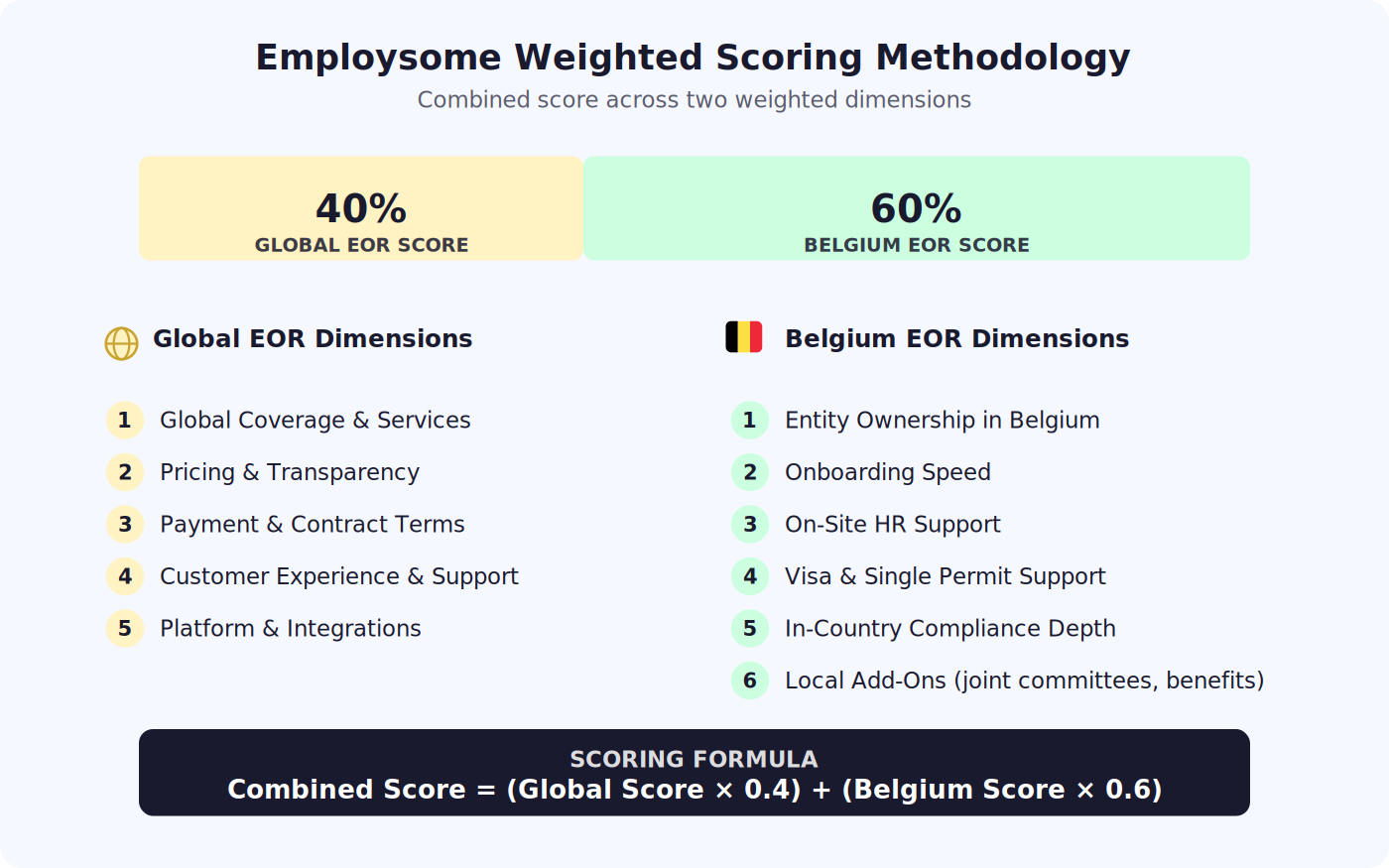
Our Employer of Record Belgium ranking is built on a transparent, weighted methodology that reflects how Belgian compliance complexity actually drives buyer outcomes. Each provider receives two scores: a Global EOR score capturing platform breadth, pricing transparency, contract terms, customer experience, and integrations across all markets, and a Belgium EOR score capturing the country-specific factors that matter most in this market — directly-owned Belgian entity, onboarding speed under the Dimona declaration system, on-site HR support depth, Single Permit immigration execution across Flanders, Wallonia, and Brussels-Capital, in-country compliance across the approximately 180 joint committees, and Belgium-specific add-ons including supplementary pension and meal voucher administration.
The Belgium EOR score carries a 60 percent weighting in the final ranking because Belgian execution depth is the primary buying criterion in this market: a polished global platform that handles Belgian joint committee classification poorly will produce worse outcomes than a less-polished provider with native Belgian compliance expertise. The Global EOR score carries a 40 percent weighting because platform consistency, pricing transparency, and integration depth still matter for multi-country deployments.
Hiring in Belgium with an Employer of Record (EOR): What You Need to Know
Hiring in Belgium gives companies access to one of Western Europe’s most highly skilled, multilingual, and EU-integrated labour markets. With Brussels at the heart of European Union institutions, Antwerp anchoring one of Europe’s largest port and logistics ecosystems, and a fast-growing technology and biotech corridor running from Ghent to Leuven, Belgium has become a preferred hiring destination for international companies expanding into Western Europe.
At the same time, employment law in Belgium is formal, structured, and strongly employee-protective. Employers must follow strict rules regarding written contracts, language of region, working time tracking, joint committee classification, payroll contributions, holiday allowance calculations, sick leave compensation, and termination procedures under the Single Status framework. Non-compliance can result in administrative penalties from the Federal Public Service Employment, Labour and Social Dialogue, RSZ/ONSS back-payment claims, or in the case of wrongful dismissal, court-ordered compensation that can run into many months of salary.
This guide explains how to hire employees in Belgium in 2026 and what foreign employers need to understand before entering the market. If you need more details, visit our Full Belgium Hiring Guide for 2026.
Employment Law in Belgium
Employment relationships are governed primarily by the Loi du 3 juillet 1978 relative aux contrats de travail (Wet betreffende de arbeidsovereenkomsten), supplemented by the Single Status framework introduced by the Law of 26 December 2013, the Loi du 24 juillet 1987 on temporary work and labour leasing, and approximately 180 sector-specific collective bargaining agreements established by joint committees (paritair comité / commission paritaire). These laws apply to both local Belgian companies and foreign businesses hiring through an Employer of Record in Belgium.
Belgian labour law is predictable but formal and one of the most employee-protective in the European Union. There is no concept of “at-will employment” as seen in the United States. Outside the very first months of employment, termination requires either a notice period calculated under the Single Status formula or payment in lieu of notice. Documentation is essential, and written agreements are mandatory for nearly every stage of the employment lifecycle.
The law covers working time limits, overtime compensation, annual leave with the distinctive double holiday allowance, the 10 federal public holidays, sick pay through the 30-day guaranteed salary period, parental leave, termination protection, notice periods, and the rules governing payment in lieu of notice. Employers are expected to maintain proper payroll documentation, working time records, and Dimona declarations for every employee with RSZ/ONSS.
A distinctive feature of Belgian employment law is the binding force of joint committee CBAs. Each industry sector falls under a specific joint committee, and the CBAs concluded within that committee establish minimum wages, working time arrangements, end-of-year bonuses, eco-cheques, meal vouchers, supplementary pensions, and many other terms. Joint committee CBAs override individual employment contracts on most material terms, and incorrect joint committee classification is a frequent source of compliance failures for foreign employers and inexperienced EOR providers.
Employment Contracts in Belgium
A written employment contract is mandatory in Belgium for fixed-term, part-time, replacement, and student contracts. While indefinite full-time contracts can technically exist orally, in practice all serious employment relationships are documented in writing, and the absence of a written contract creates significant evidentiary risk.
Contracts must be drafted in the official language of the employee’s region of work. This is one of Belgium’s most distinctive compliance requirements:
-
Flanders: Dutch only
-
Wallonia: French only (or German in the East Cantons)
-
Brussels-Capital: Dutch or French depending on the employer’s language regime
A contract drafted in the wrong language is null and void on the employee’s side, meaning the employee can invoke its terms but the employer cannot rely on them. Bilingual or English-only contracts are not legally valid as the binding contract.
The contract must include:
-
Parties to the contract
-
Job title and description
-
Place of work
-
Start date
-
Gross salary and pay frequency
-
Working hours and schedule
-
Applicable joint committee
-
Entitlements under sectoral CBAs
Indefinite contracts are the standard hiring model in Belgium. These contracts have no predefined end date and provide long-term employment stability. Fixed-term contracts are permitted but tightly regulated. Successive fixed-term contracts may be concluded only under specific conditions, and chains of fixed-term contracts can be re-qualified as indefinite by the labour court if abused. For most long-term hires, especially skilled professionals and senior managers, indefinite employment agreements are the safest and most common approach.
Probation Period Rules
One of Belgium’s most distinctive features in the European context is that the probation period was abolished in 2014 with the introduction of the Single Status. Indefinite employment contracts in Belgium no longer have probation periods.
In place of probation, the Single Status introduced very short statutory notice periods during the early months of employment. During the first three months of indefinite employment, notice can be as short as one to two weeks; after six months it rises to three weeks; after one year it becomes seven weeks. This effectively replaces the protective function of probation by giving both parties limited but real flexibility to end the relationship in the early period without lengthy notice.
Foreign employers accustomed to long probation periods (six months in Germany, four months in the Czech Republic, three months in France) frequently misunderstand this point. There is no Belgian probation period to negotiate, and any reference to one in a contract is unenforceable. The Single Status notice scale is the only mechanism that operates in the early employment period.
Working Hours and Overtime
Standard Working Hours
The standard full-time working schedule in Belgium is:
-
38 hours per week (statutory standard, often reduced by joint committee CBAs to 37 or 36 hours)
-
Maximum 8 hours per day
-
Maximum 40 hours per week absolute ceiling
Employers must define start and end times in the work regulations (règlement de travail / arbeidsreglement), which is a separate mandatory document filed with the labour inspectorate, and track working hours.
Overtime
Overtime in Belgium is permitted only under specific legal grounds, typically for unforeseen necessity, exceptional workload, or work that cannot be interrupted. Most overtime is subject to prior consultation with the works council or, where applicable, prior authorisation from the labour inspectorate.
Rules include:
-
Overtime is compensated at 150% of normal salary on weekdays
-
Overtime is compensated at 200% on Sundays and public holidays
-
Employees are entitled to compensatory rest in addition to overtime pay
-
The annual voluntary overtime quota is generally 100 to 120 hours, varying by sector
Weekend and Night Work
Sunday work is in principle prohibited and permitted only in specific sectors (healthcare, hospitality, retail under specific licences). Night work (8 PM to 6 AM) requires specific authorisation and additional compensation, typically defined in the joint committee CBA.
For companies running shift-based operations, compliance with working time rules and joint committee provisions is essential.
Minimum Wage in Belgium (Updated)
The national minimum wage in Belgium, known as the Guaranteed Average Minimum Monthly Income (Revenu Minimum Mensuel Moyen Garanti / Gewaarborgd Gemiddeld Minimum Maandinkomen, or RMMMG/GGMMI), applies to employees aged 18 and above working full-time. As of 1 January 2026, the GMMI is approximately €2,070 per month for employees aged 18 and over. There is no separate hourly minimum wage; the floor is set on a monthly basis. The GMMI is automatically indexed when the consumer price index crosses a defined threshold, which means it can rise multiple times within a year during high-inflation periods.
More importantly, the national GMMI is rarely the binding floor in practice. Joint committee CBAs establish sector-specific minimum wages that are typically materially higher than the national GMMI. Tech, finance, consulting, chemicals, and pharmaceuticals all operate under joint committees with sectoral floors well above €2,500 per month for entry-level roles, and market wages for skilled professionals in Brussels, Antwerp, and Ghent are significantly higher again. The competition for software engineers, finance professionals, lawyers, consultants, and senior managers drives salaries well above any sectoral floor.
Employers pay approximately 25 to 27 percent on top of gross salary in mandatory employer social security contributions to RSZ/ONSS. In addition, the double holiday allowance (double pécule de vacances / dubbel vakantiegeld) is mandatory and equals approximately 92 percent of one month’s salary, paid annually. End-of-year bonuses (often referred to as the 13th month / 13e maand / 13ème mois) are mandatory in many joint committees and equal approximately one month’s salary. Salary is typically paid monthly at the end of the month. For a full breakdown of the 2026 rate, joint committee minimums, employer cost calculations, and income tax brackets, see our Minimum Wage in Belgium Guide.
 Employsome Insight: The national GMMI is rarely the binding floor in Belgium. Joint committee CBAs almost always set higher sector minimums, and senior roles in Brussels, Antwerp, and Ghent attract market salaries well above any statutory or sectoral floor. Always benchmark against the applicable joint committee, not the national GMMI.
Payroll Taxes and Social Security Contributions (Updated)
Understanding payroll taxes in Belgium is essential for accurate workforce budgeting. The difference between gross salary and total employer cost in Belgium is among the largest in Western Europe, and companies expanding through an Employer of Record in Belgium must account for statutory social security contributions, mandatory double holiday allowance, and sector-specific end-of-year bonuses on top of base compensation.
Employers contribute approximately 25 to 27 percent of gross salary to RSZ/ONSS. The base employer rate is 25 percent, with additional sector-specific contributions to occupational accident insurance, the Sectoral Training Fund, and the wage moderation contribution. The total employer rate sits between 25 and 27 percent depending on the sector. Employer contributions cover pension insurance, health insurance, unemployment insurance, occupational accident insurance, family allowances, annual holiday financing, and the structural reduction mechanism that lowers contributions for low-wage employees.
Employees also contribute 13.07 percent of gross salary to RSZ/ONSS, and personal income tax is withheld at source through the bédéfisc / bedrijfsvoorheffing system based on the employee’s family situation, dependents, and income tax bracket. The Belgian income tax system applies a progressive structure with four brackets, and surcharges from the municipality of residence (taxes communales / gemeentebelastingen) of typically 6 to 9 percent are added on top of the federal tax due.
Below is a clear breakdown of statutory contribution rates:
|
Category |
Contribution Type |
Rate |
|
Employer |
RSZ/ONSS Base Rate |
25.00% |
|
Employer |
Sector and Other Levies |
0–2% |
|
Employer Total |
Combined Burden |
25–27% |
|
Employee |
RSZ/ONSS Total |
13.07% |
|
Income Tax |
Up to €15,820 annually |
25% |
|
Income Tax |
€15,820 to €27,920 annually |
40% |
|
Income Tax |
€27,920 to €48,320 annually |
45% |
|
Income Tax |
Above €48,320 annually |
50% |
|
Municipal Surcharge |
On federal income tax due |
6–9% |
Income tax brackets are subject to annual indexation. The municipal surcharge varies by commune and is applied to the federal income tax due, not on gross income. Brussels-Capital communes typically run at 6 to 7 percent, while certain Walloon and Flemish communes can reach 8 to 9 percent.
Beyond statutory contributions, employers must budget for the mandatory double holiday allowance (double pécule de vacances) of approximately 92 percent of one month’s salary paid annually in May or June, the sector-specific end-of-year bonus equal to roughly one month’s salary in many joint committees, mandatory meal vouchers (chèques-repas / maaltijdcheques) in most sectors, eco-cheques (éco-chèques / eco-cheques) in many CBAs, and supplementary pension contributions (the deuxième pilier / tweede pijler) where established by the joint committee.
For companies using an Employer of Record in Belgium, the EOR manages all calculations, filings, statutory registrations through the Dimona declaration system, and remittances to RSZ/ONSS and the tax authority. While the Belgian payroll system is structured and predictable once correctly set up, errors in joint committee classification, double holiday calculations, or municipal surcharge handling can result in administrative penalties or RSZ/ONSS back-payment claims.
As a practical budgeting rule, employers should assume total employment cost in Belgium equals approximately 145 to 155 percent of gross salary once the employer social contributions, double holiday allowance, end-of-year bonus, meal vouchers, and supplementary pension are all accounted for. This is before any Employer of Record service fee or voluntary benefits are added.
Employsome Insight: Belgian total employment cost is among the highest in the EU once double holiday allowance, end-of-year bonus, and sectoral benefits are included. Foreign employers benchmarking against France or Germany should expect Belgium to land at the top end of Western European cost ranges. The headline employer social rate is moderate, but mandatory benefits push the total well above 145 percent of gross.
Annual Leave and Public Holidays
Employees in Belgium are entitled to:
-
20 days of paid annual leave per year (statutory minimum, based on the prior year of work)
-
10 federal public holidays per year
-
Additional sector-specific holidays under many joint committee CBAs (typically 1 to 5 extra days)
Annual leave entitlement in Belgium operates on a deferred accrual basis: leave taken in any given year is earned during the previous calendar year. New hires therefore have limited annual leave entitlement during their first calendar year and accrue full entitlement only from the second year. This is one of the most consistent points of confusion for foreign employers and one that EOR providers must explain clearly to incoming employees.
The distinctive Belgian feature is the double holiday allowance (double pécule de vacances / dubbel vakantiegeld). In addition to the regular salary paid during annual leave, employees receive an extra allowance of approximately 92 percent of one month’s salary, paid annually in May or June. This is a mandatory employer cost on top of the gross salary and standard holiday pay.
If a public holiday falls on a weekend, employers must grant a replacement day (jour de remplacement / vervangingsdag), determined either by joint committee CBA or by company-level agreement filed with the labour inspectorate.
Employsome Insight: Belgian annual leave is calculated on the previous year’s work. New hires from abroad often expect immediate full leave entitlement and are surprised by the deferred accrual mechanism. Many employers offer European-leave style top-ups in the first year to bridge the gap and remain competitive with other Western European employers.
Sick Leave and Employer Exposure in Belgium
Sick leave in Belgium is structured around the guaranteed salary period (salaire garanti / gewaarborgd loon), one of the most distinctive features of Belgian employment law. Compared to many EU jurisdictions, employer financial exposure during sick leave is meaningful, although administratively well-defined.
When a white-collar employee becomes temporarily unfit for work, the first 30 calendar days of illness are paid by the employer at 100 percent of normal salary. This is the guaranteed salary period for white-collar (employé / bediende) employees. For blue-collar (ouvrier / arbeider) employees, the first 7 days are paid at 100 percent, followed by a percentage scale defined by the Loi du 3 juillet 1978 and the relevant joint committee CBA.
From day 31 onward (white-collar) or day 15 onward (blue-collar), sickness benefits are paid by the employee’s mutual health insurance fund (mutuelle / mutualiteit) under the framework administered by INAMI/RIZIV (the National Institute for Health and Disability Insurance). The replacement rate from the mutual fund is typically 60 percent of capped salary for the first year of incapacity, decreasing thereafter. Long-term incapacity may continue for many years under the invalidity (invalidité / invaliditeit) framework.
For employers, this structure means:
-
Direct salary exposure is 30 days for white-collar staff (versus 14 days at 60 percent in the Czech Republic and 6 weeks at 100 percent in Germany)
-
Blue-collar exposure is shorter on the headline 100 percent period but extends through a percentage tail before mutual fund coverage begins
-
Long-term illness shifts the financial burden to the public mutual insurance system
However, the employer must still:
-
Process payroll adjustments correctly during the guaranteed salary period
-
Receive and verify the medical certificate (certificat médical / medisch getuigschrift)
-
Maintain proper working time and absence records
-
Coordinate the return-to-work process and any reintegration trajectory (trajet de réintégration / re-integratietraject) for long-term absences
Many Belgian employers offer supplementary group hospitalisation insurance and incapacity top-up coverage as part of competitive benefits packages, particularly in joint committees covering professional services, finance, and technology sectors. These benefits are not strictly mandatory under federal law but are widely expected and often established by the relevant joint committee CBA.
Annual leave generally continues to accrue during short-term sickness. In cases of extended absence, leave entitlement may be proportionally reduced depending on total days not worked, subject to the rules in the applicable joint committee.
Employsome Insight: Belgian sick leave creates more employer exposure than the Czech or Polish models but less than Germany’s six-week full-pay obligation. The 30-day guaranteed salary period for white-collar staff means employers should budget for at least one full month of sick pay risk for each employee. The real complexity is the white-collar versus blue-collar distinction and the joint committee variations that overlay the federal framework.
Work From Home and Remote Hiring
Remote work in Belgium is regulated by the National Collective Bargaining Agreement No. 85 (CCT 85) on telework and the Loi du 5 mars 2017 on workable and flexible work, supplemented by joint committee CBAs and the company’s work regulations. Structural telework requires a written agreement, either as part of the employment contract or as a separate addendum.
Employers must reimburse home office expenses through one of three mechanisms: a flat-rate allowance (the most common, currently around €150 per month per the federal tax rulings), actual cost reimbursement on receipts, or a combination. Equipment costs (computer, monitor, internet connection) are typically covered separately by the employer either in cash allowance or by direct provision.
Employers must clarify:
-
Equipment provision and reimbursement structure
-
Health and safety compliance for the home workplace
-
Data protection under GDPR and the federal labour code
-
Right-to-disconnect framework (deconnexion / deconnectie), required by company policy or CBA for employers above 20 employees
Employsome Insight: Remote employment does not eliminate Belgian employer liability. Health and safety obligations apply to the home workplace under CCT 85, and the right-to-disconnect framework is mandatory for employers above 20 employees. EOR providers should have the home office allowance and equipment reimbursement structure built into their standard Belgian package.
Termination of Employment
Termination of indefinite employment in Belgium operates under the Single Status (statut unique) introduced in 2014, which unified the rules previously applicable separately to white-collar and blue-collar employees. The Single Status produces some of the longest notice periods in Western Europe for long-tenured employees and is one of the most consequential elements of Belgian employment law for foreign employers.
Mutual agreement (rupture conventionnelle / minnelijke beëindiging) is the most straightforward termination method. Both parties agree to end the employment relationship on specified terms, typically with a negotiated departure package. This approach avoids disputes and minimises legal risk.
Employer-initiated dismissal does not require statutory grounds (Belgium does not have a closed list of valid termination reasons), but the employer must serve notice or pay in lieu of notice calculated under the Single Status formula. Notice runs in weeks and scales with tenure: very short during the first months of employment (1 to 2 weeks during the first 3 months, rising to 7 weeks at one year, 12 weeks at three years, and continuing to scale upward). For very long-tenured employees, notice can reach more than 60 weeks.
Unlike many Western European jurisdictions, Belgium has no statutory severance pay separate from notice. Severance in the Belgian sense is the indemnity paid in lieu of notice (indemnité de préavis / verbrekingsvergoeding), calculated on the same scale as notice itself. For senior employees with long tenure, this can amount to a year or more of total remuneration.
Dismissal must be communicated in writing through registered letter (pli recommandé / aangetekende brief) or court bailiff service. Procedural errors in the dismissal letter can extend the notice period or render the dismissal abusive (licenciement manifestement déraisonnable / kennelijk onredelijk ontslag), which entitles the employee to additional compensation of 3 to 17 weeks’ salary on top of the standard notice.
Additional protection applies to specific employee categories: pregnant employees, employees on parental leave, employee representatives on the works council or health and safety committee, employees who have filed harassment complaints, and others. Termination of protected employees requires either statutory grounds, court approval, or significant additional indemnity.
Employsome Insight: Belgian termination cost scales steeply with tenure under the Single Status. A senior employee with 10+ years of service can require notice or payment in lieu equivalent to 30+ weeks of total remuneration, and abusive dismissal claims can add a further 3 to 17 weeks. Foreign employers should budget conservatively for termination scenarios and engage local counsel before initiating any dismissal of a long-tenured employee.
Hiring Without a Belgian Entity – Employer of Record Option
If you want to hire employees in Belgium without opening a local SRL/BV (limited company), branch office, or representative office, you can use an Employer of Record (EOR).
An EOR:
-
Acts as the legal employer under Belgian law
-
Handles RSZ/ONSS payroll and tax filings through the Dimona system
-
Manages occupational health enrolment with an external prevention service
-
Ensures compliance with the Loi du 3 juillet 1978 and the applicable joint committee CBA
-
Issues compliant Dutch-, French-, or German-language contracts depending on the employee’s region of work
-
Administers the double holiday allowance, end-of-year bonus, meal vouchers, and other sectoral benefits
This is particularly useful if:
-
You are testing the Belgian or Western European market
-
Hiring 1–5 employees in Belgium
-
Expanding into Western Europe with EU-headquartered talent
-
Avoiding the cost and time of Belgian entity setup, accounting, and legal advisory
Employsome Insight: For companies hiring fewer than five employees in Belgium, EOR is consistently cheaper than local entity setup once accounting (€8,000–15,000 per year), legal advisory, and the time cost of incorporation, RSZ registration, joint committee allocation, and external prevention service contracting are all included. Belgian entity setup is one of the more administratively involved processes in the EU and rarely makes sense below 5–10 local employees.
Final Verdict: Best Employer of Record in Belgium
After weighing all 10 Employer of Record Belgium providers across our combined scoring methodology, four stand out as the clearest picks for distinct buyer profiles. Each delivers compliant Belgian EOR execution under the Loi du 3 juillet 1978 and the Loi du 24 juillet 1987 framework, with directly-owned or natively-licensed Belgian infrastructure, but they serve genuinely different needs.
1. Multiplier — Best Overall Belgium EOR
Multiplier is the strongest all-round Employer of Record Belgium provider for 2026. The combination of a directly-owned Belgian entity, fast Dimona registration, accurate joint committee classification for mainstream sectors, language-of-region contract drafting, and competitive pricing makes Multiplier the clearest first choice for scale-ups and mid-market companies hiring 1 to 20 standard full-time employees in Belgium. Onboarding for EU nationals is consistently delivered in 3 to 5 business days, and the platform handles double holiday allowance, end-of-year bonus, and meal voucher administration without manual client intervention.
2. Remote — Best for Direct Entity Ownership and Pricing Transparency
Remote operates through its own Belgian legal entity with one of the most transparent pricing models in the EOR market. For mid-market and enterprise companies that prioritise structural compliance alignment with the Loi du 24 juillet 1987 limitations on third-party labour leasing, plus published rates and predictable FX handling, Remote is one of the strongest Belgium EOR options. Single Permit and EU Blue Card sponsorship across all three Belgian regions is well-supported, and the platform handles the Single Status notice calculation correctly across the full tenure scale including the 60+ week long-tenure scenarios.
3. SD Worx — Best Belgian-Native Execution
SD Worx is a category of its own. Founded in Antwerp in 1945 with native Belgian roots, SD Worx delivers full coverage of all approximately 180 joint committees, native-language contract drafting in Dutch, French, and German, and the deepest Belgian compliance execution in the market. For companies building substantial Belgian operations, hiring in complex or regulated joint committee sectors, employing blue-collar workforces, or sponsoring volume non-EU specialist hires across multiple Belgian regions, SD Worx is the specialist’s specialist. The trade-off is the engagement model — account-management-led, margin-on-total-employment-cost pricing, less self-service — which suits substantial Belgian deployments rather than transactional global remote hiring.
4. Workwell — Best for Non-Mainstream Sectors and Blue-Collar Workforces
Workwell is genuinely differentiated for Belgian sectors that other global EORs handle thinly. The firm covers construction (multiple paritair comités), manufacturing, healthcare, transport, and regulated services with native joint committee expertise, and handles the white-collar versus blue-collar distinctions in sick leave compensation and notice rules with practical sectoral experience. For companies hiring in non-mainstream Belgian joint committees or employing blue-collar workforces where joint committee depth matters more than platform polish, Workwell is the right choice.
Frequently Asked Questions (FAQs) about EOR in Belgium
An Employer of Record (EOR) in Belgium is a third-party company that legally employs workers on your behalf under Belgian law. The EOR becomes the official employer of record with Belgian authorities, registering the employee with RSZ/ONSS through the Dimona declaration system, enrolling with an external occupational health prevention service, issuing a compliant Dutch-, French-, or German-language employment contract under the Loi du 3 juillet 1978 (Employment Contracts Act), classifying the employee under the correct joint committee (paritair comité / commission paritaire), processing monthly payroll in EUR, withholding income tax through the bédéfisc/bedrijfsvoorheffing system, administering the mandatory double holiday allowance and any sectoral end-of-year bonus, and handling compliant termination if required.
Your company directs the employee’s day-to-day work, while the EOR carries full legal employer responsibility. This allows foreign companies to hire in Belgium without registering a local entity such as an SRL/BV or SA/NV.
Yes. Under Belgian law, a foreign company must either establish a local legal entity or use an Employer of Record provider holding the appropriate compliance structure to hire employees compliantly.
Hiring a Belgian national directly from abroad without a local entity or EOR exposes your company to significant legal risk, including fines from the Federal Public Service Employment, Labour and Social Dialogue (FOD WASO / SPF Emploi), back-payment of RSZ/ONSS social security contributions and accumulated double holiday allowance, and potential misclassification penalties under Belgium’s strict false self-employment doctrine. An EOR removes this risk by acting as the legal employer in your place.
In Belgium, EOR services operate under one of several frameworks because pure third-party employment leasing is materially restricted by the Loi du 24 juillet 1987 on temporary work and labour leasing. Most international EOR providers operate through one of these structures: a directly-owned Belgian legal entity (SRL/BV or SA/NV) employing the worker on a standard Loi du 3 juillet 1978 employment contract; a Federgon-registered interim agency licence under the temporary work framework; or a payroll partner arrangement with a licensed Belgian employer.
The structure typically involves three parties:
-
The EOR or its Belgian licensed entity, acting as the legal employer
-
The employee under contract with the EOR
-
The client company directing the work
The client has no direct employment contract with the worker. All formal employment actions, including issuing contracts, processing payroll, joint committee classification, and managing terminations, must go through the EOR.
The total employer cost in Belgium is significantly higher than the gross salary alone and among the highest in the European Union. Employers must contribute approximately 25 to 27 percent of gross salary to RSZ/ONSS social security.
Income tax is withheld from the employee’s gross salary at progressive rates of 25, 40, 45, and 50 percent depending on the bracket, with municipal surcharges of 6 to 9 percent applied on top of the federal tax due.
Employees are entitled to 20 days of paid annual leave per year, the mandatory double holiday allowance equal to approximately 92 percent of one month’s salary paid annually, sector-specific end-of-year bonuses (typically one month of salary in many joint committees), meal vouchers (chèques-repas / maaltijdcheques) in most CBAs, eco-cheques in many sectors, and the 30-day employer-paid guaranteed salary period for sick leave (white-collar) or 7-day plus percentage tail (blue-collar).
When budgeting for a Belgian hire, a total employment cost of approximately 145 to 155 percent of gross salary is a reliable working estimate before any EOR service fee.
For EU and EEA nationals, a well-structured EOR can typically complete onboarding in three to seven business days. This includes Dutch-, French-, or German-language contract issuance based on region of work, RSZ/ONSS registration via the Dimona declaration on or before the first day of work, occupational health enrolment with an external prevention service, joint committee classification, and payroll setup.
For non-EU nationals requiring a Single Permit (combiné / gecombineerde vergunning) or EU Blue Card, the process is significantly longer. The Single Permit is issued jointly by the regional employment authority (Flemish, Walloon, or Brussels-Capital depending on the place of work) and the federal Office des Étrangers / Dienst Vreemdelingenzaken. Standard processing time is 60 to 120 days from complete application submission.
Companies hiring non-EU nationals should plan for a three to four month lead time for full immigration and onboarding completion, longer for highly regulated sectors or sponsorship across multiple regions.
The Belgian Single Permit (combiné / gecombineerde vergunning) is the primary work and residence permit for non-EU nationals seeking long-term employment in Belgium. It combines both the right to work and the right to live in a single document. The Single Permit application is processed jointly by the regional employment authority that issues the work authorisation component and the federal Office des Étrangers / Dienst Vreemdelingenzaken that issues the residence component.
Depending on the employee’s place of work, the regional authority is the VDAB / Flemish Department of Work and Social Economy (Flanders), Le Forem / Walloon Public Employment Service (Wallonia), or Brussels Economy and Employment (Brussels-Capital). The regions have somewhat different processes and salary thresholds.
A Belgian EOR can act as the sponsoring employer of record, handling the application file in the appropriate region, contract issuance, and documentation coordination. Standard processing typically takes 60 to 120 days from complete application.
A joint committee (paritair comité in Dutch / commission paritaire in French) is a sector-specific industrial relations body that establishes collective bargaining agreements (CBAs) for all employers and employees within that sector. Belgium has approximately 180 joint committees covering virtually every economic sector.
CBAs concluded within a joint committee are legally binding on all employers and employees in that sector, regardless of whether they are parties to the negotiation. Joint committee CBAs override individual employment contracts on minimum wages, working time, end-of-year bonuses, eco-cheques, meal vouchers, supplementary pensions, sick leave compensation tails, and many other terms.
Accurate joint committee classification is one of the most important steps in Belgian payroll setup and is a frequent source of compliance failures for foreign employers and inexperienced EOR providers. Each company must determine its applicable joint committee based on its primary economic activity, and all employees in that company are typically subject to the same joint committee.
Yes. An EOR can act as the sponsoring employer for an EU Blue Card in Belgium, provided eligibility criteria are met. The position must require a university-level qualification or equivalent professional experience, and the salary must exceed 1.5 times the average gross annual salary in Belgium (approximately €63,500 to €68,000 in 2026, depending on the region).
The EOR submits the application to the appropriate regional employment authority depending on the employee’s place of work, issues the employment contract, and coordinates documentation with the federal Office des Étrangers. Not all EOR providers offer full immigration execution in all three regions, so companies hiring non-EU professionals regularly across Belgium should confirm regional immigration capabilities in advance.
Belgian termination law operates under the Single Status (statut unique) introduced in 2014. Unlike many European jurisdictions, Belgium does not require statutory grounds for termination of indefinite contracts (no closed list of valid reasons), but the employer must serve notice or pay an indemnity in lieu of notice, calculated under the Single Status formula.
Notice runs in weeks and scales with tenure. During the first three months, notice can be 1 to 2 weeks; at 6 months, 3 weeks; at 1 year, 7 weeks; at 3 years, 12 weeks; and continuing to scale upward. For very long-tenured employees, notice can exceed 60 weeks.
Dismissal must be communicated in writing through registered letter or court bailiff service. Procedural errors or insufficient justification can render the dismissal abusive (licenciement manifestement déraisonnable / kennelijk onredelijk ontslag), which entitles the employee to additional compensation of 3 to 17 weeks’ salary on top of the standard notice.
An EOR handles notice calculation under the Single Status, dismissal letter drafting in the appropriate language, RSZ/ONSS deregistration, and final pay calculation including any pro-rata holiday allowance and end-of-year bonus.
EOR pricing in Belgium varies by provider model.
Global EOR platforms typically charge a flat monthly fee per employee. Mid-market providers often range between 500 and 800 USD per employee per month, slightly higher than in Central Europe given Belgian compliance complexity. Belgian payroll and HR services firms charge a margin on total employment cost, often between 15 and 30 percent depending on role type and joint committee. Payroll outsourcing firms charge lower per-employee fees but require the company to have its own Belgian entity.
All EOR fees are in addition to gross salary, mandatory employer contributions, double holiday allowance, end-of-year bonus, and sectoral benefits.
Yes, but with structural caveats. Pure third-party employment leasing is materially restricted under the Loi du 24 juillet 1987 on temporary work and labour leasing. EOR services in Belgium are typically structured through one of several legal pathways: direct employment via the EOR’s own Belgian legal entity, employment via a Federgon-registered interim agency licence, or employment via a licensed payroll partner.
Employees employed through a licensed Belgian EOR receive the same protections as direct employees of equivalent Belgian employers, including coverage under the relevant joint committee CBA, the Single Status notice regime, double holiday allowance, and all other statutory entitlements.
Given the structural restrictions, it is particularly important in Belgium to verify the specific compliance structure of any EOR provider before engagement and to ensure that the structure aligns with the Loi du 24 juillet 1987 limitations.
Employees in Belgium are entitled to 20 days of paid annual leave per year (with deferred accrual), 10 federal public holidays, statutory sick leave through the 30-day guaranteed salary period for white-collar staff, 15 weeks of maternity leave, 20 days of paternity leave, parental leave of up to 4 months, and the mandatory double holiday allowance of approximately 92 percent of one month’s salary paid annually.
Additional benefits established by joint committee CBAs in many sectors include: end-of-year bonuses (13e maand / 13ème mois), meal vouchers (chèques-repas / maaltijdcheques), eco-cheques (éco-chèques / eco-cheques), supplementary pension contributions (deuxième pilier / tweede pijler), group hospitalisation insurance, and mobility budget arrangements.
An EOR manages all statutory and sector-specific entitlements as part of the employment administration process and ensures full compliance with the applicable joint committee CBA.
Copywriter
Christa is a Copywriter at Employsome with 17 years of professional writing experience across global brands, startups, and online publications. A native English-Finnish writer, she brings strong editorial skills and a versatile background in business, SaaS, and finance. At Employsome, Christa focuses on clear, practical content about HR, payroll, and Employer of Record topics.
Our content is created for informational purposes only and is not intended to provide any legal, tax, accounting, or financial advice. Please obtain separate advice from industry-specific professionals who may better understand your business’s needs. Read our Editorial Guidelines for further information on how our content is created.