Minimum Wage in Belgium: The Complete 2026 Guide
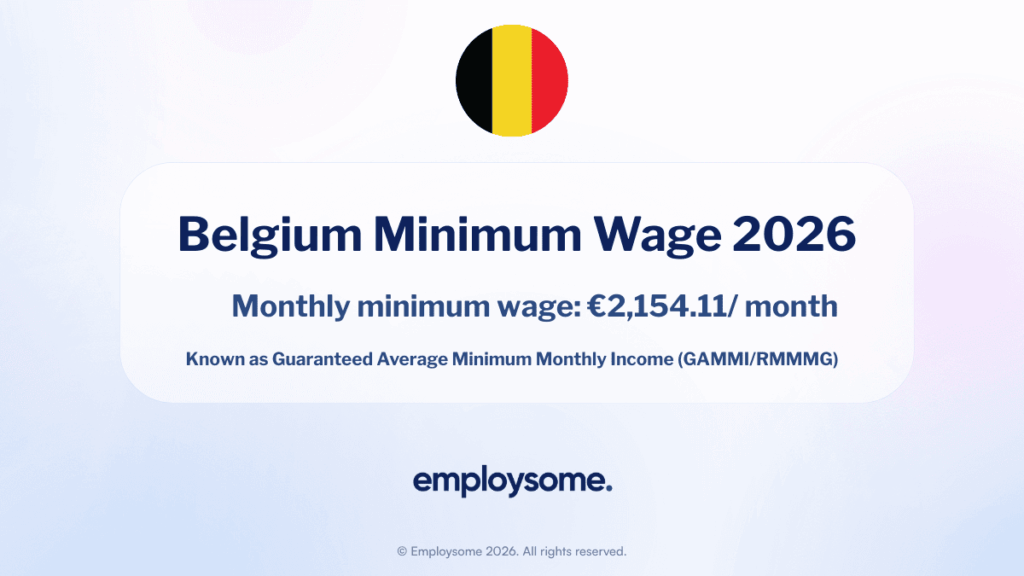
Belgium’s minimum wage (GAMMI) is €2,154.11 gross per month as of 1 January 2026, equivalent to approximately €13.08 per hour for a standard 38-hour working week. However, this national baseline applies to only around 3% of the workforce, with most employees covered by sectoral collective bargaining agreements (CBAs) that set minimum wages on average 19% higher. Belgium’s wage system is shaped by automatic indexation, one of the highest employer social security burdens in Europe (~27%), mandatory 13th-month and double holiday pay, and extensive sectoral regulation through Joint Committees. This guide covers current rates, automatic indexation, the 2026 indexation cap, employer contributions, working hours, leave entitlements, and what international companies hiring in Belgium need to know.


Minimum Wage in Belgium: Current Rates
Belgium’s minimum wage is officially known as the Guaranteed Average Minimum Monthly Income (GAMMI/RMMMG), established through Collective Agreement No. 43 negotiated within the National Labour Council (NAR/CNT). It applies to all private sector employees aged 18 and over with an employment contract.
|
Measure |
Rate (January 2026) |
|
Monthly gross (38-hour week) |
€2,154.11 |
|
Hourly gross |
~€13.08 |
|
Annual gross (12 months) |
~€25,849 |
|
Approximate net (single, no dependents) |
~€1,950 |
The GAMMI was last increased by a real (above-indexation) raise of €35 gross in May 2024. Two additional real increases of €35 are planned for 2026 and 2028. The government’s stated aim is to equate gross and net wages for minimum wage workers by supplementing gross increases with net top-ups.
Young Worker Rates
Workers under 21 are entitled to a percentage of the GAMMI based on age:
|
Age |
% of GAMMI |
|
20 years |
96% |
|
19 years |
92% |
|
18 years |
88% |
|
17 years |
76% |
|
16 years and under |
70% |
Belgium’s extensive collective bargaining system and Joint Committee wage scales position the country well for compliance with the incoming EU Pay Transparency Directive, which requires employers to provide salary range information to candidates and report on gender pay gaps. For a full overview of the Directive’s requirements and member state transposition timelines, see our EU Pay Transparency Directive guide.
💡 Employsome Insight: The GAMMI Is a Floor That Almost Nobody Actually Earns
Only about 3% of Belgian workers are paid the national GAMMI. The remaining 97% are covered by sectoral collective agreements negotiated through Belgium’s Joint Committee (Paritair Comité) system, which set sector-specific minimum wages averaging 19% above the GAMMI. For example, construction workers must be paid at least €18.19/hour, and cleaning sector workers at least €16.72/hour. International companies must identify which Joint Committee (JC) applies to their employees and pay the relevant sectoral minimum, not the GAMMI. The most common JC for office-based and commercial roles is JC 200 (Auxiliary Joint Committee for White-Collar Workers).
Automatic Wage Indexation
Belgium is one of the few countries in Europe that operates an automatic wage indexation system. When the consumer price index (measured through the ‘smoothed health index’) crosses a predetermined threshold (the ‘pivot index’), wages are automatically adjusted upward by 2%. This means Belgian wages rise with inflation without requiring individual negotiation or government intervention.
The indexation mechanism varies by sector. Some sectors index wages monthly, others quarterly, and some annually. JC 200 (the largest white-collar Joint Committee) applies annual indexation in January. The timing and frequency depend on the specific CBA governing each sector.
2026 Indexation Cap (Index in Money)
From 2026, the Belgian government is introducing a cap on wage indexation. Full indexation will apply up to a gross salary of €4,000 per month. For salaries above €4,000, the indexation amount will be reduced: only half of the normal additional indexation above the 2% threshold will be passed to the employee, with the other half retained as employer savings (and potentially subject to a government contribution). This measure is intended to moderate Belgium’s high labour costs while maintaining purchasing power for lower earners.
The exact implementation details are still being finalised and may vary by sector. International companies hiring in Belgium should monitor updates from the National Social Security Office (ONSS/RSZ) and their social secretariat.
Mandatory Employer Contributions
Belgium has one of the highest employer social security burdens in Europe. Employers contribute approximately 25% in basic contributions plus approximately 2–3% in additional sector-specific contributions, totalling around 27–28% of gross salary.
|
Contribution |
Rate |
|
Employer basic social security |
~25% of gross salary |
|
Additional employer contributions |
~2–3% (sector-dependent) |
|
Total employer social security |
~27–28% of gross salary |
|
Employee social security |
13.07% of gross salary |
|
Special social security contribution |
€9.30–€60.94/month (employee) |
From July 2025, employers are exempt from basic social security contributions on quarterly gross remuneration exceeding €85,000. This cap only applies to the ~25% basic employer contribution; other employer contributions and the 13.07% employee contribution remain payable on the full salary.
Total Employer Cost Example
For a minimum wage employee earning €2,154.11 gross per month:
|
Component |
Amount |
|
Gross monthly salary |
€2,154.11 |
|
Employer social security (~27%) |
~€581.61 |
|
Total monthly employer cost |
~€2,735.72 |
|
13th month (prorated monthly) |
~€179.51 |
|
Double holiday pay (prorated monthly) |
~€165.15 |
|
Estimated total annual employer cost |
~€36,970 |
When factoring in 13th-month pay, double holiday pay, meal vouchers, and social security contributions, employers should budget approximately 40–45% above the gross annual salary for total employment cost in Belgium. This makes Belgium one of the most expensive EU countries for employer payroll burden.
💡 Employsome Insight: Belgium’s Employer Costs Are Among the Highest in Europe
At approximately 27–28% employer social security plus mandatory 13th month and double holiday pay, Belgium’s total employer burden is comparable to France (~45% social security alone) and significantly higher than Germany (~20–21%), the Netherlands (~18–20%), or Romania (2.25%). International companies often underestimate Belgian employment costs because they focus on the gross salary figure without accounting for the substantial mandatory additions. An EOR provider in Belgium handles all contribution calculations, Joint Committee compliance, and social secretariat filings, which is particularly valuable given the system’s complexity.
Working Hours and Overtime
Working time in Belgium is governed by the Working Time Act and sector-specific CBAs:
- Standard working week: 38 hours (may be lower in some sectors based on CBA)
- Maximum daily working time: 9 hours (11 hours in shift work, 12 hours in continuous operations)
- Maximum weekly working time including overtime: 50 hours
- Voluntary overtime: Up to 120 hours per year with the employee’s written consent
- Mandatory rest: 15-minute break after 6 hours of work, 11 consecutive hours of daily rest, 35 hours (11 + 24) of uninterrupted weekly rest
Belgium’s 38-hour standard working week, 11-hour daily rest, and weekly rest requirements align with the EU Working Time Directive. For a full breakdown of how the Directive applies across EU member states, including opt-out rules and the 2019 ECJ time recording ruling, see our EU Working Time Directive 2026 guide.
Overtime Rates
- Weekdays and Saturdays: 150% of the normal hourly rate (50% premium)
- Sundays and public holidays: 200% of the normal hourly rate (100% premium)
Compensatory rest must generally be provided for overtime hours worked, in addition to the overtime premium. Probation periods have been abolished in Belgium since January 2014.
Mandatory Benefits and Leave Entitlements
13th Month and Double Holiday Pay
Most Belgian employees are entitled to a 13th-month salary (end-of-year premium), typically paid in December, and double holiday pay (approximately 92% of one month’s gross salary), typically paid in May or June when the employee takes their main vacation. Both are mandatory under most sectoral CBAs, including the widely applicable JC 200. These are prorated for employees who have not worked a full calendar year.
Annual Leave
Employees working a 38-hour, 5-day week are entitled to 20 working days of paid annual leave per year (24 days for a 6-day week). Leave entitlement is based on the previous year’s work. Unused leave cannot be carried over and must be taken within the calendar year, except in cases of illness, injury, or protected leave.
Other Leave
- Maternity leave: 15 weeks (17 weeks for multiple births), comprising up to 6 weeks prenatal and 9 weeks postnatal. Paid at 82% of salary through health insurance after the first 30 days at full pay.
- Paternity leave: 20 days within 4 months of birth. First 3 days paid by employer at full salary; remainder at 82% through health insurance.
- Sick leave: First 30 days paid by employer at 100% for white-collar workers. After 30 days, health insurance fund pays at 60% of salary (capped).
- Public holidays: 10 statutory public holidays per year. If a holiday falls on a weekend, employees receive a replacement day.
- Meal vouchers: Not mandatory but extremely common. From January 2026, the maximum value increases to €10 per working day (employer contribution up to €8.91, employee contribution €1.09). Meal vouchers are exempt from social security and income tax when structured correctly.
💡 Employsome Insight: Meal Vouchers Are a Baseline Expectation in Belgium
While not legally mandatory, meal vouchers (chèques repas) are offered by the vast majority of Belgian employers and are expected by employees. From 2026, the maximum value increases from €8 to €10 per working day. Because meal vouchers are exempt from social security contributions and income tax for both employer and employee, they represent one of the most tax-efficient forms of compensation in Belgium. International companies hiring through an EOR in Belgium should include meal vouchers in their compensation package to remain competitive in the labour market.
Penalties for Non-Compliance
Belgium enforces minimum wage compliance through the Federal Public Service Employment, Labour and Social Dialogue. Key penalties:
- Underpayment of wages: Administrative fines and potential criminal prosecution. Employers can face fines of €400–€4,000 per employee (multiplied by the social factor of 8, resulting in effective fines of €3,200–€32,000 per employee).
- Social security non-compliance: Late or incorrect ONSS/RSZ contributions attract interest and penalties. Persistent non-compliance can result in criminal sanctions.
- Misclassification: Incorrectly classifying employees as self-employed (false self-employment) carries significant penalties, including back-payment of all social contributions, taxes, and potential fines. Belgium’s Social Ruling Commission can reclassify working relationships.
- Joint Committee non-compliance: Failure to apply the correct sectoral CBA (including sectoral minimum wages, working conditions, and benefits) can result in back-pay claims, Labour Inspectorate sanctions, and employee disputes.
Belgium vs. Europe: Minimum Wage Comparison
|
Country |
Monthly Min. Wage |
Employer Burden |
Indexation |
|
Belgium |
€2,154 |
~27–28% |
Automatic |
|
€2,054 |
~20–21% |
Political decision |
|
|
€1,802 |
~45% |
Annual (indexed to CPI) |
|
|
Netherlands |
€2,178 |
~18–20% |
Biannual |
|
€1,221 (x14) |
~30–32% |
Political decision |
|
|
Ireland |
€2,146 |
~11.25% PRSI |
Annual review |
Belgium’s minimum wage is among the highest in Europe, comparable to Germany and the Netherlands. However, when combined with the ~27–28% employer social security, mandatory 13th month, double holiday pay, and meal vouchers, Belgium’s total cost of employment for a minimum wage worker is among the highest in the EU. Only France and Luxembourg consistently exceed Belgium in total employer burden.
What International Companies Need to Know
- Identify the correct Joint Committee first. The Joint Committee (Paritair Comité) determines the applicable CBA, sectoral minimum wage, working conditions, 13th-month rules, and indexation timing. Most office-based and commercial roles fall under JC 200. The wrong JC classification creates compliance risk across every aspect of the employment relationship.
- Budget for total cost, not gross salary. Employer social security (~27–28%), 13th-month pay, double holiday pay, and meal vouchers mean total employment cost is 40–45% above the annual gross salary. International companies accustomed to lower-burden jurisdictions should adjust their Belgian compensation budgets accordingly.
- Automatic indexation means salaries rise annually. Unlike most countries where salary increases require negotiation, Belgian wages increase automatically with inflation. Employers must apply indexation as it occurs or face non-compliance. Budget for annual salary growth of 2–4% even without individual raises or promotions.
- Termination is expensive. Belgium has no probation periods and notice periods are based on seniority, starting at several weeks and extending to months or even over a year for long-tenured employees. Severance in lieu of notice is common and costly. International companies should factor termination costs into their hiring decision.
- Using an Employer of Record (EOR) is essential for international companies without a Belgian entity. Belgium’s Joint Committee system, automatic indexation, social secretariat requirements, and complex payroll regulations (ONSS/RSZ filings, DmfA declarations) make self-administered employment extremely difficult without local expertise. An EOR handles Joint Committee classification, payroll, social security, 13th-month and holiday pay calculations, meal vouchers, and all statutory filings.
Final Takeaway: Minimum Wage in Belgium 2026
Belgium’s minimum wage of €2,154.11 gross per month is among the highest in Europe, but it is only the starting point. The vast majority of employees are covered by sectoral CBAs that set higher minimums, and the automatic indexation system means wages rise with inflation without employer discretion. Planned real increases of €35 in 2026 and 2028 will push the GAMMI further upward.
For employers, Belgium is one of the most expensive and complex EU labour markets. The combination of ~27–28% employer social security, mandatory 13th-month salary, double holiday pay, meal vouchers, automatic indexation, and an intricate Joint Committee system creates total employment costs that are 40–45% above annual gross salary. There are no probation periods, notice periods are among the longest in Europe, and the social secretariat filing requirements are administratively demanding.
International companies hiring in Belgium without a local entity should work with an Employer of Record that has deep Belgian expertise, including correct Joint Committee classification, social secretariat registration, and familiarity with the indexation and 13th-month rules. Belgium rewards employers who get compliance right with access to a highly skilled, multilingual workforce in the heart of Europe, but the cost of getting it wrong is significant.

Written by
Dane Cobain is a Copywriter at Employsome and an accomplished author whose work spans fiction, non-fiction, and professional writing. Over the past decade, he has built a strong track record creating straightforward content for the HR, payroll, and corporate sectors. Dane brings a storyteller’s eye to the evolving world of global employment, with a particular focus on Employer of Record and PEO models. His articles explore industry trends and dedicated Best Of Guides when managing an international workforce.
Our content is created for informational purposes only and is not intended to provide any legal, tax, accounting, or financial advice. Please obtain separate advice from industry-specific professionals who may better understand your business’s needs. Read our Editorial Guidelines for further information on how our content is created.
Other posts
Review other blog posts