TUPE Explained: Transfer of Undertakings Guide (2026)
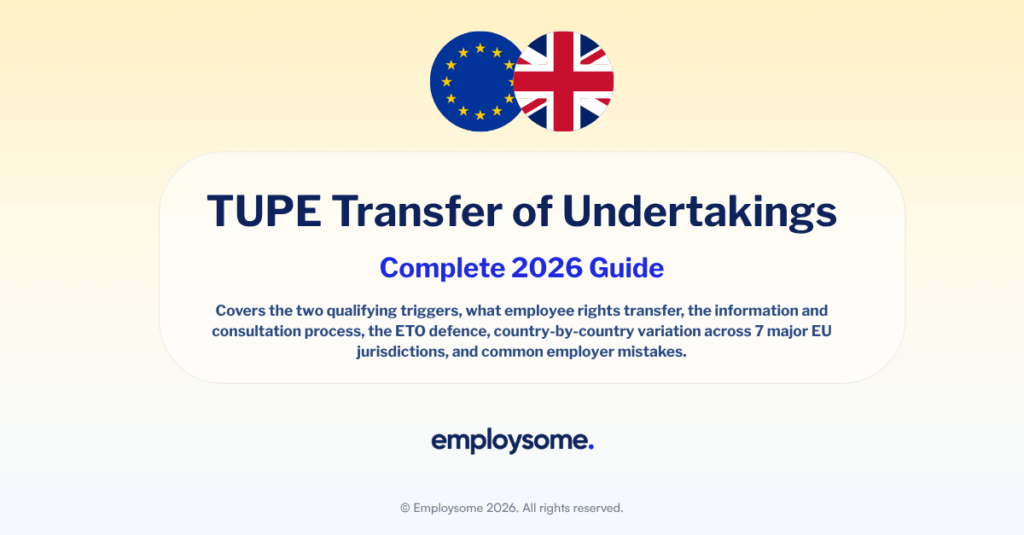
TUPE (Transfer of Undertakings, Protection of Employment) is the UK’s implementation of the EU Acquired Rights Directive 2001/23/EC, which protects employees when their business is sold, outsourced, insourced, or transferred to a new provider. This guide covers the two qualifying triggers, what employee rights transfer, the information and consultation process, the ETO defence, country-by-country variation across 7 major EU jurisdictions, and common employer mistakes.

TUPE (Transfer of Undertakings, Protection of Employment) is the UK’s implementation of the EU Acquired Rights Directive 2001/23/EC, which protects employees’ employment rights when the business they work for is transferred to a new owner or when the services they perform are outsourced, insourced, or moved to a different provider. Under TUPE, employees automatically transfer to the new employer on their existing terms, with continuous service preserved, contractual rights protected, and dismissal connected to the transfer rendered automatically unfair.
In practice, TUPE is one of the most consequential pieces of UK employment law for any business going through a sale, restructuring, outsourcing arrangement, or service contract change. The same principles, under different domestic statutes, apply across all EU member states through the Acquired Rights Directive. A transaction that looks straightforward on the corporate side, an asset sale, a facilities management contract change, an IT outsourcing deal, can trigger TUPE obligations that materially change the transaction’s cost, timeline, and post-completion structure. Getting TUPE wrong creates 13-week-pay-per-employee penalties, unfair dismissal claims, and joint and several liability between transferring parties.
This guide covers what TUPE actually is, the two qualifying triggers (business transfer and service provision change), what employee rights transfer to the new employer, the information and consultation obligations, the narrow ETO defence for dismissals connected to the transfer, how the rules work across major EU jurisdictions (UK, Ireland, France, Germany, Netherlands, Spain, Italy), and the common employer mistakes that turn TUPE compliance into tribunal exposure. International employers managing TUPE-type transfers across multiple EU countries can also use an Employer of Record to outsource the local compliance entirely.

What Is TUPE?
TUPE is shorthand for the Transfer of Undertakings (Protection of Employment) Regulations 2006, the UK statute that transposes the EU Acquired Rights Directive 2001/23/EC into UK domestic law. The regulations create a specific legal framework, set out in the TUPE regulations, for what happens to employees when the business or service they work for changes hands. Unlike most employment law, which sits between the employee and the employer, TUPE sits between two employers (the transferor and the transferee) and protects employees who are caught in the middle of the transition.
The core mechanic is automatic transfer. When a TUPE transfer occurs, the employees assigned to the transferring business or service automatically become employees of the new employer on the same terms and conditions they had with the old employer, with their continuous service preserved as if there had been no transfer at all. The transfer happens by operation of law, not by consent. Employees do not need to sign new contracts; the existing contract simply has the new employer’s name substituted as the employer party. Liabilities under those contracts (outstanding pay, accrued holiday, ongoing discrimination claims) transfer to the new employer along with the contracts themselves.
Three features distinguish TUPE from any other area of UK employment law. First, it is automatic: the transfer happens by operation of statute, not by negotiation. Second, dismissals connected to the transfer are automatically unfair, not just potentially unfair: the employer cannot reduce headcount in a TUPE-protected way without meeting the narrow ETO defence (covered later in this guide). Third, changes to terms and conditions that are connected to the transfer are void, not voidable: even if the employee signs a variation agreement, the variation may be unenforceable if the reason for it was the transfer itself.
The same principles, under different domestic statutes, apply across all 27 EU member states through the Acquired Rights Directive. The directive sets a minimum floor of protection that every member state must transpose, and individual countries can layer additional protections on top. The UK’s TUPE 2006 sits at the more protective end of the spectrum (particularly because of the Service Provision Change extension, covered in section 3), but every EU jurisdiction has its own version of TUPE-style protection.
💡 Employsome Insight: TUPE Failures Are Usually Diligence Failures, Not Procedural Failures
TUPE is one of the few areas of UK employment law where the diligence question matters as much as the procedural question. Before any acquisition or outsourcing transaction, a TUPE-aware diligence exercise needs to identify which employees will transfer, what terms transfer with them, what liabilities transfer alongside them, and what the costs of meaningful consultation will be. Most of the catastrophic TUPE failures we see in practice are not procedural mistakes after the deal; they are diligence failures before the deal. The deal economics get baked in before anyone has actually modelled the TUPE-transferring liabilities.
The Two TUPE Triggers: Business Transfer and Service Provision Change
TUPE applies to two distinct kinds of transaction, with overlapping but not identical legal tests. Understanding which trigger applies determines what consultation obligations kick in, what diligence is needed, and what the post-transaction structure looks like. The business transfer trigger comes from the original EU Acquired Rights Directive and applies across all EU member states; the service provision change trigger is a UK-specific extension introduced in 2006 and does not exist in most other EU jurisdictions.
- Asset sale of a manufacturing plant
- Sale of a division of a company
- Hive-down of a business unit before sale
- Acquisition of a going concern in administration
- Merger that preserves operating identity
- Initial outsourcing of cleaning services
- Re-tendering catering to a new contractor
- Bringing IT support back in-house
- Switching facilities management providers
- Local authority outsourcing waste collection
The business transfer test, under TUPE Regulation 3(1)(a), asks whether there has been a transfer of an economic entity that retains its identity. The classic fact pattern is the sale of a division or business unit on an asset basis (rather than a share sale, which generally does not trigger TUPE because the legal employer does not change). The economic entity must be more than just assets; it must be an organised grouping of resources with the objective of pursuing an economic activity, and that grouping must remain recognisable after the transfer.
The service provision change test, under TUPE Regulation 3(1)(b), is more mechanical. Three conditions must all be met: there must be an organised grouping of employees whose principal purpose is providing services to a client; the client must intend that the activities continue; and the activities must be carried out by a different provider after the change. SPC captures three transaction types: initial outsourcing (where work moves from in-house to a contractor), subsequent outsourcing (where work moves from one contractor to another), and insourcing (where work moves back from a contractor to the client).
An important caveat applies to SPC: the activities carried out before and after the change must be fundamentally the same. If the new contractor is providing a meaningfully different service, the SPC trigger does not apply, and the employees of the old provider have no right to transfer. UK tribunals have looked carefully at this in recent years, particularly where outsourcing arrangements have been restructured to avoid SPC by changing the service specification. Genuine changes survive scrutiny; cosmetic changes designed to defeat TUPE do not.
Service Provision Change: The UK-Specific Outsourcing Trigger
The service provision change trigger is where most modern UK TUPE disputes happen. Outsourcing, insourcing, and re-tendering of services are routine commercial activities, and the SPC trigger means each of them potentially carries TUPE consequences for the parties involved. The original Acquired Rights Directive did not cover service contracts directly; UK case law had built up an inconsistent body of decisions about whether outsourcing was a business transfer for TUPE purposes. The 2006 regulations resolved the inconsistency by introducing SPC as a parallel trigger.
SPC creates particularly counterintuitive commercial outcomes. A new contractor winning a competitive tender for, say, a hospital cleaning contract may find that they have inherited 200 employees from the previous contractor on terms set by the previous contractor, even though the new contractor priced the bid on the basis of their own workforce. Re-tendering exercises that are commercial wins on paper can become loss-making in practice if the bidder has not modelled the transferring workforce. For this reason, TUPE-aware tender exercises now routinely include an Employee Liability Information disclosure requirement (TUPE Regulation 11) under which the outgoing contractor must provide the new contractor with full workforce details at least 28 days before the transfer.
Three categories of services tend to fall outside SPC: services that are wholly or mainly for the supply of goods (where the goods, not the labour, are the principal output), services for a single specific event of short-term duration (where the contract is one-off rather than ongoing), and activities where the use of the new provider results in a fundamentally different service. The first two are statutory exclusions; the third is a tribunal judgment call. Outside these exclusions, almost any change of service provider where there is an organised grouping of dedicated employees triggers SPC.
SPC does not exist in the same form in most other EU jurisdictions. Ireland, France, Germany, the Netherlands, Spain, and Italy all transpose the underlying Acquired Rights Directive but generally limit TUPE-equivalent protection to business transfers in the original directive sense. Outsourcing and re-tendering arrangements in those jurisdictions may still trigger transfer protection where the test for “transfer of an economic entity” is satisfied, but the threshold is generally higher than the UK’s SPC rules. International employers exporting UK outsourcing practices to other EU countries often misjudge this and either over-comply (treating EU outsourcings as automatic TUPE transfers when they are not) or under-comply (assuming no transfer applies when the underlying business transfer test is in fact satisfied).
What Employee Rights Transfer Under TUPE
The whole point of TUPE is to protect employees caught in the middle of a business transition by ensuring that the change of employer does not change the substance of their employment. Four categories of right are preserved when a TUPE transfer occurs.
What transfers to the new employer
Continuous service is the most easily overlooked of the four. Employees who transfer under TUPE preserve their continuous service from their original start date with the old employer, which means redundancy qualifying periods, unfair dismissal qualifying periods, enhanced redundancy schemes, and any other length-of-service benefits all carry over. An employee with 10 years’ service at the old employer immediately has 10 years’ service at the new employer on the day after transfer. This matters particularly for redundancy planning: an employer that inherits workers under TUPE and immediately makes them redundant will face statutory redundancy pay liabilities calculated on the basis of the full service history, not the few days of post-transfer service.
Contract terms transfer almost in their entirety. Salary, working hours, holiday entitlement, overtime arrangements, bonus structures, notice periods, restrictive covenants, and most other contractual terms move with the employee. The most important exception is occupational pension benefits relating to old age, invalidity, or survivors, which are partially excluded under TUPE Regulation 10. The new employer is not required to replicate the old employer’s occupational pension scheme, although a minimum auto-enrolment standard now applies, and broader replacement obligations apply if the old scheme was a defined benefit scheme.
Liabilities transfer on a mostly automatic basis. Outstanding wages, accrued unpaid holiday, discrimination claims pending at the date of transfer, and personal injury claims connected to the transferring business all become the new employer’s problem. This is the clause that most fundamentally changes M&A transaction economics: a target business with a known equal pay claim transfers that claim along with the business, and the liability becomes the new employer’s exposure. Indemnity and warranty clauses in the share or asset purchase agreement can rebalance this commercially between the transacting parties, but they do not extinguish the underlying employee right.
Dismissal protection is the most reputationally consequential. A dismissal whose sole or principal reason is the transfer is automatically unfair, meaning the employee does not need to show ordinary unfairness criteria; the connection to the transfer is sufficient. The narrow ETO defence (covered in section 6) is the only way an employer can lawfully dismiss in connection with a transfer.
Information and Consultation Obligations
TUPE imposes specific duties on both the outgoing employer (transferor) and the incoming employer (transferee) to inform and, where relevant, consult with employee representatives about the transfer and any related measures. These duties are procedural rather than substantive, but failure to comply attracts up to 13 weeks’ gross pay per affected employee in tribunal compensation, making compliance one of the most cost-sensitive aspects of a TUPE transaction.
The information duty applies in every TUPE transfer regardless of size: every employer must inform employee representatives of the affected employees about the fact, timing, and reason for the transfer, and the legal, economic, and social implications for those employees. If the affected employer plans any “measures” in connection with the transfer (relocation, restructure, terms changes, redundancies), the duty extends to consultation: the employer must consult with representatives with a view to reaching agreement, in time for the consultation outcome to genuinely influence the planned measures. This is not a box-ticking exercise. Tribunals look closely at whether the consultation was meaningful and whether the timing allowed genuine influence over the outcome.
Where neither a recognised trade union nor an existing works council exists, employees must elect representatives specifically for the TUPE consultation. The election process itself takes time, typically 2 to 4 weeks, which is often the binding constraint on TUPE transaction timelines. Employers that announce transactions on Friday and try to complete the following Friday almost invariably breach the consultation duty, because the time required to elect representatives and conduct meaningful consultation simply does not fit the timeline. This is also where most 13-week-pay-per-employee penalties originate.
Specific UK consultation timing rules apply where 20 or more redundancies are proposed within a 90-day period in connection with the transfer: a minimum 30-day consultation period applies for 20 to 99 redundancies, and a minimum 45-day period applies for 100 or more redundancies. These minima cannot be shortened by agreement, and breach of them can lead to a separate protective award of up to 90 days’ pay per affected employee, on top of the 13-week TUPE-information-and-consultation award.
The ETO Defence: When Dismissals or Term Changes Are Permitted
Dismissals and term changes connected to a TUPE transfer are normally automatically unfair and void. The narrow exception is the ETO defence, which permits dismissals or changes where there is an economic, technical, or organisational reason entailing changes in the workforce. The defence is applied conservatively by tribunals; employers relying on it carry the burden of proving both that the reason is genuinely ETO and that it entails changes in the workforce.
The ETO Defence: Economic, Technical, or Organisational Reason
Dismissals or term changes in connection with a TUPE transfer are normally automatically unfair and void. The narrow exception allows changes where there is an economic, technical, or organisational reason entailing changes in the workforce.
The “entails changes in the workforce” requirement is the single most litigated aspect of the ETO defence. Tribunals interpret it narrowly: it requires changes in the numbers of employees or in the functions performed by the employees, not changes in the terms on which they are employed. Reducing headcount because the business cannot afford the inherited cost base is an ETO reason; harmonising salary scales between the inherited workforce and the existing workforce is not. This is counterintuitive for many employers, who expect harmonisation to be the natural post-transfer cleanup exercise, but it remains one of the most consistent areas of TUPE jurisprudence.
Even where the ETO defence is genuinely available, the dismissal must still meet ordinary unfair dismissal standards: a fair process, fair selection criteria, meaningful consultation, and consideration of alternatives. Employers sometimes treat the ETO defence as if it converted the dismissal into an at-will termination; it does not. It simply removes the automatic unfairness flag and brings the dismissal back into ordinary unfair dismissal territory, where it must still be procedurally fair to be defensible.
TUPE Across the EU: Country-by-Country Variation (UK, IE, FR, DE, NL, ES, IT)
The UK’s TUPE 2006 is the most procedurally comprehensive transposition of the Acquired Rights Directive, partly because of the Service Provision Change extension and partly because of the relatively detailed information and consultation framework. Other EU member states transpose the directive in materially different ways, and an international employer or acquirer needs to understand the local regime before assuming UK-style rules apply.
All EU member states transpose Acquired Rights Directive 2001/23/EC, but procedural specifics, scope (business transfer vs SPC), consultation timing, and penalties vary materially. Always check the local regime; the directive sets a floor, not a ceiling.
A few jurisdictional patterns are worth flagging. France’s Article L1224-1 of the Code du travail is the most automatic of the EU regimes: contracts transfer by operation of law without requiring any employee consent, and the transfer cannot be opted out of by either party. Germany’s § 613a BGB is the most employee-protective in a different way: it gives employees a right to object (Widerspruchsrecht) to the transfer, in which case they remain employed by the old employer (often facing redundancy shortly after, since the role has typically transferred with the business). Spain’s Article 44 of the Estatuto de los Trabajadores is the most acquirer-hostile: it imposes joint and several liability between old and new employer for three years after the transfer for transferring liabilities, meaning the seller cannot fully extinguish liability through indemnities.
Country-specific employer cost frameworks around the transfer also vary materially. Salary, social security, and statutory benefit baselines differ by country, and the inherited workforce’s cost profile is a function of where they sit. Our salary cluster covers the major EU destinations: Germany, France, and Czech Republic are useful reference points for diligence on EU acquisitions or outsourcings. For employers managing posted workers across EU jurisdictions in connection with a transfer, the EU Posted Workers Directive guide also covers the cross-border posting dimension that frequently interacts with TUPE-style transfers.
Common TUPE Compliance Mistakes
A handful of employer mistakes recur often enough across UK TUPE tribunals and EU equivalents to be worth flagging individually. Most reflect the gap between the corporate view of the transaction and the procedural reality of TUPE compliance.
Treating TUPE as a post-completion cleanup exercise. The most common diligence failure is pricing the transaction without modelling TUPE-transferring liabilities and consultation costs. By the time the deal has signed, the cost base is already locked in, and TUPE compliance becomes a damage-limitation exercise rather than a planning exercise. The remedy is TUPE-aware diligence before signing: workforce details, accrued liabilities, pending claims, consultation timing.
Compressing consultation timelines. Where employee representatives need to be elected, consultation cannot meaningfully start until the election has happened. A 7-day consultation window after a 14-day election process is not 21 days of consultation; it is 7 days, and tribunals routinely treat compressed consultation as no consultation at all for compensation purposes.
Harmonising terms in the name of ETO. Aligning salary scales, holiday entitlements, or benefits between an inherited workforce and the existing workforce is not an ETO reason and cannot be done in the immediate post-transfer period without exposing the changes to voidness. Genuine harmonisation requires either a long-enough gap that the change is no longer “by reason of” the transfer, or genuine ETO grounds (workforce numbers or functions) on top of the harmonisation rationale.
Failing to disclose Employee Liability Information. The outgoing contractor in an SPC situation is required to disclose detailed workforce information to the incoming contractor at least 28 days before the transfer (TUPE Regulation 11). Failure to do so is a tribunal breach that can be enforced by the incoming contractor, with a minimum award per affected employee. Tender exercises that lock in pricing without proper ELI disclosure leave the incoming contractor exposed to inheriting a workforce they have not been able to model.
Exporting UK TUPE assumptions to other EU jurisdictions. Service provision change does not exist in the same form in Ireland, France, Germany, or most other EU member states. UK procedures, including 28-day ELI disclosure or 30-day collective consultation triggers, do not automatically apply elsewhere. Multi-country transfers need country-specific legal review for each jurisdiction, not a UK template applied universally.
💡 Employsome Insight: EORs Solve the Multi-Country TUPE Compliance Problem
For multi-country acquisitions or outsourcing arrangements, the cleanest way to manage TUPE-equivalent compliance across jurisdictions is to use an Employer of Record in each destination country. The EOR holds the local employment relationship, applies the locally-correct transfer regime (UK TUPE, French L1224-1, German § 613a, Spanish Article 44), runs local consultation, and manages the post-transfer payroll, contract administration, and liability profile under local law. This converts a multi-jurisdiction transfer compliance burden into a single commercial relationship with predictable monthly fees and clear assignment of legal responsibility.
Acquiring or outsourcing across multiple EU countries?
TUPE in the UK, ARD transposition in Ireland, France, Germany, the Netherlands, Spain and Italy all impose different procedural rules. An Employer of Record holds the local employment relationships in each country and ensures the transfer is procedurally defensible under each jurisdiction’s implementation of the Acquired Rights Directive.
Frequently Asked Questions
TUPE stands for the Transfer of Undertakings (Protection of Employment) Regulations 2006, the UK statute that transposes the EU Acquired Rights Directive 2001/23/EC. TUPE protects employees’ employment rights when the business they work for is transferred to a new owner, or when the services they perform are outsourced, insourced, or moved to a different provider. Under TUPE, employees automatically transfer to the new employer on their existing terms, with continuous service preserved, contractual rights protected, and dismissal connected to the transfer rendered automatically unfair. The same principles, under different domestic statutes, apply across all EU member states through the Acquired Rights Directive.
TUPE stands for “Transfer of Undertakings (Protection of Employment)”. The full title is the Transfer of Undertakings (Protection of Employment) Regulations 2006 (often abbreviated TUPE 2006), which is the UK statutory instrument that gives effect to the EU Acquired Rights Directive (Council Directive 2001/23/EC). The TUPE meaning in modern UK HR practice extends beyond the regulations themselves: the acronym is now used as a verb in UK HR practice (“the employees TUPE’d across”, “the contract was a TUPE transfer”) as well as a noun for the regulations themselves.
TUPE applies when one of two qualifying triggers is met. The first is a business transfer (TUPE Regulation 3(1)(a)): a transfer of an economic entity that retains its identity, typically an asset sale of a business or division. The second is a service provision change (TUPE Regulation 3(1)(b)): outsourcing, insourcing, or re-tendering of services to a different provider, where there is an organised grouping of employees principally dedicated to providing the service. Share sales generally do not trigger TUPE because the legal employer does not change. Pure asset purchases without ongoing business activity also fall outside TUPE.
A service provision change (SPC) is a UK-specific TUPE trigger introduced in 2006 covering three transaction types: initial outsourcing (where work moves from in-house to a contractor), subsequent outsourcing (where work moves from one contractor to another), and insourcing (where work moves back from a contractor to the client). Three conditions must be met: there must be an organised grouping of employees whose principal purpose is providing services to the client; the client must intend that the activities continue; and the activities must be carried out by a different provider after the change. The activities before and after must be fundamentally the same. SPC does not exist in the same form in most other EU jurisdictions.
Four categories of right transfer under TUPE. (1) Continuous service: length of service with the old employer is preserved, including all length-of-service entitlements like redundancy and unfair dismissal qualifying periods. (2) Contract terms: salary, working hours, holiday entitlement, notice periods, and most contractual terms transfer unchanged (occupational pension is partially excluded). (3) Liabilities: outstanding wages, holiday pay, discrimination claims, and personal injury claims transfer to the new employer. (4) Dismissal protection: dismissal is automatically unfair if the sole or principal reason is the transfer, with only a narrow ETO (economic, technical, or organisational) defence available.
In the UK, employees cannot positively opt to remain with the old employer; the transfer happens by operation of law, and an employee who refuses to transfer is generally treated as having resigned without entitlement to redundancy or notice pay. Germany takes a different approach under § 613a BGB, where employees have a Widerspruchsrecht (right to object), and an employee who objects remains with the old employer (typically facing redundancy shortly after). France and most other EU countries follow the UK pattern: automatic transfer with no opt-out. International employers extending UK TUPE assumptions to German operations frequently miss the Widerspruchsrecht point.
The ETO defence (economic, technical, or organisational reason) is the narrow exception that allows employers to dismiss employees or change terms in connection with a TUPE transfer. To rely on the defence, the employer must show: (1) a genuine economic, technical, or organisational reason for the change; (2) that the reason “entails changes in the workforce”, meaning changes in numbers or in functions (not just changes in terms or pay); and (3) that the dismissal otherwise meets ordinary unfair dismissal standards (fair process, fair selection, meaningful consultation, consideration of alternatives). Harmonisation of terms between an inherited workforce and the existing workforce is generally NOT an ETO reason.
TUPE consultation timelines are flexible at the lower end but constrained by the substance of the consultation required. Where employee representatives need to be elected (no recognised union or existing works council), the election process alone takes 2 to 4 weeks. Meaningful consultation on planned measures typically requires a further 2 to 4 weeks beyond that, and longer where complex measures are proposed. Where 20 or more redundancies are proposed in connection with the transfer, statutory minima apply: 30 days for 20-99 redundancies, 45 days for 100+ redundancies. These cannot be shortened by agreement. Compressed timelines are the single most common origin of 13-week-pay-per-employee penalties.
No. TUPE does not generally apply to share sales because the legal employer does not change: the company that employs the workforce remains the same; only its ownership has changed. Asset sales typically do trigger TUPE, because the legal employer changes (the buyer of the assets becomes the new employer for the workforce that comes with them). Hybrid transactions (such as hive-downs followed by share sales of the new entity) need careful analysis because the structure can determine whether TUPE applies. Many transactions are structured to avoid or trigger TUPE depending on commercial preference, and tax or commercial considerations often drive the choice.
All EU member states transpose the EU Acquired Rights Directive 2001/23/EC, which sets a minimum floor of TUPE-equivalent protection. The substantive rules vary materially: France’s Article L1224-1 is fully automatic with no employee consent or opt-out; Germany’s § 613a BGB allows employees to object; Spain’s Article 44 imposes joint and several liability between old and new employer for three years; Ireland’s 2003 Regulations broadly mirror UK TUPE but without the Service Provision Change extension. Procedural specifics, consultation timing, and penalties all vary by jurisdiction. International employers managing transfers across multiple EU countries should not assume UK procedures apply elsewhere.
Dane Cobain is a Copywriter at Employsome and an accomplished author whose work spans fiction, non-fiction, and professional writing. Over the past decade, he has built a strong track record creating straightforward content for the HR, payroll, and corporate sectors. Dane brings a storyteller’s eye to the evolving world of global employment, with a particular focus on Employer of Record and PEO models. His articles explore industry trends and dedicated Best Of Guides when managing an international workforce.
Our content is created for informational purposes only and is not intended to provide any legal, tax, accounting, or financial advice. Please obtain separate advice from industry-specific professionals who may better understand your business’s needs. Read our Editorial Guidelines for further information on how our content is created.
Other posts
Along with our standard maps we offer highly customizable maps.