Netherlands Contractor Law 2027: The Rechtsvermoeden Rule Explained
The Netherlands is overhauling how companies engage independent contractors. A new legal presumption of employment takes effect 1 January 2027 for workers earning below €38/hour, shifting the burden of proof onto hiring companies. We break down what the law says, who it affects, and what your compliance options are.

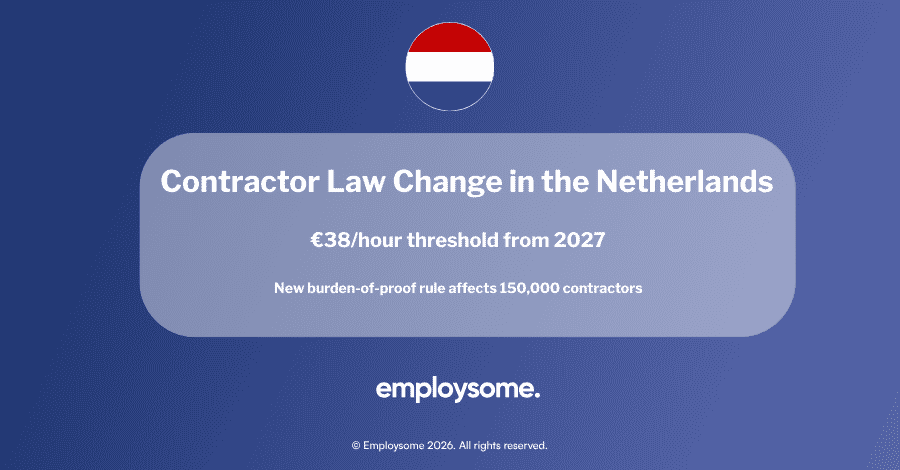
The Netherlands is introducing one of Europe’s most significant contractor classification reforms. From 1 January 2027, companies hiring independent workers (zzp’ers) below a rate threshold will face a legal presumption that the relationship is, in fact, employment. The burden of proof shifts to the hiring company to prove otherwise.
Key Takeaway: The Tweede Kamer adopted the Wet invoering rechtsvermoeden van arbeidsovereenkomst on 21 April 2026. Once in force, any contractor earning below approximately €38/hour (projected to reach ~€39 by 2027 after indexation) can invoke a legal presumption that they are an employee. The hiring company, not the worker, must then prove the arrangement is genuinely self-employed. Roughly 150,000 zzp’ers fall below this threshold.
Compare 100+ EORs, real-time & for free
See pricing, scoring, and country fit for Employer of Record providers, side by side.
Get started free

What Is the New Dutch Contractor Law?
The law that passed the lower house on 21 April 2026 is formally titled the Wet invoering rechtsvermoeden van arbeidsovereenkomst op basis van uurtarief (bill number 36 783). In plain English: the Act introducing a legal presumption of an employment contract based on hourly rate.
It inserts a new Article 7:610aa into the Dutch Civil Code (Burgerlijk Wetboek). The mechanism is straightforward: if a contractor’s effective hourly rate falls below a statutory threshold, the working relationship is legally presumed to be employment.
This is a narrower piece of legislation than what was originally proposed. The Dutch government initially bundled this rate-based presumption with a broader clarification of employment criteria under the Wet VBAR (Wet Verduidelijking Beoordeling Arbeidsrelaties en Rechtsvermoeden). In March 2026, Minister of Work and Participation Thierry Aartsen stripped the clarification section after it lost political support. What remains, and what parliament adopted with near-unanimous backing (only Forum voor Democratie voted against), is the standalone rate-based presumption.
The broader classification framework is being moved into a separate initiative bill called the Zelfstandigenwet, targeted for 1 January 2028.
Timeline of Key Events
| Date | Event |
|---|---|
| July 2025 | Wet VBAR submitted to Tweede Kamer (combined bill) |
| March 2026 | Minister Aartsen files nota van wijziging, removing the clarification section |
| 21 April 2026 | Tweede Kamer adopts the standalone rechtsvermoeden bill |
| 12 May 2026 | Eerste Kamer SZW Committee begins procedural discussion |
| 31 August 2026 | Deadline for Staatsblad publication to meet 1 January 2027 start |
| 1 January 2027 | Targeted commencement date (pending Senate approval) |
| 1 January 2028 | Zelfstandigenwet (broader classification framework) targeted |
The €38/Hour Threshold: How It Works
The law does not name a fixed euro amount. Instead, it sets a reference rate that is rounded up to whole euros and indexed annually. The threshold has tracked upward since the bill was first drafted:
| Reference Date | Threshold | Basis |
|---|---|---|
| 2024 (initial draft) | €33 | Original proposal |
| 1 January 2025 (submission) | €36 | Peildatum at bill submission |
| 1 January 2026 (current bill text) | €38 | Current statutory figure |
| 1 January 2027 (projected) | ~€39 | After one more indexation step |
An important amendment adopted on 21 April 2026 (the Neijenhuis/D66 amendment) changed the indexation basis from the statutory minimum wage to collective-bargaining (cao) wage development. This insulates the threshold from political minimum-wage interventions and ties it more closely to actual market wages.
Piece Work and Fixed-Fee Contracts
The threshold applies whether the parties agreed an explicit hourly rate or a piece price. For fixed-fee or piece work, the worker must demonstrate that the implied hourly rate (after deducting directly attributable costs such as acquisition and preparation) falls below the threshold. This closes the most obvious loophole: restructuring contracts as project fees to avoid the rate test.
Who Can Invoke the Presumption?
This is where the law is narrower than many LinkedIn posts suggest. The presumption is:
- Rebuttable: the hiring company can counter it with evidence
- Civil-law only: the Belastingdienst (Dutch tax authority), UWV, and Labour Inspectorate cannot trigger it themselves under this Act
- Optional: only the worker (or a representative such as a trade union) can invoke it
Once the worker shows their effective rate is below the threshold, the relationship is presumed to be an employment contract. The burden then flips to the hiring company to prove that one of the classic employment elements (wages, work, authority/gezag) is absent.
💡 Employsome Insight
Working below the threshold remains legal. The rule only changes the litigation posture if a dispute arises. But that shift in burden of proof is significant: companies must now be prepared to demonstrate genuine self-employment rather than simply assert it.
How Many Workers Are Affected?
The Dutch Ministry of Social Affairs and Employment (SZW) estimates roughly 150,000 zzp’ers currently work below the threshold. This figure comes from the Zelfstandigen Enquête Arbeid (ZEA), a joint survey by TNO and CBS (the Dutch central statistics bureau).
The official Rijksoverheid press release phrases this as approximately 15% of zzp’ers who deliver their own labour to business clients. That denominator is important: it is not the full 1.3 million Dutch self-employed workforce. It is the subset (roughly 60%) who sell their own labour rather than products, and who work for business clients rather than consumers. Within that roughly 1 million subset, 15% equals approximately 150,000.
Sectors with the highest concentration of sub-threshold contractors include construction, hospitality, delivery and logistics, agriculture, and personal care services. These are also the sectors where employee misclassification risk has historically been highest.
What Happens If the Presumption Is Triggered?
If a worker invokes the presumption and the hiring company fails to rebut it, the consequences are substantial. The worker gains full employee rights under Dutch law:
- Sick pay (up to two years of continued salary, a major Dutch employer obligation)
- Dismissal protection under the Dutch Civil Code
- WW unemployment benefit eligibility
- WIA disability insurance coverage
- Pension accrual under applicable sector schemes
- All terms of any applicable collective bargaining agreement (cao)
The company also faces exposure to retroactive payroll tax and social-insurance premiums. Depending on the duration of the relationship, this can represent a significant financial liability.
The Rebuttal Standard
To successfully rebut the presumption, companies must demonstrate that the working relationship lacks one of the three classic employment elements:
- Wages: the worker does not receive regular compensation as an employee would
- Work: the worker is not personally obligated to perform the work
- Authority (gezag): the company does not exercise direction or control over how the work is done
Dutch courts will apply the holistic nine-factor test established in the Supreme Court’s Deliveroo ruling (2023) and reinforced in the February 2025 Uber/FNV taxi judgment. That second ruling confirmed that external entrepreneurship (whether the worker genuinely operates as an independent business) is now a fully weighted criterion.
💡 Employsome Insight
The practical standard for rebuttal is high. Companies will need to document genuine entrepreneurship indicators: multiple clients, own tools, own commercial risk, KvK (Chamber of Commerce) registration, active marketing, and the ability to set own working hours. Simply labelling a contract as “freelance” will not be sufficient.
The Bigger Picture: Parallel Enforcement Already in Progress
The rechtsvermoeden does not exist in isolation. Companies engaging contractors in the Netherlands face a layered compliance environment that is tightening on multiple fronts simultaneously.
Wet DBA Enforcement Resumed
The Dutch tax authority’s enforcement moratorium on contractor misclassification under the Wet DBA (Deregulering Beoordeling Arbeidsrelaties) was lifted on 1 January 2025. Since that date, retroactive tax assessments have been possible. A “soft-landing” regime (no penalties) was extended through 2026, but full vergrijpboetes (penalty fines) resume from 1 January 2027, the same day the rechtsvermoeden takes effect.
This means companies face two simultaneous compliance triggers on 1 January 2027: the new civil-law presumption and the end of the tax enforcement grace period.
Upcoming Reforms
The Dutch government has described the rechtsvermoeden as explicitly a “first step.” During the 15 April 2026 plenary debate, Minister Aartsen stated the bill is an important initial move in resolving the zzp debate, but not the final answer. The broader reform package includes:
| Reform | Target Date | What It Does |
|---|---|---|
| Rechtsvermoeden (this law) | 1 January 2027 | Rate-based employment presumption for sub-threshold contractors |
| Wet toelating terbeschikkingstelling van arbeidskrachten (Wtta) | 1 January 2027 | Licensing regime for temporary staffing agencies |
| EU Pay Transparency Directive | 2027 | New pay reporting obligations for employers |
| Zelfstandigenwet | 1 January 2028 | Structural framework defining who may work as a zzp’er |
The Zelfstandigenwet is expected to revive the W/Z criteria (work relationship assessment factors) that were dropped from the original VBAR bill. It will likely define entrepreneurship as the default premise, supported by an independent assessment committee for advance rulings.
What This Means for Companies Hiring in the Netherlands
Legal analysis from major Dutch and international firms (Loyens & Loeff, De Brauw, Houthoff, NautaDutilh, CMS, Hogan Lovells, and others) converges on three practical options for sub-threshold contractor engagements:
Option 1: Raise Rates Above the Threshold
The simplest approach. If the contractor’s rate is close to the threshold, increasing it to €39+ per hour removes the presumption entirely. This option works for higher-skilled contractors where a modest rate increase is commercially viable.
The trade-off: increased cost, but with certainty. For companies with a small number of Dutch contractors, this may be the path of least resistance.
Option 2: Convert to Employee Status
For workers who are functionally employees already (set hours, single client, company tools, ongoing supervision), conversion is the compliant path. This can be done through a direct entity or, for companies without a Dutch legal entity, through an Employer of Record (EOR).
EOR providers with strong Netherlands coverage, including Deel, Remote, G-P, Multiplier, and Oyster HR, can onboard a Dutch employee in days and handle the full compliance burden: employment contracts, payroll taxes, social contributions, pension, and the two-year sick pay obligation.
You can compare providers with Netherlands-specific ratings in our Best EOR in the Netherlands guide.
Option 3: Accept Compliance Risk (Not Recommended)
Companies can choose to maintain the status quo and rely on the contractor’s genuine independence to rebut any future presumption claim. This only works where the contractor demonstrably operates an independent business: multiple clients, own tools, own commercial risk, active KvK registration, independent marketing presence.
The risk is asymmetric. If a dispute arises, the company bears the burden of proof. Retroactive payroll tax exposure, employee rights claims, and social-insurance liabilities can accumulate quickly.
💡 Employsome Insight
For most companies hiring contractors in the Netherlands below €38/hour, the correct move is to begin auditing those relationships now. Do not wait for Senate approval. Conversion timelines, especially through EOR providers, typically require 2 to 4 weeks of lead time for contracts, benefits setup, and payroll registration. Starting the process in Q3 2026 positions you well ahead of the 1 January 2027 deadline.
The Netherlands in Context: Europe’s Contractor Crackdown
The Netherlands is not acting in isolation. Across Europe, governments are tightening rules around contractor classification and the line between contractors and employees is getting harder to straddle.
| Country | Recent/Upcoming Change | Impact |
|---|---|---|
| Netherlands | Rechtsvermoeden (2027) | Rate-based employment presumption, burden of proof on hirer |
| Germany | AÜG enforcement tightening | Stricter scrutiny of EOR and staffing arrangements |
| Spain | Riders’ Law (2021) + enforcement expansion | Presumption of employment for platform workers, expanding to other sectors |
| UK | IR35 off-payroll rules | Client responsibility for determining worker status in medium/large businesses |
| EU-wide | Platform Workers Directive (2024) | Presumption of employment for platform workers, member state transposition by 2026 |
The common thread is clear. Governments are shifting the classification burden from workers to hiring companies. The Dutch rechtsvermoeden is notable because it goes beyond platform workers and applies a rate-based test to all contractor relationships. This makes it one of the broadest misclassification reforms in Europe.
For companies hiring employees internationally, understanding these country-specific compliance obligations is no longer optional. A contractor arrangement that is perfectly legal in one jurisdiction may create significant exposure in another.
Compliance Checklist for Employers
If your company engages independent contractors in the Netherlands, here is a practical checklist for preparing before 1 January 2027:
- Audit your Dutch contractor population. Identify every contractor earning below €38/hour (or the projected ~€39 threshold at entry into force). Flag those on piece-rate or fixed-fee contracts and calculate implied hourly rates.
- Assess genuine independence. For each sub-threshold contractor, evaluate whether they have multiple clients, use their own tools, bear commercial risk, and control how the work is performed. If the honest answer is “this person functions like an employee,” that is your compliance signal.
- Decide: raise, convert, or document. For each contractor, choose one of the three paths. Raising the rate above the threshold is simplest. Converting to employment (directly or via an EOR provider) is safest. Maintaining the contractor arrangement requires robust documentation of independence.
- Review your contract templates. Ensure Dutch contractor agreements explicitly address the rechtsvermoeden. Include clauses around rate documentation, independence indicators, and dispute resolution.
- Budget for potential conversions. Dutch employment costs run roughly 25 to 35% above gross salary when you factor in employer social contributions, holiday allowance (8% mandatory), pension, and the two-year sick pay obligation. If you are converting contractors to employees, model this cost increase.
- Monitor the Senate timeline. The Eerste Kamer’s SZW Committee discussion was scheduled for 12 May 2026. Staatsblad publication by 31 August 2026 is required for the 1 January 2027 commencement to hold.
Frequently Asked Questions
We have compiled the most common questions about the new Dutch contractor classification law below.
No. Working as an independent contractor below the threshold remains legal. The law creates a rebuttable legal presumption of employment that only applies when a worker actively invokes it. Contractors earning above the threshold are unaffected by this specific law, though existing misclassification rules under the Wet DBA still apply to all contractor relationships regardless of rate.
Not directly. The rechtsvermoeden is a civil-law mechanism that only the worker (or their representative, such as a trade union) can invoke. The Belastingdienst, UWV, and Labour Inspectorate cannot trigger it. However, the tax authority can still pursue misclassification under the separate Wet DBA enforcement regime, which resumed on 1 January 2025 with full penalties starting 1 January 2027.
The current statutory threshold in the bill text is €38 per hour (based on the 1 January 2026 reference date). Industry commentators project this will reach approximately €39 by the 1 January 2027 entry-into-force date after one more indexation step. The threshold is indexed annually based on collective-bargaining wage development following the Neijenhuis amendment.
Yes. For fixed-fee or piece work, the worker must demonstrate that the implied hourly rate (after deducting directly attributable costs) falls below the threshold. This prevents companies from restructuring hourly contracts as project fees to avoid the rate test.
Dutch courts apply a holistic nine-factor test from the Deliveroo and Uber/FNV Supreme Court rulings. Key indicators of genuine self-employment include: serving multiple clients, using own tools and equipment, bearing commercial risk (including non-payment risk), having a KvK registration, maintaining an active marketing presence, and controlling how and when the work is performed. The more indicators present, the stronger the rebuttal.
The Wet DBA is the existing framework for assessing whether a contractor relationship is genuinely self-employed, enforced by the tax authority. The rechtsvermoeden is a new civil-law addition that creates an automatic presumption of employment below a rate threshold, triggered by the worker. They operate in parallel: the rechtsvermoeden gives workers a civil-law tool, while Wet DBA gives the tax authority an enforcement tool. Both create exposure for companies engaging contractors incorrectly.
Yes. An Employer of Record can convert contractor relationships to compliant employment without requiring you to set up a Dutch legal entity. The EOR becomes the legal employer, handling employment contracts, payroll taxes, social contributions, pension, and sick pay obligations. This is particularly relevant for foreign companies without an existing Dutch entity who need to convert contractors before the 1 January 2027 deadline.
The Zelfstandigenwet is a separate initiative bill from VVD, D66, CDA and SGP, targeted for 1 January 2028. It aims to create a structural framework defining who may work as a zzp’er (self-employed professional). The rechtsvermoeden is considered “phase one,” while the Zelfstandigenwet is the broader “phase two” that will define the criteria for genuine self-employment.
Final Verdict
The Dutch rechtsvermoeden is not a theoretical policy discussion. It is adopted legislation on track for 1 January 2027, with broad parliamentary support, EU funding milestones incentivising the timeline, and parallel tax enforcement already active.
For companies engaging contractors in the Netherlands, the compliance calculus has shifted. Below approximately €38/hour (likely ~€39 by 2027), any contractor can invoke a presumption that they are your employee, and you carry the burden of proving otherwise. Combined with the end of the Wet DBA soft-landing regime on the same date, 1 January 2027 represents a double compliance trigger.
The time to act is now, not January. Audit your Dutch contractor relationships, model conversion costs, and decide whether each engagement sits above the threshold, converts to employment, or carries documented independence indicators strong enough to withstand a challenge.
At Employsome, we track EOR providers with Netherlands coverage and score them on Dutch-specific compliance capabilities, including payroll tax handling, sick pay insurance, pension administration, and 30% ruling support. If you are evaluating a contractor-to-employee conversion, our comparison tool can help you find the right partner.
Courtney Pocock is a Copywriter at Employsome with 15+ years of experience writing for the HR, corporate, and financial sectors. She has a strong interest in global business expansion and Employer of Record / PEO topics, focusing on news that matters to business owners and decision-makers. Courtney covers industry updates, regulatory changes, and practical guides to help leaders navigate international hiring with confidence. Connect with Courtney on LinkedIn.
Our content is created for informational purposes only and is not intended to provide any legal, tax, accounting, or financial advice. Please obtain separate advice from industry-specific professionals who may better understand your business’s needs. Read our Editorial Guidelines for further information on how our content is created.
Other posts
Read More