What Is a Performance Improvement Plan? A 2026 Guide for HR Leaders
A Performance Improvement Plan (PIP) is a formal document that identifies specific performance gaps, sets SMART improvement goals, commits the employer to defined support, and states clear consequences over a 30 to 90 day timeline. This 2026 guide covers what a PIP is and isn’t, the 5-stage process, how to write SMART goals, recommended timelines, three real-world examples (sales, customer service, engineering), legal and documentation requirements, common mistakes, and how PIPs differ from PDPs and progressive discipline.


What Is a Performance Improvement Plan?
A Performance Improvement Plan is a formal document that does four things at once: it names a specific performance problem with concrete examples, defines what success looks like through SMART goals, commits the employer to specific support (training, coaching, mentoring, tools), and states the consequences of meeting or not meeting the targets within the agreed timeline.
Three features distinguish a PIP from informal feedback or a standard performance review:
- It is formal and written. Both manager and employee sign a copy of the plan. HR is involved in drafting and reviewing. The document creates a record that protects both parties.
- It is time-bound. PIPs run for a defined period (typically 30, 60, or 90 days), after which a documented decision is made: passed, extended, or terminated.
- It carries explicit consequences. The plan states what happens if the goals are not met, including the possibility of further discipline or termination.
A standard PIP document includes seven sections: (1) employee and manager identifying details with the start and end dates of the plan; (2) a clear statement of the performance issue with specific, documented examples; (3) the SMART goals the employee must meet; (4) the action plan with specific steps, milestones, and check-in dates; (5) the resources and support the employer will provide; (6) the consequences of meeting or not meeting the goals; and (7) signatures from employee, manager, and HR with space for employee comments.
When this is done well, the PIP becomes what one experienced HR leader described as “a reset button, not a trapdoor”: a structured second chance grounded in honest expectations and real support. When it is done badly, it becomes a documentation exercise designed to make termination defensible, which employees recognise immediately and which produces the cynical reputation the practice carries today.
When Should You Use a PIP? (And When You Shouldn’t)
Knowing when not to use a PIP is as important as knowing when to use one. A PIP is the right tool in some specific situations and the wrong tool in others. Using it incorrectly is the most common reason PIPs fail.
When a PIP is appropriate:
- Persistent performance gaps after informal feedback has already been given and has not produced improvement
- Specific, observable performance issues that can be measured (missing deadlines, output quality below standard, KPI shortfalls, declining customer satisfaction scores)
- Behavioural issues with measurable indicators (repeated tardiness, communication problems with documented impact, failure to follow agreed processes)
- The employee was previously meeting expectations and something has changed, and the company wants to genuinely help them recover
- The role itself is salvageable with realistic improvement, given adequate time and support
When a PIP is the wrong tool:
- The decision to terminate has already been made. Using a PIP as a paperwork exercise before firing someone is the single most damaging misuse of the tool. Employees and their colleagues see through it, trust in HR collapses, and the legal protection it offers is weaker than people assume.
- The performance issue is gross misconduct (theft, harassment, fraud, safety violations). These warrant immediate disciplinary action, not a 60-day improvement runway.
- The employee is new and within a probationary period. Probationary review processes are usually faster and lower-friction than a full PIP.
- The performance gap is caused by structural issues (unclear role, missing tools, conflicting priorities, manager unavailability). A PIP cannot fix what the system is breaking; the manager must address the system first.
- The employee has not received clear feedback yet. PIPs should never be the first time someone hears that they are underperforming. Use informal feedback first; reserve formal PIPs for cases where informal feedback has not produced change.
- The employee is facing a temporary personal crisis (family illness, bereavement, mental health). Performance dips during life events are usually better addressed through accommodation, leave, or temporary workload adjustment than through a formal PIP.
💡 Employsome Insight: The One Question to Ask Before Issuing Any PIP
The single most consequential question a manager can ask before starting a PIP is: “Do I genuinely believe this person can recover?” If the honest answer is no, do not use a PIP. The right tool in that situation is a respectful, fair separation conversation (with appropriate severance and notice), not a 60-day paperwork process designed to make termination feel justified. Using a PIP as termination theatre damages the organisation in three ways: the employee disengages immediately, their colleagues lose trust in HR, and the legal protection is weaker than the paper trail suggests.
The 5 Stages of the Performance Improvement Plan Process
A well-run PIP follows five stages from start to close. The stages do not need fancy names; they need to be done in order, with discipline at each step. Skipping any stage (especially stage 4) is the most common reason PIPs do not produce real improvement.
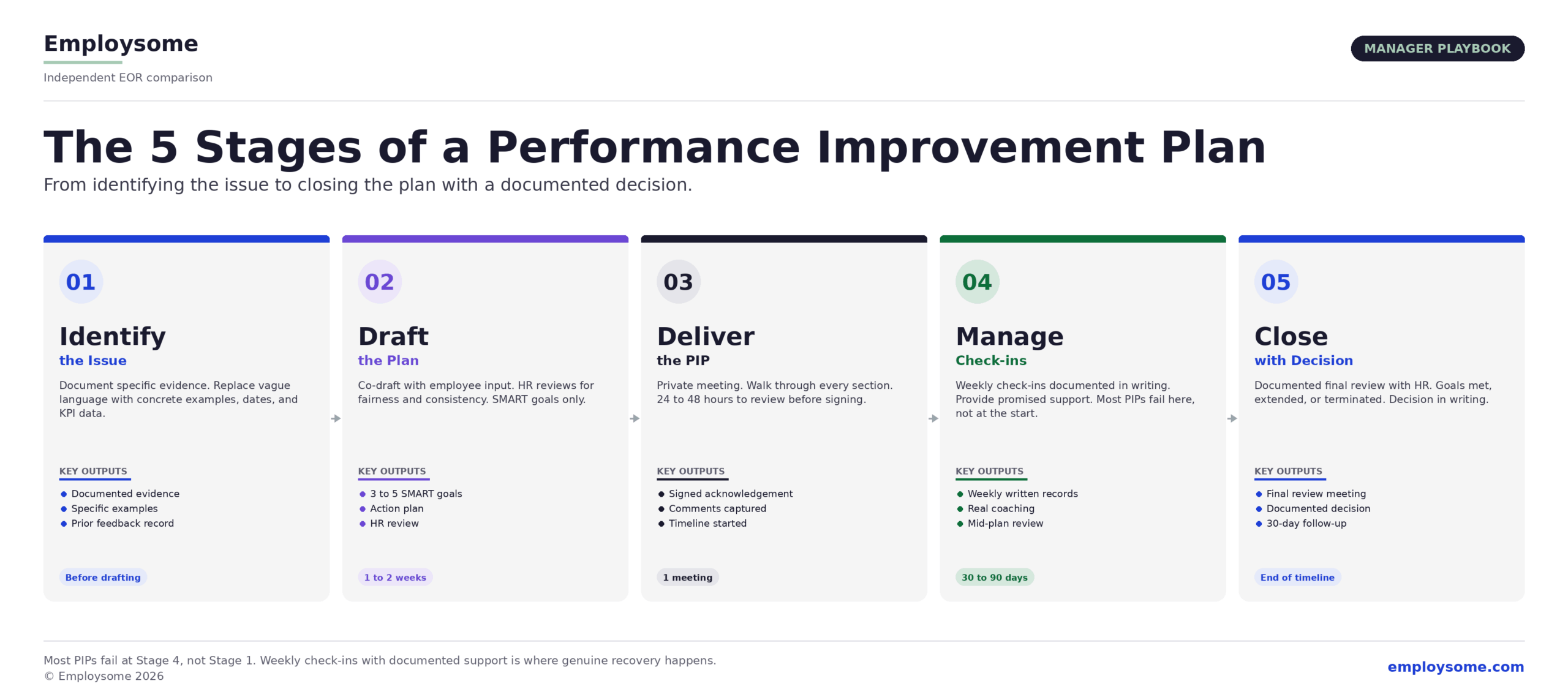
Stage 1: Identify and document the performance issue (before drafting the PIP)
The PIP starts before the document does. Gather specific, observable evidence of the performance gap: missed deadlines with dates, output quality issues with examples, customer feedback with sources, KPI data showing the trend. Replace vague language (“unreliable”, “poor attitude”) with specific behaviours and outcomes (“Missed 3 of 5 project deadlines in Q2, causing delayed launch of [project name]”). Talk to HR and review prior performance documentation. If informal feedback has not already been given, give it now and document the conversation.
Stage 2: Draft the PIP collaboratively (HR, manager, and ideally the employee)
The strongest PIPs are drafted with employee input, not imposed top-down. Schedule a meeting where the manager presents the performance gap and the proposed goals, and invites the employee to discuss the situation, identify root causes, and shape the action plan. HR should review the draft for clarity, fairness, and consistency with company practice (if most PIPs run 60 days, do not give one person 30 days without a specific reason). Involving the employee in goal-setting materially increases commitment and reduces the perception that the plan is designed to fail.
Stage 3: Deliver the PIP and start the timeline
Deliver the PIP in a private, scheduled 1:1 meeting. Walk the employee through every section, allow time for questions, and be explicit about consequences (both meeting and not meeting the goals). Allow the employee 24 to 48 hours to review before signing rather than asking for a signature in the room: this signals fairness and gives the employee time to engage thoughtfully rather than reactively. The official PIP timeline starts from the agreed date documented in the plan, typically the day after signature.
Stage 4: Manage check-ins and provide real support (this is where most PIPs fail)
The middle of the PIP is where the actual work happens. Schedule check-ins at least weekly (more often for 30-day plans). Document each check-in in writing: what was discussed, what progress was made, what is still off-track, what support was provided. Provide the resources you committed to in the plan: training, coaching, mentoring, tools, time. If you committed to a daily 15-minute check-in, hold them every day. The most common reason PIPs fail is not employee underperformance but manager under-engagement: the goals were set, but the support promised never showed up.
Stage 5: Close the PIP with a documented decision
At the end of the timeline, hold a final review meeting with HR present. Document a clear decision: (a) goals met, plan closed and employee returns to standard performance management; (b) goals partially met with material progress, plan extended for a defined additional period; or (c) goals not met, employment ended in line with company policy and local employment law. In all three outcomes, document the decision in writing, attach the check-in records and progress evidence, and store with HR. If the employee successfully completes the PIP, schedule a 30-day follow-up to monitor sustained performance.
How to Write SMART Goals for a Performance Improvement Plan
The single biggest predictor of a successful PIP is whether the goals are genuinely SMART: Specific, Measurable, Achievable, Relevant, and Time-bound. Vague goals (“improve communication”, “be more proactive”, “have a better attitude”) leave both parties guessing about what success looks like and produce frustration on both sides. Concrete goals turn the PIP into a working tool rather than a complaint document.
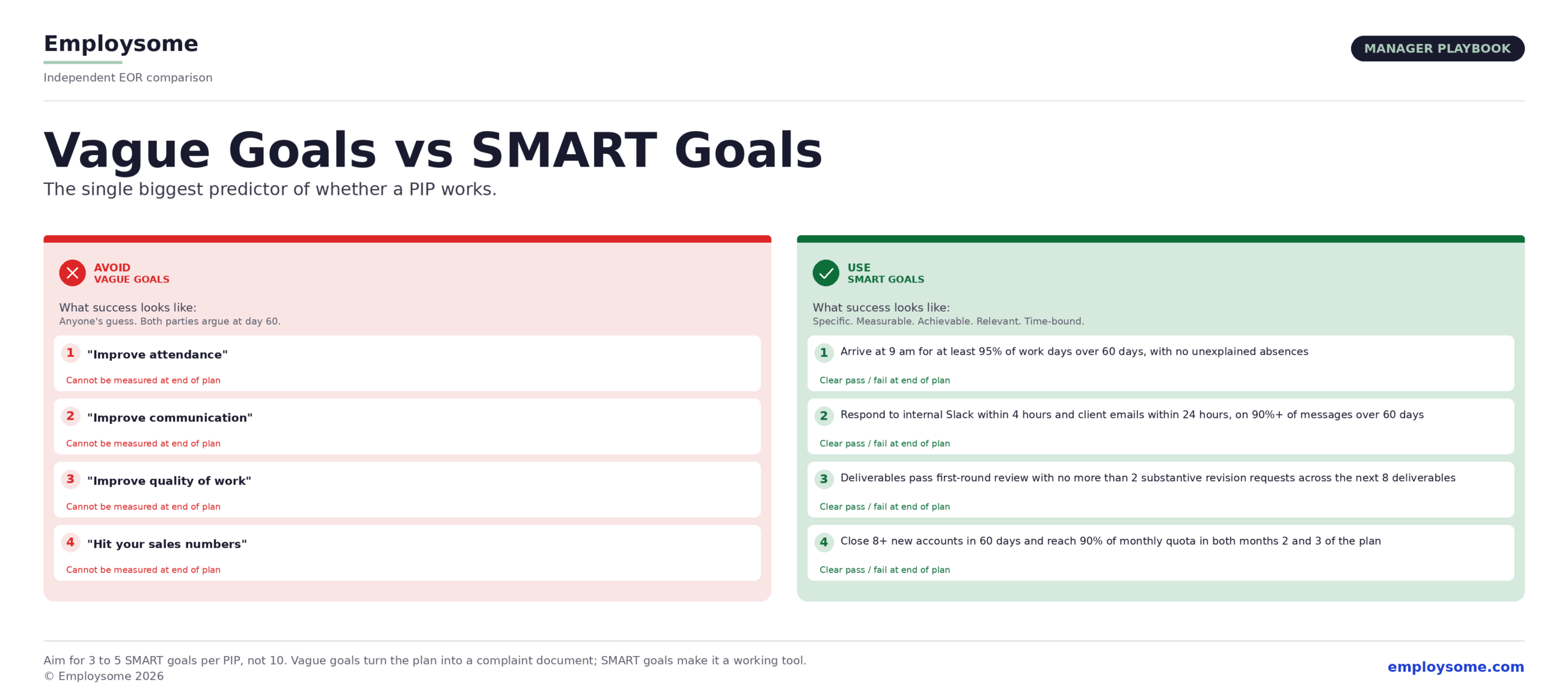
| Vague Goal (Avoid) | SMART Goal (Use Instead) |
| Improve attendance | Arrive at scheduled start time (9:00 am) for at least 95% of work days over the next 60 days, with no unexplained absences |
| Improve communication | Respond to internal Slack messages within 4 working hours and to client emails within 24 hours, for at least 90% of messages received over the next 60 days |
| Improve quality of work | Submit deliverables that pass first-round review with no more than 2 substantive revision requests per deliverable, across the next 8 deliverables |
| Hit your sales numbers | Close at least 8 new accounts in the next 60 days and reach 90% of monthly quota in both months 2 and 3 of the plan |
| Be more proactive | Identify and document at least 2 process improvements per month, present each to the team in the weekly meeting, and implement one with manager approval |
| Be a better team player | Provide written summaries of key decisions within 24 hours of each cross-functional meeting attended, and offer help to at least 1 colleague per week documented in 1:1 with manager |
The numbers tell the story. The vague version of each goal could be argued in either direction at the end of 60 days; the SMART version cannot. This is what makes a PIP defensible (legally and morally) and what gives the employee a real chance to demonstrate progress. Aim for 3 to 5 SMART goals per PIP, not 10. More than 5 goals dilutes focus and signals that the manager has not prioritised the most important issues.
How Long Should a PIP Be? (30, 60, or 90 Days)
PIPs typically run for 30, 60, or 90 days, with 60 days being the most common default. The right length depends on the complexity of the issues, the role, and how much time is genuinely needed for behaviour change.
| Timeline | When to Use | Risks |
| 30-day PIP | Probationary periods, urgent compliance or behavioural issues, client-facing roles where service is already deteriorating, time-sensitive project deliverables | Short for genuine skill-based behaviour change. Can feel designed-to-fail unless paired with intensive support and weekly check-ins |
| 60-day PIP (most common) | Standard performance issues where the employee has shown ability to do the job before. Allows time to introduce new habits, training, and coaching while still creating urgency | Long enough to be defensible. Requires consistent manager engagement throughout, not check-ins only at week 4 |
| 90-day PIP | Complex performance issues, senior roles, situations requiring substantial new skills, technical roles where competency takes time to demonstrate | Longer plans risk losing momentum. Schedule formal review points at 30 and 60 days, not just at 90 |
| 120+ day PIP | Rare. Use only for very senior roles or where major skill development is genuinely required and structured | At this length, consider whether the right intervention is actually a development plan (PDP), not a PIP |
Cadence within the timeline: Whatever the total length, build in regular check-in milestones. A 30-day PIP needs check-ins at week 1, week 2, week 3, and final review at day 30. A 60-day PIP needs weekly check-ins plus formal review points at day 30 and day 60. A 90-day PIP needs weekly check-ins plus formal reviews at day 30, day 60, and day 90. Without these milestones, the employee has no way to know if they are on track until the end, which is exactly when no further correction is possible.
Extensions: If the employee is making real progress but has not fully met the goals at the end of the timeline, extending by 30 days is reasonable. If there is no material progress at the midway review, an extension at the end is unlikely to change the outcome and may simply prolong a difficult situation for both parties.
3 Performance Improvement Plan Examples (Sales, Customer Service, Engineering)
Real-world PIPs vary by role and issue. Three concrete examples illustrate how the SMART framework applies in different contexts.
Example 1: Sales representative consistently missing quota
Performance issue: Account Executive has closed below 60% of monthly quota for three consecutive months and pipeline coverage ratio has dropped from 3.0x to 1.4x.
SMART goals (60-day PIP):
- Reach at least 85% of monthly quota in months 2 and 3 of the plan
- Build pipeline coverage ratio back to a minimum of 2.5x by day 45
- Complete a minimum of 50 outbound prospecting calls per week, logged in CRM
- Submit weekly pipeline review with manager every Friday at 4 pm
Support provided: Daily 15-minute pipeline check-in with sales manager (first 14 days), weekly call shadowing with top performer, access to sales coaching with external coach (4 sessions), priority on inbound leads through day 30. Final review on day 60 with sales director and HR.
Example 2: Customer service agent with declining CSAT scores
Performance issue: Customer service representative’s CSAT (Customer Satisfaction) score has dropped from 4.6 to 3.8 out of 5 over Q2, with three customer escalations in the same period.
SMART goals (45-day PIP):
- Maintain rolling CSAT score of 4.4 or higher for the final 30 days of the plan
- Zero customer escalations in the 45-day period
- Average response time under 2 hours for all customer inquiries during business hours
- Complete advanced customer communication training (2 modules, certificate of completion) by day 21
Support provided: Twice-weekly call review sessions with team lead, paired shadowing with senior agent for first 2 weeks, access to communication coaching, mid-point review on day 21 with team lead and HR.
Example 3: Software engineer missing project milestones
Performance issue: Senior software engineer has missed 4 of last 6 sprint commitments, with code reviews showing incomplete error handling and missing tests on submitted PRs.
SMART goals (90-day PIP):
- Meet 90% of sprint commitments across the 6 sprints in the PIP period
- All submitted pull requests pass code review with no more than one round of substantive revision
- Achieve test coverage of at least 80% on all new code submitted
- Lead at least one technical design review session per month, with documented design document
Support provided: Weekly technical pairing sessions with staff engineer (2 hours/week), test-driven development course (8 hours), reduced code review load (one PR per week max as reviewer rather than 3+) so capacity is freed for own work. Formal reviews on days 30, 60, and 90.
10 Common Performance Improvement Plan Mistakes to Avoid
Even well-intentioned PIPs fail in predictable ways. The list below covers the most common mistakes managers and HR teams make.
- Treating the PIP as a paperwork exercise before termination. The single most damaging misuse. Employees recognise it instantly, colleagues lose trust in HR, and the legal protection is weaker than the paper trail suggests.
- Setting vague or unmeasurable goals. “Improve communication” leaves the employee guessing. SMART goals are the difference between a working tool and a complaint document.
- Not providing the support you committed to. The plan promises training, coaching, or pairing. The training never gets scheduled, the coach is never booked, the senior partner is too busy. This is the most common failure mode and is more often a manager-engagement problem than an employee one.
- Using unrealistic timelines. A 7-day deadline for an issue that genuinely takes 60 days to address signals the plan is designed to fail. Calibrate to the complexity of the change required.
- Excluding the employee from the drafting process. Top-down PIPs produce compliance theatre rather than genuine commitment. Employees who help shape goals are materially more invested in achieving them.
- Surprising the employee with a PIP they did not expect. A PIP should never be the first feedback. If the employee did not know they were underperforming, the manager has a separate problem to fix before issuing a formal plan.
- Inconsistent application across employees. Different performance issues should not get materially different timelines or goal structures without specific reasons. Inconsistency is the most common discrimination claim trigger.
- No mid-plan check-ins or written records. A 60-day PIP with no documented check-ins until day 60 is structurally broken. Weekly check-ins documented in writing are non-negotiable.
- Punitive or hostile language in the document. The plan should be direct and specific without being humiliating. Tone matters: employees who feel respected during a PIP are more likely to genuinely engage with it.
- Failing to celebrate progress. When an employee meets milestones, acknowledge it. Continuing to treat them as “the underperformer” after they have demonstrated improvement is its own form of self-fulfilling prophecy.
PIP vs PDP vs Performance Review vs Progressive Discipline
PIPs are often confused with related but distinct HR practices. Knowing the difference helps managers pick the right tool and avoids over-formalising small issues or under-formalising serious ones.
| Tool | Purpose | When to Use |
| Informal feedback | Real-time correction or coaching on a specific behaviour or outcome | Most performance conversations. The default. Should always come before a PIP. |
| Performance review | Formal periodic evaluation of overall performance, usually quarterly or annually | Standard performance management cycles. Tied to compensation and promotion decisions. |
| Performance Improvement Plan (PIP) | Formal time-bound plan to address specific performance gaps when informal feedback has not produced change | Persistent measurable underperformance after informal feedback. Documented evidence exists. |
| Performance Development Plan (PDP) | Forward-looking plan to develop skills, capabilities, or career growth | Strong performers who want to grow into next-level roles. Not a remediation tool. |
| Progressive discipline | Escalating sequence of formal warnings (verbal, written, final written, suspension, termination) for misconduct | Behavioural or rule violations rather than performance gaps. Different from PIPs in tone and legal framework. |
| Termination conversation | End of employment, with appropriate notice and severance | When the role is genuinely not the right fit and recovery is unrealistic. PIP is not a substitute. |
The PIP vs PDP distinction is particularly important. A Performance Development Plan is forward-looking and aspirational: it helps a strong performer build skills for their next role. A Performance Improvement Plan is corrective: it addresses a gap between current performance and the standard the role requires. Calling a PIP a “Development Plan” to soften the language is dishonest and ultimately damaging. Employees know the difference. Use the right name for the right tool.
Key Takeaways for HR Leaders and Managers
A PIP is a formal time-bound process, not a soft warning
A Performance Improvement Plan is a written document that identifies specific performance gaps, sets SMART improvement goals, commits the employer to defined support, and states clear consequences over a 30 to 90 day timeline.
Use a PIP only when you genuinely believe recovery is possible
If the decision to terminate has already been made, a PIP is the wrong tool. Using one as a paperwork exercise before firing damages organisational trust, weakens legal protection, and harms the employee’s remaining time.
The 5-stage process is the spine: identify, draft, deliver, manage, close
Most PIPs fail at stage 4 (managing weekly check-ins and providing committed support), not stage 1 or 2. The middle of the plan is where actual recovery happens; the edges are paperwork.
SMART goals are non-negotiable
Specific, Measurable, Achievable, Relevant, Time-bound. Vague goals like “improve communication” leave both parties guessing. Aim for 3 to 5 SMART goals per plan, no more.
60 days is the most common timeline; 30 and 90 are alternatives
30-day PIPs work for urgent compliance issues and probationary periods. 90-day PIPs suit complex issues and senior roles. Always include mid-plan formal review milestones, not just an end-of-plan review.
Documentation protects both parties
Pre-PIP evidence, signed acknowledgement, written check-in records, consistent application across the company, reasonable timelines, and genuine support records all matter. A documented PIP that ends in termination is far more defensible than an undocumented dismissal.
Involving the employee in drafting increases recovery rates
PIPs imposed top-down produce compliance theatre. PIPs co-authored with employee input produce genuine commitment. Schedule a collaborative drafting meeting before finalising the plan.
The PIP is a starting point; the template makes it operational
When you are ready to draft, use a structured template with role-specific examples. Our Performance Improvement Plan template includes a complete copy-and-paste format with five role-specific examples (sales, customer service, technical, leadership, attendance).
Frequently Asked Questions
A Performance Improvement Plan (PIP) is a formal, written document that identifies specific gaps in an employee’s performance, sets measurable improvement goals tied to a clear timeline (typically 30, 60, or 90 days), specifies the support and resources the employer will provide, and defines what happens if the employee does or does not meet the targets. A standard PIP includes seven sections: identifying details and dates; the performance issue with documented examples; SMART goals; the action plan with milestones; resources and support; consequences; and signatures from employee, manager, and HR. Used well, a PIP is a structured second chance; used poorly, it becomes paperwork before termination.
PIPs typically run for 30, 60, or 90 days, with 60 days being the most common. The right length depends on the complexity of the issues and the time genuinely needed for behaviour change. 30-day PIPs suit urgent compliance issues, probationary reviews, or client-facing roles where service is already deteriorating. 60-day PIPs handle most standard performance issues and allow time to introduce new habits, training, and coaching. 90-day PIPs suit complex performance issues, senior roles, or situations requiring substantial new skill development. Whatever the total length, schedule weekly check-ins plus formal review milestones at day 30 and day 60 (and day 90 for longer plans).
Not necessarily, but the perception is rooted in real practice. Experienced HR practitioners report that 30% to 50% of employees who go through a properly designed PIP recover and continue in their roles. The other 50% to 70% either resign during the PIP or are terminated at the end. Whether a specific PIP leads to termination depends on four factors: clarity of expectations, measurability of goals, genuine support from the employer, and the employee’s genuine engagement with the plan. A PIP issued in good faith with realistic goals and committed support is a real opportunity to recover. A PIP issued as paperwork before a termination decision that has already been made is, in practice, a precursor to firing.
Not automatically. The right answer depends on whether the PIP is genuine and whether you can realistically meet the goals. Stay and engage if: the goals are clear and SMART, the timeline is reasonable, the support promised is concrete (training, coaching, mentoring), your manager is engaged in regular check-ins, and you genuinely believe you can demonstrate the required improvement. Consider your options if: the goals are vague or unrealistic, the timeline is unreasonably short for the issue, the promised support is missing, your manager is disengaged, or you can identify clear evidence the decision to terminate has already been made. In either case, do not sign the PIP on the spot; ask for 24 to 48 hours to review, document everything, and consider speaking to an employment lawyer or HR contact outside your immediate management chain.
A standard PIP includes seven sections: (1) identifying details (employee, manager, HR contact, plan start and end dates); (2) clear statement of the performance issue with specific documented examples (dates, projects, incidents, KPI data); (3) SMART goals the employee must meet (specific, measurable, achievable, relevant, time-bound); (4) action plan with milestones and check-in dates; (5) resources and support the employer will provide (training, coaching, tools, time); (6) consequences of meeting or not meeting the goals (return to standard performance management, extension, or termination); and (7) signatures from employee, manager, and HR with space for employee comments. The strongest PIPs are co-drafted with employee input rather than imposed top-down.
SMART is an acronym for Specific, Measurable, Achievable, Relevant, and Time-bound. SMART goals are the single biggest predictor of a successful PIP. Vague goals like “improve communication” or “be more proactive” leave both parties guessing about what success looks like. Concrete SMART goals turn the PIP into a working tool. For example, instead of “improve attendance”, write “arrive at scheduled start time (9:00 am) for at least 95% of work days over the next 60 days, with no unexplained absences.” Instead of “improve quality of work”, write “submit deliverables that pass first-round review with no more than 2 substantive revision requests per deliverable, across the next 8 deliverables.” Aim for 3 to 5 SMART goals per PIP, not 10.
There is no universal industry success rate, since outcomes vary by organisation, role, and individual circumstances. Experienced HR practitioners typically report that 30% to 50% of employees in well-designed PIPs recover and continue in their roles. The success rate depends primarily on four things: clarity of expectations through SMART goals; reasonable timelines (30 to 90 days appropriate to the issue); genuine support (training, coaching, manager engagement, weekly check-ins); and whether the PIP was issued in good faith rather than as a precursor to a termination decision already made. The single biggest predictor of failure is not employee underperformance but manager under-engagement during the plan.
A Performance Improvement Plan (PIP) is a corrective tool that addresses a gap between current performance and the standard the role requires. A Performance Development Plan (PDP) is a forward-looking development tool for strong performers who want to grow into next-level roles. The two practices serve different purposes and use different language. PIPs are time-bound (30 to 90 days), name specific underperformance, and carry consequences including possible termination. PDPs are open-ended (often 6 to 12 months or longer), name aspirational growth areas, and have no consequence structure beyond opportunity. Calling a PIP a “Development Plan” to soften the language is dishonest and ultimately damaging; employees recognise the difference.
Yes. The strongest PIPs are co-drafted with employee input rather than imposed top-down. Schedule a meeting where the manager presents the performance gap and the proposed goals, then invites the employee to discuss the situation, identify root causes, and shape the action plan. Involving the employee in goal-setting materially increases commitment, reduces the perception that the plan is designed to fail, and produces a more realistic improvement timeline. Employees who help shape their PIP are more invested in achieving it. Final approval still rests with the manager and HR (the employee cannot veto reasonable goals), but the drafting conversation should genuinely incorporate employee input.
PIPs are not legally required in most jurisdictions (in at-will employment systems like the United States, employers can terminate without offering one), but a well-documented PIP provides material legal protection if termination follows. Key requirements for a defensible PIP include: pre-PIP evidence of the performance issue (prior feedback, performance reviews, KPI data); specific examples in the document with dates and incidents; signed acknowledgement; written check-in records; consistent application across the company (inconsistency triggers discrimination claims); reasonable timelines and goals; documented genuine support; and a clear final decision in writing. Employment law varies materially across countries, with stronger employee protections in the UK, EU, India, and most non-US jurisdictions. Always consult local employment counsel or your Employer of Record (EOR) partner before initiating a PIP in a jurisdiction with strong employee protections.
Copywriter
Christa is a Copywriter at Employsome with 17 years of professional writing experience across global brands, startups, and online publications. A native English-Finnish writer, she brings strong editorial skills and a versatile background in business, SaaS, and finance. At Employsome, Christa focuses on clear, practical content about HR, payroll, and Employer of Record topics.
Our content is created for informational purposes only and is not intended to provide any legal, tax, accounting, or financial advice. Please obtain separate advice from industry-specific professionals who may better understand your business’s needs. Read our Editorial Guidelines for further information on how our content is created.
Other posts
Along with our standard maps we offer highly customizable maps.