1:1 Meeting Template: Agenda, Questions, and Best Practices
A 1:1 meeting template is a reusable agenda that helps managers and direct reports run consistent one-on-one conversations. The best templates follow a six-part structure: personal check-in, action items review, employee-led topics, manager-led topics, feedback exchange, and next steps. This guide covers the complete template, 50+ questions sorted by situation, the SOON coaching framework, specialised templates for first 1:1s, remote teams, and difficult feedback, plus optimal cadence and common mistakes to avoid.

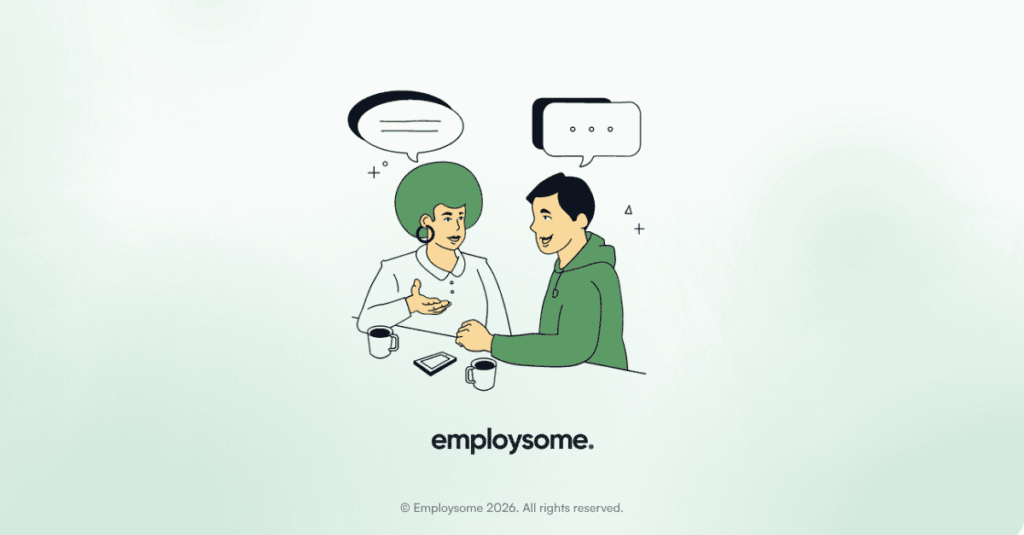
A 1:1 meeting template is a reusable, structured agenda that helps managers and direct reports run consistent, high-quality one-on-one conversations without reinventing the format every week. The best 1:1 templates follow a simple six-part structure: a brief personal check-in, a review of action items from the previous meeting, employee-led agenda topics first, manager-led topics second, two-way feedback exchange, and clear next steps. The conversation typically lasts 30 minutes for weekly cadence and 45 to 60 minutes for biweekly or monthly meetings, anchored to a shared running document that both parties can edit before, during, and after each session.
Despite being one of the most-talked-about practices in modern management, many 1:1s fail in predictable ways. Research from Leapsome shows that 71% of managers believe they give constructive feedback, but only 37% of individual contributors agree. Gallup data finds that employees with regular check-ins are 3 times more engaged than those without, and weekly 1:1s correlate with approximately 20% lower anxiety and 12% higher self-reported success compared to less frequent meetings. The gap between intent and impact is almost always closed by structure: a clear template, a shared agenda, and a consistent cadence.
This guide gives you a complete 1:1 meeting template you can copy and use today, plus the deeper context HR leaders and managers need: the six-part agenda structure, ideal cadence and duration, 50+ questions sorted by situation (check-in, performance, career, feedback, well-being, manager feedback), specialised templates for first 1:1s with new reports, remote teams, difficult conversations, and skip-level meetings, the SOON coaching framework (Success, Obstacles, Options, Next Steps), the CAMPS engagement model, common mistakes that derail 1:1s, and how to track action items so commitments actually get followed up.

What Is a 1:1 Meeting? (And What It Isn’t)
A 1:1 meeting (also written “one-on-one” or “one-to-one”) is a private, structured conversation between two people in an organisation. While most 1:1s involve a manager and a direct report, the format also covers skip-level meetings (employee with their manager’s manager), peer-to-peer 1:1s (two colleagues at the same level), and mentor-mentee conversations. This guide focuses on the most common type: weekly 1:1s between a manager and their direct report.
The purpose of a 1:1 is fundamentally different from a status meeting or project review. In The Making of a Manager, Julie Zhuo (former VP of Design at Meta) describes four conversation goals that distinguish 1:1s from other meetings:
- Reflecting: Discussing current workload, energy, and what is or is not working in how the employee is operating
- Coaching: Helping the employee think through challenges they own, rather than solving the problem for them
- Feedback exchange: Both giving feedback to the employee and inviting feedback on the manager’s own approach
- Career and growth: Connecting current work to longer-term professional development goals
What 1:1s are not: They are not status meetings (use Slack, async updates, or a project tool for those). They are not performance reviews (those are formal, scheduled separately, and tied to compensation cycles). They are not for crisis management (urgent issues shouldn’t wait a week). When 1:1s drift into status update mode, both parties typically lose engagement within a few cycles, and the meeting starts to feel like overhead.
The 6-Part 1:1 Meeting Template (Copy and Use Today)
Below is the core 1:1 meeting template that works for most manager-direct report relationships. Copy it into a shared document (Google Doc, Notion, or a dedicated 1:1 tool) that both you and your direct report can edit. Keep it as a running log, with each meeting appearing as a new entry at the top, so you have a continuous record of conversations, action items, and themes over time.
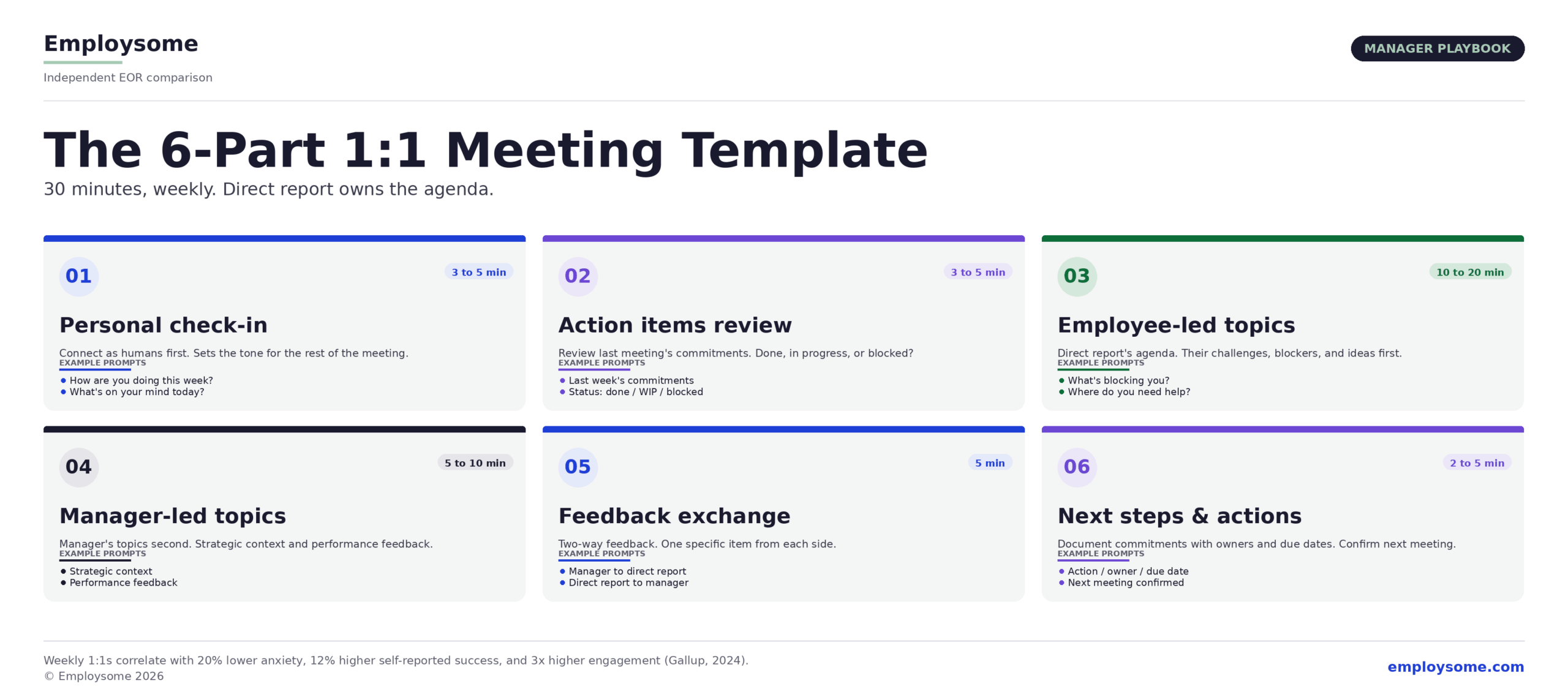
The 6-part 1:1 meeting template (30 to 60 minutes):
| Section | Time | Purpose |
| 1. Personal check-in | 3 to 5 minutes | Connect as humans before diving into work. How are you doing? What’s your energy like this week? |
| 2. Action items review | 3 to 5 minutes | Review commitments from the previous meeting. What got done? What’s still in progress? What changed? |
| 3. Employee-led topics | 10 to 20 minutes | Direct report’s agenda first. Challenges, blockers, questions, ideas, anything they want input on. |
| 4. Manager-led topics | 5 to 10 minutes | Your topics second. Strategic context, priorities, performance feedback, organisational changes. |
| 5. Feedback exchange | 5 minutes | Two-way feedback. Specific, actionable, balanced. Cover one item per side rather than a long list. |
| 6. Next steps and action items | 2 to 5 minutes | Document specific commitments with owners and due dates. Confirm the next meeting time. |
Why this order matters:
- Personal check-in first sets a human tone and surfaces energy or stress that will affect everything else. If your direct report reports they’re burnt out or going through something personal, that should shape the conversation that follows.
- Employee-led topics before manager-led topics is the most consequential design choice. When managers lead the agenda, 1:1s become glorified status meetings. When direct reports lead, 1:1s become genuine coaching conversations. This is the single biggest difference between an effective 1:1 culture and an ineffective one.
- Two-way feedback is not optional. Inviting feedback on your management style every few weeks is what closes the 71% / 37% gap between what managers think they’re providing and what direct reports actually receive.
The shared document approach: Both parties should be able to add agenda items throughout the week, not just in the 5 minutes before the meeting starts. Use sections like:
- This week’s agenda (topics for the upcoming meeting)
- Action items (commitments with owner and due date)
- Parking lot (topics for later, not urgent enough for this week)
- Goals and priorities (longer-term development goals, current quarter focus)
- Meeting log (running history of past meetings, scrolling down)
💡 Employsome Insight: The Single Habit That Separates Great 1:1s From Forgettable Ones
The single most important habit to build around 1:1s is the shared agenda before the meeting starts. Without one, both parties spend the first 10 minutes figuring out what to talk about, which is exactly the time when the most valuable conversation should already be happening. Send a reminder to your direct report 24 hours before each 1:1 with a single question: “Anything specific you’d like to cover tomorrow?” That one habit, more than any template, separates effective 1:1s from forgettable ones.
The 1:1 Meeting Template (Copy and Paste Ready)
Below is a complete, ready-to-use 1:1 meeting template you can copy and paste directly into your own Google Doc, Notion page, or Word document. Each section contains the prompts and structure your meeting needs, with editable placeholders ready for your first session.
Personal check-in (3 to 5 min)
Connect as humans before diving into work.
- How are you doing this week, on a scale of 1 to 10?
- What’s on your mind that you’d like to talk about today?
- [Your notes here]
Action items review (3 to 5 min)
Review commitments from last meeting. What got done? What’s still open?
- [Action item from last meeting] | owner: [name] | status: [done / in progress / blocked]
- [Action item from last meeting] | owner: [name] | status: [done / in progress / blocked]
Employee-led topics (10 to 20 min)
Direct report’s agenda first. Challenges, blockers, ideas, anything you want input on.
- [Topic 1: e.g. blocker on Project X, need input on approach]
- [Topic 2: e.g. customer escalation from last week, want to debrief]
- [Topic 3: e.g. ideas for improving the deployment process]
Manager-led topics (5 to 10 min)
Manager’s topics second. Strategic context, priorities, performance, organisational changes.
- [Topic 1: e.g. context on the new Q3 priority]
- [Topic 2: e.g. positive feedback on last week’s presentation]
Feedback exchange (5 min)
Two-way feedback. Specific, actionable, balanced. One item per side.
- Manager to direct report: [Specific observation + impact + suggested action]
- Direct report to manager: [What’s one thing I could do differently to support you better?]
Next steps and action items (2 to 5 min)
Document specific commitments with owners and due dates. Confirm next meeting time.
How to use this template:
- Copy the template above into a shared document (Google Doc or Notion page) that both you and your direct report can edit.
- Replace placeholders in square brackets with names, dates, topics. Both parties add agenda items throughout the week, not just before the meeting.
- Run the meeting in order from section 1 to section 6. Resist the temptation to skip the personal check-in or the feedback exchange.
- Save each meeting as a new entry at the top of the same document, scrolling older meetings down. This creates a running log you can search later.
- Start every meeting with action item review. Without this, commitments fade and the meeting becomes a conversation rather than a system.
For the question bank to use in section 3 and section 4, see the next section: 50+ questions sorted by situation. Pick 2 to 3 per meeting, rotate categories over the month.
50+ Questions to Ask in 1:1 Meetings, Sorted by Situation
The questions you ask in a 1:1 do more to determine its quality than any other variable. The list below organises 50+ proven questions by situation and purpose. Pick 2 to 3 per meeting, not the whole list. Rotating through different categories over a month gives you a balanced picture of how your direct report is really doing without the meeting feeling like an interrogation.
Personal check-in (3 to 5 minutes):
- How are you doing this week, on a scale of 1 to 10?
- What’s your energy level like right now?
- What’s on your mind that you’d like to talk about today?
- What’s been the highlight of your week so far?
- How are things outside of work?
Current work and priorities:
- What are your top 3 priorities this week?
- What’s blocking you right now?
- Where do you need my help or input?
- What part of your work is energising you most this week? Least?
- Is anything taking longer than expected? What’s causing the delay?
Performance and impact:
- What was the most meaningful thing you accomplished this week?
- How would you grade your work over the past two weeks? Why that grade?
- What’s one thing you could have done better?
- What outcome are you most proud of recently?
- If we ran this week again, what would you do differently?
Feedback (giving):
- Here’s something I noticed you did really well: [specific example]. What was your approach?
- I want to share some feedback on [topic], is now a good time?
- How do you prefer to receive feedback in general, in the moment or with time to process?
- What feedback have you received from peers or other stakeholders recently?
- Would you like more or less feedback from me on [specific area]?
Feedback (receiving from your direct report):
- What’s one thing I could do differently to support you better?
- What’s working in our 1:1s? What’s not?
- Am I giving you the right amount of context on the broader strategy?
- Am I delegating effectively, or are there things I should hand off?
- Where am I getting in your way?
Career and growth:
- What skills do you want to build over the next 6 months?
- What does the next step in your career look like to you?
- Where do you see yourself in 2 years? In 5?
- What part of your role energises you most? What would you want more of?
- If you could redesign your job, what would you change?
- What recent project taught you the most?
- Who at the company are you learning the most from right now?
Well-being and engagement:
- How sustainable is your current pace?
- Are you taking enough time off?
- Is there anything outside of work I should know is affecting you?
- Do you feel set up to do your best work?
- What’s draining your energy that we could change?
Team and organisation:
- How is the team feeling? What’s the mood?
- Are there any tensions or dynamics I should know about?
- Who on the team should I be paying more attention to?
- What’s slowing the team down that you wish leadership would fix?
- Do you have all the context you need on company strategy and priorities?
Strategic / stretch questions:
- If you were running this team, what’s the first thing you’d change?
- What would you do if you had unlimited resources for one quarter?
- What’s a problem you keep coming back to that we haven’t solved yet?
- If we did nothing differently for the next 6 months, what would go wrong?
- What conditions create your best work? What blocks them?
The SOON Coaching Framework: Success, Obstacles, Options, Next Steps
When a direct report brings a problem to a 1:1, the manager’s instinct is usually to solve it. This is the wrong instinct. 1:1s are where coaching happens, and coaching means helping the person think through the problem rather than thinking for them. The simplest framework for this is the SOON model developed by LifeLabs Learning, which has four stages.
| Stage | Question pattern | Goal |
| S for Success | What does success look like for this? | Define the desired outcome before discussing the problem |
| O for Obstacles | What’s getting in the way? | Surface the actual blockers (often different from the surface complaint) |
| O for Options | What are 2 or 3 different approaches you could take? | Force divergent thinking before convergent thinking |
| N for Next steps | What will you do by when? | Create a concrete, owned commitment |
Why this works: Most managers default to “jumping to solutions” when a direct report brings a problem. This produces two failure modes: either the manager solves the wrong problem (because they don’t fully understand the situation), or they solve the right problem in a way the direct report doesn’t buy into (because they didn’t generate the solution themselves). The SOON sequence forces both parties to slow down, which produces better solutions and stronger ownership.
The CAMPS engagement model from LifeLabs Learning offers a complementary framework for understanding what your direct report needs to be engaged: Certainty (clear expectations), Autonomy (control over their work), Meaning (work that matters to them), Progress (visible forward movement), and Social (positive relationships and inclusion). When a direct report seems disengaged or stuck, asking which of these five needs is undersupplied is often more diagnostic than asking generic “how are you doing” questions.
Specialised 1:1 Templates: First Meeting, Remote, Feedback, Skip-Level
The core 6-part template covers most weekly 1:1s, but several specific situations call for adapted versions. The variants below borrow the same structure but adjust emphasis and add situation-specific questions.
The first 1:1 with a new direct report: This meeting sets the entire relationship. Skip the action items review (there aren’t any yet) and use the time to align on expectations:
- What does a great manager-direct-report relationship look like to you?
- How do you prefer to receive feedback?
- What’s the best way to communicate with you between meetings?
- What does a great 1:1 look like to you?
- What should I know about how you work best?
- What past managers got right? What did they get wrong?
- What are you nervous about in this role? What are you most excited about?
- How will I know you’re struggling, even if you don’t tell me directly?
The remote 1:1: Distributed teams introduce specific risks (isolation, communication gaps, work-life boundaries blurring). Add these questions to the standard template every few weeks:
- How connected do you feel to the rest of the team this week?
- Who have you talked to outside our calls in the last 7 days?
- How are your boundaries between work and personal time?
- Are there any technical issues, hardware, or software gaps slowing you down?
- Do you have what you need to focus, including a workspace that works?
- Is there anyone you’ve never met in person you wish you could?
The constructive feedback 1:1: When you need to deliver difficult feedback, structure the conversation explicitly. The Lattice 6-step framework works well:
- State intent: Name this as a constructive feedback conversation. “I want to share some difficult feedback. Is now a good time?”
- Specific observations: Describe specific behaviours you observed directly, not interpretations. “In Tuesday’s meeting, you interrupted Maria three times before she finished her point.”
- Describe reactions: Explain the impact and consequences on team, projects, or outcomes. “Maria mentioned afterwards she felt shut down and didn’t share her remaining ideas.”
- Let them respond: Create space for the employee’s perspective with open-ended questions. “How does this land?”
- Offer solutions: Come prepared with supportive solutions and resources, not just the problem.
- Follow up: Confirm what changes by when, and schedule a specific follow-up to review progress.
The skip-level 1:1: When a senior leader meets with their direct report’s direct report (skipping a level of management), the goals are different. Focus on broader perspective questions rather than managing day-to-day work:
- What’s working well on your team that I might not see from where I sit?
- What’s one thing you wish leadership understood better?
- How well does the company strategy translate into what your team works on?
- If you could change one thing about how the company operates, what would it be?
The well-being check-in 1:1: Most weekly 1:1s include 3 to 5 minutes of well-being check-in within the personal check-in section. Some signals call for a dedicated, longer session:
- Energy declining over multiple consecutive weeks
- Visible signs of burnout (working late consistently, missing deadlines, irritability)
- Major life events (family illness, bereavement, big personal transitions)
- Performance changes that don’t match the person’s usual pattern
For dedicated well-being conversations, separate the meeting from regular performance topics so the direct report feels safe being honest. Make clear that what’s discussed stays between you (subject to legal requirements around safety risk).
How Often Should You Have 1:1s? Cadence and Duration
The most common 1:1 cadence questions are about frequency and duration. The research-backed answer is consistent: weekly 1:1s of 30 minutes are optimal for most manager-direct report relationships.
| Cadence | When it works | Risks |
| Weekly (30 min) | Most situations. New hires, fast-moving projects, complex roles, large reports portfolio | Can drift into status updates if not structured |
| Biweekly (45 to 60 min) | Stable, senior reports who don’t need weekly check-ins. Smaller teams where async communication is strong. | Issues fester for too long before being addressed |
| Monthly (60 to 90 min) | Career and development focus, very senior reports, partner relationships rather than reporting | Insufficient for performance management; no relationship building |
| Quarterly (90+ min) | Never as the primary cadence. Quarterly is good in addition to weekly, for development conversations | Inadequate by itself; not really a 1:1 culture |
Why weekly 30 minutes is the sweet spot: Research from multiple management studies shows weekly 1:1s correlate with 20% lower employee anxiety, 12% higher self-reported success, and 3 times higher engagement compared to less frequent meetings. 30 minutes is enough to cover the 6-part template at depth, but short enough that the meeting doesn’t become an obligation either party dreads. Going below 30 minutes typically forces both parties into status update mode.
Consistency over duration: A 30-minute 1:1 every week beats a 90-minute 1:1 once a month every time. Direct reports will share things in week 3 they wouldn’t share in week 1, and that cumulative trust building is what makes 1:1s effective. Cancelling 1:1s is the most common manager mistake: each cancellation signals that the conversation isn’t a priority, and trust takes weeks to rebuild.
If you have to cancel: Reschedule rather than skip. Even moving the meeting by a day or two preserves the cadence. If you genuinely have nothing to discuss, the right answer is usually to keep the meeting and use it for career development or stretch questions, not to cancel.
9 Common 1:1 Mistakes Managers Make
Most 1:1s fail in predictable ways. The list below covers the most common mistakes managers make, drawn from the failure patterns reported across Asana, Lattice, Leapsome, LifeLabs, and other management research.
- Treating 1:1s as status meetings: If the agenda is “what did you do this week,” you’re running a status meeting. Status updates belong in async channels (Slack, written updates, project tools). The 1:1 should focus on what async can’t cover: feedback, coaching, career, well-being.
- The manager owns the agenda: When the manager sets the agenda, the meeting becomes about the manager’s priorities. Direct reports should own the agenda, with the manager contributing 1 to 2 items per meeting.
- Cancelling repeatedly: Each cancellation signals something else matters more. Two consecutive cancellations is enough to damage the relationship for months.
- Jumping to solutions: When a direct report brings a problem, the manager’s instinct is to solve it. This robs the direct report of growth opportunities and often solves the wrong problem. Use SOON-style coaching questions instead.
- Not following up on action items: If commitments from one meeting don’t resurface in the next, the meeting becomes a conversation rather than a system. Always start with action item review.
- One-way feedback: Managers who only give feedback and never ask for it close themselves off from learning. The 71% / 37% feedback gap is closed by managers who deliberately ask for upward feedback every few weeks.
- Distractions and multitasking: Phones face down, laptops closed (or used only for shared notes), no checking Slack. The signal that the conversation matters is undivided attention.
- Skipping the personal check-in: Diving straight into work topics misses the energy and emotional context that determines what kind of conversation the rest of the meeting needs to be.
- Same agenda every week: A 1:1 that uses identical questions every week becomes mechanical. Rotate through different categories (career, feedback, well-being, strategy) to keep the conversation fresh.
- Talking too much: A common manager rule is to aim for 70% listening, 30% talking. If the manager is doing more than half the talking, the meeting is probably not serving the direct report.
Key Takeaways for Managers and HR Leaders
A 1:1 meeting template is a reusable structure for consistent one-on-one conversations
The best 1:1 templates follow a 6-part structure: personal check-in, action items review, employee-led topics, manager-led topics, feedback exchange, next steps. Anchor it to a shared running document that both parties edit before, during, and after the meeting.
Weekly 30 minutes is the optimal cadence for most relationships
Research shows weekly 1:1s correlate with 20% lower anxiety, 12% higher self-reported success, and 3 times higher engagement compared to less frequent meetings. Consistency matters more than duration: a weekly 30-minute 1:1 beats a monthly 90-minute 1:1 every time.
Direct reports should own the agenda, not managers
When managers set the agenda, 1:1s become status meetings. When direct reports set the agenda, they become coaching conversations. This is the single biggest design choice separating effective 1:1 cultures from ineffective ones.
Pick 2 to 3 questions per meeting, not the whole list
Rotating through different question categories (work, feedback, career, well-being, strategy) over a month gives a balanced picture without making the meeting feel like an interrogation. Stretch questions every few weeks push the conversation past routine status.
Use SOON-style coaching when problems come up
Success, Obstacles, Options, Next steps. Resist the instinct to jump to solutions; coaching questions produce better solutions and stronger ownership than manager-driven advice.
Two-way feedback closes the perception gap
71% of managers believe they give constructive feedback, but only 37% of direct reports agree. Deliberately ask for upward feedback every few weeks. “What’s one thing I could do differently to support you better?” is the simplest version that works.
Track action items in writing or the meeting becomes a conversation
Document specific commitments with owner and due date in your shared 1:1 doc. Always start the next meeting with action item review. Without this, 1:1s become pleasant chats with no accumulating impact.
Never cancel without rescheduling
Each cancelled 1:1 signals the conversation isn’t a priority. Two consecutive cancellations damages trust for months. If you must cancel, reschedule within the same week. If you have nothing to discuss, use the time for career or stretch questions instead.
Frequently Asked Questions
A 1:1 meeting template is a reusable, structured agenda that helps managers and direct reports run consistent one-on-one conversations. The standard template follows a 6-part structure: a brief personal check-in (3 to 5 minutes), review of action items from the previous meeting (3 to 5 minutes), employee-led topics (10 to 20 minutes), manager-led topics (5 to 10 minutes), two-way feedback exchange (5 minutes), and clear next steps (2 to 5 minutes). The template is most effective when paired with a shared running document that both parties can edit before, during, and after each meeting.
A good 1:1 agenda includes: a personal check-in to surface energy and well-being, an action items review from last meeting, the direct report’s topics first (challenges, blockers, ideas, questions), the manager’s topics second (priorities, feedback, organisational context), a two-way feedback exchange, and documented next steps with owners and due dates. The most consequential design choice is ordering: direct report topics before manager topics. When managers lead the agenda, 1:1s become status meetings; when direct reports lead, they become coaching conversations.
Weekly 1:1s of 30 minutes are optimal for most manager-direct report relationships. Research shows weekly 1:1s correlate with 20% lower employee anxiety, 12% higher self-reported success, and 3 times higher engagement compared to less frequent meetings. Biweekly works for stable, senior direct reports who don’t need weekly check-ins. Monthly or less frequent should be the exception, not the rule. Consistency matters more than duration: a weekly 30-minute 1:1 beats a monthly 90-minute 1:1 every time, because trust building accumulates over consecutive meetings.
The direct report should own the agenda for most weekly 1:1s. This empowers them to bring the topics that matter most to them (challenges, growth, feedback, ideas) and ensures the meeting serves their development rather than just the manager’s priorities. The manager should contribute 1 to 2 agenda items per meeting (performance feedback, strategic context, organisational changes), but the bulk of the agenda should come from the direct report. A balanced approach is for the direct report to send a draft agenda 24 hours before the meeting, with the manager adding any additional points before the conversation starts.
Pick 2 to 3 questions per meeting from a rotating set of categories: personal check-in, current work and priorities, performance and impact, feedback (giving and receiving), career and growth, well-being and engagement, team and organisation, and strategic stretch questions. Strong default questions for any 1:1 include “What’s on your mind today?”, “What’s blocking you right now?”, “What’s one thing I could do differently to support you better?”, and “What does success look like for [topic]?” Asking the same questions every week makes the meeting mechanical; rotating categories keeps the conversation fresh.
A weekly 1:1 should typically be 30 minutes. This is enough to cover the 6-part template (check-in, action items, employee topics, manager topics, feedback, next steps) at meaningful depth, but short enough that neither party dreads the meeting. Going below 30 minutes typically forces the meeting into status update mode. 45 to 60 minutes works better for biweekly cadence, monthly career conversations, or difficult feedback sessions. Going significantly over 60 minutes for routine 1:1s usually signals the meeting is covering work that should happen async or in dedicated topic-specific meetings.
SOON is a four-step coaching framework developed by LifeLabs Learning that helps managers respond to problems brought up in 1:1s without jumping to solutions. The four steps are: Success (what does success look like?), Obstacles (what’s getting in the way?), Options (what are 2 or 3 different approaches?), Next steps (what will you do by when?). Walking through SOON in order forces both parties to define the desired outcome before discussing the problem, surface the actual blockers, generate divergent options before converging, and create a concrete owned commitment. This produces better solutions and stronger ownership than manager-driven advice.
The first 1:1 with a new direct report sets the entire relationship. Skip the action items review (there aren’t any yet) and use the time to align on expectations. Ask: “What does a great manager-direct-report relationship look like to you?”, “How do you prefer to receive feedback?”, “What’s the best way to communicate between meetings?”, “What should I know about how you work best?”, “What past managers got right? What did they get wrong?”, and importantly “How will I know you’re struggling, even if you don’t tell me directly?” Use the meeting to set cadence (weekly 30 minutes is the default), agree on shared document approach, and confirm topics each of you want to revisit in the next 90 days.
A 1:1 is an ongoing, informal coaching and relationship conversation; a performance review is a formal, scheduled evaluation tied to compensation and career decisions. 1:1s happen weekly or biweekly, focus on real-time challenges, feedback, and growth, and create no formal record beyond shared notes. Performance reviews happen quarterly, biannually, or annually; involve formal documentation, ratings, and competency evaluation; tie to compensation cycles and promotion decisions; and often involve HR processes, peer feedback, and self-assessment. The two are complementary: well-run weekly 1:1s mean the performance review contains no surprises.
The most common 1:1 mistakes include: treating 1:1s as status meetings (use Slack or async tools for status); the manager owning the agenda instead of the direct report; cancelling repeatedly (each cancellation damages trust for weeks); jumping to solutions instead of using coaching questions; not following up on action items between meetings; one-way feedback (managers giving but not asking for upward feedback); distractions and multitasking during the meeting; skipping the personal check-in; using identical questions every week; and the manager talking more than 30% of the time. Most failure patterns can be traced to one root cause: insufficient structure. A clear template, a shared agenda, and consistent cadence resolve most of these issues.
Courtney Pocock is a Copywriter at Employsome with 15+ years of experience writing for the HR, corporate, and financial sectors. She has a strong interest in global business expansion and Employer of Record / PEO topics, focusing on news that matters to business owners and decision-makers. Courtney covers industry updates, regulatory changes, and practical guides to help leaders navigate international hiring with confidence. Connect with Courtney on LinkedIn.
Our content is created for informational purposes only and is not intended to provide any legal, tax, accounting, or financial advice. Please obtain separate advice from industry-specific professionals who may better understand your business’s needs. Read our Editorial Guidelines for further information on how our content is created.
Other posts
Along with our standard maps we offer highly customizable maps.