Employee Performance Goals: 10 SMART Examples for 2026
Effective employee performance goals turn vague expectations into specific, measurable, time-bound targets. This guide gives you 10 SMART-format examples across the most common categories – productivity, quality, customer service, leadership, professional development, communication, sales, technical skills, behavioural, and team contribution – each with target, metric, timeline, and a coaching note for managers, plus how to write goals that work and common mistakes to avoid.


Table of Contents
- SMART Framework
- 10 Examples
- 1. Productivity
- 2. Quality
- 3. Customer Service
- 4. Leadership
- 5. Professional Development
- 6. Communication
- 7. Sales
- 8. Technical Skills
- 9. Behavioural
- 10. Team Contribution
- How to Write Goals
- Mistakes to Avoid
- Goals & Review Cycles
- What HR Teams and Managers Need to Know
- FAQs
Effective employee performance goals turn vague expectations like “be more productive” into specific, measurable, time-bound targets that drive real results. The most useful goals follow the SMART framework (Specific, Measurable, Achievable, Relevant, Time-bound), pair an outcome with a target metric and deadline, and ladder up to the broader business or team objective. Done well, they align effort with priority, surface skill gaps early, and replace subjective performance conversations with data-backed reviews.
This guide covers 10 practical employee performance goals examples across the most common categories that line managers and HR teams set: productivity, quality, customer service, leadership, professional development, communication, sales, technical skills, behavioural goals, and team contribution. Each example is written in SMART format with the target, measurement method, and a coaching note for managers. The article also covers how to write performance goals that actually work, common mistakes to avoid, and how to tie goals to formal review cycles.

The SMART Framework: How Effective Performance Goals Are Structured
Before the examples, a quick refresher on the framework most of them use. SMART stands for:
- Specific: clearly defined, with no room for ambiguity (“close 12 enterprise deals”, not “close more deals”)
- Measurable: tied to a metric or completion criterion you can verify objectively
- Achievable: stretching but realistic given the employee’s role, tenure, and resources
- Relevant: aligned to the team’s and company’s broader objectives, not a vanity target
- Time-bound: with an explicit deadline (end of quarter, within 6 months, by review date)
A useful add-on is the SMARTER extension, which adds Evaluated (regular check-ins) and Reviewed (adjusted as conditions change). Static goals set in January and ignored until December tend to underperform; goals that are reviewed quarterly tend to deliver measurably better outcomes.
10 Employee Performance Goals Examples
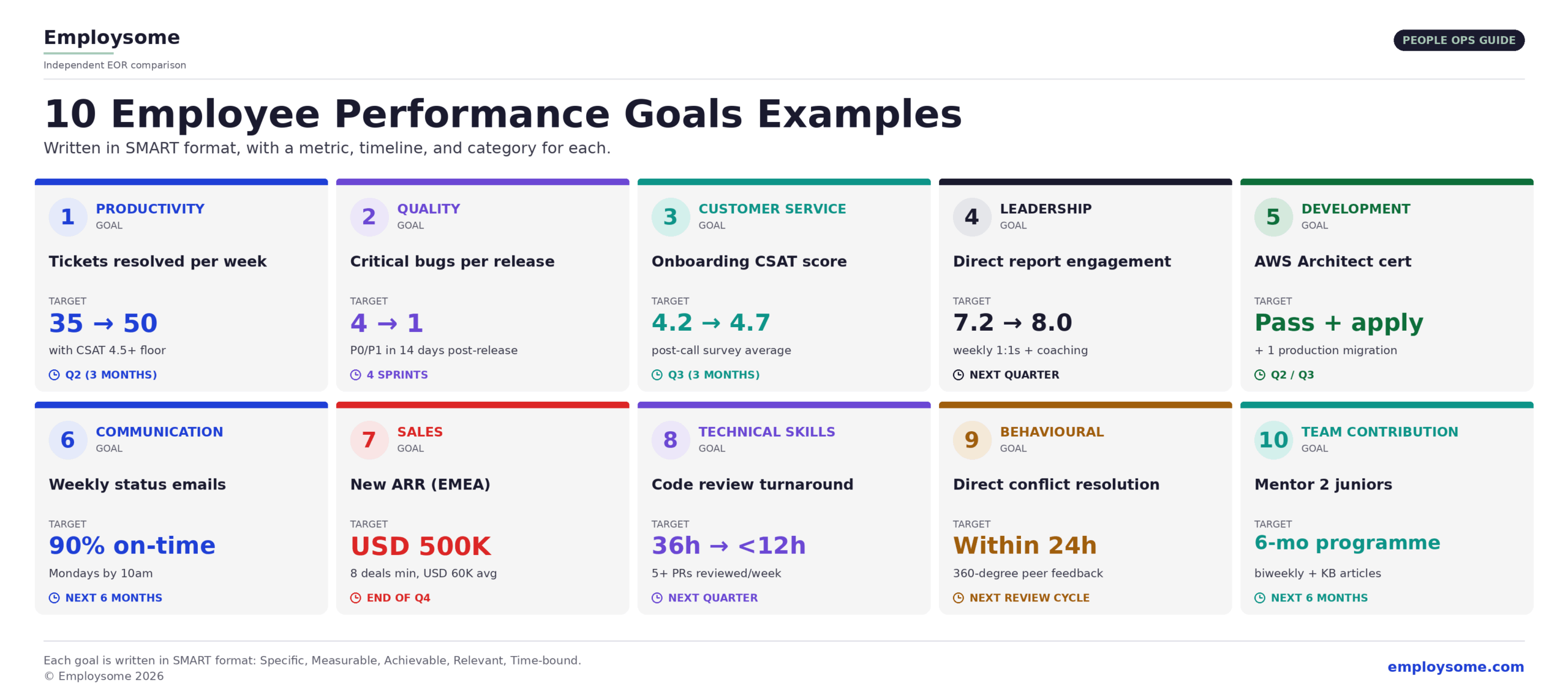
The 10 examples below cover the most common categories used in modern performance management. Each is written in SMART format with target, metric, timeline, and a coaching note that explains why the goal works and how to manage it.
Example 1: Productivity Goal (Customer Support)
Category: Productivity
Goal: Increase weekly output of completed customer support tickets from a baseline of 35 per week to 50 per week by the end of Q2, while maintaining a CSAT score of 4.5 out of 5 or higher.
| Metric | Tickets resolved per week (Zendesk dashboard); CSAT (post-ticket survey) |
| Timeline | End of Q2 (3 months) |
Coaching note for managers: Pair productivity goals with a quality guardrail. Without the CSAT floor, employees may rush tickets and erode customer experience. Review weekly for the first month, then biweekly.
Example 2: Quality Goal (Engineering)
Category: Quality
Goal: Reduce critical bugs in production releases from an average of 4 per release to 1 or fewer per release across the next 4 sprint cycles, by introducing pre-merge review checklists and pair-programming on high-risk modules.
| Metric | Number of P0 and P1 bugs reported in the 14 days post-release (Jira) |
| Timeline | End of next 4 sprints (8 weeks) |
Coaching note for managers: Quality goals work best when paired with a process change, not just a target. Make the checklist or pairing practice visible so progress is observable, not just measured at the end.
Example 3: Customer Service Goal (Onboarding)
Category: Customer Service
Goal: Improve the customer satisfaction score (CSAT) on outbound onboarding calls from 4.2 to 4.7 out of 5 over the next quarter, by implementing a structured call agenda and follow-up email template within 24 hours of each call.
| Metric | Average CSAT score on post-onboarding survey |
| Timeline | End of Q3 (3 months) |
Coaching note for managers: Customer service goals often improve through small structural changes (templates, agendas) rather than personality coaching. Watch for outliers in the score distribution rather than just the average.
Example 4: Leadership Goal (People Manager)
Category: Leadership / Management
Goal: Improve direct report engagement scores in the next quarterly pulse survey from 7.2 to 8.0 out of 10, by holding weekly 1:1s with each of the 6 direct reports, documenting development conversations, and completing a leadership coaching programme.
| Metric | Engagement score on quarterly pulse survey; 1:1 completion rate |
| Timeline | End of next quarter (3 months) |
Coaching note for managers: Leadership goals are most effective when they include specific behaviours (1:1s held, development plans documented), not just outcome metrics. Outcomes lag inputs by 6 to 12 weeks.
Example 5: Professional Development Goal (Technical Certification)
Category: Professional Development
Goal: Complete the AWS Solutions Architect Associate certification by the end of Q2, dedicating 4 hours per week to study and applying the learning to migrate at least one production service to a new region by the end of Q3.
| Metric | Certification pass / fail; production migration completed |
| Timeline | Certification by end Q2; applied project by end Q3 |
Coaching note for managers: Development goals must include an applied component. Certification without practical application is a sunk cost; tie the credential to a real project to lock in the skill.
Example 6: Communication Goal (Project Updates)
Category: Communication
Goal: Deliver clear written project status updates to stakeholders by sending a structured weekly update email every Monday by 10am, covering progress, blockers, decisions needed, and next steps, with at least 90% on-time delivery over the next 6 months.
| Metric | On-time delivery rate (timestamp on sent emails); stakeholder feedback in mid-cycle review |
| Timeline | Next 6 months |
Coaching note for managers: Communication goals are best framed as a habit (frequency, format, timing) rather than a vague “improve communication.” The 90% threshold builds room for legitimate misses.
Example 7: Sales Goal (Account Executive)
Category: Sales
Goal: Close USD 500,000 in new annual recurring revenue (ARR) from new logo accounts in the EMEA region by the end of Q4, with a minimum of 8 closed deals and an average deal size of USD 60,000 or higher.
| Metric | Closed-won ARR (Salesforce); deal count and average deal size |
| Timeline | End of Q4 (current fiscal year) |
Coaching note for managers: Sales quota goals should always include both a revenue figure and a deal count or deal size guardrail. Revenue alone can be hit by one large outlier deal that doesn’t reflect repeatable performance.
Example 8: Technical Skills Goal (Code Review)
Category: Technical Skills
Goal: Reduce average code review turnaround time from 36 hours to under 12 hours over the next quarter, by establishing a daily review hour, documenting team review standards, and reviewing at least 5 PRs per week.
| Metric | Average PR review time (GitHub or GitLab dashboard); reviews completed per week |
| Timeline | End of next quarter (3 months) |
Coaching note for managers: Technical skills goals can be input-driven (reviews completed) or outcome-driven (turnaround time). Combining both prevents employees from gaming a single metric.
Example 9: Behavioural Goal (Conflict Resolution)
Category: Behavioural / Soft Skills
Goal: Demonstrate constructive conflict-resolution behaviours in cross-functional meetings by addressing disagreements directly with colleagues within 24 hours rather than escalating to managers, with progress evaluated through 360-degree peer feedback at the next review cycle.
| Metric | 360-degree peer feedback scores on conflict-resolution behaviours; manager observation |
| Timeline | Next 6-month review cycle |
Coaching note for managers: Behavioural goals are inherently subjective. Tie them to a specific feedback mechanism (360 reviews, peer surveys) and document examples in 1:1s, otherwise the goal becomes “the manager’s opinion at year-end.”
Example 10: Team Contribution Goal (Mentoring)
Category: Team Contribution
Goal: Mentor two junior team members through a structured 6-month onboarding programme, hosting biweekly mentoring sessions, owning their first-90-days review, and documenting one knowledge-base article per month based on common questions.
| Metric | Mentee 90-day review completion; knowledge-base articles published; mentee feedback at 6 months |
| Timeline | Next 6 months |
Coaching note for managers: Team contribution goals reward employees who scale others, not just themselves. Make sure these goals are weighted in the review process; otherwise high performers learn that helping the team has no career payoff.
💡 Employsome Insight: The Best Performance Goals Are Co-Authored, Not Assigned
Goals imposed top-down hit fewer targets than goals where the employee had meaningful input on the metric and approach. The manager’s job is to ensure the goal ladders up to the team objective and is genuinely stretching; the employee’s job is to own the path. When both contribute to the wording, ownership and follow-through both improve materially.
How to Write Performance Goals That Actually Work
The 10 examples above share a common structure that you can apply to any role. To write effective performance goals from scratch, work through these steps:
- Start with the team or company objective. The employee’s goal should ladder up to a broader outcome, otherwise it risks being a vanity target.
- Choose 3 to 5 goals total, not 10+. Concentrating effort beats scattering it. Most performance management research suggests fewer, more meaningful goals outperform long lists.
- Mix outcome goals and behaviour goals. Outcome goals (close X deals) measure results; behaviour goals (hold weekly 1:1s) measure inputs. Outcomes are more important but behaviours are more controllable.
- Pair every quantitative goal with a quality guardrail. “Close 50 tickets per week” alone invites shortcuts; “close 50 tickets per week with CSAT 4.5+” builds in protection.
- Write the measurement method explicitly. “Measured by Zendesk dashboard” is far better than “measured by performance.” Specifying the tool and dashboard prevents end-of-cycle disputes.
- Set a real deadline. “By end of Q2” is better than “as soon as possible.”
- Review monthly, not annually. Goals set in January and reviewed in December are functionally just wishes. Quarterly check-ins minimum, monthly preferred.
- Document agreement explicitly. Both manager and employee should have written copies, ideally in a shared HR system.
Common Mistakes to Avoid
Even with a solid framework, performance goals fail in predictable ways. The most common mistakes:
- Setting goals that aren’t measurable: “Be more collaborative” cannot be evaluated objectively. If you cannot identify a metric or completion criterion, the goal will become a year-end argument about interpretation.
- Setting too many goals: 12 goals across 4 categories means no real prioritisation. Focus on 3 to 5 goals that genuinely matter.
- Goals that don’t ladder up: An employee’s goal should connect to a team objective, which connects to a company objective. Goals in isolation become resume bullet points rather than business outcomes.
- No baseline: “Increase customer satisfaction” means nothing without a starting score. Always document the baseline measurement at goal-setting time.
- Stretch goals masquerading as targets: A 50% growth goal when the team has historically grown 5% per year demoralises rather than motivates. Stretch goals are valuable, but should be labelled as such.
- Goals tied only to bonus: When goals exist only for compensation, employees optimise for the metric and ignore the spirit. Use a mix of rated and unrated goals.
- Set-and-forget: Goals reviewed only at year-end miss the window for course correction. Quarterly reviews are the realistic minimum.
- No connection to development: Performance goals that don’t include a development component suggest the employee is fully formed and only needs to execute, which is rarely true.
How Goals Fit Into the Performance Review Cycle
Employee performance goals work best when they’re embedded in a structured review process rather than a once-a-year ritual. Most modern performance management cycles follow this rhythm:
| Touchpoint | Frequency | Purpose |
| Goal-setting conversation | Annually or per cycle | Align goals to team and company priorities |
| Weekly 1:1 | Weekly | Surface blockers, track informal progress |
| Monthly check-in | Monthly | Light review of metrics; coaching |
| Quarterly review | Quarterly | Formal progress check; adjust goals if needed |
| Mid-cycle review | Every 6 months | Full performance conversation; preview year-end |
| Annual review | Annually | Final rating; compensation discussion; next-cycle goal-setting |
Some organisations have moved away from formal annual reviews entirely (Adobe’s “check-in” model, Deloitte’s rolling reviews) in favour of more frequent, lower-stakes conversations. Whatever the cadence, the most important factor is that goals are revisited and updated. A goal set in January and revisited in December is rarely still the right goal.
What HR Teams and Managers Need to Know
Use the SMART framework, not just intuition
Specific, Measurable, Achievable, Relevant, Time-bound goals consistently outperform vague aspirations. The framework forces precision that pays off at review time.
Limit goals to 3 to 5 per cycle
More goals fragment effort. Concentrate on the few that genuinely matter for the role and the business outcome.
Always pair quantitative goals with quality guardrails
A volume metric without a quality floor invites shortcuts. “50 tickets per week with CSAT 4.5+” is far stronger than “50 tickets per week.”
Mix outcome goals with behaviour goals
Outcome goals (close X deals) measure what got done; behaviour goals (hold weekly 1:1s) measure how the work happens. Behaviours are more controllable; outcomes matter more for the business.
Document the baseline at goal-setting time
“Increase CSAT” is meaningless without a starting score. Capture the baseline metric the day the goal is agreed, with the data source noted.
Review quarterly minimum, monthly preferred
Goals reviewed only at year-end miss the window for course correction. Quarterly check-ins build accountability without creating bureaucracy.
Tie individual goals to team and company objectives
An employee’s goal should ladder up to a broader outcome. Standalone goals become resume bullets rather than business results.
Frequently Asked Questions
Employee performance goals are specific, measurable, time-bound targets that an employee agrees with their manager at the start of a performance cycle, then works toward across the quarter or year. Effective performance goals follow the SMART framework (Specific, Measurable, Achievable, Relevant, Time-bound) and ladder up to broader team and company objectives. They typically combine outcome targets (such as revenue closed or tickets resolved) with behaviour targets (such as holding weekly 1:1s or completing certifications) to capture both what gets done and how it gets done.
A SMART performance goal is a goal that is Specific, Measurable, Achievable, Relevant, and Time-bound. “Close USD 500,000 in new ARR by end of Q4” is a SMART goal; “close more deals” is not. The framework forces precision so the goal can be evaluated objectively at review time. The SMARTER extension adds Evaluated (regular check-ins) and Reviewed (adjusted as conditions change), which addresses the most common failure mode of static goals that go unreviewed for an entire year.
Most performance management research suggests 3 to 5 goals per cycle is the sweet spot. Fewer than 3 risks under-stretching the employee or missing important parts of the role; more than 5 fragments effort and tends to dilute focus. The mix should typically include 1 to 2 outcome goals (revenue, delivery), 1 to 2 development goals (skills, certifications), and 1 behaviour or team contribution goal. Larger lists indicate the goal-setting process is being used as a to-do list rather than a prioritisation tool.
Examples include: increase weekly resolved support tickets from 35 to 50 with CSAT above 4.5 (productivity); reduce production bugs from 4 to 1 per release (quality); close USD 500,000 in new ARR by Q4 (sales); improve direct report engagement scores from 7.2 to 8.0 (leadership); complete an AWS certification by end Q2 (development); reduce code review turnaround from 36 hours to under 12 hours (technical skills). The common pattern: a baseline figure, a target figure, a timeline, and a documented data source.
Monthly is ideal; quarterly is the realistic minimum. Goals reviewed only at the end of the year functionally become wishes rather than commitments because there is no opportunity for course correction. Most modern performance management cycles include weekly 1:1s for blockers, monthly check-ins for metrics, quarterly formal reviews for progress, and a mid-cycle review at 6 months. Static “set and forget” goals consistently underperform goals that are revisited and adjusted as conditions change.
Performance goals measure what the employee accomplishes in their current role this cycle: revenue closed, tickets resolved, projects shipped. Development goals measure how the employee is growing toward their next role or expanded responsibility: certifications earned, mentoring undertaken, new skills acquired. Most effective performance plans include both: pure performance goals tend to leave employees stagnant, while pure development goals can leave the current role under-delivered. A 70/30 or 80/20 split toward performance is typical.
For new employees, set a 30/60/90-day plan rather than a full annual cycle initially. Days 1 to 30 focus on learning (complete onboarding, meet stakeholders, understand systems); days 31 to 60 on contribution (deliver one defined output independently); days 61 to 90 on ownership (run a small project end-to-end). After day 90, transition the employee to standard quarterly performance goals aligned with their team’s objectives. Setting full annual goals on day 1 is usually counterproductive because the employee lacks the context to commit credibly.
OKRs (Objectives and Key Results) are typically used at the team or company level to set ambitious directional outcomes (the Objective) and 3 to 5 measurable indicators of progress (the Key Results). They are usually set quarterly and intentionally include stretch targets that may not be fully achieved. Individual performance goals are typically used for the employee’s own annual or semi-annual review and tend to be calibrated to be achievable rather than stretching. Many organisations use both: company OKRs at the top, individual performance goals cascaded from them.
Some performance goals should be tied to compensation, but not all of them. When every goal is tied to bonus, employees optimise for the metric at the expense of the spirit (a phenomenon known as Goodhart’s Law: “when a measure becomes a target, it ceases to be a good measure”). A common balance is 60% to 70% of variable compensation tied to a small number of clear quantitative goals (revenue, delivery, retention), with the remainder reserved for qualitative and behavioural goals reviewed but not formulaically rewarded.
First, separate missed because of effort from missed because of conditions. If conditions changed (market downturn, project cancellation, illness), the goal should have been adjusted mid-cycle rather than penalised at year-end; this is a goal-setting process failure, not a performance failure. If effort fell short, the conversation should focus on whether the goal was achievable, what blocked progress, what support was missing, and what the employee plans to do differently. Repeated missed goals across multiple cycles are a different conversation, often best handled with a structured performance improvement plan (PIP).
Copywriter
Christa is a Copywriter at Employsome with 17 years of professional writing experience across global brands, startups, and online publications. A native English-Finnish writer, she brings strong editorial skills and a versatile background in business, SaaS, and finance. At Employsome, Christa focuses on clear, practical content about HR, payroll, and Employer of Record topics.
Our content is created for informational purposes only and is not intended to provide any legal, tax, accounting, or financial advice. Please obtain separate advice from industry-specific professionals who may better understand your business’s needs. Read our Editorial Guidelines for further information on how our content is created.
Other posts
Review other templates