
Average Salary in the Philippines 2026: PSA Data, BPO & Rates
The average salary in the Philippines in 2026 is approximately ₱21,544 (USD 380) per month for full-time formal-sector workers per the Philippine Statistics Authority, with skilled professionals earning ₱25,000-45,000. This guide covers wages by industry, city (Metro Manila, Cebu, Davao), the regional minimum wage system, TRAIN Law income tax, SSS / PhilHealth / Pag-IBIG contributions, the mandatory 13th month pay, BPO salaries, and USD-denominated remote work pay.

The average salary in the Philippines in 2026 is approximately ₱21,544 per month (USD 380) for full-time formal-sector workers, according to the most recent Philippine Statistics Authority (PSA) Occupational Wages Survey. This breaks down into ₱20,309 basic pay plus ₱1,235 in allowances. Skilled professionals working in technology, finance, and BPO typically earn ₱25,000 to ₱45,000 per month, while the median monthly income sits closer to ₱13,000 to ₱20,000 when informal-sector workers are included. Average annual salary, including the mandatory 13th month pay, is approximately ₱280,000 (USD 4,930).
Three structural features make Philippine salary data particularly tricky to interpret. First, the country has no national minimum wage: 17 Regional Tripartite Wages and Productivity Boards (RTWPBs) set separate daily minimums by region, with NCR (Metro Manila) at ₱645 per day and the lowest regional rates around ₱395 per day. Second, the Philippines mandates a 13th month pay under Presidential Decree 851 paid every December, which adds approximately one month’s salary to annual income (with the first ₱90,000 tax-exempt). Third, BPO and remote work salaries materially exceed PSA averages because Filipino professionals are increasingly hired by foreign companies paying in USD, GBP, or EUR.
This 2026 guide to the average salary in the Philippines covers official PSA Occupational Wages Survey data, salary by industry (technology, finance, BPO, manufacturing, healthcare), salary by city (Metro Manila, Cebu, Davao, Iloilo), salary by experience and role, the regional minimum wage system, the TRAIN Law income tax brackets, mandatory SSS / PhilHealth / Pag-IBIG contributions, the 13th month pay mechanic, BPO salaries, salary in USD purchasing power terms, projected 2026 increases, and what international employers hiring through a Philippine Employer of Record (EOR) need to know.

Average Salary in the Philippines 2026: Latest PSA Data
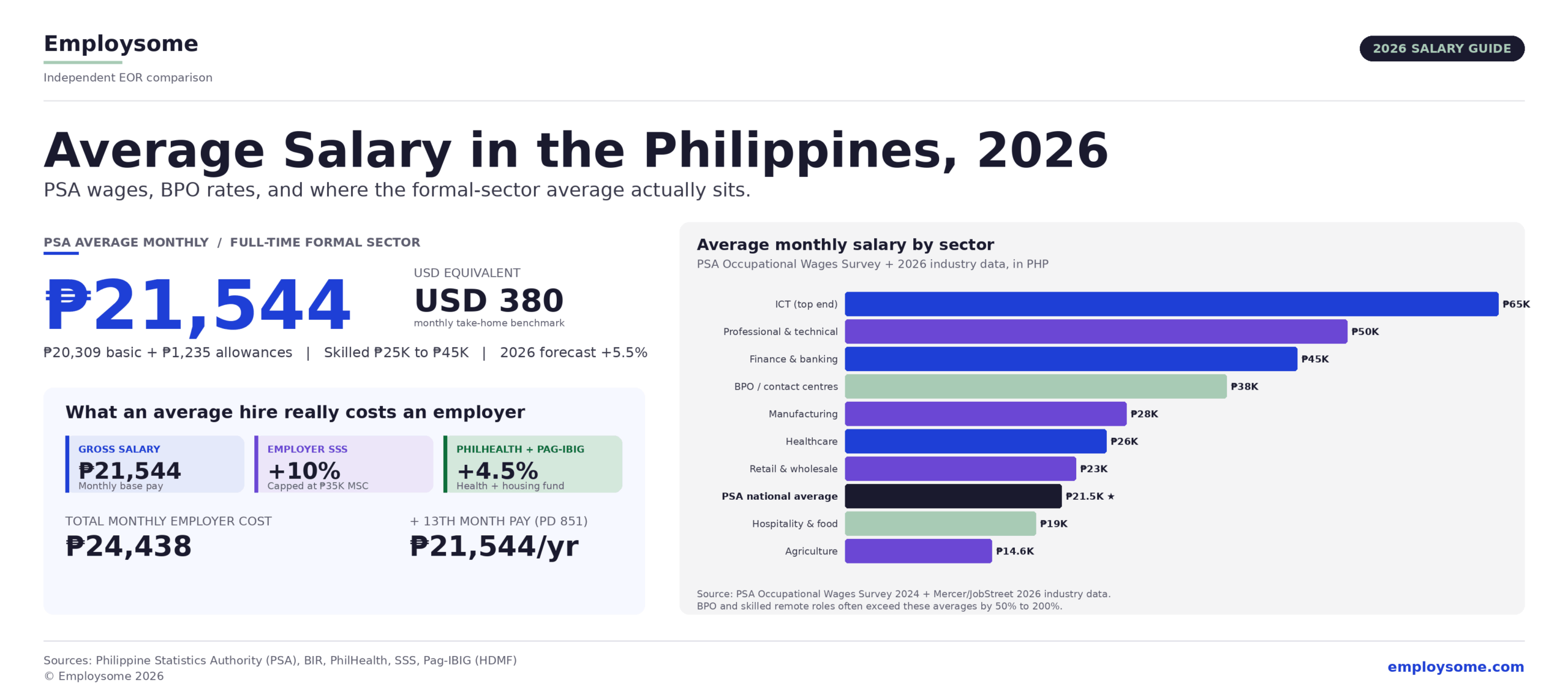
According to the Philippine Statistics Authority (PSA) Occupational Wages Survey 2024 (the most recent official release available in 2026) and updated industry surveys, the 2026 wage benchmarks for the Philippines are as follows:
| Wage Indicator (2026) | Value (PHP) | Approx. USD |
| PSA average monthly wage rate (full-time, formal sector) | ₱21,544 | USD 380 |
| Of which: average basic pay | ₱20,309 | USD 358 |
| Of which: average allowances | ₱1,235 | USD 22 |
| Skilled professionals (typical range) | ₱25,000 to 45,000 | USD 440 to 793 |
| Median monthly salary (all workers) | ₱13,000 to 20,000 | USD 229 to 352 |
| Median household income (annual, PSA FIES) | ₱353,230 | USD 6,225 |
| Annual gross salary including 13th month (avg) | ₱280,000 | USD 4,930 |
| Net monthly salary (after deductions, average earner) | ~₱19,000 | USD 335 |
| Highest sector: Information & Communications Technology | ₱43,676 | USD 770 |
| Lowest sector: Agriculture, Forestry & Fishing | ₱14,615 | USD 257 |
| 2026 projected wage increase (WTW) | +5.5% | n/a |
Why average and median diverge so dramatically: The PSA ₱21,544 figure covers full-time, time-rated workers in formal establishments with 10 or more employees. This excludes the informal sector, which accounts for an estimated 60%+ of the Philippine workforce, and excludes part-time, contractual, and gig workers. When informal and gig workers are included, the median monthly income drops to roughly ₱13,000 to ₱20,000. For employers benchmarking salaries to attract formal-sector talent, the PSA full-time figure is the more relevant baseline.
The remote work and BPO premium: Filipino professionals working for foreign companies as remote employees, BPO staff, virtual assistants, or freelance contractors frequently earn 2 to 4 times the PSA average. A Filipino software engineer working for a US scale-up can earn USD 1,500 to USD 4,500 per month (₱85,000 to ₱255,000), well above what the same engineer would earn at a Philippine-domiciled employer. This dynamic increasingly shapes salary expectations across the wider labour market.
💡 Employsome Insight: Distinguish PSA Averages From Competitive Market Rates
When benchmarking Philippine hires, distinguish between the PSA national average and the competitive market rate for skilled remote talent. The PSA figure of ₱21,544 is correct for understanding the broader labour market but is significantly below what global companies actually pay to attract experienced Filipino developers, accountants, marketers, or customer success staff. A more realistic budgeting figure for skilled remote roles is ₱35,000 to ₱70,000 per month, with senior tech and finance roles routinely above ₱100,000. Underbidding the market with PSA-anchored offers is a common newcomer mistake that leads to high-quality candidates declining offers.
Average Salary in the Philippines by Industry and Sector
Industry differences in the Philippines are pronounced, with technology and finance roles paying 2 to 3 times the lowest sectors. The data below combines PSA Occupational Wages Survey 2024 figures with industry-specific salary surveys (Mercer, JobStreet, WTW), expressed as average monthly gross salary for full-time workers in 2026.
| Industry / Sector | Average Monthly Gross Salary 2026 (PHP) |
| Information & Communications Technology (ICT) | ₱35,000 to 65,000 (PSA ₱43,676) |
| Professional, Scientific & Technical Activities | ₱30,000 to 55,000 (PSA ₱36,096) |
| Electricity, Gas & Air Conditioning Supply | ₱30,000 to 45,000 (PSA ₱35,188) |
| Finance, Banking & Insurance | ₱28,000 to 60,000 |
| Pharmaceuticals & Life Sciences | ₱25,000 to 50,000 |
| Business Process Outsourcing (BPO / Contact Centres) | ₱25,000 to 40,000 |
| Manufacturing (electronics, automotive, food processing) | ₱21,000 to 35,000 |
| Construction & Real Estate | ₱20,000 to 32,000 |
| Wholesale & Retail Trade | ₱18,000 to 28,000 |
| Transportation & Logistics | ₱18,000 to 30,000 |
| Healthcare & Social Services | ₱18,000 to 35,000 |
| Education (private and public) | ₱18,000 to 30,000 |
| Hospitality, Hotels & Food Service | ₱15,000 to 24,000 |
| Agriculture, Forestry & Fishing | ₱14,615 (PSA average) |
Specific 2026 role benchmarks (gross monthly): a software engineer in Metro Manila earns ₱45,000 to ₱110,000 depending on level and employer, with senior engineers at multinationals or remote-first foreign companies reaching ₱140,000 to ₱280,000+ including USD-denominated bonuses; a BPO customer service agent earns ₱25,000 to ₱38,000; a financial analyst ₱35,000 to ₱60,000; a marketing manager ₱45,000 to ₱80,000; a registered nurse ₱25,000 to ₱40,000; an HR manager ₱45,000 to ₱75,000; and a virtual assistant working for foreign clients ₱30,000 to ₱80,000.
The Philippines is particularly strong in BPO and contact centres (the country is widely known as the “BPO Capital of the World”, with the industry employing over 1.7 million workers and contributing roughly 8% of GDP), IT services and software development, healthcare and nursing, finance and accounting shared services, and creative services. Strong English proficiency, cultural affinity with Western markets, and a young, college-educated workforce drive this sectoral concentration.
Average Salary by City: Metro Manila, Cebu, Davao, Iloilo
Salary in the Philippines varies dramatically by location, with Metro Manila commanding a 20% to 50% premium over provincial and rural rates. The country’s major economic hubs cluster wages around national or above-national averages, while smaller cities and rural barangays pay materially less.
| City / Region | Average Monthly Salary 2026 (PHP) | Notes |
| Metro Manila (NCR) | ₱30,000 to 45,000 | Capital region; finance, BPO, government, multinationals |
| Cebu City | ₱25,000 to 38,000 | Second-largest BPO hub; IT services; tourism |
| Davao City | ₱22,000 to 32,000 | Largest Mindanao city; agriculture and IT growth |
| Iloilo City | ₱21,000 to 30,000 | Visayas regional centre; growing BPO sector |
| Cagayan de Oro | ₱20,000 to 28,000 | Northern Mindanao economic centre |
| Bacolod | ₱19,000 to 27,000 | Negros Occidental capital; sugar, BPO |
| Baguio City | ₱19,000 to 28,000 | Cordillera regional centre; education, tourism |
| Clark / Angeles (Pampanga) | ₱22,000 to 32,000 | Special Economic Zone; BPO, aviation |
| Subic / Olongapo | ₱21,000 to 30,000 | Freeport zone; logistics, manufacturing |
| Cagayan Valley & rural Luzon | ₱15,000 to 22,000 | Lower-cost regions; agriculture and trades |
| BARMM (Mindanao autonomous region) | ₱14,000 to 20,000 | Lowest regional wages; rural economy |
Cost of living context: A 1-bedroom apartment in central Metro Manila (Bonifacio Global City, Makati, Ortigas) rents for approximately ₱25,000 to ₱50,000 per month. The same apartment in Cebu City costs ₱15,000 to ₱25,000; in Davao or Iloilo ₱10,000 to ₱18,000; in smaller provincial cities ₱6,000 to ₱12,000. Total monthly expenses for a single person in Metro Manila run roughly ₱45,000 to ₱70,000 including rent; in provincial cities, ₱20,000 to ₱35,000.
The Metro Manila vs regional trade-off: A salary of ₱50,000 monthly in Metro Manila provides comparable discretionary income to ₱38,000 in Cebu or ₱32,000 in Davao once housing and general cost of living are factored in. For remote-first employers, Cebu City has emerged as the most credible alternative to Manila: strong BPO talent pool, Tier-1 broadband, 20-30% lower living costs, and an established expat community. Davao and Iloilo are rapidly catching up.
💡 Employsome Insight: BPO Pay Floors Run 20% to 30% Above PSA Averages
BPO industry concentration creates wage pressure that benefits employers paying above local averages. The minimum competitive offer for a college-educated BPO agent in Metro Manila is approximately ₱25,000 to ₱30,000 per month with night-shift differential; below that, attrition exceeds 50% annually. For senior BPO roles (team leads, quality analysts, operations managers), the competitive floor is ₱45,000 to ₱70,000. Foreign employers benchmarking PSA averages alone routinely under-budget BPO hires and lose candidates to higher-paying competitors during the offer stage.
Minimum Wage in the Philippines: The Regional System
The Philippines has no national minimum wage. Instead, 17 Regional Tripartite Wages and Productivity Boards (RTWPBs), established under the 1989 Wage Rationalization Act, set daily minimum wages separately for each of the country’s 17 regions, with further variations by sector (non-agriculture vs agriculture vs retail) and establishment size.
| Region (2026 daily minimum, non-agriculture) | Daily Min (PHP) | Approx. Monthly Equivalent (PHP) |
| National Capital Region (Metro Manila) | ₱645 | ₱16,770 |
| Calabarzon (Region IV-A) | ₱425 to 560 | ₱11,050 to 14,560 |
| Central Luzon (Region III) | ₱435 to 550 | ₱11,310 to 14,300 |
| Western Visayas (Region VI) | ₱480 to 513 | ₱12,480 to 13,338 |
| Cordillera Administrative Region (CAR) | ₱470 | ₱12,220 |
| Cagayan Valley (Region II) | ₱460 to 480 | ₱11,960 to 12,480 |
| Central Visayas (Region VII) | ₱453 to 501 | ₱11,778 to 13,026 |
| Ilocos Region (Region I) | ₱435 to 468 | ₱11,310 to 12,168 |
| Mimaropa (Region IV-B) | ₱404 to 430 | ₱10,504 to 11,180 |
| Eastern Visayas (Region VIII) | ₱405 to 435 | ₱10,530 to 11,310 |
| Bicol Region (Region V) | ₱395 | ₱10,270 |
| BARMM (lowest regional rate) | ₱366 to 390 | ₱9,516 to 10,140 |
How regional minimum wages are set: Each of the 17 RTWPBs reviews regional minimum wages typically once per year, with separate wage orders issued for non-agriculture, agriculture (plantation and non-plantation), retail and service establishments employing 10 or fewer workers, and specific sectors. Decisions take effect upon publication in two newspapers of general circulation in the region. Several regions have staggered “tranche” increases during 2026 in regions like Northern Mindanao and Caraga.
Why the regional system matters for hiring: An employer hiring across multiple Philippine regions must comply with each region’s wage order. A worker employed in Metro Manila must earn at least ₱645/day; the same role based in BARMM may legally pay as little as ₱366/day. For remote-first foreign employers, the relevant minimum is usually the region where the worker is based, not where the company is headquartered. Many EORs default to NCR rates as a safe-harbour benchmark even when employees are in lower-wage regions.
Income Tax in the Philippines 2026: TRAIN Law Brackets
Personal income tax in the Philippines is governed by the Tax Reform for Acceleration and Inclusion (TRAIN) Law (Republic Act 10963, effective 2018, with updated brackets effective 2023). The system is progressive with graduated rates from 0% to 35%, and the first ₱250,000 of annual taxable income is tax-free.
2026 personal income tax brackets (annual):
| Annual Taxable Income (PHP) | Tax Rate |
| Up to ₱250,000 | 0% (tax-exempt) |
| ₱250,001 to 400,000 | 15% on excess over ₱250,000 |
| ₱400,001 to 800,000 | ₱22,500 + 20% on excess over ₱400,000 |
| ₱800,001 to 2,000,000 | ₱102,500 + 25% on excess over ₱800,000 |
| ₱2,000,001 to 8,000,000 | ₱402,500 + 30% on excess over ₱2,000,000 |
| Above ₱8,000,000 | ₱2,202,500 + 35% on excess over ₱8,000,000 |
Key TRAIN Law features: The first ₱250,000 of annual taxable income is fully exempt from income tax, meaning a worker earning the PSA average of ₱21,544/month (₱258,528/year) pays minimal income tax after deductions for mandatory contributions. The 13th month pay is tax-exempt up to ₱90,000 per year under the National Internal Revenue Code, with the excess subject to standard income tax.
Tax annualization: Philippine employers are required to perform tax annualization in December (or upon employee separation), reconciling total tax withheld throughout the year against the actual annual tax due. Any over-withholding is refunded to the employee in the December payroll; under-withholding is collected from the final pay. The Bureau of Internal Revenue (BIR) requires employers to issue BIR Form 2316 annually as proof of compensation and tax withheld.
Mandatory Contributions: SSS, PhilHealth, Pag-IBIG, 13th Month
Beyond income tax, all Philippine employees and employers contribute to four mandatory government programmes: Social Security System (SSS), Philippine Health Insurance Corporation (PhilHealth), Home Development Mutual Fund (Pag-IBIG / HDMF), and Bureau of Internal Revenue (BIR) for income tax. Combined employer contributions add approximately 11% to 13% on top of gross salary.
| Contribution (2026) | Employer Rate | Employee Rate | Notes |
| SSS (Social Security System) | 10% | 5% | Combined 15% of MSC; capped at ₱35,000 MSC ceiling |
| PhilHealth (health insurance) | 2.5% | 2.5% | 5% combined; salary floor ₱10K, ceiling ₱100K |
| Pag-IBIG (HDMF housing fund) | 2% | 1% to 2% | Capped at ₱10,000 monthly compensation base |
| SSS Employees’ Compensation (EC) | ₱10 to 30/month | ₱0 | Workplace injury cover; included in SSS employer share |
| Total typical employer cost (above gross) | ~11% to 13% | ~7.5% to 9.5% | Excluding 13th month pay accrual and benefits |
SSS specifics (2026 update): The SSS contribution rate increased from 14% to 15% effective January 2025 under SSS Circular 2024-006. The maximum Monthly Salary Credit (MSC) is ₱35,000, meaning the maximum monthly employee contribution is ₱1,750 and the maximum employer contribution is ₱3,530 (including a ₱30 EC contribution).
PhilHealth specifics: The premium rate is held at 5% for 2026 under the Universal Health Care Law. With a salary floor of ₱10,000 and ceiling of ₱100,000, the minimum monthly contribution is ₱500 (split ₱250 each) and the maximum is ₱5,000 (split ₱2,500 each).
Pag-IBIG specifics: The maximum monthly compensation base is ₱10,000. Even an employee earning ₱50,000 or more contributes only ₱200 per side. The employer always pays 2%; the employee rate is 1% if monthly compensation is ₱1,500 or below, and 2% above that threshold.
13th month pay: Under Presidential Decree 851, all rank-and-file employees who have worked at least one month within a calendar year are entitled to 13th month pay equivalent to one-twelfth of their basic salary earned during the calendar year, paid on or before December 24. The first ₱90,000 is tax-exempt under TRAIN Law; the excess is subject to standard income tax. 13th month pay is mandatory regardless of company profitability and applies even when the employee leaves before year-end (pro-rated).
Salary in the Philippines per Month in USD
For US, UK, Australian, and other foreign employers, the most relevant salary metric is USD-equivalent monthly cost, since foreign-employed Filipino workers are typically paid in foreign currency and exchange rates affect real costs. At the prevailing 2026 exchange rate of approximately USD 1 = ₱57, the table below shows typical Philippine salaries in USD terms.
| Role / Level (2026) | Monthly Salary (PHP) | Monthly Salary (USD) |
| BPO entry-level customer service | ₱25,000 to 35,000 | USD 440 to 615 |
| Virtual assistant (junior) | ₱25,000 to 45,000 | USD 440 to 790 |
| Virtual assistant (experienced) | ₱45,000 to 80,000 | USD 790 to 1,400 |
| Junior software developer | ₱45,000 to 70,000 | USD 790 to 1,230 |
| Mid-level software engineer | ₱70,000 to 130,000 | USD 1,230 to 2,280 |
| Senior software engineer | ₱130,000 to 280,000 | USD 2,280 to 4,910 |
| Accountant (mid-level) | ₱45,000 to 80,000 | USD 790 to 1,400 |
| Marketing manager | ₱60,000 to 120,000 | USD 1,050 to 2,100 |
| Operations manager (BPO) | ₱80,000 to 160,000 | USD 1,400 to 2,810 |
| Senior management (Director / VP) | ₱180,000 to 400,000+ | USD 3,160 to 7,020+ |
Comparison with other offshore destinations: At mid-level, Philippine professionals typically earn 40% to 70% less in USD terms than their US counterparts, while delivering comparable or higher-quality work in BPO, finance, healthcare administration, and English-language roles. Compared to other regional outsourcing destinations, Philippine BPO and IT salaries sit roughly on par with India, slightly above Vietnam, and well below Malaysia and Singapore. Strong English proficiency and cultural affinity with the US remain the country’s key competitive advantages.
FX volatility consideration: The Philippine peso has fluctuated meaningfully against the USD over the past five years, ranging from ₱48 to ₱58 per dollar. For employers paying Filipino workers in USD, peso depreciation reduces real worker purchasing power; for employers paying in pesos, peso depreciation lowers USD-equivalent labour costs. Many global companies adopt a hybrid pay structure: base salary in pesos with periodic FX adjustments, plus performance bonuses in USD.
BPO Salaries: The Philippines’ Largest Employment Sector
The Philippines is widely known as the “BPO Capital of the World”, with the IT-Business Process Management (IT-BPM) industry employing over 1.7 million workers directly and contributing approximately 8% of national GDP. Salary expectations in this sector are well above the broader PSA average and have particular characteristics worth understanding for foreign employers.
| BPO Role (2026) | Monthly Salary Range (PHP) | USD Equivalent |
| Entry-level customer service representative (CSR) | ₱25,000 to 30,000 | USD 440 to 525 |
| Senior CSR / specialised account | ₱30,000 to 42,000 | USD 525 to 740 |
| Quality analyst | ₱35,000 to 50,000 | USD 615 to 880 |
| Team leader / supervisor | ₱50,000 to 75,000 | USD 880 to 1,320 |
| Operations manager | ₱80,000 to 140,000 | USD 1,400 to 2,460 |
| Site director | ₱150,000 to 280,000 | USD 2,630 to 4,910 |
| Technical support specialist (IT) | ₱40,000 to 60,000 | USD 700 to 1,050 |
| Healthcare BPO (medical billing, RN reviewer) | ₱35,000 to 60,000 | USD 615 to 1,050 |
Night shift differential: BPO workers serving US, UK, or Australian clients typically work overnight Philippine time. Under the Labour Code, workers performing duties between 10pm and 6am are entitled to a 10% night shift differential on the hourly rate. This usually represents an additional ₱3,000 to ₱6,000 per month for full-time night shift staff.
Attrition realities: BPO industry attrition runs at 40% to 60% annually at the agent level, well above the cross-industry norm. Foreign employers benchmarking against PSA averages without factoring in the night shift differential, attrition cost, retention bonuses, and benefits often underestimate true total cost by 30% or more.
Remote Work Salaries: USD-Denominated Pay
Filipino professionals working remotely for foreign employers represent one of the fastest-growing segments of the labour market. The USD or GBP salaries paid by remote-first foreign companies can be 2 to 5 times the equivalent local employer rate, fundamentally reshaping salary expectations across the Philippines.
| Remote Role (2026) | Typical Pay (USD/month) | PHP Equivalent |
| Junior virtual assistant (US client) | USD 600 to 1,200 | ₱34,000 to 68,000 |
| Senior virtual assistant / Executive Assistant | USD 1,500 to 3,500 | ₱85,000 to 200,000 |
| Customer success (SaaS, US) | USD 1,500 to 4,000 | ₱85,000 to 228,000 |
| Content writer / marketing specialist | USD 1,500 to 5,000 | ₱85,000 to 285,000 |
| Mid-level software developer (remote, US client) | USD 2,500 to 5,500 | ₱142,000 to 314,000 |
| Senior software engineer (US scale-up) | USD 4,500 to 9,000 | ₱257,000 to 513,000 |
| Senior accountant / financial controller | USD 2,000 to 5,000 | ₱114,000 to 285,000 |
| Designer (UX, product, brand) | USD 2,000 to 5,500 | ₱114,000 to 314,000 |
Why remote pay diverges from local: When a Filipino developer can take a remote job with a US scale-up paying USD 4,000/month (₱228,000), they have effectively no incentive to accept a local offer of ₱60,000/month from a Philippine-domiciled employer. This creates wage pressure on foreign-funded local employers and increasingly on Philippine corporates competing for senior talent in technology, finance, and creative roles.
What Foreign Employers Need to Know
2026 average salary in the Philippines is around ₱21,544 per month for full-time formal workers
According to PSA, the average monthly salary in 2026 is approximately ₱21,544 (₱20,309 basic plus ₱1,235 allowances). Skilled professionals in technology, finance, and BPO typically earn ₱25,000 to ₱45,000. Median monthly income is closer to ₱13,000 to ₱20,000 when informal-sector workers are included.
The 2026 wage growth rate is projected at 5.5%
According to the WTW 2026 Salary Budget Planning Report, employers in the Philippines are projecting a median salary increase of 5.5% in 2026, with higher increases in tech, finance, and BPO sectors. Inflation in January 2026 ran at 2.0%, making real wage growth meaningfully positive.
The Philippines has no national minimum wage
17 Regional Tripartite Wages and Productivity Boards (RTWPBs) set separate daily minimums by region, sector, and establishment size. NCR (Metro Manila) is highest at ₱645/day; BARMM lowest at around ₱366/day. Foreign employers must comply with the wage order in the region where each worker is based.
13th month pay is mandatory under PD 851
All rank-and-file employees are entitled to 13th month pay equivalent to one-twelfth of basic salary earned during the calendar year, paid on or before December 24. The first ₱90,000 is tax-exempt under TRAIN Law. This effectively adds approximately one month’s salary to annual gross compensation.
Total employer overhead is approximately 11% to 13% on top of gross
Mandatory employer contributions cover SSS (10%), PhilHealth (2.5%), and Pag-IBIG (2% capped at ₱10K base), totalling roughly 11% to 13% of gross salary for typical earners. Add 13th month pay accrual and the all-in employer cost is approximately 21% above gross monthly salary on an annualised basis.
The first ₱250,000 of annual income is tax-exempt under TRAIN Law
TRAIN Law income tax brackets run from 0% (up to ₱250,000 annual) to 35% (above ₱8 million). A worker earning the PSA average pays minimal income tax after deductions for SSS, PhilHealth, and Pag-IBIG, which are themselves income-tax-deductible.
BPO and remote pay materially exceeds PSA averages
BPO entry-level pay in Metro Manila starts at ₱25,000 to ₱30,000 monthly, well above the ₱21,544 PSA average. Filipino professionals working remotely for US, UK, or Australian employers commonly earn USD 1,500 to USD 5,000 per month (₱85,000 to ₱285,000), 2 to 5 times the local equivalent.
Consider an EOR for compliant Philippine hiring
For international companies without a Philippine entity, an Employer of Record (EOR) handles SSS, PhilHealth, and Pag-IBIG registration; monthly contribution remittance; BIR Form 2316 issuance; tax annualization; 13th month pay; and DOLE labour code compliance. See our Best EOR in the Philippines guide for verified provider rankings.
Hiring in the Philippines?
Philippine employment requires SSS, PhilHealth, and Pag-IBIG registration; monthly remittance to four government agencies (BIR, SSS, PhilHealth, Pag-IBIG); 13th month pay accrual under PD 851; mandatory tax annualization in December under TRAIN Law; and BIR Form 2316 issuance to all employees by 31 January each year. Compare the top Employer of Record providers for the Philippines in 2026 – verified pricing, compliance scores, and expert rankings from Employsome’s independent research team.
Frequently Asked Questions
According to the Philippine Statistics Authority (PSA) Occupational Wages Survey, the average salary in the Philippines in 2026 is approximately ₱21,544 (USD 380) per month for full-time, time-rated workers in formal establishments with 10 or more employees. This breaks down into ₱20,309 in basic pay plus ₱1,235 in allowances. Skilled professionals in technology, finance, and BPO typically earn ₱25,000 to ₱45,000 per month. The median monthly income across all workers (including informal sector) is closer to ₱13,000 to ₱20,000.
The average monthly salary in Metro Manila (NCR) is approximately ₱30,000 to ₱45,000 gross, a 20% to 50% premium over provincial and rural rates. Metro Manila commands the wage premium because of its concentration of finance, BPO, government, multinationals, and IT services. The premium is partly offset by Metro Manila’s significantly higher cost of living; central 1-bedroom apartments in BGC, Makati, or Ortigas rent for ₱25,000 to ₱50,000 per month.
No national minimum wage exists. Instead, 17 Regional Tripartite Wages and Productivity Boards (RTWPBs), established under the 1989 Wage Rationalization Act, set separate daily minimum wages by region, with further variations by sector. NCR (Metro Manila) has the highest at ₱645 per day for non-agriculture workers, equivalent to approximately ₱16,770 per month. The lowest regional rates are in BARMM and parts of Visayas/Mindanao, around ₱366 to ₱395 per day. Each RTWPB reviews wages typically once per year via a regional wage order.
The median monthly salary in the Philippines in 2026 is approximately ₱13,000 to ₱20,000 (USD 230 to 350), materially below the formal-sector average of ₱21,544. The gap exists because PSA’s formal-sector data excludes the informal sector, which makes up an estimated 60%+ of the workforce, and excludes part-time, contractual, and gig workers. The median household income (annual, all sources) per the PSA Family Income and Expenditure Survey is approximately ₱353,230 (USD 6,225).
Philippine income tax follows the Tax Reform for Acceleration and Inclusion (TRAIN) Law with progressive brackets from 0% to 35%: 0% up to ₱250,000 annual, 15% (₱250K to 400K), 20% (₱400K to 800K), 25% (₱800K to 2M), 30% (₱2M to 8M), and 35% above ₱8M. The first ₱250,000 is fully tax-free, and the 13th month pay is tax-exempt up to ₱90,000 per year. Employees also pay SSS (5%), PhilHealth (2.5%), and Pag-IBIG (1% to 2%) contributions, all of which reduce taxable income before income tax computation.
Under Presidential Decree 851, all rank-and-file employees are entitled to 13th month pay equivalent to one-twelfth of their basic salary earned during the calendar year, paid on or before December 24. This effectively adds approximately one month’s salary to annual gross compensation. The first ₱90,000 of 13th month pay (and other employee benefits) is tax-exempt under TRAIN Law; the excess is subject to standard income tax. 13th month pay is mandatory regardless of company profitability and applies even to employees who leave before year-end (pro-rated).
Total employer overhead in the Philippines is approximately 11% to 13% of gross salary, covering: SSS at 10% of monthly salary credit (capped at ₱35,000 MSC, so max employer share is ₱3,530); PhilHealth at 2.5% (capped at ₱100,000 monthly salary, so max employer share is ₱2,500); and Pag-IBIG at 2% (capped at ₱10,000 monthly compensation base, so max employer share is ₱200). Employees contribute approximately 7.5% to 9.5% on their side. Add 13th month pay accrual and the all-in annualised employer cost is approximately 21% above monthly gross.
At the prevailing 2026 exchange rate of approximately USD 1 = ₱57, typical Philippine salaries in USD terms are: PSA average ₱21,544 = USD 380/month; BPO entry-level ₱25,000 to ₱35,000 = USD 440 to 615/month; mid-level professionals ₱35,000 to ₱60,000 = USD 615 to 1,050/month; senior tech and finance roles ₱100,000 to ₱280,000 = USD 1,750 to 4,900/month. Filipino professionals working remotely for foreign employers can earn 2 to 5 times the local equivalent in USD-denominated pay.
BPO industry salaries in the Philippines run materially above the PSA average. Entry-level customer service representatives earn ₱25,000 to ₱30,000 per month; senior CSRs ₱30,000 to ₱42,000; team leaders ₱50,000 to ₱75,000; operations managers ₱80,000 to ₱140,000; and site directors ₱150,000 to ₱280,000. BPO workers serving US, UK, or Australian clients on overnight shifts (10pm to 6am) are entitled to a 10% night shift differential under the Labour Code, typically adding ₱3,000 to ₱6,000 per month. Foreign employers benchmarking against PSA averages alone systematically under-budget BPO hires.
International companies hiring in the Philippines have three main options: (1) establish a Philippine subsidiary or branch (typically a domestic corporation or PEZA-registered entity), which provides full operational control but requires SEC registration, capital requirements, and ongoing accounting; (2) engage Filipino workers as independent contractors, which is workable for genuine freelance arrangements but carries misclassification risk under DOLE rules for ongoing roles; or (3) use a Philippine Employer of Record (EOR) that formally employs the worker on your behalf and handles SSS, PhilHealth, Pag-IBIG, BIR tax annualization, 13th month pay, and DOLE compliance. For verified provider rankings see our Best EOR in the Philippines guide.
Courtney Pocock is a Copywriter at Employsome with 15+ years of experience writing for the HR, corporate, and financial sectors. She has a strong interest in global business expansion and Employer of Record / PEO topics, focusing on news that matters to business owners and decision-makers. Courtney covers industry updates, regulatory changes, and practical guides to help leaders navigate international hiring with confidence. Connect with Courtney on LinkedIn.
Our content is created for informational purposes only and is not intended to provide any legal, tax, accounting, or financial advice. Please obtain separate advice from industry-specific professionals who may better understand your business’s needs. Read our Editorial Guidelines for further information on how our content is created.