
Average Salary in Sweden 2026: SCB Data, by City & Industry
The average salary in Sweden in 2026 is approximately SEK 37,000 to 41,000 (USD 3,520-3,900) per month before tax according to Statistics Sweden, with median around SEK 36,500 and Stockholm averaging SEK 40,000. This guide covers wages by industry, city, the Swedish income tax system (municipal and state tax, grundavdrag, jobbskatteavdrag), arbetsgivaravgifter at 31.42%, the kollektivavtal collective bargaining system, foreign worker salaries, and the gender pay gap.

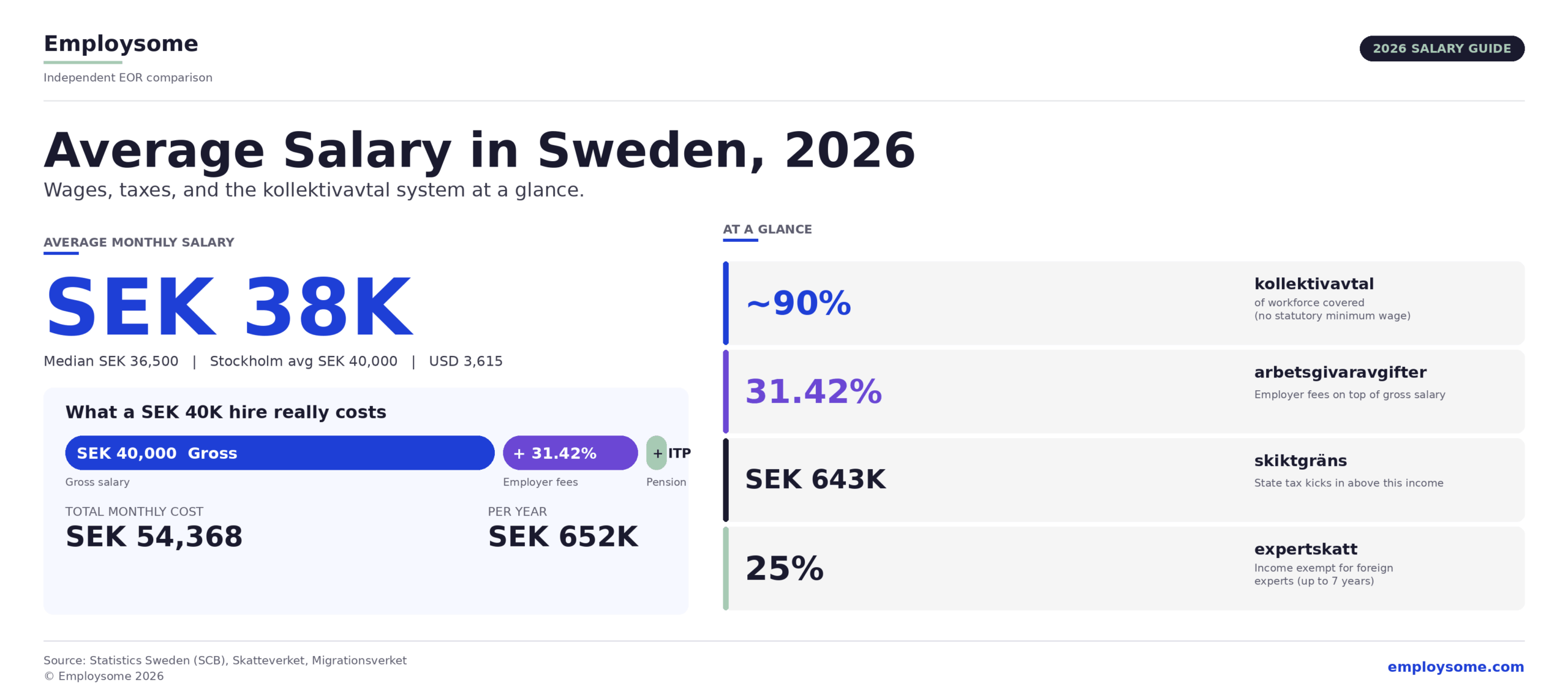
The average salary in Sweden in 2026 is approximately SEK 37,000 to 41,000 (USD 3,500 to 3,900) per month before tax, equivalent to roughly SEK 444,000 to 492,000 per year, according to the latest data from Statistics Sweden (Statistiska centralbyrån, SCB). The median monthly salary sits closer to SEK 36,500, while Stockholm averages around SEK 40,000, slightly above the national figure. Average annual gross salary across all sectors is approximately SEK 480,000, with full-time professionals in finance, engineering, and IT comfortably exceeding SEK 600,000 per year.
Sweden’s pay landscape is shaped by three distinctive features that set it apart from most European labour markets. First, Sweden has no statutory minimum wage: pay floors are set entirely through sectoral collective bargaining agreements (kollektivavtal) that cover approximately 90% of the workforce. Second, employer social contributions (arbetsgivaravgifter) at 31.42% of gross salary sit on top of pay, while employees themselves pay almost no social security, making total employer cost significantly higher than the headline salary suggests. Third, the 2026 budget introduced several changes including a reduced 20.81% employer rate for workers aged 19 to 23 (effective 1 April 2026 to 30 September 2027) and a phased reduction of the SINK non-resident flat tax to 22.5% from 1 January 2026.
This 2026 guide to the average salary in Sweden covers official SCB wage data, salary by industry (technology, finance, engineering, healthcare), salary by city (Stockholm, Gothenburg, Malmö, Uppsala, Västerås), salary by occupation and experience, the Swedish income tax system (municipal tax, state tax, grundavdrag, and jobbskatteavdrag), employer social contributions (arbetsgivaravgifter), the 2026 work permit salary threshold, the gender pay gap, and what international employers benchmarking Swedish salaries need to know.
+

Average Salary in Sweden 2026: Latest SCB Data
According to Statistics Sweden (Statistiska centralbyrån, SCB) and the most recent salary structure data for the whole economy, the 2026 wage benchmarks for Sweden are as follows:
| Wage Indicator (2026) | Value (SEK) | Approx. USD |
| Average monthly salary (full-time, all workers) | SEK 37,000 to 41,000 | USD 3,520 to 3,900 |
| Median monthly salary | SEK 36,500 | USD 3,470 |
| Average annual gross salary | SEK 444,000 to 492,000 | USD 42,250 to 46,830 |
| Median household income (annual) | SEK 407,000 | USD 38,720 |
| Lower quartile (25th percentile, monthly) | SEK 30,500 | USD 2,900 |
| Upper quartile (75th percentile, monthly) | SEK 47,500 | USD 4,520 |
| Stockholm average monthly salary | SEK 40,000 | USD 3,810 |
| 2026 work permit salary threshold | SEK 33,390/month | USD 3,180 |
| Net monthly salary (after tax, average) | SEK 25,000 to 27,000 | USD 2,380 to 2,570 |
Why average and median diverge: As in most European economies, Sweden’s reported averages are pulled upward by senior earners in finance, technology, and executive roles. The median of around SEK 36,500 monthly is a more realistic benchmark for what a typical Swedish worker actually earns. SCB publishes salary structure data with detailed quartile breakdowns by occupation, sector, and region for employers who need precise benchmarking.
Net pay reality: After municipal tax (averaging 32.38%), a Swedish worker on the average gross salary of SEK 38,000 takes home approximately SEK 26,000 to 27,000 per month, with the jobbskatteavdrag earned-income tax credit reducing the effective rate well below the headline municipal rate. State tax kicks in only above SEK 643,100 in annual income, meaning most Swedish workers do not pay the headline 20% surtax.
The 2026 work permit threshold matters for international hiring: From 1 June 2026, the salary threshold for non-EU/EEA work permits rises to SEK 33,390 per month (90% of the median salary), up from SEK 29,680. This affects most non-EU foreign hires unless they qualify for a shortage occupation exemption. The threshold is one of the higher requirements in the EU, reflecting Sweden’s policy of restricting low-wage labour migration.
💡 Employsome Insight: Plan Against Total Employer Cost, Not Gross Salary
When budgeting Swedish hires, always plan against total employer cost, not gross salary. With arbetsgivaravgifter at 31.42%, a SEK 40,000/month gross salary actually costs the employer approximately SEK 52,568 per month, or SEK 630,816 per year before benefits, equipment, and indirect costs. This is roughly 50% higher than the loaded cost of an equivalent UK or Irish hire and 30% higher than a Polish hire. Sweden’s payroll arithmetic rewards employers who plan capacity carefully and avoid over-hiring.
Average Salary in Sweden by Industry and Sector
Industry differences in Sweden are significant but more compressed than in many other developed economies, partly because of the levelling effect of collective bargaining. The highest-paying sectors are finance, IT, pharmaceuticals/life sciences, and senior management; the lowest are hospitality, retail, and personal services. The data below combines SCB salary structure statistics with industry-specific surveys, expressed as average monthly gross salary for full-time workers in 2026.
| Industry / Sector | Average Monthly Gross Salary 2026 (SEK) |
| Finance, banking, and insurance | SEK 55,000 to 75,000 |
| Information technology and software | SEK 50,000 to 70,000 |
| Pharmaceuticals and life sciences | SEK 50,000 to 68,000 |
| Engineering and technical consulting | SEK 45,000 to 65,000 |
| Telecommunications | SEK 45,000 to 62,000 |
| Manufacturing (automotive, machinery, electronics) | SEK 40,000 to 55,000 |
| Construction and real estate | SEK 38,000 to 52,000 |
| Public administration | SEK 36,000 to 48,000 |
| Education (private and public combined) | SEK 35,000 to 45,000 |
| Healthcare and social services | SEK 33,000 to 45,000 |
| Wholesale and trade | SEK 33,000 to 45,000 |
| Transportation and logistics | SEK 32,000 to 42,000 |
| Retail trade | SEK 28,000 to 36,000 |
| Hospitality, hotels, and food service | SEK 26,000 to 34,000 |
Specific 2026 role benchmarks (gross monthly): a software engineer in Stockholm earns SEK 50,000 to 75,000 depending on level and employer, with senior engineers at scale-ups (Spotify, Klarna, King) and multinationals (Google, AWS, Microsoft Sweden) reaching SEK 80,000 to 130,000+ including bonus and equity; a financial analyst earns SEK 45,000 to SEK 65,000 at major Swedish banks (SEB, Nordea, Handelsbanken, Swedbank); a marketing manager earns SEK 50,000 to 75,000; an HR business partner SEK 50,000 to 70,000; a nurse SEK 35,000 to 45,000; a teacher SEK 36,000 to 48,000; and a retail sales assistant SEK 27,000 to 32,000.
Sweden is particularly strong in technology and gaming (Spotify, Klarna, King, Mojang, Embracer Group, EA DICE), industrial machinery (Volvo, Scania, ABB, Sandvik, Atlas Copco), pharmaceuticals (AstraZeneca), telecommunications (Ericsson), and life sciences. These sectors offer globally competitive wages, particularly at senior and specialist levels, and remain major drivers of Swedish wage growth.
Average Salary by City: Stockholm, Gothenburg, Malmö
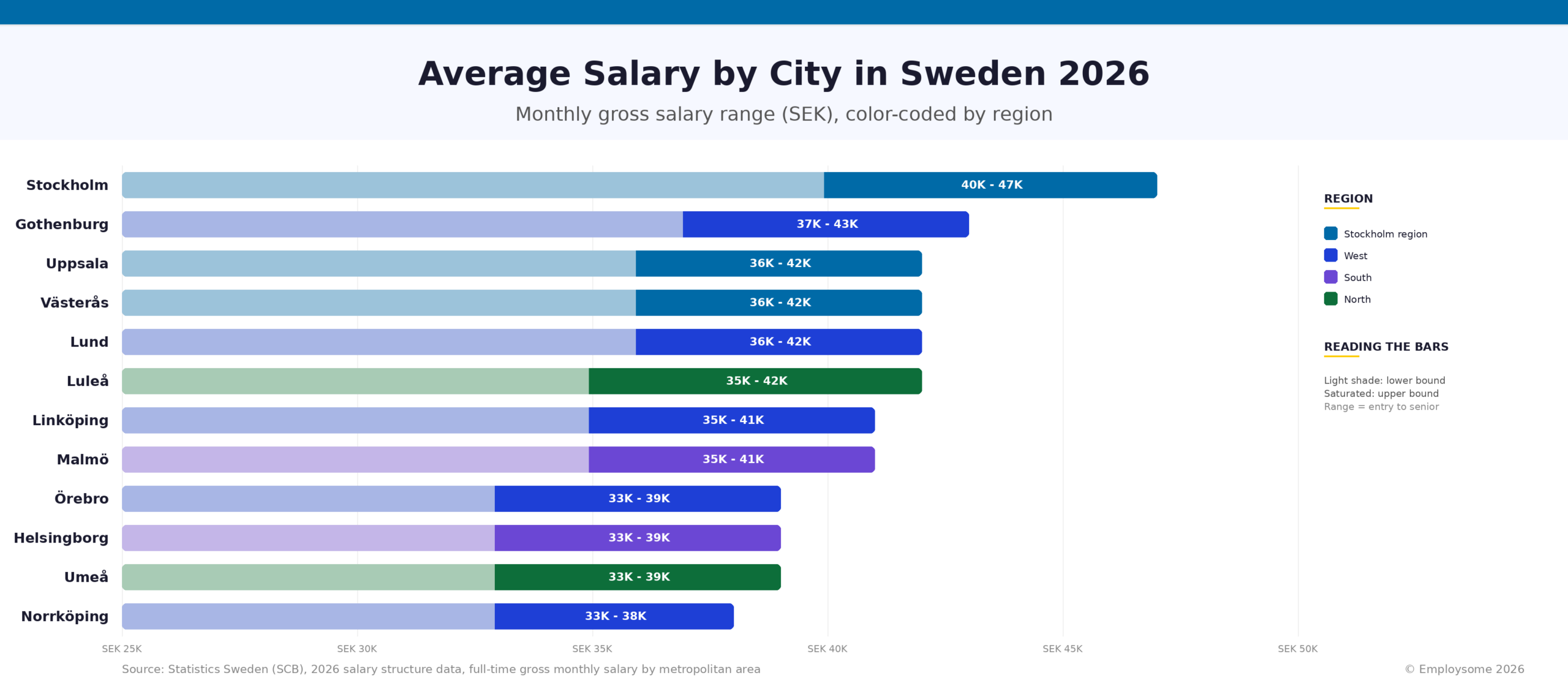
Salary in Sweden varies meaningfully by city, although less dramatically than in countries like the United States or the United Kingdom. Stockholm sits at the top of the wage league table, followed by other major metropolitan areas; smaller cities and rural kommuner sit roughly 10 to 20% below Stockholm levels for equivalent roles. Cost-of-living differences typically offset much of the wage premium.
| City / Region | Average Monthly Salary 2026 (SEK) | Notes |
| Stockholm | SEK 40,000 to 47,000 | Capital, finance and tech hub, highest cost of living |
| Gothenburg (Göteborg) | SEK 37,000 to 43,000 | Volvo, automotive, port city, strong engineering |
| Malmö | SEK 35,000 to 41,000 | Southern hub, life sciences, link to Copenhagen |
| Uppsala | SEK 36,000 to 42,000 | University city, life sciences and pharma |
| Västerås | SEK 36,000 to 42,000 | ABB, industrial machinery, energy |
| Linköping | SEK 35,000 to 41,000 | Saab, defence, aerospace, IT |
| Lund | SEK 36,000 to 42,000 | University, biotech, life sciences corridor |
| Örebro | SEK 33,000 to 39,000 | Logistics hub, public sector, university |
| Helsingborg | SEK 33,000 to 39,000 | Port and logistics, link to Helsingør |
| Umeå | SEK 33,000 to 39,000 | Northern hub, university, public services |
| Norrköping | SEK 33,000 to 38,000 | Logistics, IT, lower cost of living |
| Luleå | SEK 35,000 to 42,000 | Northern Sweden, growing green-tech corridor (H2 Green Steel, LKAB) |
Cost of living context: A 1-bedroom apartment in central Stockholm (Vasastan, Södermalm, Östermalm) rents for approximately SEK 13,000 to SEK 18,000 per month on the open market, with rent-controlled (förstahandskontrakt) apartments in the same areas often half that but effectively closed to non-residents due to multi-year housing queues. The same apartment in Gothenburg costs SEK 9,000 to 13,000; in Malmö SEK 8,500 to 12,000; in Umeå or Luleå SEK 7,000 to 10,000. Total monthly expenses for a single person in Stockholm run approximately SEK 21,000 to 28,000 including rent, while smaller cities like Norrköping or Örebro come in around SEK 16,000 to 20,000.
The Stockholm vs regional trade-off: A salary of SEK 50,000 monthly in Stockholm provides comparable discretionary income to SEK 40,000 in Luleå or Umeå once housing and general cost of living are factored in. For remote roles, Luleå has emerged as Sweden’s most credible alternative to Stockholm, driven by the green-tech corridor (H2 Green Steel, LKAB, the Northvolt restructuring fallout) and competitive engineering wages.
💡 Employsome Insight: Stockholm Housing Costs More Than Official Statistics Suggest
Sweden’s housing market is the most under-appreciated factor in salary benchmarking. The förstahandskontrakt (first-hand rental) system means central Stockholm apartments at controlled rents are functionally inaccessible to new arrivals, who must pay open-market or sublet rates. Always factor an extra SEK 4,000 to SEK 8,000 per month into Stockholm relocation packages versus the official rental data to reflect what new hires actually pay in practice. This is a common source of relocation friction for international employers benchmarking on official statistics alone.
Sweden Income Tax 2026: Municipal, State, and Reductions
Sweden uses a two-layer income tax system: a flat municipal tax (kommunalskatt) paid by all earners that varies by kommun, plus a 20% national/state tax (statlig inkomstskatt) that applies only to higher earners. Sweden has no separate employee social security tax to speak of (employees pay only a 7% pension contribution that is fully offset by a tax credit), so the headline rates above are effectively the all-in personal tax burden.
2026 income tax structure:
| Tax Component (2026) | Rate | Notes |
| Municipal tax (kommunalskatt) | ~32.38% average (range 28.93% to 35.65%) | Varies by kommun; flat rate, no progression within municipality |
| State tax (statlig inkomstskatt) | 20% | Applies only to taxable income above SEK 643,100 in 2026 (skiktgräns) |
| State tax breakpoint with grundavdrag | SEK 660,400 | Effective threshold including basic deduction |
| Combined top effective marginal rate | ~52% to 55% | Including municipal tax, state tax, and church tax (where applicable) |
| Church tax (kyrkoavgift) | 0.8% to 1.5% | Optional; only for members of the Church of Sweden |
| Burial fee (begravningsavgift) | ~0.25% | Mandatory for all residents |
| SINK (Särskild inkomstskatt) for non-residents | 22.5% | Reduced from 25% on 1 Jan 2026; falls to 20% on 1 Jan 2027 |
Why Swedish effective rates are lower than headlines: Two key mechanisms reduce the actual tax paid below the headline municipal rate. Grundavdrag (basic deduction) reduces taxable income on a sliding scale, with a maximum 2026 deduction of SEK 47,100 for incomes between SEK 200,000 and SEK 368,000. Jobbskatteavdrag (earned-income tax credit) reduces final tax liability and was strengthened in the 2026 budget; the maximum credit is approximately SEK 36,800 per year. Together, these mechanisms mean an average earner pays an effective rate well below the headline municipal rate.
2026 budget changes: The Swedish Government’s 2026 budget bill (presented 22 September 2025) introduced several personal tax changes effective 1 January 2026: a strengthened jobbskatteavdrag, an increased grundavdrag, a tax reduction for sickness and activity compensation, an increased commuting deduction threshold from SEK 11,000 to SEK 15,000, a permanent tax exemption for workplace EV charging, and the phased SINK reduction from 25% to 22.5% (and to 20% in 2027).
Expert tax relief (expertskatt): Qualifying expat employees can exclude 25% of their income from Swedish taxation for up to 7 years. Eligibility requires either an expert/researcher/specialist role or a monthly salary of at least 1.5 times the Swedish average (approximately SEK 88,100 per month in 2026). Applications must be filed with the Taxation of Research Workers Board within 3 months of starting employment.
Arbetsgivaravgifter: Swedish Employer Social Contributions
A defining feature of the Swedish payroll system is that employers carry almost the entire social security burden. Employees pay only a 7% pension contribution that is fully offset by a tax credit, while employers pay arbetsgivaravgifter at 31.42% of gross salary (plus benefits) on top of pay. This is materially higher than the EU average and changes the economics of Swedish hiring versus markets like the United Kingdom, Ireland, or Poland.
2026 employer social security contribution breakdown:
| Component | Rate | Funds |
| Old-age pension (ålderspension) | 10.21% | State pension scheme |
| Survivor pension (efterlevandepension) | 0.60% | Survivor benefits |
| Sickness insurance (sjukförsäkring) | 3.55% | Sickness benefit |
| Parental insurance (föräldraförsäkring) | 2.60% | Parental leave benefits |
| Work accident insurance (arbetsskadeförsäkring) | 0.20% | Workplace injury cover |
| Unemployment insurance (arbetsmarknadsavgift) | 2.64% | Unemployment benefits |
| General payroll tax (allmän löneavgift) | 11.62% | General government revenue |
| Total arbetsgivaravgifter | 31.42% | Standard rate, all workers |
Reduced rates from the 2026 budget:
- Workers aged 19 to 23: Temporary reduced rate of 20.81% on monthly salary up to SEK 25,000, effective from 1 April 2026 to 30 September 2027. The standard rate of 31.42% applies on any compensation above SEK 25,000 monthly.
- Workers aged 67 and over (born before 1959): Reduced rate of 10.21% covering only the pension component, effective from 1 January 2026 onwards. From 2026, this reduction applies to employees born between 2003 and 2007 reaching the full retirement age threshold.
Special payroll tax on pension contributions (SLP): Employers pay an additional 24.26% special payroll tax on pension fund contributions and pension insurance premiums provided to employees. This is in addition to arbetsgivaravgifter and is reported in the annual income tax return.
Total cost of a Swedish hire: For a typical white-collar employee on SEK 40,000 monthly gross, total monthly employer cost is approximately:
- Gross salary: SEK 40,000
- Arbetsgivaravgifter (31.42%): SEK 12,568
- Occupational pension (typical ITP plan): SEK 3,500 to 5,500
- Statutory holiday pay accrual: included in salary
- Total monthly employer cost: SEK 56,000 to 58,000
- Total annual employer cost: SEK 672,000 to 696,000
Sweden’s Collective Bargaining and Minimum Wage System
Sweden is one of the few EU member states with no statutory minimum wage. Pay floors are instead set entirely through sectoral collective bargaining agreements (kollektivavtal) negotiated between trade unions and employer associations. Approximately 90% of the Swedish workforce is covered by a collective agreement, even where individual workers are not union members.
How kollektivavtal work: Sweden’s labour market operates on a coordinated bargaining model in which trade union confederations (notably LO, TCO, and Saco) negotiate framework agreements with employer organisations (such as Svenskt Näringsliv). These agreements set minimum monthly wages by job category, working time rules, overtime premiums, holiday pay, sick pay, parental pay top-ups, and notice periods. Sectoral agreements are then signed between specific industry unions (e.g. Unionen, IF Metall, Kommunal) and employer federations to cover specific industries.
Why this matters for international employers:
- There is no statutory floor to fall back on, so knowing the relevant sectoral kollektivavtal is essential before structuring any Swedish salary offer
- Many kollektivavtal set minimum starting salaries well above what foreign employers would consider “entry level”, particularly in IT, engineering, and finance
- Even non-union employers are typically expected to match collective agreement terms via what is called hängavtal (hanging agreement) or equivalent terms in the individual employment contract
- Sweden actively opposed the EU Minimum Wage Directive on the grounds that a statutory minimum wage would undermine the existing collective bargaining system; this position remains policy in 2026
Typical kollektivavtal salary floors (2026): Entry-level minimums vary widely by sector. For example, IT and tech roles under IT-avtalet typically start around SEK 28,000 to SEK 32,000 monthly; manufacturing under Teknikavtalet around SEK 27,000 to SEK 30,000; retail under Detaljhandelsavtalet around SEK 24,000 to SEK 27,000; and hospitality under Visita’s agreement around SEK 23,000 to SEK 26,000 for entry-level roles. These figures rise substantially with experience grades and seniority bands set in each agreement.
Average Salary for Foreign Workers in Sweden
Foreign workers in Sweden’s formal labour market generally earn comparable salaries to Swedish workers in the same role, although broader aggregates are pulled down by concentration in lower-paying sectors including hospitality, construction, and food service. The 2026 budget tightened work permit salary thresholds to ensure foreign hires meet a minimum income standard.
| Foreign Worker Category (2026) | Salary Detail |
| Work permit threshold (non-EU/EEA) | SEK 33,390 per month from 1 June 2026 (90% of median salary), up from SEK 29,680 (80%) |
| Shortage occupation exemption | Applies to listed occupations, allowing offers below the standard threshold |
| EU Blue Card minimum | 1.5x average gross salary, approximately SEK 60,750/month in 2026 |
| ICT (Intra-Company Transferee) Permit minimum | Aligned with sectoral collective agreements |
| Tech sector foreign software engineer | SEK 50,000 to SEK 90,000+ depending on level and employer |
| Foreign academic researcher | SEK 40,000 to SEK 60,000 (often eligible for expert tax relief) |
| Hospitality and food service worker | SEK 25,000 to SEK 32,000 (subject to collective agreement minimums) |
Expert tax relief is a meaningful incentive for senior expats. The expertskatt regime exempts 25% of income from Swedish taxation for up to 7 years for foreign experts, researchers, key staff, and any employee earning above the 1.5x average salary threshold (approximately SEK 88,100 monthly in 2026). At a gross monthly salary of SEK 100,000, the tax saving can be around SEK 12,000 to 14,000 per month, materially improving net pay for senior foreign hires.
The Gender Pay Gap in Sweden
Sweden has one of the narrowest gender pay gaps in the OECD, reflecting decades of policy interventions, mandatory pay surveys, generous parental leave that is shared between parents, and high female labour-force participation. The 2026 raw gender pay gap stands at approximately 9 to 11%, falling to roughly 4 to 6% when controlling for occupation, sector, and full-time vs part-time status (the so-called “unexplained” gap).
Why Sweden’s gap is comparatively narrow:
- Mandatory pay surveys (lönekartläggning): All employers with 10+ employees must conduct an annual pay equity audit by law and document differences between roles of equal value
- Shared parental leave: Sweden’s 480-day parental leave allowance with 90 days reserved for each parent encourages both parents to take meaningful time off, reducing the “motherhood penalty” on careers
- High female labour-force participation: Around 80% of women aged 20 to 64 are in the labour force, one of the highest rates in the OECD
- Subsidised childcare: Universal access to municipal daycare (förskola) at capped fees enables both parents to stay in the workforce
Where gaps remain: The narrower controlled gap masks persistent vertical and horizontal segregation. Senior management positions in major Swedish corporations remain disproportionately male, and traditionally female sectors (healthcare, education, social services) pay materially less than traditionally male sectors (engineering, finance, IT). The 2026 EU Pay Transparency Directive enters full force on 7 June 2026, requiring employers with 100+ workers to publish gender pay gap data and remediate gaps above 5%, which is expected to drive further narrowing of the unexplained gap.
What Foreign Employers Need to Know
2026 average gross salary in Sweden is around SEK 37,000 to SEK 41,000 per month
According to Statistics Sweden (SCB), Sweden’s 2026 average monthly salary for full-time workers is approximately SEK 37,000 to SEK 41,000 before tax, with median around SEK 36,500 and Stockholm averaging SEK 40,000. Average annual gross is roughly SEK 444,000 to SEK 492,000.
Sweden has no statutory minimum wage
Pay floors are set entirely through sectoral collective bargaining agreements (kollektivavtal) covering ~90% of the workforce. Always identify the relevant sectoral agreement (IT-avtalet, Teknikavtalet, Detaljhandelsavtalet, etc.) before structuring an offer. Sectoral floors are typically well above what foreign employers might consider entry-level pay.
Total employer cost is approximately 132% of gross salary
Mandatory arbetsgivaravgifter (employer social security contributions) at 31.42% sit on top of gross pay, with employees paying almost no social security themselves. Add typical occupational pension contributions (ITP plan or equivalent) of around 4.5%, and the loaded cost of a Swedish hire is roughly 132% of headline gross salary.
The 2026 work permit threshold rises to SEK 33,390/month on 1 June
From 1 June 2026, the salary threshold for non-EU/EEA work permits rises to SEK 33,390 per month (90% of median salary), up from SEK 29,680. Shortage occupation exemptions continue to apply. International employers planning non-EU/EEA hires must meet this threshold or qualify for an exemption.
Reduced employer rate for workers aged 19 to 23 starts April 2026
From 1 April 2026 to 30 September 2027, employers pay a reduced arbetsgivaravgifter rate of 20.81% on monthly salary up to SEK 25,000 for workers aged 19 to 23. Standard 31.42% applies on any compensation above SEK 25,000 monthly. This is a meaningful incentive for hiring younger talent.
Expert tax relief offers a 25% income exemption for senior expats
Foreign experts, researchers, key staff, and any employee earning above approximately SEK 88,100 per month (1.5x the average salary) can apply for expertskatt, which exempts 25% of income from Swedish taxation for up to 7 years. Applications must be filed with the Taxation of Research Workers Board within 3 months of starting employment.
State tax kicks in at SEK 643,100, not at the average salary
The 20% state income tax (statlig inkomstskatt) applies only to taxable income above SEK 643,100 per year (2026 skiktgräns). Most Swedish workers do not reach this threshold and pay only municipal tax (averaging 32.38%) reduced by jobbskatteavdrag and grundavdrag.
Consider an EOR for compliant Swedish hiring
For international companies without a Swedish AB or branch entity, an Employer of Record (EOR) handles arbetsgivaravgifter registration, monthly Skatteverket filings, collective agreement compliance, occupational pension administration, and Swedish employment contract drafting in line with local law. See our Best EOR in Sweden guide for verified provider rankings.
Hiring in Sweden?
Swedish employment requires Skatteverket registration for arbetsgivaravgifter, monthly PAYE filings, alignment with the relevant sectoral kollektivavtal, occupational pension administration (typically the ITP plan), and lönekartläggning pay equity audits for employers with 10+ workers. Compare the top Employer of Record providers for Sweden in 2026 – verified pricing, compliance scores, and expert rankings from Employsome’s independent research team.
Frequently Asked Questions
According to Statistics Sweden (SCB), the average salary in Sweden in 2026 is approximately SEK 37,000 to SEK 41,000 (USD 3,520 to 3,900) per month before tax, equivalent to roughly SEK 444,000 to SEK 492,000 per year. The median monthly salary is closer to SEK 36,500. Stockholm averages around SEK 40,000 monthly, slightly above the national figure. After municipal tax (averaging 32.38%) and reductions including jobbskatteavdrag, an average earner takes home roughly SEK 25,000 to SEK 27,000 net per month.
No. Sweden has no statutory minimum wage. Pay floors are set entirely through sectoral collective bargaining agreements (kollektivavtal) negotiated between trade unions and employer associations, covering approximately 90% of the Swedish workforce. Sweden actively opposed the EU Minimum Wage Directive, arguing that a statutory minimum would undermine the existing collective bargaining system. To structure a compliant Swedish offer, identify the relevant sectoral agreement (IT-avtalet, Teknikavtalet, Detaljhandelsavtalet, Visita) and use its grade-based salary floors.
The average monthly salary in Stockholm is approximately SEK 40,000 to SEK 47,000 gross, slightly above the national average of SEK 37,000 to 41,000. Stockholm commands the wage premium because of its concentration of finance (SEB, Nordea, Handelsbanken, Swedbank), tech (Spotify, Klarna, King), and headquarters operations. The premium is partly offset by Stockholm’s significantly higher cost of living, with central 1-bedroom apartments renting for SEK 13,000 to SEK 18,000 per month on the open market.
The median monthly salary in Sweden in 2026 is approximately SEK 36,500 (USD 3,470), slightly below the average of SEK 37,000 to 41,000. The gap between average and median reflects high earners in finance, tech, and senior management pulling the average upward. The median is generally a more realistic benchmark for what a typical Swedish worker actually earns. SCB publishes detailed salary structure data with quartile breakdowns by occupation, sector, and region.
Sweden uses a two-layer tax system: a flat municipal tax (kommunalskatt) averaging 32.38% (range 28.93% to 35.65% by kommun), plus a 20% state tax (statlig inkomstskatt) on income above SEK 643,100 per year (2026 threshold). The combined top effective rate reaches approximately 52% to 55% for high earners. Two reductions lower the effective rate substantially: grundavdrag (basic deduction up to SEK 47,100 in 2026) and jobbskatteavdrag (earned-income tax credit, max approximately SEK 36,800/year). Most Swedish workers do not reach the state tax threshold and pay primarily municipal tax.
Arbetsgivaravgifter are Swedish employer social security contributions, paid by the employer on top of gross salary at a standard rate of 31.42%. They cover state pension (10.21%), survivor pension (0.6%), sickness insurance (3.55%), parental insurance (2.6%), work accident insurance (0.2%), unemployment insurance (2.64%), and a general payroll tax (11.62%). From 1 April 2026 to 30 September 2027, a temporary reduced rate of 20.81% applies to workers aged 19 to 23 on monthly salary up to SEK 25,000.
From 1 June 2026, the salary threshold for non-EU/EEA work permits in Sweden rises to SEK 33,390 per month (90% of the median salary), up from SEK 29,680 (80% of the median). The increase is part of Sweden’s policy of restricting low-wage labour migration. Shortage occupation exemptions allow offers below the standard threshold for listed occupations. Foreign workers under the EU Blue Card need to earn at least 1.5x the average gross salary, approximately SEK 60,750 per month in 2026.
The Swedish expertskatt regime allows qualifying foreign professionals to exclude 25% of their income and benefits from Swedish taxation for up to 7 years. Eligibility requires either an expert, researcher, or specialist role with skills not readily available in Sweden, or a monthly salary of at least 1.5 times the Swedish average salary (approximately SEK 88,100 per month in 2026). At a gross salary of SEK 100,000 monthly, the tax saving is approximately SEK 12,000 to 14,000 per month. Applications must be filed with the Taxation of Research Workers Board (Forskarskattesnämnden) within 3 months of starting employment.
Sweden has one of the narrowest gender pay gaps in the OECD, with a 2026 raw gap of approximately 9 to 11%, falling to 4 to 6% when controlling for occupation, sector, and full-time vs part-time status. Mandatory annual pay equity audits (lönekartläggning) for employers with 10+ employees, generous shared parental leave (480 days with 90 reserved for each parent), and universal subsidised childcare (förskola) all contribute to the comparatively narrow gap. The 2026 EU Pay Transparency Directive enters full force on 7 June 2026, expected to drive further narrowing.
International companies hiring in Sweden have three main options: (1) establish a Swedish legal entity (aktiebolag, AB) requiring a minimum SEK 25,000 capital and Skatteverket registration; (2) engage Swedish workers as independent contractors, which is workable for genuine freelance arrangements but carries misclassification risk for ongoing roles; or (3) use a Swedish Employer of Record (EOR) that formally employs the worker on your behalf and handles arbetsgivaravgifter, Skatteverket filings, collective agreement compliance, and occupational pension administration. For verified provider rankings see our Best EOR in Sweden guide.
Copywriter
Christa is a Copywriter at Employsome with 17 years of professional writing experience across global brands, startups, and online publications. A native English-Finnish writer, she brings strong editorial skills and a versatile background in business, SaaS, and finance. At Employsome, Christa focuses on clear, practical content about HR, payroll, and Employer of Record topics.
Our content is created for informational purposes only and is not intended to provide any legal, tax, accounting, or financial advice. Please obtain separate advice from industry-specific professionals who may better understand your business’s needs. Read our Editorial Guidelines for further information on how our content is created.