Hire compliantly in Sweden. Navigate arbetsgivaravgifter at 31.42%, a collective agreement culture that shapes nearly every employment term and 25 days of mandatory annual leave.
Hiring guides covering regulations, contributions and costs specific to Sweden. Updated for 2026.
(No) Minimum Wage in Sweden: What Employers Pay in 2026
Sweden has no national minimum wage and is not getting one in 2026. Instead, roughly 700 collective agreements between trade unions and employer associations set sector-specific pay floors covering approximately 90% of the workforce. Entry-level rates range from SEK 25,000 to 28,000/month depending on industry. Add 31.42% in mandatory employer contributions on top, and total employment cost is among the highest in Europe. This guide covers how the Swedish model works, what employers actually pay by sector, the June 2026 work permit salary threshold increase to SEK 33,390, and how an EOR handles compliance.
Arbetsgivaravgifter 2026: Sweden Employer Contributions Guide
Arbetsgivaravgifter are Sweden's mandatory employer social security contributions, totalling 31.42% of gross salary in 2026 with no salary cap. The rate consists of seven sub-contributions including the 10.21% old-age pension, 3.55% sickness insurance, and the 12.62% allmän löneavgift (general payroll tax). From April 2026, a temporary youth discount reduces the rate to 20.81% for employees aged 19-23. This guide covers the full breakdown, calculation examples, reduced rates for retirees and R&D, collective agreement pension costs (ITP/SAF-LO), the 24.26% SLP pension tax, European comparison, and all 2026 changes.
EU Working Time Directive : 2026 Guide for Employers
The EU Working Time Directive (2003/88/EC) sets the minimum rules for working hours, rest periods, and annual leave across all EU member states. It limits the average working week to 48 hours, guarantees 11 hours of daily rest, requires a minimum of 4 weeks’ paid annual leave, and regulates night work. However, each member state implements the directive differently through national legislation, creating significant variation in how the rules apply in practice. This guide explains what the directive requires, how key EU countries have implemented it, where the opt-out applies, and what employers hiring across Europe need to know.
Sweden’s employer contributions have no salary cap. A senior hire at SEK 80,000/month triggers SEK 25,136 in arbetsgivaravgifter every month. Any provider quoting a capped or averaged rate is miscalculating.
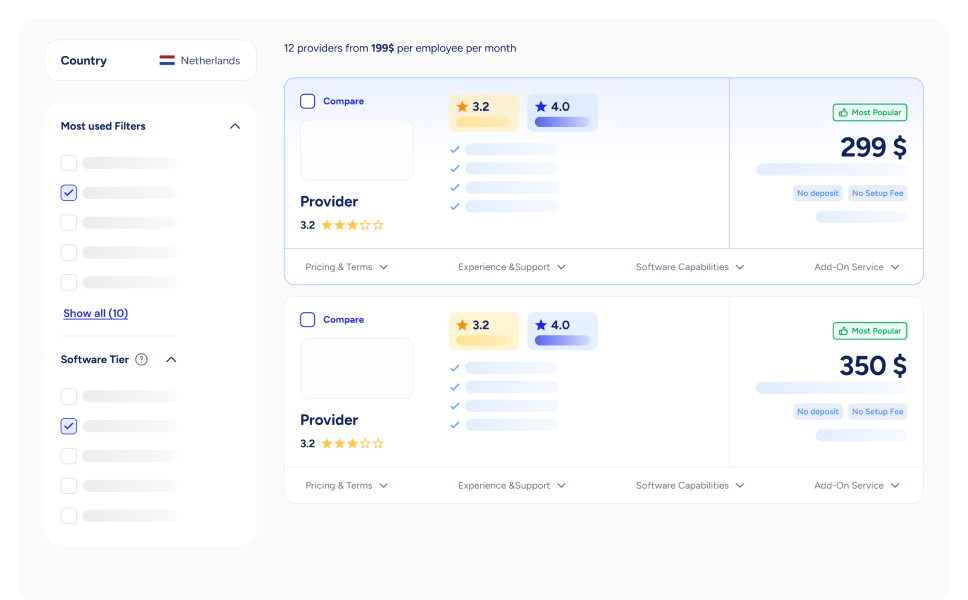
Our assessment of providers in Sweden evaluates arbetsgivaravgifter accuracy, collective agreement compliance and Skatteverket reporting.
Employer contributions are 31.42% of gross salary with no cap. Unlike most European countries, Sweden does not cap social security contributions. The 31.42% applies to every krona of salary, bonuses and taxable benefits. A SEK 50,000 salary costs SEK 15,710 in contributions. A SEK 100,000 salary costs SEK 31,420.
Employees do not pay a separate social security deduction from payroll. The entire 31.42% is an employer cost. Employees pay income tax only. This means the gap between gross salary and take-home pay is smaller than in most EU countries, but employer costs are among the highest.
Collective agreements (kollektivavtal) are the norm, not the exception. About 90% of Swedish workers are covered by collective agreements. These set minimum wages, pension contributions, insurance, overtime rates and notice periods. There is no statutory minimum wage because collective agreements fill that role.
Holiday pay is 12% of gross annual salary. Employees are entitled to 25 vacation days plus additional holiday pay calculated at 12% of annual earnings. This holiday supplement (semestertillagg) is paid during the vacation period and adds materially to employer cost.
Sick pay for the first 14 days is employer-funded at 80%. Day 1 is a qualifying day (karensdag) with no pay. Days 2-14 are paid by the employer at 80% of salary. From day 15, Forsakringskassan (the Social Insurance Agency) takes over.
Why hire in Sweden
One of Europe's most educated and English-fluent workforces
Sweden consistently ranks among the top 3 globally for English proficiency among non-native speakers. Combined with one of the highest rates of tertiary education in Europe, this makes Sweden a talent market where language barriers are effectively zero.
No statutory minimum wage keeps hiring flexible
Wages are set by market forces and collective agreements, not government mandate. This means salaries reflect actual market value per role and sector rather than political negotiation. For specialist roles, you pay what the role is worth.
R&D reduction cuts employer costs by up to 19.59%
Companies with employees performing qualifying R&D work can reduce arbetsgivaravgifter by up to 19.59 percentage points. For a tech company, this effectively brings employer contributions down from 31.42% to roughly 11.8% on qualifying salaries.
Digital infrastructure makes payroll operationally simple
Skatteverket's systems are fully digital. Employer declarations, tax withholding and social contribution payments are all handled online. Sweden's digital maturity means less manual administration compared to southern European markets.
Key Employment Facts
Sweden's 25 days leave and 31.42% uncapped contributions make it one of Europe's most expensive employment markets.
Key Employment Facts
Minimum Wage
No statutory minimum (set by collective agreements)
Probation Period
6 months maximum
Standard Working Hours
40 hours/week
Paid Annual Leave
25 days
Notice Period
1-6 months (by tenure, per LAS)
13th Salary
Not statutory
Sick Leave
Day 1 unpaid (karensdag), days 2-14 at 80% (employer), day 15+ via Forsakringskassan
Maternity/Parental Leave
480 days shared between parents (~80% via Forsakringskassan)
Good to Know: Sweden’s parental leave is 480 days shared between both parents, with 90 days reserved for each parent that cannot be transferred. Forsakringskassan pays approximately 80% of salary up to a ceiling. Many collective agreements top up the difference. Employees taking extended parental leave is culturally normal and expected. Budget for 6-12 months of reduced availability per parent.
What to Watch When Hiring in Sweden
No contribution cap means linear cost scaling on high salaries
Unlike Germany or France where contributions cap out, Sweden's 31.42% applies to every krona. A senior hire at SEK 120,000/month costs SEK 37,704 in arbetsgivaravgifter alone.
Collective agreements create obligations your contract cannot override
If your industry has a relevant kollektivavtal, the terms apply whether you've signed one or not if employees are union members. Ignoring collective agreement terms on overtime, pensions or notice periods creates dispute risk with Swedish trade unions.
The LAS (Employment Protection Act) makes termination procedural
Dismissal requires objective grounds (saklig grund). For redundancy, last-in-first-out (LIFO) rules apply unless a collective agreement modifies the order. The 2022 LAS reform introduced some flexibility, but employers still cannot dismiss at will.
A youth contribution reduction applies April 2026 to September 2027
Employers hiring workers aged 19-23 benefit from reduced contributions of up to SEK 2,700/month during this temporary window. Your payroll system must activate and deactivate this reduction precisely within the valid period.
Employer Costs and Employee Taxes in Sweden
Sweden's employer contribution of 31.42% is a single flat rate with no cap, making it one of the simplest but most expensive social contribution systems in Europe. Employees pay only income tax, with no separate social security deduction from payroll.
Employer Contributions (2026)
Contribution
Employer Rate
Old-Age Pension
10.21%
Survivor’s Pension
0.60%
Health Insurance
3.55%
Parental Insurance
2.60%
Occupational Injury
0.20%
Labour Market (Unemployment)
2.64%
General Payroll Tax (allman loneavgift)
11.62%
Total Employer Cost
31.42% (no cap)
Employee Taxes
Tax / Contribution
Employee Rate
Municipal Income Tax
~29-35% (varies by municipality)
National Income Tax
20% on income above SEK 625,800/year
Pension Fee (employee)
7% (fully creditable against income tax)
Social Security
0% (employer-funded entirely)
Good to Know: Sweden’s true employer cost is higher than 31.42%. Add holiday pay (12% of annual salary), sick pay obligation (days 2-14 at 80%), and occupational pension contributions under most collective agreements (~4-5% of salary), and total employer cost reaches approximately 50-55% above base salary. For an employee earning SEK 45,000/month: arbetsgivaravgifter SEK 14,139 + holiday pay provision ~SEK 450/month + pension ~SEK 2,000. Monthly employer cost: approximately SEK 61,600, or 1.37x the gross salary.
Public Holidays in Sweden (2026)
Sweden has 13 public holidays. There is no statutory substitute day when a holiday falls on a weekend.
Date
Holiday
January 1
New Year’s Day (Nyarsdagen)
January 6
Epiphany (Trettondedag jul)
April 3
Good Friday (Langfredagen)
April 6
Easter Monday (Annandag pask)
May 1
May Day (Forsta maj)
May 14
Ascension Day (Kristi himmelsfardsdag)
June 6
National Day (Sveriges nationaldag)
June 19
Midsummer Day (Midsommardagen)
November 1
All Saints’ Day (Alla helgons dag)
December 24
Christmas Eve (Julafton)
December 25
Christmas Day (Juldagen)
December 26
Boxing Day (Annandag jul)
December 31
New Year’s Eve (Nyarsafton)
Good to Know: Midsummer culturally one of Sweden’s most important holidays, often more significant than Christmas for taking time off. Most Swedes take the entire week of Midsummer as annual leave, and many companies effectively shut down. The week between Christmas and New Year (mellandagarna) follows the same pattern. Plan project deadlines around these two periods.
Compare All EOR Providers for Sweden
Filter providers by Sweden coverage, compliance and supported services using the Employsome Comparison Tool. Over 130 providers compared.