
Maternity Leave Japan 2026: Sango Kyugyo, Allowance & Leave
Maternity leave in Japan in 2026 provides 14 weeks of statutory leave (6 weeks before birth + 8 weeks after) under the Labor Standards Act, with a 67% Maternity Allowance paid through Health Insurance, tax-exempt and with social insurance waived. This guide covers the full entitlement, the ¥500,000 lump-sum childbirth allowance, Childcare Leave at 67% then 50%, the April 2025 sango papa ikukyu reform with its 80% top-up benefit, employer obligations including the matahara anti-discrimination framework, and what foreign employers need to know.

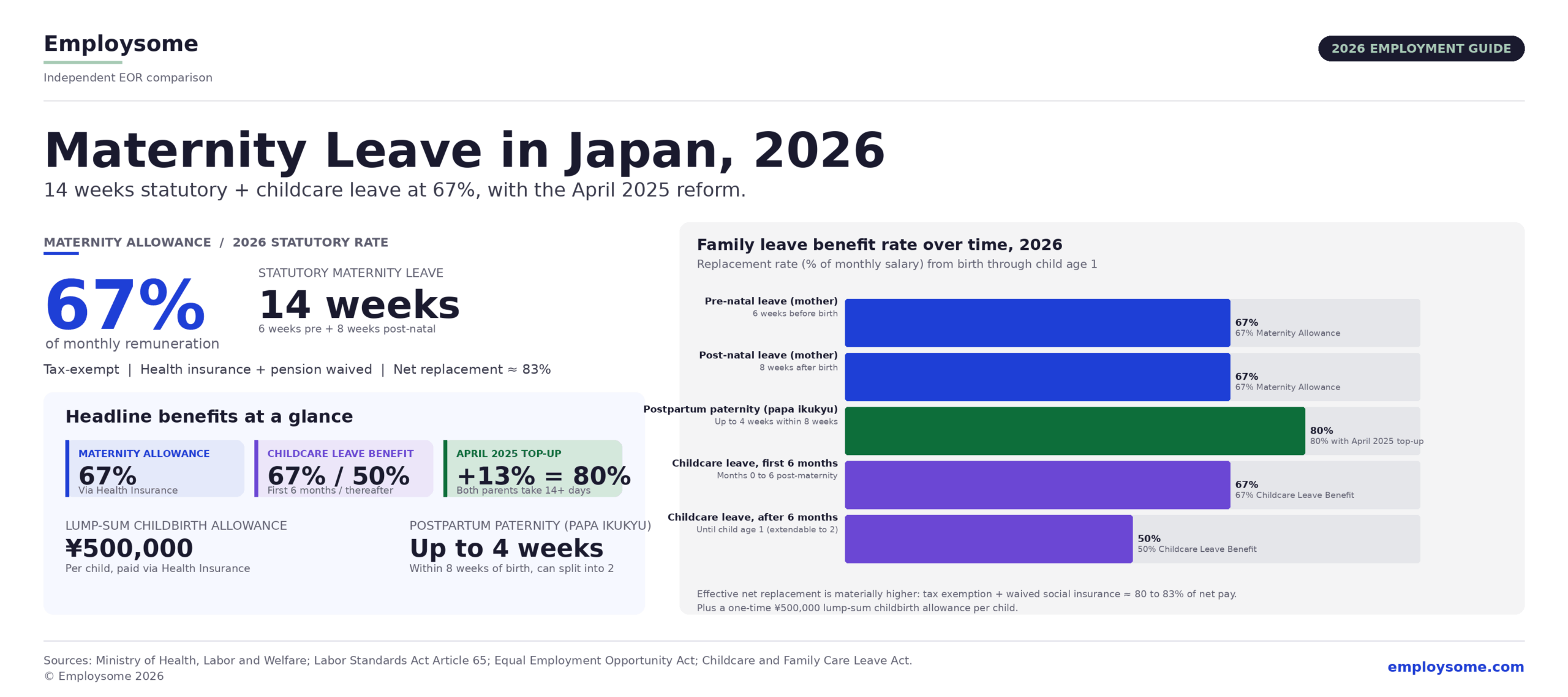
Maternity leave in Japan, known as sango kyugyo (産前産後休業), provides 6 weeks of leave before the expected due date and 8 weeks of leave after birth (14 weeks total), with the prenatal period extending to 14 weeks for multiple births. During this leave, employees receive a Maternity Allowance (出産手当金) equal to two-thirds (approximately 67%) of their average standard monthly remuneration, paid through the Employee Health Insurance system rather than by the employer directly. Health insurance and pension contributions are fully waived during the leave period, and the allowance is tax-exempt, so effective take-home pay is materially higher than the 67% headline rate suggests.
Maternity leave then transitions seamlessly into Childcare Leave (育児休業, ikuji kyugyo), which can be taken until the child turns 1 year old (extendable to 2 years where daycare placement is unavailable). Childcare Leave Benefits pay 67% of salary for the first 6 months and 50% thereafter, also tax-exempt with social insurance waived. As of April 2025, Japan introduced the Post-Childbirth Leave Support Benefit (出生後休業支援給付金), which adds a 13% top-up bringing the total to 80% of gross salary when both parents each take at least 14 days of qualifying childcare leave. This is a major 2026 policy lever specifically designed to lift Japan’s historically low paternity leave uptake rate.
Maternity protection in Japan is grounded in the Labor Standards Act (労働基準法) Article 65 and the Equal Employment Opportunity Act, which together prohibit employers from dismissing or otherwise treating employees disadvantageously because of pregnancy, childbirth, or use of maternity or childcare leave. These protections apply to all working parents in Japan, including foreign nationals on work visas, regardless of full-time or part-time status. This 2026 guide covers the full statutory entitlement, eligibility rules, the lump-sum childbirth allowance of ¥500,000, the father-specific sango papa ikukyu system, employer obligations including the Maternity Leave Notification process, taxation, the April 2025 top-up benefit, and what international employers hiring through a Japanese Employer of Record (EOR) need to know.

Maternity Leave in Japan 2026: Headline Facts
As of 2026, the headline maternity and childcare leave figures for Japan are as follows. Note that maternity leave (sango kyugyo) and childcare leave (ikuji kyugyo) are technically two separate but consecutive entitlements, with the transition typically happening 8 weeks after birth.
| Key Employment Fact (2026) | Value |
| Pre-natal maternity leave | 6 weeks (42 days), 14 weeks for multiples |
| Post-natal maternity leave | 8 weeks (56 days), mandatory minimum of 6 weeks |
| Total statutory maternity leave | 14 weeks (98 days) |
| Maternity Allowance (出産手当金) rate | 2/3 (67%) of average standard monthly remuneration |
| Childcare Leave maximum duration | Until child turns 1 year (extendable to 2 years) |
| Childcare Leave Benefit, first 6 months | 67% of average monthly salary |
| Childcare Leave Benefit, after 6 months | 50% of average monthly salary |
| Post-Childbirth Leave Support Benefit (April 2025) | +13% top-up = 80% total when both parents take 14+ days |
| Lump-sum childbirth allowance (出産育児一時金) | ¥500,000 (approx. USD 3,300) |
| Postpartum paternity leave (産後パパ育休) | Up to 4 weeks within 8 weeks of birth |
| Health insurance and pension during leave | Fully waived (employee + employer share) |
| Maternity Allowance taxation | Tax-exempt |
| Notice required to employer | At least 2 weeks (1 month recommended) |
| Primary legal framework | Labor Standards Act Article 65, Equal Employment Opportunity Act |
Maternity leave in Japan is a system most foreign employers find more generous in practice than the headline 67% rate suggests, because the combination of tax exemption and waived social insurance means effective replacement income often reaches 80% of net pre-leave pay. The April 2025 Post-Childbirth Leave Support Benefit pushes this further when both parents participate.
Statutory Maternity Leave (Sango Kyugyo): Pre-natal and Post-natal
Statutory maternity leave (sango kyugyo) under Labor Standards Act Article 65 is divided into two distinct phases with different rules around mandatory versus optional leave.
Pre-natal leave (産前休業): Up to 6 weeks (42 days) before the expected due date, extending to 14 weeks (98 days) for multiple births. Pre-natal leave is requested by the employee, not automatically granted: the employee submits a written notification to the employer and the leave begins on the date specified. If the actual delivery date is later than expected, the additional days are added to the leave period.
Post-natal leave (産後休業): 8 weeks (56 days) after birth. Crucially, the first 6 weeks of post-natal leave are mandatory: under Article 65, employers are prohibited from allowing a woman to work during this period, even at the woman’s own request. The final 2 weeks (between weeks 6 and 8 post-birth) can be waived if the employee requests to return early and a doctor approves the return. This 6-week mandatory period applies regardless of profession, role, or employer size.
Eligibility: Statutory maternity leave under Article 65 applies to all female employees in Japan, including:
- Permanent (regular) full-time employees
- Contract (fixed-term) employees, provided the contract does not expire before the leave ends or is reasonably expected to be renewed
- Part-time employees with no minimum hours threshold
- Dispatched workers (haken) employed by staffing agencies
- Foreign nationals on any work visa, including spousal visas with work authorisation
What the law does not require employers to pay: Critically, employers in Japan are not required to pay salary during maternity leave. The Maternity Allowance comes from the Health Insurance system, not the employer’s payroll. This is a structural difference from countries like the United Kingdom or several EU states where employers pay statutory maternity pay directly. In Japan, the employer’s primary payroll obligation during the leave is to continue to enrol the employee in Health Insurance and Pension while the contributions are statutorily waived, not to pay the allowance.
💡 Employsome Insight: Why 67% in Japan Is Closer to 83% of Net Pay
For foreign employers benchmarking maternity costs in Japan, the key misconception to avoid is the assumption that “67% replacement = roughly 67% of net pay.” It is actually closer to 80% of net, because the Maternity Allowance is fully tax-exempt and both health insurance (~10% of salary) and pension (~9% of salary) contributions are waived for both employee and employer. This means employees experience a relatively soft income drop during leave, and employers benefit from meaningful payroll cost reduction during the same period. Foreign employers who model Japanese maternity leave on European assumptions consistently overestimate both the employee burden and the employer cost.
Maternity Allowance and the ¥500,000 Lump-Sum Childbirth Allowance
The Maternity Allowance (出産手当金, shussan teate kin) is paid through Japan’s Employee Health Insurance system (健康保険, kenko hoken) and replaces income during the 14-week statutory leave period. It is administered by the employer’s health insurance association (健康保険組合 or similar) and applies for and processed via the employer’s HR or payroll department.
The 67% calculation explained:
- Take the employee’s average standard monthly remuneration over the most recent 12 months (or shorter period if employed for less)
- Divide by 30 to get the daily rate
- Multiply by 2/3 (or 0.6667) to get the daily Maternity Allowance
- Multiply by the number of leave days actually taken
Worked example: An employee with average standard monthly remuneration of ¥300,000 takes the full 98-day maternity leave (42 days pre-natal + 56 days post-natal). Daily rate is ¥300,000 ÷ 30 = ¥10,000. Daily Maternity Allowance is ¥10,000 × 2/3 = approximately ¥6,667. Total Maternity Allowance for 98 days is approximately ¥653,000, compared to ¥980,000 in regular salary for the equivalent period. Crucially, the ¥653,000 is tax-exempt and not subject to the employee’s usual ~¥60,000/month in social insurance contributions, so net take-home over the leave period is approximately ¥653,000 against a typical net salary of approximately ¥780,000. The effective replacement rate is around 83% of normal net pay, not 67%.
Lump-sum childbirth allowance (出産育児一時金): Separate from the Maternity Allowance, every birth covered by a Japanese health insurance scheme triggers a lump-sum payment of ¥500,000 per child (raised from ¥420,000 in April 2023). This payment is intended to cover the cost of childbirth itself (hospital fees, delivery, post-natal medical care). Most major hospitals participate in a direct-payment system where the lump sum is paid directly to the hospital, and the employee pays only the remaining balance (if delivery cost exceeds ¥500,000) or receives the surplus (if delivery cost is below ¥500,000).
Application process: The Maternity Allowance requires the employee to submit a health insurance Maternity Allowance application form (出産手当金請求書) to the health insurance association via the employer. The form requires the doctor to certify the expected and actual delivery dates, and the employer to certify the maternity leave dates and the absence of salary during the leave period. Payment is typically made approximately 1 to 2 months after the application is submitted, in a single lump sum covering the full leave period.
Childcare Leave (Ikuji Kyugyo) and the 67% / 50% Benefit Structure
When the 8-week post-natal maternity leave ends, employees transition into Childcare Leave (育児休業, ikuji kyugyo), a separate statutory entitlement under the Childcare and Family Care Leave Act. Childcare leave is open to both mothers and fathers, can be split into multiple periods, and is funded by the Employment Insurance system rather than Health Insurance.
Duration: Childcare leave can be taken until the child reaches 1 year of age. The duration extends to 1 year and 6 months, then to 2 years, in cases where the child cannot be enrolled in a licensed nursery or similar childcare facility (a documented condition that is common in Japanese metropolitan areas with high daycare demand).
Childcare Leave Benefits (育児休業給付金, ikuji kyugyo kyufukin): Paid through Employment Insurance:
- 67% of average monthly salary for the first 6 months of childcare leave
- 50% of average monthly salary thereafter, up to the maximum 2-year period
- Tax-exempt and exempt from social insurance contributions
- Paid every 2 months in arrears, after the employee submits each periodic application
Eligibility requirements: To qualify for Childcare Leave Benefits, the employee must:
- Be enrolled in Employment Insurance (雇用保険) for at least 12 months in the 2 years before leave starts
- Have paid into Employment Insurance during 11 or more days of work per month, for at least 12 months
- Plan to return to work after the childcare leave (an explicit requirement, though not strictly enforced if circumstances change)
Worked example: An employee with a ¥300,000 monthly salary takes 12 months of childcare leave starting 8 weeks after birth. For the first 6 months, monthly benefit is ¥300,000 × 67% = approximately ¥201,000. For the following 6 months, monthly benefit is ¥300,000 × 50% = ¥150,000. Both amounts are tax-exempt and free of social insurance deductions, so net take-home is close to the gross. Total childcare leave benefits over 12 months is approximately ¥2,106,000, plus the earlier ¥653,000 in Maternity Allowance, plus the ¥500,000 lump-sum childbirth allowance.
The April 2025 Reform: Sango Papa Ikukyu and the 80% Top-Up Benefit
Japan introduced a major reform in April 2025 specifically designed to lift the country’s historically low paternity leave uptake rate, which had remained around 17% even after multiple policy rounds. The reform pairs two complementary mechanisms: an enhanced father-specific leave system and a top-up benefit that incentivises both parents to take leave together.
Postpartum paternity leave (産後パパ育休, sango papa ikukyu): A father-specific entitlement separate from standard childcare leave. Fathers can take up to 4 weeks (28 days) of leave within the first 8 weeks after the child’s birth, with the option to split the leave into two separate periods for flexibility. The leave is paid at the standard 67% of average monthly salary (matching mothers’ childcare leave benefit rate during the same period), tax-exempt and exempt from social insurance contributions.
The Post-Childbirth Leave Support Benefit (出生後休業支援給付金) (introduced April 2025): When both parents each take at least 14 days of qualifying childcare leave, an additional 13% top-up is added to the standard 67% childcare leave benefit, bringing the total to 80% of gross salary for that qualifying period. Combined with tax exemption and waived social insurance, the effective replacement rate during the qualifying period is close to 100% of normal net take-home pay.
Worked example of the 80% top-up: A father earning ¥300,000 monthly takes 4 weeks of postpartum paternity leave while the mother also takes leave. Daily wage calculation is ¥300,000 × 6 months ÷ 180 days = ¥10,000. Standard 67% benefit is ¥10,000 × 28 days × 67% = approximately ¥187,600. Post-Childbirth Support Benefit top-up of 13% is ¥10,000 × 28 days × 13% = ¥36,400. Combined total for the 4 weeks is approximately ¥224,000 (80% of pre-leave gross), tax-exempt and not subject to social insurance.
Why this matters in practice: The April 2025 reform is structurally designed to overcome what Japanese policy researchers call kachi kachi yamai, the cultural pressure on fathers to remain in the workplace during and after the birth of a child. The 80% replacement rate is sufficiently close to full pay that the financial objection to taking leave largely disappears. The first reporting cycles in 2025-2026 already showed a measurable uptick in qualifying paternity leave applications, particularly at large employers covered by enhanced reporting requirements.
Employer Obligations and the Maternity Leave Notification Process
Japanese employers carry specific obligations during maternity leave under the Labor Standards Act and Equal Employment Opportunity Act, alongside duties around the Health Insurance and Employment Insurance systems that pay leave benefits.
Anti-discrimination protections:
- No dismissal or disadvantageous treatment based on pregnancy, childbirth, or use of maternity or childcare leave (Equal Employment Opportunity Act Article 9, Labor Standards Act Article 65)
- Light duties on request: Pregnant employees may request transfer to lighter duties (Labor Standards Act Article 65, Paragraph 3)
- Prohibition on dangerous duties: Employers are prohibited from assigning pregnant or nursing employees to duties that might harm the pregnancy or interfere with childcare
- No overtime, late-night work, or holiday work for pregnant employees who request exemption (Labor Standards Act Article 66)
- Right to attend prenatal medical appointments with paid time off where the company’s rules of employment provide for this
- Nursing time: After return to work, nursing mothers may request 30 minutes of nursing time twice daily (Labor Standards Act Article 67)
The Maternity Leave Notification process:
- Employee provides written notification of pregnancy and intended leave dates at least 2 weeks before leave begins (1 month is recommended)
- The notification includes the expected due date (with doctor’s certification), planned start date of leave, and planned return-to-work date
- Employer is required to confirm acceptance in writing and process the Health Insurance and Employment Insurance applications on the employee’s behalf
- If the employee plans to take childcare leave after the maternity period, a separate Childcare Leave Notification is submitted, ideally at the same time as the Maternity Leave Notification
- The Maternity Allowance application is filed with the health insurance association after the leave period ends, with the employer certifying the leave dates and absence of salary
- The Childcare Leave Benefit application is filed with the Public Employment Security Office (ハローワーク) every 2 months during the leave period, with the employer providing the monthly wage record
Health Insurance and Pension during leave: Both employee and employer contributions to Health Insurance, Employees’ Pension Insurance, and Long-term Care Insurance are fully waived during the maternity and childcare leave period, when the employer submits a written application to the relevant insurance authority. This is a meaningful payroll saving for employers (typically 15-17% of gross salary in employer-share contributions) that partly offsets the loss of productive labour during the leave. The employee retains continuous coverage and accrual of pension entitlement as if contributions had been paid in full.
How Maternity Leave Interacts with Childcare, Paternity, and Family Leave
Maternity leave is one of several family-related leave entitlements under Japanese law. The interactions between these systems matter for foreign employers planning to support employees through the full transition from pregnancy to return-to-work.
| Leave Type (Japan, 2026) | Duration | Benefit Rate | Funded By |
| Maternity Leave (産前産後休業) | 6 weeks pre + 8 weeks post (98 days) | 67% (Maternity Allowance) | Health Insurance |
| Childcare Leave (育児休業) | Until child age 1, extendable to 2 | 67% (first 6 months), 50% thereafter | Employment Insurance |
| Postpartum Paternity Leave (産後パパ育休) | Up to 4 weeks within 8 weeks of birth | 67% (or 80% with top-up) | Employment Insurance |
| Post-Childbirth Leave Support Benefit (April 2025) | Top-up benefit when both parents take 14+ days | +13% on top of standard 67% | Employment Insurance |
| Lump-sum Childbirth Allowance (出産育児一時金) | One-time payment per child | ¥500,000 per child | Health Insurance |
| Family Care Leave (介護休業) | Up to 93 days per family member | 67% during qualifying periods | Employment Insurance |
| Sick child care leave (子の看護休暇) | 5 days/year (10 for 2+ children) | Unpaid (employer-discretion) | n/a |
The combined trajectory: A typical Japanese family using the full statutory framework can expect approximately 14 weeks of maternity leave + 12 to 24 months of childcare leave for the mother, plus up to 4 weeks of postpartum paternity leave + 12 months of childcare leave for the father. Total household leave entitlement, when both parents participate, can reach 2 years of combined paid leave with replacement rates between 67% and 80% across the period. This is materially more generous than commonly perceived from outside Japan, where the focus tends to be only on the 14-week maternity leave figure.
What Foreign Employers Need to Know
For international companies hiring Japanese employees through a local entity or via an Employer of Record (EOR), maternity leave compliance involves several practical considerations that differ materially from US, UK, and EU practice.
Key compliance points:
- Foreign nationals are fully covered by Japanese maternity protections, including foreign employees on Engineer/Specialist in Humanities/International Services visas, intra-company transferee visas, Highly Skilled Professional visas, and spousal visas with work authorisation. Visa status does not affect entitlement to Maternity Allowance or Childcare Leave Benefits.
- The employer pays no salary during leave, but continues to administer Health Insurance and Pension enrolment (with contributions waived) and processes benefit applications on the employee’s behalf. This is structurally different from the UK or many EU markets where employers pay statutory maternity pay directly and recover from social insurance later.
- Employer cost during leave is materially lower than during normal employment: with both employee and employer social insurance contributions waived (~15-17% of gross salary in employer share), the only ongoing employer cost is HR administration time. However, the employer must continue to provide return-to-work guarantee and the role must remain available.
- Anti-discrimination liability is real and enforced. Japanese labour authorities and employee tribunals take pregnancy and maternity-related discrimination claims (マタハラ, matahara) seriously. Foreign employers should ensure manager training on pregnancy-related conduct and avoid restructuring decisions that disproportionately affect employees on or returning from maternity leave.
- Return-to-work accommodations include the right to request reduced working hours (up to 6 hours/day) until the child reaches age 3, the right to refuse overtime until the child reaches age 3, and protection from late-night and holiday work. These are not optional and apply automatically upon employee request.
- The April 2025 reform shifts cultural expectations. Foreign employers that actively encourage paternity leave uptake, particularly the qualifying 14+ day period that triggers the 80% top-up, often see meaningful retention and recruitment benefits in the Japanese talent market, where progressive parental leave policies are increasingly visible to candidates.
- Maternity-related changes to compensation, role, or location on or after return to work require explicit employee consent. Unilateral demotion or role reduction following a maternity leave is a documented matahara violation that has produced multiple successful employee tribunal cases.
Hiring in Japan?
Japanese maternity leave compliance under the Labor Standards Act, the April 2025 Post-Childbirth Leave Support Benefit, Health Insurance and Employment Insurance benefit applications, and the matahara anti-discrimination framework all require local expertise. Compare the top Employer of Record providers for Japan in 2026 – verified pricing, compliance scores, and expert rankings from Employsome’s independent research team.
Frequently Asked Questions
Statutory maternity leave in Japan is 14 weeks (98 days) total: 6 weeks (42 days) before the expected due date and 8 weeks (56 days) after birth. The pre-natal period extends to 14 weeks for multiple births. The first 6 weeks of post-natal leave are mandatory under Labor Standards Act Article 65, even at the employee’s own request. Maternity leave then transitions seamlessly into Childcare Leave (ikuji kyugyo), which can be taken until the child turns 1 year old (extendable to 2 years where licensed daycare is unavailable). Combined, mothers in Japan can typically take between 14 weeks and 2 years of paid family leave.
Maternity leave in Japan is not paid by the employer. Instead, employees receive a Maternity Allowance (出産手当金) equal to two-thirds (67%) of their average standard monthly remuneration, paid through the Employee Health Insurance system. The allowance is tax-exempt, and both employee and employer Health Insurance and Pension contributions are fully waived during the leave period. As a result, effective take-home pay during maternity leave is approximately 80% to 83% of normal net pay, materially higher than the 67% headline rate suggests. After maternity leave, Childcare Leave Benefits continue at 67% for 6 months and 50% thereafter.
During statutory maternity leave (14 weeks), employees receive the Maternity Allowance at 67% of their average standard monthly remuneration, calculated as: average monthly remuneration over the most recent 12 months, divided by 30 to get a daily rate, multiplied by 2/3, multiplied by the number of leave days. For an employee earning ¥300,000 monthly, the total Maternity Allowance for 98 days is approximately ¥653,000 (tax-exempt). Additionally, every birth triggers a separate ¥500,000 lump-sum childbirth allowance (出産育児一時金) intended to cover the cost of childbirth itself.
The lump-sum childbirth allowance (出産育児一時金, shussan ikuji ichiji kin) is a separate one-time payment of ¥500,000 per child (raised from ¥420,000 in April 2023) paid through Japanese health insurance schemes. It is intended to cover the cost of childbirth itself (hospital fees, delivery, post-natal medical care). Most major hospitals participate in a direct-payment system where the lump sum is paid directly to the hospital, with the employee paying any remaining balance or receiving any surplus. The payment applies regardless of whether the parent is enrolled in Employee Health Insurance or National Health Insurance, and is paid for both natural births and stillbirths after 22 weeks of gestation.
Japan has two paternity leave systems. First, Childcare Leave (育児休業) is open to both fathers and mothers and can be taken until the child turns 1 year old (extendable to 2). Second, the April 2025 reform introduced postpartum paternity leave (産後パパ育休, sango papa ikukyu), a father-specific entitlement of up to 4 weeks (28 days) within the first 8 weeks after the child’s birth, with the option to split the leave into two separate periods. Both systems pay 67% of average monthly salary, tax-exempt and exempt from social insurance. When both parents each take at least 14 days of qualifying leave, the Post-Childbirth Leave Support Benefit adds a 13% top-up to bring total replacement to 80%.
Sango papa ikukyu (産後パパ育休) is the postpartum paternity leave system that allows fathers to take up to 4 weeks (28 days) of leave within the first 8 weeks after the child’s birth. Unlike standard childcare leave, sango papa ikukyu can be split into two separate periods for flexibility around work schedules and family needs. It pays 67% of the father’s average monthly salary (or 80% with the Post-Childbirth Leave Support Benefit top-up if the mother also takes 14+ days). The system was strengthened in April 2025 specifically to address Japan’s historically low paternity leave uptake rate, which had remained around 17% before the reform.
The Post-Childbirth Leave Support Benefit (出生後休業支援給付金), introduced in April 2025, is a 13% top-up paid on top of the standard 67% childcare leave benefit, bringing the total to 80% of gross salary when both parents each take at least 14 days of qualifying childcare leave within 8 weeks of the birth. Combined with tax exemption and waived social insurance contributions, the effective replacement rate during the qualifying period approaches 100% of normal net take-home pay. The benefit is structurally designed to encourage shared parental leave at the start of a child’s life and to lift Japan’s historically low paternity leave uptake rate.
Yes. Foreign nationals working in Japan are fully entitled to all maternity protections under the Labor Standards Act and Equal Employment Opportunity Act. This includes employees on Engineer/Specialist in Humanities/International Services visas, intra-company transferee visas, Highly Skilled Professional visas, spousal visas with work authorisation, and any other work visa category. As long as the employee is enrolled in Employee Health Insurance and Employment Insurance (which is mandatory for nearly all employees), they qualify for the full Maternity Allowance, Childcare Leave Benefits, the ¥500,000 lump-sum childbirth allowance, and the April 2025 Post-Childbirth Leave Support Benefit. The Ministry of Health, Labor and Welfare has explicitly confirmed equal application of these protections to foreign workers.
No. Both the Labor Standards Act Article 65 and the Equal Employment Opportunity Act Article 9 explicitly prohibit dismissal or any disadvantageous treatment based on pregnancy, childbirth, or use of maternity or childcare leave. This protection extends throughout the leave period and a reasonable period after return to work. Pregnancy and maternity-related discrimination (マタハラ, matahara) is actively enforced by Japanese labour authorities and employee tribunals, with multiple successful claims producing reinstatement orders, back pay, and damages. Restructuring decisions that disproportionately affect employees on or returning from maternity leave are also a documented matahara violation. Foreign employers should ensure manager training on pregnancy-related conduct and avoid unilateral changes to compensation, role, or location during or immediately after maternity leave.
International employers hiring Japanese staff must comply with the Labor Standards Act Article 65, the Equal Employment Opportunity Act, and the Childcare and Family Care Leave Act regardless of where the company is headquartered. Employers do not pay salary during maternity leave (the Maternity Allowance comes from Health Insurance) but must continue to administer Health Insurance and Pension enrolment with contributions waived, process benefit applications on behalf of the employee, and protect the role for the employee’s return. Anti-discrimination protections (matahara framework) are actively enforced. Companies without a Japanese entity typically engage an Employer of Record (EOR) to handle these compliance obligations end-to-end. See our Best EOR Japan guide for verified provider rankings.
Dane Cobain is a Copywriter at Employsome and an accomplished author whose work spans fiction, non-fiction, and professional writing. Over the past decade, he has built a strong track record creating straightforward content for the HR, payroll, and corporate sectors. Dane brings a storyteller’s eye to the evolving world of global employment, with a particular focus on Employer of Record and PEO models. His articles explore industry trends and dedicated Best Of Guides when managing an international workforce.
Our content is created for informational purposes only and is not intended to provide any legal, tax, accounting, or financial advice. Please obtain separate advice from industry-specific professionals who may better understand your business’s needs. Read our Editorial Guidelines for further information on how our content is created.