
Work Visa Indonesia: 2026 Guide to KITAS, RPTKA & E33G
A work visa for Indonesia is the legal authorisation that allows foreign nationals to live and work in Indonesia, either for an Indonesian-based employer (E23 Work KITAS) or remotely for a foreign company (E33G Remote Worker KITAS). This guide covers all 7 visa categories, the full RPTKA-IMTA-VITAS-KITAS process, salary thresholds, document requirements, costs, timelines, and what changed under the 2024 to 2026 immigration reforms.
A work visa for Indonesia is the legal authorisation that allows a foreign national to live and work in Indonesia, whether for an Indonesian-based company or, in specific cases, remotely for a foreign employer. Working in Indonesia without the correct visa is illegal regardless of how the employee is paid, and can result in deportation, fines, and a ban from re-entering the country. Tourist visas, visa-on-arrival (VOA), and business visit visas do not authorise paid work of any kind.
Indonesia overhauled its work visa system in 2024 and has continued to refine it through 2025 and 2026. The most significant changes include the launch of the E33G Remote Worker KITAS for digital nomads in April 2024, the rollout of the fully digital RPTKA, e-Visa, and e-KITAS workflow, and a more rigorous feasibility assessment (HPK RPTKA) before any work visa can be issued. The system now uses standardised E-series visa codes (E23 for traditional work, E33G for remote work, E28A for investors, E28B/C/D for the Golden Visa) that replaced the older C312, C313, and C314 codes.
This guide covers the seven main Indonesian work visa categories in 2026, who needs each one, the eligibility and salary requirements, the full step-by-step application process, costs and timelines, mandatory employer obligations like RPTKA approval and the DKP-TKA monthly levy, the documents employees and employers need to prepare, the differences between VITAS, KITAS, and KITAP, and what changed in the most recent reform of Indonesian immigration law.

The Main Indonesian Work Visa Types in 2026
Indonesia uses several different visa categories depending on the nature of the foreign worker’s relationship with their employer. Picking the wrong category causes delays, rejections, and in some cases retroactive penalties. Below are the seven main work-related visa types in 2026.
| Visa Type | Code | Who It Is For | Validity |
| Work KITAS | E23 (former C312) | Foreign employees hired by an Indonesian-registered company (PT, PT PMA, or representative office) | 6 months, 1 year, or 2 years; renewable annually |
| Remote Worker KITAS (Digital Nomad Visa) | E33G | Employees of companies registered outside Indonesia, working remotely from Indonesia | 1 year, non-extendable (must exit and re-apply) |
| Investor KITAS | E28A (former C313/C314) | Shareholders or directors of an Indonesian PT PMA who do not actively work in operational roles | 2 years, renewable |
| Freelance Artist KITAS | E23R | Foreign artists, performers, and creative professionals on short engagements | 1 month (Visa C7) up to 1 year |
| Internship Visa | C22A / C22B | Foreign nationals on formal internship programmes with Indonesian companies | Up to 6 or 12 months depending on programme |
| Golden Visa | E28B / E28C / E28D | High-net-worth individuals, executives, and top-tier talent investing in Indonesia | 5 or 10 years |
| Second Home Visa | E33 | Wealthy foreigners who want to reside in Indonesia long-term without active employment | 5 or 10 years |
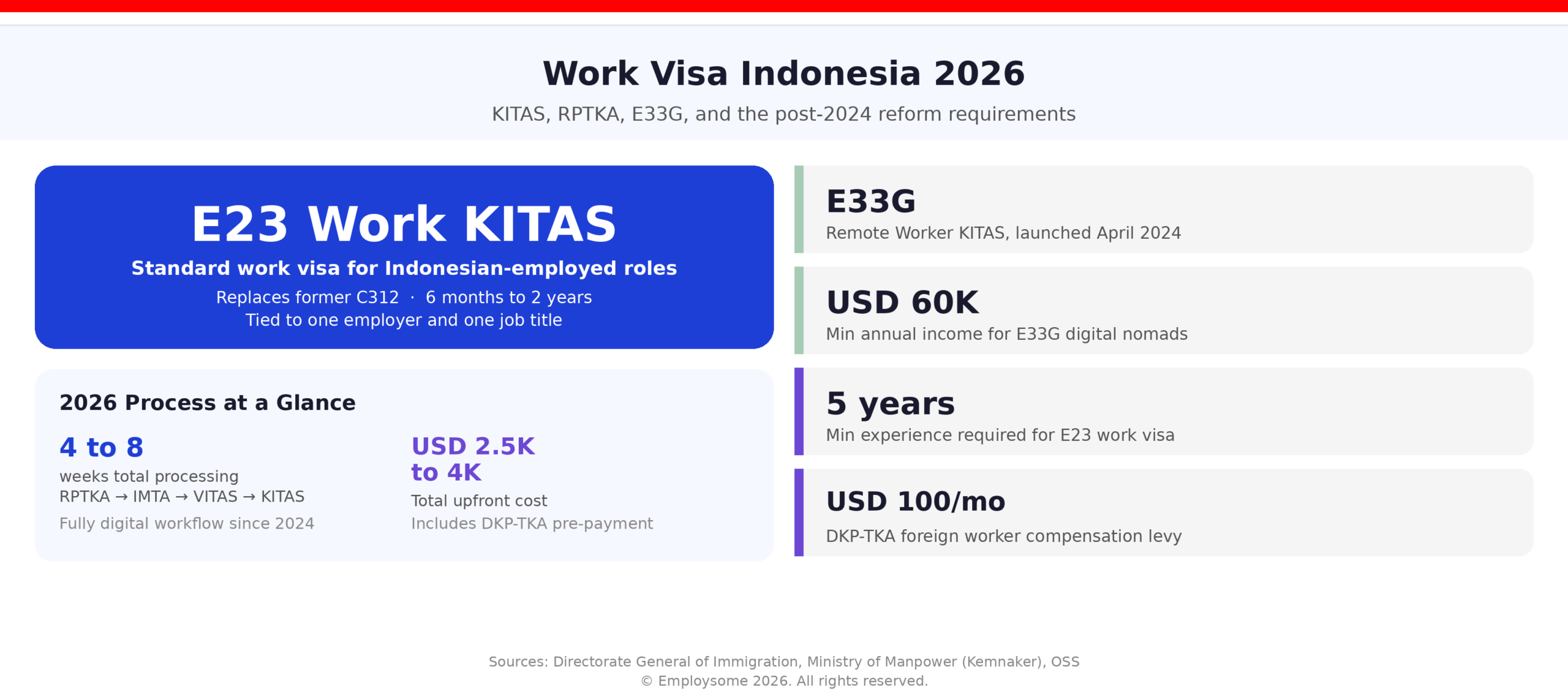
The standard pathway for most foreign professionals working for an Indonesian employer is the E23 Work KITAS. The path for foreign employees of overseas companies (digital nomads, remote employees) is the E33G Remote Worker KITAS, introduced in April 2024 and now Indonesia’s primary legal route for remote work. Investors and shareholders use the E28A Investor KITAS, while high-net-worth individuals can pursue the longer-validity Golden Visa or Second Home Visa.
What about VITAS, ITAS, and KITAS? These three terms are commonly confused but they describe different stages of the same process:
- VITAS (Visa Izin Tinggal Terbatas): The Limited Stay Visa issued overseas (or via the e-Visa system) that authorises entry to Indonesia for the purpose of obtaining a stay permit. Valid for 60 to 90 days from issue.
- ITAS (Izin Tinggal Terbatas): The Limited Stay Permit itself, i.e., the immigration status granted on arrival.
- KITAS (Kartu Izin Tinggal Terbatas): The physical card (or electronic e-KITAS PDF) that records the ITAS. Functionally, KITAS and ITAS are the same thing; the K just stands for the card (Kartu).
E23 Work KITAS: Eligibility Requirements
The E23 Work KITAS is the standard route for foreign nationals employed directly by an Indonesian-registered company. To qualify, both the employer and employee must meet specific criteria, and the role must demonstrably require foreign expertise that cannot be sourced locally.
Employer eligibility requirements:
- Be a legally registered Indonesian entity: either a foreign-investment company (PT PMA), a representative office (KPPA), or an Indonesian-owned company (PT)
- Hold a valid business licence (NIB) issued through the Online Single Submission (OSS) system
- Have a valid tax registration (NPWP)
- Meet the minimum paid-up capital requirement applicable to the company structure (typically IDR 10 billion for a PT PMA)
- Submit a Foreign Manpower Utilisation Plan (RPTKA) and pass the feasibility assessment (HPK RPTKA) introduced in the 2024 reform
- Demonstrate that the role cannot be filled by an Indonesian national, and commit to training and knowledge transfer to local staff
Employee eligibility requirements:
- Hold a passport valid for at least 18 months beyond the planned arrival date
- Possess a relevant degree or professional qualification
- Have a minimum of 5 years of cumulative work experience in the relevant field (a key requirement under the 2024 reform)
- Hold a job title that aligns with permitted positions under the RPTKA framework. Restricted positions include human resources director, certain legal roles, and positions reserved for Indonesian nationals under the Manpower Law
- Earn a salary aligned with national minimum standards for the role; the typical threshold for foreign workers is approximately IDR 25 to 30 million per month (USD 1,600 to 1,950), though specific minimums vary by industry and seniority
- Provide a clean criminal background and a valid health certificate
Restricted nationalities: The Indonesian work visa system excludes citizens of certain countries, including (as of 2026) Afghanistan, Cameroon, Guinea, Israel, Kosovo, Liberia, Nigeria, North Korea, and Somalia. The list is updated periodically by the Directorate General of Immigration.
💡 Employsome Insight: The Work KITAS Is Tied to One Employer and One Role
The Work KITAS is tied to a specific employer and a specific job title. If you change employer, role, or location, the entire RPTKA, IMTA, and KITAS process must be redone, not amended. There is no straightforward transfer mechanism. Foreign employees who change jobs in Indonesia typically cancel their existing KITAS, exit the country, and re-enter under a new VITAS sponsored by the new employer. Plan transitions carefully: the gap between KITAS cancellation and the new permit being issued can be 4 to 8 weeks during which the employee cannot legally work or earn income in Indonesia.
How to Apply for an Indonesian Work Visa: Step by Step
Obtaining an E23 Work KITAS in Indonesia is a multi-stage process involving the Ministry of Manpower (Kemnaker) and the Directorate General of Immigration. Since the 2024 digital reform, much of the workflow runs through the TKA-Online and Visa-Online systems, but several steps still require physical biometrics and document submission. The full process typically takes 4 to 8 weeks from RPTKA submission to KITAS issuance, sometimes longer for complex cases.
| Step | Action | Approximate Timeline |
| 1. RPTKA submission | Employer submits the Foreign Manpower Utilisation Plan including role justification, qualifications required, and training commitment | 2 to 4 weeks for approval |
| 2. HPK RPTKA feasibility assessment | Ministry of Manpower assesses whether the role genuinely requires foreign expertise (introduced 2024) | Built into RPTKA review |
| 3. DKP-TKA payment | Employer pays the foreign worker compensation fund (USD 100 per month per employee, often pre-paid for the full visa duration) | 1 to 3 days |
| 4. IMTA / Notification issuance | Once RPTKA is approved and DKP-TKA paid, the work permit (IMTA, now often called Notifikasi) is issued via the Kemnaker system | 2 to 3 weeks |
| 5. VITAS application (e-Visa) | Employer applies for the Limited Stay Visa via the Directorate General of Immigration’s e-Visa system | 5 to 10 working days |
| 6. VITAS issued and entry to Indonesia | Employee receives the e-Visa by email and must enter Indonesia within 90 days of issue | Up to 90 days window |
| 7. Biometrics and KITAS conversion | Within 7 days of arrival, the employee reports to the local immigration office for biometric data, photo, and fingerprinting; e-KITAS PDF issued shortly afterwards | 2 to 4 weeks |
| 8. STM local registration | Within 14 days of receiving the KITAS, the employee registers their residential address (Surat Tanda Melapor) with local immigration | Same day |
| 9. NPWP and BPJS registration | Employer registers the employee for income tax (NPWP, PPh21) and social security (BPJS Ketenagakerjaan and BPJS Kesehatan) | 1 to 2 weeks |
| 10. Multiple Re-Entry Permit (MERP) | Optional but recommended: allows the employee to leave and re-enter Indonesia without invalidating the KITAS | Issued with KITAS |
Onshore conversion option: Foreign nationals already in Indonesia on a C1 visit visa, B211A tourism visa, or another KITAS type may be able to switch to a Work KITAS without leaving the country, through a process called Alih Status Keimigrasian (immigration status change). The onshore process typically takes around 4 weeks and incurs an additional IDR 2,500,000 fee on top of standard charges. Onshore conversion is not available for foreigners who arrived on a Visa on Arrival (VOA).
E33G Remote Worker KITAS (Digital Nomad Visa)
The E33G Remote Worker KITAS, also known as the Indonesian digital nomad visa, was launched in April 2024 to formally legalise long-term remote work for employees of overseas companies. It replaced the previous workaround where digital nomads used social or tourist visas with regular border runs. The E33G is now the only legal pathway for full-time remote work from Indonesia.
Key 2026 details:
- Validity: 1 year, single permit (the E33G is not formally renewable; holders must exit Indonesia and re-apply for a new permit)
- Multiple entries: Yes, with a Multiple Exit Re-Entry Permit (MERP)
- Family: Spouses and children can apply for dependent visas linked to the E33G
- Cost: IDR 7,000,000 government fee (PNBP) plus around IDR 6,000,000 service fee; total approximately USD 850 to 1,000 with agent fees
- Processing: 5 to 10 working days for the e-Visa, 2 to 4 weeks total including KITAS activation
Eligibility requirements:
- Employed (not self-employed or freelance) by a company registered outside Indonesia
- Minimum annual income of USD 60,000 from foreign sources
- Bank balance of at least USD 2,000 evidenced by statements from the last 3 months
- Passport valid for at least 6 months from intended entry (some sources require 12 to 18 months)
- Cannot be a citizen of restricted nationalities listed by the Directorate General of Immigration
- Must not work for, invoice, or earn income from any Indonesian entity or individual
What you can and cannot do on an E33G: Holders may carry out assignments for their overseas employer, bring eligible family members to live in Indonesia, travel in and out of Indonesia, conduct tourism, and visit friends or family. They cannot work for, invoice, or earn income from Indonesian companies or individuals; cannot be self-employed, registered as sole traders, or freelancers; and cannot exceed the income source restriction without risking permit revocation, fines, deportation, or a re-entry ban.
Tax implications: E33G holders may be classified as Indonesian tax residents from arrival because the permit establishes intent to reside, regardless of the 183-day rule. Indonesian tax residents are taxed on worldwide income on a progressive scale (5% to 35%); non-residents are only taxed on Indonesian-source income at 20%. E33G holders should obtain a tax ID (NPWP) and consult a local tax professional, particularly given the interaction with home-country tax treaties.
Costs and Fees for an Indonesian Work Visa
Beyond the standard work visa fees, Indonesian employers face several mandatory cost components for each foreign worker. The most significant is the DKP-TKA (Dana Kompensasi Penggunaan TKA), formerly called DPKK, a compensation fund intended to fund Indonesian workforce skills development. This is typically required to be pre-paid for the full visa duration before the visa will be issued.
| Cost Component | Amount (2026) | Paid By |
| DKP-TKA monthly levy (foreign worker compensation fund) | USD 100 per worker per month (often pre-paid for full visa duration; up to USD 1,200 per year) | Employer (typically pre-paid) |
| RPTKA application fee | Variable, typically IDR 1,500,000 to 5,000,000 in agent fees | Employer |
| VITAS / e-Visa fee | IDR 1,500,000 to 3,000,000 (approx. USD 100 to 200) | Employer (typically) |
| KITAS issuance and biometrics | IDR 1,500,000 to 3,000,000 | Employer (typically) |
| Multiple Re-Entry Permit (MERP) | IDR 1,500,000 (1 year) or IDR 2,500,000 (2 years) | Employer or employee |
| BPJS Ketenagakerjaan (work social security) | ~5.7% of monthly gross salary (employer + employee) | Employer + employee |
| BPJS Kesehatan (health insurance) | ~5% of monthly gross salary (employer 4%, employee 1%) | Employer + employee |
| PPh21 income tax | Progressive 5% to 35% on worldwide income for residents | Withheld by employer |
| Onshore conversion fee (if applicable) | Additional IDR 2,500,000 | Employer or employee |
| Agent / visa service fee (optional) | IDR 5,000,000 to 25,000,000 depending on complexity | Employer or employee |
For a typical 1-year E23 Work KITAS, the total upfront cost including DKP-TKA pre-payment, government fees, and a visa agent is approximately USD 2,500 to 4,000, depending on the role, agent, and whether onshore conversion is needed. Costs scale with visa duration: a 2-year KITAS roughly doubles the DKP-TKA component. Higher-level roles (directors, commissioners) often incur additional documentation requirements but use the same fee schedule. See our Indonesia Hiring Guide to learn more about employer costs in Indonesia.
Required Documents
Both employers and employees need to assemble specific documents before starting an Indonesian work visa application. Missing or inaccurate paperwork is the most common cause of delays and rejections.
Documents required from the employee (E23 Work KITAS):
- Scanned copy of passport (valid for at least 18 months)
- Curriculum vitae (CV) detailing professional history
- Certificate of degree or equivalent professional qualification
- Reference letter or letters demonstrating at least 5 years of cumulative work experience in the field
- Proof of valid health insurance (any recognised provider)
- Color passport-sized photographs (red or white background)
- Police clearance / clean criminal background certificate from country of residence
- Health certificate from an authorised medical provider
Documents required from the employer (E23 Work KITAS):
- Indonesian ID card (KTP) or passport / KITAS of the company director
- Company’s NIB (business licence from OSS)
- Tax registration certificate (NPWP)
- Articles of association (Akta Perusahaan)
- Manpower report (Wajib Lapor Ketenagakerjaan)
- Identity card and color photo of the Indonesian employee who will work alongside the foreign worker (knowledge transfer assignment)
- Username and password for TKA-Online and Visa-Online systems
- Detailed RPTKA submission including role description, justification for hiring a foreign worker, and training commitment to Indonesian staff
Documents required for the E33G Remote Worker KITAS:
- Passport valid for at least 6 months beyond entry date (some sources require 18 months)
- Employment contract with a company registered outside Indonesia
- Personal bank statement showing minimum USD 2,000 balance for the last 3 months
- Proof of annual income of at least USD 60,000 from foreign sources (salary slips, tax returns, or employment letter)
- Curriculum vitae (CV)
- Recent color photograph (white or red background, 4×6 cm)
- Health insurance valid for the duration of stay
What Changed in 2024 to 2026
The 2024 reform of Indonesian immigration law continues to shape how work visas are issued and managed in 2026. Several specific changes affect both employers and foreign employees, and missing them is a common cause of compliance issues.
- Fully digital workflow: RPTKA, IMTA / Notifikasi, e-Visa, and e-KITAS are all processed through online systems (TKA-Online, Visa-Online, and the Directorate General of Immigration e-Visa portal). Physical embassy visits are no longer always required.
- Mandatory feasibility assessment (HPK RPTKA): Before any RPTKA is approved, employers must pass a feasibility assessment justifying why the role requires a foreign worker rather than an Indonesian national. Weak justifications are increasingly rejected.
- 5-year minimum experience: Foreign workers applying for an E23 Work KITAS must demonstrate at least 5 years of cumulative work experience in the relevant field. Recent graduates and early-career professionals do not qualify under standard rules.
- Pre-paid DKP-TKA: The USD 100 per month foreign worker compensation fund must usually be pre-paid for the full duration of the visa before the e-Visa is issued, increasing upfront cash flow requirements.
- All Indonesia Arrival Card: Effective 1 September 2025, all travellers entering Indonesia must complete the All Indonesia Arrival Card via a dedicated app within 3 days of their flight, including KITAS holders re-entering the country.
- Standardised E-series codes: The older C-series codes (C312, C313, C314, C316, C319) have been replaced with E-series codes (E23, E28A, E30A, E33F). The rules and validity remain similar, but employers should check current official documentation when applying.
- Tax residency intent rule: KITAS holders, including E33G holders, may be classified as Indonesian tax residents from arrival because the permit establishes intent to reside, regardless of the 183-day physical presence rule that applies to non-permit holders.
- Stricter enforcement against illegal work: Special task forces in Bali and Jakarta actively investigate foreigners working without permits. Penalties include deportation, fines, and a 6-month to 5-year ban on re-entering Indonesia. Companies caught hiring without proper authorisation face fines and may be blacklisted from sponsoring future foreign workers.
What Foreign Workers and Employers Need to Know
Tourist visas, VOA, and business visas do not allow paid work
Working in Indonesia under a tourist visa, visa on arrival, or B211A business visit visa is illegal regardless of how the worker is paid or where the employer is based. Penalties include deportation, fines, and a re-entry ban of up to 5 years. The E23 Work KITAS or E33G Remote Worker KITAS are the only legal routes for paid work.
The E23 Work KITAS is the standard route for Indonesian-employed roles
Foreign nationals hired by an Indonesian-registered company (PT, PT PMA, or representative office) need an E23 Work KITAS. The full process from RPTKA approval through KITAS issuance typically takes 4 to 8 weeks and requires the employer to pre-pay the USD 100 per month DKP-TKA levy for the full visa duration.
The E33G Remote Worker KITAS covers digital nomads
Launched in April 2024, the E33G is the first formal Indonesian permit for foreign employees of overseas companies working remotely from Indonesia. Requires minimum USD 60,000 annual foreign-source income and USD 2,000 bank balance. Valid for 1 year, non-extendable.
Five years of relevant experience is now mandatory for E23 visas
Under the 2024 reform, foreign workers applying for an E23 Work KITAS must demonstrate at least 5 years of cumulative work experience in the field. Junior and early-career professionals generally do not qualify and would need an alternative route such as an internship visa.
The Work KITAS is tied to a specific employer and role
Changing employer, role, or location requires the entire RPTKA, IMTA, and KITAS process to be redone. There is no transfer mechanism. Plan job transitions carefully to avoid working illegally during the gap between cancelled and new permits.
Tax registration is mandatory shortly after KITAS issuance
All KITAS holders, including E33G holders, must obtain an Indonesian tax ID (NPWP). Tax residents are taxed on worldwide income on a progressive scale (5% to 35%). Failing to register triggers a 20% surcharge on standard tax rates, regardless of the source of income.
Total cost is around USD 2,500 to 4,000 for a 1-year Work KITAS
The combined cost of RPTKA, DKP-TKA pre-payment, e-Visa, KITAS issuance, biometrics, MERP, and visa agent fees for a standard 1-year E23 Work KITAS typically runs USD 2,500 to 4,000. Costs scale with visa duration; a 2-year visa roughly doubles the DKP-TKA component.
Without a local entity, employers can use an Employer of Record
Foreign companies that do not yet have an Indonesian PT or PT PMA but want to hire local or relocated talent can use an Indonesian Employer of Record to handle sponsorship, payroll, BPJS, PPh21, and KITAS-related compliance through an existing local entity. Review our Best EORs in Indonesia Comparison to see the best providers in that country.
Frequently Asked Questions
The main work visa for Indonesia is the E23 Work KITAS (formerly C312), issued for foreign nationals employed directly by an Indonesian-registered company (PT, PT PMA, or representative office). It is valid for 6 months, 1 year, or 2 years depending on the role and renewable annually. For employees of companies registered outside Indonesia who want to work remotely from Indonesia, the relevant permit is the E33G Remote Worker KITAS, launched in April 2024.
No. Working in Indonesia under a tourist visa, visa on arrival (VOA), B211A business visit visa, or any other visit visa is illegal, regardless of how the worker is paid or where the employer is based. Penalties for working without authorisation include fines, deportation, and a re-entry ban of up to 5 years. Special enforcement task forces operate in Bali and Jakarta to identify foreigners working illegally. The only legal routes for paid work are the E23 Work KITAS or the E33G Remote Worker KITAS.
A standard E23 Work KITAS typically takes 4 to 8 weeks from RPTKA submission to KITAS issuance. The breakdown is approximately 2 to 4 weeks for RPTKA approval, 2 to 3 weeks for IMTA / Notifikasi processing, 5 to 10 working days for the e-Visa, and 2 to 4 weeks for KITAS conversion after arrival in Indonesia. Priority sectors and OSS-registered companies may experience faster processing. The E33G Remote Worker KITAS is faster: 5 to 10 working days for the e-Visa and 2 to 4 weeks total including KITAS activation.
The minimum salary for a foreign worker on an E23 Work KITAS is typically around IDR 25 to 30 million per month (USD 1,600 to 1,950), although specific minimums vary by industry and seniority. The salary must align with the role described in the RPTKA and be consistent with regulated minimum standards. The E33G Remote Worker KITAS instead requires a minimum annual income of USD 60,000 from foreign sources, evidenced by an employment contract and pay slips or tax returns.
VITAS (Visa Izin Tinggal Terbatas) is the Limited Stay Visa issued before arrival that authorises entry to Indonesia for the purpose of obtaining a stay permit; it is typically valid for 60 to 90 days. ITAS (Izin Tinggal Terbatas) is the Limited Stay Permit itself, granted after arrival. KITAS (Kartu Izin Tinggal Terbatas) is the physical or electronic card recording the ITAS. Functionally, ITAS and KITAS are the same; the K just stands for the card (Kartu). The order is: VITAS to enter, then convert to ITAS / KITAS upon arrival.
RPTKA (Rencana Penggunaan Tenaga Kerja Asing) is the Foreign Manpower Utilisation Plan that an Indonesian employer must submit and have approved by the Ministry of Manpower (Kemnaker) before any foreign worker can be hired. The RPTKA outlines the role, justification for hiring a foreigner, qualifications required, the duration of employment, and the employer’s commitment to training Indonesian staff. Since the 2024 reform, RPTKA submissions are subject to a feasibility assessment (HPK RPTKA) that requires strong justification for the foreign hire.
DKP-TKA (Dana Kompensasi Penggunaan Tenaga Kerja Asing), formerly called DPKK, is the foreign worker compensation fund that Indonesian employers must pay for each foreign employee. The fee is USD 100 per worker per month, totalling USD 1,200 per year, and is typically pre-paid for the full duration of the visa before the e-Visa is issued. The fund is used to develop Indonesian workforce skills.
In some cases, yes. Foreign nationals already in Indonesia on a C1 visit visa, B211A tourism visa, or another KITAS type can convert their status to a Work KITAS or Remote Worker KITAS through an onshore process called Alih Status Keimigrasian (immigration status change). The onshore process typically takes around 4 weeks and incurs an additional IDR 2,500,000 fee. Onshore conversion is not available for foreigners who arrived on a Visa on Arrival (VOA); they must exit and re-enter using the appropriate offshore visa.
The E33G Remote Worker KITAS is for foreign nationals who are employees (not self-employed or freelance) of a company registered outside Indonesia. Applicants must have a minimum annual income of USD 60,000 from foreign sources, a bank balance of at least USD 2,000 evidenced by 3 months of statements, a passport valid for at least 6 months beyond intended entry, and must not be a citizen of restricted countries. Holders cannot work for, invoice, or earn income from Indonesian companies or individuals during their stay.
KITAS holders, including E33G holders, may be classified as Indonesian tax residents from arrival because the permit establishes intent to reside, regardless of the 183-day physical presence rule that applies to non-permit holders. Indonesian tax residents are taxed on worldwide income on a progressive scale of 5% to 35%. Non-residents are taxed only on Indonesian-source income at a flat 20% rate. All KITAS holders must obtain an Indonesian tax ID (NPWP); failure to register triggers a 20% surcharge on standard tax rates.

Courtney Pocock is a Copywriter at Employsome with 15+ years of experience writing for the HR, corporate, and financial sectors. She has a strong interest in global business expansion and Employer of Record / PEO topics, focusing on news that matters to business owners and decision-makers. Courtney covers industry updates, regulatory changes, and practical guides to help leaders navigate international hiring with confidence. Connect with Courtney on LinkedIn.
Our content is created for informational purposes only and is not intended to provide any legal, tax, accounting, or financial advice. Please obtain separate advice from industry-specific professionals who may better understand your business’s needs. Read our Editorial Guidelines for further information on how our content is created.