
Average Salary in Indonesia 2026: Complete Guide & Data
The average salary in Indonesia in 2026 is approximately IDR 3,050,000 per month (around USD $190) at the national level per Statistics Indonesia (BPS) data, with Jakarta leading at IDR 5,729,876 (UMP). This complete 2026 guide breaks down the average monthly salary in Indonesia by city, industry, and role, with full provincial UMP and UMK minimum wage figures, the BPJS social security and PPh 21 tax wedge, the mandatory THR religious holiday allowance, regional comparisons across Southeast Asia, and worked employer cost examples for international companies hiring in Indonesia.

The average salary in Indonesia in 2026 is approximately IDR 3.05 million per month (around USD $190) according to the latest Statistics Indonesia (BPS) data, with meaningful variation by city, industry, and role. Jakarta leads on average pay at IDR 5,729,876 per month under the 2026 provincial minimum wage (UMP), while industries like banking, telecommunications, and oil and gas pay 3 to 5 times the national average. This guide breaks down the average monthly salary in Indonesia across all major dimensions: by city, by industry, by role and seniority, with full 2026 minimum wage (UMP and UMK) figures, the BPJS social security and PPh 21 tax wedge, and the mandatory THR religious holiday allowance.
Understanding the average salary Indonesia 2026 is essential whether you are an international employer budgeting for a new hire, an HR professional benchmarking compensation, a candidate evaluating a job offer, or an Employer of Record customer comparing total cost of employment across Southeast Asia. The numbers matter not just at the gross level: mandatory employer contributions, the 13th-month THR, and Indonesia’s progressive PPh 21 income tax brackets all materially shift the real cost of hiring and the take-home pay an employee actually receives. This article covers the latest 2026 figures with full currency conversions in IDR and USD, plus the structural context foreign employers need to make accurate offers.
The structural reality is that Indonesia’s salary landscape is highly geographically uneven. The gap between the highest-paying province (Jakarta DKI) and the lowest (Central Java) on the 2026 minimum wage alone is more than 2.5x. Industry premiums layer on top: a junior software engineer in Jakarta earns roughly 4 times what a junior retail worker in Yogyakarta earns. Multinational companies and established Indonesian employers in Jakarta, Surabaya, Bandung, and Bali tend to anchor compensation against international benchmarks; smaller domestic companies and operations in Central Java, Yogyakarta, or Sumatra anchor closer to provincial minimum wages. Reading the average income in Indonesia as a single number obscures these structural realities.
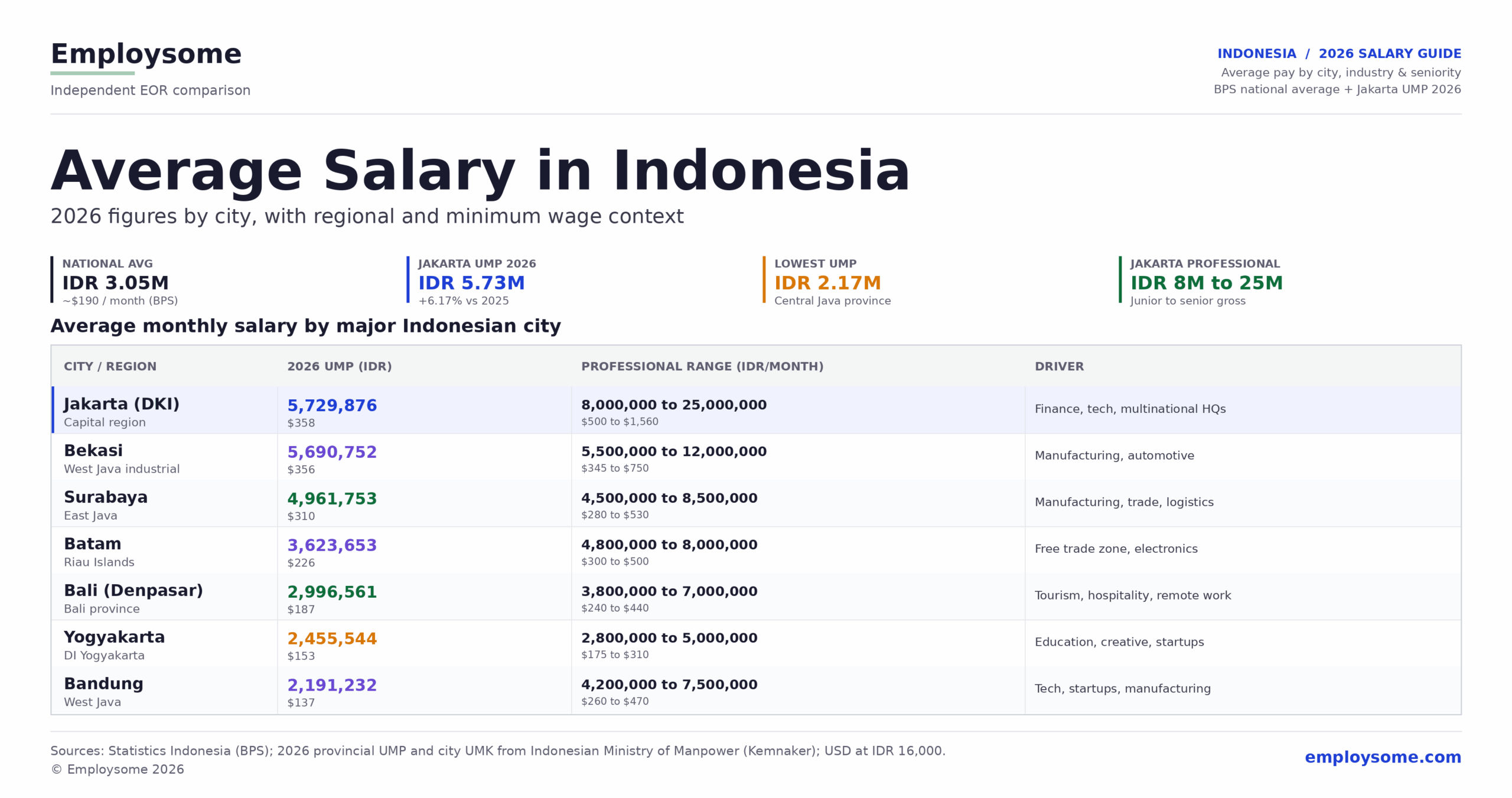

Average Monthly Salary in Indonesia 2026: National & City Breakdown
The average monthly salary in Indonesia 2026 varies dramatically by region. Below is the BPS (Badan Pusat Statistik) national average alongside the major cities and economic zones, all in Indonesian Rupiah (IDR) and US Dollar (USD) at approximately IDR 16,000 = USD 1.
| Region | Average Monthly Salary (IDR) | Approx. USD | Context |
| National average (BPS, 2026) | ~IDR 3,050,000 | ~$190 | All workers, all sectors |
| Jakarta (DKI) | IDR 5,500,000 to 12,000,000 | $345 to $750 | Skewed by financial services and tech |
| Surabaya (East Java) | IDR 4,500,000 to 8,500,000 | $280 to $530 | Manufacturing and trade hub |
| Bandung (West Java) | IDR 4,200,000 to 7,500,000 | $260 to $470 | Tech and startup growth |
| Bali (Denpasar) | IDR 3,800,000 to 7,000,000 | $240 to $440 | Tourism and hospitality led |
| Yogyakarta | IDR 2,800,000 to 5,000,000 | $175 to $310 | Education and creative sectors |
| Medan (North Sumatra) | IDR 3,500,000 to 6,500,000 | $220 to $410 | Trade and palm oil |
| Makassar (South Sulawesi) | IDR 3,200,000 to 5,500,000 | $200 to $345 | Eastern Indonesia hub |
| Batam (Riau Islands) | IDR 4,800,000 to 8,000,000 | $300 to $500 | Free trade zone, shipping, electronics |
Why the national average is misleading: The IDR 3,050,000 figure is a population-weighted average that captures Indonesia’s 280-million-strong workforce across formal and informal sectors, urban and rural areas, and all skill levels. For a foreign employer benchmarking a knowledge-worker hire in Jakarta, the relevant baseline is closer to IDR 8 to 15 million per month, not IDR 3 million. The indonesia average salary figure most articles cite ignores this stratification.
2026 Indonesia Minimum Wage (UMP & UMK) by Province
Indonesia’s minimum wage system has two layers: the Upah Minimum Provinsi (UMP), set at the provincial level, and the Upah Minimum Kabupaten/Kota (UMK), set at the regency or city level. UMK figures are typically higher than the UMP for that province, particularly in industrial cities. For 2026, all UMP and UMK figures were announced in late November and early December 2025 by provincial governors, following the national wage formula set by Government Regulation No. 51/2023.
2026 UMP rates for major Indonesian provinces:
| Province | 2026 UMP (IDR/month) | Approx. USD | YoY Change |
| Jakarta (DKI Jakarta) | IDR 5,729,876 | $358 | +6.17% |
| Banten | IDR 3,066,719 | $192 | +6.50% |
| West Java (Jawa Barat) | IDR 2,191,232 | $137 | +6.50% |
| Central Java (Jawa Tengah) | IDR 2,169,349 | $136 | +6.50% |
| East Java (Jawa Timur) | IDR 2,305,985 | $144 | +6.50% |
| Yogyakarta (DI Yogyakarta) | IDR 2,455,544 | $153 | +6.50% |
| Bali | IDR 2,996,561 | $187 | +6.50% |
| North Sumatra (Sumatera Utara) | IDR 2,992,559 | $187 | +6.50% |
| South Sulawesi (Sulawesi Selatan) | IDR 3,791,664 | $237 | +6.50% |
| Riau Islands (Kepulauan Riau) | IDR 3,623,653 | $226 | +6.50% |
| East Kalimantan (Kalimantan Timur) | IDR 3,679,454 | $230 | +6.50% |
| Papua | IDR 4,285,847 | $268 | +6.50% |
2026 UMK highlights for major industrial cities: Within West Java, the UMK for Bekasi Regency is IDR 5,690,752 (~$356) and for Karawang Regency is IDR 5,599,593 (~$350), reflecting their position as Indonesia’s major manufacturing belt. Tangerang City in Banten reaches IDR 5,016,792 (~$314). In East Java, Surabaya City UMK is IDR 4,961,753 (~$310), well above the East Java provincial UMP. The UMK in industrial regencies often exceeds the UMP of the province by 50% or more, making the regency-level figure the practically relevant benchmark for manufacturing and logistics employers.
Jakarta’s 6.17% increase for 2026 is slightly lower than the 6.50% applied across most provinces, reflecting the formula differential where higher-base provinces see slightly smaller percentage increases. The Jakarta UMP is now more than 2.6x the lowest provincial UMP in the country (Central Java), highlighting the structural wage gap between Indonesia’s capital region and the rest of the country.
💡 Employsome Insight: The Average Salary in Indonesia Is Not a Hiring Benchmark
Foreign employers benchmarking a Jakarta hire often anchor on the average salary in Indonesia figure of around IDR 3 million, then assume that any offer above the Jakarta UMP of IDR 5.73 million is “above market”. This is wrong. A professional knowledge-worker offer in Jakarta typically needs to anchor at 2.5 to 4 times the UMP (IDR 14 to 23 million) to attract talent comparable to Singapore, Kuala Lumpur, or Manila benchmarks. The UMP is a legal floor for any worker; it is not a market rate for skilled professionals. Reading the average monthly salary in indonesia as the relevant benchmark for hiring software engineers, product managers, or finance professionals systematically underprices offers and produces poor candidate response rates.
Average Salary in Indonesia by Industry: 2026 Data
Industry choice is the largest single determinant of average income in indonesia after location. High-paying sectors include banking and financial services, oil and gas, telecommunications, technology, and pharmaceuticals. Lower-paying sectors include retail, food services, agriculture, and tourism (with the exception of luxury hospitality in Bali and Jakarta). The figures below reflect typical 2026 monthly gross salaries for full-time professional roles in major Indonesian cities, primarily Jakarta and Surabaya.
| Industry | Junior (IDR) | Mid-level (IDR) | Senior (IDR) |
| Banking & Financial Services | 8,000,000 to 14,000,000 | 15,000,000 to 30,000,000 | 35,000,000 to 80,000,000 |
| Oil, Gas & Mining | 10,000,000 to 18,000,000 | 20,000,000 to 40,000,000 | 45,000,000 to 100,000,000 |
| Technology & Software | 8,000,000 to 15,000,000 | 16,000,000 to 35,000,000 | 40,000,000 to 90,000,000 |
| Telecommunications | 7,500,000 to 13,000,000 | 14,000,000 to 28,000,000 | 30,000,000 to 65,000,000 |
| Pharmaceuticals & Healthcare | 7,000,000 to 12,000,000 | 13,000,000 to 25,000,000 | 28,000,000 to 60,000,000 |
| FMCG & Consumer Goods | 6,500,000 to 11,000,000 | 12,000,000 to 22,000,000 | 25,000,000 to 50,000,000 |
| Manufacturing & Industrial | 5,500,000 to 9,500,000 | 10,000,000 to 18,000,000 | 20,000,000 to 40,000,000 |
| Professional Services (consulting, audit) | 7,000,000 to 12,000,000 | 14,000,000 to 28,000,000 | 30,000,000 to 70,000,000 |
| Marketing & Advertising | 5,500,000 to 9,500,000 | 10,000,000 to 20,000,000 | 22,000,000 to 45,000,000 |
| Construction & Real Estate | 5,500,000 to 9,000,000 | 10,000,000 to 18,000,000 | 20,000,000 to 45,000,000 |
| Tourism & Hospitality | 4,500,000 to 7,500,000 | 8,500,000 to 15,000,000 | 17,000,000 to 35,000,000 |
| Retail & E-commerce | 4,800,000 to 8,000,000 | 9,000,000 to 16,000,000 | 18,000,000 to 35,000,000 |
Industry premium drivers: Banking, oil and gas, and telecommunications consistently lead Indonesian salary surveys because of (a) capital intensity and high productivity per worker, (b) regulatory complexity requiring specialised expertise, and (c) competition from regional multinationals headquartered in Singapore, Hong Kong, or Kuala Lumpur. Technology has risen sharply in recent years driven by unicorn growth (Gojek-Tokopedia, Traveloka, Bukalapak, Xendit) and now competes head-to-head with banking on senior engineering compensation in Jakarta.
Regional variation within industries: A senior software engineer in Jakarta typically earns IDR 50 to 90 million per month, while the same role in Yogyakarta or Bandung typically pays IDR 25 to 50 million for equivalent experience. Companies running distributed teams across Indonesia often anchor compensation to the lowest-cost city where they have presence, with cost-of-living adjustments only for Jakarta and Bali.
Indonesia Average Salary by Role and Seniority Level
For HR teams and international employers benchmarking specific roles, the table below provides typical 2026 monthly gross salaries by seniority level across the most commonly recruited positions in Indonesia. Figures reflect Jakarta-anchored roles in mid-to-large companies; multiply by approximately 0.6 to 0.7 for non-Jakarta cities, and by approximately 1.2 to 1.5 for top-tier multinational employers.
| Role / Level | Typical Monthly (IDR) | Annual (IDR) | Approx. USD/year |
| Entry-level (0 to 2 yrs) | 5,000,000 to 9,000,000 | 65,000,000 to 117,000,000 | $4,100 to $7,300 |
| Junior professional (2 to 5 yrs) | 8,000,000 to 15,000,000 | 104,000,000 to 195,000,000 | $6,500 to $12,200 |
| Mid-level professional (5 to 8 yrs) | 14,000,000 to 25,000,000 | 182,000,000 to 325,000,000 | $11,400 to $20,300 |
| Senior professional (8 to 12 yrs) | 22,000,000 to 40,000,000 | 286,000,000 to 520,000,000 | $17,900 to $32,500 |
| Manager / Department head | 30,000,000 to 60,000,000 | 390,000,000 to 780,000,000 | $24,400 to $48,750 |
| Senior Manager | 50,000,000 to 90,000,000 | 650,000,000 to 1,170,000,000 | $40,600 to $73,100 |
| Director / VP | 80,000,000 to 150,000,000 | 1,040,000,000 to 1,950,000,000 | $65,000 to $121,900 |
| Senior Director / SVP | 120,000,000 to 250,000,000 | 1,560,000,000 to 3,250,000,000 | $97,500 to $203,100 |
| C-suite (CFO, COO, CTO) | 200,000,000+ | 2,600,000,000+ | $162,500+ |
What the seniority bands mean in practice: Indonesian career progression is generally faster than Western norms in technology and consumer-facing industries (a strong performer can reach Senior Manager by age 32 to 35), and somewhat slower in traditional sectors like banking and oil and gas. Years of experience matter less than role scope and management responsibility for compensation determination. A senior individual contributor with 10 years of experience often earns less than a manager with 7 years of experience and 5 direct reports.
Annual versus monthly framing: Indonesian salaries are nearly always quoted as monthly gross figures rather than annual. When converting to annual, the standard approach is to multiply monthly by 13 (not 12) to capture the mandatory THR religious holiday allowance, which is paid as one additional month of salary before Eid al-Fitr or Christmas. Many international employers underestimate annual costs by missing the THR uplift.
BPJS Social Security, PPh 21 Tax & THR: The Real Cost of Employment
The average salary in indonesia tells only half the story of what an employer actually pays and what an employee actually receives. Indonesia’s mandatory social security contributions, the 13th-month THR, and the progressive PPh 21 income tax all materially shift the real cost of employment. International employers benchmarking against IDR figures alone systematically underestimate total cost.
BPJS Kesehatan (national health insurance):
- Employer contribution: 4% of monthly salary, capped at IDR 12 million salary base (so maximum employer contribution is approximately IDR 480,000/month)
- Employee contribution: 1% of monthly salary, capped at the same IDR 12 million base (maximum employee deduction approximately IDR 120,000/month)
- Provides healthcare access through the BPJS Kesehatan public health system
BPJS Ketenagakerjaan (employment social security):
- Old-Age Security (JHT): 5.7% total (3.7% employer + 2% employee)
- Pension (JP): 3% total (2% employer + 1% employee), capped at IDR 9.5 million salary base
- Work Accident (JKK): 0.24% to 1.74% employer-only, depending on industry risk classification
- Death Benefit (JKM): 0.3% employer-only
- Job Loss Insurance (JKP): 0.46% total (employer-paid government subsidy)
Total employer cost of BPJS: approximately 10.24% to 11.74% on top of gross salary, depending on industry. For a typical office-based role in a low-risk industry, employer-side BPJS adds about 10.8% to gross.
Total employee deduction for BPJS: approximately 4% of gross salary, deducted before take-home calculation.
PPh 21 (income tax) under the TER system: Indonesia uses a progressive income tax structure governed by the Tax Effective Rate (TER) system implemented in 2024. The 2026 brackets remain:
| Annual Taxable Income (IDR) | Tax Rate |
| Up to 60,000,000 | 5% |
| 60,000,001 to 250,000,000 | 15% |
| 250,000,001 to 500,000,000 | 25% |
| 500,000,001 to 5,000,000,000 | 30% |
| Above 5,000,000,000 | 35% |
PTKP (Penghasilan Tidak Kena Pajak, tax-free allowance): The 2026 PTKP starts at IDR 54 million per year for a single employee, with additions of IDR 4.5 million for a spouse and per dependent (maximum 3 dependents). Effective tax rates after PTKP are typically 7% to 12% for mid-level professionals (IDR 15 to 30 million/month), 15% to 22% for senior managers, and 25% to 32% for director-level roles.
THR (Tunjangan Hari Raya, religious holiday allowance): Indonesia legally requires employers to pay one additional month of salary before each employee’s major religious holiday (typically Eid al-Fitr for Muslim employees, Christmas for Christian employees). THR is mandatory under Government Regulation No. 36/2021 and must be paid no later than 7 days before the relevant holiday. Failure to pay THR triggers fines and reputational risk; THR enforcement actions are publicly reported each year by the Ministry of Manpower (Kemnaker).
💡 Employsome Insight: Add 18 to 22% to Gross Salary for True Employer Cost
A simple rule of thumb for international employers: add approximately 18 to 22% to the gross monthly salary to estimate the true cost of employment in Indonesia. The math: BPJS employer contributions (~10.8%) plus the THR uplift (equivalent to ~8.3% spread across 12 months, since THR is one extra month’s salary annually). For a mid-level professional on IDR 20 million/month gross, the true monthly cost to the employer is closer to IDR 24 to 24.5 million, and the annual cost is IDR 295 to 300 million. Calculating average salary in indonesia as gross x 12 understates real employer cost by 15 to 20%.
Indonesia Average Salary in Southeast Asian Context
Indonesia’s salary levels are best understood in the context of Southeast Asian peers and major regional multinational hubs. The table below compares average monthly professional-level gross salaries across the region for 2026.
| Country | Average Monthly Salary (USD) | Junior Professional | Mid-level Professional |
| Indonesia (Jakarta) | $190 (national avg) | $500 to $940 | $1,000 to $2,200 |
| Vietnam (Ho Chi Minh) | $280 | $600 to $1,100 | $1,200 to $2,500 |
| Philippines (Manila) | $340 | $650 to $1,200 | $1,400 to $2,800 |
| Thailand (Bangkok) | $520 | $900 to $1,500 | $1,700 to $3,400 |
| Malaysia (KL) | $680 | $1,100 to $1,800 | $2,000 to $4,200 |
| Singapore | $4,400 | $3,000 to $4,500 | $5,000 to $9,500 |
What these comparisons mean: For foreign employers building distributed Southeast Asian teams, Indonesia delivers approximately the lowest average salary levels in the region for most professional categories, particularly outside Jakarta. This makes Indonesia a strong option for cost-sensitive expansion plays, though employers should weigh the higher BPJS and THR uplift, language considerations (Bahasa Indonesia plus English), and logistical considerations versus the somewhat higher Vietnam or Philippines salary levels but simpler English-language business operations in those markets.
The regional context for Jakarta specifically: Jakarta’s senior professional and management compensation is now approaching Bangkok and Kuala Lumpur levels for top-tier multinational and unicorn-backed roles. The gap between Jakarta and Singapore remains large (typically 3 to 5x at senior levels), but the gap between Jakarta and the rest of Indonesia is structurally widening as multinational presence and tech investment concentrate in the capital.
Worked Examples: Calculating Real Employer Cost in Indonesia
For international employers using these average salary in indonesia figures to build realistic offers, the following worked examples illustrate how gross monthly salary translates to real annual employer cost.
Example 1: Senior Software Engineer in Jakarta
- Gross monthly: IDR 25,000,000 (~$1,560)
- BPJS employer contribution (10.8%): IDR 2,700,000
- THR uplift (8.3% spread across 12 months): IDR 2,083,333
- True monthly employer cost: IDR ~29,783,333 (~$1,860)
- Annual employer cost: IDR ~392,700,000 (~$24,545)
- Cost ratio: 1.31x gross salary
Example 2: Mid-level Marketing Manager in Surabaya
- Gross monthly: IDR 12,000,000 (~$750)
- BPJS employer contribution (10.8%): IDR 1,296,000
- THR uplift: IDR 1,000,000
- True monthly employer cost: IDR ~14,296,000 (~$894)
- Annual employer cost: IDR ~178,752,000 (~$11,170)
- Cost ratio: 1.24x gross salary (lower because Surabaya UMK sets a higher floor relative to mid-level pay than Jakarta)
Example 3: Entry-level Customer Support Agent in Yogyakarta
- Gross monthly: IDR 4,500,000 (~$281)
- BPJS employer contribution (10.8%): IDR 486,000
- THR uplift: IDR 375,000
- True monthly employer cost: IDR ~5,361,000 (~$335)
- Annual employer cost: IDR ~67,032,000 (~$4,189)
- Cost ratio: 1.19x gross salary (compressed by BPJS caps)
Pattern: The employer-cost multiplier ranges from approximately 1.19x to 1.32x of gross monthly salary, depending primarily on whether the role hits the BPJS Kesehatan cap (IDR 12 million salary base) or the BPJS Ketenagakerjaan JP cap (IDR 9.5 million salary base). Higher-paid roles see a slightly lower multiplier as caps bite; lower-paid roles see a smaller absolute uplift but a similar percentage of gross.
Hiring in Indonesia?
Hiring in Indonesia involves more than the gross monthly salary. BPJS social security adds 10 to 12%, the mandatory THR adds 8.3%, and provincial UMP and UMK minimum wages create regional floors that most international compensation benchmarks miss. Compare the top Employer of Record providers for Indonesia in 2026 – verified pricing, compliance scores, and expert rankings from Employsome’s independent research team.
Frequently Asked Questions
The average salary in Indonesia in 2026 is approximately IDR 3,050,000 per month (around USD $190) according to Statistics Indonesia (BPS) data, but this national average masks substantial variation. The average monthly salary in Jakarta ranges from IDR 5.5 to 12 million ($345 to $750), while professional roles in technology and finance reach IDR 25 to 90 million ($1,560 to $5,625). The 2026 Jakarta provincial minimum wage (UMP) is IDR 5,729,876 ($358), up 6.17% from 2025. For HR teams and international employers, the relevant benchmark is by city, industry, and role rather than the national average.
Indonesia’s 2026 minimum wage is set at the provincial level (UMP, Upah Minimum Provinsi) and at the regency or city level (UMK, Upah Minimum Kabupaten/Kota). The 2026 UMP for major provinces: Jakarta DKI IDR 5,729,876 (+6.17%), Banten IDR 3,066,719 (+6.50%), West Java IDR 2,191,232 (+6.50%), East Java IDR 2,305,985 (+6.50%), Bali IDR 2,996,561 (+6.50%), and South Sulawesi IDR 3,791,664 (+6.50%). UMK figures for industrial cities often exceed the provincial UMP by 50% or more: Bekasi Regency IDR 5,690,752, Karawang Regency IDR 5,599,593, and Tangerang City IDR 5,016,792. Most provinces saw a 6.50% increase under the wage formula in Government Regulation No. 51/2023.
The average monthly salary in Indonesia in 2026 is approximately IDR 3,050,000 (USD $190) at the national level per BPS data, but this varies dramatically by city and role. Jakarta professional roles average IDR 8 to 25 million ($500 to $1,560), Surabaya and Bandung professional roles average IDR 6 to 18 million ($375 to $1,125), and entry-level roles in non-Jakarta cities range from IDR 3 to 6 million ($188 to $375). For senior professionals and managers in Jakarta, monthly gross salaries reach IDR 30 to 90 million ($1,875 to $5,625). The average monthly salary indonesia 2026 figure is most useful as context, not as a hiring benchmark.
The average income in indonesia per month for 2026 is approximately IDR 3,050,000 (USD $190) based on the BPS national average, with the median worker earning slightly less due to income distribution skew toward Jakarta and major cities. Indonesia’s GDP per capita is approximately USD $4,800 in 2026, which translates to roughly USD $400/month in average gross domestic product per worker. The average income in indonesia is meaningfully higher in formal-sector employment (typically IDR 5 to 15 million/month) than in informal sectors that employ over 60% of Indonesian workers.
The average salary in Jakarta ranges widely by role level. The 2026 Jakarta provincial minimum wage (UMP) is IDR 5,729,876 per month (~$358 USD). Professional roles in Jakarta typically pay IDR 8 to 25 million ($500 to $1,560) for junior and mid-level positions, IDR 25 to 50 million ($1,560 to $3,125) for senior professionals, and IDR 50 to 150 million ($3,125 to $9,375) for management and director-level roles. Tech and banking roles command the highest premiums in Jakarta, with senior software engineers and senior banking professionals routinely earning IDR 50 to 90 million per month at top employers.
Indonesian employers pay approximately 10.24% to 11.74% of gross salary in mandatory social security contributions to BPJS, depending on industry risk classification. The breakdown: BPJS Kesehatan (health insurance) 4% employer + 1% employee, capped at IDR 12 million salary base; BPJS Ketenagakerjaan covering Old-Age Security (JHT) 3.7% employer + 2% employee, Pension (JP) 2% employer + 1% employee capped at IDR 9.5 million, Work Accident (JKK) 0.24% to 1.74% employer-only, Death Benefit (JKM) 0.3% employer-only, and Job Loss Insurance (JKP) 0.46% employer-paid. Employees see approximately 4% deducted from gross. For a typical office role, employer-side BPJS adds approximately 10.8% to gross salary.
THR (Tunjangan Hari Raya, religious holiday allowance) is a mandatory annual payment under Indonesian Government Regulation No. 36/2021. Employers must pay one additional month of salary before each employee’s major religious holiday: Eid al-Fitr for Muslim employees and Christmas for Christian employees. THR must be paid no later than 7 days before the relevant holiday. THR effectively makes Indonesian annual salaries 13 months rather than 12 months, adding approximately 8.3% to annual employer cost. International employers calculating annual salary as monthly x 12 systematically underestimate Indonesian compensation costs by missing THR. Failure to pay THR triggers Ministry of Manpower (Kemnaker) enforcement actions and reputational risk.
Indonesian income tax (PPh 21) is progressive under the 2024-implemented TER (Tax Effective Rate) system. The 2026 brackets are: 5% on annual income up to IDR 60 million, 15% on IDR 60 to 250 million, 25% on IDR 250 to 500 million, 30% on IDR 500 million to 5 billion, and 35% above IDR 5 billion. The PTKP (Penghasilan Tidak Kena Pajak, tax-free allowance) starts at IDR 54 million per year for a single employee, with IDR 4.5 million additions for spouse and per dependent (max 3). Effective tax rates after PTKP run approximately 7% to 12% for mid-level professionals, 15% to 22% for senior managers, and 25% to 32% for director-level roles.
No. Indonesia’s national average salary (~USD $190/month) is generally lower than Vietnam (~USD $280) and the Philippines (~USD $340). However, this national-level comparison flattens significant city-level differences: Jakarta professional salaries are competitive with or slightly above Ho Chi Minh City and Manila for similar roles, while non-Jakarta Indonesian cities tend to be materially below Vietnamese and Filipino metropolitan averages. The average salary indonesia figure is most useful for cost-sensitive distributed teams targeting non-Jakarta locations; for Jakarta-anchored hiring, Indonesia falls in the same compensation tier as the Philippines and Vietnam, with the regional differentiator being the BPJS and THR uplift rather than the gross salary itself.
An Employer of Record in Indonesia handles all employment compliance on behalf of an international company without a local entity, including: payroll calculation in IDR with proper PPh 21 tax withholding under the TER system, BPJS Kesehatan and BPJS Ketenagakerjaan contributions and registration, mandatory THR religious holiday allowance payment, compliance with provincial UMP and UMK minimum wages, and statutory benefits administration. The EOR also handles labour-law compliance under the Indonesian Manpower Law and Government Regulation No. 35/2021 (post-Job Creation Law). For international employers exploring the Indonesian market, an EOR provides faster and lower-risk hiring than incorporating a local entity. See our Best EOR Indonesia guide for verified provider rankings.
Copywriter
Christa is a Copywriter at Employsome with 17 years of professional writing experience across global brands, startups, and online publications. A native English-Finnish writer, she brings strong editorial skills and a versatile background in business, SaaS, and finance. At Employsome, Christa focuses on clear, practical content about HR, payroll, and Employer of Record topics.
Our content is created for informational purposes only and is not intended to provide any legal, tax, accounting, or financial advice. Please obtain separate advice from industry-specific professionals who may better understand your business’s needs. Read our Editorial Guidelines for further information on how our content is created.