
Canada Work Permit 2026: TFWP, LMIA-Exempt IMP & Guide
Foreign nationals working in Canada need a work permit issued under either the Temporary Foreign Worker Program (TFWP, which requires an LMIA) or the LMIA-exempt International Mobility Program (IMP). The 2026-2028 Immigration Levels Plan sets the IMP target at 170,000 and the TFWP at 60,000, signalling a clear federal preference for the LMIA-exempt pathway. This guide covers all 11 IMP categories (CUSMA, CETA, CPTPP, ICT, IEC, PGWP, C10, C20, Mobilité Francophone, and more), the LMIA process, the February 2026 C10 and C20 reforms, the Global Skills Strategy 2-week processing route, and what foreign employers hiring in Canada need to know.

Foreign nationals working in Canada need a work permit issued under one of two distinct programs administered by Immigration, Refugees and Citizenship Canada (IRCC). The Temporary Foreign Worker Program (TFWP) requires the employer to first obtain a Labour Market Impact Assessment (LMIA) proving no qualified Canadian or permanent resident is available for the role. The International Mobility Program (IMP) is LMIA-exempt: foreign workers in IMP categories such as free trade agreement professionals, intra-company transferees, post-graduation work permit holders, francophone mobility candidates, and reciprocal employment exchanges can obtain work permits without a labour market test.
2026 marks the most significant rebalancing between these two programs in over a decade. The 2026-2028 Immigration Levels Plan raises the IMP admissions target to 170,000, a 32% increase from the previous plan, while cutting the TFWP target by 27% to just 60,000. For every LMIA-based work permit issued in 2026, Canada will issue nearly three LMIA-exempt permits. The policy direction is unambiguous: the federal government is steering employers and workers away from the LMIA pathway and toward the IMP wherever a category fits. For an employer with a choice between an LMIA stream and an IMP exemption, the IMP route now saves $1,000 in LMIA fees, 10 to 20 weeks of processing time, and the documentation burden of a full labour market test.
Two recent IRCC policy updates also reset employer expectations. On 20 February 2026, IRCC published revised officer instructions for reciprocal employment work permits under exemption code C20, expanding reciprocity to include both Canadian citizens and permanent residents and removing the requirement for formal bilateral agreements. On 24 February 2026, IRCC tightened the criteria for significant benefit work permits under exemption code C10, requiring a “demonstrable impact” standard and stricter scrutiny of social and cultural benefit claims. Both updates increase compliance complexity even as IMP volumes grow.
This 2026 guide covers the full Canadian work permit framework: the TFWP versus IMP structural choice, the 11 main IMP categories with their eligibility rules, how the LMIA process works (fees, timelines, advertising requirements), the Global Skills Strategy 2-week processing route, the Employer Portal submission process and the $230 employer compliance fee, the February 2026 C10 and C20 changes, processing times across pass types, the open vs employer-specific work permit distinction, and what international employers hiring Canadian-resident foreign nationals through a Canadian Employer of Record need to know.

Canada Work Permit Programs: TFWP vs IMP
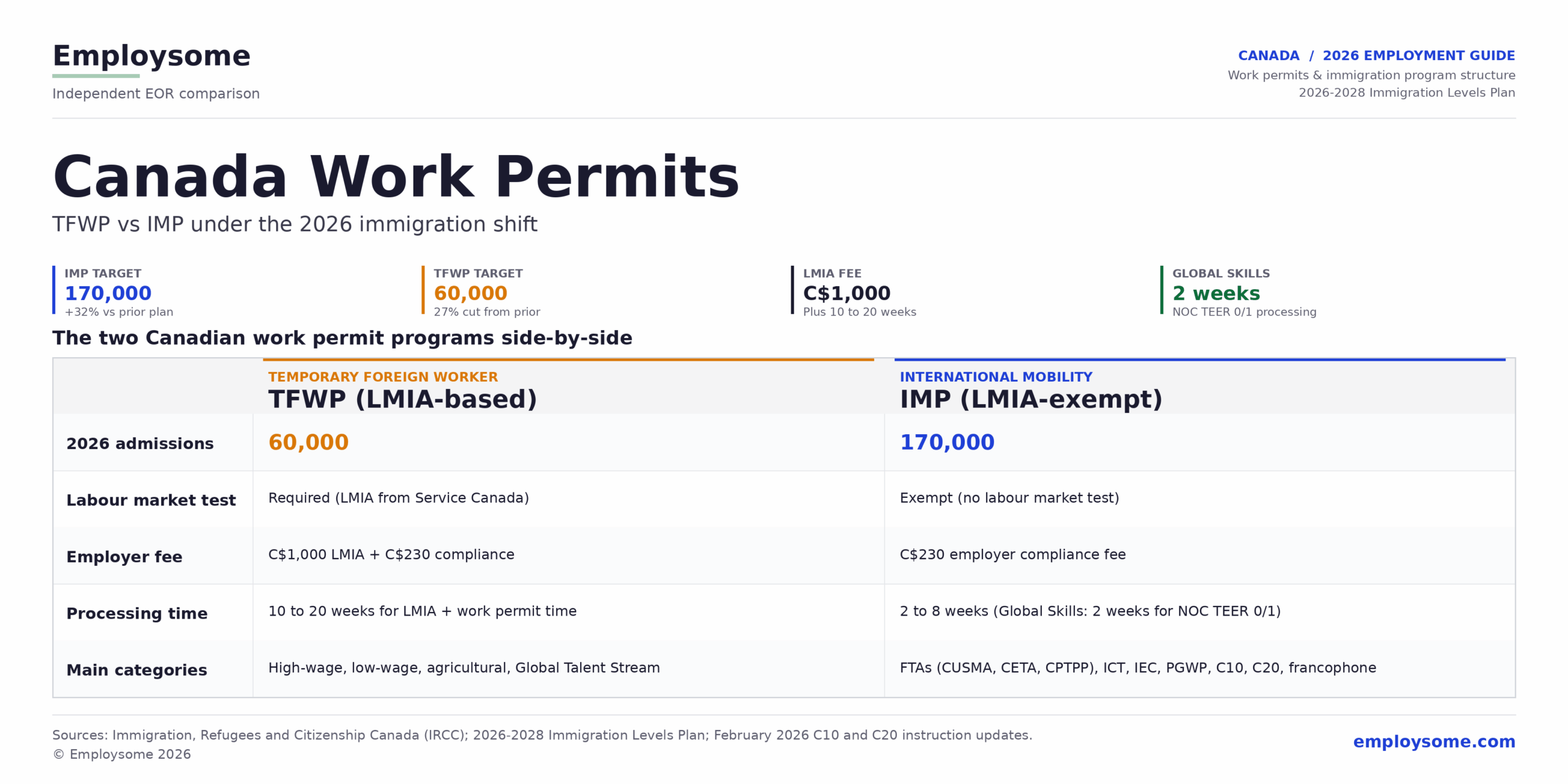
Canada operates two distinct work permit programs with fundamentally different requirements, costs, and processing times. Choosing between them, where the employer has a choice, is the single most consequential decision in the application process.
| Program | 2026 Target | LMIA Required | Employer Fee | Processing |
| Temporary Foreign Worker Program (TFWP) | 60,000 admissions | Yes (C$1,000 LMIA application) | C$1,000 LMIA + C$230 compliance | 10 to 20 weeks for the LMIA alone, plus work permit time |
| International Mobility Program (IMP) | 170,000 admissions | No (LMIA-exempt) | C$230 employer compliance fee | 2 to 8 weeks (Global Skills Strategy: 2 weeks for NOC TEER 0/1) |
The TFWP path: An employer who needs to hire a foreign national for a position not covered by an IMP exemption must first obtain an LMIA from Service Canada. The LMIA process requires the employer to advertise the position through Job Bank and at least two other recruitment channels for a minimum period (typically four consecutive weeks), document why each Canadian or permanent resident applicant was not suitable, and submit a comprehensive application demonstrating the absence of qualified domestic candidates. The LMIA application fee is $1,000 per position. Standard LMIA processing takes 10 to 20 weeks, with some streams (such as the Global Talent Stream) processed in 2 weeks.
The IMP path: When the foreign worker qualifies for an LMIA exemption, the employer skips the LMIA entirely. Instead, the employer submits an Offer of Employment through the IRCC Employer Portal, pays a $230 employer compliance fee, and the foreign worker applies for the work permit directly with IRCC. There is no labour market test, no mandatory advertising, and no requirement to demonstrate the absence of qualified Canadians. The IMP exists because the listed categories are deemed to provide social, cultural, or economic benefits that justify bypassing the standard test.
The 2026 admissions split makes the strategic priority clear: 170,000 IMP versus 60,000 TFWP means the federal government is steering nearly three out of every four work permits through the LMIA-exempt pathway. Employers and workers who identify a viable IMP exemption will move faster, pay less, and face fewer documentation hurdles. Employers stuck on the TFWP path face the slower, more expensive route by default, but with reduced overall allocation and likely higher refusal rates as Service Canada concentrates approvals on genuine labour shortage cases.
The 11 Main International Mobility Program (IMP) Categories
The IMP encompasses 11 main exemption categories, each with distinct eligibility rules, supporting documentation, and employer obligations. The most commonly used categories cover free trade agreement professionals, intra-company transferees, post-graduation work permits, and significant benefit cases.
1. Free Trade Agreement (FTA) work permits
Canada is party to multiple free trade agreements that include LMIA-exempt work permit provisions for citizens of partner countries:
- CUSMA (Canada-United States-Mexico Agreement): US and Mexican professionals in more than 60 eligible occupations (including engineers, accountants, lawyers, scientists, and IT professionals), intra-company transferees, traders, and investors
- CETA (Comprehensive Economic and Trade Agreement): EU citizens including intra-company transferees, investors, contractual service suppliers, and independent professionals
- CPTPP (Comprehensive and Progressive Agreement for Trans-Pacific Partnership): Citizens of 11 member states including Australia, Japan, Mexico, Singapore, New Zealand, Vietnam, and others, in covered professional categories
- CUKTCA (Canada-UK Trade Continuity Agreement): UK nationals in eligible categories following the post-Brexit continuity arrangement
2. Intra-Company Transferees (ICT)
Multinational companies can transfer executives, senior managers, and specialised knowledge workers to a Canadian branch, subsidiary, parent, or affiliate without an LMIA. The foreign worker must have been employed continuously by the related foreign entity for at least 1 of the last 3 years in a similar capacity. ICT permits are typically issued for up to 3 years initially with extensions available, capped at 5 years total for specialised knowledge workers and 7 years for executives and senior managers.
3. International Experience Canada (IEC)
A youth mobility program covering citizens of 35+ partner countries aged 18 to 35 (30 in some countries). IEC has three streams: Working Holiday (open work permit, up to 24 months depending on country), Young Professionals (employer-specific work permit for career development), and International Co-op (for students completing a work placement). Quotas are set annually per partner country and processed through random invitation rounds.
4. Post-Graduation Work Permit (PGWP)
An open work permit issued to international students who have completed an eligible program at a designated learning institution. Validity matches the length of the study program completed, up to a maximum of 3 years. PGWP holders can work for any employer in any role, making this one of the most flexible Canadian work permits. IRCC has frozen the PGWP eligible-program list for 2026 to provide stability for current and prospective international students.
5. Spousal and Common-Law Partner Open Work Permits
Spouses and common-law partners of foreign workers holding a work permit for a skilled position (NOC TEER 0, 1, or 2 in most cases) can apply for an open work permit. This allows them to work for any employer in Canada without an LMIA. Spouses of international students may also qualify under specific conditions.
6. Significant Benefit (C10) (tightened February 2026)
A discretionary category for foreign nationals whose work would provide significant social, cultural, or economic benefit to Canada. As of 24 February 2026, IRCC has tightened the criteria with a “demonstrable impact” standard: officers now require evidence of “creating a large number of employment or training opportunities” for Canadians and permanent residents “where the number of positions will have a demonstrable impact.” For social or cultural benefit applications, officers must examine whether the person’s presence is “crucial to an event and/or whether circumstances have created a need for the person’s entry.” Significant benefit applications are subject to extensive case-by-case scrutiny.
7. Reciprocal Employment (C20) (updated February 2026)
Allows foreign workers to take up employment in Canada when Canadians have similar reciprocal opportunities abroad. As of 20 February 2026, IRCC has updated the rules: reciprocity now extends to both Canadian citizens and permanent residents (previously only citizens were considered), country-specific reciprocity must be demonstrated (reciprocal opportunities must exist in the specific country the worker is coming from, not just “somewhere abroad”), and no formal bilateral agreement is required: employers can demonstrate reciprocity through HR policies, global mobility programs, or exchange documentation. Organisations with short reciprocity history should start with fewer permits; established organisations can issue more and assess reciprocity over a longer period (such as 5 years).
8. Mobilité Francophone (Francophone Mobility)
An LMIA-exempt category for French-speaking or bilingual foreign workers destined to work outside Quebec, supporting Canada’s goal of strong francophone communities across the country. Applicants must qualify under NOC TEER 0, 1, 2, or 3 occupations and demonstrate French-language proficiency. The category was strengthened in recent immigration plans and now sees significant employer interest in Ontario, New Brunswick, and the Prairie provinces.
9. Provincial Nominee Work Permits
Workers nominated by a province for permanent residence who have a job offer in that province may qualify for an LMIA-exempt work permit while their PR application is processed. This bridges the gap between nomination and PR confirmation, enabling workers to start the role without waiting for the full PR process to complete.
10. Bridging Open Work Permit (BOWP)
Foreign nationals who have already submitted a permanent residence application in certain economic immigration categories (Express Entry, Provincial Nominee Program, etc.) and whose current work permit is expiring may apply for a Bridging Open Work Permit, allowing them to continue working in any role while the PR application is processed.
11. Other discretionary and humanitarian categories
Researchers, guest lecturers, visiting professors, TV and film production workers, athletes and coaches, charitable and religious workers, and humanitarian or compassionate cases all have discrete LMIA-exempt routes with specific eligibility criteria.
💡 Employsome Insight: Always Check IMP Eligibility Before Defaulting to the LMIA Path
The single most consequential question in any Canadian work permit application is: “Can this hire qualify for an IMP exemption instead of an LMIA?” The answer determines whether the process takes 2 to 8 weeks or 6 to 9 months end-to-end, whether the employer pays $230 or over $1,200, and whether the application needs to clear a labour market test or just prove eligibility under an exemption category. With 2026’s 170,000 IMP target versus 60,000 TFWP allocation, the policy direction reinforces this: the federal government is actively steering employers toward the LMIA-exempt route. A diligent first-pass review of every Canadian work permit case should walk the IMP category list before defaulting to the LMIA process.
How the LMIA Process Works: 7 Steps and 4 to 9 Months
For employers who cannot find an IMP exemption that fits, the LMIA process is the standard route. Despite the 2026 cuts to the TFWP, LMIA-based work permits remain the only option for many employer-employee combinations, particularly in lower-skilled occupations and in cases where neither party qualifies under an IMP category.
The 7-step LMIA process:
| Step | Action | Typical Duration |
| 1. Job advertising | Post the position on Job Bank and at least 2 other recruitment channels for a minimum of 4 consecutive weeks. Specific advertising rules apply by NOC TEER level. | 4 weeks (minimum) |
| 2. Recruitment review | Document responses from Canadian and permanent resident applicants. Note why each unsuitable applicant was not selected. Maintain detailed records. | Concurrent with advertising |
| 3. LMIA application | Submit the application to Service Canada with employment contract, recruitment documentation, business legitimacy evidence, and C$1,000 application fee per position. | 1 to 2 days |
| 4. LMIA processing | Service Canada reviews the application. May request additional documentation or interview the employer. Standard processing 10 to 20 weeks. | 10 to 20 weeks (Global Talent Stream: 2 weeks) |
| 5. LMIA decision | Positive LMIA confirms no Canadian or permanent resident is available for the role. Negative LMIA cannot be appealed; employer must address deficiencies and reapply. | n/a |
| 6. Work permit application | Foreign worker applies for the work permit directly with IRCC, citing the positive LMIA. Application can be made from outside Canada or, in some cases, from within. | Variable by source country |
| 7. Work permit issuance | IRCC issues the work permit; foreign worker enters Canada and starts work in the LMIA-approved role with the LMIA-approved employer. | 1 to 12 weeks depending on country |
| Total typical timeline | n/a | 4 to 9 months end-to-end |
LMIA streams and processing speeds: Not all LMIAs are processed at the same speed. The Global Talent Stream processes high-skilled positions (typically in tech and innovation occupations) in 2 weeks, subject to the employer meeting specific labour market benefit plan requirements. The Recognized Employer Pilot offers 3-year LMIA validity for trusted employers with strong compliance history. Standard LMIAs for high-wage and low-wage positions take 10 to 20 weeks. Quebec LMIAs are processed jointly by Service Canada and the Ministère de l’Immigration du Québec, with the additional Quebec Acceptance Certificate (CAQ) requirement for most positions in the province.
LMIA refusal grounds: Common reasons for negative LMIA decisions include insufficient advertising, inability to demonstrate labour shortage, wage or working conditions below provincial standards, employer compliance issues from previous foreign worker hiring, suspected misrepresentation in the application, and failure to provide adequate justification for the requested NOC level. Negative LMIAs cannot be appealed; the employer must address the deficiencies and submit a new application.
How the IMP Process Works: Employer Portal and Global Skills Strategy
For LMIA-exempt hires under the IMP, the employer’s primary administrative task is the Offer of Employment submission via the IRCC Employer Portal. This step replaces the LMIA in the workflow and triggers the foreign worker’s ability to apply for their own work permit.
The 4-step IMP process:
- Step 1: Identify the IMP category. Confirm the foreign worker qualifies for a specific IMP exemption (FTA, ICT, C10, C20, Mobilité Francophone, etc.). Document the eligibility evidence supporting the exemption claim.
- Step 2: Submit Offer of Employment via Employer Portal. Pay the $230 employer compliance fee (unless exempt). The submission generates an Offer of Employment number the foreign worker uses in their work permit application.
- Step 3: Foreign worker applies for work permit. Application submitted to IRCC with the Offer of Employment number, supporting documentation for the IMP category, and any country-specific requirements (medical examination, biometrics, police certificates).
- Step 4: Work permit issuance and entry. IRCC reviews and approves the application. The foreign worker receives a Port of Entry letter (or visa where required) and presents at a Canadian Port of Entry to receive the physical work permit.
The Global Skills Strategy 2-week processing: IMP applicants in NOC TEER 0 (management) or TEER 1 (university degree professional) roles can access expedited 2-week processing if applying from outside Canada, subject to meeting Global Skills Strategy criteria. This makes high-skilled IMP hires the fastest work permit category in Canada.
Open vs employer-specific work permits: Canadian work permits are issued in two formats:
- Open work permits: Allow the holder to work for any employer in Canada (with limited exceptions for certain employers on a non-compliance list). Examples include PGWPs, Bridging Open Work Permits, IEC Working Holiday permits, and spousal open work permits.
- Employer-specific (closed) work permits: Tied to a specific employer, role, location, and duration. Switching employers requires a new work permit application. Most LMIA-based permits and many IMP categories (ICT, FTA professional, C10, C20) are employer-specific.
The employer compliance regime: Employers hiring through either the TFWP or IMP are subject to random and complaint-based compliance inspections by Employment and Social Development Canada (ESDC) for TFWP employers, and IRCC for IMP employers. Inspections review whether the employer has complied with the wages, working conditions, occupation, and other terms specified in the LMIA or Offer of Employment. Non-compliance can result in administrative monetary penalties (AMPs), bans from the program, public listing on the IRCC compliance website, and revocation of work permits already issued.
February 2026 IRCC Updates: Stricter C10 and Expanded C20
The most important 2026 developments for Canadian work permit compliance are two IRCC officer instruction updates published within four days of each other in February 2026. Together they reset the criteria for two of the most-used discretionary IMP categories.
The 24 February 2026 C10 update (Significant Benefit)
IRCC published revised officer instructions tightening the evaluation criteria for work permits issued under exemption code C10 (general exemption for significant benefit). Key changes:
- The previous instructions cited “creating training opportunities” as an example of qualifying benefit. The new instructions specify “creating a large number of employment or training opportunities” for Canadians and permanent residents “where the number of positions will have a demonstrable impact”
- For social or cultural benefit applications, officers must now “examine whether the person’s presence in Canada is crucial to an event and/or whether circumstances have created a need for the person’s entry”
- Multiple additional changes throughout the document indicate officers are expected to subject C10 applications to extensive case-by-case scrutiny
- The instructions apply only to general-exemption work permits under R205(a); pre-identified scenarios (intra-company transferees, specific entrepreneur categories) are not affected
The 20 February 2026 C20 update (Reciprocal Employment)
IRCC published revised officer instructions for reciprocal employment work permits under exemption code C20, now titled “Reciprocal employment general guidelines [R205(b) – C20] – Canadian interests – International Mobility Program.” Key changes:
- Reciprocity now includes both Canadian citizens and permanent residents. Previously, only Canadian citizens were considered when assessing reciprocity. Officers must now consider reciprocal opportunities for both citizens and PRs, broadening the scope of valid reciprocity claims
- Country-specific reciprocity required. Officers must verify reciprocal opportunities exist in the specific country the worker is coming from, not just generally “abroad”
- No formal agreement required. Employers can demonstrate reciprocity via internal HR policies, global mobility programs, or exchange documentation, without needing a formal bilateral agreement
- Organisational history matters. Organisations with a short history of reciprocity should start with fewer permits. Established organisations can issue more permits and assess reciprocity over a longer period (such as 5 years)
- Cultural agreements still apply: the rules cover cultural agreements with Belgium, Brazil, Germany, Italy, Japan, Mexico, France, and China; they do not apply to International Experience Canada (IEC) permits
- Fallback to LMIA: if a C20 reciprocal work permit is refused, the employer can obtain an LMIA and reapply through the TFWP
Other 2026 policy developments:
- The Canada-Ukraine Authorization for Emergency Travel (CUAET) expires 31 March 2026. IRCC has not confirmed extensions. Affected workers should pursue alternative pathways (Express Entry, PNP, work permit extensions) before expiry
- Temporary measures for Iranian nationals expire 28 February 2026
- The special open work permit policy for Provincial Nominees expired 31 December 2025 and has not been renewed
- IRCC has frozen the PGWP eligible-program list for 2026, providing stability for current international students
10 Common Canadian Work Permit Mistakes to Avoid
Foreign workers and their employers fall into a small set of recurring errors when navigating Canadian work permits. Most are fixable in the application stage but become expensive once a refusal is issued or a compliance inspection identifies a problem.
- Defaulting to the LMIA path without checking IMP eligibility first. A diligent first-pass review of every case should walk the 11 IMP categories before assuming an LMIA is required. The 2026 admissions split makes this even more important.
- Misclassifying Intra-Company Transferees. The “specialised knowledge” prong is one of the most refused IMP routes. Generic descriptions of the worker’s skills are insufficient; applications need to demonstrate proprietary knowledge of the company’s products, services, equipment, techniques, management, or operations not generally available in the Canadian labour market.
- Underestimating C10 scrutiny after February 2026. Significant benefit applications now require evidence of “demonstrable impact” rather than general benefit claims. Documentation should include specific numbers of jobs created or training opportunities generated, expert testimony, and evidence of unique role requirements.
- Missing the country-specific reciprocity requirement for C20. Post-February 2026, reciprocity must be demonstrated in the specific country the worker is coming from, not in some other partner country. Employers using C20 for multi-country talent flows need to document reciprocity for each source country.
- Insufficient LMIA advertising documentation. Job Bank posting alone is not enough; the employer must advertise on at least 2 other recruitment channels for the full minimum period and document why each Canadian or PR applicant was unsuitable.
- Relying on LMIA exemptions that no longer exist. The Provincial Nominee open work permit policy expired in December 2025; CUAET expires March 2026. Workers and employers should not plan around expired or expiring measures.
- Ignoring compliance after permit issuance. Wages, working conditions, occupation, and location must match the LMIA or Offer of Employment. Promotions, salary changes, location changes, or role redefinitions can trigger compliance issues if not properly amended through IRCC or the Employer Portal.
- Treating Quebec as a regular province. Quebec requires an additional Quebec Acceptance Certificate (CAQ) for most positions, and the LMIA process involves both Service Canada and the Quebec ministry. Quebec timelines run materially longer than the rest of Canada.
- Misusing visitor or business visitor status. Foreign nationals attending meetings, training, or short-term consultations may qualify as business visitors without a work permit, but the line between business visitor and work-permit-required activity is narrow. Performing actual productive work, even briefly, requires a work permit.
- Forgetting biometrics. Most foreign nationals must provide biometrics as part of their work permit application. Failure to schedule biometrics promptly is a common cause of application delays.
What Foreign Employers Need to Know
For international companies hiring Canadian-resident foreign nationals through a local entity or via an Employer of Record, the 2026 work permit framework creates both planning opportunities and compliance complexity.
Key compliance points for foreign employers:
- The IMP-first strategy maximises speed and minimises cost. With 2026’s 170,000 IMP target versus 60,000 TFWP allocation, employers who structure hires through IMP categories where eligible will move materially faster and pay less. The practical workflow is to assess IMP eligibility before pursuing an LMIA in every case.
- Free Trade Agreement professionals are the lowest-friction route for US, Mexican, and EU citizens. CUSMA covers 60+ occupations, CETA covers EU citizens including ICT and contractual service suppliers. For multinational employers with talent in these jurisdictions, FTA work permits are typically the fastest and cleanest pathway.
- Intra-company transferees require careful documentation of specialised knowledge. Generic role descriptions are insufficient. ICT applications should include specific examples of proprietary knowledge, training programs the worker has completed, and how their expertise differs from what is generally available in the Canadian market.
- Use Global Skills Strategy 2-week processing for high-skilled roles. NOC TEER 0 and 1 positions applying from outside Canada qualify for the 2-week IMP processing route, making this the fastest work permit category Canada offers.
- Plan around the February 2026 C10 changes. Significant benefit applications now require demonstrable-impact evidence. Build the case file with specific numbers, expert testimony, and evidence of unique role requirements before submission rather than relying on general benefit narratives.
- Build C20 reciprocity documentation now if it applies. The post-February 2026 country-specific reciprocity requirement means employers using C20 across multiple source countries need separate documentation per country. HR policies, global mobility program records, and exchange documentation can satisfy the “no formal agreement” standard if structured properly.
- Companies without a Canadian entity should use a Canadian EOR. Setting up a Canadian corporation to sponsor work permits is rarely cost-effective at fewer than 5 hires. EOR providers handle Employer Portal registration, Offer of Employment submission, compliance fee payment, ongoing wage and working-condition compliance, and inspection response. See our Best EOR Canada guide for verified provider rankings.
- Compliance inspections are real and growing. Both ESDC (TFWP) and IRCC (IMP) conduct random and complaint-based compliance inspections. Wages, working conditions, occupation, and location must match the LMIA or Offer of Employment. Administrative monetary penalties, program bans, and public listing on the IRCC compliance website are real consequences of documented non-compliance.
- Quebec is a separate jurisdiction in practice. Quebec’s Ministère de l’Immigration co-administers work permits for the province with its own Quebec Acceptance Certificate (CAQ) requirement. Timelines are materially longer than for the rest of Canada. Plan separately for Quebec hires.
Hiring in Canada?
Canadian work permit compliance under the 2026 IMP-first policy shift, the February 2026 C10 and C20 updates, Employer Portal Offer of Employment submission, the $230 compliance fee, and ongoing compliance inspections by IRCC and ESDC all require local expertise. Compare the top Employer of Record providers for Canada in 2026 – verified pricing, compliance scores, and expert rankings from Employsome’s independent research team.
Frequently Asked Questions
A Canadian work permit is the document that authorises a foreign national to work in Canada. It is issued by Immigration, Refugees and Citizenship Canada (IRCC) under one of two programs: the Temporary Foreign Worker Program (TFWP), which requires the employer to first obtain a Labour Market Impact Assessment (LMIA) proving no qualified Canadian or permanent resident is available; or the International Mobility Program (IMP), which is LMIA-exempt and covers foreign workers in categories such as free trade agreement professionals, intra-company transferees, post-graduation work permit holders, francophone mobility candidates, and reciprocal employment exchanges. The 2026-2028 Immigration Levels Plan sets the IMP target at 170,000 admissions versus 60,000 for the TFWP, signalling a clear federal preference for the LMIA-exempt pathway.
The Temporary Foreign Worker Program (TFWP) requires the employer to obtain an LMIA before hiring a foreign worker, costing $1,000 in application fees, taking 10 to 20 weeks to process, and requiring extensive recruitment advertising and documentation to demonstrate no Canadian or permanent resident is available. The International Mobility Program (IMP) is LMIA-exempt: foreign workers in qualifying categories can obtain work permits without a labour market test, with the employer paying a $230 employer compliance fee and submitting an Offer of Employment via the IRCC Employer Portal. The 2026 admissions split is 60,000 TFWP versus 170,000 IMP, meaning Canada will issue nearly three LMIA-exempt work permits for every LMIA-based one.
A Labour Market Impact Assessment (LMIA) is a document Canadian employers must obtain from Service Canada before hiring a foreign worker through the TFWP. It proves that no qualified Canadian or permanent resident is available for the role. The LMIA application costs $1,000 per position, takes 10 to 20 weeks for standard processing (2 weeks under the Global Talent Stream), and requires the employer to advertise the position on Job Bank and at least 2 other recruitment channels for a minimum of 4 consecutive weeks before applying. Negative LMIA decisions cannot be appealed; the employer must address deficiencies and submit a new application. With the 2026 cuts to TFWP allocation, LMIA processing is expected to be more selective with higher refusal rates.
The International Mobility Program (IMP) is the framework under which Canada issues LMIA-exempt work permits to foreign nationals whose employment provides Canada with social, cultural, or economic benefits. The 11 main IMP categories include: free trade agreement work permits (CUSMA, CETA, CPTPP, CUKTCA), intra-company transferees (executives, senior managers, specialised knowledge workers), International Experience Canada (youth mobility), Post-Graduation Work Permits (international graduates), spousal open work permits, significant benefit (C10), reciprocal employment (C20), Mobilité Francophone, provincial nominee work permits, bridging open work permits, and discretionary humanitarian categories. The 2026 IMP target is 170,000 admissions, a 32% increase from the previous plan.
Two important IRCC officer instruction updates were published within four days of each other in February 2026. On 20 February 2026, IRCC updated the rules for reciprocal employment work permits under exemption code C20: reciprocity now includes both Canadian citizens and permanent residents (previously only citizens), country-specific reciprocity must be demonstrated, and no formal bilateral agreement is required. On 24 February 2026, IRCC tightened the criteria for significant benefit work permits under exemption code C10: a “demonstrable impact” standard now applies, requiring evidence of large-scale employment or training opportunities created for Canadians, and stricter scrutiny of social and cultural benefit claims. Both updates increase compliance complexity even as overall IMP volumes grow.
Processing times vary significantly by program and stream. LMIA-based (TFWP) work permits typically take 4 to 9 months end-to-end: 4 weeks minimum for advertising, 10 to 20 weeks for LMIA processing, and 1 to 12 weeks for the work permit itself depending on the applicant’s country. The Global Talent Stream processes high-skilled LMIAs in 2 weeks. IMP (LMIA-exempt) work permits typically take 2 to 8 weeks. The Global Skills Strategy processes IMP applications for NOC TEER 0 (management) or TEER 1 (university degree professional) roles in 2 weeks when applying from outside Canada, making it the fastest work permit category in Canada. Quebec processing runs materially longer than other provinces due to the additional Quebec Acceptance Certificate (CAQ) requirement.
Costs vary by program. For LMIA-based work permits: $1,000 LMIA application fee per position (employer-paid), $155 work permit application fee (worker-paid), and additional fees for biometrics ($85) and any required medical examinations or police certificates. Total typical employer cost: around $1,200 plus internal recruitment and advertising costs. For IMP (LMIA-exempt) work permits: $230 employer compliance fee, $155 work permit application fee, plus biometrics. Total typical employer cost: $230 plus the worker’s out-of-pocket fees. The 2026 admissions split makes this cost gap strategically important: employers who can route hires through IMP categories save approximately $1,000 per hire compared to the LMIA path.
An open work permit allows the holder to work for any employer in Canada (with limited exceptions for employers on the IRCC non-compliance list) and is not tied to a specific job, location, or duration of contract. Examples include Post-Graduation Work Permits (PGWP), Bridging Open Work Permits (BOWP), International Experience Canada Working Holiday permits, and most spousal open work permits. An employer-specific (closed) work permit is tied to a specific employer, role, location, and duration; switching employers requires a new work permit application. Most LMIA-based permits are employer-specific, as are many IMP categories including intra-company transferees, free trade agreement professionals, C10 significant benefit, and C20 reciprocal employment. Open permits offer the holder more flexibility; employer-specific permits give the employer more retention certainty.
The Global Skills Strategy is an IRCC programme that processes work permit applications for high-skilled foreign workers in 2 weeks, subject to specific eligibility criteria. To qualify, the position must be at NOC TEER 0 (management occupations) or TEER 1 (occupations requiring a university degree), the applicant must apply from outside Canada, and the application must be submitted online with biometrics already collected. The Global Skills Strategy applies to both LMIA-based applications under the Global Talent Stream and IMP applications under qualifying exemption categories. It is the fastest work permit pathway Canada offers and is widely used by tech and innovation companies bringing in international talent. Employers must meet specific compliance requirements including a labour market benefit plan for Global Talent Stream LMIAs.
International employers hiring foreign nationals to work in Canada must comply with the relevant program (TFWP or IMP) regardless of where the company is headquartered. Key obligations include: maintaining the wages, working conditions, occupation, and location specified in the LMIA or Offer of Employment; paying the $230 employer compliance fee for IMP hires or the $1,000 LMIA fee plus compliance fee for TFWP hires; submitting accurate Offers of Employment via the IRCC Employer Portal; cooperating with random and complaint-based compliance inspections by ESDC (TFWP) or IRCC (IMP); and updating IRCC promptly if material employment changes occur. Companies without a Canadian entity typically engage an Employer of Record to handle these obligations end-to-end. See our Best EOR Canada guide for verified provider rankings.
Copywriter
Christa is a Copywriter at Employsome with 17 years of professional writing experience across global brands, startups, and online publications. A native English-Finnish writer, she brings strong editorial skills and a versatile background in business, SaaS, and finance. At Employsome, Christa focuses on clear, practical content about HR, payroll, and Employer of Record topics.
Our content is created for informational purposes only and is not intended to provide any legal, tax, accounting, or financial advice. Please obtain separate advice from industry-specific professionals who may better understand your business’s needs. Read our Editorial Guidelines for further information on how our content is created.