
Maternity Leave in Germany 2026: Duration, Pay & Employer Costs
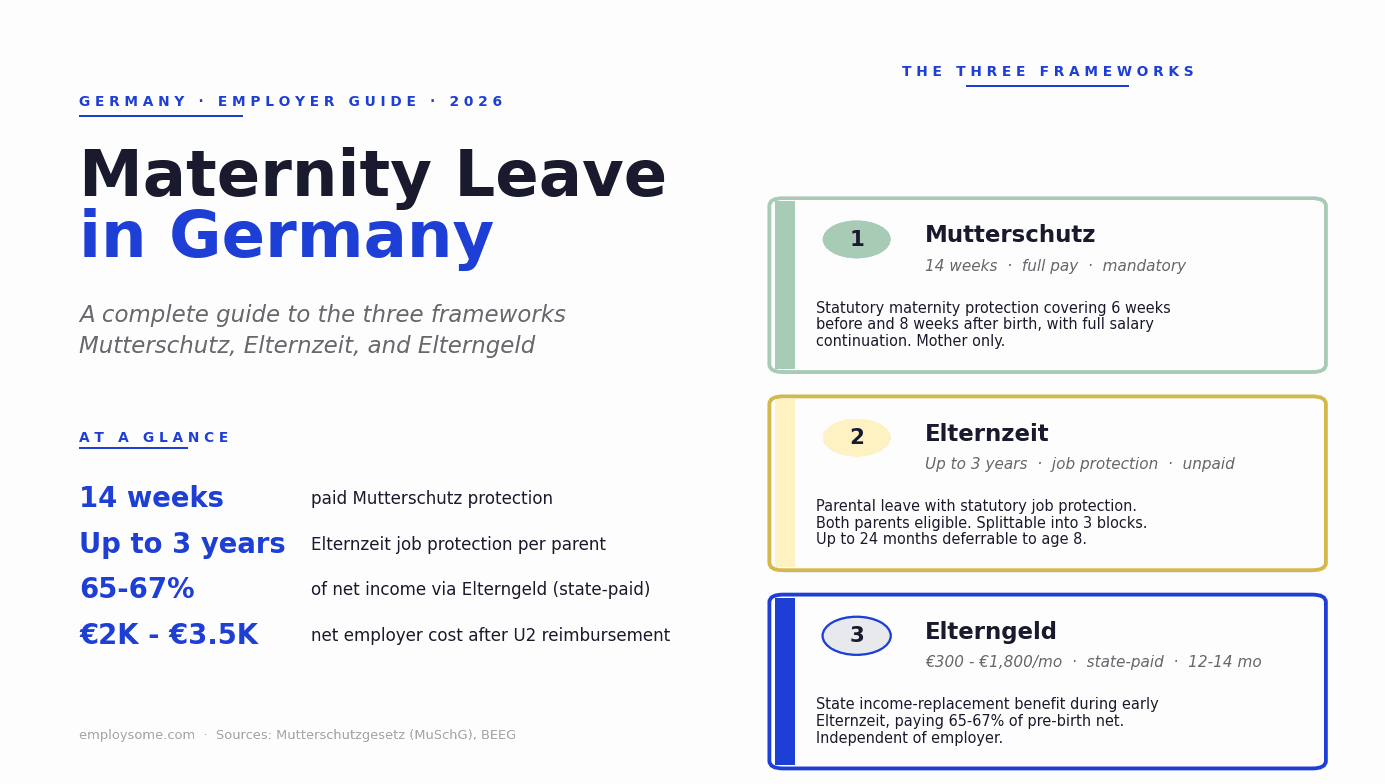
Maternity leave in Germany combines three frameworks: Mutterschutz (14 weeks of statutory protection with full pay), Elternzeit (up to 3 years of parental leave with job protection), and Elterngeld (state allowance of 65-67 percent of pre-birth net income). This guide covers each framework in detail, including pay calculation, employer top-up obligations, foreign worker eligibility, total employer cost, the notification process, worked examples, and common compliance mistakes for foreign employers hiring in Germany.

Maternity leave in Germany is one of the most generous and structurally complex parental leave frameworks in Europe. The system combines three distinct legal entitlements that operate sequentially: Mutterschutz (statutory maternity protection covering 6 weeks before and 8 weeks after birth, with full pay), Elternzeit (parental leave providing job protection for up to 3 years), and Elterngeld (parental allowance paid by the state during the early months of parental leave). Understanding the distinction between these three concepts is essential for foreign employers hiring in Germany, since each has separate eligibility rules, separate funding mechanisms, and separate compliance obligations.
For foreign employers, German maternity leave is typically more expensive than equivalent EU countries because of the employer top-up obligation under Mutterschutzgeld, the long-tail Elternzeit job protection that requires the role to remain available for up to 3 years, and the social contributions that continue accruing during the protected period. Total employer cost for a 14-week Mutterschutz period typically runs €4,000 to €12,000 above the statutory benefit reimbursement, depending on salary level, with additional administrative complexity for the multi-year Elternzeit framework. Official guidance is published by the Bundesministerium für Familie, Senioren, Frauen und Jugend (BMFSFJ) and the relevant Krankenkasse (statutory health insurance fund).
This guide covers the complete German maternity leave framework: the statutory Mutterschutz protection period, Mutterschutzgeld pay calculation including employer top-up, Elternzeit job protection rules, Elterngeld benefit calculation, eligibility rules for non-German employees and expats, employer obligations and total cost, the notification and documentation process, worked examples, common compliance mistakes, and how German maternity leave compares with neighbouring EU markets. For broader German employment law context, see our best Germany EOR guide.

Overview: Mutterschutz, Elternzeit, and Elterngeld
German maternity and parental leave operates through three legally distinct frameworks that most generic guides incorrectly conflate. Each addresses a different aspect of the parent-employee relationship and triggers different employer obligations. Understanding the boundaries between them is the single most important compliance step for foreign employers.
| Framework | Purpose | Duration | Who Pays |
| Mutterschutz | Maternity protection for the mother’s health | 6 weeks before + 8 weeks after birth (12 weeks for premature/multiple births) | Krankenkasse (€13/day cap) + employer top-up to full salary |
| Elternzeit | Parental leave with job protection | Up to 3 years per child (per parent) | Unpaid by employer; job is held open |
| Elterngeld | State income replacement during early parental leave | 12 months (or 14 months if both parents take time) | Federal government via the Elterngeldstelle |
Mutterschutz applies only to the biological mother and is mandatory; the employee cannot waive it. The 6 weeks before birth are voluntary (the mother can request to keep working until birth, though this is rarely done in practice), but the 8 weeks after birth are an absolute prohibition on work, with criminal penalties for employers who allow work during this period. Elternzeit applies to both parents and can be split between them. Elterngeld is the income-replacement state benefit and is administered separately from the employment relationship.
For foreign employers, the practical implication is that an employee starting maternity leave will trigger three separate processes: a salary continuation obligation (Mutterschutzgeld) during the Mutterschutz period, a job-protection obligation (Elternzeit) potentially spanning multiple years afterward, and a benefit application (Elterngeld) handled through state agencies. Each has its own paperwork, deadlines, and consequences for non-compliance.
Mutterschutz: The Statutory Maternity Protection Period
Mutterschutz is the statutory maternity protection period regulated by the Mutterschutzgesetz (MuSchG), which was significantly modernised in 2018 to expand coverage and clarify employer obligations. The law applies to all pregnant employees in Germany regardless of nationality, contract type (permanent, fixed-term, part-time, mini-job), or duration of employment. The protection is automatic and does not require the employee to apply for it.
The Mutterschutz period covers 6 weeks before the expected due date and 8 weeks after birth, totalling 14 weeks for typical pregnancies. The post-birth period extends to 12 weeks for premature births, multiple births, or if the child is born with a disability requiring extended care. The 6-week pre-birth period can be voluntarily waived by the employee with written declaration to the employer (revocable at any time), but the 8-week post-birth period is an absolute prohibition (Beschäftigungsverbot) that cannot be waived under any circumstances.
During Mutterschutz, the employer is prohibited from terminating the employee’s contract from the moment pregnancy is communicated until 4 months after the end of the Mutterschutz period. This protection extends to almost all dismissal grounds, including economic redundancy, restructuring, and most performance-based dismissals. Termination during this period requires explicit approval from the regional Mutterschutz authority (the Aufsichtsbehörde für den Arbeitsschutz), which is granted only in exceptional cases.
| Mutterschutz Component | Standard | Premature/Multiple Birth |
| Pre-birth protection | 6 weeks (waivable) | 6 weeks (waivable) |
| Post-birth protection | 8 weeks (absolute) | 12 weeks (absolute) |
| Total duration | 14 weeks | 18 weeks |
| Termination protection | From pregnancy notification + 4 months after | From pregnancy notification + 4 months after |
| Work prohibition | 8 weeks post-birth (absolute) | 12 weeks post-birth (absolute) |
During Mutterschutz, the employee retains all employment rights, including holiday accrual, social security contributions (paid jointly by employer and Krankenkasse), pension accrual, and seniority. The Mutterschutz period counts as time worked for the purposes of probation period completion, vacation entitlement, and tenure-based benefits.
Mutterschutzgeld: Maternity Pay Calculation
During the 14-week Mutterschutz period, the employee receives Mutterschutzgeld (maternity pay) calculated to ensure full income continuation. The payment is split between two sources: a fixed daily benefit from the Krankenkasse (statutory health insurance) and an employer top-up bringing the total to full pre-pregnancy net salary.
The Krankenkasse pays a maximum of €13 per calendar day (€403 maximum per 31-day month) under the standard scheme. This figure has not changed in many years and is now structurally below most employees’ actual daily earnings. The employer must top up the difference between the Krankenkasse benefit and the employee’s average net daily salary calculated over the 13 weeks prior to the start of the Mutterschutz period (or the 3 calendar months prior, whichever the employee chooses).
For employers, the practical consequence is that almost all Mutterschutzgeld cost falls on the employer rather than on the Krankenkasse. The Krankenkasse contribution covers approximately 5-15 percent of the total maternity pay for a typical full-time professional employee. The remaining 85-95 percent is the employer’s top-up obligation. However, employers can recover most of this cost through the Umlageverfahren U2 insurance scheme, which is mandatory for all employers and reimburses the employer top-up at typically 65-100 percent depending on the U2 contribution rate.
| Pay Component | Source | Amount | Notes |
| Mutterschutzgeld base | Krankenkasse | €13 per calendar day | Fixed cap, not indexed |
| Employer top-up | Employer | Difference to full net daily salary | Mandatory under MuSchG §20 |
| Total to employee | Combined | 100% of pre-pregnancy net daily salary | Calculated over 13 weeks or 3 months |
| U2 reimbursement to employer | Krankenkasse Umlage U2 | 65-100% of employer top-up | Varies by Krankenkasse rate |
U2 contributions are paid by all German employers as a percentage of payroll (typically 0.5 to 0.9 percent depending on the Krankenkasse), regardless of whether they have any female employees. The Umlageverfahren U2 system is designed to spread the cost of maternity benefits across the entire German employer base, removing the structural disincentive that would otherwise apply to hiring women of reproductive age. Reimbursement is processed automatically by the Krankenkasse upon submission of the maternity pay records.
Employsome Insight: The €13/day Krankenkasse cap is a German payroll quirk many foreign employers miss.
Foreign employers running first-time German maternity payroll are routinely surprised by the structure of Mutterschutzgeld. The headline assumption is that “the German government pays maternity leave,” and on a high level this is partly true via Elterngeld later. But during the 14-week Mutterschutz period itself, the Krankenkasse pays only €13 per day (a flat cap last meaningfully updated decades ago), and the employer is legally obligated to top up to full net salary. For an employee on €5,000 monthly net, this is approximately €4,800 per month in employer-paid top-up over the 14-week period. The good news is that approximately 65-100 percent of this is reimbursed through the U2 Umlageverfahren scheme, which all German employers contribute to anyway. But the cash-flow timing matters: the employer pays the top-up first, and the U2 reimbursement comes weeks later.
Elternzeit: Parental Leave with Job Protection
Elternzeit is the German parental leave framework providing job protection for up to 3 years per child per parent. It applies to both biological and adoptive parents, both mothers and fathers, and can be split between the parents in any combination. Elternzeit is regulated by the Bundeselterngeld- und Elternzeitgesetz (BEEG), which has been amended several times to expand flexibility, including the 2015 reform that allowed splitting into multiple time blocks.
Each parent can take up to 36 months of Elternzeit per child. The period can be taken consecutively or split into up to three separate blocks (with employer agreement on the timing of blocks 2 and 3). Up to 24 months of the 36-month entitlement can be deferred until the child’s 8th birthday, allowing parents to spread parental leave across early childhood and school transition periods. This is one of the most flexible parental leave frameworks in Europe.
During Elternzeit, the employer is not required to pay salary, but the employment contract continues in full force. The employee retains the right to return to the same or an equivalent position at the end of the leave period, and the employer is prohibited from terminating the contract during Elternzeit (with the same exceptional-cases authority approval requirement as Mutterschutz). Social security and pension contributions continue to accrue, with the federal government covering the contributions during Elternzeit periods that overlap with Elterngeld.
| Elternzeit Feature | Standard Rule | Notes |
| Maximum duration per parent per child | 36 months | Each parent has full 36-month entitlement |
| Splitting into blocks | Up to 3 blocks | Blocks 2 and 3 require employer agreement |
| Deferral until age 8 | Up to 24 months can be deferred | For early-school-years flexibility |
| Notification deadline | 7 weeks before start (for first 3 years) | 13 weeks if deferred portion taken later |
| Part-time work during Elternzeit | Up to 32 hours/week allowed | Right to part-time after 6 months |
| Termination protection | From notification + during entire leave | Authority approval required for dismissal |
| Salary continuation | Unpaid by employer | Elterngeld covers some income via state |
| Right to return | Same or equivalent position | Equivalent must match seniority and pay |
Employees can work part-time during Elternzeit (up to 32 hours per week) without losing their Elternzeit status, provided they request part-time arrangement with at least 7 weeks notice. After 6 months of employment, the employee has a statutory right to part-time work during Elternzeit unless the employer can demonstrate compelling operational reasons against it. Working hours below 32 per week reduce Elterngeld pro-rata but do not affect Elternzeit job protection.
Elterngeld: State Parental Allowance
Elterngeld is the federal income-replacement benefit paid by the state during the early months of parental leave. It is administered by regional Elterngeld offices (Elterngeldstelle) and is not paid by the employer. Eligibility, application, and payment are entirely separate from the employment relationship, although the employer may be asked to provide salary verification.
The standard Elterngeld (Basiselterngeld) is calculated at 65-67 percent of the parent’s net pre-birth average monthly income, with a minimum of €300 per month (paid even to non-working parents) and a maximum of €1,800 per month. The benefit is paid for up to 12 months per family for one parent, or up to 14 months if both parents share the leave (the additional 2 months are the so-called “partner months” designed to incentivise paternal participation).
Two variants exist alongside the Basiselterngeld: ElterngeldPlus (half the monthly amount paid for double the duration, designed for parents who work part-time during leave) and the Partnerschaftsbonus (additional months paid to parents who both work 24-32 hours per week simultaneously). These variants increase flexibility but do not change the total benefit amount available per family.
| Elterngeld Variant | Amount per Month | Duration | Best For |
| Basiselterngeld | 65-67% of net (€300-€1,800) | 12 months (14 if shared) | Standard parental leave |
| ElterngeldPlus | Half monthly amount | Double duration (24-28 months) | Part-time work during leave |
| Partnerschaftsbonus | Additional months | 4 extra ElterngeldPlus months | Both parents working 24-32 hr/week |
Income above €250,000 per year (single) or €500,000 per year (couple) disqualifies the parent from Elterngeld entirely as of 2024 reform. Income between thresholds is calculated against actual net rather than gross. Multiple birth surcharges add €300 per additional child per month. Adoption and foster care arrangements are eligible on the same basis as biological parenthood.
Eligibility for Foreign Workers and Expats
Foreign workers employed in Germany are entitled to the same Mutterschutz, Elternzeit, and Elterngeld as German nationals, with some specific eligibility rules around residence permit duration and EU coordination.
EU/EEA/Swiss nationals are entitled to the full framework on the same basis as German citizens from day one of employment. Their EU residence rights ensure no additional documentation is required beyond standard German employment registration.
Non-EU nationals are entitled to Mutterschutz from day one of employment regardless of residence permit status. Elternzeit is also available from day one. Elterngeld eligibility depends on residence permit type: holders of a permanent residence permit (Niederlassungserlaubnis), EU long-term residence permit, or Blue Card EU are eligible immediately. Holders of a temporary residence permit (Aufenthaltserlaubnis) are generally eligible if the permit allows employment, with some exceptions for permits explicitly tied to specific short-term assignments.
Posted workers from EU countries on temporary assignments to Germany under EU Posted Workers Directive frameworks may have different applicable rules under bilateral coordination, with the home country’s maternity framework typically applying for short assignments. The 2024 amendments to the Posted Workers Directive changed certain aspects of this for assignments over 12 months.
Cross-border commuters living in a neighbouring country (Austria, Netherlands, Belgium, France, Luxembourg, Poland, Czechia, Switzerland, Denmark) but employed in Germany are typically subject to German Mutterschutz and Elternzeit rules but may receive Elterngeld from their country of residence under EU social security coordination Regulation 883/2004.
Foreign employers using an Employer of Record (EOR) arrangement to hire German employees are bound by the same Mutterschutz, Elternzeit, and Elterngeld obligations as direct employers, with the EOR handling the administrative compliance and the foreign company bearing the underlying cost.
Employer Obligations and Total Cost
Total employer cost for a German maternity leave varies based on salary level, U2 reimbursement rate, and Elternzeit duration. The Mutterschutz period creates the largest cash-flow impact, while Elternzeit creates ongoing administrative obligations rather than direct salary cost.
For a typical full-time professional employee on €5,000 gross monthly salary (approximately €3,200 net), the 14-week Mutterschutz period creates the following employer cost structure.
| Cost Component | Amount (14-week period) | Notes |
| Krankenkasse Mutterschutzgeld | ~€1,274 | €13/day × 98 days, paid to employee directly by Krankenkasse |
| Employer top-up to full net | ~€9,200 | (€3,200 – €403 Krankenkasse) × 3 months + partial fourth month |
| Employer social contributions during Mutterschutz | ~€1,000 | Approx. 21% of gross continues during protected period |
| U2 reimbursement (recovered) | ~€7,500 to €9,200 | 65-100% of employer top-up reimbursed via Umlage |
| Net employer cost | ~€2,000 to €3,500 | After U2 reimbursement |
| U2 contributions paid annually | ~€300-€540 | 0.5-0.9% of gross payroll, regardless of female employees |
For Elternzeit, direct salary cost is zero (the period is unpaid by the employer). However, ongoing costs include: continued accrual of statutory pension contributions for periods overlapping with Elterngeld (covered by federal government, not employer), holding the role open or arranging temporary cover (which can cost 10-30 percent above the absent employee’s salary if a contractor or interim hire is engaged), and potential restructuring constraints since the role cannot be eliminated during Elternzeit.
Indirect costs that foreign employers often underestimate include: temporary replacement hire costs, training time for the returning employee, potential part-time arrangement adjustments at return, and the operational complexity of coordinating across multiple Elternzeit periods if the employee has multiple children. For foreign employers running their first German maternity leave, the recommendation is to budget €15,000 to €25,000 in total cost for a 14-week Mutterschutz plus 12-month Elternzeit cycle, before any U2 reimbursement, to capture both direct and indirect impact.
Notification and Documentation Process
German maternity leave triggers several notification and documentation deadlines that must be met by both the employee and the employer. Missing these deadlines does not generally void the employee’s rights but can delay benefit payments and create compliance issues.
| Step | Who | Deadline | Recipient |
| 1. Notify employer of pregnancy | Employee | As soon as possible | Direct employer (HR or line manager) |
| 2. Notify Aufsichtsbehörde of pregnant employee | Employer | Immediately upon notification | Regional Mutterschutz authority |
| 3. Submit pregnancy certificate (Mutterpass) | Employee | By start of Mutterschutz | Employer + Krankenkasse |
| 4. Apply for Mutterschutzgeld | Employee | Up to 7 weeks before due date | Krankenkasse |
| 5. Apply for Elternzeit (first 3 years) | Employee | 7 weeks before start | Employer (in writing) |
| 6. Apply for Elterngeld | Employee | Up to 3 months retroactive | Regional Elterngeldstelle |
| 7. Issue Elterngeld income certificate | Employer | Upon employee request | Employee for Elterngeld application |
| 8. Process U2 reimbursement | Employer | Within standard payroll cycle | Krankenkasse |
The employee’s notification of pregnancy to the employer triggers the start of the termination protection period and the obligation to perform a workplace risk assessment for pregnancy hazards. The risk assessment must consider physical hazards (heavy lifting, prolonged standing, exposure to chemicals), working time constraints (no work between 20:00 and 06:00 unless explicitly approved by the Aufsichtsbehörde), and any role-specific risks. If the role cannot be made compatible with pregnancy, the employer must offer alternative work or place the employee on individual Beschäftigungsverbot (work prohibition) with full salary continuation.
Employsome Insight: Pregnancy notification triggers immediate employer obligations beyond just paid leave.
Many foreign employers focus on the leave-and-pay aspect of maternity but overlook the immediate obligations triggered by the moment an employee notifies pregnancy. From that moment: the employer must notify the regional Aufsichtsbehörde authority, conduct a pregnancy-specific workplace risk assessment, eliminate hazardous tasks from the role (or offer alternative work), prohibit night work between 20:00 and 06:00 (with limited exceptions), prohibit Sunday and holiday work (with exceptions), and refrain from terminating the employment contract until 4 months after Mutterschutz ends. These obligations apply from the day of notification, not from the day Mutterschutz starts. Failing to perform the risk assessment is the most commonly missed obligation by foreign employers, and it carries fines of up to €30,000 per violation under the modernised MuSchG. Working with a German payroll provider or EOR that understands the full lifecycle is the simplest way to avoid these compliance gaps.
Worked Example: Full Maternity-to-Return Timeline
A worked example illustrates the full timeline of German maternity leave and parental leave for a typical foreign-employer scenario. Consider a software engineer at a foreign tech company with a German Employer of Record arrangement, on €72,000 annual gross (~€48,000 net), notifying pregnancy on 1 February 2026 with an expected due date of 15 August 2026.
| Date | Phase | Action | Income Source |
| 1 February 2026 | Pregnancy notification | Employee notifies employer; risk assessment performed; Aufsichtsbehörde notified | Full salary continues |
| 1 February to 4 July 2026 | Pregnancy with normal duties | Adjusted role per risk assessment, full pay | Full salary from employer |
| 4 July 2026 | Mutterschutz starts | 6 weeks before due date (15 August) | Krankenkasse + employer top-up |
| 15 August 2026 | Birth | Birth certificate registered, Krankenkasse notified | Krankenkasse + employer top-up |
| 15 August to 10 October 2026 | Post-birth Mutterschutz | 8 weeks absolute work prohibition | Krankenkasse + employer top-up |
| 10 October 2026 | Mutterschutz ends | Elternzeit notification deadline already passed (7 weeks before) | Transition to Elterngeld |
| 10 October 2026 to 14 August 2027 | Elternzeit + Elterngeld | 10 months Basiselterngeld at 65% of net (~€2,600/month) | State Elterngeld |
| 14 August 2027 to 14 August 2028 | Elternzeit (continued, optional) | Up to 12 additional months unpaid Elternzeit | No income (or part-time) |
| 14 August 2028 to 14 August 2029 | Elternzeit (final year, optional) | Final Elternzeit year, return to work option | No income (or part-time) |
| 15 August 2029 (or earlier) | Return to work | Right to same or equivalent position | Full salary resumes |
Total employer cost across this 3.5-year cycle: approximately €11,000 in Mutterschutzgeld top-up (largely reimbursed via U2 to a net of ~€2,500), plus zero direct salary cost during Elternzeit, plus ongoing administrative cost of holding the role open and managing temporary coverage. Total employee income across the cycle: approximately €72,000 in 2026 (mix of full salary, Mutterschutzgeld, and Elterngeld), €31,200 in Elterngeld for the first 12 months overlapping into 2027, then €0 to €36,000 depending on whether part-time work is taken during the unpaid Elternzeit periods.
Common Mistakes Foreign Employers Make
Foreign employers running their first German maternity leave routinely make several specific mistakes. Each can result in fines, back-pay obligations, employee disputes, or reputational damage in the German labour market.
1. Not performing the pregnancy-specific risk assessment. The MuSchG §10 obligation to perform a written workplace risk assessment is triggered immediately upon pregnancy notification. Failing to perform it carries fines up to €30,000. Most foreign employers focus on the leave-and-pay aspects and overlook this immediate operational obligation.
2. Treating the 8-week post-birth period as waivable. Unlike the 6-week pre-birth period, the 8-week post-birth Mutterschutz is an absolute prohibition. An employee cannot waive it, and an employer who allows work during this period faces criminal penalties under the MuSchG. Some employers misinterpret the voluntary nature of the pre-birth period as applying to the entire Mutterschutz.
3. Calculating Mutterschutzgeld on gross rather than net. The employer top-up is calculated on net salary (after tax and social contributions), not gross. Confusion between gross and net is one of the most common payroll calculation errors. The reference period is the average of the 13 weeks before Mutterschutz start, with overtime and one-off payments treated under specific rules.
4. Missing the 7-week Elternzeit notification deadline. The employee must notify Elternzeit start in writing at least 7 weeks before the start date for the first 36 months. Late notification doesn’t void the right but can delay the start date. The 7-week deadline is also the employer’s window for confirming receipt and beginning replacement planning.
5. Failing to apply for U2 reimbursement. The Umlageverfahren U2 reimburses 65-100 percent of the employer’s Mutterschutzgeld top-up, but the application is not automatic. The employer must submit the documentation to the Krankenkasse. Some foreign employers pay the full top-up without realising they can recover most of it.
6. Terminating without Aufsichtsbehörde approval. Termination during the protected period (pregnancy notification + 4 months after Mutterschutz, plus all Elternzeit) requires explicit approval from the regional authority. Termination without approval is automatically void under §17 MuSchG and §18 BEEG, with the employee entitled to immediate reinstatement and back-pay.
7. Restricting return-to-same-position rights. The employee has a statutory right to return to the same or equivalent position. “Equivalent” must match the original role in seniority, scope, location (within reasonable commute), and pay. Offering a materially different role on return (e.g. demotion, geographic relocation, significant pay cut) is a violation that triggers immediate termination of the employment contract with full severance liability for the employer.
Germany vs Neighbouring EU Maternity Leave
German maternity leave is among the most generous and structured frameworks in Europe. The Mutterschutz duration is shorter than some Scandinavian peers, but the combination of Mutterschutz, Elternzeit, and Elterngeld creates one of the most flexible and well-funded total parental leave systems in the EU.
All four markets exceed the 14-week minimum required by the EU Pregnant Workers Directive. Germany’s 3-year Elternzeit job protection is the most generous in this group.
Frequently Asked Questions: Maternity Leave in Germany
German maternity leave consists of three sequential frameworks. The mandatory Mutterschutz period is 14 weeks (6 weeks before and 8 weeks after birth), with full salary continuation. Following Mutterschutz, parents can take up to 3 years of Elternzeit (parental leave) per parent per child with job protection but no employer-paid salary. During the early Elternzeit months, the state pays Elterngeld at 65-67 percent of net pre-birth income (€300-€1,800 per month) for up to 14 months total per family.
Maternity leave is paid through a combination of the Krankenkasse (statutory health insurance, paying €13 per calendar day during Mutterschutz), the employer (paying the top-up to full net salary, mostly reimbursed via the U2 Umlageverfahren), and the federal government (paying Elterngeld during early parental leave). The employer’s actual net cost after U2 reimbursement is typically only 15-30 percent of the headline employer top-up amount.
Mutterschutz is the 14-week mandatory maternity protection period (6 weeks before, 8 weeks after birth) with full pay continuation, applying only to the biological mother. Elternzeit is the up-to-3-year parental leave job protection that follows Mutterschutz, applying to both parents, generally unpaid by the employer (Elterngeld covers some income via state benefit). Mutterschutz is mandatory and cannot be waived; Elternzeit is voluntary and the employee chooses how much to take.
Elterngeld pays 65-67 percent of pre-birth net monthly income, with a minimum of €300 (paid even to non-working parents) and a maximum of €1,800 per month. Standard Basiselterngeld is paid for up to 12 months per family for one parent or 14 months if both parents share leave. Income above €250,000/year (single) or €500,000/year (couple) disqualifies the parent from Elterngeld entirely. Multiple births add €300 per additional child.
No. Under §17 MuSchG, the employer cannot terminate the employment contract from the moment pregnancy is notified until 4 months after the end of Mutterschutz. The same protection extends through the entire Elternzeit period under §18 BEEG. Termination during these periods requires explicit approval from the regional Mutterschutz authority, which is granted only in exceptional cases (e.g. employer insolvency, gross misconduct). Termination without authority approval is automatically void.
Yes. All employees working in Germany are entitled to Mutterschutz and Elternzeit on the same basis as German citizens, regardless of nationality. EU/EEA/Swiss nationals have full Elterngeld access from day one. Non-EU nationals are entitled to Elterngeld depending on residence permit type, with Niederlassungserlaubnis, EU Blue Card, and EU long-term residence permit holders eligible immediately. Cross-border commuters and posted workers may have different rules under EU coordination.
Fathers are entitled to up to 3 years of Elternzeit per child on the same basis as mothers. Elternzeit can be split between parents in any combination, taken concurrently or sequentially. The Elterngeld framework specifically incentivises paternal participation through the Partnerschaftsbonus (additional months for parents who both work part-time simultaneously) and the 14-month total available only when both parents take some leave. Approximately 40 percent of fathers in Germany now take some Elternzeit, though most take 2 months rather than the full 3 years.
For a typical full-time professional employee on €5,000 monthly gross, total employer cost during the 14-week Mutterschutz period is approximately €10,000-€12,000 in salary top-up plus social contributions. After U2 Umlageverfahren reimbursement (typically 65-100 percent of the top-up), the net employer cost is €2,000-€3,500. Elternzeit creates no direct salary cost since the period is unpaid by the employer, though indirect costs include temporary replacement, training time on return, and operational complexity. Total employer cost for a complete maternity-to-return cycle is typically €15,000-€25,000 before U2 reimbursement.
Courtney Pocock is a Copywriter at Employsome with 15+ years of experience writing for the HR, corporate, and financial sectors. She has a strong interest in global business expansion and Employer of Record / PEO topics, focusing on news that matters to business owners and decision-makers. Courtney covers industry updates, regulatory changes, and practical guides to help leaders navigate international hiring with confidence. Connect with Courtney on LinkedIn.
Information in this guide is current as of May 2026 and reflects the Mutterschutzgesetz (MuSchG) as modernised in 2018, the Bundeselterngeld- und Elternzeitgesetz (BEEG), and the 2024 amendments to Elterngeld income thresholds. The €13 per day Mutterschutzgeld cap, the U2 Umlageverfahren rates, and Elterngeld minimum and maximum amounts are subject to revision. Worked examples use approximate 2026 net-to-gross ratios and are illustrative; actual calculations depend on individual tax class, deductions, and Krankenkasse contribution rates. This guide is for informational purposes only and does not constitute legal, tax, or compensation advice. Foreign employers should engage a qualified German employment law adviser, payroll provider, or Employer of Record before implementing maternity leave for German employees.