
Employer of Record (EOR) Argentina: 2026 Rankings
The 10 best Employer of Record providers in Argentina for 2026, independently ranked across pricing, owned-entity coverage, post-reform Ley 27.802 compliance, FAL contributions, and Latin America regional capability. Compare Multiplier, Remote, Deel, G-P, Atlas HXM, Ontop, Biz Latin Hub, Papaya Global, Salvatech, and Europortage. This guide covers Argentine payroll taxes, the new 6-month probation framework, severance caps, aguinaldo timing, and dollar payment mechanics now permitted under the post-reform foreign currency authorization.


Table of Contents
Hiring an Employer of Record in Argentina lets foreign companies employ workers compliantly without setting up a local Argentine entity. The right Argentina EOR handles the Ley de Contrato de Trabajo (Ley 20.744), AFIP tax and social security registration, the recently enacted Ley 27.802 (the Modernización Laboral Law of March 2026), the Fondo de Asistencia Laboral (FAL) contributions, the mandatory aguinaldo (13th salary), and the gross-to-net mechanics shaped by Argentina’s persistent inflation and FX environment, while you retain full operational control of the day-to-day work.
Argentina is one of the most legally and economically distinctive EOR markets in the Americas. The Modernización Laboral Law of March 2026 reshaped probation periods (now 6 months by default, up to 12 months for the smallest employers), capped severance at three times the average collective bargaining agreement salary, introduced the Fondo de Asistencia Laboral as a mandatory severance-funding mechanism, and explicitly authorised salary payment in foreign currency. The persistent inflation environment and the structural gap between the official, MEP, and unofficial peso-dollar exchange rates create unique compensation and payment-mechanics challenges that European or US providers without Argentine specialism handle inconsistently. Choosing the right Employer of Record in Argentina is therefore as much about post-reform compliance fit and dollar-payment capability as it is about pricing or platform polish.
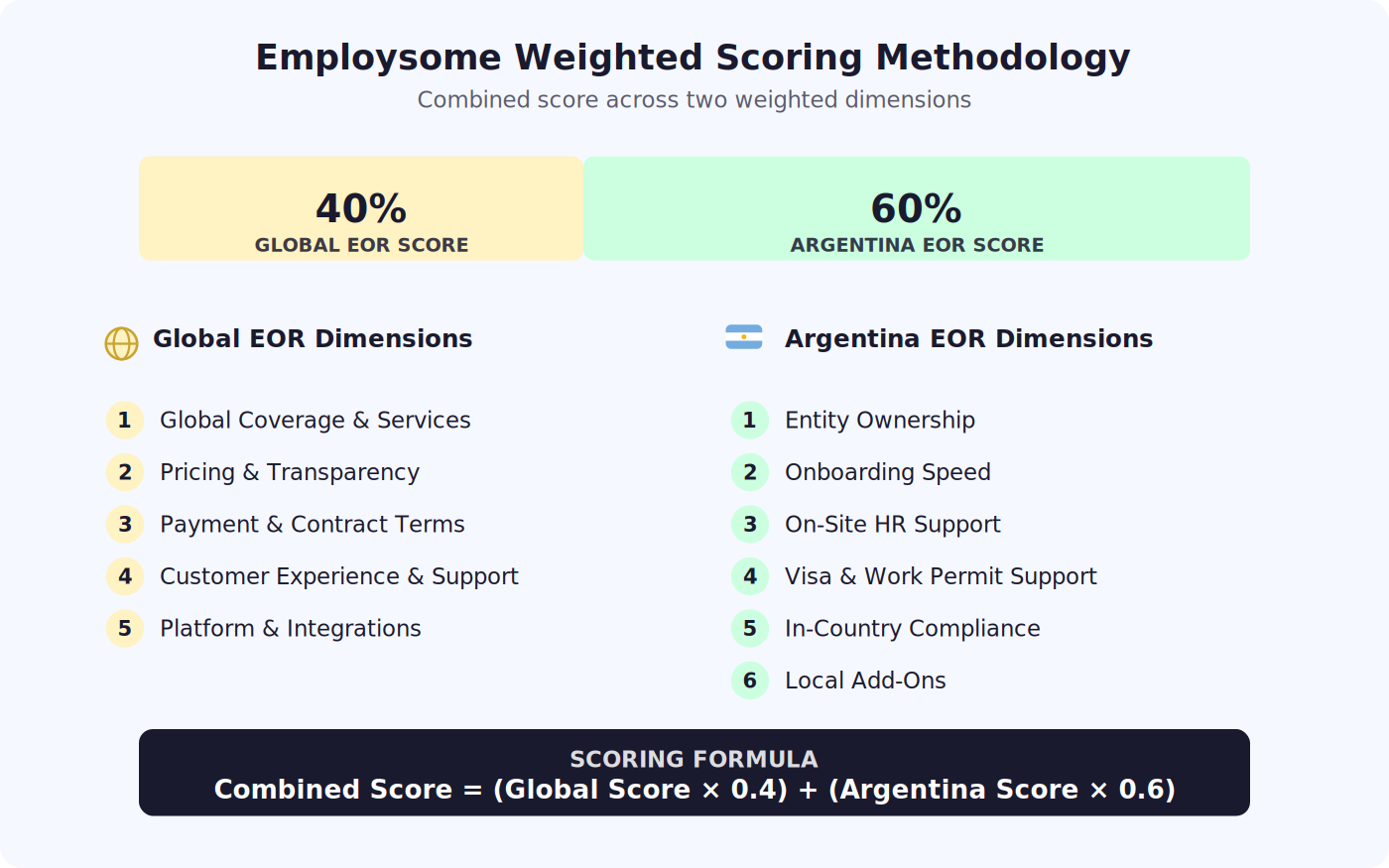
This guide ranks the 10 best Employer of Record Argentina providers for 2026 across two weighted dimensions: a 40 percent Global EOR score (coverage, pricing, contract terms, customer experience, platform) and a 60 percent Argentina EOR score (entity ownership, onboarding speed, on-site HR support, AFIP and FAL handling, post-reform compliance, and Latin America regional capability). The 10 providers covered are Multiplier, Remote, Deel, Atlas HXM, Ontop, Biz Latin Hub, Papaya Global, G-P, Salvatech, and Europortage. For comparison with neighbouring Latin American markets, see our Best Employer of Record in Brazil, Chile, and Mexico guides.

Quick Verdict: Best Employer of Record in Argentina

Ø price p.m.
4.5/5
4.3/5

Ø price p.m.
4.6/5
4.3/5

Ø price p.m.
4.5/5
4.3/5

Ø price p.m.
4.0/5
4.3/5

Ø price p.m.
4.1/5
4.3/5

Ø price p.m.
3.7/5
4.7/5

Ø price p.m.
3.9/5
4.0/5

Ø price p.m.
3.8/5
4.3/5

Ø price p.m.
3.5/5
3.9/5

Ø price p.m.
2.8/5
4.3/5
Why Trust Our Best Employer of Record in Argentina Comparison
100% independent rankings. Employsome is not owned by, affiliated with, or funded by any Employer of Record provider. No company can pay to appear higher in our rankings. We highlight both strengths and weaknesses so companies can make a genuinely unbiased decision when choosing an Employer of Record in Argentina.
Data-driven EOR scoring model. Every provider is evaluated using our two-layer scoring system combining the Global EOR Score with our Argentina EOR Score. We assess pricing transparency, contract terms, platform quality, support responsiveness, entity ownership structure, AFIP and Servicio de Conciliación Laboral Obligatoria (SECLO) handling, post-reform Ley 27.802 compliance fitness, FAL administration capability, dollar payment mechanics, and real delivery performance in the Argentine market.
Verified Argentina EOR data. We independently validate each provider’s Argentine setup, including local entity ownership versus partner reliance, AFIP registration handling for both employer-side contributions (Contribuciones Patronales) and employee-side withholdings (Aportes Personales), payroll execution under Ley 20.744 as amended by Ley 27.802, the new Fondo de Asistencia Laboral (FAL) contribution administration (1 percent for large employers, 2.5 percent for SMEs, operational from 1 June 2026), aguinaldo timing (Sueldo Anual Complementario, paid in two installments by 30 June and 18 December), the new 6-month probation period and its scaled extensions, severance calculations under the post-reform cap of three times the average CBA salary, and dollar payment mechanics now permitted under the reform but operationally non-trivial.
Built by former EOR operators. Employsome was created by former EOR and global payroll operators who have managed complex Latin American hiring projects at scale. We have seen firsthand where EOR models fail in the Argentine market, including Monotributo contractor misclassification, AFIP registration timing errors that produce retroactive contribution liabilities, FAL contribution miscalculation in the transition period, severance calculation errors under the new three-times-CBA cap, and dollar payment mechanics that produce unintended FX losses for the employee. Our mission is to bring transparency and practical post-reform expertise to one of the most economically dynamic EOR markets in Latin America.
In-Depth Reviews: Top Employer of Record Providers in Argentina
Multiplier is a global Employer of Record and payroll platform founded in 2020 and headquartered in Singapore, focused on transparent flat-rate pricing and direct-entity coverage across more than 150 countries including Argentina. The company operates EOR services, payroll, contractor management, and benefits administration, with a particular reputation for predictable pricing and strong Latin America coverage relative to its size.
In the Argentine market, Multiplier operates through its own legal entity rather than relying on partner-chain delegation, which is a meaningful structural advantage given the post-reform Ley 27.802 framework and the operational complexity of AFIP, ANSES, and ART administration. The platform handles Spanish-language Ley 20.744-compliant contracts, AFIP registration, ART occupational accident insurance enrolment, the new Fondo de Asistencia Laboral (FAL) contributions, the post-reform 6-month probation framework, aguinaldo (SAC) split timing, and the dollar-denominated salary mechanics now permitted under the reform at a reliable standard.
Global
Ø Fee per Employee per Month, First Year
✓ Global Coverage & Services (5.0/5): EOR services across 120+ countries, including contractor management, global payroll outsourcing, statutory compliance, benefits administration, and immigration support in selected jurisdictions.
✓ Pricing & Transparency (4.0/5): Generally clear pricing, though FX markups apply (stated ~2%, reported higher in some cases up to 8%) and country-level cost breakdowns are not always fully transparent upfront. Sales staff at Multiplier is eager to sell so they have lots of room for negotiations!
✓ Payment & Contract Terms (4.5/5): No minimum contract commitment and flexible agreements. However, invoices are issued early and short payment windows (often ~7 days) can impact cash flow.
✓ Customer Experience & Support (4.5/5): Improved support quality in recent years with a solid self-service knowledge base. Support experience and escalation handling can vary by region.
✓ Platform & Integrations (4.5/5): Strong, modern platform with clean UX, efficient onboarding, and good multi-country reporting. Integration depth and automation are slightly behind top tech-first EORs.
4.5/5
✓ Entity Ownership (4.5/5): Multiplier operates through its own Argentine entity, providing direct employment execution under Ley 20.744 (as amended by Ley 27.802) with full compliance control rather than partner-chain delegation. This structure aligns well with the post-reform framework and simplifies dispute resolution if labour issues arise.
✓ Onboarding Speed (4.5/5): Reliable onboarding within 5 to 10 business days for Argentine nationals, including AFIP registration, Obra Social enrolment, ART occupational accident insurance setup, language-of-region contract drafting in Spanish, and payroll activation. Foreign nationals requiring 23 A or 23 E work visas add 60 to 120 days.
✗ On-Site HR Support (4.0/5): Argentine HR support is delivered through regional Latin America teams rather than dedicated Argentine specialists. Depth is solid for standard scenarios but less than at LatAm-native providers for complex CCT classification disputes or Monotributo-to-employment conversions.
✓ Visa & Work Permit Support (4.0/5): Competent handling of 23 A (general work visa) and 23 E (specialist and management) sponsorship for foreign nationals relocating to Argentina, including DNM (Direccion Nacional de Migraciones) coordination and CDI (Clave de Identificacion) registration. Less specialist than dedicated immigration providers but suitable for typical professional relocations.
✓ In-Country Compliance (4.5/5): Robust coverage of Argentine statutory obligations including CCT classification for mainstream sectors, AFIP and ANSES registration, ART, aguinaldo administration in two halves (June and December), 14 to 35 day tenure-based annual leave accrual, the post-reform 6-month probation framework, severance cap of three times the average CBA salary, FAL contribution administration from the 1 June 2026 launch, and the codified Vizzoti calculation methodology.
✓ Local Add-Ons (4.0/5): Solid additional services including FAL contribution administration from launch, dollar-denominated salary support under the post-reform foreign currency authorization, contractor management, and supplementary benefits structuring beyond statutory minimums.
4.3/5
Owned Argentine entity with strong post-reform readiness: Multiplier operates through its own legal entity in Argentina with documented FAL contribution administration from the 1 June 2026 launch and demonstrated post-reform Ley 27.802 implementation, providing structural compliance alignment with the new framework and direct accountability for employment execution.
Industry-leading pricing transparency: Clear public pricing, predictable FX handling, and minimal hidden fees make Multiplier one of the most straightforward providers to budget against, particularly important in the Argentine market where peso volatility and dollar-conversion mechanics complicate cost forecasting at less transparent providers.
Argentine team smaller than the largest LatAm specialists: Multiplier’s Argentine in-country team is smaller than at LatAm-native providers, so complex termination cases or contested CCT classifications may move slower than with a regional specialist who maintains a larger Buenos Aires-based labour law team.
Limited specialist depth for unusual sectors: Mainstream professional and technology roles are well-handled, but unusual Argentine sectors (oil and gas CBA disputes, healthcare CCT particularities, mining sectoral negotiations) where a deeper local advisor adds material value are not Multiplier’s strongest area.
Multiplier in Argentina is best suited for foreign employers hiring 1 to 25 mainstream professional or technology roles in Buenos Aires, Cordoba, or Rosario who want a reliable post-reform compliance baseline at competitive pricing without paying premium service tiers. The structural fit is particularly strong for technology, SaaS, and professional services companies expanding from US or European markets into Argentina as part of a broader Latin America hiring plan, where the platform consistency across multiple LatAm countries is a meaningful operational benefit.
The transparent flat-rate pricing model is a meaningful advantage for procurement-driven enterprises that need to budget multi-country deployments with predictable cost structures, and the post-reform Ley 27.802 readiness (including FAL contributions and dollar payment mechanics) makes Multiplier well-suited for foreign employers entering the Argentine market in 2026 without prior institutional knowledge of the pre-reform framework.
It is less ideal for highly regulated industries (oil and gas, mining, healthcare) where specialist sectoral expertise is the binding constraint, and for the most complex termination scenarios where a LatAm regional specialist with named Spanish-speaking advisors will deliver more substantive expertise. For cross-border hiring scenarios involving foreign nationals relocating to Argentina, Atlas HXM offers a more comprehensive immigration and visa sponsorship capability; for treasury-heavy use cases prioritising dollar payment infrastructure, Papaya Global is the stronger fit.
Remote is a global Employer of Record and payroll platform founded in 2019, focused on compliant international hiring with a strong emphasis on owned-entity infrastructure and transparent pricing. The company operates EOR services, payroll, contractor management, and benefits administration across more than 80 countries including Argentina.
In the Argentine market, Remote operates through its own legal entity rather than relying primarily on payroll partner infrastructure, which is a meaningful structural advantage given the operational complexity of AFIP, ANSES, and ART administration under the post-reform Ley 27.802 framework. The platform handles Spanish-language Ley 20.744-compliant contracts, AFIP registration, ART enrolment, FAL contributions, joint CCT classification for mainstream sectors, the new 6-month probation framework, aguinaldo administration, and the dollar-denominated salary mechanics now authorized under the reform at a reliable standard.
Global
Ø Fee per Employee per Month, First Year
- Global country coverage
- Enterprise-grade software
✓ Global Coverage & Services (5.0/5): Strong global EOR coverage, mostly through Remote-owned legal entities. Wide range of add-on services offered beyond EOR such as global payroll services, contractor payments, equity add-ons, HRIS, benefits, U.S. PEO and more.
✓ Pricing & Transparency (4.0/5): Fees are higher compared to other global EORs. Also, a “hidden” currency exchange fee of up to 8% applies. However, Remote does not apply an EOR security deposit. OK, overall.
✓ Payment & Contract Terms (4.5/5): No minimum contract commitment which allows for flexible EOR hiring. Further, payroll cut-off on the 11th of the month and payment terms of 10 days.
✓ Customer Experience & Support (4.5/5): Remote’s EOR solution is designed to be mostly self-service for customers hiring < 10 staff. No dedicated account manager is assigned and support is run through their offshore-team.
✓ Platform & Integrations (5.0/5): Remote’s platform is amongst the best of the industry with a large amount of features and integrations available. It’s suitable for enterprise customers.
4.6/5
✓ Entity Ownership (4.5/5): Remote operates through its own Argentine legal entity, providing direct employment execution under Ley 20.744 (as amended by Ley 27.802) with full compliance control rather than partner-chain delegation. This structure delivers the strongest entity ownership credentials in the Argentina-covered category and simplifies dispute resolution materially.
✓ Onboarding Speed (4.5/5): Reliable onboarding within 7 to 12 business days for Argentine nationals, including AFIP registration, Obra Social enrolment, ART occupational accident insurance setup, Spanish-language contract drafting, and payroll activation. Foreign nationals requiring 23 A or 23 E work visas add 60 to 120 days for the immigration component.
✗ On-Site HR Support (4.5/5): No local office but 100+ local employees in Argentine that support HR and support questions in Spanish language.
✓ Visa & Work Permit Support (4.5/5): Strong handling of 23 A (general work visa), 23 E (specialist and management), and Mercosur visa pathways, with practical experience navigating DNM and the consular network. Particularly capable on Mercosur national pathways where the simplified residency process applies.
✓ In-Country Compliance (4.0/5): Solid coverage of Argentine statutory obligations including CCT classification for mainstream sectors, AFIP and ANSES registration, ART, aguinaldo administration in two halves, tenure-based annual leave accrual across the 14 to 35 day scale, the post-reform 6-month probation framework, and the new severance cap of three times the average CBA salary. Less granular on niche sectoral compliance than service-led specialists.
✓ Local Add-Ons (4.0/5): Solid additional services including FAL contribution administration, dollar-denominated salary support under the post-reform foreign currency authorization, contractor management, and supplementary benefits structuring beyond statutory minimums.
4.3/5
Direct Argentine entity ownership: Remote operates through its own legal entity in Argentina, providing structural compliance alignment with the post-reform Ley 27.802 framework and direct accountability for employment execution rather than partner-chain delegation.
Excellent platform usability for non-Spanish-speaking HR teams: English-language reporting, contract templates, and request workflows tailored to Argentine compliance make Remote well-suited for US, UK, and Australian HR teams managing the relationship without becoming Argentine compliance experts themselves.
Platform-led rather than service-led support model: On-the-ground support is platform-led rather than service-led, so foreign employers wanting dedicated Argentine HR specialists rather than ticket-based support may find the experience less hands-on than at LatAm regional specialists.
Pricing premium in the Argentine market: Pricing has trended upward as the Argentine market has matured, putting Remote in the mid-to-upper range rather than the value tier where it positions globally. For the most cost-sensitive smaller deployments the difference relative to platform-first providers can be material.
Remote in Argentina is best suited for distributed-team companies and US, UK, or Australian SMEs and mid-market firms hiring 1 to 30 Argentine employees as part of a broader global hiring plan, where platform consistency and English-language workflow matter as much as Argentine compliance depth. The structural fit is particularly strong because the direct Argentine entity provides post-reform Ley 27.802 alignment with the new framework and direct accountability for employment execution.
Remote works especially well for organisations hiring across both Argentine nationals and foreign professionals who need 23 A or 23 E work visa sponsorship, where the platform handles both scenarios competently. The English-language platform usability is a meaningful advantage for non-Spanish-speaking HR teams managing distributed Argentine hires alongside US and European team members.
It is less ideal for the most price-sensitive small deployments where the cost difference relative to platform-led competitors is hard to justify, and for foreign employers wanting Spanish-language hands-on HR partnership at the country level. For Argentina-only deployments at smaller scale, Multiplier may offer a slightly more efficient platform experience at competitive pricing; for service-led HR partnership on complex cases, G-P or Atlas HXM are stronger fits.
Deel is the largest global Employer of Record by revenue, founded in 2019 and headquartered in San Francisco, focused on platform-led international hiring and contractor payments across more than 150 countries including Argentina. The company operates EOR services, contractor management, payroll, and embedded finance, with particular strength in onboarding speed and contractor payment infrastructure.
In the Argentine market, Deel has invested heavily in dedicated Latin American infrastructure including its own Argentine legal entity, dedicated Spanish-language support, and one of the strongest contractor-payment infrastructures in the market. The platform is the fastest in the category for onboarding (typically 3 to 7 business days for straightforward Argentine hires), supported by extensive automation in AFIP registration and contract generation. The platform handles Spanish-language Ley 20.744-compliant contracts, AFIP registration, ART enrolment, FAL contributions, aguinaldo administration, and the post-reform Ley 27.802 framework with pragmatic implementation that prioritised operational availability from the reform launch.
Global
Ø Fee per Employee per Month, First Year
- $1,500 Deel Credit Available
- Enterprise-grade software
- Great price-for-value
✓ Global Coverage & Services (5.0/5): Deel provides EOR services in 150+ countries, operating through 120+ wholly owned legal entities (including Germany, UK, Spain, Australia, Canada, India, and UAE). Services include compliant employment contracts, payroll, statutory filings, terminations, country-specific benefits, immigration support, background checks, equipment provisioning via Deel IT, equity & stock option administration, and access to 200+ in-house legal experts covering local employment law.
✓ Pricing & Transparency (4.0/5): Public EOR pricing starts at USD 599 per employee/month (discounted to USD 499 in the first year in some markets). Contractor management is USD 49/month, and Deel HRIS is free. Security deposits of 1–3 months of gross salary apply in most countries. FX fees are borne by the transacting party. Optional add-ons (Deel Engage, Deel IT, time tracking) increase total cost as teams scale.
✓ Payment & Contract Terms (4.5/5): Deel offers month-to-month EOR contract flexibility with no long-term minimum commitment. Deposits are required in many countries and typically refunded within 60 days after contract termination. Payments are processed via regulated PSPs in multiple currencies. Deel Shield provides contractor misclassification protection covering up to USD 25,000 in legal costs per contractor.
✓ Customer Experience & Support (4.0/5): Deel provides 24/7 in-house chat support, with a 4.8/5 Trustpilot rating across 7,000+ reviews. Dedicated customer success managers are assigned to larger accounts. Payroll and compliance guidance is supported by Deel AI, with onboarding completed in 2–3 business days in many countries. Support is efficient but less white-glove for very small teams.
✓ Platform & Integrations (5.0/5): Deel offers a modern, self-service global HR platform with 120+ native integrations (including Workday, BambooHR, Personio, Greenhouse, QuickBooks, Xero, NetSuite, Slack, and Microsoft Teams). Supports bi-directional HRIS syncing, open API, Zapier automation, and can function as a standalone global HRIS with onboarding, PTO, documents, org charts, and compliance monitoring.
4.5/5
✓ Entity Ownership (4.5/5): Deel operates through its own Argentine legal entity with substantial Latin American infrastructure investment behind it. The structure is well-established and supports fast onboarding, although institutional depth is younger than at long-established providers like G-P.
✓ Onboarding Speed (5.0/5): Fastest onboarding in the Argentina-covered category, typically 3 to 7 business days for straightforward Argentine hires, supported by extensive automation in AFIP registration, contract generation, and payroll activation. Foreign nationals requiring work visas add 60 to 120 days for the immigration component.
✗ On-Site HR Support (3.5/5): Volume-led support model produces a more transactional experience on complex Argentine cases. Dedicated Spanish-language support exists but the volume of accounts Deel manages globally produces less substantive expertise on edge cases than smaller competitors offer.
✓ Visa & Work Permit Support (4.0/5): Capable handling of 23 A and 23 E work visa sponsorship through dedicated immigration teams, although the high-volume processing model can produce less personalised case management than at service-led providers like G-P or Atlas HXM.
✓ In-Country Compliance (4.0/5): Solid coverage of Argentine statutory obligations including CCT classification, AFIP and ANSES registration, ART, aguinaldo administration, tenure-based annual leave accrual, the post-reform 6-month probation framework, and the new severance cap of three times the average CBA salary. Depth is competent but not category-leading on complex sectoral cases.
✓ Local Add-Ons (4.5/5): Strong additional services including contractor and dollar payment infrastructure, support for the new post-reform foreign currency salary authorization, split-currency compensation structures, FAL contribution administration, and embedded financing options for cross-border payment scenarios.
4.3/5
Fastest onboarding in the Argentine EOR category: Typical 3 to 7 business day onboarding for straightforward Argentine hires, supported by extensive automation in AFIP registration and contract generation. The speed advantage is materially valuable for fast-moving hiring scenarios where time-to-employment matters.
Strong contractor and dollar payment infrastructure: Best-in-category support for managing both employees and contractors through the same platform, with refined dollar payment mechanics under the post-reform foreign currency salary authorization and embedded financing for cross-border payment scenarios.
Volume-led support model produces transactional experience: The volume of accounts Deel manages globally produces a more transactional support experience than smaller competitors offer, particularly on complex Argentine cases that require substantive labour law judgment rather than process execution.
Documented edge case inconsistencies: Client experience on edge cases (contested CCT classifications, complex terminations, Monotributo conversion to employment) is less consistent than at service-led providers, where the platform automation reaches its limits and the support model becomes the binding constraint.
Deel in Argentina is best suited for foreign employers prioritising speed of onboarding and platform automation over depth of expert-led service, particularly fast-moving technology and SaaS companies hiring multiple Argentine employees in compressed timelines. The 3 to 7 business day onboarding is a meaningful operational advantage when team build-out velocity matters more than service-led HR partnership.
Deel works especially well for companies needing to manage both employees and contractors through the same platform, where Deel’s contractor-side infrastructure adds material value beyond pure EOR execution. The platform is also a strong fit for organisations running broader cross-border contractor payment operations alongside Argentine employee hires.
It is less optimal for enterprise compliance teams entering Argentina without prior LatAm hiring experience, where the volume-led support model produces friction relative to service-led providers. For complex termination scenarios or contested CCT classifications, G-P or Atlas HXM offer more substantive expertise; for institutional credibility on regulated industry hires, G-P’s longer Argentine track record is the stronger fit.
Atlas HXM is a Direct Employer of Record provider founded in 2015 (originally as Elements HR Services) and headquartered in Chicago, focused on enterprise-grade owned-entity infrastructure across more than 160 countries including Argentina. The company operates EOR services, immigration sponsorship, and global mobility, with particular reputation for visa and work permit handling and service-led HR partnership.
In the Argentine market, Atlas HXM operates through its own legal entity and positions itself as the enterprise-grade Direct EOR alternative to the platform-led global providers. Argentine compliance handling is comprehensive, with strong on-the-ground HR support, deep visa and immigration sponsorship capability for foreign nationals relocating to Argentina under 23 A or 23 E visas, and a service-led model that suits complex hiring scenarios better than platform-first competitors. The platform handles Spanish-language Ley 20.744-compliant contracts, AFIP registration, ART enrolment, FAL contributions, aguinaldo administration, and the post-reform Ley 27.802 framework methodically with the focus on getting the implementation right rather than first to market.
Global
Ø Fee per Employee per Month, First Year
✓ Global Coverage & Services (4.5/5): Atlas HXM operates through directly owned entities in 140+ countries, offering full EOR, contractor management, mobility, relocation, and strong coverage in regulated and high-risk markets. Particularly strong for companies that need control, compliance depth, and global consistency.
✓ Pricing & Transparency (3.0/5): Flat-rate, all-inclusive pricing with no third-party markups, but positioned at the premium end. Pricing details require consultation, and costs can be prohibitive for startups or budget-focused teams.
✓ Payment & Contract Terms (4.0/5): Flexible, scalable contracts with no rigid long-term lock-ins and a single agreement covering all countries. Initial setup and country-specific deposits can add complexity, especially for first-time global hires.
✓ Customer Experience & Support (4.5/5): White-glove, relationship-led support with dedicated HR consultants and strong satisfaction scores. Widely recognized by analysts, though some users report occasional response delays and platform-related friction.
✓ Platform & Product Experience (4.0/5): Enterprise-grade HXM platform covering the full employee lifecycle, advanced analytics, mobile apps, and learning tools. Feature-rich but comes with a steeper learning curve and less flexibility for lighter, self-serve use cases.
4.0/5
✓ Entity Ownership (4.5/5): Atlas HXM operates through its own Argentine legal entity with the strongest Direct EOR positioning in the category. The structure delivers enterprise-grade entity ownership credentials with no partner-chain dependencies, which is a board-level requirement at some compliance-driven enterprises.
✗ Onboarding Speed (3.5/5): Standard onboarding window of 10 to 18 business days for Argentine nationals, noticeably longer than the platform-led category leaders. The trade-off is more thorough due diligence and human-led process orientation, which produces fewer compliance surprises later in the relationship.
✓ On-Site HR Support (4.5/5): Argentine HR support is delivered through named Spanish-speaking advisors with substantive labour law expertise, well-suited to complex cases requiring judgment rather than process execution. The service-led model is materially stronger than the platform-led category leaders.
✓ Visa & Work Permit Support (5.0/5): Best-in-category handling of 23 A, 23 E, residency pathway, and Mercosur visa sponsorship for foreign nationals relocating to Argentina, supported by a deep in-house global mobility practice and substantive experience with complex immigration scenarios that platform-led providers route through external counsel.
✓ In-Country Compliance (4.5/5): Robust coverage of Argentine statutory obligations including CCT classification, AFIP and ANSES registration, ART, aguinaldo administration, tenure-based annual leave accrual, the post-reform 6-month probation framework, and the new severance cap of three times the average CBA salary, with particularly strong handling of immigration sponsorship for foreign nationals.
✗ Local Add-Ons (3.5/5): Operational rollout of post-reform features (notably FAL administration mechanics and dollar payment structures) has lagged the most aggressive platform competitors. Immigration and global mobility services are the stronger differentiator rather than treasury or payment automation.
4.3/5
Strong immigration and visa sponsorship capability: Materially better than the platform-led category for cross-border hiring scenarios involving foreign nationals relocating to Argentina under 23 A or 23 E visas. The deep institutional capability on global mobility makes Atlas HXM the strongest fit for senior international transferees.
Direct EOR enterprise model with named advisors: Fully owned Argentine entity with named Spanish-speaking HR advisors, well-suited to complex cases requiring substantive labour law judgment. The Direct EOR positioning eliminates partner-chain dependencies that some compliance-driven enterprises require at the board level.
Onboarding noticeably slower than platform-led leaders: Standard 10 to 18 business day onboarding is materially slower than the 3 to 7 day platform-led category leaders, which can create friction for fast-moving hiring scenarios where time-to-employment matters.
Lagging post-reform feature rollout: Operational rollout of post-reform features (notably FAL administration mechanics and dollar payment structures) has lagged the most aggressive platform competitors, which can frustrate clients expecting day-one feature parity with the most advanced platform-led implementations.
Atlas HXM in Argentina is best suited for foreign employers with cross-border immigration requirements (relocating non-Argentine nationals into Argentina under 23 A or 23 E visas) or for enterprise compliance scenarios where the Direct EOR ownership model is a board-level requirement. The structural fit is particularly strong for regulated industries hiring senior international transferees, where the deep immigration capability and enterprise-grade documentation deliver value beyond pure EOR execution.
Atlas HXM works especially well for organisations running global mobility programmes that include Argentina alongside other markets, where the unified Direct EOR model across multiple countries simplifies internal compliance review and audit documentation. The named Spanish-speaking advisor model is also a meaningful advantage for complex termination scenarios and contested CCT classifications.
It is less ideal for fast-moving SME hiring scenarios where time-to-employment matters more than enterprise-grade documentation, and for Argentine-citizen-only hires where the platform-led category leaders deliver equivalent compliance at materially faster onboarding.
Ontop is a Latin America-focused Employer of Record and contractor management platform founded in 2020 by Jaime Abella and Julian Torres, headquartered in Colombia and built specifically for digital-first businesses scaling across LATAM. The company operates EOR services, contractor payments, and a USD wallet with Visa card across more than 150 countries, with particular strength in Argentina, Brazil, Mexico, and Colombia and a market positioning oriented toward fast-growing startups rather than enterprise procurement.
In the Argentine market, Ontop combines local-entity coverage with bilingual concierge-level support, with onboarding times among the fastest in the Argentina-covered category (typically 6 to 9 business days). The platform’s signature USD wallet plus Visa card capability is particularly relevant under the post-reform Ley 27.802 foreign currency salary authorization, allowing employees to receive dollars directly with no peso intermediation. Argentina coverage spans Spanish-language Ley 20.744-compliant contracts, AFIP registration, ART enrolment, FAL contributions, the post-reform 6-month probation framework, and aguinaldo split timing. The platform also handles the contractor side cleanly, which is useful given the Monotributo-to-employment conversion pathway many foreign employers run when transitioning Argentine contractors to compliant employment.
Global
Ø Fee per Employee per Month, First Year
✓ Global Coverage & Services (4.0/5): EOR and contractor services in 50+ countries with strong presence in LATAM. Includes compliant contracts, global payments, Ontop Wallet, Visa card, and visa support – though coverage outside core regions depends on partners.
✓ Pricing & Transparency (4.5/5): Clear, publicly listed pricing – $49/month for contractors, $499/month for EOR. Significantly cheaper than premium competitors, but enterprise setups and advanced integrations may add cost.
✓ Payment & Contract Terms (4.0/5): Fast, automated contract generation with flexible payment options (wire, ACH, card, crypto). Strong worker experience via Ontop Wallet, though less ideal for teams wanting traditional bank-only payroll.
✓ Customer Experience & Support (4.0/5): Good balance of tech and human support with dedicated managers and fast onboarding. Well-reviewed by users, but less depth for highly complex enterprise cases.
✓ Platform & Integrations (4.0/5): Modern, startup-friendly platform with wallet and card features, solid API, and key integrations. Not a full HRIS and analytics depth still developing, but strong for SMB and scale-up needs.
4.1/5
✓ Entity Ownership (4.5/5): Ontop operates through its own Argentine entity with direct employment execution under Ley 20.744 (as amended by Ley 27.802). The structure is well-established for a LATAM-native specialist and provides direct accountability for typical professional roles, although institutional depth is younger than the longest-established global providers.
✓ Onboarding Speed (4.5/5): Among the fastest in the Argentina-covered category, typically 6 to 9 business days for Argentine nationals, supported by streamlined automation in AFIP registration and Spanish-language contract generation. Foreign nationals requiring 23 A or 23 E work visas add 60 to 120 days for the immigration component.
✓ On-Site HR Support (4.5/5): Argentine HR support is delivered through dedicated bilingual specialists with direct LATAM employment expertise. The concierge-level service model is materially stronger than at the platform-led global providers and well-suited for fast-growing startups requiring hands-on partnership.
✗ Visa & Work Permit Support (3.5/5): Visa and work permit support is competent for standard 23 A and 23 E sponsorship cases but is not Ontop’s strongest area, with deeper specialist immigration capability available at providers like G-P or Atlas HXM that maintain in-house global mobility practices.
✓ In-Country Compliance (4.0/5): Solid coverage of Argentine statutory obligations including CCT classification for mainstream sectors, AFIP and ANSES registration, ART, aguinaldo administration in two halves, tenure-based annual leave accrual, the post-reform 6-month probation framework, and the new severance cap of three times the average CBA salary. Less granular on niche sectoral compliance than the most established providers.
✓ Local Add-Ons (4.5/5): Best-in-category USD wallet with Visa card capability, supporting direct dollar payments to Argentine employees under the post-reform foreign currency authorization with no peso intermediation. Strong contractor management side and embedded payment infrastructure that exceeds most direct-entity competitors on dollar-denominated mechanics.
4.3/5
LATAM-native specialist with deep regional expertise: Ontop is a Colombia-founded LATAM specialist with deep regional knowledge of Argentine compliance, tax, and labour code particularities. The bilingual concierge-level support model delivers materially more substantive Argentine expertise than the volume-led global platforms.
USD wallet plus Visa card for direct dollar payments: The USD wallet plus Visa card capability is particularly relevant under the post-reform Ley 27.802 foreign currency salary authorization, allowing Argentine employees to receive dollars directly with no peso intermediation and no FX conversion friction.
Limited enterprise-level features and integrations: Ontop’s platform depth is oriented toward fast-growing startups rather than enterprise procurement. HRIS integrations, advanced compliance dashboards, and enterprise-grade reporting are less developed than at platform-led competitors like Deel, Remote, or Papaya Global.
Narrower entity coverage than global providers: Beyond core LATAM markets, Ontop’s coverage relies more heavily on partner infrastructure. For multi-country deployments spanning LATAM plus US, Europe, or Asia, a global platform with broader direct-entity coverage will produce more consistent execution.
Ontop in Argentina is best suited for fast-growing startups and digital-first businesses hiring 1 to 25 employees as part of a LATAM-only or LATAM-led expansion, where the bilingual concierge support model and USD wallet capability deliver value that platform-led global providers do not match. The structural fit is particularly strong for Web3, fintech, and remote-first companies where direct dollar payments to Argentine employees are a core requirement.
Ontop works especially well for organisations transitioning Argentine contractors to compliant employment under the EOR model, where the platform’s contractor-side infrastructure provides a smooth migration path. The fast onboarding (6 to 9 business days) is a meaningful operational advantage when team build-out velocity matters more than enterprise-grade documentation.
It is less ideal for enterprise compliance teams hiring across multiple regions, where broader direct-entity coverage at global platforms like Multiplier, Remote, or G-P produces more consistent multi-country execution. For complex termination scenarios or contested CCT classifications, G-P or Atlas HXM offer more substantive expertise; for treasury-heavy multi-currency payroll across many markets, Papaya Global delivers more sophisticated automation.
Biz Latin Hub is a Latin America-specialist legal, accounting, and Employer of Record firm founded in Bogota in 2014 by Craig Dempsey and David Wright, with 100 percent owned subsidiary offices across 18 markets in Latin America and the Caribbean including Argentina. The company combines integrated back-office services (company formation, legal advisory, tax, accounting, payroll, EOR, recruitment) under a single bilingual delivery model, with particular reputation for transitioning clients from EOR to fully owned local entity as their Argentine presence grows.
In the Argentine market, Biz Latin Hub operates through its own Buenos Aires legal entity with a directly-employed bilingual team handling Spanish-language Ley 20.744-compliant contracts, AFIP registration, ART enrolment, FAL contributions, aguinaldo administration, and the post-reform Ley 27.802 framework. The integrated legal-and-EOR model is the primary differentiator: clients who eventually outgrow the EOR engagement can transition to a fully owned Argentine SA or SRL using the same firm, with no provider switching cost or institutional knowledge loss. This positions Biz Latin Hub well for foreign employers using Argentina as a market-entry test before committing to a long-term local entity, which is the dominant LATAM expansion pattern for North American and European mid-market firms.
Corporate
Ø fee per employee per month, first year
✓ Global Coverage & Services (3.5/5): EOR and PEO services across 18 countries in Latin America and the Caribbean, supported by wholly-owned local entities. Strong regional depth, but no coverage outside LATAM and not suitable for multi-region (EMEA/APAC) hiring strategies.
✗ Pricing & Transparency (3.5/5): Competitive regional pricing in practice, but no publicly listed EOR fees or cost breakdowns. Benchmarking requires direct engagement with sales.
✓ Payment & Contract Terms (4.0/5): Acts as legal employer through owned entities in each market, with contracts aligned to local labour law and support for multi-currency payroll. Contract terms and invoicing details are not publicly standardised.
✓ Customer Experience & Support (4.0/5): Strong service-led delivery with country-specific legal and accounting contacts and bilingual English/Spanish/Portuguese support. Good professional reputation, though limited EOR-specific third-party reviews.
✗ Platform & Integrations (3.5/5): Service-led operating model with payroll calculators and structured reporting. No dedicated self-service EOR platform, employee dashboards, APIs, or HRIS integrations.
3.7/5
✓ Entity Ownership (5.0/5): Biz Latin Hub operates through its own Argentine legal entity with a 100 percent owned subsidiary office in Buenos Aires, providing direct employment execution under Ley 20.744 (as amended by Ley 27.802). The structure delivers strong entity ownership credentials matching the strongest direct-entity providers in the category.
✓ Onboarding Speed (4.0/5): Standard onboarding window of 7 to 14 business days for Argentine nationals, broadly comparable to other direct-entity providers. The thorough due diligence supports the integrated legal-and-EOR model where compliance accuracy is prioritised over raw speed.
✓ On-Site HR Support (5.0/5): Argentine HR support is delivered through directly-employed Spanish-speaking specialists with substantive labour law expertise integrated with the legal advisory practice. The integrated legal-EOR delivery model produces measurably better outcomes on complex termination cases, contested CCT classifications, and Monotributo misclassification remediation than purely platform-led competitors.
✓ Visa & Work Permit Support (4.5/5): Strong handling of 23 A, 23 E, and Mercosur visa pathways supported by the in-house immigration legal practice integrated with the EOR delivery. The unified legal-immigration model is particularly valuable for cross-border hiring scenarios involving foreign nationals relocating to Argentina.
✓ In-Country Compliance (5.0/5): Robust coverage of Argentine statutory obligations including deep institutional knowledge of historical CCT classifications, sector-specific compliance, the labour court system, AFIP and ANSES registration, ART, aguinaldo administration, the post-reform 6-month probation framework, severance cap of three times the average CBA salary, FAL contribution administration, and the codified Vizzoti calculation methodology.
✓ Local Add-Ons (4.5/5): Best-in-category transition support for foreign employers ready to move from EOR to fully owned Argentine entity (SA or SRL formation, AFIP setup, ongoing accounting and legal advisory) using the same firm with no institutional knowledge loss. Also includes recruitment, immigration, and corporate secretarial services that platform-led EORs do not offer.
4.7/5
Integrated legal, accounting, and EOR delivery: Biz Latin Hub combines EOR services with legal advisory, tax, accounting, and recruitment under a single bilingual delivery model, eliminating the coordination overhead of stitching multiple providers together for foreign employers entering Argentina.
Owned Argentine entity with smooth transition pathway: The 100 percent owned Argentine subsidiary supports a smooth transition from EOR to fully owned local entity as the foreign employer’s Argentine presence grows, with no provider switching cost or institutional knowledge loss compared to platform-led competitors.
Lower platform automation than tech-led competitors: Biz Latin Hub’s platform automation, dashboards, and self-service workflows are less developed than at platform-led competitors like Multiplier, Remote, or Deel. The service-led model produces strong outcomes on complex cases but adds friction for routine self-service queries.
Less integrated for multi-country global deployments: Biz Latin Hub’s coverage is exclusively Latin America and the Caribbean, so foreign employers running multi-region deployments spanning LATAM plus US, Europe, or Asia will need separate providers for non-LATAM markets, adding coordination overhead that global platforms eliminate.
Biz Latin Hub in Argentina is best suited for foreign employers using Argentina as a market-entry test before committing to a long-term local entity, where the integrated legal-and-EOR model and the smooth transition pathway from EOR to owned subsidiary deliver value that platform-led global providers do not match. The structural fit is particularly strong for North American and European mid-market firms in the 50 to 500 global employee range expanding into Latin America for the first time.
Biz Latin Hub works especially well for organisations needing combined legal, tax, immigration, and EOR services under a single delivery model, where the coordination overhead of stitching multiple providers together would otherwise consume material management attention. The 18-country LATAM coverage is also a meaningful advantage for foreign employers running multi-country LATAM expansion plans.
It is less ideal for foreign employers prioritising platform automation, self-service workflows, or unified multi-region (LATAM plus US plus Europe) deployments where global platforms like Remote, Multiplier, or G-P deliver more consistent execution. For pure platform polish at competitive pricing, Multiplier or Deel are stronger fits; for treasury-heavy dollar payment scenarios, Papaya Global offers more sophisticated payment automation.
Papaya Global is a global payroll and Employer of Record platform founded in 2016 and headquartered in New York, focused on treasury-grade payment infrastructure and multi-currency payroll execution across more than 160 countries including Argentina. The company operates EOR services, contractor management, global payroll, and embedded financing, with particular strength in FX handling and cross-border payment automation.
In the Argentine market, Papaya Global operates predominantly through partner-entity infrastructure rather than fully owned local incorporation, but the platform’s treasury depth produces some of the cleanest dollar-to-peso conversion handling in the market, particularly relevant under the post-reform Ley 27.802 foreign currency salary authorization. The platform handles Spanish-language Ley 20.744-compliant contracts via partner execution, AFIP registration, FAL contribution management, aguinaldo split timing, and CCT compliance with reporting and analytics depth that exceeds most direct-entity competitors.
Global
Ø Fee per Employee per Month, First Year
- Strong global payroll engine
- Global coverage through partners
✓ Global Coverage & Services (4.0/5): Global EOR and payroll platform combining EOR, contractor management, and global payroll in a single system. Coverage is broad, but delivered only through local partners rather than owned entities.
✗ Pricing & Transparency (3.0/5): Pricing is available via sales-led quotes. Costs are on the higher end of the market and may include FX fees, partner costs, and security deposits depending on country.
✓ Payment & Contract Terms (4.0/5): Standardized global contracts with secure pre-funding requirements. Payment workflows are reliable but less flexible than product-led EORs.
✓ Customer Experience & Support (4.0/5): Dedicated account management model with strong payroll expertise. Support quality can vary by country due to partner dependency.
✓ Platform & Integrations (4.5/5): One of the strongest global payroll engines in the market, with deep reporting, compliance tooling, and enterprise-grade integrations.
3.9/5
✗ Entity Ownership (3.5/5): Papaya Global operates predominantly through partner-entity infrastructure rather than fully owned Argentine incorporation. The partner relationships are well-established and produce reliable execution for typical professional roles, but complex compliance cases route through a coordination layer that can slow time-sensitive issues compared to direct-entity providers.
✓ Onboarding Speed (4.0/5): Standard onboarding window of 8 to 14 business days for Argentine nationals, slightly longer than the fastest direct-entity competitors due to the partner-coordination layer. Foreign nationals requiring work visas add 60 to 120 days for the immigration component.
✓ On-Site HR Support (4.0/5): Argentine HR support is delivered through partner-network teams with platform-led oversight. Depth is solid for standard professional roles but less than at service-led specialists for hands-on partnership scenarios.
✗ Visa & Work Permit Support (3.5/5): Visa and work permit support is handled through partner immigration counsel rather than directly. Adequate for standard 23 A and 23 E sponsorship cases but adds coordination overhead and is less seamlessly integrated into the platform than at providers with in-house immigration teams.
✓ In-Country Compliance (4.5/5): Robust coverage of Argentine statutory obligations through partner execution including CCT classification, AFIP and ANSES registration, ART, aguinaldo administration, tenure-based annual leave accrual, the post-reform 6-month probation framework, and the new severance cap of three times the average CBA salary. Reporting and analytics layer adds material value over basic compliance execution.
✓ Local Add-Ons (4.5/5): Best-in-class additional services including refined dollar-to-peso conversion handling, support for split-currency salary structures (part dollars, part pesos), FAL contribution administration, and treasury-grade payment automation that exceeds most direct-entity competitors on multi-currency mechanics.
4.0/5
Best-in-class treasury and payment infrastructure: Papaya Global offers some of the most refined dollar-to-peso conversion handling in the Argentine market, with proven track record on multi-currency payroll execution and support for split-currency salary structures under the post-reform foreign currency authorization.
Strong reporting and analytics capability: The platform’s reporting depth is particularly useful for foreign employers benchmarking Argentine total compensation against US or European peer markets, and for procurement teams managing multi-country LatAm payroll with unified treasury and reporting visibility.
Partner-based operation: Papaya operates through partner infrastructure rather than fully owned Argentine entity, meaning complex compliance cases route through a coordination layer that can slow time-sensitive issues compared to direct-entity providers like Remote, Multiplier, or G-P.
Pricing premium versus direct-entity providers: Papaya sits at the upper end of the global EOR range for Argentina, which is justifiable for treasury-heavy use cases but expensive for simple peso-denominated payroll execution where a less sophisticated provider would deliver equivalent compliance outcomes at materially lower cost.
Papaya Global in Argentina is best suited for foreign employers prioritising dollar payment infrastructure over pure compliance depth, particularly fintech, crypto, gaming, and US-headquartered companies wanting to insulate Argentine employees from peso volatility through dollar-denominated compensation under the post-reform foreign currency authorization. The treasury-grade payment infrastructure delivers value that justifies the pricing premium for high-compensation senior roles where FX handling matters.
Papaya is also strong for companies running multi-country LatAm payroll where a unified treasury and reporting layer matters more than country-by-country specialist depth. The reporting and analytics capability is particularly valuable for procurement-driven enterprises managing multi-country deployments with consolidated visibility requirements.
It is less optimal for foreign employers hiring in regulated sectors with complex CCT requirements, where the partner-coordination layer adds friction relative to direct-entity providers like Remote or G-P. For pure peso-denominated payroll execution at smaller scale, Multiplier offers competitive compliance at lower cost; for service-led HR partnership on complex Argentine cases, G-P or Atlas HXM are stronger fits.
G-P (formerly Globalization Partners) is one of the longest-established global Employer of Record providers, founded in 2012 and headquartered in Boston, with directly-owned legal entities across more than 180 countries including Argentina. The company operates EOR services, contractor management, and global hiring, with particular reputation for enterprise-grade compliance documentation and service-led HR partnership.
In the Argentine market, G-P operates one of the longest-established Argentine entities among global EOR providers, with a service model leaning toward enterprise-grade HR partnership rather than platform-led self-service. The Argentine team includes Spanish-speaking specialists with substantive labour law expertise, which produces measurably better outcomes on complex termination cases, contested CCT classifications, and Monotributo misclassification remediation than purely platform-led competitors. The platform handles Spanish-language Ley 20.744-compliant contracts, AFIP registration, ART enrolment, FAL contributions, aguinaldo administration, and the post-reform Ley 27.802 framework methodically rather than aggressively, which suits enterprise compliance teams better than fast-moving startups.
Global
Ø Fee per Employee per Month, First Year
- White-glove service
- Enterprise-grade software
✓ Global Coverage & Services (4.5/5): EOR services across 125+ countries, covering compliant employment contracts, payroll processing, statutory filings, terminations, and benefits administration. Supports contractor management (USD 39/month per contractor), global payroll, immigration and visa services, insurance and pension support, background checks, equipment procurement, and equity & stock option administration.
✗ Pricing & Transparency (3.0/5): EOR pricing typically ranges around USD 940 per employee/month plus a one-time setup fee of USD 2,820. Security deposits of 1–2.5 months of total employment cost apply depending on credit checks. FX markup estimated at ~3%. Pricing is sales-led only, with no public or self-serve country-level cost breakdowns.
✗ Payment & Contract Terms (3.0/5): Enterprise-leaning contract structures, often requiring longer minimum commitments (up to 12 months). Invoices are issued around the 15th of the month with net-7 payment terms. Late payments incur 5% interest. Offboarding fees of USD 1,000 may apply. Contracts are standardized, compliance-driven, and relatively rigid.
✓ Customer Experience & Support (4.5/5): Enterprise-grade, consultative support model with dedicated account managers, live chat (≈2-minute first response), phone support, onboarding and termination assistance, compliance alerts, and AI-supported guidance. Strong depth across HR, legal, and compliance topics.
✓ Platform & Integrations (4.0/5): Stable enterprise platform covering payroll, employment documents, time-off, expenses, reporting, and compliance workflows. Includes G-P Assist AI. SOC 2 and ISO 27001 certified. Integrations available with major HRIS/HCM systems (Workday, SAP SuccessFactors, UKG, BambooHR, HiBob). Reliable, but less automation-heavy than newer tech-first platforms.
3.8/5
✓ Entity Ownership (4.5/5): G-P operates through its own long-established Argentine legal entity with deep institutional knowledge accumulated across more than a decade of in-country operation. This structure delivers strong entity ownership credentials and simplifies dispute resolution on complex cases that would challenge less-established providers.
✓ Onboarding Speed (4.0/5): Standard onboarding window of 7 to 14 business days for Argentine nationals, slightly longer than the fastest direct-entity competitors due to the more thorough enterprise-grade due diligence and human-led process orientation. Foreign nationals requiring work visas add 60 to 120 days.
✓ On-Site HR Support (4.5/5): Argentine HR support is delivered through dedicated Spanish-speaking specialists with substantive labour law expertise, producing measurably better outcomes on complex termination cases, contested CCT classifications, and Monotributo misclassification remediation than purely platform-led competitors.
✓ Visa & Work Permit Support (4.5/5): Strong handling of 23 A and 23 E work visa sponsorship, plus residency pathway support for senior international transferees, supported by an in-house immigration practice and named immigration counsel rather than partner-network coordination.
✓ In-Country Compliance (4.5/5): Robust coverage of Argentine statutory obligations including deep institutional knowledge of historical CCT classifications, sector-specific compliance, the labour court system, AFIP and ANSES registration, ART, aguinaldo administration, the post-reform 6-month probation framework, and the new severance cap of three times the average CBA salary with the codified Vizzoti calculation methodology.
✗ Local Add-Ons (3.5/5): Conservative implementation of post-reform features including FAL administration where some competitors have moved faster on operational rollout. Dollar payment mechanics are supported but with less treasury-grade automation than Papaya Global or Deel.
4.3/5
Long-established Argentine entity with deep institutional knowledge: G-P maintains one of the longest-established Argentine entities in the global EOR category, with deep institutional knowledge of historical CCT classifications, sector-specific compliance, and the labour court system that produces measurably better outcomes on complex cases.
Service-led HR partnership with named Spanish-speaking advisors: Dedicated Argentine HR specialists with substantive labour law expertise deliver enterprise-grade partnership particularly valuable for complex termination cases, contested CCT classifications, and compliance scenarios requiring substantive judgment rather than process execution.
Conservative post-reform implementation: G-P’s methodical approach to the March 2026 Modernizacion Laboral framework lags the most aggressive platform competitors on operational rollout of features like FAL administration mechanics, which can frustrate fast-moving startups expecting day-one feature parity.
Premium pricing positioning: G-P sits at the upper end of the Argentina-covered EOR pricing range, which is hard to justify for simple professional roles where a less expensive provider would deliver equivalent compliance outcomes. The price premium is most defensible for complex cases requiring substantive labour law judgment.
G-P in Argentina is best suited for enterprise foreign employers (typically 500+ global employees) hiring 5 to 50 Argentine employees, where the service-led HR partnership and institutional credibility outweigh price sensitivity. The structural fit is particularly strong for regulated industries (financial services, pharmaceuticals, healthcare) where the compliance track record and enterprise-grade documentation matter for internal audit and legal review.
G-P works especially well for organisations entering the Argentine market without prior LatAm hiring experience, where the long-established institutional knowledge compresses the learning curve materially. The named Spanish-speaking advisor model is also a meaningful advantage for complex termination scenarios, contested CCT classifications, and Monotributo conversion to employment cases.
It is less ideal for SMEs, startups, or single-employee Argentine hires where the price premium does not unlock proportional value relative to platform-led alternatives. For fast-moving SME hiring at competitive pricing, Multiplier or Deel are stronger fits; for treasury-heavy dollar payment requirements, Papaya Global delivers more sophisticated payment automation; for the most aggressive platform-led implementation of post-reform features, Deel has moved faster operationally.
Salvatech is a Latin America-focused nearshore staffing and Employer of Record firm founded in 2014 in Barranquilla, Colombia, by two Colombian entrepreneurs with a market positioning oriented toward connecting Latin American talent with North American businesses. The company operates nearshore staffing, recruitment, and EOR services with primary infrastructure in Colombia and coverage extending to Argentina, with particular reputation for cost-effective bilingual talent placement in tech development, sales, marketing, back-office, and logistics functions for SMEs. The recruitment-led positioning suits foreign employers who need to source Argentine talent and employ it under one provider rather than coordinating between separate recruitment and EOR vendors.
Regional
Ø fee per employee per month, first year
✓ Global Coverage & Services (3.0/5): EOR services across Colombia and multiple Latin American countries, with payroll, benefits, and local compliance handling. Strong regional execution, but no true global coverage outside LATAM and not suitable for multi-region (EMEA/APAC) hiring strategies.
✓ Pricing & Transparency (4.5/5): Flat pricing from $399 per employee per month, covering payroll, statutory compliance, contracts, and core HR support. Transparent base pricing, though limited public detail on optional add-ons and no country-level price differentiation.
✓ Payment & Contract Terms (3.5/5): Acts as legal employer through local infrastructure with contracts aligned to local labour law. Payment terms, notice periods, and FX handling vary by country and are not fully standardised or publicly documented.
✓ Customer Experience & Support (3.5/5): Service-led delivery model with named points of contact and bilingual English/Spanish support. Strong hands-on execution, but limited third-party reviews and fewer public EOR case studies than larger global providers.
✓ Platform & Integrations (3.0/5): Tech-enabled service workflows supporting payroll and HR administration. No dedicated self-service EOR platform, employee dashboard, public API, or native HRIS integrations; most actions remain service-driven rather than automated.
3.5/5
✓ Entity Ownership (4.5/5): Salvatech operates Argentina through its own directly-incorporated legal entity, providing direct employment execution under Ley 20.744 with full compliance control.
✓ Onboarding Speed (4.0/5): Standard onboarding window of 7 to 14 business days for Argentine nationals when the recruitment side has already identified the candidate.
✗ On-Site HR Support (3.5/5): The primary in-house operations are concentrated in Colombia rather than Argentina, which produces less hands-on country-specific HR partnership than at directly-employed in-country specialists.
✗ Visa & Work Permit Support (3.5/5): Visa and work permit support is handled through external immigration counsel rather than directly. Adequate for standard 23 A and 23 E sponsorship cases but adds coordination overhead and is materially less specialist than at providers with in-house immigration teams like G-P or Atlas HXM.
✓ In-Country Compliance (4.0/5): Solid coverage of Argentine statutory obligations including CCT classification, AFIP and ANSES registration, ART, aguinaldo administration in two halves, tenure-based annual leave accrual, the post-reform 6-month probation framework, and the new severance cap of three times the average CBA salary.
✓ Local Add-Ons (4.0/5): Strong integrated recruitment-to-EOR delivery, with the same firm sourcing Argentine talent and employing it under one engagement. This eliminates the coordination overhead between separate recruitment agencies and EOR providers that many foreign employers face when entering the Argentine market.
3.9/5
Integrated recruitment-to-EOR delivery: Salvatech combines recruitment and EOR under a single engagement, eliminating the information loss that occurs when separate recruitment agencies hand off to standalone EOR providers. Particularly valuable for foreign employers without existing Argentine recruitment relationships.
Cost-effective LATAM-only positioning: Salvatech’s Argentina-covered EOR pricing sits at the lower end of the category, supported by the LATAM-only operational footprint that avoids the overhead of global multi-region infrastructure. Suitable for cost-sensitive SME hiring scenarios.
Limited platform features and integrations: Salvatech’s platform automation, dashboards, and self-service workflows are less developed than at platform-led competitors. The recruitment-led service model produces strong outcomes on talent sourcing but adds friction for routine HR self-service queries that platform leaders handle through automation.
Not a global EOR: Best suited for Colombia and Latin America; not ideal for companies needing broad multi-region (EMEA/APAC) coverage.
Salvatech in Argentina is best suited for cost-sensitive SME foreign employers needing combined recruitment-to-EOR delivery for tech development, sales, marketing, back-office, or logistics roles, where the integrated talent sourcing plus employment model under one engagement delivers value that standalone EOR providers do not match. The structural fit is strong for North American SMEs entering Latin America for the first time who need to source Argentine talent rather than transfer existing Argentine hires.
Salvatech works especially well for organisations running broader LATAM nearshore staffing operations primarily concentrated in Colombia, where the firm’s primary in-house operations create operational synergies between Colombia and Argentina hiring under a unified provider relationship.
Europortage is a Latin America-specialist Employer of Record firm founded in 2003 in Fortaleza, Brazil, with more than 22 years of in-region operating history and direct legal entities in Brazil and Mexico supplemented by partner infrastructure across other LATAM markets including Argentina. The company operates EOR, payroll, HR compliance, immigration support, and work-from-home equipment provisioning, with particular reputation as one of the longest-established LATAM EOR specialists predating most global EOR platforms. The platform handles Spanish-language Ley 20.744-compliant contracts via partner execution, AFIP registration, FAL contribution management, aguinaldo split timing, and CCT compliance with onboarding windows in the 7 to 12 business day range. Europortage’s positioning emphasizes its direct LATAM expertise rather than platform automation, which suits foreign employers prioritising substantive regional knowledge over self-service tooling.
Regional
Ø fee per employee per month, first year
✓ Global Coverage & Services (3.5/5): Europortage provides Employer of Record and payroll services across 9+ Latin American countries, with strongest operational depth in Brazil and Mexico. The offering extends beyond standard EOR into recruitment, immigration support, equipment management, and tax advisory, though delivery outside core markets is largely partner-based.
✓ Pricing & Transparency (3.5/5): Europortage does not publish public EOR pricing and operates through consultation-based quotes. While blog materials reference typical industry fee ranges (5–15% of salary), the lack of upfront cost disclosure makes benchmarking difficult compared to flat-fee global platforms.
✓ Payment & Contract Terms (4.0/5): Europortage acts as the legal employer through wholly owned entities in Brazil and Mexico, enabling compliant contract execution and statutory payroll administration. It manages complex regional obligations such as FGTS/INSS in Brazil and IMSS/Infonavit in Mexico, though partner-market terms require direct clarification.
✓ Customer Experience & Support (4.0/5): Service delivery is high-touch and multilingual (Portuguese, English, Spanish, French, Russian), with client testimonials highlighting responsive execution. However, independent third-party review visibility remains limited, with minimal presence on major platforms like G2 or Capterra.
✓ Platform & Integrations (2.0/5): Europortage is not a tech-first EOR provider and shows little evidence of modern self-service tooling, automated onboarding workflows, HRIS integrations, dashboards, or API connectivity. Delivery is primarily human-led through accounting and HR teams.
2.8/5
✓ Entity Ownership (4.5/5): Europortage operates Argentina through its own directly-incorporated legal entity, providing direct employment execution under Ley 20.744 with full compliance control.
✓ Onboarding Speed (4.0/5): Argentine onboarding completes in 7 to 12 business days from contract signature to payroll activation, including AFIP registration and ART setup.
✓ On-Site HR Support (4.0/5): Spanish-speaking HR specialists support Argentine clients remotely from Europportage’s regional hubs in Brazil, with 22+ years of LATAM operating experience behind the team.
✓ Visa & Work Permit Support (4.0/5): Integrated immigration practice handles 23 A and 23 E sponsorship in-house rather than through external counsel, suitable for typical professional relocations.
✓ In-Country Compliance (4.5/5): Comprehensive coverage of Ley 27.802 post-reform fundamentals: AFIP/ANSES registration, ART, aguinaldo (30 June and 18 December), 14-to-35 day vacation scale, 6-month probation, and three-times-CBA severance cap.
✓ Local Add-Ons (4.5/5): Integrated WFH equipment provisioning under the Ley 27.555 Teletrabajo framework, plus immigration practice and FAL administration from 1 June 2026.
4.3/5
22+ years of LATAM EOR specialism: Europortage is one of the longest-established LATAM EOR specialists, with operating history predating most global EOR platforms and substantive institutional knowledge of historical Argentine compliance, sector-specific particularities, and the labour court system.
Integrated immigration and equipment provisioning: Europortage offers integrated immigration support and work-from-home equipment provisioning that platform-led EORs typically route through separate vendors, simplifying operations for foreign employers building distributed Argentine teams under the Ley 27.555 Teletrabajo framework.
Lower platform automation than tech-led competitors: Europortage’s platform automation, dashboards, and self-service workflows are less developed than at platform-led competitors. The service-led model produces strong outcomes on complex cases but adds friction for routine self-service queries that platform leaders handle through automation.
Spanish-language HR support delivered remotely from Brazil rather than a Buenos Aires office: Support Argentine clients remotely from the firm’s regional hubs in Brazil rather than from a directly-staffed Buenos Aires office. For routine professional roles this works fine, but on time-sensitive cases, the lack of in-country presence produces slower response times than at providers with dedicated Buenos Aires teams.
Europortage in Argentina is best suited for foreign employers prioritising substantive LATAM regional expertise over platform automation, particularly mid-market companies entering the Argentine market who value the 22+ years of operating history and the integrated immigration plus equipment provisioning under a unified delivery model. The structural fit is strong for organisations building distributed Argentine teams that require work-from-home equipment provisioning under the Ley 27.555 Teletrabajo framework.
Europortage works especially well for organisations running multi-country LATAM expansion where the deep regional specialism delivers value beyond what global platforms offer at the country-by-country level, particularly for foreign employers from continental Europe (the firm has historic strength in serving European clients expanding into LATAM).
It is less ideal for foreign employers prioritising direct Argentine entity ownership (where Remote, G-P, Multiplier, or Biz Latin Hub deliver stronger structural credentials), or for fast-moving SME hiring scenarios where platform automation matters more than regional expertise. For direct entity ownership combined with platform polish, Remote is the stronger fit; for the integrated legal-and-EOR transition pathway, Biz Latin Hub offers a more comprehensive service model.
How We Score & Rank Argentina EOR Providers
Our Employer of Record Argentina ranking is built on a transparent, weighted methodology that reflects how Argentine compliance complexity actually drives buyer outcomes. Each provider receives two scores: a Global EOR score capturing platform breadth, pricing transparency, contract terms, customer experience, and integrations across all markets, and an Argentina EOR score capturing the country-specific factors that matter most in this market post-reform: directly-owned Argentine entity, onboarding speed under AFIP and Ministerio de Trabajo registration, on-site HR support depth, demonstrated fitness with Ley 27.802 (Modernización Laboral) including the new 6-month probation, severance cap of three times the average CBA salary, FAL contributions, post-reform aguinaldo handling, dollar payment mechanics, and Latin America regional capability for clients deploying across multiple markets.
The Argentina EOR score carries a 60 percent weighting in the final ranking because Argentine execution depth is the primary buying criterion in this market: a polished global platform that handles the post-reform framework poorly will produce worse outcomes than a less-polished provider with native Argentine compliance expertise. The Global EOR score carries a 40 percent weighting because platform consistency, pricing transparency, and integration depth still matter for multi-country deployments.
Hiring in Argentina with an EOR: What You Need to Know
Hiring in Argentina gives companies access to one of Latin America’s most highly skilled, English-fluent, and time-zone-aligned labour markets. With Buenos Aires anchoring a deep technology and shared-services ecosystem, Córdoba and Rosario offering strong engineering and software talent, and the country’s historic competitive advantage in tech outsourcing, Argentina has become a preferred hiring destination for international companies expanding into Latin America.
At the same time, employment law in Argentina was substantially reshaped by the Ley 27.802 (the Modernización Laboral Law, enacted 6 March 2026) which represents the most significant labour reform in decades. Probation periods were extended, severance was capped, the Fondo de Asistencia Laboral (FAL) was introduced as a structured severance-funding mechanism, several non-remunerative benefits were clarified, and salary payment in foreign currency was explicitly authorised. The reform produces a more predictable cost environment than the pre-2026 framework but introduces transition complexities that EOR providers without specific Argentine post-reform expertise handle inconsistently. Non-compliance can result in administrative penalties from the Ministerio de Trabajo, AFIP back-payment claims, or in the case of wrongful dismissal, court-ordered compensation under the post-reform formulas.
This guide explains how to hire employees in Argentina in 2026 and what foreign employers need to understand about the post-reform framework before entering the market.
Employment Law in Argentina (Post-Reform 2026)
Employment relationships in Argentina are governed primarily by the Ley de Contrato de Trabajo (Ley 20.744), as substantially amended by Ley 27.802 (the Modernización Laboral Law, March 2026), supplemented by sector-specific collective bargaining agreements (Convenios Colectivos de Trabajo, CCTs). These laws apply to both local Argentine companies and foreign businesses hiring through an Employer of Record in Argentina.
Argentine labour law is detailed and predominantly employee-protective, although the post-2026 reforms produced more cost predictability for employers than the historic framework. There is no concept of at-will employment as seen in the United States. Outside the probation period, termination requires either a notice period under Ley 20.744 article 231 or payment in lieu of notice. Documentation is essential, and written agreements are mandatory for nearly every stage of the employment lifecycle.
The law covers working time limits (8 hours per day, 48 hours per week, with the post-reform option to use a banco de horas system to balance hours over time without overtime premiums), overtime compensation, annual leave on the tenure-based scale (14 to 35 days), 19 federal public holidays (one of the highest counts in Latin America), the mandatory aguinaldo (Sueldo Anual Complementario) paid in two halves by 30 June and 18 December, sick leave through paid sickness absence rules, parental leave, termination protection, notice periods, and the rules governing payment in lieu of notice. Employers are expected to maintain proper payroll documentation, working time records, and AFIP registration for every employee.
Collective bargaining agreements (CCTs) play a central role in Argentine employment, setting sector-specific minimum wages, working time arrangements, end-of-year bonuses, and other terms. The applicable CCT depends on the activity of the employer and the role of the employee. Incorrect CCT classification is a frequent source of compliance failures for foreign employers and inexperienced EOR providers, since the wrong CCT means the wrong wage floor and the wrong benefits package.
Probation Period Rules (Post-Reform)
Probation rules in Argentina were materially revised by Ley 27.802 in March 2026. The new probation framework is one of the central innovations of the reform and represents a substantial shift from the pre-reform 3-month default.
The default probation period under post-reform rules is now 6 months for indefinite employment contracts. For small and medium employers (typically 6 to 100 employees, subject to applicable CCT), the period can be extended to 8 months by collective bargaining agreement. For very small employers (up to 5 employees), probation can be extended to 12 months. During the first 30 days of probation, either party can terminate without notice or severance. From day 31 to the end of probation, 15 days written notice is required before termination but no severance is owed.
The reform also eliminated the requirement to provide prior notice (preaviso) for termination during probation in certain configurations and modernised the registration framework by reducing fines for unregistered employment that historically inflated severance claims. Foreign employers should note that the probation extension only applies to contracts signed after the reform took effect; pre-reform contracts retain their original probation terms.
Working Hours and Overtime
The standard full-time working schedule in Argentina is 8 hours per day and 48 hours per week across most sectors. Many CCTs reduce this further to 40 or 44 hours per week as the contractual standard. The post-reform Ley 27.802 introduced a banco de horas (hours bank) mechanism allowing voluntary worker agreement to extra hours that can be balanced with reduced hours later, without overtime premium, up to 12-hour shifts subject to the mandatory 12-hour minimum rest period between shifts.
Overtime in Argentina outside the banco de horas framework attracts statutory premiums. Standard overtime is compensated at 150% of normal salary on weekdays and Saturdays before 13:00, and 200% on Saturdays after 13:00, Sundays, and public holidays. The annual statutory overtime cap is generally 30 hours per month and 200 hours per year, although CCTs can adjust this. Night work (21:00 to 06:00) attracts additional premiums or shorter equivalent shifts under most CCTs.
Minimum Wage in Argentina
The Salario Mínimo Vital y Móvil (SMVM) is Argentina’s national minimum wage, set by the Consejo Nacional del Empleo, la Productividad y el Salario Mínimo, Vital y Móvil and adjusted on a published schedule. As of January 2026, the SMVM is approximately ARS 322,000 per month for employees aged 18 and above working full-time, with further scheduled increases through 2026 under Resolution 9/2025.
In practice, the SMVM is rarely the binding floor for skilled or professional roles. CCTs almost always set higher sectoral minimums, particularly in technology, finance, energy, and pharmaceuticals where market wages substantially exceed the statutory floor. The hyperinflationary environment of recent years means the SMVM is adjusted multiple times per year, often quarterly, and EOR providers must apply the correct rate by reference period.
Salary payment in foreign currency was explicitly authorised by Ley 27.802 (March 2026), addressing one of the historic complications of Argentine employment. Employers can now denominate or pay salaries in dollars or other foreign currencies subject to documented agreement, although the ARS-equivalent must be calculable for AFIP and CCT-floor compliance purposes. This is one of the most operationally significant changes for foreign employers and EOR providers, since it removes the prior need for complex peso-dollar conversion structures and largely eliminates the FX-loss exposure that previously affected Argentine employees on dollar-equivalent compensation.
Payroll Taxes and Social Security Contributions
Understanding payroll taxes in Argentina is essential for accurate workforce budgeting. Total employer cost in Argentina runs approximately 30 to 32 percent of gross salary in mandatory employer contributions, plus the proportional share of the aguinaldo (one full month of salary annually, paid in two halves by 30 June and 18 December), plus the Fondo de Asistencia Laboral (FAL) contribution introduced by the 2026 reform.
The principal employer-side contributions (Contribuciones Patronales) are split between social security (Seguridad Social) covering retirement (SIPA), the family allowance regime (Asignaciones Familiares), the National Employment Fund (Fondo Nacional de Empleo), and the social-medical insurance regime (Obra Social and INSSJP). Employers also fund occupational accident insurance through the Aseguradora de Riesgos del Trabajo (ART) at variable rates by sector and risk profile.
Employees pay personal contributions (Aportes Personales) at 17 percent of gross salary, split between SIPA pension (11 percent), Obra Social (3 percent), and INSSJP (3 percent). On top of this, personal income tax (Impuesto a las Ganancias) is withheld at source on income above the non-taxable thresholds, with progressive rates from 5 to 35 percent depending on income bracket. The tax-free thresholds are adjusted annually for inflation.
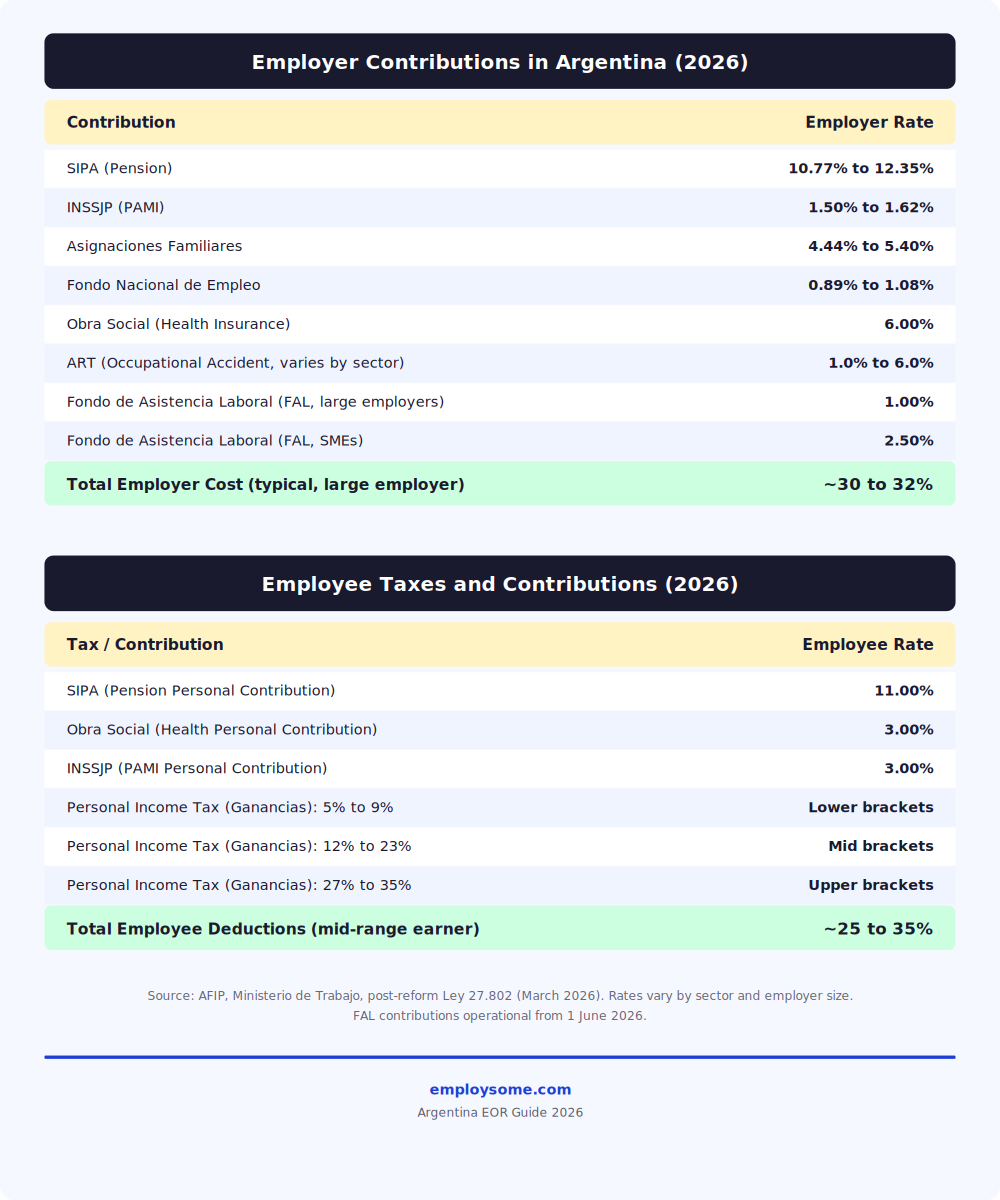
Employsome Insight: The Fondo de Asistencia Laboral is the post-reform structural shift to track. Operational from 1 June 2026, the FAL converts unpredictable lump-sum severance liability into a steady monthly contribution: 1% of salaries for large employers, 2.5% for SMEs. Funds sit in employer-owned accounts withdrawable only for severance, after a six-month accumulation window. For foreign employers this turns severance from a tail risk into a predictable monthly expense, but EOR providers vary materially in their FAL administration readiness.
Annual Leave and Public Holidays
Annual leave entitlement in Argentina scales with tenure under Ley 20.744 article 150:
- Less than 5 years of service: 14 calendar days
- 5 to 10 years of service: 21 calendar days
- 10 to 20 years of service: 28 calendar days
- More than 20 years of service: 35 calendar days
Vacation accrues from day one and includes the probation period. Leave traditionally had to be taken in a single block between October and April, but the 2026 reform introduced flexibility allowing employers and employees to agree to split vacation into segments of no less than one week, taken at any time during the year, with at least 30 days notice. Argentina has 19 federal public holidays per year, one of the highest counts in Latin America. When a holiday falls on a Tuesday or Thursday, the government can declare a movable bridge day (día no laborable con fines turísticos) to create a long weekend.
Sick Leave and Employer Exposure
Sick leave in Argentina is one of the more employer-favourable elements of the labour code by international standards. Employees with up to 5 years of tenure receive paid sickness absence for up to 3 months per year at full salary, and employees with more than 5 years receive up to 6 months per year. The employer pays the full salary during this period without any deduction.
After the maximum sickness leave period expires, the employee enters reserva de puesto (post-reservation) for up to one additional year, during which the employer is not required to pay salary but must hold the position. After the reservation period, the employer can terminate the relationship by paying half of the standard severance amount (under Ley 20.744 article 212). The medical certificate must be submitted to the employer, and the employer can require an independent medical examination if the certificate is contested.
Maternity leave is 90 days (45 before birth and 45 after) at full salary funded by the social security system, not the employer directly. Paternity leave is 2 days at full salary, with the post-reform reform expanding parental leave provisions in some sectoral CCTs to 15 days or more for new fathers.
Work From Home and Remote Hiring
Remote work in Argentina was historically governed by Ley 27.555 (Teletrabajo Law of 2020), which imposed extensive employer obligations including reimbursement of internet and electricity costs, mandatory equipment provision, the right to disconnect, and enhanced family-care protections. The 2026 reform proposed substantial changes to this framework, with several of the most onerous obligations now subject to negotiation by collective agreement rather than statutory mandate.
In the post-reform 2026 environment, employers must clarify in writing the equipment provision and reimbursement structure, the location and conditions of remote work, the data protection framework under Argentine personal data protection law, and the right-to-disconnect provisions either statutorily or through company policy. The reform reduced the rigidity of the prior framework but did not eliminate employer obligations entirely, and the exact post-reform regulatory implementation continues to evolve as secondary regulations are issued through 2026.
Termination of Employment (Post-Reform)
Termination of indefinite employment in Argentina under the post-reform framework is materially more predictable than the pre-2026 environment, although still requiring careful procedural compliance. The Modernización Laboral Law (Ley 27.802) reshaped severance calculation, capped exposure, and introduced the FAL severance-funding mechanism.
Termination categories. Termination with cause (con justa causa) requires documented serious misconduct, must follow a prior disciplinary procedure, and does not trigger severance obligations. Termination without cause (sin justa causa) requires full notice and severance payments under the post-reform formulas. Termination by mutual agreement (rupture conventionnelle equivalent) avoids the dispute risk of contested terminations and is commonly used for senior departures.
Notice requirements. After probation, employees with less than 5 years of service require 1 month notice and those with 5 or more years require 2 months notice (Ley 20.744 article 231). Employers may pay in lieu of notice at full gross salary for the applicable period.
Severance calculation post-reform. Severance for termination without cause is calculated at one month of the highest normal monthly remuneration per year of service (or fraction exceeding three months), with the post-reform critical change being the calculation base: aguinaldo, vacation pay, and non-monthly bonuses are now excluded from the base, and a three-times-CBA-average cap applies to the per-year amount. The Vizzoti judicial precedent on cap calculation methodology is now codified directly into the law. The FAL contributions can be applied to the severance liability, reducing the cash outflow at termination.
Procedural compliance. Dismissal must be communicated in writing through a documented method (telegram, document delivery, or notarial communication). Procedural errors can extend the notice period or trigger constructive dismissal claims, although the post-reform framework eliminated several of the historic registration-fine multipliers that previously inflated total exposure.
Employsome Insight: Monotributo contractor misclassification is the most expensive Argentine compliance failure for foreign companies. The Monotributo regime allows independent contractors to operate under a simplified tax structure, and many foreign companies engage Argentine contractors under Monotributo arrangements rather than through an EOR. When the relationship is functionally an employment relationship (regular hours, exclusive client, supervised work, fixed compensation), Argentine labour courts routinely reclassify contractors as employees, triggering retroactive obligations including unpaid social contributions, the full severance liability, statutory damages, and AFIP back-payment claims. The post-reform framework partially addressed this by clarifying which platform-based arrangements qualify as genuine independent work, but the fundamental misclassification risk remains for traditional client-contractor structures. EOR engagement is materially safer than Monotributo contractor arrangements for any role with traditional employment characteristics.
Hiring Without an Argentine Entity: The EOR Option
If you want to hire employees in Argentina without opening a local Sociedad Anonima (SA) or Sociedad de Responsabilidad Limitada (SRL), you can use an Employer of Record (EOR). An Argentine EOR acts as the legal employer under Ley 20.744, handles AFIP tax and social security registration, manages the FAL contribution under the post-reform framework, ensures compliance with the relevant CCT, issues compliant Spanish-language contracts, and administers aguinaldo, vacation accrual, and other statutory benefits.
The EOR model is particularly useful for companies testing the Argentine market, hiring 1 to 10 employees in Argentina, expanding into Latin America with a regional team that includes Argentine nationals, or avoiding the cost and time of Argentine entity setup, AFIP registration, and ongoing accounting and legal advisory. Argentine entity setup is one of the more administratively involved processes in Latin America and rarely makes economic sense below 5 to 10 local employees.
Final Verdict: Best Employer of Record in Argentina
After weighing all 10 Employer of Record Argentina providers across our combined scoring methodology, four stand out as the clearest picks for distinct buyer profiles. Each delivers compliant Argentine EOR execution under the post-reform Ley 27.802 framework, but they serve genuinely different needs depending on whether the priority is platform polish, Latin America regional depth, post-reform compliance specialism, or dollar-payment infrastructure.
Best Overall Argentina EOR: Multiplier
Argentina EOR Score: 4.3/5 | Global Score: 4.5/5 | $605/month
Multiplier wins the overall pick on the strength of its balanced execution: directly-owned Argentine entity, transparent flat-rate pricing without FX surprises, demonstrated FAL contribution administration from the 1 June 2026 launch, and platform polish that suits foreign HR teams without Argentine specialism. The 5 to 10 business day onboarding sits comfortably ahead of most competitors, and the post-reform Ley 27.802 readiness is among the strongest in the field. For foreign employers hiring 1 to 25 mainstream professional or technology roles in Buenos Aires, Cordoba, or Rosario as part of a broader LATAM expansion, Multiplier delivers the cleanest combination of compliance fit, pricing predictability, and platform consistency without forcing a trade-off between any of them.
Best for Argentina-Specific Compliance Depth: Biz Latin Hub
Argentina EOR Score: 4.7/5 | Global Score: 3.7/5 | $320/month
Biz Latin Hub posts the highest Argentina-specific score in the field at 4.7/5, anchored by the 100 percent owned Buenos Aires subsidiary, the integrated legal-and-EOR delivery model, and a directly-employed bilingual team handling AFIP, ART, FAL, and CCT classification in-house rather than through partner coordination. The smooth transition pathway from EOR to fully owned Argentine SA or SRL (using the same firm with no provider switch) is genuinely differentiated and matters most when foreign employers eventually outgrow the EOR model. Best suited for North American and European mid-market firms using Argentina as a market-entry test before committing to a long-term local entity, particularly where the integrated legal advisory and tax services deliver value beyond pure EOR execution.
Best for Speed and Dollar Payment Infrastructure: Ontop
Argentina EOR Score: 4.3/5 | Global Score: 4.1/5 | $541/month
Ontop is the LATAM-native specialist pick, combining a directly-owned Argentine entity with bilingual concierge-level support and the most operationally relevant differentiator in the post-reform environment: the USD wallet plus Visa card capability that allows Argentine employees to receive dollars directly under the new Ley 27.802 foreign currency salary authorization, with no peso intermediation or FX conversion friction. The 6 to 9 business day onboarding is among the fastest in the field, and the Colombia-founded LATAM positioning produces deeper regional knowledge than the volume-led global platforms. Strongest fit for fast-growing startups and digital-first businesses (particularly Web3, fintech, and remote-first companies) where dollar-denominated compensation is a core hiring requirement and platform consistency across LATAM markets matters operationally.
Best for Cross-Border Hiring and Visa Sponsorship: Atlas HXM
Argentina EOR Score: 4.3/5 | Global Score: 4.0/5 | $489/month
Atlas HXM wins the cross-border specialist pick on the strength of its 5.0 Visa & Work Permit Support score, the highest in the field. The deep in-house global mobility practice handles 23 A, 23 E, residency pathway, and Mercosur visa sponsorship with substantive expertise that platform-led providers route through external counsel. Combined with the directly-owned Argentine entity and named Spanish-speaking HR advisors handling complex termination cases, Atlas HXM is the right structural fit for foreign employers relocating non-Argentine nationals into Argentina or for enterprise compliance scenarios where the Direct EOR ownership model is a board-level requirement. Less optimal for fast-moving SME hiring (the 10 to 18 business day onboarding is materially slower than the platform-led leaders), but the immigration capability is genuinely best-in-category.
Frequently Asked Questions (FAQs) about EOR in Argentina
An Employer of Record (EOR) in Argentina is a third-party provider that legally employs workers on behalf of foreign companies under the Ley de Contrato de Trabajo (Ley 20.744) as amended by Ley 27.802 (March 2026). The EOR handles AFIP registration, payroll, social security contributions, the new Fondo de Asistencia Laboral (FAL), aguinaldo administration, CCT compliance, and termination procedures, while the foreign client retains operational control of the day-to-day work.
No. Hiring through an Employer of Record in Argentina lets foreign companies employ workers compliantly without setting up a local SA or SRL. EOR engagement is materially faster (typically 5 to 14 business days for onboarding) than Argentine entity setup, which can take 3 to 6 months including AFIP registration, accounting setup, and ongoing legal advisory. EOR is generally more cost-effective below 5 to 10 local employees.
Ley 27.802 (the Modernización Laboral Law of March 2026) is the most significant Argentine labour reform in decades. Key changes affecting EOR hiring include: probation extended from 3 months to 6 months (default), 8 months for SMEs, up to 12 months for very small employers; severance capped at three times the average CBA salary; the Fondo de Asistencia Laboral (FAL) introduced as a structured severance-funding mechanism; salary payment in foreign currency explicitly authorised; and several non-remunerative benefits clarified. EOR providers vary materially in their post-reform readiness.
Employer-side mandatory contributions in Argentina total approximately 30 to 32 percent of gross salary, including SIPA pension (10.77 to 12.35 percent), Asignaciones Familiares (4.44 to 5.40 percent), Fondo Nacional de Empleo (0.89 to 1.08 percent), Obra Social (6 percent), INSSJP (1.50 to 1.62 percent), ART occupational accident insurance (variable by sector), and the new FAL contribution (1 percent for large employers, 2.5 percent for SMEs). On top of this, the mandatory aguinaldo equals one full month of salary annually paid in two halves.
Standard onboarding through an Argentine EOR typically takes 5 to 14 business days for local employees with no immigration requirements. The process includes employment contract drafting, AFIP registration of the employee, Obra Social enrolment, ART occupational accident insurance setup, and payroll activation. Foreign nationals requiring work permits or residence visas add 60 to 120 days to the total timeline.
The aguinaldo, formally Sueldo Anual Complementario (SAC), is Argentina’s mandatory 13th salary. It equals one full month of salary annually, paid in two installments: the first half by 30 June (covering January to June) and the second half by 18 December (covering July to December). The amount is calculated as 50 percent of the highest monthly remuneration in each half-year period. The aguinaldo is mandatory across all sectors and cannot be waived. EOR providers automatically calculate and remit the aguinaldo as part of standard payroll execution.
Employer of Record fees in Argentina typically range from $400 to $850 per employee per month for the EOR service charge, on top of the employee’s gross salary and approximately 30 to 32 percent in employer contributions. Pricing varies by provider business model, with global platform-led EORs typically at the lower end and Latin America regional specialists or service-led providers at the upper end. The post-reform FAL contribution is included in the employer cost calculation.
Yes. Engaging an Employer of Record in Argentina is fully compliant under Argentine labour law, provided the EOR operates as a legitimate registered entity, maintains AFIP registration, complies with the relevant CCT, and meets post-reform Ley 27.802 requirements including FAL contributions. EOR engagement is materially safer than Monotributo contractor arrangements for any role with traditional employment characteristics, since labour courts routinely reclassify mismatched contractor relationships as employment with retroactive consequences.
The Fondo de Asistencia Laboral (FAL) is a mandatory severance-funding mechanism introduced by the 2026 reform and operational from 1 June 2026. Large employers contribute 1 percent of gross salaries monthly into a use-restricted fund, and SMEs contribute 2.5 percent. The fund accumulates for the first 6 months before withdrawals are permitted. Funds remain employer property but can only be used to cover severance obligations. The mechanism converts severance from an unpredictable lump-sum liability into a predictable monthly operating expense, although it does not replace the underlying severance obligation.
Yes, since Ley 27.802 (March 2026). The post-reform framework explicitly authorises salary payment in foreign currency including US dollars, addressing one of the historic complications of Argentine employment. The ARS-equivalent must be calculable for AFIP and CCT-floor compliance purposes, and dollar-denominated salary requires documented agreement between employer and employee. This change is operationally significant for foreign employers since it removes the prior need for complex peso-dollar conversion structures and largely eliminates FX-loss exposure for the employee.
Argentine employees are entitled to: 14 to 35 days of annual leave depending on tenure, 19 federal public holidays, the mandatory aguinaldo (13th salary, paid in two halves), paid sick leave (up to 3 months for less than 5 years tenure, up to 6 months for 5+ years), 90 days maternity leave, paternity leave, social security coverage through SIPA pension and Obra Social health insurance, and ART occupational accident insurance. Sectoral CBAs may add further benefits including supplementary pensions, training funds, and additional leave entitlements.
The Monotributo is Argentina’s simplified tax regime for independent contractors and very small businesses. Many foreign companies engage Argentine workers under Monotributo arrangements rather than through an EOR. When the relationship is functionally an employment relationship (regular hours, exclusive client, supervised work, fixed compensation), Argentine labour courts routinely reclassify the contractor as an employee, triggering retroactive obligations including unpaid social contributions, the full severance liability under post-reform formulas, statutory damages, and AFIP back-payment claims. EOR engagement is materially safer than Monotributo for any role with traditional employment characteristics.
Courtney Pocock is a Copywriter at Employsome with 15+ years of experience writing for the HR, corporate, and financial sectors. She has a strong interest in global business expansion and Employer of Record / PEO topics, focusing on news that matters to business owners and decision-makers. Courtney covers industry updates, regulatory changes, and practical guides to help leaders navigate international hiring with confidence. Connect with Courtney on LinkedIn.
Our content is created for informational purposes only and is not intended to provide any legal, tax, accounting, or financial advice. Please obtain separate advice from industry-specific professionals who may better understand your business’s needs. Read our Editorial Guidelines for further information on how our content is created.