
Work Permit Malaysia 2026: Employer Guide to EP, PVP & RP-T
Foreign nationals working in Malaysia generally need an Employment Pass (EP) issued by the Immigration Department through the Expatriate Services Division (ESD), with three salary-based categories. From 1 June 2026, MOHA’s reform raises minimum salaries (Category I to RM20,000, Category II to RM10,000, Category III to RM5,000), introduces a 10-year cumulative tenure cap, and mandates succession plans for Categories II and III. This guide covers all Malaysian work permit types (EP, PVP, RP-T, Visitor’s Pass), application timelines, the new 1:3 internship policy, and what foreign employers need to know.

Foreign nationals working in Malaysia generally need a work permit issued by the Immigration Department of Malaysia (Jabatan Imigresen Malaysia) and processed through the Expatriate Services Division (ESD) or other authorised agencies. The most common work permit is the Employment Pass (EP), a long-term work permit issued in three salary-based categories that allows foreign professionals, managers, and technical specialists to take up employment with a Malaysian-registered company. Other work permits include the Professional Visit Pass (PVP) for short-term project work where the foreign professional remains employed and paid by an overseas company, the Residence Pass-Talent (RP-T) for highly skilled expatriates, and the Visitor’s Pass (Temporary Employment) for semi-skilled workers in approved sectors.
2026 is the most consequential year for Malaysian work permit policy in over a decade. Following Cabinet approval on 17 October 2025 and publication of the revised salary policy on 14 January 2026, the Ministry of Home Affairs (MOHA) has implemented sweeping changes to the Employment Pass framework that take effect for all new and renewal applications submitted from 1 June 2026 onwards. The changes include sharply higher minimum salary thresholds across all three EP categories (Category I rises from RM10,000 to RM20,000 per month, Category II from RM5,000 to RM10,000, and Category III from RM3,000 to RM5,000), a new 10-year cumulative cap on EP holder tenure, mandatory local succession plans for Categories II and III, and expanded dependent rights for Category III holders.
This 2026 guide covers the full Malaysian work permit framework as of the post-1 June 2026 reforms: the three Employment Pass categories with revised salary thresholds and validity periods, the 10-year cumulative cap and how the clock works, the mandatory succession plan requirement, the Professional Visit Pass for short-term work, the Residence Pass-Talent for high-mobility expatriates, the digital ePASS system replacing physical work permit stickers, the 1:3 expatriate-to-intern policy implemented from January 2026, application processes and timelines through the Expatriate Services Division, and what international employers hiring through a Malaysian Employer of Record (EOR) need to know to navigate the new framework.

Malaysia Work Permit Types: 2026 Overview
As of 2026, the Malaysian work permit landscape consists of four primary pass types, each designed for a specific employment scenario. Choosing the correct pass is a non-negotiable compliance requirement: using a Professional Visit Pass for ongoing employment, or a Visitor’s Pass for skilled professional work, is a documented violation that can trigger employer sanctions, employee deportation, and future application restrictions.
| Work Permit Type | Used For | Maximum Duration | Sponsor |
| Employment Pass (EP) | Long-term professional, managerial, executive, or technical employment with a Malaysian company | Up to 5 years per pass; 10-year cumulative cap from June 2026 | Malaysian-registered employer |
| Professional Visit Pass (PVP) | Short-term project work, training, technical installation, consultancy, where employee remains paid by overseas company | Up to 12 months (6 months for training placements) | Malaysian sponsor company |
| Residence Pass-Talent (RP-T) | Highly skilled expatriates with established Malaysian residency; flexibility to change employers | Up to 10 years | TalentCorp (not employer-tied) |
| Visitor’s Pass (Temporary Employment) | Semi-skilled workers in manufacturing, plantation, agriculture, construction, services, foreign domestic helpers | Up to 24 months, renewable | Malaysian-registered employer |
Key 2026 reforms summary: The most significant 2026 reform package targets the Employment Pass framework. Category I minimum salary is rising from RM10,000 to RM20,000 per month; Category II from RM5,000 to RM10,000; and Category III from RM3,000 to RM5,000, all effective 1 June 2026. A new 10-year cumulative tenure cap applies across all EP categories, with the clock starting either from 1 June 2026 or from the next pass issued with the same employer (whichever is later). Mandatory succession plans are required for Category II and III applications, demonstrating how the company will transfer knowledge to local Malaysian employees over the duration of the EP. Category III holders gain dependent rights from June 2026, a meaningful improvement for mid-skilled foreign professionals bringing families.
The digital ePASS system: Since March 2025, Malaysia has replaced the traditional work-permit sticker affixed to passports with the ePASS, a fully digital pass linked to the holder’s biometric records. All new EP applications use ePASS by default, eliminating the need to surrender passports during processing and speeding up renewal cycles. Existing sticker passes remain valid until expiry and convert to ePASS on renewal.
The Employment Pass: Three Categories Under the 2026 Reforms
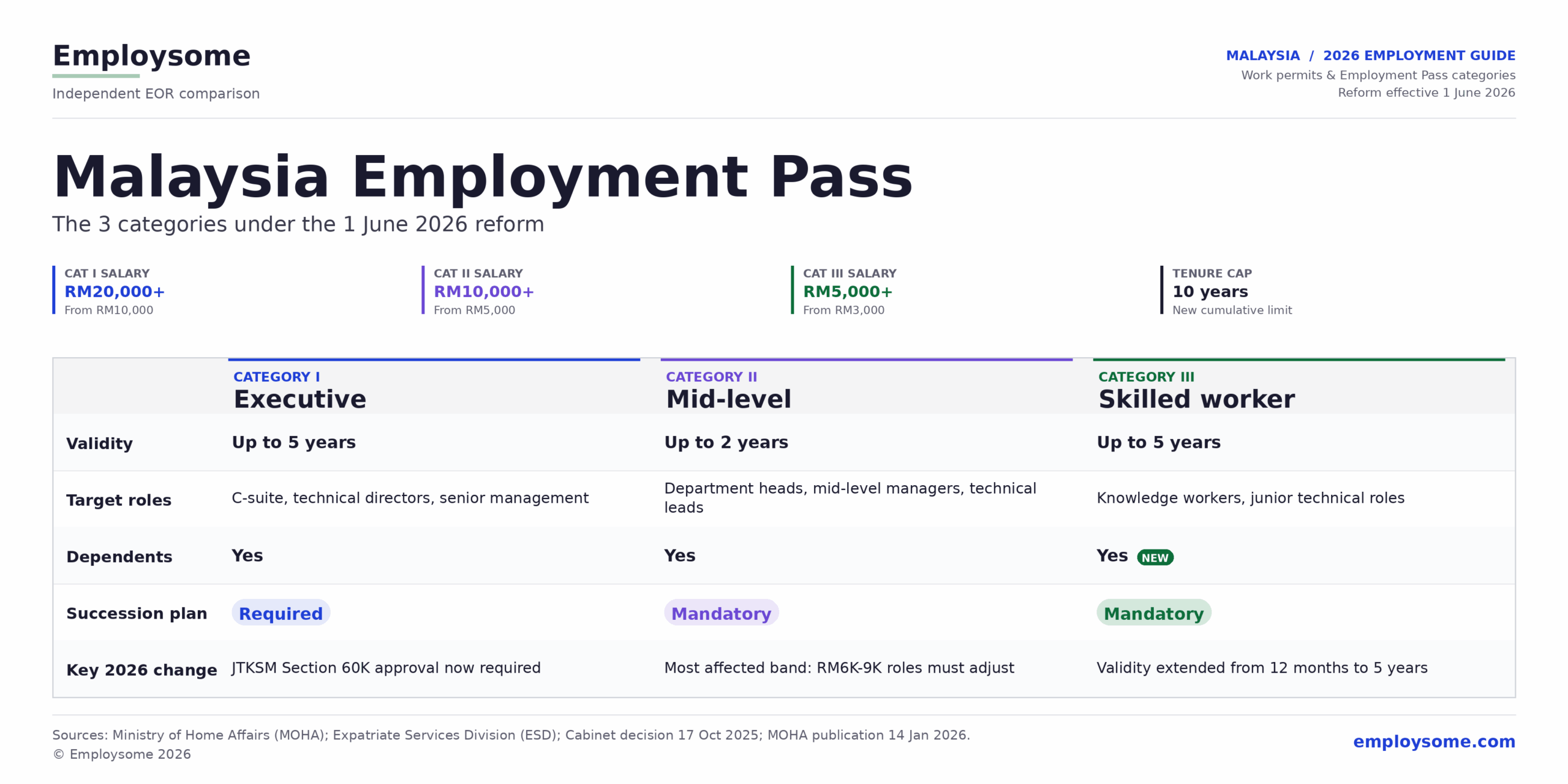
The Employment Pass is the dominant work permit for foreign professionals in Malaysia and accounts for the majority of work-permit holders. As of 1 June 2026, the three EP categories are structured as follows.
| Category (Post-1 June 2026) | Minimum Monthly Salary | Validity | Target Roles | Dependents |
| Category I | RM20,000+ | Up to 5 years per pass, 10-year total | C-suite, senior executives, technical directors, regional VP-level | Yes |
| Category II | RM10,000 to RM19,999 | Up to 2 years per pass, 10-year total (with succession plan) | Department heads, mid-level managers, technical leads, specialised professionals | Yes |
| Category III | RM5,000 to RM9,999 (general); RM7,000+ in manufacturing | Up to 5 years total (with succession plan) | Knowledge and skilled workers, junior technical roles | Yes (new for June 2026) |
Category I, the executive tier: Targeted at C-suite executives, technical directors, and senior management. The RM20,000+ threshold (effective 1 June 2026) is the highest in Southeast Asia and signals Malaysia’s strategic focus on attracting genuinely high-value expatriate talent. Category I positions are exempt from the mandatory 14 to 30 day job advertisement requirement on the national employment portal, expediting hiring timelines by 3 to 4 weeks. Category I applications now require JTKSM (Jabatan Tenaga Kerja Semenanjung Malaysia) approval under Section 60K before submission to the ESD. Category I holders gain priority access to multiple directorships and have stronger residency stability.
Category II, the workhorse tier: This is the most heavily affected category under the 2026 reform. Pre-reform, Category II covered roles earning RM5,000 to RM9,999 per month, which was the standard band for experienced regional managers, finance leads, and technical specialists. Post-1 June 2026, the band rises to RM10,000 to RM19,999, meaning that any role currently in the RM5,000 to RM9,999 range either requires a salary adjustment to meet the new minimum or must be restructured. Category II applications now require a mandatory succession plan demonstrating how the company will transfer knowledge and skills to local Malaysian staff during the EP period.
Category III, the skilled-worker tier: Pre-reform, Category III was a short-term, dependent-restricted pass for roles earning RM3,000 to RM4,999. Post-1 June 2026, the threshold rises to RM5,000 (RM7,000 in manufacturing) with validity up to 5 years and full dependent rights for the first time. The new Category III is a meaningful upgrade for mid-skilled foreign professionals: junior technical roles, knowledge workers, and skilled specialists who can now bring families and qualify for longer-duration passes than under the pre-reform framework. Category III also requires the mandatory succession plan.
💡 Employsome Insight: The June 2026 Reform Resets the Cost-Benefit of Hiring Expatriates
The 2026 EP reforms reset the cost-benefit calculation for hiring expatriates in Malaysia. The headline impact is that Category II roles in the RM6,000 to RM9,000 band, historically the largest segment of expatriate hiring, will no longer qualify for new EPs from June 2026 without salary adjustments. For multinational employers with five, ten, or twenty expatriates in this band, the cumulative payroll uplift to retain pre-reform headcount is material (typically RM200,000 to RM800,000 in additional annual salary cost per cohort, before taxes and benefits). Companies that begin EP renewal planning before the 1 June 2026 deadline will have meaningfully more options than those that discover the change through a rejected renewal in late 2026.
The 10-Year Cumulative Cap and the Mandatory Succession Plan
A second 2026 reform that has received less attention than the salary changes but carries equally significant long-term implications is the 10-year cumulative tenure cap. Pre-reform, Employment Passes had no maximum lifetime duration: an expatriate could theoretically renew their EP indefinitely, working in Malaysia for 15, 20, or 30 years on consecutive passes. From 1 June 2026, this is no longer the case.
How the 10-year clock works:
- The clock starts from 1 June 2026, or from the date of the next EP issued with the same employer, whichever is later. Tenure accumulated before 1 June 2026 does not count toward the 10-year cap.
- The clock resets when the expatriate changes employer. Moving to a new Malaysian-registered company starts a fresh 10-year window with that employer.
- The clock also resets when the expatriate changes EP category (e.g., promoted from Category II to Category I), giving them a fresh 10-year window from the new pass issuance date.
- Extensions beyond the 10-year cap will be assessed by MOHA on a case-by-case basis tied to national interest, with no automatic right to continue.
Practical implications for long-tenured expatriates: Companies with expatriates who have been in Malaysia for five years or more should model when each individual would reach the 10-year ceiling under the new calculation, factoring in planned promotions or role changes that would reset the clock. For expatriates approaching the horizon, succession planning should begin well ahead of the deadline. The mandatory succession plan requirement (Categories II and III) and the 10-year cap are designed to work together: the succession plan is the practical mechanism for transferring the role to a local Malaysian employee before the cap is reached.
The mandatory succession plan: From 1 June 2026, Category II and Category III EP applications must include a documented Local Succession Plan demonstrating how the company will transfer knowledge and skills from the expatriate to local Malaysian staff during the duration of the EP. MOHA has confirmed there is no prescribed format or submission timeline, which gives companies flexibility to structure their own approach but creates an obligation that is live from June 2026. A workable succession plan typically covers: (1) identification of the realistic Malaysian successor or successor pool for each expatriate role; (2) a development programme with training, mentoring, and stretch assignments; (3) competency milestones with documented progress; and (4) handover documentation that captures critical role knowledge.
The Professional Visit Pass (PVP): Short-Term Project Work
The Professional Visit Pass (PVP) is a fundamentally different work permit from the Employment Pass and serves a different purpose. Many employers confuse the two, which is one of the most common compliance errors in Malaysian immigration practice.
The core distinction: An Employment Pass is for an expatriate employed and paid by a Malaysian company in a long-term role. A Professional Visit Pass is for a foreign professional providing short-term services to a Malaysian organisation while remaining employed and paid by an overseas company. No Malaysian salary is permitted under a PVP.
Common PVP use cases:
- Technical experts for machinery installation, commissioning, or maintenance (e.g., a foreign engineer sent to install machinery purchased from an overseas supplier)
- IT specialists for system implementation, software deployment, or technical training of local teams
- Consultants providing professional advice on a specific project with defined start and end dates
- Trainers and lecturers delivering short courses or workshops to local staff
- Film crews and performing artists (subject to PUSPAL approval through the Ministry of Communications)
- Religious teachers (Islamic teachers, priests, Hindu Sami, Sikh Granthi, Dharma teachers)
- Trainees and exchange students on industrial training placements (capped at 6 months)
PVP key parameters:
| Parameter | Value |
| Maximum validity | 12 months (6 months for training placements) |
| Extensions beyond 12 months | Not permitted; new application required |
| Salary requirement | None (paid by overseas company, not Malaysian sponsor) |
| Application fee | RM800 per application |
| Processing time | 2 to 6 weeks (typically 14 to 21 days) |
| Sponsor | Malaysian company (must be ESD-registered) |
| Dependents | Not permitted |
| Conversion to Employment Pass | Not possible directly; new EP application required |
| Bank guarantee or security bond | Required for nationals from certain countries |
The misclassification risk: Using a PVP for ongoing operational employment is a documented violation of Malaysian immigration law. If a foreign professional is embedded in the Malaysian organisation, receives a Malaysian salary, or contributes on an ongoing basis beyond a defined project, the correct work permit is an Employment Pass. Employers caught misclassifying have faced employee deportation, employer sanctions, and restrictions on future EP applications. When in doubt, lean toward the Employment Pass; over-classification carries no penalty, while under-classification creates real legal exposure.
Residence Pass-Talent (RP-T) and the Visitor’s Pass Framework
Beyond the EP and PVP, two additional work permit structures are relevant for international employers hiring in Malaysia.
Residence Pass-Talent (RP-T): Issued by TalentCorp rather than the Immigration Department, the RP-T is a 10-year multi-purpose visa for highly skilled expatriates who have established Malaysian residency through previous Employment Pass tenure or other qualifying criteria. The defining feature is that the RP-T is not tied to a single employer: holders can change jobs without reapplying for a new pass, take up multiple directorships, or work as independent professionals (subject to sector-specific licensing).
- Eligibility: Generally requires at least 3 years of continuous work experience in Malaysia, a minimum salary threshold (typically RM15,000+ per month at application), and demonstrated specialised skills or expertise valuable to Malaysia
- Validity: 10 years, renewable subject to continued eligibility
- Dependents: Spouse and unmarried children under 18 qualify for Long-Term Social Visit Pass; spouse may apply for own work authorisation
- Strategic positioning: For multinational employers, sponsoring or supporting RP-T applications for star expatriates is a retention tool, since the pass de-risks a potential future job change within Malaysia for the employee while preserving the employer’s ability to retain talent.
Visitor’s Pass (Temporary Employment): For semi-skilled foreign workers in approved sectors. This is a separate framework from the EP/PVP system and is governed by bilateral agreements between Malaysia and source countries.
- Approved sectors: Manufacturing, plantation, agriculture, construction, services (limited sub-sectors), and foreign domestic helpers
- Source country restrictions: Workers must come from countries with bilateral agreements (Indonesia, Bangladesh, Nepal, Myanmar, India, Philippines, Pakistan, Sri Lanka, Thailand, Vietnam, and others)
- Age requirement: 18 to 45 years at time of application
- Validity: Typically 24 months, renewable
- Quota: Sector-specific quotas apply, with employer approval required from the Ministry of Home Affairs
- Not relevant for skilled professional employment: The Visitor’s Pass framework does not cover the skilled or professional-grade hires that most multinational employers focus on.
How to Apply for an Employment Pass: 6-Step Process and Timeline
The Employment Pass application process is run through the Expatriate Services Division (ESD) of the Ministry of Home Affairs, with online submission via the ESD portal. The process is employer-led: the Malaysian entity must register with ESD, get the role approved, and submit the EP application on the employee’s behalf. Foreign employees cannot apply for an EP on their own initiative.
Standard 6-step EP application process:
| Step | Action | Typical Duration |
| 1. ESD Registration | Malaysian entity registers with ESD portal and creates an Expatriate Post matching the role | 1 to 2 weeks |
| 2. Expatriate Post Approval | Expatriate Committee (EC) reviews and approves the position. Companies must demonstrate the role cannot be filled locally. | 2 to 4 weeks |
| 3. EP Application Submission | Employer submits EP application via ESD portal with full documentation (passport, qualifications, contract, succession plan for Cat II/III) | 1 to 2 days |
| 4. ESD Processing | Standard processing 2 to 4 weeks; complex cases or positions requiring additional endorsement 4 to 8 weeks | 2 to 8 weeks |
| 5. Endorsement and Entry | Approval letter issued; employee obtains entry visa from Malaysian embassy if required, then enters Malaysia | 1 to 3 weeks |
| 6. ePASS Issuance | Employee attends ESD office for biometrics and ePASS activation. Pass is digitally linked to passport. | 1 to 2 weeks |
| Total typical timeline | n/a | 8 to 16 weeks end-to-end |
Required documents (employer side): company registration documents, ESD registration confirmation, Expatriate Post approval, employment contract, justification for hiring an expatriate (skills not available locally), succession plan (Categories II and III from June 2026), proof of payment of application fees.
Required documents (employee side): valid passport with at least 18 months remaining validity, academic qualifications and transcripts, professional certifications, employment history with letters of reference, recent passport photographs, medical examination report (where required by source country agreement), police clearance certificate from country of origin (where applicable).
Application fees: EP application fees are approximately RM200 to RM500 per year of validity, with additional processing and visa endorsement fees of RM300 to RM800 depending on country of origin. For a 5-year Category I EP, total government fees typically run RM1,500 to RM3,500. Dependent Pass fees are charged separately at approximately RM200 to RM500 per dependent per year.
The 1:3 Internship Policy and Other 2026 Employer Obligations
A critical 2026 development that affects all Employment Pass-sponsoring employers is the 1:3 expatriate-to-intern policy, piloted from February 2025 and made mandatory from January 2026. This policy is part of the broader Thirteenth Malaysia Plan (RMK-13) goal of reducing reliance on foreign labour while building local talent capacity.
How the 1:3 policy works:
- Companies hiring EP holders must provide structured, paid internships for local Malaysian students
- 3 interns for each Category I expatriate
- 2 interns for each Category II expatriate
- 1 intern for each Category III expatriate
- Total internship obligations are capped at 2% of total workforce to prevent disproportionate burden on smaller companies
- Internships must be paid (no minimum amount specified, but typically RM800 to RM2,500/month depending on industry and seniority)
- Programme structure must include genuine professional development, not pure clerical work
Practical implementation: For a multinational with 10 expatriates (split as 2 Category I, 6 Category II, 2 Category III), the internship obligation is approximately 2×3 + 6×2 + 2×1 = 20 internship slots annually, subject to the 2% workforce cap. For a 200-person Malaysian operation, the 2% cap limits the obligation to 4 internships, materially below the theoretical 20. The policy interacts directly with the succession plan requirement: well-designed internship programmes can be structured as feeder pipelines for the local successor pool referenced in the mandatory succession plans for Category II and III applications.
Other ongoing employer obligations:
- EP is employer-specific: switching employers is not allowed without a new EP application. The new employer must submit a completely new application; the gap between cancellation and new EP approval can be bridged with a Special Pass.
- Role and salary must match approved details: any change to job title, duties, salary, or work location may require fresh ESD approval or a new EP application
- EP must be cancelled within 30 days of employment termination; failure to do so creates compliance issues for both employer and employee
- No side jobs or freelance work: EP holders may work only for the sponsoring company
- Mandatory pass shortening before permanent departure: EP holders must formally cancel the pass and exit Malaysia, with documented immigration check-out
What Foreign Employers Need to Know
For international companies hiring Malaysian-based professionals or relocating expatriates to Malaysia through a local entity or via an Employer of Record (EOR), the 2026 work permit reforms create both compliance complexity and planning opportunities. Several practical considerations differ from other Asian markets.
Key compliance points for foreign employers:
- Plan EP renewals around the 1 June 2026 cliff. Renewals submitted before 1 June 2026 are processed under the old salary thresholds; renewals from 1 June 2026 onwards use the new thresholds regardless of how long the employee has been with the company. There is no grace period and no grandfathering.
- Run the 10-year tenure model for long-tenured expatriates. Identify employees who have been in Malaysia for 5+ years and model when they would reach the 10-year cap from June 2026, factoring in planned promotions or category changes that would reset the clock.
- Build the succession plan now. Category II and III applications from June 2026 require documented succession plans. MOHA has not specified format, which is an opportunity to design a plan that fits the company’s actual succession process rather than retrofitting one to fit a regulatory template.
- Match the 1:3 internship programme to the succession plan. Well-designed paid internships can serve dual purposes: satisfying the 1:3 mandatory policy and feeding the local successor pool referenced in the EP succession plan.
- Companies without a Malaysian entity should use an EOR for EP sponsorship. Setting up a Malaysian Sdn Bhd to sponsor a small number of EPs is rarely cost-effective at fewer than 5 expatriates. EOR providers handle ESD registration, Expatriate Post approval, EP application, ePASS issuance, and ongoing compliance (including the new succession plan and 1:3 internship requirements).
- The Visitor’s Pass framework is not an EP shortcut. For skilled professional roles, the Employment Pass is the only compliant option. Some companies have attempted to use Visitor’s Pass or Professional Visit Pass routes to avoid the EP salary thresholds; these workarounds are documented violations and carry employer sanctions.
- For RP-T eligible employees, sponsor the application as a retention tool. The Residence Pass-Talent de-risks the employee’s residency without weakening the employer relationship, and is increasingly visible to senior expatriate candidates as a differentiating benefit.
- Budget the salary uplift now. Multinationals with expatriates in the pre-reform Category II band (RM5,000 to RM9,999) face a material payroll uplift to retain headcount under the new RM10,000 floor. Modelling the cumulative cost across the affected cohort, with recruitment alternatives where economics no longer work, is the immediate planning priority for 2026.
Best Providers for Work Permits in Malaysia




Hiring in Malaysia?
Malaysian work permit compliance under the 1 June 2026 EP reforms, the 10-year cumulative cap, mandatory succession plans for Categories II and III, the 1:3 internship policy, and ESD digital ePASS administration all require local expertise. Compare the top Employer of Record providers for Malaysia in 2026 – verified pricing, compliance scores, and expert rankings from Employsome’s independent research team.
Frequently Asked Questions
The main work permit for Malaysia is the Employment Pass (EP), a long-term work authorisation issued by the Immigration Department through the Expatriate Services Division (ESD) for foreign professionals, managers, executives, and technical specialists hired for skills not easily found locally. The EP is issued in three salary-based categories: Category I (RM20,000+ from 1 June 2026, up to 5 years), Category II (RM10,000 to RM19,999, up to 2 years per pass), and Category III (RM5,000 to RM9,999, up to 5 years total). Other work permits include the Professional Visit Pass (PVP) for short-term project work where the employee remains paid by an overseas company, the Residence Pass-Talent (RP-T) for highly skilled expatriates, and the Visitor’s Pass (Temporary Employment) for semi-skilled workers in approved sectors.
2026 introduced the most significant overhaul of Malaysian work permit policy in over a decade, effective 1 June 2026. Following Cabinet approval on 17 October 2025, the Ministry of Home Affairs revised Employment Pass salary thresholds: Category I rose from RM10,000 to RM20,000; Category II from RM5,000 to RM10,000; and Category III from RM3,000 to RM5,000. A new 10-year cumulative tenure cap applies across all categories, with the clock starting from 1 June 2026. Mandatory succession plans are required for Category II and III applications. Category III holders gain dependent rights. The 1:3 expatriate-to-intern policy became mandatory from January 2026.
From 1 June 2026, the minimum salary thresholds are: Category I: RM20,000 per month (up from RM10,000); Category II: RM10,000 per month (up from RM5,000); Category III: RM5,000 per month general / RM7,000 in manufacturing (up from RM3,000). For applications submitted between January 2026 and 31 May 2026, the pre-reform thresholds (RM10,000 / RM5,000 / RM3,000) still apply. There is no grace period or grandfathering: any application submitted on or after 1 June 2026 must meet the new thresholds, regardless of how long the employee has been with the company. Companies should plan EP renewals around this cliff date.
The core distinction is the employment relationship. An Employment Pass (EP) is for an expatriate employed and paid by a Malaysian company in a long-term role (up to 5 years per pass). A Professional Visit Pass (PVP) is for a foreign professional providing short-term services to a Malaysian organisation while remaining employed and paid by an overseas company, with no Malaysian salary permitted. PVPs are limited to 12 months (6 months for training placements) and cannot be extended; a new application is required after 12 months. Common PVP use cases include foreign engineers installing machinery, IT consultants implementing systems, technical trainers, and short-term consultants. Using a PVP for ongoing operational employment is a documented violation of Malaysian immigration law.
The 10-year cumulative cap is a new 2026 policy limiting how long an expatriate can hold an Employment Pass with the same employer. The clock starts from 1 June 2026 (or from the next EP issued with the same employer, whichever is later) and runs continuously across consecutive EP renewals. Tenure accumulated before 1 June 2026 does not count toward the cap. The clock resets when the expatriate changes employer or changes EP category (e.g., promoted from Category II to Category I). Extensions beyond 10 years will be assessed by MOHA on a case-by-case basis tied to national interest, with no automatic right to continue. Companies with long-tenured expatriates should model when each individual would reach the ceiling and incorporate this into succession planning.
From 1 June 2026, Category II and Category III Employment Pass applications must include a documented Local Succession Plan demonstrating how the company will transfer knowledge and skills from the expatriate to local Malaysian staff during the EP period. MOHA has not specified a prescribed format or submission timeline, giving companies flexibility to design their own approach. A workable plan typically covers: identification of the realistic Malaysian successor or successor pool for each expatriate role; a development programme with training, mentoring, and stretch assignments; competency milestones with documented progress; and handover documentation that captures critical role knowledge. The succession plan requirement is designed to work alongside the 10-year cumulative cap, with the plan being the practical mechanism for transferring the role to a local employee before the cap is reached.
The 1:3 expatriate-to-intern policy, made mandatory from January 2026, requires companies hiring EP holders to provide structured, paid internships for local Malaysian students. The ratios are: 3 interns per Category I expatriate, 2 interns per Category II expatriate, and 1 intern per Category III expatriate. Total internship obligations are capped at 2% of total workforce to prevent disproportionate burden on smaller companies. Internships must be paid (typically RM800 to RM2,500 per month depending on industry) and must include genuine professional development. The policy is part of the Thirteenth Malaysia Plan goal of reducing reliance on foreign labour while building local talent capacity. Well-designed internship programmes can serve as feeder pipelines for the local successor pool referenced in the mandatory succession plan.
A standard Employment Pass application typically takes 8 to 16 weeks end-to-end from start to ePASS issuance. The 6-step process breaks down as: ESD registration (1 to 2 weeks), Expatriate Post approval by the Expatriate Committee (2 to 4 weeks), EP application submission (1 to 2 days), ESD processing (2 to 8 weeks for standard cases, longer for complex cases requiring additional endorsement), endorsement and entry visa (1 to 3 weeks), and ePASS biometric activation in Malaysia (1 to 2 weeks). Renewal applications typically take 2 to 3 weeks. Incomplete documentation is the most common cause of delays. Category I applications now also require JTKSM (Department of Labour Peninsular Malaysia) approval under Section 60K before submission to the ESD.
Yes, with material 2026 changes. Category I and Category II EP holders have always been entitled to bring dependents through Dependant Passes for spouse and children under 18, and Long-Term Social Visit Pass for parents and children over 18 (subject to conditions). From 1 June 2026, Category III holders also gain dependent rights for the first time, which is a meaningful upgrade for mid-skilled expatriates. Spouses of EP holders may apply for their own work permits subject to meeting standard EP requirements (job offer, salary threshold for the relevant category). Children receive Dependant Passes allowing enrollment in Malaysia’s international and public school systems. Dependent Pass applications are typically submitted together with the EP application or shortly after EP approval.
International employers hiring Malaysian-based foreign professionals must comply with the Immigration Act 1959/63, Employment Act 1955, and the post-1 June 2026 ESD framework, regardless of where the company is headquartered. The Malaysian-registered entity must register with ESD, secure Expatriate Post approval, submit EP applications, maintain compliant role descriptions matching ESD-approved expatriate posts, manage the new succession plan and 1:3 internship requirements, and handle ongoing pass renewals and cancellations. Companies without a Malaysian entity typically engage an Employer of Record (EOR) to handle these compliance obligations end-to-end. The EOR handles ESD registration, Expatriate Post approval, EP application, ePASS issuance, dependent pass administration, and ongoing compliance including the new 2026 reforms. See our Best EOR Malaysia guide for verified provider rankings.
Courtney Pocock is a Copywriter at Employsome with 15+ years of experience writing for the HR, corporate, and financial sectors. She has a strong interest in global business expansion and Employer of Record / PEO topics, focusing on news that matters to business owners and decision-makers. Courtney covers industry updates, regulatory changes, and practical guides to help leaders navigate international hiring with confidence. Connect with Courtney on LinkedIn.
Our content is created for informational purposes only and is not intended to provide any legal, tax, accounting, or financial advice. Please obtain separate advice from industry-specific professionals who may better understand your business’s needs. Read our Editorial Guidelines for further information on how our content is created.