
Minimum Wage in India 2026: State Rates & Employer Guide
India does not have a single national minimum wage in 2026. The Central Government sets a National Floor Level Minimum Wage of ₹178/day, with states ranging from ₹11,389 to ₹19,846 monthly for unskilled workers. This guide covers state-by-state 2026 rates, the four-tier skill classification (unskilled, semi-skilled, skilled, highly skilled), Variable Dearness Allowance (VDA) revisions, the Code on Wages 2019 changes, total employer cost including PF and ESI, and what foreign employers need to know.

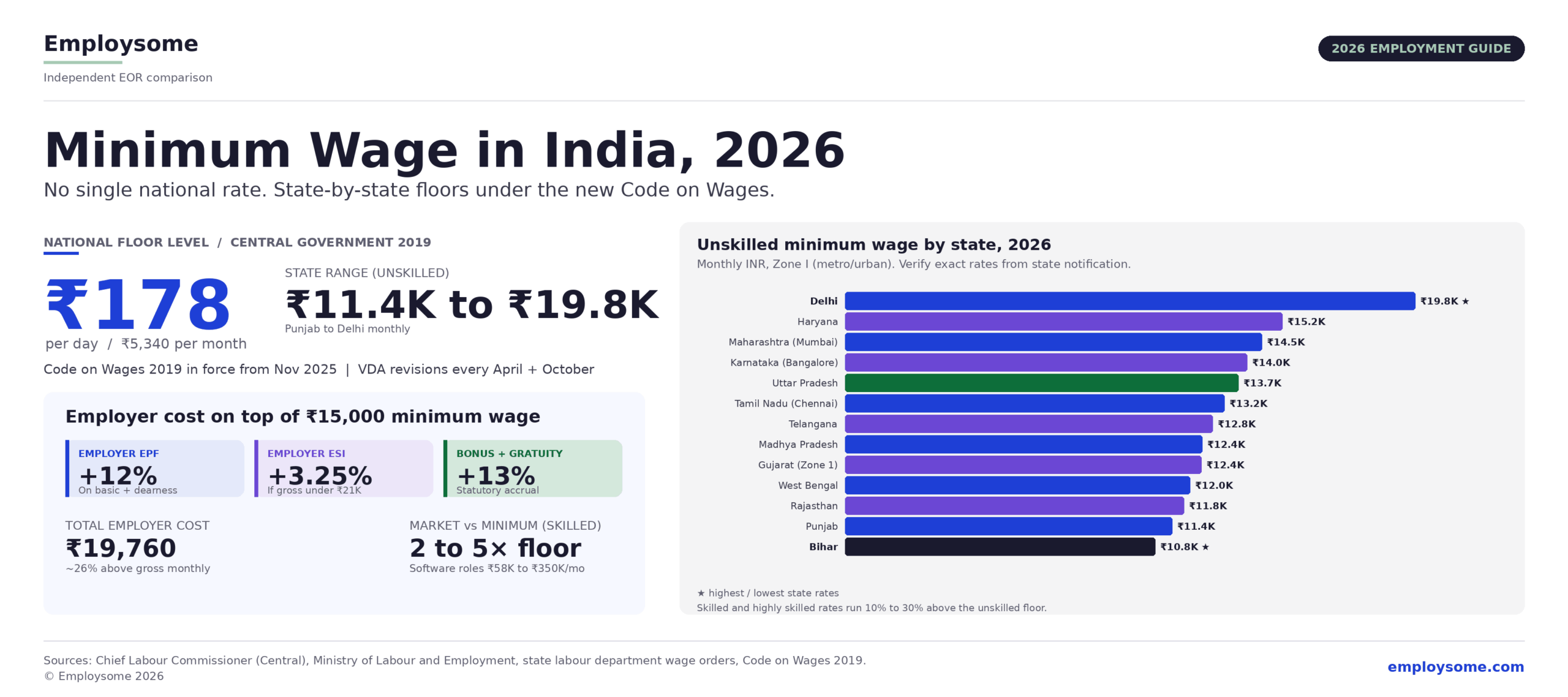
India does not have a single national minimum wage. Instead, the country operates a multi-tiered system in which the Central Government sets a National Floor Level Minimum Wage (NFLMW) of ₹178 per day (₹5,340/month), and 28 individual states and 8 Union Territories set their own higher rates by industry, skill level, and geographic zone. As of 2026, state-notified minimum wages range from approximately ₹11,389 per month in Punjab to ₹19,846 per month in Delhi for unskilled workers, with skilled and highly skilled workers earning materially more.
For workers in central sphere employments (railways, mines, oil fields, major ports, central government undertakings), the Central Government sets separate rates that range from ₹783 per day (₹20,358/month) for unskilled workers to ₹1,035 per day for highly skilled workers. The effective minimum wage for any given hire therefore depends on three factors: the state where the worker is based, the scheduled employment (industry classification) the establishment falls under, and the skill category assigned to the role.
The legal framework is undergoing a major transition. The Code on Wages, 2019 consolidates four older statutes (the Minimum Wages Act 1948, Payment of Wages Act 1936, Payment of Bonus Act 1965, and Equal Remuneration Act 1976) into a single unified Code, introduces a statutory floor wage binding on all states, and extends minimum wage protection to all employments universally (including IT/ITES, BPO, and white-collar roles). As of November 2025, the Code came into force alongside three other Labour Codes, and 2026 has seen multiple state revisions including a 21% rise in Uttar Pradesh effective 1 April 2026, a 35% rise in Haryana, and corresponding adjustments across most states.
This 2026 guide covers the National Floor Level Wage, central sphere rates, comprehensive state-by-state minimum wage rates for unskilled, semi-skilled, skilled, and highly skilled workers, the four-tier skill classification system, how Variable Dearness Allowance (VDA) revisions work twice a year, the Code on Wages 2019 changes affecting employers in 2026, total employer cost calculations including PF / ESI / bonus / gratuity accrual on top of minimum wage, USD equivalents for foreign employers, penalties for non-compliance, and what international companies hiring through an Indian Employer of Record (EOR) need to know.

Minimum Wage in India 2026: National Floor and Central Sphere Rates
As of 2026, the headline minimum wage indicators for India are as follows. Note that the “minimum wage in India” is actually a matrix of rates rather than a single number, so the table below shows the most commonly referenced benchmarks.
| Wage Indicator (2026) | Value (INR) | Approx. USD |
| National Floor Level Minimum Wage (NFLMW), daily | ₹178/day | USD 2.13 |
| National Floor Level Minimum Wage, monthly equivalent | ₹5,340/month | USD 64 |
| Central sphere unskilled worker, daily | ₹783/day | USD 9.40 |
| Central sphere unskilled worker, monthly | ₹20,358/month | USD 244 |
| Central sphere highly skilled worker, daily | ₹1,035/day | USD 12.40 |
| Highest state minimum (Delhi, unskilled) | ₹19,846/month | USD 238 |
| Highest state minimum (Delhi, skilled) | ₹22,411/month | USD 269 |
| Lowest state minimum (Punjab unskilled, indicative) | ₹11,389/month | USD 137 |
| Effective monthly calculation | 26 days standard | n/a |
| VDA revision schedule | Twice per year (April + October) | n/a |
| Indicative exchange rate used in this guide | USD 1 = ₹83.50 | n/a |
26 days vs 30 days, the most-asked clarification: When converting daily minimum wage rates to a monthly figure, Indian payroll practice typically uses 26 working days per month rather than 30 calendar days. This is because the standard practice assumes 4 weekly off days (Sundays) and one paid weekly off, leaving 26 paid working days. So a ₹783/day central rate becomes ₹20,358/month (783 × 26), not ₹23,490 (783 × 30). Some state notifications specify 30 days; always check the specific state notification.
Why the National Floor Level Wage is so low: The ₹178/day NFLMW was set in 2019 and has not been formally revised since. The figure is widely seen as outdated and is now an advisory floor that all states already exceed. Under the Code on Wages 2019 (now in force), this figure will be replaced by a statutory National Floor Wage binding on all states, currently being finalised in 2026 by the Ministry of Labour and Employment.
💡 Employsome Insight: Never Budget Indian Hires Against the National Floor Level Wage
The minimum wage figure that matters for any specific Indian hire is almost never the National Floor Level Wage. It is the state-notified minimum wage for the specific scheduled employment, skill level, and geographic zone applicable to that role. Foreign employers benchmarking against the ₹178/day national floor will systematically underpay and trigger compliance violations. As a working rule of thumb for 2026: budget at least ₹15,000 to ₹20,000 per month for unskilled compliant pay in major states, and ₹18,000 to ₹25,000 for skilled workers, before adding PF, ESI, bonus, and gratuity accrual.
The Four Skill Categories: Unskilled, Semi-Skilled, Skilled, Highly Skilled
The Indian minimum wage system classifies workers into four skill categories, with progressively higher minimum wages for each tier. Correctly classifying an employee is a core compliance requirement: misclassifying a skilled worker as unskilled to reduce wage costs is a violation that can be detected during a labour inspection and triggers penalties under the Code on Wages.
| Skill Category | Definition | Typical Examples |
| Unskilled | Workers performing simple tasks requiring no formal training, certification, or prior experience | Loaders, helpers, sweepers, peons, basic security guards |
| Semi-Skilled | Workers with some training, basic experience, or familiarity with tools and machinery, but not yet able to perform complex tasks independently | Cooks, gardeners, assistant electricians, machine operators in training, basic data entry |
| Skilled | Workers with formal training, certification, or significant on-the-job experience, capable of performing specialised tasks independently | Electricians, plumbers, fitters, welders, drivers, bookkeepers, qualified nurses, BPO agents |
| Highly Skilled | Workers with advanced expertise, formal qualifications, supervisory capability, or roles requiring complex judgement | Software developers, engineers, supervisors, project managers, scientists, doctors, certified accountants |
Universal coverage under the Code on Wages: Under the old Minimum Wages Act 1948, only specific listed “scheduled employments” were covered. The Code on Wages 2019 extends minimum wage protection to all employments universally, including IT/ITES, BPO, software development, professional services, and other white-collar roles that were previously inconsistent in coverage. This is one of the most material changes for foreign employers: a software developer in Bangalore now has a statutory minimum wage floor (set at the highly skilled rate for Karnataka), even though market rates are far above it.
The Code on Wages 50% rule: The Code requires that basic wage and dearness allowance combined must constitute at least 50% of total compensation. This affects how foreign employers structure CTC (cost to company) packages for Indian hires: previously common practice of paying a low basic and high allowances to reduce PF and gratuity liability is no longer compliant. All packages must now satisfy the 50% rule, materially increasing employer PF and gratuity contributions on the same gross compensation.
Zone-based variation within states: Several states (notably Maharashtra, Karnataka, and Gujarat) divide their territory into Zone A, B, C, D based on level of urbanisation and cost of living. Zone A typically covers the state capital and major metropolitan areas (Mumbai, Bangalore, Ahmedabad) and has the highest minimum wage; Zone D covers rural districts and has the lowest. A skilled worker in Mumbai (Maharashtra Zone I) and the same role in rural Maharashtra (Zone IV) can have minimum wages differing by 20% to 35%.
Central Sphere Minimum Wages 2026 (Railways, Mines, Major Ports)
For workers employed in central sphere establishments (railways, mines, oil fields, major ports, central government undertakings, and certain other industries directly under Central Government authority), minimum wages are notified by the Chief Labour Commissioner (Central) rather than state governments. These rates apply nationwide for those employments and are revised every six months via Variable Dearness Allowance (VDA) effective 1 April and 1 October each year.
Central sphere minimum wage rates for 2026 (effective from the most recent VDA revision):
| Skill Category (Central Sphere 2026) | Daily Rate (INR) | Monthly (INR, 26 days) | USD/month |
| Unskilled | ₹783 | ₹20,358 | USD 244 |
| Semi-Skilled | ₹868 | ₹22,568 | USD 270 |
| Skilled | ₹954 | ₹24,804 | USD 297 |
| Highly Skilled | ₹1,035 | ₹26,910 | USD 322 |
The April 2026 VDA revision reflected an increase of 11.28 CPI points, resulting in upward adjustments across all centrally regulated scheduled employments. Subsequent revisions are due at the next October cycle. Rates apply uniformly nationwide for central sphere workers.
What counts as a central sphere establishment: An establishment falls under central sphere if it is owned, controlled, or directly administered by the Central Government, or operates in a sector where the Constitution’s Seventh Schedule places authority with the Centre. This includes Indian Railways, coal mines, oil and natural gas extraction, major shipping ports, civil aviation establishments, and central government public sector undertakings (PSUs). Most private sector employers (including factories, shops, IT companies, BPOs, and most service businesses) fall under state sphere and follow state-specific minimum wages.
State-by-State Minimum Wage Rates: Major Indian States in 2026
State-notified minimum wages vary substantially across India. The table below shows indicative 2026 rates for unskilled and skilled workers under the Shops and Establishments Act in major states (Zone I / metropolitan areas). Always verify the exact rate from the state Labour Department notification applicable to the specific scheduled employment before processing payroll.
| State (Zone I, monthly INR, 2026) | Unskilled | Skilled | Highly Skilled | USD (skilled) |
| Delhi | ₹19,846 | ₹22,411 | ₹24,356 | USD 268 |
| Haryana | ₹15,220 | ₹18,000 | ₹19,000 | USD 216 |
| Maharashtra (Mumbai) | ₹14,500 | ₹16,800 | ₹18,200 | USD 201 |
| Karnataka (Bangalore) | ₹13,990 | ₹16,100 | ₹17,800 | USD 193 |
| Tamil Nadu (Chennai) | ₹13,200 | ₹15,800 | ₹17,200 | USD 189 |
| Uttar Pradesh (1 April 2026) | ₹13,690 | ₹16,868 | ₹18,200 | USD 202 |
| Telangana (Hyderabad) | ₹12,800 | ₹14,965 | ₹16,500 | USD 179 |
| Gujarat (Zone 1) | ₹12,400 | ₹13,897 | ₹15,600 | USD 166 |
| Madhya Pradesh | ₹12,425 | ₹14,500 | ₹16,769 | USD 174 |
| West Bengal | ₹12,000 | ₹14,200 | ₹15,800 | USD 170 |
| Rajasthan | ₹11,800 | ₹13,800 | ₹15,200 | USD 165 |
| Punjab | ₹11,389 | ₹13,600 | ₹15,000 | USD 163 |
| Bihar | ₹10,800 | ₹13,168 | ₹17,472 | USD 158 |
The Noida protests and the 2026 wage revisions: In November 2025, approximately 40,000 workers protested in Noida (Uttar Pradesh) over the wage disparity with neighbouring Haryana. Haryana had announced a 35% wage hike on 10 April 2026 raising unskilled minimum to ₹15,220, while Uttar Pradesh’s rate had remained at ₹11,313, creating a roughly ₹4,000 monthly gap for the same work in the same NCR economic zone. In response, the UP government announced a 21% rise effective 1 April 2026, raising unskilled minimum to ₹13,690. The episode illustrates how state-by-state asymmetric revisions can destabilise wage expectations across borders, particularly in the National Capital Region where workers can easily compare rates.
The 2026 trend: Most major states have implemented meaningful upward revisions in 2026, ranging from 10% to 35%, driven by inflation, CPI movements, and the implementation of the Code on Wages 2019. Foreign employers operating across multiple Indian states must monitor each state’s notification cycle separately, since missing one revision creates backdated liability that compounds month over month until corrected.
How VDA Revisions Work: The Twice-Yearly Adjustment Mechanism
Indian minimum wages are not static numbers. They move twice per year through a mechanism called the Variable Dearness Allowance (VDA), which automatically adjusts the minimum wage based on inflation as measured by the Consumer Price Index for Industrial Workers (CPI-IW).
How VDA works:
- The minimum wage is structured as Basic Wage + VDA, where Basic is fixed (revised every 5 years) and VDA changes every 6 months
- VDA is recalculated each 1 April and 1 October based on the previous 6 months of CPI-IW movement
- When CPI-IW rises, VDA increases proportionally, so the total minimum wage rises automatically without requiring new legislation
- Each scheduled employment may have a different VDA factor, and rural and urban CPI-IW indices can produce different VDA outcomes
The April 2026 revision: Effective 1 April 2026, the Central Government applied a VDA increase of 11.28 CPI points, which translated into upward adjustments of approximately ₹300 to ₹450 per month across the four central sphere skill categories. State governments apply their own VDAs at varying schedules, with most major states aligning to the April / October cycle. The next revision is expected on 1 October 2026.
Compliance implication: VDA changes do not require individual employee notifications or contract amendments. They take effect automatically on the notified date. Employers are responsible for monitoring the relevant state’s wage orders and updating payroll within the effective date, even when the change is small. Non-compliance accumulates as backdated liability plus 10× underpayment compensation under the Code on Wages.
The Code on Wages 2019: Major Changes Affecting Employers in 2026
The Code on Wages, 2019, came into force in November 2025 alongside three other Labour Codes (Industrial Relations Code 2020, Code on Social Security 2020, and Occupational Safety, Health and Working Conditions Code 2020). The Code on Wages consolidates four older statutes (Minimum Wages Act 1948, Payment of Wages Act 1936, Payment of Bonus Act 1965, Equal Remuneration Act 1976) into a single unified law and introduces several material changes for employers in 2026.
Universal application: The Code extends minimum wage protection to all employments, removing the previous limitation of the Minimum Wages Act 1948 to specific “scheduled employments.” Software developers, BPO agents, retail staff, and previously uncovered white-collar roles now have statutory minimum wage protection, even when market rates exceed the floor by multiples.
Statutory National Floor Wage: The Code provides for a binding national floor below which no state can set its minimum wage. The ₹178/day NFLMW set in 2019 has been the advisory floor; the Code converts this into a statutory floor with formal central government revision powers. As of 2026 the rule is being finalised state by state.
The 50% basic + DA rule: Under the Code, basic wage plus dearness allowance combined must constitute at least 50% of total compensation. Previous practice of structuring CTC with low basic and high allowances (to reduce PF, gratuity, and bonus liability) is no longer compliant. This typically increases employer PF contributions by 8 to 12% on the same gross compensation, with corresponding gratuity accrual increases.
Stricter penalties:
| Violation under Code on Wages | Penalty |
| Paying less than minimum wage (first offence) | Up to ₹50,000 fine |
| Repeat offence within 5 years | Up to ₹1,00,000 fine + up to 3 months imprisonment |
| Compensation to affected worker | Up to 10× the underpaid amount |
| Failure to maintain wage records | Up to ₹10,000 fine |
| Obstruction of inspection | Up to ₹50,000 fine |
Payment timeline rule: Wages must be paid by the 7th day of the following month for establishments with fewer than 1,000 employees, stricter than the previous framework. Larger establishments have longer windows specified in the Code.
Gender neutrality: The Code explicitly prohibits discrimination based on gender in matters of wages, recruitment, and employment conditions for the same work or work of similar nature, replacing the older Equal Remuneration Act 1976.
Total Employer Cost: PF, ESI, Bonus, and Gratuity on Top of Minimum Wage
Minimum wage compliance is necessary but not sufficient. Indian employers must also factor in mandatory statutory contributions paid on top of the gross minimum wage: Provident Fund (EPF), Employees’ State Insurance (ESI), bonus accrual, and gratuity accrual. The total all-in employer cost typically runs 20% to 28% above the gross minimum wage.
Standard 2026 monthly cost calculation for a compliant unskilled hire in a major Indian state at ₹15,000 monthly gross:
| Cost Component | Rate | Amount (INR) |
| Gross monthly salary | n/a | ₹15,000 |
| Employer EPF contribution | 12% of basic + DA (capped at ₹15,000 base) | ₹1,800 |
| Employer ESI contribution | 3.25% of gross (if gross under ₹21,000) | ₹488 |
| Bonus accrual | 8.33% to 20% of basic wage (Payment of Bonus Act) | ₹1,250 |
| Gratuity accrual | 4.81% of basic + DA (after 5 years) | ₹722 |
| Other allowances and benefits | Variable | ₹500 |
| Total monthly employer cost | ~26% above gross | ₹19,760 |
| Annual employer cost | n/a | ₹237,120 |
EPF specifics: Both employer and employee contribute 12% of basic salary plus dearness allowance to the Employees’ Provident Fund Organisation (EPFO). Statutory cap is on monthly salary up to ₹15,000 for mandatory coverage; voluntary higher contributions are permitted. Of the 12% employer share, 8.33% goes to the Employees’ Pension Scheme (EPS) and 3.67% to EPF.
ESI specifics: Employees’ State Insurance covers workers earning up to ₹21,000 per month. Employer pays 3.25% and employee pays 0.75% of gross salary. Above the ₹21,000 threshold, ESI does not apply and employees are typically covered through employer-provided private health insurance.
Bonus accrual: Under the Payment of Bonus Act 1965 (now within the Code on Wages), employees earning up to ₹21,000/month are entitled to a statutory bonus of 8.33% to 20% of basic wage, depending on company profitability. Most employers accrue 8.33% as a baseline. Bonus is paid as a separate annual lump sum, not monthly.
Gratuity accrual: Under the Payment of Gratuity Act 1972, employees who complete 5 years of continuous service are entitled to gratuity at 15 days of basic + DA per completed year of service. Employers typically accrue this at 4.81% of basic + DA monthly (15/26 = 4.81%). Gratuity ceiling is ₹20 lakh under current rules.
Salary in India per Month in USD: 2026 Reference for Foreign Employers
For US, UK, and other foreign employers benchmarking Indian wages, the most relevant comparisons are USD-equivalent monthly cost and the gap between statutory minimum wage and competitive market rates. At the prevailing 2026 exchange rate of approximately USD 1 = ₹83.50, representative Indian wages convert as follows.
| Wage Reference (2026) | Monthly INR | Monthly USD |
| National Floor Level Minimum Wage | ₹5,340 | USD 64 |
| Lowest state minimum (unskilled) | ₹10,800 | USD 129 |
| Delhi unskilled minimum | ₹19,846 | USD 238 |
| Delhi skilled minimum | ₹22,411 | USD 268 |
| Central sphere highly skilled minimum | ₹26,910 | USD 322 |
| Market rate, junior software engineer (Bangalore) | ₹58,000 to 70,000 | USD 695 to 838 |
| Market rate, mid-level software engineer | ₹100,000 to 150,000 | USD 1,200 to 1,800 |
| Market rate, senior software engineer | ₹180,000 to 350,000 | USD 2,160 to 4,190 |
| Market rate, BPO agent | ₹20,000 to 35,000 | USD 240 to 420 |
The market rate gap: Market rates for skilled professionals in India typically run 2 to 5 times above the statutory minimum wage. A junior software engineer in Bangalore earns around ₹58,000 to ₹70,000 per month against a Karnataka highly skilled minimum of approximately ₹17,800. Foreign employers benchmarking against minimum wage will systematically underbid the talent market and lose competitive hires. The minimum wage is a compliance floor, not a market benchmark.
What Foreign Employers Need to Know
India does not have a single national minimum wage
India operates a multi-tiered minimum wage system. The Central Government sets a National Floor Level Minimum Wage of ₹178/day, plus separate central sphere rates for railways, mines, and similar sectors. Each of 28 states and 8 Union Territories sets its own state-level minimum wages by industry, skill level, and zone, creating a matrix of hundreds of distinct minimum wage rates.
State minimum wages range from ₹11,389 to ₹19,846 per month for unskilled workers in 2026
Punjab is at the lower end and Delhi at the upper end. Skilled and highly skilled minimum wages range correspondingly higher, with Delhi highest at ₹22,411 to ₹24,356 monthly. Major states have implemented 10% to 35% upward revisions in 2026 driven by CPI movements and the Code on Wages 2019 implementation.
The Code on Wages 2019 came into force in November 2025
The Code consolidates four older statutes, extends minimum wage protection to all employments universally, introduces a binding statutory National Floor Wage, and requires that basic wage plus dearness allowance constitute at least 50% of total compensation. Penalties for non-compliance now reach ₹1,00,000 plus up to 3 months imprisonment for repeat offences, plus up to 10× underpayment compensation to the affected worker.
Minimum wages revise twice per year through VDA
Variable Dearness Allowance is recalculated each 1 April and 1 October based on Consumer Price Index for Industrial Workers movements. Employers must monitor each relevant state’s wage orders and update payroll automatically; missing a revision creates backdated liability that compounds month over month until corrected.
Total employer cost is approximately 20% to 28% above gross minimum wage
Mandatory contributions on top of gross include 12% Employees’ Provident Fund (EPF), 3.25% Employees’ State Insurance (ESI for workers under ₹21,000), 8.33% to 20% bonus accrual under the Payment of Bonus Act, and 4.81% gratuity accrual under the Payment of Gratuity Act. A ₹15,000 monthly gross hire costs approximately ₹19,760 in total monthly employer cost.
The Code on Wages 50% rule changes CTC structuring
Basic wage plus dearness allowance combined must now constitute at least 50% of total compensation. Previous practice of low-basic / high-allowance CTC structures (designed to reduce PF and gratuity liability) is no longer compliant under the Code on Wages.
Market rates run 2 to 5 times above statutory minimum for skilled roles
A junior software engineer in Bangalore earns approximately ₹58,000 to ₹70,000 per month against a Karnataka highly skilled minimum of approximately ₹17,800. The minimum wage is a compliance floor, not a market benchmark.
Consider an EOR for compliant Indian hiring
For international companies without an Indian entity, an Employer of Record (EOR) manages multi-state minimum wage compliance, EPF and ESI registration and remittance, gratuity accrual, bonus calculations, VDA revision tracking across all relevant states, and Code on Wages compliance including the 50% basic + DA rule. See our Best EOR in India guide for verified provider rankings and our guide to the new Indian Labour Codes for the broader 2026 regulatory context.
Hiring in India?
Indian employment compliance under the Code on Wages 2019 requires multi-state minimum wage tracking, EPF and ESI registration and remittance, twice-yearly VDA monitoring, the 50% basic plus dearness allowance rule, gratuity accrual, and statutory bonus calculations under the Payment of Bonus Act. Compare the top Employer of Record providers for India in 2026 – verified pricing, compliance scores, and expert rankings from Employsome’s independent research team.
Frequently Asked Questions
India does not have a single national minimum wage. The Central Government sets a National Floor Level Minimum Wage of ₹178 per day (₹5,340/month) below which no state can go, plus separate central sphere rates for railways, mines, and similar sectors ranging from ₹783 to ₹1,035 per day. State-notified minimum wages range from approximately ₹11,389/month in Punjab to ₹19,846/month in Delhi for unskilled workers, with skilled and highly skilled wages materially higher. The effective minimum wage for any specific hire depends on the state, industry, skill level, and zone applicable to that role.
In monetary terms, monthly minimum wages for 2026 typically range from approximately ₹11,000 to ₹20,000 per month for unskilled workers in major states (calculated on a 26-day working month). Delhi has the highest unskilled minimum at ₹19,846/month, while smaller states like Punjab and Bihar are at the lower end around ₹10,800 to ₹11,389. Skilled and highly skilled categories add 10% to 30% on top depending on the state. The National Floor Level Wage of ₹5,340/month is an advisory baseline only and is below all state-notified rates.
Indian payroll practice typically uses 26 working days per month rather than 30 calendar days when converting daily minimum wage rates to monthly figures. This reflects the standard assumption of 4 weekly off days (Sundays) plus 1 paid weekly off, leaving 26 paid working days. So a ₹783/day central sphere rate becomes ₹20,358/month (₹783 × 26), not ₹23,490 (₹783 × 30). Some specific state notifications may specify 30 days; always verify the calculation basis from the relevant state Labour Department wage order.
The National Floor Level Minimum Wage of ₹178 per day (₹5,340/month) is the absolute statutory floor, set by the Central Government in 2019 and not formally revised since. However, this figure is largely advisory: every Indian state has set higher state-level minimum wages well above this floor. The lowest state-notified unskilled minimum wage in 2026 is approximately ₹10,800 per month in Bihar and ₹11,389 per month in Punjab. Workers in central sphere employments (railways, mines, oil fields, ports) earn at least ₹783/day (₹20,358/month) under Central Government notifications.
Not in the sense that most countries use the term. India has a National Floor Level Minimum Wage (NFLMW) of ₹178/day set in 2019, but this is an advisory floor below which no state can set its own minimum wage, not a binding national rate that all employers must pay. The actual minimum wage paid to any worker depends on the state, industry, skill level, and zone. The Code on Wages 2019 (now in force from November 2025) provides for a binding statutory National Floor Wage, but as of 2026 the implementation rules are still being finalised.
For 2026, the unskilled minimum wage varies by state. Delhi has the highest at ₹19,846/month, followed by Haryana at ₹15,220/month (post-April 2026 revision), Maharashtra at ₹14,500/month in Mumbai, Karnataka at ₹13,990/month in Bangalore, and Uttar Pradesh at ₹13,690/month (post-April 2026 revision). Smaller states are lower: Punjab at ₹11,389/month, Bihar at ₹10,800/month. Central sphere unskilled minimum is ₹783/day (₹20,358/month). Always verify the exact rate from the state Labour Department notification for the specific scheduled employment before processing payroll.
Most Indian state minimum wages are revised twice per year through the Variable Dearness Allowance (VDA) mechanism, with effective dates of 1 April and 1 October. The VDA is recalculated based on the Consumer Price Index for Industrial Workers (CPI-IW), automatically increasing the minimum wage when inflation rises without requiring new legislation. Basic wage components are formally reviewed every 5 years under the Code on Wages 2019. Some states may also issue interim notifications outside the standard cycle, particularly during periods of high inflation or political pressure (such as the November 2025 Noida protests).
Yes, since the Code on Wages 2019 came into force in November 2025, minimum wage protection applies universally to all employments including IT, ITES, BPO, software development, and other white-collar roles. Under the older Minimum Wages Act 1948, only specific listed “scheduled employments” were covered, and IT/ITES coverage was inconsistent across states. The Code removed this limitation: a software developer in Bangalore now has a statutory minimum wage floor (set at the Karnataka highly skilled rate, around ₹17,800/month). However, market rates for IT roles run 2 to 5 times above the statutory minimum, so this is rarely the practical compliance constraint for skilled hires.
Under the Code on Wages 2019, paying less than the notified minimum wage triggers: a fine of up to ₹50,000 for the first offence; a fine of up to ₹1,00,000 plus up to 3 months imprisonment for repeat offences within 5 years; and compensation to the affected worker of up to 10× the underpaid amount. Failure to maintain wage records attracts up to ₹10,000, and obstruction of labour inspection up to ₹50,000. The Code also empowers labour authorities with stronger enforcement tools including digital records inspection. For multi-state employers, missed VDA revisions create backdated liability that compounds month over month.
International companies hiring in India have three options: (1) establish an Indian subsidiary or branch, which provides full operational control but requires extensive incorporation, MCA registration, GST and TAN registrations, and ongoing compliance; (2) engage Indian workers as independent contractors, which is workable for genuine freelance arrangements but carries misclassification risk under the Code on Wages and Industrial Relations Code; or (3) use an Indian Employer of Record (EOR) that formally employs the worker on the company’s behalf and handles multi-state minimum wage compliance, EPF and ESI registration, twice-yearly VDA tracking, the 50% basic + DA rule, and Code on Wages obligations. See our Best EOR in India guide and guide to the new Labour Codes for full context.
Copywriter
Christa is a Copywriter at Employsome with 17 years of professional writing experience across global brands, startups, and online publications. A native English-Finnish writer, she brings strong editorial skills and a versatile background in business, SaaS, and finance. At Employsome, Christa focuses on clear, practical content about HR, payroll, and Employer of Record topics.
Our content is created for informational purposes only and is not intended to provide any legal, tax, accounting, or financial advice. Please obtain separate advice from industry-specific professionals who may better understand your business’s needs. Read our Editorial Guidelines for further information on how our content is created.