What Is Succession Planning? The 2026 Guide for HR Leaders
Succession planning is the systematic process of identifying critical roles, assessing the talent pool, and developing successors so leadership transitions cause minimum disruption. Despite obvious value, only 21% of HR teams have formal plans (SHRM). This guide covers the definition, why it matters in 2026, the 4 stages of the process, the 9-box grid, an 8-step build process, common mistakes, examples across CEO and technical roles, and roles of HR, leaders, and the Board.

Succession planning is the systematic process by which an organisation identifies its most critical roles, assesses the internal talent pool against those roles, and develops a pipeline of qualified successors so that leadership transitions cause minimum disruption to the business. It is the discipline that ensures a CEO’s sudden departure doesn’t freeze decision making for six months, that a key engineering lead resigning doesn’t cost a product launch, and that a regional director retiring doesn’t leave a market rudderless for a year.
Despite the obvious value, succession planning is one of the most consistently neglected disciplines in HR. SHRM survey data shows only 21% of HR professionals report having a formal succession plan in place, with 56% reporting no plan at all. AIHR research finds that only 34% of organisations consider their succession planning highly effective. The gap between the recognised importance of succession planning and the maturity of actual practice is one of the largest in modern people management.
This guide explains what succession planning is, how it differs from replacement planning and broader succession management, the four stages of the process used by most mature organisations (identify, assess, develop, transition), tools and frameworks including the 9-box grid and competency profiling, common mistakes that derail programmes, the role of HR and senior leadership, and practical examples of what succession planning looks like in CEO, technical, and regional management contexts.
Succession Planning Template: 10 Templates for Every Scenario
Now that you understand the strategic foundations, put succession planning into practice with our 10 visualized templates: critical role identification matrix, 9-box talent grid, emergency succession plan, CEO succession, mid-manager planning, skills gap and development, readiness tracker, knowledge transfer, family business handover, and board director succession. No email gates, no PDFs, every template fully rendered inline.

What Is Succession Planning? Definition and Core Principles
Succession planning is a structured, future-oriented talent process that identifies critical roles in an organisation, defines the competencies needed to perform those roles, evaluates internal candidates against those competencies, and invests in development plans that prepare those candidates to step into the roles when they become vacant. It is not the same as filling an open position when someone resigns: that is reactive recruitment. Succession planning is deliberate, long-horizon preparation, typically a 12 to 36 month process for senior roles.
Three features distinguish succession planning from related practices:
- It is proactive, not reactive. The process starts long before a vacancy exists. Successors are being prepared while the incumbent is still in role, rather than identified after they leave.
- It focuses on critical roles, not all roles. Succession planning concentrates investment on roles where a sudden vacancy would cause meaningful business disruption: typically the CEO, the executive team, business-unit leaders, key technical roles, and roles holding scarce institutional knowledge. It does not attempt to plan succession for every position.
- It develops successors, it does not pre-select them. Modern succession planning prepares a pool of candidates for each critical role rather than designating a single named heir. This protects the organisation against changes in business strategy, candidate departures, and the political fallout of public anointment.
The Society for Human Resource Management (SHRM) defines succession planning as a “strategic practice of identifying the knowledge, skills, and abilities required to perform critical functions and then developing a plan to prepare individuals to potentially perform those functions.” The CIPD (Chartered Institute of Personnel and Development) describes it as the discipline that “focuses on identifying and growing talent to fill leadership and business-critical positions in the future.”
Why Succession Planning Matters in 2026
The case for succession planning rests on four converging pressures that make leadership transitions both more likely and more costly than in previous decades.
1. Demographic and tenure shifts are accelerating leadership turnover. CEO turnover hit record highs in 2024 and 2025, with the Conference Board reporting more S&P 500 CEO transitions than at any point in the past two decades. As experienced workers retire and average executive tenure shortens, the available labour pool for senior roles is thinning at the same time vacancies are rising.
2. The cost of a bad leadership transition is severe. Research by Russell Reynolds and Heidrick & Struggles consistently shows that externally hired CEOs fail at materially higher rates than internal successors (estimates range from 1.5x to 2x failure rates), and that the lost productivity, strategic drift, and team disruption associated with a botched transition can erase 6 to 18 months of business momentum. Internal succession is empirically the safer route, but only when there is a successor ready.
3. Knowledge transfer takes time that doesn’t exist in a reactive scenario. Critical roles accumulate institutional knowledge that takes years to acquire. When a role suddenly becomes vacant, the new incumbent may need 6 to 18 months to reach full effectiveness. Succession planning shortens that learning curve by giving prospective successors years of exposure, mentorship, and stretch assignments before they take on the role.
4. Engagement and retention benefits are material. Employees who see a clear path to advancement stay longer and engage more deeply. Gallup and Deloitte engagement studies consistently rank “career growth opportunity” in the top 3 drivers of voluntary retention, and succession planning is the organisational practice that translates that abstract opportunity into a concrete, visible path. Conversely, organisations that consistently hire externally for senior roles signal to internal talent that there is a ceiling, accelerating the loss of precisely the people they should be developing.
Succession Planning vs Replacement Planning, Workforce Planning, and Talent Management
“Succession planning” is often used loosely to describe several distinct talent practices. Understanding the differences is the foundation of designing a programme that actually works.
| Practice | What it does | Time horizon |
| Replacement planning | Identifies a single named backup for each critical role to cover an immediate vacancy. Tactical and short-term. | 0 to 6 months |
| Succession planning | Identifies critical roles and develops a pool of candidates over time so the organisation always has multiple qualified successors. Strategic and forward-looking. | 12 to 36 months |
| Succession management | The broader, ongoing organisational discipline of which succession planning is a focused subset. Integrates succession planning with talent acquisition, learning and development, performance management, and organisational strategy. | Continuous |
| Workforce planning | Forecasts the total quantity and skill mix of workforce required to meet business strategy. Concerns headcount and capability across the whole organisation, not just leadership. | 1 to 5 years |
| Career development / pathing | Helps individual employees plan their career progression. Bottom-up rather than top-down: starts with the employee’s aspirations rather than the organisation’s critical roles. | Ongoing |
| Talent management | The umbrella practice of attracting, developing, retaining, and deploying talent. Succession planning is talent management’s most strategic expression for leadership continuity. | Strategic |
The most consequential confusion is between replacement planning and succession planning. Many organisations that claim to “do succession planning” actually maintain a replacement chart: a spreadsheet listing one named backup for each senior role. This is useful for short-notice continuity but does not develop talent, build a pool, or prepare anyone for an actual transition. True succession planning invests in capability building over years, not in maintaining a list.
The 4 Stages of the Succession Planning Process
Most mature succession planning programmes use a four-stage model: Identify, Assess, Develop, Transition. The model is widely adopted because it provides clarity of ownership at each stage, makes progress measurable, and matches the natural rhythm of an annual talent review cycle.
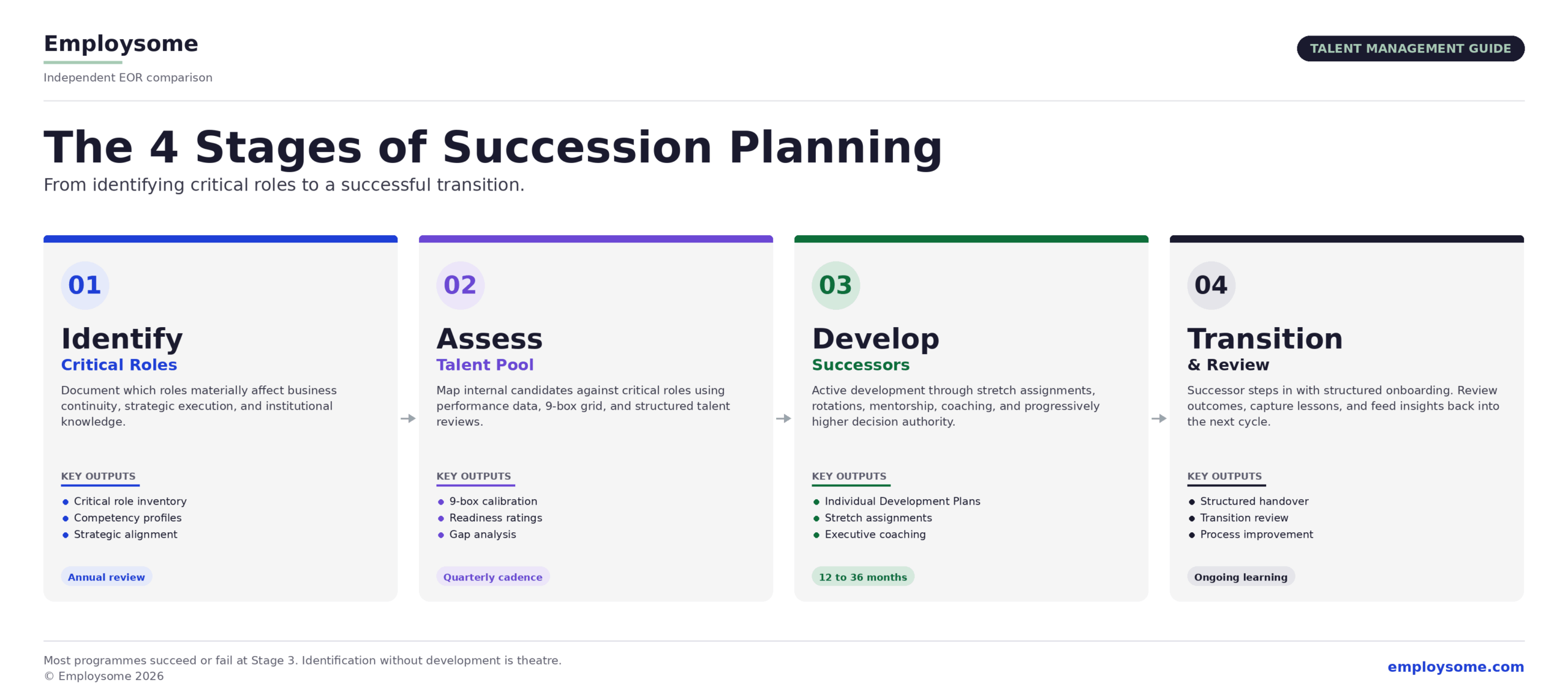
Stage 1: Identify critical roles
Not every role is critical. The first stage is a deliberate exercise to identify the roles where a sudden vacancy would cause meaningful business disruption, then build competency profiles for each. Typical criteria for criticality include strategic importance to the business, scarcity of the skill set, difficulty of external replacement, and depth of institutional knowledge held. Output: a documented list of 10 to 50 critical roles (depending on company size) with a competency profile for each.
Stage 2: Assess the talent pool
For each critical role, identify the internal candidates who could plausibly succeed into it. The standard tools are the 9-box grid (mapping employees on performance and potential), 360-degree feedback, structured talent reviews, psychometric assessments, and skills inventories. Output: a calibrated list of high-potential employees mapped against critical roles, with each candidate placed on a readiness ladder (typically Ready Now / Ready in 1 to 2 years / Ready in 3 to 5 years).
Stage 3: Develop the successors
This is the stage where most succession programmes succeed or fail. Identified successors need active development, not merely the label. Effective development uses a mix of techniques: stretch assignments and rotations, formal leadership development programmes, executive coaching and mentorship, exposure to the board and senior leadership, cross-functional projects, external education (MBA, executive education), and progressively higher-stakes decision authority. Output: an Individual Development Plan (IDP) for each succession candidate with specific milestones, owner, and review cadence.
Stage 4: Transition and review
When the role becomes vacant, the prepared successor (or one of the pool) takes over with structured onboarding and continued support. After the transition, the organisation reviews what worked: was the successor truly ready, what gaps emerged, was the development plan accurate, what should be improved for the next cycle? This stage closes the loop and feeds learning back into Stage 1 of the next planning cycle. Output: a transition review document and updated process for the next succession cycle.
💡 Employsome Insight: Most Programmes Fail at Stage 3, Not Stage 1
The most common reason succession planning fails is that organisations do all of Stage 1 and Stage 2, then skip Stage 3. They identify the critical roles, build a thoughtful 9-box grid, and place candidates in talent pools, and then nothing changes. Without active development (rotations, stretch assignments, coaching, real decision authority), succession candidates do not actually become more prepared. They just sit on a list. Stage 3 is where talent investment turns into succession readiness, and it is the stage that requires the most discipline, the longest time horizon, and the most senior management support.
The 9-Box Grid: The Standard Talent Review Tool
The 9-box grid (also called the performance-potential matrix) is the most widely used tool for visualising the talent pool against succession needs. It plots employees on a 3×3 matrix: current performance (low / medium / high) on one axis and future potential (low / medium / high) on the other.
| 9-Box Position | Performance | Potential | Typical Action |
| 1. Inconsistent player | Low | Low | Manage out or reposition |
| 2. Effective | Medium | Low | Retain in role; recognise contribution |
| 3. Trusted professional | High | Low | Reward and retain as expert; not a successor candidate |
| 4. Inconsistent rising star | Low | Medium | Coach for performance; reassess potential |
| 5. Core player | Medium | Medium | Develop incrementally; solid contributor |
| 6. High professional | High | Medium | Prepare for next-level role; possible successor |
| 7. Latent potential | Low | High | Address performance gaps urgently; potential is wasted |
| 8. Emerging leader | Medium | High | Strong successor candidate; invest in development |
| 9. Top talent / future leader | High | High | Primary succession candidate; protect with retention focus |
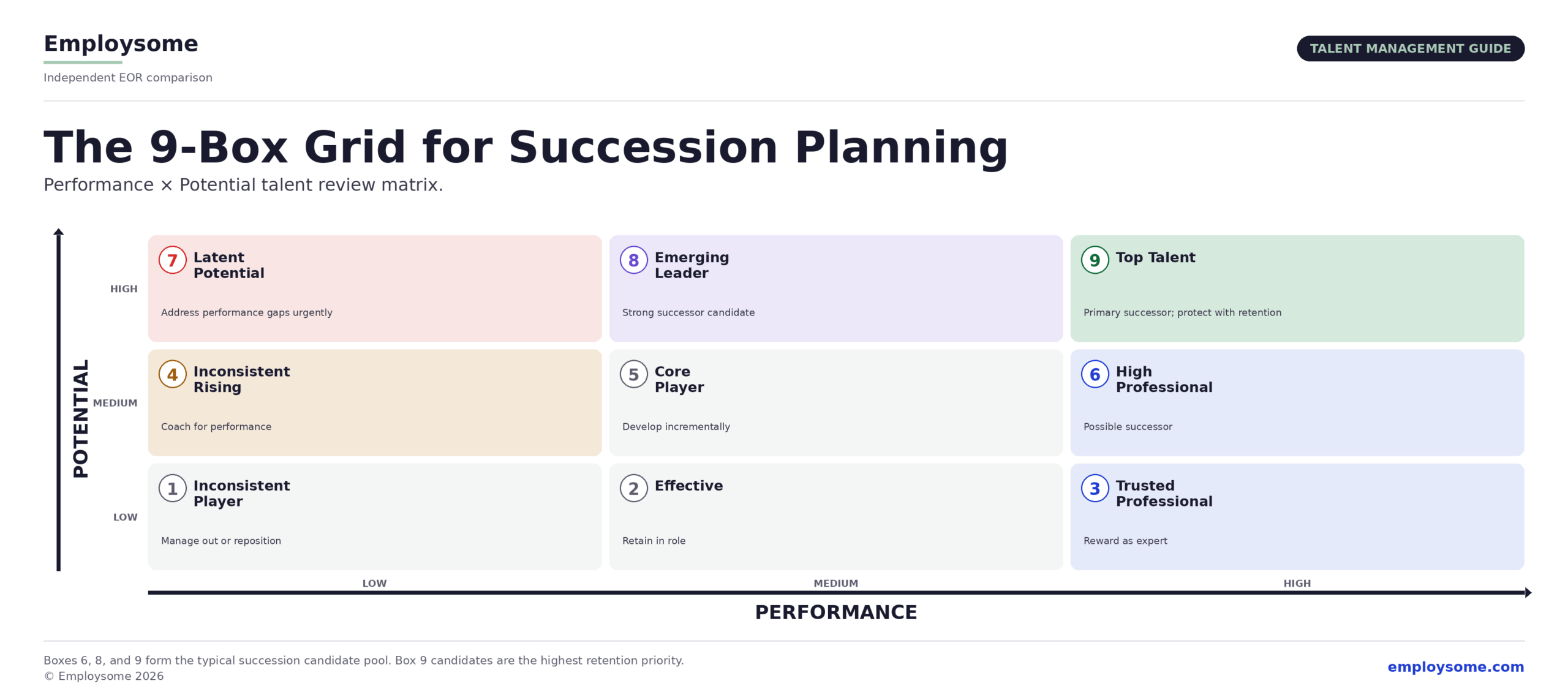
How to use it well: The 9-box is a calibration tool, not a destiny. The most rigorous organisations run group calibration sessions where managers across the business compare and challenge each other’s placements, reducing single-manager bias. Boxes 6, 8, and 9 are the typical succession candidate pool; box 9 candidates are the highest-priority retention risk. Box 7 (high potential, low performance) deserves particular attention: something is blocking the talent, and it is often a manager-fit issue, role-fit issue, or unaddressed development need rather than a fundamental capability gap.
Common pitfalls: Many organisations use the 9-box mechanically (forced ranking by quota), which damages culture and produces meaningless results. Others use it once and never revisit, treating it as a snapshot rather than a working tool. The most effective use is annual or biannual, with mid-year recalibration and explicit links to Individual Development Plans for those in the upper boxes.
How to Build a Succession Plan: 8 Practical Steps
A practical succession planning process for a mid-sized to large organisation typically runs through these eight steps each cycle:
- Align with business strategy. Begin with the organisational strategy: where the business is going over the next 3 to 10 years, what new markets or capabilities will be needed, and what shape the leadership team should take to deliver that strategy. Succession planning that ignores strategy ends up developing leaders for the company you used to be, not the company you’re becoming.
- Identify critical roles. Document which roles materially affect business continuity, strategic execution, or institutional knowledge. Do not try to cover every role; concentration of investment is part of what makes succession planning work. Most organisations end up with 10 to 50 roles depending on size.
- Define competency profiles. For each critical role, document the skills, leadership behaviours, technical knowledge, and experience required for success. Modern profiles also include AI literacy, data fluency, and change-management capability. The profile is the rubric against which candidates will be assessed.
- Assess the current talent pool. Conduct talent reviews using 9-box grids, performance data, 360 feedback, and structured manager input. Map each candidate against each critical role, marking readiness as Ready Now, Ready in 1 to 2 years, or Ready in 3 to 5 years.
- Identify gaps. Where the talent pool does not cover a critical role at sufficient readiness, document the gap. Gaps may be filled by accelerated development, external hiring, or organisational redesign. Naming the gap explicitly is half the work; many gaps go unaddressed because no one ever wrote them down.
- Build Individual Development Plans (IDPs). For each high-potential employee in the succession pool, create a documented IDP with specific development goals, learning experiences, mentor assignments, stretch projects, target readiness date, and review cadence. IDPs should be co-authored by the employee, the manager, and HR, not imposed top-down.
- Communicate transparently. Modern succession planning is more open than it once was. Letting high-potential employees know they are in a succession pool (without promising a specific role) increases retention and engagement materially. Hiding succession plans entirely tends to lose the people you are trying to develop.
- Review and recalibrate annually. Succession planning is not a one-time exercise. Repeat the cycle annually, recalibrating the talent pool, updating IDPs, and adjusting critical roles as the business strategy evolves. Mid-year touchpoints between annual reviews keep momentum.
Succession Planning Examples: CEO, Technical, and Regional
Succession planning looks different depending on the role, sector, and organisation size. Three concrete examples below illustrate the discipline in different contexts.
Example 1: CEO succession at a publicly traded company
A FTSE 250 manufacturing business identifies CEO succession as the highest-priority critical role. The Board’s Nomination Committee owns the process, working with the CEO and CHRO. The committee maintains a list of three internal candidates (typically the CFO, COO, and a divisional president) at different readiness levels: Ready Now, Ready in 2 years, Ready in 4 years. Each has a documented IDP with rotation through Board exposure, investor relations meetings, M&A leadership, and external coaching. The Board also retains a search firm on standby to maintain an external benchmark. When the CEO announces a planned 18-month departure, the Ready Now successor is named, with a structured handover including overlap period, mentorship, and Board calibration.
Example 2: Technical succession at a software company
A 500-person SaaS company identifies its Principal Engineer roles as critical because each holds deep architectural knowledge of a core product surface. The succession plan is a deliberate technical career ladder with clear progression milestones (Senior Engineer → Staff Engineer → Senior Staff → Principal). Successor development includes paired authorship of architecture decision records, rotation through different product areas, conference speaking, and explicit “Principal in Training” assignments. When a Principal departs, the designated successor steps up with continued mentorship from the outgoing engineer for 90 days as a contractor or advisor.
Example 3: Regional succession at a multinational
A consumer goods multinational treats Country Manager and Regional Director roles as critical because they hold market-specific commercial relationships and regulatory knowledge. The HR team runs an annual talent review across all regions, identifying 2 to 3 internal successors per critical role, with at least one expat candidate and one local-national candidate. Development includes 18-month cross-market rotations, regional leadership development programmes, and stretch assignments leading global product launches. When a Regional Director resigns, the organisation moves a Ready Now successor from a different region into the role, with the original successor’s region now opening up for the next pool candidate.
Common Succession Planning Mistakes to Avoid
Even well-designed succession programmes fail in predictable ways. The most common mistakes:
- Treating succession planning as replacement planning. Maintaining a list of named backups is not succession planning. Without active development, the named successors do not actually grow more prepared over time.
- Skipping Stage 3 development. Many organisations identify critical roles and assess their talent pool, then do nothing concrete to develop the candidates. Identification without development is theatre.
- Anointing a single heir. Naming one named successor publicly is risky: that person may leave, the strategy may change, or the role may evolve. Modern practice favours pools of 2 to 3 candidates per role.
- Optimising for retiring leaders, not future strategy. Succession planning that develops leaders to replicate the current leadership team fails when the business needs to change direction. The competency profile must reflect future strategy, not historical incumbents.
- Excluding non-managerial critical roles. A senior research scientist, a top sales producer, or a key product architect can be more critical to the business than many vice presidents. Succession planning that only covers management track misses important continuity risks.
- Hiding the plan from the people in it. Confidential succession lists tend to lose the talent they are trying to retain. Modern best practice is to communicate inclusion in a succession pool transparently, while avoiding specific role promises.
- Lacking diversity in the pool. Successor pools that look demographically similar to the current leadership reproduce existing biases. Inclusive succession planning deliberately surfaces high-potential candidates from underrepresented groups and addresses the development gaps that exclude them from consideration.
- Failing to integrate with performance management. Succession planning that runs in parallel to performance management produces conflicting signals. Performance reviews, talent reviews, and succession planning must use the same data and feed each other.
- Treating it as a one-time exercise. Succession plans built once and never revisited become stale within a year. The cycle must be annual at minimum, with a senior leader (typically the CHRO) accountable for the calendar.
The Roles of HR, Business Leaders, the CEO, and the Board
Succession planning succeeds when ownership is shared correctly: HR designs and operates the process, business leaders provide the talent assessments and development opportunities, and the CEO and Board ensure strategic alignment and accountability.
HR’s role: HR owns the methodology, framework, and operating cadence. Specifically, HR designs the talent review process and tools (9-box, IDPs, calibration), facilitates calibration meetings, maintains the succession dashboard and metrics, ensures consistency across business units, and links succession planning into broader talent management practices including performance reviews, learning and development, and reward.
Business leaders’ role: Line managers and business unit leaders own the talent assessments for their organisations, identify critical roles within their domain, propose succession candidates, sponsor stretch assignments, and accept candidates from other parts of the business into developmental rotations. Without active business leader engagement, HR-led succession planning becomes paper exercise.
The CEO’s and Board’s role: The CEO sets the cultural priority on succession planning by participating personally in talent reviews, holding direct reports accountable for developing successors, and modelling the mindset that “developing my replacement is part of my job, not a threat to it.” The Board’s Nomination Committee owns CEO succession specifically, and ensures that broader executive succession planning is taken seriously by reviewing it at least annually.
How to know your programme is working: Mature succession planning programmes track measurable outputs: percentage of critical roles with at least 2 Ready Now / Ready in 1 to 2 years successors, internal promotion rate for senior roles, time-to-fill for critical vacancies, retention rate of high-potential employees, and the success rate of internal successors at 12 and 24 months into role. A programme that cannot show measurable improvement on these metrics over 2 to 3 years is not actually working.
Key Takeaways for HR Leaders and Executives
Succession planning is the systematic preparation of internal successors for critical roles
Succession planning is not the same as filling an open position. It is the deliberate, multi-year process of identifying which roles matter most, assessing the talent pool, and developing successors so transitions cause minimum disruption.
Most organisations do not actually do it well
SHRM data shows only 21% of HR teams have a formal succession plan. AIHR finds only 34% of organisations consider their programme highly effective. The gap between recognised importance and actual practice is one of the largest in modern HR.
The four-stage model is the most widely used framework
Identify critical roles → Assess the talent pool → Develop successors → Transition and review. Most failures occur at Stage 3 (development), where organisations identify high-potential candidates but do not actually invest in developing them.
Succession planning is different from replacement planning
Replacement planning maintains a list of named backups for short-term continuity (0 to 6 months). Succession planning develops a pool of candidates over 12 to 36 months. The two practices are complementary but should not be confused.
The 9-box grid is the standard talent review tool
Performance on one axis, potential on the other. Boxes 6, 8, and 9 are the typical succession candidate pool. Use the 9-box as a calibration tool in group review sessions, not as a forced-ranking quota mechanism.
Develop pools, not single named heirs
Modern succession planning prepares 2 to 3 candidates per critical role rather than designating one named successor. This protects against candidate departures, strategy changes, and the political fallout of public anointment.
Communicate transparently with the people in the pool
Hiding succession plans tends to lose the high-potential employees they are trying to retain. Best practice is to tell people they are in a succession pool (without promising a specific role) and to co-author their Individual Development Plans openly.
Run the cycle annually with senior leadership accountability
Succession plans built once and never revisited become stale within a year. The CEO must take it seriously personally, the CHRO must own the calendar, and the Board must review CEO succession formally at least annually.
Frequently Asked Questions
Succession planning is the deliberate process of identifying which roles in an organisation matter most, assessing which internal employees could grow into those roles, and actively developing those candidates so that when a vacancy occurs, the organisation has prepared successors ready to step in. In simple terms: it is preparing the next generation of leaders before they are needed, rather than scrambling to find replacements after a critical employee leaves.
The four stages are: (1) Identify critical roles and document the competency requirements for each; (2) Assess the current talent pool against those requirements using tools like the 9-box grid, 360 feedback, and structured talent reviews; (3) Develop the identified successors through stretch assignments, rotations, mentorship, formal leadership development, and progressively higher decision authority; and (4) Transition the successor into the role when the vacancy occurs, with structured onboarding, then review what worked and feed lessons into the next cycle.
Replacement planning is short-term, tactical, and focused on naming a single backup for each critical role to cover an immediate vacancy (0 to 6 months horizon). It produces a list. Succession planning is long-term, strategic, and focused on developing a pool of candidates over 12 to 36 months so the organisation has multiple qualified successors prepared in advance. It produces capability. The two are complementary: most organisations need both a replacement chart for short-notice continuity and a succession pipeline for genuine leadership development.
Succession planning matters for four reasons. First, leadership turnover is at record highs, and the cost of a botched transition can erase 6 to 18 months of business momentum. Second, internally promoted leaders fail materially less often than externally hired ones (estimates from Russell Reynolds and Heidrick & Struggles suggest 1.5x to 2x lower failure rates). Third, succession planning protects institutional knowledge that takes years to acquire. Fourth, employees who see clear advancement paths stay longer and engage more deeply, so succession planning is one of the most effective retention tools available.
Responsibility is shared across three groups. HR (typically led by the CHRO) owns the methodology, framework, calendar, and tools, and facilitates the calibration process. Business leaders and line managers own the talent assessments for their teams, identify critical roles, propose successors, and sponsor development. The CEO and Board set strategic priority and own CEO succession specifically (usually through the Nomination Committee). When any of the three abdicates, the programme stalls: HR-only succession planning is paper exercise, leader-only succession planning is inconsistent, and CEO-only succession planning has no reach into the broader organisation.
The 9-box grid is a 3×3 matrix that plots employees on current performance (low, medium, high) and future potential (low, medium, high). The grid produces nine talent categories, with the top-right boxes (high performance and high potential) representing the primary succession candidate pool. The 9-box is most useful in group calibration sessions where managers across the business compare and challenge each other’s placements, reducing single-manager bias. It is a working tool to be revisited annually, not a one-time snapshot or a forced-ranking quota mechanism.
Annually at minimum, with mid-year touchpoints. Most mature organisations run a full talent review cycle once per year (often anchored to the annual performance review cycle), with calibration meetings to recalibrate 9-box placements, IDPs to update, and critical role lists to refresh. Mid-year, a lighter touchpoint catches material changes such as resignations from succession pools, strategy shifts, or development progress. CEO and executive succession should additionally be reviewed at every Board meeting that covers people topics.
The most common mistakes include: treating succession planning as a list of named backups (replacement planning) rather than active development; skipping Stage 3 development after identifying candidates; anointing a single named heir publicly; developing leaders to replicate the current team rather than the future strategy; excluding critical non-managerial roles; hiding the plan from the people in it (which loses the talent you are trying to retain); failing to surface diverse candidates; and treating succession planning as a one-time exercise rather than an annual cycle.
For a single role, succession planning is typically a 12 to 36 month preparation horizon for senior roles, with the development stage being the longest phase. For an organisation building a succession planning programme from scratch, expect 2 to 3 years before the programme produces measurable results: Year 1 focuses on identifying critical roles and running the first talent reviews; Year 2 focuses on Individual Development Plans and concrete development experiences; Year 3 begins to show internal promotion rate and time-to-fill improvements. Programmes evaluated after only one year tend to be judged unfairly.
Succession planning is a focused, time-bound process that prepares specific individuals for specific critical roles. Succession management is the broader, ongoing organisational discipline that integrates succession planning with talent acquisition, learning and development, performance management, and organisational strategy. Put simply: succession planning is one of the practices inside succession management. Most organisations should think of succession management as the umbrella discipline and succession planning as the operational engine that runs underneath it. The two terms are often used interchangeably in casual conversation, but the distinction matters when designing a coherent talent strategy.
Dane Cobain is a Copywriter at Employsome and an accomplished author whose work spans fiction, non-fiction, and professional writing. Over the past decade, he has built a strong track record creating straightforward content for the HR, payroll, and corporate sectors. Dane brings a storyteller’s eye to the evolving world of global employment, with a particular focus on Employer of Record and PEO models. His articles explore industry trends and dedicated Best Of Guides when managing an international workforce.
Our content is created for informational purposes only and is not intended to provide any legal, tax, accounting, or financial advice. Please obtain separate advice from industry-specific professionals who may better understand your business’s needs. Read our Editorial Guidelines for further information on how our content is created.
Other posts
Review other blog posts