Minimum Wage in the Netherlands (2026): Hourly Rate Guide
The Netherlands minimum wage is €14.71/hour from 1 January 2026 for employees aged 21+, a 2.15% increase. Since 2024, the Dutch system is hourly only with no fixed monthly rate. Employers must budget for the mandatory 8% holiday allowance on top (making the effective rate €15.89/hour), plus social security contributions of approximately 18 to 22%. This guide covers youth rates, employer and employee contributions, the 30% ruling, the new VBAR Act (€36/hour false self-employment presumption from July 2026), CAO obligations, income tax brackets, and an EU comparison.

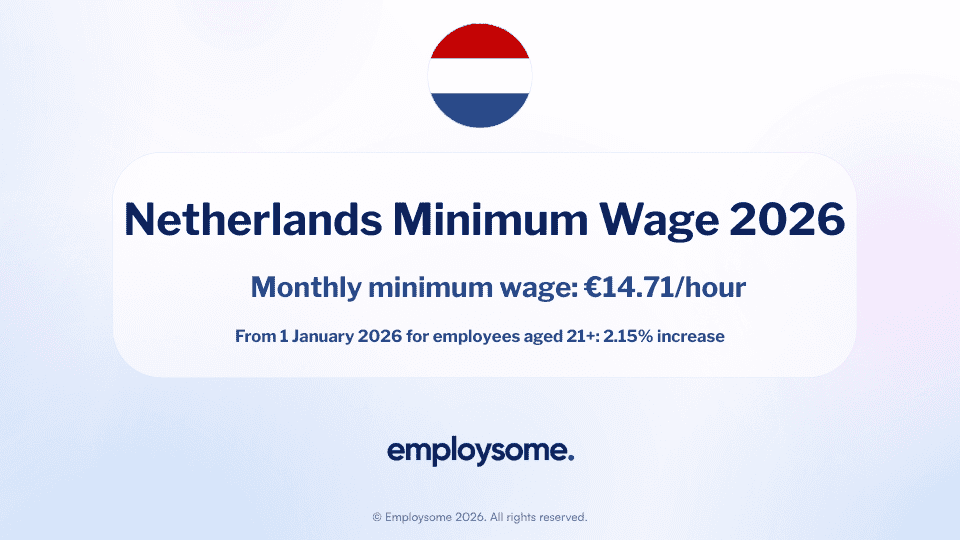
Table of Contents
- Minimum Wage Rate: January 2026
- Youth Minimum Wage Rates (Ages 15-20)
- How the Dutch Minimum Wage System Works
- Employer Costs: Social Security and Payroll Contributions
- Worked Example: Total Employer Cost for a Minimum Wage Employee
- Income Tax Brackets (2026)
- The 30% Ruling for Expat Workers
- False Self-Employment: The VBAR Act (From 1 July 2026)
- Collective Labour Agreements (CAOs)
- European Minimum Wage Comparison
- Minimum Wage History: 2020 to 2026
- Penalties for Non-Compliance
- FAQs
The minimum wage in the Netherlands is €14.71 per hour from 1 January 2026 for employees aged 21 and over, a 2.15% increase from the previous rate of €14.40 (H2 2025). This places the Netherlands third in the EU for minimum wage levels, behind Luxembourg and Ireland.
Since 1 January 2024, the Dutch minimum wage system has been purely hourly. There is no longer a fixed monthly, weekly, or daily minimum wage. Monthly earnings depend entirely on the number of hours worked, which means the same employee can receive different gross pay in months with different numbers of working days. This was a fundamental shift in how Dutch payroll works, and employers must ensure their systems calculate pay on an hourly basis rather than relying on fixed monthly amounts.
For international companies hiring in the Netherlands, the minimum wage is just the starting point. Employer social security contributions add approximately 18 to 22% on top of gross pay, the mandatory 8% holiday allowance (vakantiegeld) effectively increases total compensation further, and collective labour agreements (CAOs) in many sectors set minimums well above the statutory floor. The Netherlands is one of the most regulated employment markets in Europe, and payroll compliance errors are actively enforced.

Minimum Wage Rate: January 2026
|
Metric |
Value (H1 2026) |
|
Hourly minimum wage (age 21+) |
€14.71 gross |
|
Increase from H2 2025 |
+2.15% (from €14.40) |
|
Monthly equivalent (40-hour week) |
~€2,549.73 gross (varies by month) |
|
Monthly equivalent (38-hour week) |
~€2,422.24 gross (varies by month) |
|
Monthly equivalent (36-hour week) |
~€2,294.76 gross (varies by month) |
|
Holiday allowance (vakantiegeld) |
8% of gross salary (mandatory, paid separately) |
|
Total minimum compensation (incl. holiday allowance) |
€15.89/hour effective |
|
Adjustment frequency |
Twice per year: 1 January and 1 July |
|
Next adjustment |
1 July 2026 (rate not yet announced) |
The minimum wage applies to all employees aged 21 and over, regardless of nationality, contract type (permanent, temporary, or agency), or whether they work full-time or part-time. Part-time employees receive the same hourly rate; only their total hours differ.
💡 Employsome Insight: The 8% Holiday Allowance Is on Top, Not Included
A common mistake by international employers is assuming that €14.71/hour is the total cost of minimum wage labour. It is not. Dutch law requires employers to pay an additional 8% holiday allowance (vakantiegeld) on top of gross salary. This is typically accumulated monthly and paid out as a lump sum in May or June, though some contracts spread it across 12 months. The true minimum compensation is therefore €15.89/hour (€14.71 + 8%), and this must be reflected in your payroll budget.
Youth Minimum Wage Rates (Ages 15-20)
Employees under 21 receive a reduced minimum wage, calculated as a percentage of the adult rate. The youth rates for H1 2026 are:
|
Age |
% of Adult Rate |
Hourly Rate (H1 2026) |
|
21 and over |
100% |
€14.71 |
|
20 years |
80% |
€11.77 |
|
19 years |
60% |
€8.83 |
|
18 years |
50% |
€7.36 |
|
17 years |
39.5% |
€5.81 |
|
16 years |
34.5% |
€5.07 |
|
15 years |
30% |
€4.41 |
MBO (secondary vocational education) students working as part of a practical learning pathway (BBL) have separate minimum wage rates, which are generally lower than the standard youth rates. Employers in sectors with significant youth employment (retail, hospitality, logistics) should verify the applicable rate for each employee.
How the Dutch Minimum Wage System Works
The Dutch minimum wage is governed by the Minimum Wage and Minimum Holiday Allowance Act (Wet minimumloon en minimumvakantiebijslag, or WML). Key features of the system:
Hourly-only since 2024: From 1 January 2024, the minimum wage is defined exclusively as an hourly rate. The previous system of monthly/weekly/daily rates was abolished. Monthly gross pay now depends entirely on the number of hours in the employee’s contract multiplied by the hourly rate, which means pay varies between months.
Twice-yearly adjustment: The minimum wage is reviewed and adjusted on 1 January and 1 July each year, based on changes in collective agreement (CAO) wages as calculated by Statistics Netherlands (CBS). Employers must update payroll systems for each adjustment.
Inclusive definition: The minimum wage includes the basic wage plus compensation for overtime, supplements, and tips. However, it excludes holiday allowance (8%), profit-sharing, special benefits, and expense reimbursements. The total of basic wage plus these inclusions must meet or exceed the statutory minimum.
Payslip requirement: Employers must show the applicable hourly minimum wage on the employee’s payslip. This has been mandatory since the hourly system was introduced.
Employer Costs: Social Security and Payroll Contributions
The minimum wage is the employee’s gross pay. On top of this, employers must pay significant social security contributions and other mandatory costs. Total employer costs typically add 18 to 22% above gross salary.
Employer-Paid Contributions
|
Contribution |
Rate (2026) |
Paid By |
|
WW (Unemployment Insurance) – low rate (permanent contract) |
2.64% |
Employer |
|
WW – high rate (flexible/temp contract) |
7.64% |
Employer |
|
WIA/WAO (Disability Insurance) – basic |
6.27% or 7.63% |
Employer |
|
WHK (Return-to-Work Fund) |
~0.38% to 6.08% (varies) |
Employer |
|
ZVW (Health Insurance – income-related) |
6.10% |
Employer |
|
Total employer contributions (approx.) |
~18% to 22% |
Employer |
Employee-Paid Contributions (Deducted from Gross)
|
Contribution |
Rate (2026) |
Notes |
|
AOW (Old Age Pension) |
17.90% |
On income up to €38,883 |
|
ANW (Survivor Benefits) |
0.10% |
On income up to €38,883 |
|
WLZ (Long-Term Care) |
9.65% |
On income up to €38,883 |
|
Total national insurance |
27.65% |
Capped at €10,751/year |
The maximum income for employee insurance contributions is €79,412 per year in 2026 (up from €75,864 in 2025). Above this cap, no further employer contributions are due. For minimum wage workers, the cap is not relevant, but it matters for salary planning of higher-paid employees.
💡 Employsome Insight: The WW Rate Difference Between Permanent and Flexible Contracts Is Huge
Employers pay 2.64% WW (unemployment insurance) for employees on permanent contracts but 7.64% for employees on flexible or temporary contracts. That is a 5 percentage point difference that directly incentivises permanent hiring and penalises flexible arrangements. For companies using temp workers or short-term contracts, this premium is a meaningful payroll cost. It also affects EOR arrangements: if the EOR classifies the employee on a temporary contract, the higher WW rate applies, increasing your invoiced cost.
Worked Example: Total Employer Cost for a Minimum Wage Employee
|
Component |
Monthly Amount (€) (40hr/week) |
|
Gross salary (€14.71 x avg. 173.33 hrs) |
€2,549.73 |
|
Holiday allowance (8%) |
€203.98 (accrued monthly) |
|
Employer social security (~20% avg.) |
~€509.95 |
|
Total monthly employer cost (approx.) |
~€3,263.66 |
|
Annual employer cost (approx.) |
~€39,164 |
This calculation does not include pension contributions (which are mandatory under many CAOs), training costs, or the work-related expenses scheme (WKR). Many sectors require employer pension contributions of 5 to 15% on top of the above, which can push total employer costs to 30%+ above gross salary.
Income Tax Brackets (2026)
Dutch income tax and national insurance contributions are combined into a single tax in the first bracket. The 2026 brackets are:
|
Taxable Income |
Combined Rate (2026) |
|
Up to €38,883 |
35.70% (incl. national insurance) |
|
€38,883 to €79,137 |
37.56% |
|
Over €79,137 |
49.50% |
A minimum wage worker earning approximately €30,600 gross per year (40 hours/week) falls entirely within bracket 1 at 35.70%. However, after applying the general tax credit (algemene heffingskorting) and employed person’s tax credit (arbeidskorting), the effective tax rate is significantly lower. Minimum wage workers typically take home approximately 90% of gross pay after all deductions and credits.
The 30% Ruling for Expat Workers
The Netherlands offers one of Europe’s most attractive tax incentives for highly skilled foreign workers: the 30% ruling (30%-regeling). Under this scheme, qualifying expat employees can receive up to 30% of their gross salary tax-free as a reimbursement for extraterritorial costs. This effectively reduces their taxable income by 30%.
The 30% ruling is confirmed to remain at 30% for 2025 and 2026. However, the option for beneficiaries to choose partial foreign taxpayer status is being abolished from 1 January 2025 (with transitional rules for those already benefiting as of 31 December 2023, who retain the status until 31 December 2026).
To qualify, the employee must be recruited from abroad (or transferred), possess specific expertise that is scarce in the Dutch labour market, and meet minimum salary thresholds. For 2026, the minimum salary criterion for highly skilled migrants is adjusted in line with the minimum wage increase. The 30% ruling is not relevant for minimum wage workers (the salary thresholds are much higher), but it is important context for international companies hiring both junior and senior roles in the Netherlands.
False Self-Employment: The VBAR Act (From 1 July 2026)
The Netherlands is cracking down aggressively on false self-employment (schijnzelfstandigheid). Two major developments affect employers in 2026:
Enforcement resumed (2025): The moratorium on enforcement under the DBA Act (Deregulering Beoordeling Arbeidsrelaties) ended in 2025. The Tax and Customs Administration (Belastingdienst) is now actively investigating and can impose retroactive wage tax assessments back to 1 January 2025. In cases of intent or gross negligence, penalties apply immediately. The soft landing period ends completely on 1 January 2027.
VBAR Act (1 July 2026): The new Verduidelijking Beoordeling Arbeidsrelaties en Rechtsvermoeden (VBAR) Act introduces clearer rules for assessing whether a working relationship is employment or self-employment. Critically, it creates a legal presumption of employment for any engagement where the hourly rate is below €36. For rates above €36, a holistic assessment considers authority, integration into the organisation, and entrepreneurship.
💡 Employsome Insight: The €36/Hour Threshold Changes Everything for Contractors
From 1 July 2026, if you engage a contractor in the Netherlands at a rate below €36/hour, there is a legal presumption that the relationship is employment, not self-employment. The burden of proof shifts to the engaging company to demonstrate otherwise. For international companies that use contractors in the Netherlands, this means either increasing rates above €36, converting contractors to employees (through an EOR or your own entity), or accepting significant compliance risk. The €36 threshold is approximately 2.4 times the minimum wage, which means a large portion of the contractor population is affected.
Collective Labour Agreements (CAOs)
In the Netherlands, collective labour agreements (collectieve arbeidsovereenkomsten, or CAOs) play a much larger role than in many other countries. Approximately 80% of Dutch employees are covered by a CAO, and many CAOs set minimum wages significantly above the statutory floor. CAOs also govern pension contributions, overtime rates, shift allowances, notice periods, and other employment conditions.
If a CAO has been declared universally binding (algemeen verbindend verklaard, or AVV) by the Ministry of Social Affairs, all employers in that sector must comply, regardless of whether they are a member of the employers’ association that negotiated the agreement. International companies hiring through an EOR should verify which CAO applies to their employees’ roles, as the EOR’s compliance obligations depend on correct CAO classification.
From 1 January 2026, a new CAO for temporary workers (ABU/NBBU) requires agency and temporary workers to receive truly equal compensation compared to permanent employees, including bonuses, extra vacation days, training budgets, and enhanced pension rights. This is a significant change that increases costs for companies relying heavily on temporary staffing.
European Minimum Wage Comparison
|
Country |
Hourly Min. Wage |
Monthly (40hr) |
Employer SI Rate |
Holiday Allowance |
|
Luxembourg |
~€14.86 |
~€2,571 |
~12-15% |
No statutory |
|
Ireland |
~€14.20 |
~€2,460 |
~11.05% |
No statutory |
|
Netherlands |
€14.71 |
~€2,550 |
~18-22% |
8% mandatory |
|
Germany |
~€12.82 |
~€2,222 |
~20-21% |
No statutory |
|
Belgium |
~€13.22 |
~€2,070 |
~25-27% |
Varies by sector |
|
France |
~€11.88 |
~€1,802 |
~25-42% |
10% (paid leave) |
|
Spain |
~€8.87 |
~€1,221 (14 pay) |
~30-32% |
Included in 14 payments |
|
Poland |
~€6.48 |
~€1,066 |
~20% |
No statutory |
The Netherlands has the third-highest minimum wage in the EU. However, when you add the mandatory 8% holiday allowance and employer social security contributions of 18 to 22%, the total employer cost for a minimum wage worker in the Netherlands is comparable to or higher than Germany and Belgium. The Netherlands is not a low-cost labour market.
Minimum Wage History: 2020 to 2026
|
Period |
Rate |
Notes |
|
H1 2020 |
€1,653.60/month |
Monthly system |
|
H1 2022 |
€1,725.00/month |
Monthly system |
|
H1 2023 |
€1,934.40/month |
10.15% increase + age lowered to 21 |
|
H1 2024 |
€13.27/hour |
Switch to hourly system |
|
H2 2024 |
€13.68/hour |
+3.1% |
|
H1 2025 |
€14.06/hour |
+2.8% |
|
H2 2025 |
€14.40/hour |
+2.4% |
|
H1 2026 |
€14.71/hour |
+2.15% |
The minimum wage has increased by approximately 30% since 2020, driven by the switch to the hourly system, the reduction of the adult age threshold from 23 to 21, and general wage growth. The twice-yearly adjustment mechanism means employers must update payroll systems every six months.
Penalties for Non-Compliance
The Dutch Labour Inspectorate (Nederlandse Arbeidsinspectie) actively enforces minimum wage compliance. Penalties for violations include fines of up to €10,400 per employee per violation for first offences, doubled for repeat offences, and potential criminal prosecution for persistent or deliberate underpayment. The employer’s name may be published in the public register of labour violations (naming and shaming).
Since 2024, the requirement to show the applicable minimum hourly wage on each payslip means inspectors can immediately identify underpayment from payroll records. International companies using payroll providers or EORs should verify that payslips comply with this requirement.
💡 Hiring in the Netherlands?
Compare the best EOR providers for the Netherlands on Employsome. We score each provider on entity ownership, Dutch labour law compliance, CAO handling, payroll accuracy, and the 30% ruling administration so you can hire compliantly without setting up a Dutch entity. Visit Best EORs in Netherlands Guide to see the full comparison.
Frequently Asked Questions
€14.71 per hour gross for employees aged 21 and over, from 1 January 2026. This excludes the mandatory 8% holiday allowance, which brings effective minimum compensation to €15.89/hour.
No. Since 1 January 2024, the Netherlands has only an hourly minimum wage. Monthly pay depends on the number of hours worked. For a 40-hour week, the approximate monthly gross is €2,549.73, but this varies between months.
Approximately 18 to 22% in employer social security contributions, plus the 8% holiday allowance. Total employer cost for a full-time minimum wage employee is approximately €3,200 to €3,300 per month, or around €39,000 per year.
A tax incentive for highly skilled foreign workers recruited from abroad. Up to 30% of gross salary can be paid tax-free. It remains at 30% for 2025 and 2026 but is not relevant for minimum wage roles (the salary threshold is much higher).
The VBAR Act (effective 1 July 2026) introduces clearer rules for determining whether a working relationship is employment or self-employment. It creates a legal presumption of employment for rates below €36/hour. This significantly affects companies engaging contractors in the Netherlands.
Yes. An Employer of Record in the Netherlands handles employment contracts, payroll processing, minimum wage compliance, holiday allowance, social security contributions, CAO classification, and statutory reporting. This removes the compliance burden from the foreign company.

Written by
Christa is a Copywriter at Employsome with 17 years of professional writing experience across global brands, startups, and online publications. A native English-Finnish writer, she brings strong editorial skills and a versatile background in business, SaaS, and finance. At Employsome, Christa focuses on clear, practical content about HR, payroll, and Employer of Record topics.
Our content is created for informational purposes only and is not intended to provide any legal, tax, accounting, or financial advice. Please obtain separate advice from industry-specific professionals who may better understand your business’s needs. Read our Editorial Guidelines for further information on how our content is created.
Other posts
Review all blog posts