Minimum Wage in Brazil (2026): Rate & Employer Costs
Brazil’s federal minimum wage is R$1,621 per month (R$7.37/hour) from 1 January 2026, a 6.79% increase under Decree 12.797/2025. Five states set higher rates, with Paran\u00E1 reaching R$2,408 for technical workers. Total employer cost adds approximately 47% on top of gross salary once INSS (20%), FGTS (8%), work accident insurance, third-party contributions, the mandatory 13th month salary, and vacation bonus are included. The wage is adjusted annually using a formula tied to INPC inflation plus capped GDP growth, making increases predictable at 5 to 8% per year.

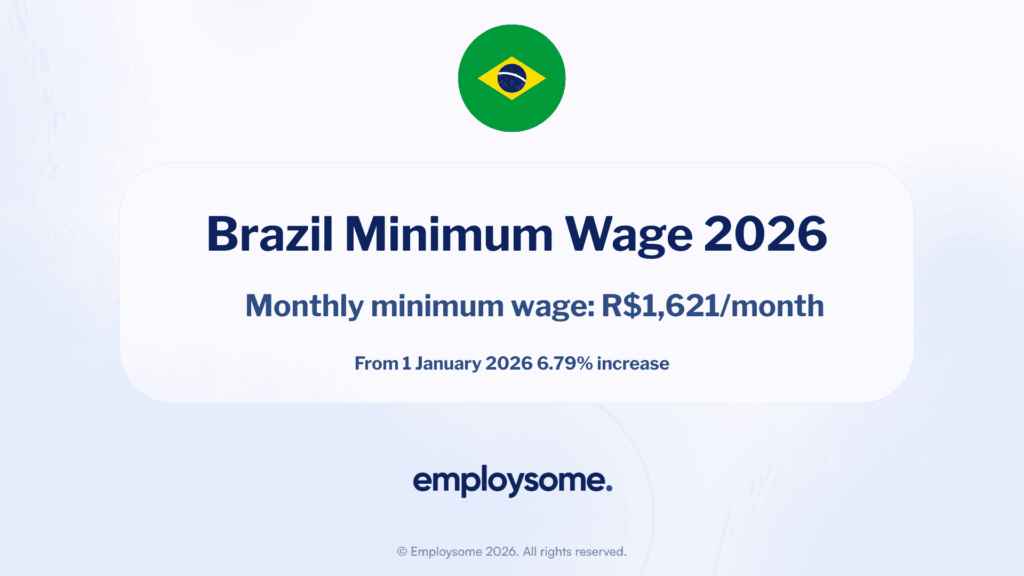
Table of Contents
Brazil’s federal minimum wage (salário mínimo) increased to R$1,621.00 per month from 1 January 2026 under Decree 12.797/2025, a 6.79% increase over the 2025 rate of R$1,518.00. In US dollar terms, this is approximately $295 to $325 per month depending on exchange rates.
The minimum wage in Brazil is far more than just a paycheck floor. It serves as a national reference price that directly or indirectly affects the income of approximately 61.9 million Brazilians, according to DIEESE (the Inter-Union Department of Statistics and Socio-Economic Studies). Pensions, social security benefits, and many collective bargaining agreements are indexed to it, meaning a change at the floor ripples through the entire economy.
For employers hiring in Brazil, whether through a local entity or an Employer of Record, understanding the minimum wage is essential because it determines not only base pay but also the calculation base for mandatory employer contributions that can add 28 to 30% or more on top of gross salary.
💡 Employsome Insight: Brazil’s Total Employment Cost Is Much Higher Than the Headline Salary
The R$1,621 minimum wage is just the starting point. Once you add the mandatory 13th month salary, vacation bonus (one third of monthly salary), FGTS (8%), INSS employer contribution (20%), and other statutory charges, total employer costs can reach 70 to 100% above the base salary for minimum wage workers. If you are using an EOR in Brazil, make sure the quoted fee includes all of these components. Some providers quote base salary only and bill statutory costs separately.

Current Minimum Wage in Brazil (2026)
|
Rate |
Amount (2026) |
|
Monthly minimum wage |
R$1,621.00 |
|
Daily minimum wage |
R$54.04 |
|
Hourly minimum wage |
R$7.37 |
|
Annual (12 months + 13th month) |
R$21,073.00 |
|
Approximate USD equivalent (monthly) |
$295 to $325 |
|
Increase vs. 2025 |
R$103 (+6.79%) |
|
Effective date |
1 January 2026 (Decree 12.797/2025) |
The minimum wage applies to all employees working under the CLT (Consolidação das Leis do Trabalho) framework, which governs formal employment contracts in Brazil. It covers full-time, part-time, and fixed-term employees regardless of sector, nationality, or region, unless a state-level or collective bargaining agreement sets a higher rate.
How the Minimum Wage Is Calculated
Since 2023, Brazil has followed a rules-based formula for annual minimum wage adjustments:
Step 1: Inflation adjustment. The minimum wage is increased by the INPC (National Consumer Price Index) for the 12 months through November of the preceding year. For 2026, the INPC input was 4.18%.
Step 2: Real GDP growth share. A share of real GDP growth from two years prior is added on top of inflation. For 2026, the GDP input was 2024 growth of 3.4%.
Step 3: Fiscal cap. Under the current fiscal framework, the real increase (above inflation) is capped at 2.5%. This cap limits the pass-through of strong economic growth to the wage floor, prioritising budget discipline.
The result: INPC of 4.18% plus a capped real increase of 2.5% produced the 6.79% nominal increase, bringing the minimum wage from R$1,518 to R$1,621. The rounding (from the calculated R$1,620.99) is provided for by law.
💡 Employsome Insight: The Formula Means Predictable Annual Increases
Because Brazil’s minimum wage is tied to a transparent formula (inflation + GDP growth, capped at 2.5% real), employers can reasonably forecast annual increases. For budgeting purposes, expect nominal increases of 5 to 8% per year for the foreseeable future, assuming inflation stays in the 3 to 5% range and GDP growth remains positive. Build this into your multi-year employment cost models when hiring in Brazil.
State-Level Minimum Wages
While the federal minimum wage of R$1,621 applies nationwide, five Brazilian states maintain their own regional minimum wages, which must be equal to or higher than the federal rate. These state rates often vary by occupational category.
|
State |
Minimum Wage Range (2026) |
Notes |
|
São Paulo |
R$1,804.00 |
Set in July 2025. 16.1% above federal rate. Single rate for all categories. |
|
Paraná |
R$2,105.34 to R$2,407.90 |
Highest regional range in Brazil. Four occupational groups under CETER Resolution 632/2026. |
|
Rio Grande do Sul |
R$1,789.04 to R$2,099.27 |
Five salary brackets by occupation (2025 rates, pending 2026 update). |
|
Santa Catarina |
R$1,730.00 to R$1,978.00 |
Two groups: agricultural/domestic (Group I) and industry/commerce (Group II). |
|
Rio de Janeiro |
R$1,621.00 (follows federal rate) |
In 2026, Rio de Janeiro follows the national rate instead of setting an independent state rate. |
Employers must apply whichever rate is higher: the federal minimum wage, the state minimum wage, or the minimum set by the applicable collective bargaining agreement (CBA) for the employee’s sector. In practice, many CBAs set sector-specific floors that exceed both the federal and state minimums.
💡 Employsome Insight: Always Check the CBA, Not Just the Federal Rate
Brazil has an extensive system of collective bargaining agreements that set sector-specific minimum wages, benefits, and working conditions. A CBA for the technology sector in São Paulo, for example, may set a minimum salary significantly higher than the state minimum of R$1,804. Before hiring in any sector, your EOR or legal advisor should identify the applicable CBA (convenção coletiva de trabalho) and confirm the correct minimum for the role.
Employer Costs on Top of the Minimum Wage
Brazil is one of the most expensive countries in the world for employer-side mandatory contributions. On top of the gross salary, employers must pay into social security (INSS), the severance fund (FGTS), and several other statutory charges. The total employer burden typically adds 28 to 30% or more to the base salary, before factoring in the 13th month salary and vacation bonus.
|
Contribution |
Employer Rate |
Notes |
|
INSS (Social Security) |
20% |
Funds pensions, healthcare, maternity, disability. Some sectors pay 1 to 3% additional for work accident insurance (RAT). |
|
FGTS (Severance Fund) |
8% |
Monthly deposit to employee’s individual account. Paid out on dismissal without cause, retirement, or housing purchase. |
|
Work Accident Insurance (RAT/SAT) |
1% to 3% |
Rate depends on industry risk classification. |
|
Third-party contributions (Sistema S: SENAI, SESI, SENAC, SESC, SEBRAE, INCRA) |
~3.3% to 5.8% |
Funds sectoral training and welfare programmes. Rate varies by sector. |
|
Education salary (salário-educação) |
2.5% |
Funds public education. |
|
Total employer contributions (approx.) |
~28 to 36% |
Varies by sector, risk classification, and applicable CBA. |
Worked Example: Employee Earning the Federal Minimum Wage
|
Cost Component |
Monthly Amount (R$) |
|
Gross salary |
1,621.00 |
|
INSS employer (20%) |
324.20 |
|
FGTS (8%) |
129.68 |
|
RAT (average 2%) |
32.42 |
|
Third-party + education salary (~5.8%) |
94.02 |
|
Total monthly employer cost |
~2,201.32 (~R$580 above salary) |
|
13th month salary (amortised monthly) |
135.08 |
|
Vacation bonus (1/3 of salary, amortised monthly) |
45.03 |
|
Total annualised monthly cost |
~2,381.43 |
For a minimum wage employee, the total annualised employer cost is approximately R$2,381 per month, which is roughly 47% above the gross salary of R$1,621. For higher-paid employees, the percentage burden decreases slightly because some contributions are capped, but the absolute cost remains significant.
Employee Deductions
Employees also contribute to INSS through progressive payroll deductions:
|
Monthly Salary Bracket (R$) |
INSS Employee Rate |
|
Up to 1,518.00 |
7.5% |
|
1,518.01 to 2,793.88 |
9% |
|
2,793.89 to 4,190.83 |
12% |
|
4,190.84 to 8,157.41 |
14% |
These rates are applied progressively (each bracket applies only to the portion of salary within that range). The maximum employee INSS contribution is capped at approximately R$951.63 per month. On top of INSS, employees are subject to income tax (IRRF) withholding at progressive rates from 0% to 27.5%, with an exemption threshold of R$2,428.80 per month as of May 2025.
For a minimum wage earner at R$1,621, the INSS deduction is approximately R$130 (7.5% on the first R$1,518 + 9% on the remaining R$103), and no income tax applies because the salary falls below the exemption threshold.
13th Month Salary and Vacation Bonus
Brazil mandates two additional payments that significantly increase total annual compensation:
13th month salary (Gratificação de Natal): An annual bonus equal to one month’s salary, paid in two instalments. The first instalment must be paid between 1 February and 30 November (free of INSS deductions), and the second by 20 December (with INSS and tax withholding applied). This is mandatory for all CLT employees.
Vacation bonus (terço de férias): When an employee takes their annual 30-day vacation, the employer must pay an additional one third of the monthly salary as a vacation bonus. This is constitutionally guaranteed and cannot be waived.
Together, the 13th month and vacation bonus add approximately 1.33 months of salary to the annual cost. For a minimum wage worker, that is an additional R$2,161 per year (R$1,621 for the 13th month + R$540 for the vacation bonus).
💡 Employsome Insight: The 13th Month Salary Affects Your Cash Flow
Unlike countries where the 13th month is optional or cultural, in Brazil it is a strict legal obligation with fixed payment deadlines. Missing the 30 November or 20 December instalment deadlines triggers fines and interest. If you are hiring through an EOR, most providers spread this cost across 12 monthly invoices to smooth your cash flow. Confirm whether your EOR handles it this way or bills it as a lump sum in November/December.
Working Hours and Overtime
Under the CLT, the standard working week is 44 hours (8 hours per day, Monday to Friday, plus 4 hours on Saturday) or 8 hours per day across a 5-day week if agreed by CBA or company policy. Many professional roles operate a 40-hour week.
Overtime is paid at the following rates:
|
Type of Overtime |
Rate |
|
Regular overtime (weekdays) |
150% of normal hourly rate (50% premium) |
|
Sundays and public holidays |
200% of normal hourly rate (100% premium) |
|
Night work (10pm to 5am) |
120% of normal rate (20% premium), with reduced hour (52.5 minutes = 1 hour) |
Overtime is limited to 2 hours per day unless otherwise provided by a CBA. Employers must maintain accurate time records for all employees, and the Ministry of Labour actively enforces overtime compliance.
Penalties for Non-Compliance
Paying below the minimum wage in Brazil is a serious violation. The Ministry of Labour (Ministério do Trabalho e Emprego) conducts workplace inspections and audits, with enforcement expected to intensify in 2026 particularly for domestic workers, construction, and outsourced services.
Penalties include fines per employee affected (amounts vary by the severity and number of violations), back-payment of the salary difference plus interest and monetary correction, potential criminal liability in cases of systematic underpayment, and labour court lawsuits (Brazil’s labour courts process over 2 million cases per year, many involving wage disputes).
Additionally, failure to correctly deposit FGTS or INSS contributions on time triggers interest, penalties, and in severe cases, suspension of the company’s ability to issue tax invoices.
💡 Employsome Insight: Brazil’s Labour Courts Are Extremely Active
Brazil has one of the most litigious labour environments in the world, with over 2 million lawsuits filed annually. Disputes over minimum wage, overtime, 13th month salary, and FGTS are among the most common claims. For international companies without deep local expertise, using an EOR that assumes employer liability significantly reduces exposure to these claims. When evaluating EOR providers for Brazil, ask specifically about their track record with labour court disputes.
Historical Minimum Wage Trend
|
Year |
Monthly Rate (R$) |
Increase (%) |
Approximate USD |
|
2020 |
1,045.00 |
4.7% |
~$195 |
|
2021 |
1,100.00 |
5.3% |
~$200 |
|
2022 |
1,212.00 |
10.2% |
~$230 |
|
2023 |
1,320.00 |
8.9% |
~$260 |
|
2024 |
1,412.00 |
7.0% |
~$270 |
|
2025 |
1,518.00 |
7.5% |
~$285 |
|
2026 |
1,621.00 |
6.79% |
~$300 |
Over the past six years, Brazil’s minimum wage has increased by approximately 55% in nominal terms (from R$1,045 in 2020 to R$1,621 in 2026). In real terms (adjusted for inflation), the increases have been more modest due to the high-inflation environment, but the current formula-based policy ensures workers receive at least partial real wage gains when the economy grows.
Hiring in Brazil?
Compare the best EOR providers for Brazil on Employsome. We score each provider on entity ownership, local compliance expertise, payroll accuracy, and pricing transparency so you can hire compliantly without setting up a Brazilian entity. Visit our Brazil Ranking to see the full comparison.
Frequently Asked Questions
The federal minimum wage is R$1,621.00 per month (R$54.04/day, R$7.37/hour) effective 1 January 2026 under Decree 12.797/2025. This is a 6.79% increase over 2025.
Yes. Five states maintain regional minimum wages above the federal rate: São Paulo (R$1,804), Paraná (R$2,105 to R$2,408 by category), Rio Grande do Sul (R$1,789 to R$2,099 by category), and Santa Catarina (R$1,730 to R$1,978). Rio de Janeiro follows the federal rate in 2026.
Total monthly employer cost for a minimum wage employee is approximately R$2,381 (about 47% above the R$1,621 gross salary) when factoring in INSS (20%), FGTS (8%), work accident insurance, third-party contributions, 13th month salary, and vacation bonus.
Yes. The 13th month salary (Gratificação de Natal) is legally mandatory for all CLT employees. It equals one month’s salary and must be paid in two instalments: the first by 30 November and the second by 20 December.
The employer faces fines, back-payment with interest and monetary correction, and potential labour court litigation. Brazil’s labour courts process over 2 million cases annually, and wage disputes are among the most common claims.
Yes. An Employer of Record becomes the legal employer under the CLT and handles payroll, INSS contributions, FGTS deposits, 13th month salary, vacation bonus, and income tax withholding. Using an EOR removes the need to set up a Brazilian entity while ensuring full compliance with minimum wage and labour law obligations.

Written by
Courtney Pocock is a Copywriter & EOR/PEO Researcher at Employsome with 15+ years of experience writing for the HR, corporate, and financial sectors. She has a strong interest in global business expansion and Employer of Record / PEO topics, focusing on news that matters to business owners and decision-makers. Courtney covers industry updates, regulatory changes, and practical guides to help leaders navigate international hiring with confidence.
Our content is created for informational purposes only and is not intended to provide any legal, tax, accounting, or financial advice. Please obtain separate advice from industry-specific professionals who may better understand your business’s needs. Read our Editorial Guidelines for further information on how our content is created
Other posts
Review other blog posts