Minimum Wage in South Korea: The Complete 2026 Guide
South Korea’s minimum wage rose 2.9% to KRW 10,320 per hour on 1 January 2026, translating to KRW 2,156,880 per month for a standard 209-hour work month. But the real story in 2026 is not the wage increase. Three social insurance premiums rose simultaneously in January: national pension jumped from 9% to 9.5% (the first step toward 13% by 2033), health insurance went from 7.09% to 7.19%, and long-term care insurance increased from 12.95% to 13.14% of health premiums. Workers saw smaller paychecks even with the wage bump. This guide covers every number employers need.

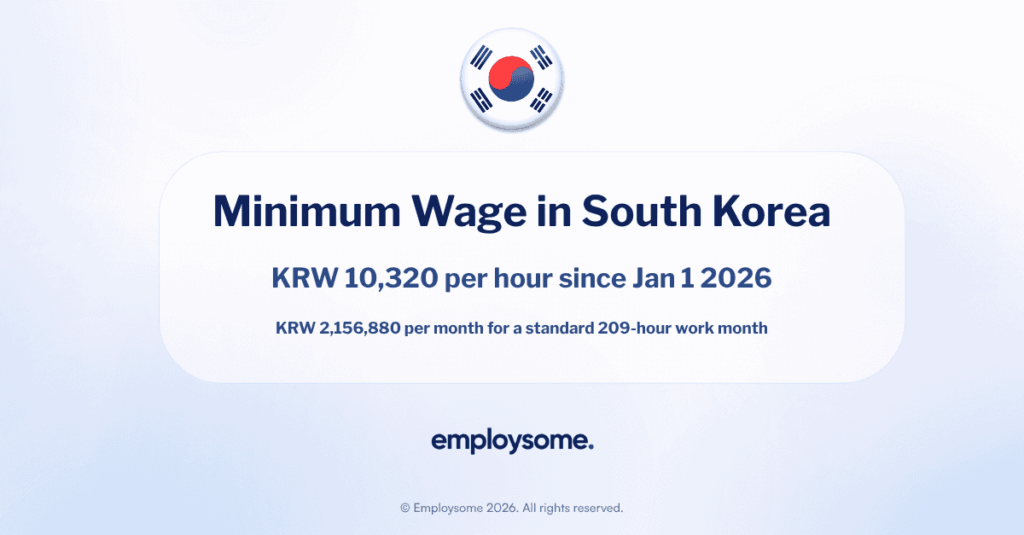
Table of Contents
- South Korea Minimum Wage 2026: The Numbers
- Minimum Wage History: 2018 to 2026
- The 2026 Pension Reform: Why Employer Costs Are Rising
- Total Employer Cost: The Four Social Insurance Contributions
- Severance: Korea’s Hidden 8.3%
- Employee Income Tax
- Working Hours, Overtime, and Leave
- How South Korea Compares in East Asia
- FAQs
South Korea’s minimum wage for 2026 is KRW 10,320 per hour. Based on a standard 209-hour work month (40 hours per week plus paid weekly rest), that works out to KRW 2,156,880 per month (~USD 1,570). The increase of 2.9% from 2025’s KRW 10,030 was the first time since 2008 that the Minimum Wage Council reached a consensus agreement between labour, management, and public interest representatives. No drama. No walkouts. Just a number everyone could live with.
The minimum wage itself is not the interesting part of 2026. What matters more is what happened alongside it. On 1 January, three of the four major social insurance premiums increased simultaneously. The National Pension contribution rose from 9% to 9.5%, the first step in a reform that will push it to 13% by 2033. Health insurance went from 7.09% to 7.19%. Long-term care insurance climbed from 12.95% to 13.14% of health premiums. The result: even workers who got the minimum wage bump are taking home less than you would expect, because the deductions grew faster than the gross pay.
For international employers, this means the cost of hiring in South Korea is going up, not because of wage inflation, but because the social insurance system is being restructured. If you are planning multi-year headcount in Korea, the pension trajectory alone adds roughly 0.5% to employer costs every year through 2033. This guide covers the minimum wage rate, the full social insurance picture, employer costs, severance obligations, income tax, working hours, and what it takes to stay compliant.

South Korea Minimum Wage 2026: The Numbers
|
Metric |
2026 Rate |
|
Hourly minimum wage |
KRW 10,320 (~USD 7.50) |
|
Monthly minimum wage (209 hours) |
KRW 2,156,880 (~USD 1,570) |
|
Daily minimum wage (8 hours) |
KRW 82,560 (~USD 60) |
|
Annual minimum wage |
~KRW 25,882,560 (~USD 18,840) |
|
Increase from 2025 |
+KRW 290/hour (+2.9%) |
|
Workers directly affected |
~782,000 (4.5% of workforce) |
|
Regional variation |
None. Single national rate. |
|
Probation period discount |
Up to 10% reduction for first 3 months (contracts of 1 year+, non-simple labour only) |
The 209-hour monthly calculation is Korea-specific and catches international employers off guard. It includes 40 hours per week x 4.345 weeks = 173.8 hours, plus one paid weekly rest day per week (8 hours x 4.345 weeks = 34.8 hours). The paid weekly rest is mandatory under the Labour Standards Act for employees who work a full week. You pay for it even though the employee does not work. This is why Korea’s monthly minimum (KRW 2,156,880) is higher than simply multiplying the hourly rate by 160 or 174 hours.
Minimum Wage History: 2018 to 2026
|
Year |
Hourly (KRW) |
Monthly (KRW) |
YoY Change |
|
2018 |
7,530 |
1,573,770 |
+16.4% |
|
2019 |
8,350 |
1,745,150 |
+10.9% |
|
2020 |
8,590 |
1,795,310 |
+2.9% |
|
2021 |
8,720 |
1,822,480 |
+1.5% |
|
2022 |
9,160 |
1,914,440 |
+5.0% |
|
2023 |
9,620 |
2,010,580 |
+5.0% |
|
2024 |
9,860 |
2,060,740 |
+2.5% |
|
2025 |
10,030 |
2,096,270 |
+1.7% |
|
2026 |
10,320 |
2,156,880 |
+2.9% |
The Moon Jae-in era (2018 to 2019) delivered two consecutive double-digit increases that pushed the minimum wage up 29% in two years. Since then, the pace has slowed dramatically. The 2025 increase of 1.7% was the smallest on record. The 2.9% for 2026 is a modest recovery, but the IMF has flagged that large minimum wage increases in Korea tend to reduce employment 3 to 4 years later, which partially explains the government’s cautious approach.
The 2026 Pension Reform: Why Employer Costs Are Rising
The National Pension Service (NPS) reform, enacted in March 2025, is the most significant change to Korea’s social insurance system in decades. The total NPS contribution rate will increase by 0.5 percentage points per year from 2026 to 2033:
|
Year |
Total NPS Rate |
Employer Share |
Employee Share |
|
2025 |
9.0% |
4.50% |
4.50% |
|
2026 |
9.5% |
4.75% |
4.75% |
|
2027 |
10.0% |
5.00% |
5.00% |
|
2028 |
10.5% |
5.25% |
5.25% |
|
2029 |
11.0% |
5.50% |
5.50% |
|
2030 |
11.5% |
5.75% |
5.75% |
|
2031 |
12.0% |
6.00% |
6.00% |
|
2032 |
12.5% |
6.25% |
6.25% |
|
2033 |
13.0% |
6.50% |
6.50% |
For a minimum-wage employee earning KRW 2,156,880/month, the employer’s NPS contribution in 2026 is KRW 102,452 (4.75%). By 2033, that same contribution will be KRW 140,197 (6.50%), an increase of KRW 37,745/month per employee. For a team of 20, that is an additional KRW 9 million per year in pension costs alone. International companies budgeting multi-year EOR contracts need to factor this escalation in from day one.
💡 Employsome Insight: The Pension Reform Is the Real Cost Story
The 2.9% minimum wage increase gets the headlines. But the NPS reform adds 2 percentage points to total employer costs over the next 8 years, on top of whatever the minimum wage does. If you are comparing Korea against other countries for hiring, model the 2033 cost structure, not just the 2026 snapshot. At 13% total NPS, Korea’s pension burden alone will exceed Japan’s total social insurance employer share.
Total Employer Cost: The Four Social Insurance Contributions
Every employer in South Korea must enrol employees in four mandatory social insurance schemes. The costs are split between employer and employee, except for industrial accident insurance, which is 100% employer-funded.
|
Contribution (2026) |
Total Rate |
Employer |
Employee |
|
National Pension (NPS) |
9.5% |
4.75% |
4.75% |
|
National Health Insurance (NHI) |
7.19% |
~3.60% |
~3.60% |
|
Long-Term Care Insurance |
~0.94% (13.14% of NHI) |
~0.47% |
~0.47% |
|
Employment Insurance |
1.8% to 2.65% |
1.15% to 1.75% |
0.90% |
|
Industrial Accident (WCI) |
0.56% to 18.56% |
0.56% to 18.56% |
0% (employer only) |
|
Total employer (typical office) |
N/A |
~10 to 11% |
~9.7% |
For a typical office-based employer (low industrial accident risk), total employer social insurance contributions in 2026 run approximately 10 to 11% of gross salary. That is moderate by OECD standards and significantly lower than Germany (~21%), France (~25 to 42%), or Sweden (31.42%). But this does not include severance, which adds substantially.
💡 Employsome Insight: Severance Applies to Everyone, Including EOR Employees
Some international employers assume that because they are using an Employer of Record, severance is the EOR’s problem. It is not. The severance cost is factored into your EOR fees or charged separately, but it is always your cost. An employee who stays for 3 years accumulates 3 months of severance. Ask your EOR how they handle severance: do they accrue monthly, or do they charge a lump sum at termination? The answer affects your cash flow.
Employee Income Tax
South Korea uses a progressive income tax system. Tax is withheld monthly by the employer through the PAYE system:
|
Annual Taxable Income (KRW) |
Tax Rate |
|
Up to 14 million |
6% |
|
14M to 50 million |
15% |
|
50M to 88 million |
24% |
|
88M to 150 million |
35% |
|
150M to 300 million |
38% |
|
300M to 500 million |
40% |
|
500M to 1 billion |
42% |
|
Over 1 billion |
45% |
A minimum-wage worker earning KRW 25.9M annually falls into the 15% bracket, but after personal deductions and credits, the effective rate is closer to 3 to 5%. A local resident surtax of 10% of income tax also applies, which pushes the effective top marginal rate to 49.5%. Korea also taxes foreign workers, though some expatriates can elect a flat 19% rate on Korean-source employment income (without deductions) for up to 5 years, which can be advantageous for higher earners.
Working Hours, Overtime, and Leave
|
Rule |
Details |
|
Standard workweek |
40 hours (8 hours/day, 5 days/week). Paid weekly rest day (1 day) on top. |
|
Maximum overtime |
12 hours per week (employer and employee must agree in writing) |
|
Overtime premium |
50% surcharge on regular hourly rate |
|
Night work (22:00 to 06:00) |
50% surcharge (cumulative with overtime if both apply) |
|
Holiday work |
50% surcharge (100% if also overtime) |
|
Annual leave |
15 days for 1 year of service. +1 day per 2 years thereafter, max 25 days. |
|
Public holidays |
15 to 16 days per year (varies by calendar). Mandatory paid holidays since 2022 for all employers. |
|
Maternity leave |
90 days (45 days post-birth mandatory). Employer pays first 60 days; employment insurance pays remaining 30. |
|
Paternity leave |
10 days paid within 90 days of birth |
|
Severance |
30 days average wage per year of service. No cap. Applies from 1 year of continuous employment. |
|
Notice period |
30 days (or wages in lieu). Dismissal requires just cause. |
Korea’s overtime rules are strictly enforced. The 52-hour maximum workweek (40 regular + 12 overtime) has been in effect since 2018 for large firms and since 2021 for all employers with 5+ employees. Violations can result in fines or even imprisonment for the employer. This is not theoretical: labour inspections in Seoul and Gyeonggi are frequent, and the Ministry of Employment and Labor publishes enforcement data quarterly.
How South Korea Compares in East Asia
|
Country |
Min Wage (USD/mo) |
Workweek |
Employer SI |
Severance |
Pension Reform |
|
South Korea |
~$1,570 |
40 hrs + paid rest |
~10 to 11% |
30d/yr, no cap |
9.5% to 13% (2026 to 2033) |
|
Japan |
~$1,100 to 1,300 |
40 hrs |
~15 to 16% |
None (voluntary) |
Stable at 18.3% |
|
~$920 |
40 hrs |
~14 to 15% |
0.5 to 1mo/yr |
Stable at 12% |
|
|
China (Shanghai) |
~$370 |
40 hrs |
~30 to 40% |
1mo/yr |
Varies by city |
|
Vietnam (Region I) |
~$206 |
48 hrs |
~21 to 22% |
None (insurance) |
N/A |
|
No statutory |
44 hrs |
~17% (CPF) |
None |
Stable at 37% total CPF |
Korea’s minimum wage is among the highest in Asia, second only to Japan in certain prefectures and well above China, Vietnam, and most Southeast Asian markets. But Korea’s real employer cost advantage comes from relatively low social insurance contributions (10 to 11%) compared to China (30 to 40%) and Japan (15 to 16%). The severance obligation (8.3% accrual) partially offsets this, but the total package remains competitive for the quality of the workforce. For companies evaluating where to hire developers in Asia, Korea offers a strong combination of talent quality and moderate total cost.
Hiring in South Korea?
South Korea’s pension reform, simultaneous insurance premium increases, and mandatory severance make total employer cost more complex than the minimum wage headline suggests. Compare the best EOR providers for South Korea on Employsome. We score each provider on Labour Standards Act compliance, social insurance handling, severance administration, and payroll accuracy. Compare EOR providers or explore our EOR guide for South Korea to see the full rankings.
Frequently Asked Questions
KRW 10,320 per hour, which translates to KRW 2,156,880 per month based on the standard 209-hour work month (including paid weekly rest). This is approximately USD 1,570 per month.
Korea’s Labour Standards Act requires employers to pay for one weekly rest day. The calculation is: (40 work hours + 8 rest hours) x 52 weeks / 12 months = 208.67, rounded to 209 hours. This is why the monthly minimum is higher than simply multiplying the hourly rate by 160 or 174.
Employer social insurance contributions total approximately 10 to 11% of gross salary (NPS 4.75%, NHI ~3.60%, long-term care ~0.47%, employment insurance 1.15 to 1.75%, industrial accident varies). Add severance accrual of ~8.3%, and total employer cost is approximately 118 to 120% of gross salary.
The NPS contribution rate will increase by 0.5 percentage points per year from 9.5% (2026) to 13% (2033), split equally between employer and employee. This adds roughly 0.25% per year to employer costs through 2033.
Yes. After one year of continuous service, employees are entitled to at least 30 days of average wages per year of service. There is no cap. Severance applies regardless of the reason for departure, including voluntary resignation.
Yes. An EOR with a Korean entity manages employment contracts, social insurance enrolment, PAYE tax withholding, severance accrual, and compliance with the 52-hour workweek rule. Most EORs can onboard a Korean employee within 5 to 10 business days.

Written by
Courtney Pocock is a Copywriter & EOR/PEO Researcher at Employsome with 15+ years of experience writing for the HR, corporate, and financial sectors. She has a strong interest in global business expansion and Employer of Record / PEO topics, focusing on news that matters to business owners and decision-makers. Courtney covers industry updates, regulatory changes, and practical guides to help leaders navigate international hiring with confidence.
Our content is created for informational purposes only and is not intended to provide any legal, tax, accounting, or financial advice. Please obtain separate advice from industry-specific professionals who may better understand your business’s needs. Read our Editorial Guidelines for further information on how our content is created.
Other posts
Along with our standard maps we offer highly customizable maps.