Minimum Wage in Taiwan: The Complete 2026 Guide
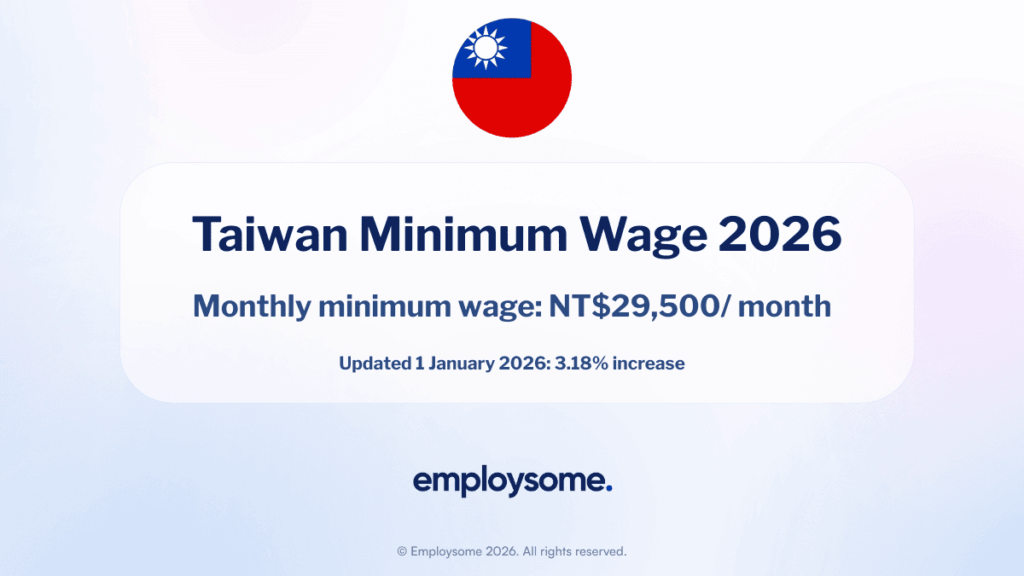
Taiwan’s minimum wage is NT$29,500 per month (approximately US$967) and NT$196 per hour as of 1 January 2026, a 3.18% increase from the previous year. This marks the 10th consecutive annual increase, reflecting the government’s sustained policy of raising wages in line with economic growth and inflation. An estimated 2.47 million workers benefit from the adjustment. Taiwan’s minimum wage is a national flat rate that applies uniformly across all industries and regions. This guide covers the current minimum wage rates, mandatory employer contributions (Labor Insurance, National Health Insurance, Labor Pension), working hours and overtime rules under the Labor Standards Act, leave entitlements, penalties for non-compliance, and what international companies hiring in Taiwan need to know.


Minimum Wage in Taiwan: Current Rates
Taiwan’s minimum wage is set through the Minimum Wage Deliberation Committee, which comprises labour representatives, employer representatives, scholars, and government officials. The Committee reviews factors including the Consumer Price Index (CPI), GDP growth, and labour productivity before recommending adjustments to the Ministry of Labor (MOL). The Executive Yuan approves the final rate. The 2026 increase was based on a CPI increase of 1.76% and GDP growth forecast of 4.45%.
|
Measure |
Rate (January 2026) |
|
Monthly minimum wage |
NT$29,500 (~US$967) |
|
Hourly minimum wage |
NT$196 (~US$6.20) |
|
Previous monthly rate (2025) |
NT$28,590 |
|
Increase |
NT$910 (3.18%) |
|
Workers benefiting |
~2.47 million (including ~2.08 million local workers) |
The minimum wage applies to all employees covered by the Labor Standards Act (LSA), regardless of industry, nationality, or region. Taiwan does not operate regional or sectoral minimum wages. The rate is the same in Taipei, Hsinchu, Taichung, Kaohsiung, and all other cities and counties.
President Lai Ching-te has signalled that the minimum wage will be raised again in 2026, with a target of exceeding NT$30,000 per month.
💡 Employsome Insight: Ten Consecutive Years of Increases
Taiwan’s minimum wage has risen every year since 2016, with the monthly rate increasing by 47.4% (from NT$20,008 to NT$29,500) and the hourly rate increasing by 63.3% (from NT$120 to NT$196) over that period. This consistent upward trajectory means international companies should build annual wage growth of 3–4% into their compensation budgets when hiring in Taiwan, even without individual performance-based raises.
Who the Minimum Wage Applies Toa
The minimum wage applies broadly under the Labor Standards Act:
- All full-time employees in firms with five or more employees in industry and commerce
- Part-time and hourly workers (at the hourly minimum of NT$196)
- Foreign workers with valid work permits
- Workers paid by hour, day, month, or piece rate (total earnings must meet the minimum)
Exemptions and Special Categories
- Domestic workers: Not covered by the Labor Standards Act and therefore not subject to the statutory minimum wage
- Certain public sector employees: Governed by separate civil service regulations
- Apprentices and trainees: May be subject to different arrangements depending on the training programme
Mandatory Employer Contributions
Taiwan’s employer contribution structure spans three main programmes: Labor Insurance, National Health Insurance, and the Labor Pension Fund. Total employer contributions are approximately 15–17% of the employee’s insured salary.
Labor Insurance (LI)
Covers disability, death, retirement pensions, maternity, and injury/sickness benefits.
- Total premium rate: ~11.5% of insured salary (including 1% employment insurance)
- Employer share: 70% of the premium (~8.05%)
- Employee share: 20% (~2.3%)
- Government subsidy: 10% (~1.15%)
- Insured salary cap: NT$45,800/month
Occupational Accident Insurance
Introduced under the Occupational Accident Insurance and Protection Act (2022), this is a separate employer-funded contribution.
- Employer rate: 0.11%–0.93% of insured salary, depending on industry risk level
National Health Insurance (NHI)
Taiwan’s universal healthcare system, providing comprehensive medical coverage for employees and their dependents.
- Total premium rate: 5.17% of insured salary
- Employer share: 60% of the premium × (1 + average dependents of 1.56) = ~4.84%
- Employee share: 30% (~1.55%)
- Government subsidy: 10%
- Insured salary cap: NT$150,000/month (for NHI calculation purposes)
- Supplementary NHI premium: 2.11% on bonus payments exceeding 4 times the monthly insured salary
Labor Pension Fund (LPP)
A mandatory defined-contribution individual pension account system.
- Employer contribution: Minimum 6% of the employee’s monthly salary (mandatory)
- Employee voluntary contribution: Up to 6% of monthly salary (tax-deductible)
- Salary cap: NT$150,000/month
From April 2026, defined-contribution pension coverage under the Labor Pension Act is extended to foreign professionals. Defined-benefit pension contributions also become mandatory for long-serving foreign manual workers.
Total Employer Cost Summary
For a minimum wage employee earning NT$29,500/month:
|
Component |
Employer Cost (NT$/month) |
|
Gross salary |
29,500 |
|
Labor Insurance (employer ~8.05%) |
~2,375 |
|
Occupational Accident Insurance (~0.2% avg) |
~59 |
|
NHI (employer ~4.84%) |
~1,428 |
|
Labor Pension Fund (6%) |
1,770 |
|
Total employer contributions |
~5,632 (~19.1%) |
|
Total monthly employer cost |
~35,132 |
Employers should budget approximately 17–20% above gross salary for mandatory statutory contributions in Taiwan, depending on industry risk classification for occupational accident insurance. This is moderate by Asian standards and comparable to South Korea (~15%) but lower than Japan (~16–17%) and significantly lower than China (~27–30%).
💡 Employsome Insight: The 6% Labor Pension Is the Largest Employer Cost
Unlike many Asian countries where health insurance dominates employer costs, Taiwan’s largest mandatory contribution is the 6% Labor Pension Fund payment. This is deposited into an individual pension account for each employee and is not pooled. For international companies, this means the pension contribution is a direct, non-recoverable cost per employee. Companies should also note that from April 2026, foreign professionals become eligible for the Labor Pension scheme, increasing the employer cost of hiring expatriates in Taiwan.
Working Hours and Overtime
Working hours in Taiwan are governed by the Labor Standards Act (LSA):
- Standard working hours: 8 hours per day, 40 hours per week
- Maximum total hours (including overtime): 12 hours per day
- Maximum overtime: 46 hours per month (can be extended to 54 hours/month with union or labour-management conference consent, capped at 138 hours over 3 months)
- Rest days: 2 days off per 7 days worked: 1 mandatory rest day (no overtime allowed except emergencies) and 1 flexible rest day (overtime permitted with premium pay)
- Break: At least 30 minutes after 4 consecutive hours of work
Overtime Rates
|
Overtime Type |
Rate |
|
First 2 hours on a regular day |
Regular rate + 1/3 (133.3%) |
|
Hours 3–4 on a regular day |
Regular rate + 2/3 (166.7%) |
|
Rest day (first 2 hours) |
Regular rate + 1 1/3 (233.3%) |
|
Rest day (hours 3–8) |
Regular rate + 1 2/3 (266.7%) |
|
Public holiday / mandatory rest day |
Double the regular daily wage (200%) |
Employers may offer compensatory leave in lieu of overtime pay with the employee’s consent, at a 1:1 ratio. The compensatory leave must be taken by the end of the calendar year in which the overtime was worked.
Leave Entitlements
Annual Leave (Special Leave)
Annual leave in Taiwan is based on length of continuous service with the same employer:
|
Length of Service |
Annual Leave Days |
|
6 months to 1 year |
3 days |
|
1 to 2 years |
7 days |
|
2 to 3 years |
10 days |
|
3 to 5 years |
14 days |
|
5 to 10 years |
15 days |
|
10+ years |
15 days + 1 day per additional year (max 30 days) |
Other Leave
- Public holidays: 16 statutory paid public holidays per year, including Lunar New Year (9-day break in 2026), Labour Day, National Day, and others
- Maternity leave: 8 weeks paid (100% salary if employed 6+ months; 50% if less than 6 months)
- Paternity leave: 7 days paid
- Sick leave: 30 days per year at 50% of regular salary. If hospitalised, up to 1 year of leave within a 2-year period
- Bereavement leave: 3–8 days depending on the relationship
💡 Employsome Insight: Taiwan’s Annual Leave Starts Low but Scales Quickly
New employees receive only 3 days of annual leave after their first 6 months, which is low by global standards. However, entitlements scale rapidly: 7 days after 1 year, 14 days after 3 years, and up to 30 days after 10+ years. International companies offering only the statutory minimum for new hires may find it competitive for entry-level roles but should consider offering above-statutory leave to attract experienced professionals in Taiwan’s tight labour market, particularly in the semiconductor and technology sectors.
Penalties for Non-Compliance
Taiwan enforces minimum wage and labour law compliance through the Ministry of Labor and local labour inspection offices:
- Minimum wage violations: Fines of NT$20,000–NT$1,000,000. Repeat offenders can face higher penalties and public disclosure of the company name.
- Overtime violations: Fines for exceeding maximum overtime hours, failing to pay overtime premiums, or not maintaining attendance records (which must be kept for 5 years and recorded to the minute).
- Labor Insurance non-compliance: Late enrollment or contribution penalties, including fines and potential criminal charges for severe non-compliance.
- NHI non-compliance: Employers who fail to enroll employees face fines and liability for the employee’s medical expenses during the unenrolled period.
Minimum Wage History in Taiwan
|
Year |
Monthly Rate (NT$) |
Hourly Rate (NT$) |
|
2016 |
20,008 |
120 |
|
2018 |
22,000 |
140 |
|
2020 |
23,800 |
158 |
|
2022 |
25,250 |
168 |
|
2024 |
27,470 |
183 |
|
2025 |
28,590 |
190 |
|
2026 |
29,500 |
196 |
The monthly minimum wage has increased by 47.4% since 2016, while the hourly rate has increased by 63.3% over the same period. The faster growth in the hourly rate reflects the government’s focus on improving conditions for part-time and gig workers.
Taiwan vs. Asia: Minimum Wage Comparison
| Country | Monthly Min. Wage | Approx. USD | Employer Burden |
| Taiwan | NT$29,500 | ~$967 | ~17–20% |
| South Korea | KRW 2,163,150 | ~$1,540 | ~15% |
| Japan (Tokyo) | ¥1,210/hr | ~$1,400 | ~16–17% |
| China (Shanghai) | CNY 2,690 | ~$370 | ~27–30% |
| Malaysia | RM 1,700 | ~$370 | ~15–20% |
| Vietnam (Region I) | VND 4,960,000 | ~$195 | ~21.5% |
Taiwan’s minimum wage sits between South Korea/Japan and the lower-cost Southeast Asian markets. The employer contribution burden of ~17–20% is moderate and comparable to South Korea and Japan. Taiwan’s advantage lies in its world-class semiconductor and technology ecosystem, strong IP protections, well-educated English-proficient workforce, and stable regulatory environment.
💡 Employsome Insight: Taiwan Offers a Unique Combination of Advanced Manufacturing and Moderate Labour Costs
While Taiwan’s minimum wage is below South Korea and Japan in absolute terms, the country’s dominance in semiconductors (TSMC, MediaTek, UMC), advanced electronics, and precision manufacturing creates a talent ecosystem that is difficult to replicate elsewhere. For international companies in the technology supply chain, Taiwan offers access to highly specialised engineering talent at salary levels that are 30–50% below equivalent roles in South Korea or Japan, with employer contribution rates that are comparable. An EOR in Taiwan handles all statutory registrations, contribution calculations, and LSA compliance.
What International Companies Need to Know
- Wages must be paid in New Taiwan Dollars (NT$). Payment must be made at least twice per month unless otherwise agreed. Employers must maintain detailed payroll records and keep attendance records for 5 years, recorded to the minute.
- The minimum wage is a national flat rate. There are no regional or industry-specific variations. The same NT$29,500 monthly rate applies in Taipei, Hsinchu, Taichung, and all other locations.
- Employer contributions total approximately 17–20% above gross. The 6% Labor Pension, ~8% Labor Insurance, and ~4.8% NHI (employer shares) create a meaningful overhead that must be factored into total compensation budgets.
- Foreign workers are now covered by the Labor Pension scheme. From April 2026, defined-contribution pension coverage extends to foreign professionals, increasing the employer cost of hiring expatriates.
- Overtime is strictly regulated. Maximum 46 hours/month (extendable to 54 with consent), 12-hour daily cap, and stepped premium rates. Attendance records must be kept to the minute for 5 years. Non-compliance attracts significant fines.
- Using an Employer of Record (EOR) is the most practical route for international companies without a Taiwanese entity. An EOR handles Labor Insurance and NHI enrollment, Labor Pension Fund contributions, LSA-compliant employment contracts, payroll in NT$, and all statutory filings with the Bureau of Labor Insurance and NHI Administration.
For a full breakdown of EOR options in Taiwan, see our Best Employer of Record in Taiwan guide.
Final Takeaway: Minimum Wage in Taiwan 2026
Taiwan’s minimum wage of NT$29,500 per month (~US$967) represents the 10th consecutive annual increase, with the government signalling a target of exceeding NT$30,000 in the near future. The national flat rate applies uniformly across all industries and regions, making compliance straightforward for international companies.
Total employer cost is approximately 17–20% above gross salary, driven primarily by the 6% Labor Pension Fund contribution, ~8% Labor Insurance, and ~4.8% NHI employer share. Working hours are capped at 40 per week with strictly regulated overtime (maximum 46 hours/month), and the LSA mandates detailed attendance records kept to the minute for 5 years.
For international companies, Taiwan offers access to one of Asia’s most skilled workforces, particularly in semiconductors, advanced manufacturing, and technology, at salary levels below South Korea and Japan with comparable employer contribution rates. Companies hiring in Taiwan without a local entity should work with an Employer of Record to handle statutory registrations, contribution calculations, and Labour Standards Act compliance.

Written by
Courtney Pocock is a Copywriter & EOR/PEO Researcher at Employsome with 15+ years of experience writing for the HR, corporate, and financial sectors. She has a strong interest in global business expansion and Employer of Record / PEO topics, focusing on news that matters to business owners and decision-makers. Courtney covers industry updates, regulatory changes, and practical guides to help leaders navigate international hiring with confidence.
Our content is created for informational purposes only and is not intended to provide any legal, tax, accounting, or financial advice. Please obtain separate advice from industry-specific professionals who may better understand your business’s needs. Read our Editorial Guidelines for further information on how our content is created
Other posts
Review other blog posts