
Minimum Wage in Turkey: The Complete 2026 Guide
The minimum wage in Turkey in 2026 is TRY 33,030 gross per month (TRY 28,075.50 net, USD 655), effective 1 January 2026 and a 27% increase from 2025. This guide covers daily and hourly equivalents, SGK social security and health insurance contributions, the income tax exemption, foreign worker salary thresholds, the wage history from 2020, and total employer cost calculations under the 2026 Law No. 7566 reforms.

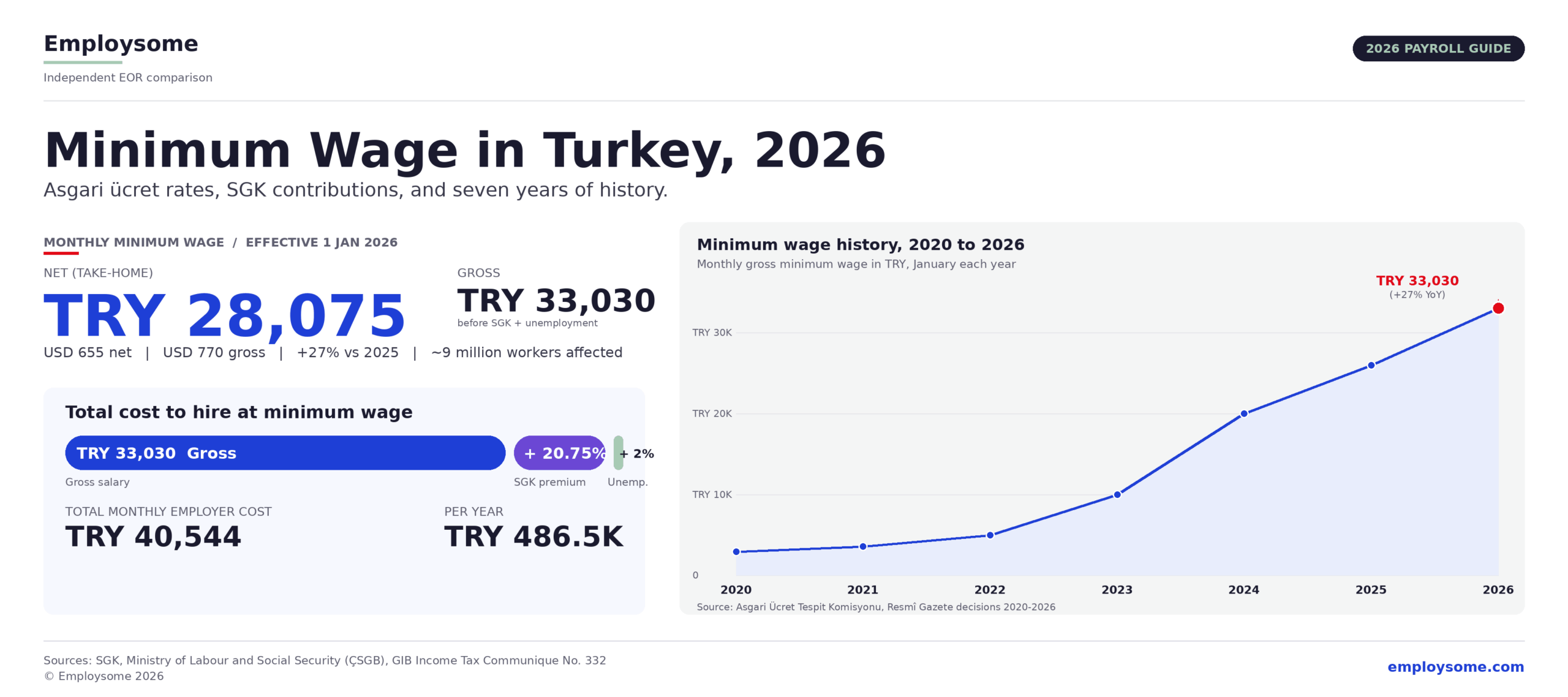
The minimum wage in Turkey in 2026 is TRY 33,030 per month gross (TRY 28,075.50 net, approximately USD 655), effective from 1 January 2026. The daily gross minimum wage is TRY 1,101, the hourly gross minimum wage is TRY 146.80, and the annual gross minimum wage is TRY 396,360. The 2026 figure represents a 27% increase from the 2025 net minimum wage of TRY 22,104, set by the Asgari Ücret Tespit Komisyonu (Minimum Wage Determination Commission) on 23 December 2025 and published in the Resmî Gazete.
The Turkish minimum wage (asgari ücret) applies to all employees regardless of age, sector, or qualification, and affects approximately 9 million workers, around one third of Turkey’s formal workforce. It serves as the base for SGK (Sosyal Güvenlik Kurumu) social security contributions, the floor for severance pay calculations, and the benchmark used by foreign workers and immigration authorities for work permit salary thresholds. A unique feature of the Turkish system is that minimum wage earnings are exempt from both income tax and stamp tax, a measure introduced in 2022 and confirmed for 2026.
This 2026 guide to the minimum wage in Turkey covers the current gross and net rates, daily and hourly equivalents, full SGK social security contribution breakdowns for employer and employee, the 2026 income tax brackets, the minimum wage tax exemption, foreign worker salary thresholds tied to the minimum wage, the wage history from 2020 to 2026, the role of the Minimum Wage Determination Commission, the recent Law No. 7566 reforms changing payroll, and what employers hiring in Turkey need to know about health insurance, payroll calculations, and total employment cost.

Minimum Wage in Turkey 2026: Current Gross and Net Rates
Effective from 1 January 2026, Turkey’s minimum wage is set as follows by the Minimum Wage Determination Commission decision dated 23 December 2025:
| Minimum Wage Indicator (2026) | Amount (TRY) | Approx. USD |
| Monthly gross minimum wage | TRY 33,030.00 | USD 770 |
| Monthly net minimum wage | TRY 28,075.50 | USD 655 |
| Daily gross minimum wage | TRY 1,101.00 | USD 25.70 |
| Hourly gross minimum wage | TRY 146.80 | USD 3.43 |
| Annual gross minimum wage | TRY 396,360.00 | USD 9,240 |
| Year-on-year increase | +27% | n/a |
| Workers affected | ~9 million (≈33% of workforce) | n/a |
| Effective date | 1 January 2026 | n/a |
| Mid-year revision possible | Yes, if CPI warrants | n/a |
Why net is meaningfully lower than gross: Although the minimum wage is fully exempt from income tax and stamp tax, employees still pay 14% to SGK social security and 1% to unemployment insurance on their gross earnings. This 15% combined deduction is what brings the gross TRY 33,030 down to a net of TRY 28,075.50.
The 2026 increase in context: The 27% rise was set against official inflation forecasts of around 31% for 2025 and a target of 16% for 2026. Critics including the Confederation of Turkish Trade Unions (Türk-İş) argued the increase fails to fully compensate for cumulative inflation since 2023, when consumer prices peaked at 75%. The government response cited fiscal discipline and inflation-targeting commitments to the Central Bank as constraints. Türk-İş boycotted the final commission talks in protest at the commission’s tripartite structure, which they argue tilts decisions in favour of employer and government interests.
Mid-year adjustment possibility: Although the 2026 minimum wage was set as a single annual figure, Turkey has a precedent of mid-year increases when inflation outpaces forecasts. In 2022, the minimum wage was raised three times in a single calendar year. Employers should monitor the Resmî Gazete in June 2026 for any potential CPI-triggered revision.
💡 Employsome Insight: Always Budget on Total Employer Cost, Not Net Pay
For accurate budgeting, always work in gross terms with full employer overhead, not net pay. A worker on minimum wage in Turkey costs the employer approximately TRY 40,512 per month after SGK premiums and unemployment insurance, before adding any allowances, severance accrual, or benefits. The gap between net pay (TRY 28,075.50) and total employer cost (TRY 40,512) is roughly 44%, which is significantly wider than many newcomers expect.
Turkish Social Security (SGK) and Health Insurance Contributions
Turkey’s SGK (Sosyal Güvenlik Kurumu, the Social Security Institution) is the central system handling pension, health insurance, work accident, unemployment, and maternity benefits. SGK contributions apply to all employees from the first day of work, calculated as a percentage of gross salary up to defined floors and ceilings. The 2026 SGK earnings ceiling has been raised from 7.5× to 9× the minimum wage under Law No. 7566, expanding the contribution base for mid and high earners.
| Contribution (2026) | Employer Rate | Employee Rate | Notes |
| SGK general health and pension premium | 20.75% (standard) / 16.75% (with 4-point incentive eligible) / 15.75% (5% manufacturing) | 14% | Employer rate cut from 4 to 2 points for non-manufacturing in 2026 |
| Unemployment insurance premium | 2% | 1% | State also contributes 1% |
| MYO occupational disease and work accident | 2.25% | 0% | Embedded in employer SGK rate; raised from 2% in 2026 |
| Total typical employer contribution | ~22.75% (standard) or 18.75% (with incentive) or 17.75% (manufacturing) | n/a | Includes SGK + unemployment + MYO |
| Total typical employee contribution | n/a | 15% | SGK 14% + unemployment 1% |
SGK earnings base limits for 2026:
- Lower earnings base: TRY 33,030/month (one-thirtieth of this figure is TRY 1,101 per day, equal to the daily minimum wage)
- Upper earnings base: TRY 297,270/month (9× the minimum wage, raised from 7.5× in 2025)
- Earnings above TRY 297,270 are not subject to additional SGK premium contributions, although they remain subject to income tax
The 4-point Treasury incentive (2-point post-2026 reform): Employers who meet specified compliance conditions (timely SGK filings, no debt to SGK, no employment law violations) qualify for a reduction in the employer share of SGK premium. Until 2025 this was a 4-point reduction (employer rate 20.75% → 16.75%); under Law No. 7566 effective 2026, the incentive is reduced to 2 points for non-manufacturing sectors (employer rate 20.75% → 18.75%). The manufacturing sector retains a 5-point reduction through the end of 2026, bringing the employer rate to 15.75% for qualifying manufacturers.
Health insurance under SGK: All workers covered by SGK are automatically enrolled in Genel Sağlık Sigortası (General Health Insurance, GSS), which provides access to public hospitals and state-funded health services. Private supplementary health insurance (özel sağlık sigortası) is offered by many employers as a benefit, with premiums up to 15% of monthly gross salary deductible from income tax under Article 63/3 of the Income Tax Law (capped at the annual gross minimum wage in aggregate).
Income Tax and the Minimum Wage Tax Exemption
A defining feature of the Turkish system since 2022 is that income earned at or below the minimum wage level is fully exempt from income tax and stamp tax. The exemption applies across the board to all employees, not just minimum wage earners: every employee benefits from a tax-free portion equal to the gross minimum wage (TRY 33,030/month in 2026), with only earnings above that threshold subject to the progressive income tax rates below.
2026 personal income tax brackets (annual):
| Annual Taxable Income (TRY) | 2026 Marginal Rate |
| Up to TRY 158,000 | 15% |
| TRY 158,001 to 330,000 | 20% |
| TRY 330,001 to 1,200,000 | 27% |
| TRY 1,200,001 to 4,300,000 | 35% |
| Above TRY 4,300,000 | 40% |
Stamp tax (damga vergisi): Wages are subject to stamp tax at 0.759% of gross earnings. As with income tax, the portion of the wage equivalent to the gross minimum wage is fully exempt from stamp tax under the Stamp Tax Law as amended by Law No. 7349 in 2022. Employees earning above the minimum wage pay stamp tax only on the excess.
Cumulative income tax tracking: Turkey operates a cumulative income tax system where the marginal rate applied each month depends on the employee’s year-to-date taxable income. This means an employee earning a constant monthly salary may see their tax bracket shift upward during the year as cumulative income crosses each bracket threshold, with later months having higher withholding. Employers must track cumulative bases per employee to apply the correct rate each payroll cycle.
Turkish Minimum Wage History: 2020 to 2026
Turkey’s minimum wage has risen substantially over the past five years, reflecting both inflation and government policy commitments. The table below tracks the gross monthly minimum wage from 2020 through 2026.
| Year (effective from January) | Monthly Gross Minimum Wage (TRY) | YoY Change |
| 2020 | TRY 2,943 | +15.0% |
| 2021 | TRY 3,577.50 | +21.6% |
| 2022 (Jan) | TRY 5,004 | +39.9% |
| 2022 (Jul, mid-year) | TRY 6,471 | +29.3% |
| 2023 (Jan) | TRY 10,008 | +54.7% |
| 2023 (Jul, mid-year) | TRY 13,414.50 | +34.0% |
| 2024 | TRY 20,002.50 | +49.1% |
| 2025 | TRY 26,005.50 | +30.0% |
| 2026 (current) | TRY 33,030 | +27.0% |
Real purchasing power decline: Despite consistent double-digit increases in nominal terms, Turkish minimum wage purchasing power has fallen significantly when measured in foreign currency. In USD terms, the gross monthly minimum wage has dropped from approximately USD 405 in 2020 to USD 770 in 2026 (after recovering from a 2024 low of USD 580), but cumulative TRY depreciation against the dollar has been so severe that real purchasing power for imported goods is materially lower today than five years ago. For employers benchmarking Turkish hires against European or US salaries, this shifts Turkey from a “low-wage” market to a “FX-volatile” market that requires periodic re-benchmarking.
Who Sets the Minimum Wage in Turkey?
Turkey’s minimum wage is set by the Asgari Ücret Tespit Komisyonu (Minimum Wage Determination Commission), a tripartite body established under Article 39 of the Turkish Labour Law (Law No. 4857). The Commission comprises five representatives each from government, employers, and labour, totalling 15 members.
Composition of the Commission:
- Government: Five representatives appointed by the Ministry of Labour and Social Security (Çalışma ve Sosyal Güvenlik Bakanlığı)
- Employers: Five representatives from the Turkish Confederation of Employer Associations (TİSK, Türkiye İşveren Sendikaları Konfederasyonu)
- Labour: Five representatives from the Confederation of Turkish Trade Unions (Türk-İş, Türkiye İşçi Sendikaları Konfederasyonu), the largest union confederation
How decisions are made: The Commission must convene at least once every two years to review the minimum wage, although in practice it has reviewed annually for the past decade and twice annually during periods of high inflation. Decisions are taken by majority vote: a quorum of at least 10 members is required, and the rate is set by the votes of those present. Decisions take effect when published in the Resmî Gazete (Official Gazette) and are binding on all employers nationwide.
2025 boycott and political backlash: Türk-İş boycotted the final 2026 wage-setting talks in December 2025, arguing that the Commission’s structure systematically disadvantages workers and that the 27% increase fails to compensate for cumulative inflation since 2023. The decision was announced by Labour Minister Vedat Işıkhan and welcomed by President Recep Tayyip Erdoğan, although it sparked widespread criticism on social media under the hashtag #AsgariÜcret. The political dynamics around minimum wage decisions are a meaningful part of the Turkish labour market context that international employers should understand.
Foreign Worker Salary Thresholds Tied to the Minimum Wage
Turkey’s 2026 minimum wage directly anchors the salary thresholds foreign nationals must meet to qualify for a Turkish work permit. The Ministry of Labour and Social Security sets these as multiples of the gross minimum wage, varying by occupation category.
| Foreign Worker Category (2026) | Minimum Gross Monthly Salary (TRY) | Multiplier |
| High-level managers, pilots | TRY 165,150 | 5× minimum wage |
| Engineers and architects | TRY 132,120 | 4× minimum wage |
| Department managers | TRY 99,090 | 3× minimum wage |
| Specialists, teachers, mid-level technical staff | TRY 66,060 | 2× minimum wage |
| Household workers, junior marketing, sales officers, other roles | TRY 33,030 | 1× minimum wage |
Important compliance notes: These thresholds exclude all benefits (housing, bonuses, allowances) and must be maintained throughout the full validity of the employee’s work permit, not just at hire. Falling below the threshold mid-permit can trigger work permit revocation. Foreign nationals who remain covered under the social security system of their home country may be exempt from Turkish SGK premiums for up to three months, extendable if a social security treaty with the home country provides for a longer period.
Total Employer Cost: Calculating a Minimum Wage Hire in Turkey
Calculating the total cost of a minimum-wage employee in Turkey involves four components: the gross salary, employer SGK and unemployment contributions, severance accrual, and the minimum wage support payment from the Treasury (where eligible).
Standard 2026 monthly cost calculation for a minimum wage employee (assuming standard non-incentive employer SGK rate):
| Cost Component | Amount (TRY) |
| Gross monthly salary | TRY 33,030.00 |
| Employer SGK general premium (20.75% standard) | TRY 6,853.73 |
| Employer unemployment insurance (2%) | TRY 660.60 |
| Stamp tax (paid by employee, not employer cost) | n/a |
| Total monthly employer cost (standard rate) | TRY 40,544.33 |
| Less: Minimum wage support (where eligible, deducted from SGK premium) | TRY 1,270.00 |
| Net employer cost after support | TRY 39,274.33 |
| With 2-point Treasury incentive (non-manufacturing eligible employer) | TRY 38,613.73 |
| With 5-point manufacturing discount (eligible manufacturer) | TRY 37,622.83 |
Net pay calculation for the employee:
- Gross monthly salary: TRY 33,030.00
- Employee SGK 14%: TRY 4,624.20
- Employee unemployment 1%: TRY 330.30
- Income tax: TRY 0 (exempt up to minimum wage level)
- Stamp tax: TRY 0 (exempt up to minimum wage level)
- Net monthly take-home: TRY 28,075.50
Severance pay accrual (kıdem tazminatı): Turkish employers accrue 30 days of gross salary per year of service as severance pay liability, payable on termination (with limited exceptions). For a minimum wage employee, this represents an additional TRY 33,030 per year in liability accrual, or roughly TRY 2,752.50 per month. The severance ceiling for higher earners is updated periodically by the Ministry of Treasury and Finance.
Minimum wage support (asgari ücret desteği): For 2026, eligible employers receive a Treasury-funded subsidy of TRY 1,270 per month per minimum wage employee (raised from TRY 1,000 in 2025), deducted directly from the SGK premium owed. Eligibility depends on workplace employee count and timely SGK declarations.
What Foreign Employers Need to Know
The 2026 minimum wage is TRY 33,030 gross / TRY 28,075.50 net per month
Effective 1 January 2026, the Turkish minimum wage rose 27% from the 2025 rate. The daily minimum is TRY 1,101, hourly TRY 146.80, and annual gross TRY 396,360. Approximately 9 million workers (33% of the formal workforce) earn at or near minimum wage.
Minimum wage earnings are exempt from income tax and stamp tax
Under reforms introduced in 2022 and continued for 2026, every employee in Turkey benefits from an income tax and stamp tax exemption equal to the gross minimum wage (TRY 33,030/month). Only earnings above this threshold are subject to progressive income tax (15% to 40%) and stamp tax (0.759%).
Total employer cost is approximately 23% on top of gross
Employer SGK premium (20.75% standard, 16.75% with 4-point incentive in manufacturing-adjacent sectors, 15.75% for manufacturing) plus 2% unemployment insurance brings the typical total employer cost to around 22.75% on top of gross salary. A minimum wage hire costs approximately TRY 40,500 per month in total, before allowances or severance accrual.
The 2026 reform under Law No. 7566 changed several SGK parameters
Key changes: SGK earnings ceiling raised from 7.5× to 9× the minimum wage (now TRY 297,270/month); MYO occupational disease premium up 1 point (employer 11% to 12%); Treasury-supported employer incentive cut from 4 points to 2 points for non-manufacturing; minimum wage support raised from TRY 1,000 to TRY 1,270 per month per eligible worker.
Foreign worker salaries are tied to multiples of the minimum wage
Work permit thresholds: 1× minimum wage (TRY 33,030) for general roles, 2× (TRY 66,060) for specialists and teachers, 3× (TRY 99,090) for department managers, 4× (TRY 132,120) for engineers and architects, 5× (TRY 165,150) for high-level managers and pilots. These must be maintained throughout the work permit’s validity, not just at hire.
Mid-year adjustment is possible but not guaranteed
Turkey raised the minimum wage twice in 2022 and 2023 in response to high inflation. While the 2026 figure is expected to hold for the full calendar year, employers should monitor the Resmî Gazete in mid-year for any CPI-triggered revision.
Consider an EOR for compliant Turkish hiring
For international companies without a Turkish entity, an Employer of Record (EOR) handles SGK registration, monthly cumulative income tax tracking, payroll declarations, severance accrual, and work permit salary threshold compliance. See our Best EOR in Turkey guide for verified provider rankings.
Hiring in Turkey?
Turkish employment requires SGK registration before the employee’s start date, monthly cumulative income tax tracking under Income Tax Communique No. 332, severance pay accrual under the Turkish Labour Law, and ongoing work permit salary threshold compliance for foreign nationals. Compare the top Employer of Record providers for Turkey in 2026 – verified pricing, compliance scores, and expert rankings from Employsome’s independent research team.
Frequently Asked Questions
The minimum wage in Turkey in 2026 is TRY 33,030 gross per month (TRY 28,075.50 net, approximately USD 655), effective from 1 January 2026. The daily gross minimum wage is TRY 1,101 and the hourly gross is TRY 146.80. This represents a 27% increase from the 2025 net minimum wage of TRY 22,104. The figures were set by the Asgari Ücret Tespit Komisyonu (Minimum Wage Determination Commission) on 23 December 2025 and apply to all employees in Turkey regardless of age, sector, or qualification.
In 2025, the gross monthly minimum wage in Turkey was TRY 26,005.50 and the net monthly minimum wage was TRY 22,104. This was set on 1 January 2025 and remained unchanged through the year (no mid-year revision was made). The 2026 figure of TRY 28,075.50 net represents a 27% rise. The daily gross minimum wage in 2025 was TRY 866.85, and the hourly gross was approximately TRY 115.58.
No. Since 2022, income earned at or below the minimum wage level is fully exempt from income tax and stamp tax in Turkey. This exemption applies across the board to all employees, not just minimum wage earners: every employee benefits from a tax-free portion equal to the gross minimum wage (TRY 33,030/month in 2026), with only earnings above that threshold subject to progressive income tax (15% to 40%) and stamp tax (0.759%). Minimum wage employees still pay 14% SGK social security and 1% unemployment insurance on their gross earnings, which is why the gross of TRY 33,030 reduces to a net of TRY 28,075.50.
In 2026, Turkish social security contributions are 14% from the employee and approximately 20.75% from the employer (or 16.75% with the 4-point Treasury incentive for eligible employers, or 15.75% for manufacturing). Both employee and employer also pay separate unemployment insurance premiums (1% and 2% respectively). The total typical employer contribution is around 22.75% on top of gross salary, while the total typical employee contribution is 15%. Contributions are calculated on a base capped between TRY 33,030 (lower limit) and TRY 297,270 (upper limit) per month.
Yes. All workers covered by Turkish social security (SGK) are automatically enrolled in Genel Sağlık Sigortası (General Health Insurance, GSS), which provides access to public hospitals and state-funded health services regardless of salary level. Many employers also offer private supplementary health insurance (özel sağlık sigortası) as an employee benefit; premiums up to 15% of monthly gross salary are deductible from income tax under Article 63/3 of the Income Tax Law (capped at the annual gross minimum wage in aggregate).
For a minimum wage employee in 2026, the total monthly employer cost is approximately TRY 40,544 (USD 945) at the standard non-incentive SGK rate. This breaks down as: gross salary TRY 33,030 + employer SGK 20.75% (TRY 6,854) + employer unemployment 2% (TRY 661). Employers eligible for the 4-point Treasury incentive pay around TRY 39,884; manufacturing employers eligible for the 5-point discount pay around TRY 37,623. Eligible employers also receive a TRY 1,270/month minimum wage support payment from the Treasury, deducted from SGK premiums owed.
Turkey’s minimum wage is set by the Asgari Ücret Tespit Komisyonu (Minimum Wage Determination Commission), a 15-member tripartite body comprising five government representatives (Ministry of Labour and Social Security), five employer representatives (TİSK), and five labour representatives (Türk-İş). The Commission must convene at least every two years but in practice has met annually since 2016. Decisions take effect when published in the Resmî Gazete (Official Gazette). Türk-İş boycotted the December 2025 talks for 2026, arguing the structure favours government and employer interests.
No. Turkey applies a single national minimum wage that covers all employees regardless of age, sector, region, qualification, or experience. There is no youth minimum wage, sub-minimum wage for trainees, or sectoral variation. Collective bargaining agreements (toplu iş sözleşmesi) in some sectors set higher minimum pay floors above the statutory minimum wage, but the statutory figure is always the absolute legal floor.
Yes. Although the 2026 minimum wage was set as a single annual figure, Turkey has a precedent of mid-year increases when inflation outpaces forecasts. In 2022, the minimum wage was raised three times within a single calendar year, and in 2023 it was raised twice. Employers should monitor the Resmî Gazete in mid-2026 for any CPI-triggered revision. Mid-year increases are typically announced 1 to 4 weeks before they take effect, requiring rapid payroll reconfiguration.
Foreign worker salary thresholds in Turkey are tied to multiples of the gross minimum wage. For 2026, the thresholds are: 1× (TRY 33,030) for general roles such as household workers and junior staff; 2× (TRY 66,060) for specialists and teachers; 3× (TRY 99,090) for department managers; 4× (TRY 132,120) for engineers and architects; and 5× (TRY 165,150) for high-level managers and pilots. These thresholds exclude all benefits and must be maintained throughout the entire work permit validity, not just at hire.
Dane Cobain is a Copywriter at Employsome and an accomplished author whose work spans fiction, non-fiction, and professional writing. Over the past decade, he has built a strong track record creating straightforward content for the HR, payroll, and corporate sectors. Dane brings a storyteller’s eye to the evolving world of global employment, with a particular focus on Employer of Record and PEO models. His articles explore industry trends and dedicated Best Of Guides when managing an international workforce.
Our content is created for informational purposes only and is not intended to provide any legal, tax, accounting, or financial advice. Please obtain separate advice from industry-specific professionals who may better understand your business’s needs. Read our Editorial Guidelines for further information on how our content is created.