Onboarding Plan Examples: 10 Free Templates for 2026
A structured onboarding plan template can improve employee retention by 82% and productivity by 70% according to industry research. This guide provides 10 ready-to-use onboarding plan templates covering the 30-60-90 day plan, first week onboarding, remote employees, sales reps, software engineers, new managers, customer success, marketing, executives, and interns. Each template includes phase-based goals, deliverables, and success metrics for managers to use immediately.

Table of Contents
- What Is an Onboarding Plan Template?
- 1. 30-60-90 Day Plan
- 2. First Week Plan
- 3. Remote Onboarding
- 4. Sales Rep Plan
- 5. Software Engineer Plan
- 6. New Manager Plan
- 7. Customer Success Plan
- 8. Marketing Plan
- 9. Executive Plan
- 10. Internship Plan
- Best Practices
- Common Mistakes
- Measure Effectiveness
- Tools & Software
- International Hire Onboarding
- FAQs
An onboarding plan template is a reusable framework that standardises how new hires integrate into your organisation across their first 30, 60, 90 days or beyond. Rather than starting from scratch with every new employee, a structured template ensures consistency, reduces administrative burden, and dramatically improves new hire productivity and retention. Research from BambooHR shows that employees with an effective structured onboarding plan feel up to 18 times more committed to their workplace than those without one, and Asana research suggests strong onboarding can improve retention by 82% and productivity by over 70%.
Despite this, most organisations rely on scattered spreadsheets, ad-hoc checklists, and good intentions rather than a coordinated onboarding system. The result is predictable: 18% of new hires leave during their probationary period, often citing unclear expectations, lack of structure, or feeling disconnected from the team. A well-designed onboarding plan template solves this by giving new hires (and their managers) a clear roadmap with milestones, learning goals, deliverables, and check-in cadences.
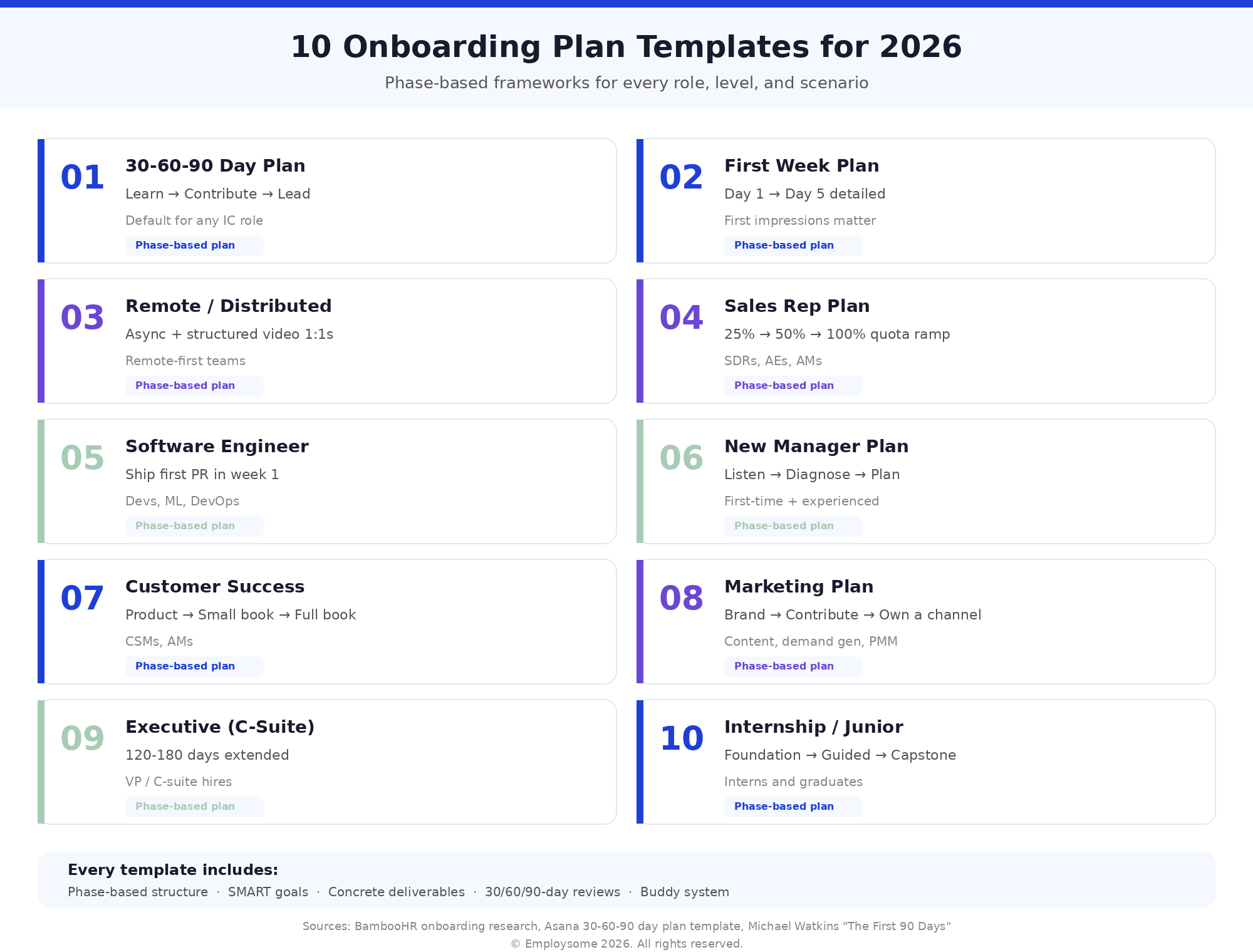
This guide provides 10 different onboarding plan templates covering the most common scenarios: the classic 30-60-90 day plan, first-week intensive onboarding, remote onboarding, sales rep ramp, software engineer onboarding, new manager onboarding, customer success, marketing, executive onboarding, and internship plans. Each template is structured around three things: clear phase-based goals, specific learning and output deliverables, and measurable success criteria. Use them as starting points and customise to your team’s context and culture.

What Is an Onboarding Plan Template?
An onboarding plan template is a structured document that outlines what a new hire should learn, do, and achieve during a defined onboarding period (typically 30, 60, or 90 days, sometimes longer for senior roles). Unlike a basic onboarding checklist (which is a list of administrative tasks like signing forms and getting access to systems), a true onboarding plan template covers four critical components:
- Phase-based structure: Breaks the onboarding period into distinct phases (typically Learn → Contribute → Lead) with progressively increasing autonomy and responsibility
- SMART goals at each phase: Specific, Measurable, Achievable, Relevant, Time-bound objectives so the new hire and their manager both know what success looks like
- Deliverables and outputs: Concrete artefacts the new hire produces – documents, presentations, code reviews, sales calls completed, customer accounts owned
- Check-in cadence and feedback loops: Structured 30-day, 60-day, and 90-day reviews with the manager (and ideally a buddy or mentor)
Done well, an onboarding plan template transforms the first 90 days from a blurry, ad-hoc experience into a structured journey with clear milestones. It reduces the time-to-productivity for new hires, signals to the employee that the company takes their success seriously, and gives the manager a tool for early performance discussions. Done poorly, or not at all, the predictable consequences are disengagement, missed performance goals, and the most expensive outcome of all: turnover within the first 12 months.
1. The Classic 30-60-90 Day Onboarding Plan
The 30-60-90 day plan is the gold standard onboarding template, used across industries and seniority levels. It divides the first three months into three distinct phases: Learn (days 1-30), Contribute (days 31-60), and Lead (days 61-90). It works for almost any role and is the best starting point if you have no other onboarding structure in place.
| Phase | Focus | Goals | Deliverables by End of Phase |
| Days 1-30: Learn | Context and orientation | Understand the role, team, product, customer, and processes | Process notes, list of key contacts, 2-3 observed improvement opportunities |
| Days 31-60: Contribute | Initial output and ownership | Take ownership of core responsibilities; produce real work; build relationships | First independent project or major task complete; second-month review with manager |
| Days 61-90: Lead | Full ownership and forward planning | Drive a project end-to-end; propose improvements; plan next quarter | End-of-onboarding review; agreed Q1 priorities; documented working relationships |
When to use it: Default template for individual contributors across most roles. Pair with weekly 1:1s and structured 30, 60, 90 day reviews.
2. First Week Onboarding Plan Template
The first week shapes a new hire’s entire perception of the company. A first-week onboarding plan template breaks down day 1 to day 5 in detail, covering administrative setup, team introductions, product orientation, and immediate tasks. This level of detail is particularly important for the first 5 days when new hires are most overwhelmed.
| Day | Morning | Afternoon |
| Day 1: Welcome | Welcome breakfast, HR paperwork, equipment setup, account provisioning | Office tour, team introductions, lunch with manager, first 1:1 to align expectations |
| Day 2: Company orientation | Company history, mission and values session, org structure walkthrough | Product demo, customer overview, security and compliance training |
| Day 3: Role deep-dive | Role-specific training, tool walkthroughs, key process introductions | Shadow a teammate, review existing documentation, set up regular meeting cadence |
| Day 4: Stakeholder mapping | Coffee chats with 2-3 cross-functional stakeholders, learn dependencies | Buddy meeting, review the 30-60-90 day plan, ask questions |
| Day 5: First small win | Complete a small first task or contribution | End-of-week review with manager, set goals for week 2, week 1 retrospective |
When to use it: For any new hire, embedded inside the first 30 days of the broader 30-60-90 day plan. Especially valuable for highly structured cultures.
3. Remote / Distributed Employee Onboarding Plan
Remote and distributed onboarding requires more deliberate structure than in-person onboarding because organic learning (overheard conversations, hallway chats, spontaneous coffees) does not happen. This template replaces in-person touchpoints with video check-ins, virtual coffee chats, structured async documentation, and a more intentional buddy system.
| Phase | Async Setup | Synchronous Touchpoints |
| Pre-boarding (week before start) | Equipment shipped; access provisioned; welcome video and onboarding portal opened | Welcome call with manager; intro Slack message to team |
| Week 1 | Self-paced product and tool tutorials; recorded company orientation videos | Daily 30-min video 1:1 with manager; virtual welcome lunch; buddy intro call |
| Weeks 2-4 | Documented onboarding tasks in project tool; written knowledge transfer | 3x per week 1:1s with manager; virtual coffee chats with 5 cross-functional teammates |
| Days 31-60 | Project documentation; recorded demos of work completed | Weekly 1:1; bi-weekly buddy session; virtual social events |
| Days 61-90 | Working autonomously; contributing to team docs and processes | Weekly 1:1; 30/60/90 day video reviews; in-person team offsite if possible |
When to use it: For any fully-remote or distributed-first team, including international hires. The buddy system and structured social touchpoints are critical to compensate for the absence of organic in-office learning.
4. Sales Rep Onboarding Plan Template
Sales onboarding plans differ from general onboarding because they must balance product knowledge, sales process and methodology, territory and account familiarity, and quota ramp. A typical sales rep takes 3-9 months to reach full quota, so the onboarding plan should explicitly include a ramp-up quota expectation rather than full quota from day 1.
| Phase | Activity Goal | Output Goal |
| Days 1-30: Product and process mastery | Complete sales certification; shadow 10 calls; learn ICP and personas; master CRM and sales tooling | Pass internal sales certification; build first prospect list; deliver mock pitch |
| Days 31-60: Pipeline build (25% quota) | Run first prospecting cadences; co-sell with senior rep; deliver 10+ live demos | Build pipeline to 3x first-quarter quota; close first 1-2 deals (small) |
| Days 61-90: Independent selling (50% quota) | Own full sales cycle independently; receive territory; daily activity targets met | Close ≥3 deals; pipeline to 4x quarterly target; quarterly territory plan complete |
| Days 91-180: Full quota ramp | Achieve 75% then 100% of full quota over the next 90 days | Hit 100% of monthly quota by month 6 at the latest |
When to use it: For any quota-carrying sales role – SDRs, AEs, account managers. Critical to set ramp-up quota expectations explicitly to avoid the “full quota from month one” trap that drives early sales turnover.
5. Software Engineer Onboarding Plan Template
Engineering onboarding focuses on three things: codebase familiarity, development environment setup, and shipping production code. Top engineering organisations aim for a new engineer to ship their first production change within the first 1-2 weeks. This template balances technical learning with autonomy.
| Phase | Focus | Concrete Output |
| Week 1: Environment and first commit | Dev environment set up; codebase walkthrough; CI/CD overview; ship first PR (typo fix or small bug) | First merged PR to production by end of week 1 |
| Weeks 2-4: Bug fixes and small features | Take 3-5 small tickets independently; pair-program with senior engineers; participate in code review | 3-5 PRs merged; first design doc reviewed (small) |
| Days 31-60: Owning a feature | Take ownership of a medium-sized feature end-to-end; write tests; deploy to production | One medium feature shipped end-to-end; on-call shadow |
| Days 61-90: Full ownership | Drive feature scoping and architecture; mentor newer hires; participate in on-call rotation | Driving features independently; on-call rotation; tech-design proposal |
When to use it: For software engineers, data engineers, ML engineers, and DevOps engineers. The “ship in week 1” goal builds early confidence and signals trust.
6. New Manager Onboarding Plan Template
Onboarding a new manager (whether external hire or internal promotion) requires a different structure than IC onboarding. The manager must learn the team’s context, build trust, understand the team’s strengths and gaps, and develop a leadership plan, all without immediately disrupting team rhythms. Michael Watkins’ “The First 90 Days” framework is the basis for most modern manager onboarding plans.
| Phase | Leadership Focus | Outputs |
| Days 1-30: Listen and learn | 1:1s with every direct report (45-60 mins each); skip-level meetings; review team OKRs and history | Team-context document; SWOT on team; preliminary view on team strengths and gaps |
| Days 31-60: Diagnose and align | Identify highest-leverage problems and opportunities; align with stakeholders; observe team dynamics in meetings | 30-day team assessment shared with manager; written stakeholder map; preliminary team plan |
| Days 61-90: Plan and act | Publish team strategy; make organisational changes if needed; set quarterly OKRs with team | 90-day team plan; quarterly OKRs; first “small change” successfully implemented |
When to use it: For any new people manager, including internal promotions to manager. The strong emphasis on listening for the first 30 days is critical – new managers who try to make changes too fast typically lose team trust.
7. Customer Success Manager Onboarding Plan
Customer Success Manager (CSM) onboarding requires balancing product depth, customer empathy, account ownership, and renewal process. CSMs typically take 2-4 months to fully ramp, with expanded book size in months 3-4 once they have demonstrated comfort with their initial accounts.
| Phase | Focus | Outputs |
| Days 1-30: Product and customer model | Master product and use cases; learn customer ICP, segmentation, and health metrics; shadow renewal calls | Pass product certification; map of top 10 customer use cases; CRM and CS tooling proficiency |
| Days 31-60: First book of accounts (small) | Take ownership of 5-10 small accounts; conduct first QBRs (Quarterly Business Reviews); identify expansion opportunities | 5-10 accounts owned; first QBRs delivered; first expansion opportunity created |
| Days 61-90: Expanded book and first renewal | Book expanded to full size; deliver first renewal; manage at-risk accounts | Full book of accounts; first renewal closed; at-risk-account playbook applied |
When to use it: For Customer Success Managers, Account Managers, and Customer Operations roles. Ramped book size and structured QBR cadence are critical components.
8. Marketing Onboarding Plan Template
Marketing onboarding plans must balance brand and product knowledge with campaign execution and analytics. Marketing roles vary widely (content, demand gen, product marketing, brand) so this template covers a generalised approach that can be tailored to the specific specialisation.
| Phase | Focus | Outputs |
| Days 1-30: Brand, product, and ICP | Master brand voice and guidelines; learn product positioning, ICP and personas; review past campaigns and performance | Brand-voice review; ICP/persona document refreshed; competitive landscape analysis |
| Days 31-60: Campaign contribution | Contribute to active campaigns; draft first content piece or campaign brief; learn analytics tooling | 2-3 content pieces published or campaign assets shipped; first measurable campaign output |
| Days 61-90: Own a campaign or channel | Take ownership of a specific channel or campaign end-to-end; report on results; propose Q2 plan | One owned campaign; performance report; Q2 plan and budget proposal |
When to use it: Adapt to the specific marketing function. Content marketers should have a content-published target by day 30; demand-gen marketers should have first-campaign metrics by day 60.
9. Executive (C-Suite) Onboarding Plan Template
Executive (C-suite or VP-level) onboarding extends to 120-180 days rather than 90, given the complexity of the role and the breadth of stakeholder relationships. Executives must build trust, understand the business deeply, and set strategic direction without making damaging early mistakes. The cost of a bad executive hire is often 5-10x annual compensation, so structured onboarding is high-ROI.
| Phase | Focus | Outputs |
| Days 1-30: Listening tour | 1:1s with CEO, board, peer execs, direct reports, key customers; review financials, OKRs, strategy docs | 30-day listening report; preliminary strategic POV; written stakeholder map |
| Days 31-60: Diagnosis | Deep-dive into function-specific data; identify top 3 strategic priorities and 3 organisational gaps; consult with peer execs | Function diagnostic; preliminary plan shared with CEO |
| Days 61-90: Plan | Publish strategic plan to board; align with peers; finalise team structure and key hires | Strategic plan; team structure decisions; quarterly OKRs |
| Days 91-180: Execute | Drive first wave of strategic initiatives; make first major team changes; deliver first quarter of results | First-quarter business results; key hires complete; published strategy in motion |
When to use it: For VP-level and C-suite hires. The longer timeline acknowledges that executives need more time to build context and credibility before making material changes.
10. Internship and Junior-Hire Onboarding Plan
Internship and junior-hire onboarding plans should be more tightly structured and include heavier mentorship than senior-hire plans. Interns and junior employees need explicit context-setting, foundational training, and visible early wins to build confidence and establish performance habits.
| Phase | Focus | Outputs |
| Week 1: Foundation | Tools and account setup; team intros; mentor pairing; foundational training modules | All access set up; mentor identified; foundational training complete |
| Weeks 2-4: Guided contribution | Take small tasks under mentor supervision; pair on every project; receive feedback weekly | 3-5 small completed tasks; weekly feedback log; first peer-review |
| Days 31-60: Independent execution | Take ownership of small projects; mentor reviews work but doesn’t direct it; daily standup participation | One independent project complete; presentation to team |
| Days 61-90: Capstone project | Lead a capstone project end-to-end; present to broader team; receive structured 90-day feedback | Capstone project delivered; 90-day review; full-time conversion decision |
When to use it: For interns, apprentices, and entry-level graduate hires. The capstone project is particularly important for internship-to-full-time conversion decisions.
💡 Employsome Insight: The Buddy System Is the Highest-ROI Element of Onboarding
Across every template above, one element consistently has the largest impact on new hire success: a dedicated buddy or mentor distinct from the manager. The buddy gives the new hire a peer they can ask the awkward, basic, or confused questions of without worrying about how it looks to their manager. Manager 1:1s focus on performance, expectations, and growth; buddy conversations focus on context, culture, and unwritten rules. Companies that pair every new hire with a buddy in week 1 see measurable improvements in onboarding NPS, time to productivity, and 90-day retention. Make this non-negotiable in your onboarding plan.
Best Practices Across All Onboarding Templates
Regardless of which template you start with, the highest-performing onboarding plans share six characteristics:
- SMART goals at every phase: Goals must be Specific, Measurable, Achievable, Relevant, and Time-bound. “Learn the company processes” is too vague; “Complete new-hire onboarding training and document 3 process improvement opportunities by day 30” is actionable.
- Structured manager check-ins at 30, 60, 90 days: These are not optional. Skipping the 30-day or 60-day check-in is the most common manager failure in onboarding. Block them on the calendar before day 1.
- A buddy or mentor distinct from the manager: A buddy gives the new hire a peer to ask “dumb questions” without judgement. The manager is for performance and growth; the buddy is for context and culture.
- Clear deliverables, not just activities: “Meet with 5 cross-functional stakeholders” is an activity. “Produce a written stakeholder map identifying top 3 collaboration dependencies” is a deliverable. Deliverables drive output; activities drive busywork.
- Forward planning at the 90-day mark: The end of onboarding should naturally transition into the next quarterly planning cycle. The 90-day review and the Q1 OKR-setting conversation should happen on the same day.
- Customisation by role and seniority: A junior individual contributor and a senior executive should not have the same onboarding plan. Use the templates above as starting points and customise based on level, function, and company context.
Common Onboarding Plan Mistakes to Avoid
Treating the plan as a document to file away in week 1. The plan is a living conversation. Update it when things change, revisit it at every checkpoint, and never skip 30/60-day check-ins where small problems get fixed before they become big ones.
Confusing onboarding with orientation. Orientation is a 1-2 day event covering paperwork and intros. Onboarding is a 30-90+ day journey. They are not the same. Many companies do the former and call it the latter.
Loading day 1 with too much information. New hires retain ~10% of what they hear on day 1. Deliver foundational information across the first 1-2 weeks, not in a single overwhelming morning.
No clear success metrics at each phase. If neither the new hire nor the manager can answer “what does success at day 60 look like?” the plan is not yet useful. Lock in measurable phase-end success criteria.
Not adapting for remote and international hires. Remote and international hires need more deliberate touchpoints, not fewer. Adapt your standard template with extra structured social touchpoints, video check-ins, and an active buddy system.
Ignoring the buddy or mentor system. The buddy is one of the highest-ROI elements of onboarding. Without one, new hires direct all their questions (including the awkward ones) to their manager, which damages the manager relationship and slows ramping.
How to Measure Onboarding Plan Effectiveness
Strong onboarding programmes track a defined set of metrics to measure effectiveness and improve the templates over time. The most important metrics include:
| Metric | Definition | Benchmark |
| Time to productivity | Days until new hire reaches expected baseline output | Varies by role; engineering: ship first PR within 7 days, sales: 100% quota by month 6 |
| 90-day retention | % of new hires still employed at day 90 | Aim for >95%; below 90% indicates onboarding or hiring issues |
| 12-month retention | % of new hires still employed at 12 months | Aim for >85%; benchmark for high-performing companies is 90%+ |
| Onboarding satisfaction (eNPS-style) | New hire NPS-style score at end of onboarding | Above 50 is strong; above 70 is exceptional |
| Manager confidence | Manager assessment of hire’s ramp progress at day 30/60/90 | Rated on 1-5 scale; aim for 4+ at day 90 |
| First milestone hit rate | % of new hires who hit their day-30 SMART goals | Aim for >85%; below 70% indicates unrealistic goals or weak onboarding |
These metrics should feed back into iterating your onboarding templates. If 90-day retention is below benchmark, examine whether the day-30 and day-60 expectations are realistic. If onboarding NPS is low, ask new hires what was missing in their first 30 days. The templates above are starting points – your data will tell you what to adjust.
Tools to Run Onboarding Plan Templates at Scale
A great onboarding plan template can be delivered through a simple Google Doc or Notion page; you do not need an enterprise HRIS to run effective onboarding. That said, as headcount scales beyond 50-100 employees, dedicated tooling helps. The most common options:
- Onboarding-specific platforms: BambooHR, Workday Onboarding, SAP SuccessFactors Onboarding, Rippling Onboarding, Sapling, Enboarder. These deliver the template, automate task assignments, send reminders, and collect feedback.
- HRIS with onboarding modules: Most modern HRIS platforms include basic onboarding workflow capability. For most companies under 200 employees, this is enough.
- Project management tools: Notion, Asana, Monday, ClickUp can run onboarding workflows effectively, especially when the templates are simple and your team is already comfortable with the tool.
- Mentoring platforms: Together, Qooper, MentorcliQ specifically support the buddy and mentor pairing component of onboarding.
- Learning Management Systems (LMS): Lessonly, Docebo, 360Learning deliver structured training modules and certifications.
For most early-stage and mid-market companies, the right approach is: start with a simple Notion or Google Docs template, run it manually for 6-12 months, measure what works, then graduate to dedicated tooling once you have headcount and process maturity to justify it.
Onboarding International Hires Through an EOR
When hiring international employees through an Employer of Record (EOR), the onboarding plan templates above remain fundamentally the same. The 30-60-90 day structure, SMART goals, manager check-ins, and buddy system all apply identically to international hires. What changes is the administrative layer: the EOR handles employment contracts, payroll, tax, and statutory benefits compliance, freeing your team to focus on the actual onboarding experience: training, culture integration, and ramp-up.
For a deeper dive into how EORs handle the administrative side of international hire onboarding (employment contracts, payroll setup, country-specific compliance, equipment provisioning, and benefits enrolment), see our complete guide to EOR onboarding. The combination of a strong onboarding plan template (covered in this article) and a competent EOR partner (covered in the EOR onboarding guide) is the most efficient way to get international new hires productive quickly.
Hiring internationally? Read the complete EOR onboarding guide
Hiring an international employee through an Employer of Record? The onboarding plan templates above still apply, but the administrative work (contracts, payroll, statutory benefits) shifts to your EOR partner. Read our complete EOR onboarding guide for the full operational walkthrough including timelines, documents, and country-specific gotchas.
Frequently Asked Questions
An onboarding plan template is a reusable framework that standardises how new hires integrate into an organisation across their first 30, 60, 90 days or beyond. It typically includes phase-based structure (Learn, Contribute, Lead), SMART goals at each phase, specific deliverables and outputs, and a structured cadence of manager check-ins. Unlike a basic onboarding checklist (a list of admin tasks), a template covers the strategic ramp-up of a new hire and is tailored to specific roles and seniority levels.
An onboarding checklist is a list of administrative tasks that must be completed (sign HR forms, get laptop, set up email, complete security training, attend orientation). An onboarding plan is a strategic framework covering what the new hire should learn, do, and achieve over their first 30, 60, 90 days. The checklist takes hours to complete; the plan takes 90 days. You need both, and they serve different purposes.
For most individual contributor roles, 30-60-90 days (3 months) is the standard length. For managers and executives, 90-180 days is more realistic given the additional context-building required. For internships, 90 days typically aligns with the internship duration. For sales roles with longer ramp times to full quota, the formal onboarding may be 90 days but ramp-up quota expectations often extend to 6 months.
A standard 30-60-90 day plan covers three phases. Days 1-30 (Learn): understand the role, team, product, customers, and processes; produce process notes and identify improvement opportunities. Days 31-60 (Contribute): take ownership of core responsibilities; produce real work; complete first independent project. Days 61-90 (Lead): drive a project end-to-end; propose improvements; plan the next quarter. Each phase has SMART goals, specific deliverables, and a structured manager review.
Yes. Remote employees need a more deliberately structured onboarding plan because organic learning (overheard conversations, hallway chats, spontaneous coffees) does not happen. Remote onboarding plans should include more frequent video 1:1s with the manager, structured virtual coffee chats with cross-functional stakeholders, an active buddy system with weekly touchpoints, and recorded async training to compensate for the absence of in-person learning. The phase structure and SMART goals remain the same.
Sales onboarding plans must include explicit ramp-up quota expectations rather than full quota from day one. A typical sales rep takes 3-9 months to reach full quota. The plan should include 25% quota by day 60, 50% by day 90, 75% by day 120, and 100% by day 180. The first 30 days focus on product certification, ICP knowledge, and CRM mastery; days 31-60 on supervised pipeline building; days 61-90 on independent selling; and beyond 90 days on full ramp.
The most important onboarding metrics are: time-to-productivity (days until new hire reaches expected baseline output), 90-day retention (>95% target), 12-month retention (>85% target), onboarding satisfaction NPS (>50 strong), manager confidence rating at 30/60/90 days, and first milestone hit rate (>85% should hit their day-30 SMART goals). Track these for at least 6-12 months to identify patterns and improve the templates.
Yes – a buddy or mentor distinct from the manager is one of the highest-ROI elements of onboarding. The buddy gives the new hire a peer to ask context-and-culture questions without judgement. Manager 1:1s focus on performance and growth; buddy conversations focus on unwritten rules and how things really work. Companies that pair every new hire with a buddy in week 1 measurably improve onboarding NPS, time-to-productivity, and 90-day retention.
For international hires, the onboarding plan template structure stays the same but the administrative layer changes. If you use an Employer of Record (EOR), the EOR handles employment contracts, country-specific payroll, statutory benefits, and compliance, freeing your team to focus on training, culture integration, and ramp-up. The 30-60-90 day plan, SMART goals, manager check-ins, and buddy system all apply identically. See our EOR onboarding guide for the administrative side of international hire setup.
For most early-stage and mid-market companies, a simple Notion page or Google Docs template is sufficient. As you scale beyond 50-100 employees, consider dedicated platforms: BambooHR, Workday Onboarding, Rippling Onboarding, Sapling, or Enboarder. Project management tools like Asana, Monday, or ClickUp also work well. Mentoring-specific platforms like Qooper or Together support the buddy/mentor pairing component. Start simple, measure what works, then graduate to specialised tooling.
Copywriter
Christa is a Copywriter at Employsome with 17 years of professional writing experience across global brands, startups, and online publications. A native English-Finnish writer, she brings strong editorial skills and a versatile background in business, SaaS, and finance. At Employsome, Christa focuses on clear, practical content about HR, payroll, and Employer of Record topics.
Our content is created for informational purposes only and is not intended to provide any legal, tax, accounting, or financial advice. Please obtain separate advice from industry-specific professionals who may better understand your business’s needs. Read our Editorial Guidelines for further information on how our content is created.
Other posts
Review other templates