Work Visa Norway 2026: How to Get a Residence Permit
A work visa in Norway requires a residence permit issued by UDI (the Norwegian Directorate of Immigration). The most common route is the Skilled Worker permit, which requires a concrete job offer, relevant qualifications, and a salary meeting strict Norwegian thresholds: NOK 599,200 for master’s-level roles and NOK 522,600 for bachelor’s-level from September 2025. There are no annual quotas or lotteries. Processing takes 4 to 8 weeks, and the early employment start scheme allows some workers to begin before the permit is approved. This guide covers every permit type, salary requirements, the step-by-step application process, employer obligations, permanent residency, and what it means for companies hiring through an EOR.

Table of Contents
- Types of Work Visa in Norway
- Work Visa Norway: Salary Thresholds
- Eligibility Requirements for a Work Visa in Norway
- How to Apply for a Work Visa in Norway: Step by Step
- Early Employment Start
- Can You Enter Norway Before the Work Visa Is Approved?
- Changing Employers on a Work Visa in Norway
- Permanent Residency After a Work Visa in Norway
- Employer Obligations When Sponsoring a Work Visa in Norway
- Common Reasons Work Visa Norway Applications Are Rejected
- Family Immigration with a Work Visa in Norway
- What This Means for Companies Hiring Through an EOR
- FAQs
A work visa in Norway is not technically a visa. What non-EU/EEA nationals need to work legally in Norway is a residence permit for work, issued by the Norwegian Directorate of Immigration (UDI). The distinction matters because the permit is tied to a specific employer and position, not to the worker independently.
For EU/EEA nationals, the work visa Norway question is simpler: you have the right to work without a permit but must register with the police if your stay exceeds three months. For everyone else, you need a residence permit before you can legally start working, and in most cases you need a concrete job offer from a Norwegian employer before you can even apply.
What makes the work visa Norway system unusual compared to many countries is its transparency. There are no annual quotas, no lotteries, and no caps on skilled worker permits. If you meet the requirements, UDI will approve your application. But the requirements are strict, particularly around salary thresholds, which were significantly increased in September 2025 to reflect Norwegian wage growth. Norway does not have a statutory national minimum wage, but the work permit salary floors effectively function as minimums for foreign workers.

Types of Work Visa in Norway
Norway offers several categories of residence permits for work. Understanding which type applies to your situation is the first step in the work visa Norway process.
Skilled Worker Permit (the main route)
This is the work visa Norway route that applies to the vast majority of professional hires. It covers workers with higher education (bachelor’s or master’s degree) or completed vocational training. It requires a concrete job offer from a Norwegian employer, and the role must require your specific qualifications. The permit is valid for up to 3 years for positions requiring higher education, or 1 year for vocational-level positions (renewable). After 3 years of continuous residence, you can apply for permanent residency.
Seasonal Worker Permit
For temporary work in agriculture, forestry, or the tourism and hospitality sector. Valid for up to 6 months within a 12-month period. The worker must leave Norway when the permit expires.
Intra-Company Transfer
For employees being transferred from a foreign office to a Norwegian branch or subsidiary of the same company. Requires that the employee has worked for the company for at least one year.
Self-Employed Persons
For individuals running their own sole proprietorship in Norway. The business must require skilled worker qualifications and generate at least NOK 325,400 per year in profit. Cannot be a limited company.
Athletes and Coaches
A specific work visa Norway category for professional athletes and coaches employed by Norwegian sports clubs. Salary must be at least NOK 325,400 per year.
Religious Workers and Humanitarian Organisations
For employees of non-profit religious or humanitarian organisations. Salary must be at least NOK 325,400 per year, with exceptions where pay is not customary for religious reasons.

Work Visa Norway: Salary Thresholds
The salary requirement is one of the most critical elements of any work visa Norway application. From 1 September 2025, UDI significantly increased the minimum salary thresholds for skilled workers with higher education:
|
Education Level |
Minimum Annual Salary (pre-tax) |
Approx. Monthly |
|
Master’s degree required |
NOK 599,200 |
~NOK 49,933 |
|
Bachelor’s degree required |
NOK 522,600 |
~NOK 43,550 |
|
Vocational training |
Must match normal Norwegian wages for the role |
Varies |
|
Athletes/coaches |
NOK 325,400 |
~NOK 27,117 |
|
Self-employed |
NOK 325,400 (projected profit) |
~NOK 27,117 |
These thresholds are based on salary data from collective agreements between the Norwegian Association of Local and Regional Authorities (KS) and employee organisations. UDI may accept a lower salary if the applicant can document that this is normal for the specific occupation in the specific location, but substantial evidence is required.
For vocational-level skilled workers, there is no fixed threshold. Instead, UDI requires that pay and working conditions are not poorer than what is normal in Norway. Norway’s wage system is built around collective bargaining rather than a statutory minimum. Several sectors have legally binding minimum rates through generally binding collective agreements. For a full explanation of how wages and minimums work in Norway, see our minimum wage in Norway guide.
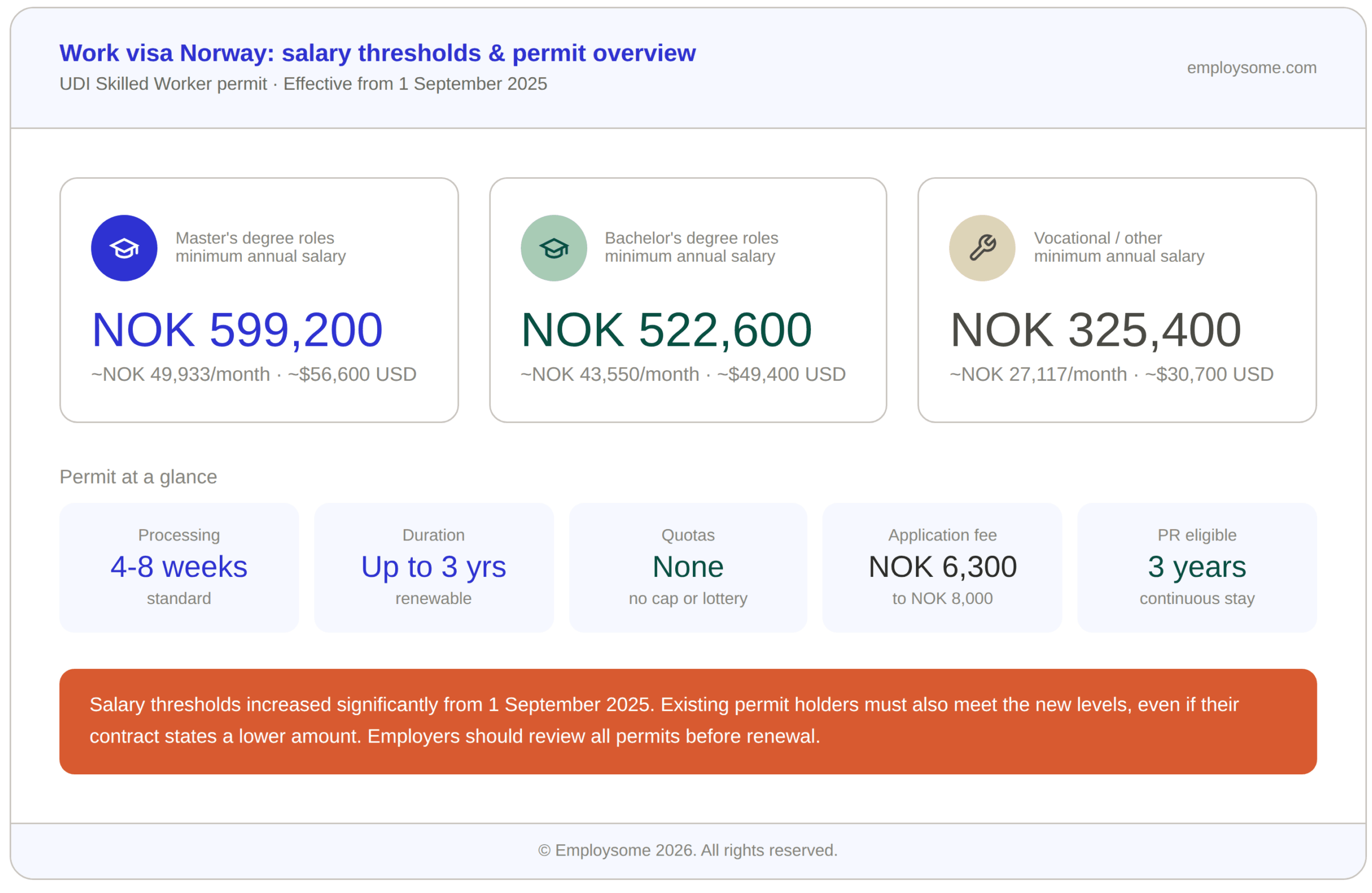
💡 Employsome Insight: The September 2025 salary increase caught many employers off guard. If you have an existing employee on a work visa in Norway whose permit was issued before the increase, they must still meet the new salary level from 1 September 2025, even if their employment contract states a lower amount. Review all existing permit holders and adjust salaries before renewal to avoid compliance issues.
Eligibility Requirements for a Work Visa in Norway
To qualify for a Skilled Worker permit, both the employee and the employer must meet specific criteria.
Employee requirements:
Completed higher education (bachelor’s or master’s degree) or completed vocational training relevant to the job. For regulated professions (healthcare, teaching, engineering), Norwegian authorisation or recognition is required. A valid passport and clean immigration record with no entry bans or serious violations in the Schengen area.
Job requirements:
A concrete job offer from one specific employer registered in Norway. The position must normally be full-time. Pay and working conditions must not be poorer than what is normal in Norway. For staffing agencies, a list of confirmed assignments from client companies is required.
Employer requirements:
The employer must be registered in Norway. From February 2026, employers must submit a digital confirmation of the job offer through UDI’s system before the applicant can submit their application. This is a new anti-fraud measure. The employment contract must meet Norwegian standards.
How to Apply for a Work Visa in Norway: Step by Step
The work visa Norway application follows a structured process managed through UDI’s online portal.
- Step 1: Employer confirms the job offer. Since February 2026, the employer must submit a digital confirmation through UDI’s system. This is mandatory for most skilled worker applications and must be completed before the employee can apply.
- Step 2: Employee submits the application online. The applicant completes the UDI online form and pays the fee (approximately NOK 6,300 to NOK 8,000 for skilled worker permits).
- Step 3: Biometrics and document submission. The applicant provides fingerprints and photos at a Norwegian embassy, consulate, VFS centre, or (if already in Norway) at a local police station.
- Step 4: UDI processes the application. Standard processing is 4 to 8 weeks for most work visa Norway applications. Incomplete documentation or complex cases can extend this.
- Step 5: Decision issued. If approved, the applicant receives a residence permit. Those abroad who need a visa to enter Norway receive an entry visa arranged by UDI through the relevant embassy.
- Step 6: Arrival and registration. After arriving in Norway, the permit holder registers at a police station and collects their residence card within two weeks.
Early Employment Start: Working Before the Permit Is Approved
One of the most practical features of the work visa Norway system is the early employment start scheme. If the employer applies for and receives confirmation from the police, the employee can begin working immediately rather than waiting the full processing period.
This is available for skilled worker applications where the employer is in Norway and the employee either does not need a visa or can obtain an entry visa. All standard requirements must be met, and a complete application must have been submitted.
For employers with urgent hiring needs, this scheme significantly reduces the gap between application and productive work.
Can You Enter Norway Before the Work Visa Is Approved?
If you do not need a visa to visit Norway (or hold a valid Schengen visa), you can enter and stay while your work visa Norway application is processed. You cannot work until the permit is granted or you receive early employment start confirmation.
If you need a visa, you must generally wait for UDI’s decision. However, if the police issue early employment start confirmation, the embassy will issue an entry visa allowing travel and work.
If you hold a residence permit in another Schengen country, you can enter Norway and submit your application at a police station within 90 days.
Changing Employers on a Work Visa in Norway
For skilled workers with higher education, you can change employers without a new permit if the new position is the same type of work. You must notify local police within 7 days. If the work type is different, you need a new permit and cannot start until it is granted.
For skilled workers with vocational qualifications, any employer change requires a new permit application.
If you lose your job, you can stay in Norway for up to 6 months to find new employment, provided your residence permit remains valid. You must notify police within 7 days of termination.
Permanent Residency After a Work Visa in Norway
After 3 years of continuous residence on a work visa in Norway, you can apply for permanent residency. Requirements include continuous legal residence (no more than 7 months of total absence during the 3-year period), minimum income of NOK 310,070 per year, passing the Norwegian language test at B1 level (Norskproven, covering speaking, listening, reading, and writing), and completing the mandatory social studies course.
Permanent residency removes the employer-tied restriction and allows unrestricted work and residence in Norway.
Hiring in Norway?
If you are looking to hire in Norway without setting up a local entity, an Employer of Record handles employment contracts, work permit sponsorship, payroll, social security, and pension compliance on your behalf. See our Best Employer of Record in Norway guide for providers ranked on entity ownership, visa capability, and in-country execution.
Employer Obligations When Sponsoring a Work Visa in Norway
Employers sponsoring a work visa in Norway must fulfil several obligations beyond the application itself. The employer must ensure the employment contract complies with Norwegian law, register the employee with Norwegian tax authorities, pay employer social security contributions (approximately 14.1% of gross salary), enrol the employee in the mandatory occupational pension scheme (minimum 2% of salary between 1G and 12G), comply with Norwegian working time regulations (37.5-hour standard week), and provide at least 25 working days of paid annual leave (5 weeks).
Norway has no statutory minimum wage set by law. Wages are determined through collective agreements negotiated by trade unions. In sectors with generally binding collective agreements (construction, cleaning, hospitality, agriculture, transport, and others), the agreed minimum rates are legally enforceable for all employers.
Common Reasons Work Visa Norway Applications Are Rejected
UDI rejects skilled worker applications for several common reasons: the salary does not meet the required threshold, the qualifications do not match the position, documentation is incomplete or contains incorrect information, the employer is not properly registered in Norway, or the position does not genuinely require skilled worker qualifications.
UDI has flagged heightened scrutiny for applications involving certain occupations (chefs, car mechanics, carpenters, painters, bricklayers, hairdressers) where documentation was issued in Bangladesh, China, India, Iran, Kosovo, Nepal, Pakistan, Turkey, or Vietnam, due to past incidents of fraudulent documentation. Applications from these countries are not automatically rejected, but documentation must be particularly thorough.
Family Immigration with a Work Visa in Norway
Spouses, registered partners, and minor children of work visa Norway holders can apply for family immigration permits. These permits match the duration of the main permit and grant the right to work and study. The primary permit holder must demonstrate adequate income and housing. Family members should apply at the same time as the primary applicant to receive decisions simultaneously.
What This Means for Companies Hiring Through an EOR
For companies hiring in Norway without a local entity, an Employer of Record can serve as the registered Norwegian employer for work visa purposes. The EOR handles employment contract issuance compliant with Norwegian law, UDI job offer confirmation and application support, payroll registration and tax withholding, employer social security contributions (~14.1%), mandatory occupational pension enrolment, and ongoing compliance with Norwegian working time and leave regulations.
Norway’s work visa system requires the sponsoring employer to be a registered Norwegian entity. An EOR with an owned entity in Norway can fulfil this requirement directly. EOR providers using partner models may also support visa sponsorship, but the accountability chain is less direct. For a broader overview of how to structure international hiring across complex immigration systems, see our international hiring guide.
Frequently Asked Questions
A work visa in Norway is technically a residence permit for work, issued by UDI. Non-EU/EEA nationals need this permit before they can legally work in Norway. EU/EEA nationals can work without a permit but must register if staying beyond 3 months.
From September 2025: NOK 599,200 per year for master’s-level positions, NOK 522,600 for bachelor’s-level. Vocational roles must match normal Norwegian wages. UDI may accept lower salaries with substantial documentation.
Typically 4 to 8 weeks for standard skilled worker applications. The early employment start scheme allows some applicants to begin working before the decision is issued.
Skilled workers with higher education can change employers for the same type of work by notifying police within 7 days. Different type of work requires a new permit. Vocational skilled workers must apply for a new permit for any employer change.
After 3 years of continuous residence on a work permit, provided you meet the income requirement (NOK 310,070/year), pass the Norwegian language test at B1 level, and complete mandatory social studies.
No. Norway has no annual caps, quotas, or lotteries for skilled worker permits. If you meet the requirements, UDI will approve the application.
Approximately NOK 6,300 to NOK 8,000 for skilled worker permits. Schengen business visas cost approximately NOK 800. Family immigration permits cost approximately NOK 3,500.
Yes, if the EOR operates through an owned Norwegian entity. The EOR acts as the registered employer and can submit job offer confirmations, sponsor the permit, and handle all payroll and compliance obligations.

Written by
Dane Cobain is a Copywriter at Employsome and an accomplished author whose work spans fiction, non-fiction, and professional writing. Over the past decade, he has built a strong track record creating straightforward content for the HR, payroll, and corporate sectors. Dane brings a storyteller’s eye to the evolving world of global employment, with a particular focus on Employer of Record and PEO models. His articles explore industry trends and dedicated Best Of Guides when managing an international workforce.
Our content is created for informational purposes only and is not intended to provide any legal, tax, accounting, or financial advice. Please obtain separate advice from industry-specific professionals who may better understand your business’s needs. Read our Editorial Guidelines for further information on how our content is created.
Other posts
Review other blog posts