Minimum Wage in Norway (2026): Employer Costs Guide
Norway has no national minimum wage. Instead, legally binding minimum hourly rates apply in nine sectors (construction, cleaning, hospitality, electricians, agriculture, and others) through allmenngjorte tariffavtaler, ranging from NOK 162 to NOK 260/hour. Outside these sectors, wages are market-driven. Employer costs include arbeidsgiveravgift at 14.1% (varying by geographic zone down to 0%), holiday pay at 10.2-12%, and mandatory occupational pension (OTP) at minimum 2%. Total employer cost runs approximately 26 to 30% above gross, significantly lower than Sweden’s 45-55%. This guide covers all nine sector rates, the zone system, worked examples, income tax, working hours, enforcement, and a Scandinavian comparison.

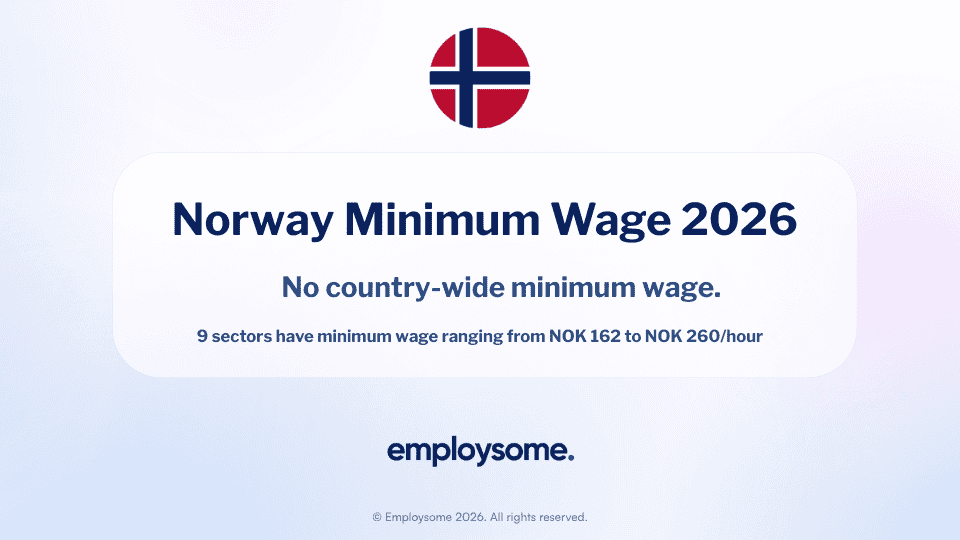
Table of Contents
Norway does not have a national minimum wage. There is no single statutory hourly or monthly floor that applies to all workers, which surprises many international employers researching the Norwegian labour market for the first time. Instead, minimum wages in Norway are set through collective bargaining agreements (tariffavtaler) between trade unions and employer organisations, and in nine specific sectors, these agreements have been made generally applicable (allmenngjort) by the Tariff Board (Tariffnemnda).
When a collective agreement is allmenngjort, its minimum wage rates become legally binding on all employers in that sector, regardless of whether the employer is a member of the relevant employer association or whether the employee is a union member. The Norwegian Labour Inspection Authority (Arbeidstilsynet) enforces compliance through inspections, fines, and corrective orders. In the nine regulated sectors, minimum hourly rates range from approximately NOK 162 to NOK 260 depending on the sector, experience, and skill level.
For sectors without an allmenngjort agreement, there is no legal minimum wage. Wages are determined by market forces, individual negotiation, and any applicable (but not generally binding) collective agreement. In practice, Norway’s strong union density (~50%), high cost of living, and competitive labour market mean that even unregulated sectors typically pay well above what would be considered a “minimum” in other countries. The average monthly salary in Norway is approximately NOK 62,000 (~$5,800 USD), one of the highest in Europe.
For international companies hiring in Norway, the key question is whether your employees fall within one of the nine regulated sectors. If they do, you must comply with the sector-specific minimum rates and conditions. If they don’t, wages are negotiated freely, but employer costs (arbeidsgiveravgift, holiday pay, occupational pension) still add significantly to the total employment bill.

Minimum Wage Rates by Sector (2026)
The following nine sectors have generally applicable (allmenngjort) minimum wage rates in Norway. These rates took effect from 15 June 2025 and remain in force until the next tariff revision (typically mid-2026). Rates are set by the Tariff Board and published by Arbeidstilsynet.
|
Sector |
Minimum Hourly Rate (NOK) |
Notes |
|
Construction |
Skilled: NOK 260.60. Unskilled: NOK 239.00. Unskilled with 1yr exp: NOK 249.00. Under 18: NOK 162.44 |
Max 37.5 hrs/week. Overtime provisions apply per Working Environment Act. |
|
Cleaning |
NOK 220.86 (standard). Higher for experience. |
Rates apply to all cleaning businesses in Norway. |
|
Hotel, restaurant & catering |
Over 20 / after 4 months exp (over 18): NOK 204.79. Under 20 (start): NOK 184.31 |
Covers onshore hotels, restaurants, catering, etc. |
|
Maritime construction (shipyards) |
Skilled: ~NOK 230-250. Unskilled: ~NOK 210-230 |
Rates vary by skill level and experience. |
|
Agriculture & horticulture |
Seasonal (18+, 0-12 wks): NOK 162.90. Seasonal (12 wks-6 mo): NOK 168.40. Permanent unskilled: NOK 182.80. Under 18: NOK 152.40 |
Skilled supplement: NOK 14.50/hr on top. |
|
Fish processing |
~NOK 200-220 (varies by role and experience) |
Covers fish processing enterprises. |
|
Electricians |
~NOK 240-260 (varies by qualification) |
Skilled electricians with certification. |
|
Freight transport by road |
Vehicles over 2.5 tonnes: NOK 229.00 |
From June 2025: threshold lowered from 3.5 to 2.5 tonnes. |
|
Passenger transport (tour bus) |
NOK 218.62 |
Covers passenger transport by coach or tour bus. |
Workers under 18 receive a reduced rate in most sectors, typically 70-80% of the adult rate. Wage seniority earned by young workers carries forward after they turn 18. All sectors include provisions for overtime supplements (minimum 40% of hourly rate), shift premiums, and working hour limits.
💡 Employsome Insight: If Your Sector Is Not Listed, There Is No Legal Minimum
For sectors outside the nine listed above, including IT, finance, professional services, marketing, and most office-based roles, there is no legally mandated minimum wage in Norway. Wages are set by the market. However, if your company is bound by a collective agreement (tariffavtale) through an employer association membership, the rates in that agreement become binding. International companies hiring through an EOR should confirm whether any collective agreement applies to their employees’ roles.
Why Norway Has No National Minimum Wage
Norway’s wage-setting model is based on the Nordic collective bargaining system, where wages are negotiated between strong trade unions and well-organised employer associations rather than set by government legislation. Approximately 50% of Norwegian workers are union members, and collective agreements cover a significant portion of the workforce.
The system of allmenngjoring (general application) was introduced specifically to prevent social dumping in sectors with large numbers of foreign workers (construction, cleaning, hospitality, agriculture). By making collective agreement minimums legally binding for all employers in these sectors, Norway ensures that foreign workers receive the same minimum pay as Norwegian workers, without needing to introduce a universal minimum wage that might undermine the collective bargaining model.
Norway is not a member of the EU and is therefore not subject to the EU Minimum Wage Directive (Directive 2022/2041), which requires EU member states to ensure adequate minimum wage protection. However, as an EEA member, Norway applies EU-related rules on posted workers and free movement, which interact with the allmenngjoring system.
Employer Costs: Arbeidsgiveravgift, Holiday Pay & Pension
The minimum wage rate is the employee’s gross hourly pay. On top of this, employers in Norway must pay several mandatory contributions:
|
Contribution |
Rate (2026) |
Paid By |
|
Arbeidsgiveravgift (employer’s NI contribution) |
14.1% (standard, Zone 1). 0% to 10.6% in remote zones. |
Employer |
|
Employee’s NI contribution (trygdeavgift) |
7.6% (2026). 5.1% for self-employed in primary industries. |
Employee (deducted from gross) |
|
Holiday pay (feriepenger) |
10.2% of gross salary (12% for workers over 60 or with 5+ weeks leave under agreement) |
Employer (accrued and paid out during holiday year) |
|
Occupational pension (OTP, tjenestepensjon) |
Minimum 2% of salary between 1G and 12G. Many agreements require higher. |
Employer (mandatory for most employers) |
|
Occupational injury insurance |
Mandatory. Varies by industry risk. |
Employer |
The arbeidsgiveravgift (employer’s National Insurance contribution) is the Norwegian equivalent of employer social security. The standard rate is 14.1% but varies by geographic zone. Norway is divided into five zones, with remote and sparsely populated areas (northern Norway, Finnmark, parts of Troms) benefiting from reduced rates down to 0%. The increased rate of 19.1% for salaries exceeding NOK 850,000, introduced in 2023, was abolished from 1 January 2025. From 2025 onwards, the flat 14.1% applies to all salary levels in Zone 1 (no cap).
|
Zone |
Rate |
Zone |
Rate |
Zone |
|
Zone 1 (standard) |
14.1% |
Zone 2 |
10.6% |
Zone 1a |
|
Zone 3 |
6.4% |
Zone 4 |
5.1% |
Zone 4a |
|
Zone 5 (Finnmark/N. Troms) |
0% |
💡 Employsome Insight: Holiday Pay Accrues on Top of Everything
Norwegian holiday pay (feriepenger) is not included in the hourly wage. It accrues at 10.2% of gross annual earnings (12% for workers over 60) and is paid out the following year, typically in June when employees take their holiday. For a construction worker earning NOK 249/hour, the employer must accrue an additional NOK 25.40/hour for holiday pay. Combined with arbeidsgiveravgift at 14.1% and OTP pension at 2%+, total employer cost is approximately 28 to 30% above the gross hourly rate before any other benefits.
Worked Example: Total Employer Cost
Construction Worker (Unskilled, 1+ Year Experience) in Oslo
|
Component |
Amount |
|
Hourly minimum wage |
NOK 249.00 |
|
Monthly gross (37.5 hrs/week x 4.33 weeks) |
~NOK 40,419 |
|
Arbeidsgiveravgift (14.1%) |
~NOK 5,699 |
|
Holiday pay accrual (10.2%) |
~NOK 4,123 |
|
OTP pension (2% min, on salary 1G-12G) |
~NOK 571 |
|
Total monthly employer cost (approx.) |
~NOK 50,812 (~$4,760 USD) |
|
Employer cost above gross hourly rate |
~26% |
This example uses the minimum OTP pension rate of 2%. Many construction sector collective agreements require higher pension contributions (4-7%), which would increase total employer cost further. Occupational injury insurance, sick pay provisions, and any shift/overtime premiums are additional.
Employee Income Tax
Norway operates a progressive income tax system combining a flat municipal/county tax of 22% with a stepped national tax (trinnskatt) on higher incomes. The 2026 rates are:
|
Annual Income (NOK) |
Marginal Tax Rate (2026) |
|
Up to ~NOK 208,050 |
22% (municipal/county tax only) |
|
NOK 208,050 to ~NOK 292,850 |
22% + 1.7% = 23.7% |
|
NOK 292,850 to ~NOK 670,000 |
22% + 4.0% = 26.0% |
|
NOK 670,000 to ~NOK 937,900 |
22% + 13.6% = 35.6% |
|
NOK 937,900 to ~NOK 1,350,000 |
22% + 16.6% = 38.6% |
|
Over ~NOK 1,350,000 |
22% + 17.6% = 39.6% |
In addition, employees pay 7.6% in National Insurance contributions (trygdeavgift) on their personal income. The combined marginal tax rate for a typical full-time worker earning around NOK 500,000-600,000 is approximately 33-34% including NI contributions. Norway also offers a simplified PAYE scheme for foreign workers at a flat 25% rate (including NI contributions), which can be advantageous for short-term assignments.
Working Hours, Overtime & Leave
The Working Environment Act (arbeidsmiljoloven) sets the framework for working hours in Norway:
|
Rule |
Details |
|
Maximum statutory working hours |
40 hours/week (9 hours/day) |
|
Standard working hours (most agreements) |
37.5 hours/week |
|
Shift work (2-shift) |
Max 36.5 hours/week average |
|
Shift work (3-shift / continuous) |
Max 35.5 hours/week average |
|
Overtime supplement |
Minimum 40% of hourly rate (by law). Many agreements: 50-100%. |
|
Maximum overtime |
10 hrs/week, 25 hrs/4 weeks, 200 hrs/year |
|
Annual leave |
25 working days (4 weeks + 1 day). 31 days for workers 60+. |
|
Holiday pay |
10.2% of prior year gross earnings (12% for 60+) |
|
Public holidays |
~10-12 per year (varies by year) |
|
Sick pay |
100% of salary for first 16 calendar days (employer). Then NAV pays (with some employer obligations for Year 2). |
💡 Employsome Insight: Norwegian Sick Pay Is Generous but the Employer Period Is Short
Unlike the Netherlands (104 weeks of employer-paid sick leave) or Germany (6 weeks at 100%), Norway limits the employer’s direct sick pay obligation to 16 calendar days at 100% of salary. After day 16, the National Insurance scheme (NAV) takes over and pays sickness benefits directly to the employee (capped at 6G, approximately NOK 711,720/year). This makes Norway significantly less risky for employers on sick pay than many other European countries (like Germany or France), and it is a genuine cost advantage when comparing total employment expenses across Scandinavia and Western Europe.
Enforcement and Penalties
The Norwegian Labour Inspection Authority (Arbeidstilsynet) actively enforces minimum wage compliance in the nine regulated sectors. Enforcement mechanisms include regular inspections (particularly targeting construction, cleaning, and hospitality where foreign workers are concentrated), corrective orders requiring immediate wage adjustments, fines of tens of thousands of NOK per violation (escalating for repeat offences), joint and several liability (solidaransvar): in contracting chains, the principal contractor at the top of the chain is liable for subcontractors’ failure to pay the minimum wage, and potential criminal prosecution for serious or systematic wage theft under the Penal Code.
Employers must maintain accurate wage records, employment contracts in compliance with the Working Environment Act, and documentation demonstrating that employees are paid at or above the applicable minimum rates. Arbeidstilsynet can request these records during inspections.
Scandinavian & European Comparison
|
Country |
National Min. Wage? |
Typical Min. Rate |
Employer SI |
Holiday Pay |
Avg. Salary |
|
Norway |
No (9 sectors) |
NOK 162-260/hr |
14.1% |
10.2-12% |
~NOK 62,000/mo |
|
Sweden |
No (collective agreements) |
~SEK 140-180/hr (agreement-dependent) |
31.42% |
Included |
~SEK 42,000/mo |
|
Denmark |
No (collective agreements) |
~DKK 130-150/hr (agreement-dependent) |
~0-1% (flat) |
12.5% |
~DKK 45,000/mo |
|
Finland |
No (collective agreements) |
~€10-14/hr (agreement-dependent) |
~20% |
Included |
~€3,800/mo |
|
Yes |
€12.82/hr |
~20-21% |
No statutory |
~€4,300/mo |
|
|
Yes |
€14.71/hr |
~18-22% |
8% |
~€3,600/mo |
|
|
Yes |
£12.71/hr (from Apr 2026) |
~13.8% |
Included (accrual) |
~£2,700/mo |
All four Nordic countries (Norway, Sweden, Denmark, Finland) rely on collective bargaining rather than statutory minimum wages. Norway is unique in having the allmenngjoring system that makes sector-specific minimums legally binding. Sweden has no equivalent mechanism (though some sectors have de facto minimums through strong union coverage). Denmark and Finland follow similar collective bargaining models. Among the Nordics, Norway has the highest absolute wage levels but also the highest cost of living.
Hiring in Norway?
Compare the best EOR providers for Norway on Employsome. We score each provider on entity ownership, collective agreement compliance, arbeidsgiveravgift handling, OTP pension administration, and A-melding reporting accuracy so you can hire compliantly without setting up a Norwegian entity. Visit our best EORs in Norway Guide to see the full comparison.
Frequently Asked Questions
Norway has no single national minimum wage. Instead, legally binding minimum hourly rates apply in nine sectors through generally applicable collective agreements (allmenngjorte tariffavtaler). Rates range from approximately NOK 162 to NOK 260 per hour depending on the sector, skill level, and experience. In unregulated sectors, there is no legal minimum.
Nine sectors: construction, cleaning, hotel/restaurant/catering, maritime construction (shipyards), agriculture and horticulture, fish processing, electricians, freight transport by road, and passenger transport by tour bus. These are the sectors where collective agreements have been allmenngjort.
The standard arbeidsgiveravgift (employer’s National Insurance contribution) is 14.1% of gross salary, with lower rates in remote geographic zones (down to 0% in Finnmark/Northern Troms). Holiday pay adds 10.2% (or 12% for workers over 60). Occupational pension (OTP) adds at least 2%. Total employer cost above gross salary is typically 26 to 30%, significantly lower than Sweden (45-55%) or France (45-55%).a
No. From 2025, the surcharge for salaries exceeding NOK 850,000 was abolished. The 14.1% standard rate now applies to all salary levels with no cap. However, geographic zone-based reductions still apply (e.g., 0% in Zone 5).
Yes. In the nine regulated sectors, the allmenngjort minimum wage applies to all workers regardless of nationality, including posted workers and agency workers. This is the core purpose of the allmenngjoring system: to prevent social dumping by ensuring foreign workers receive the same minimum pay as Norwegian workers.
In contracting chains within regulated sectors, the principal contractor at the top of the chain is jointly liable for any subcontractor’s failure to pay the minimum wage. An underpaid worker can claim the unpaid wages from the main contractor, even if they were employed by a subcontractor further down the chain.
Yes. An Employer of Record in Norway becomes the legal employer, handles arbeidsgiveravgift, holiday pay, OTP pension, income tax withholding, and ensures compliance with any applicable allmenngjort collective agreement minimum wage rates. This removes the compliance burden from the foreign company.

Written by
Courtney Pocock is a Copywriter & EOR/PEO Researcher at Employsome with 15+ years of experience writing for the HR, corporate, and financial sectors. She has a strong interest in global business expansion and Employer of Record / PEO topics, focusing on news that matters to business owners and decision-makers. Courtney covers industry updates, regulatory changes, and practical guides to help leaders navigate international hiring with confidence.
Our content is created for informational purposes only and is not intended to provide any legal, tax, accounting, or financial advice. Please obtain separate advice from industry-specific professionals who may better understand your business’s needs. Read our Editorial Guidelines for further information on how our content is created
Other posts
Review other blog posts