
Rippling EOR Expert Review [2026]: How Good Are They?
Rippling is a global EOR and HR platform that unifies payroll, benefits, and workforce management in one system. It enables companies to hire, pay, and manage employees and contractors worldwide with full compliance.


Table of Contents

Overview: Rippling at a Glance
It’s fair to say that Rippling is one of the most interesting players on global HR technology landscape. The tech giant from San Francisco is one of the most complex workforce management system that integrates HR, global payroll, IT, finance and contractor management into a single system.
They support Employer of Record (EOR) as well as two types of contractors. Rippling takes a broad-platform approach which means if you have a large HR and tech stack you want everything connected, Rippling can be a great fit. If you want to hire only a few contractors. It may be more complex and more costly.
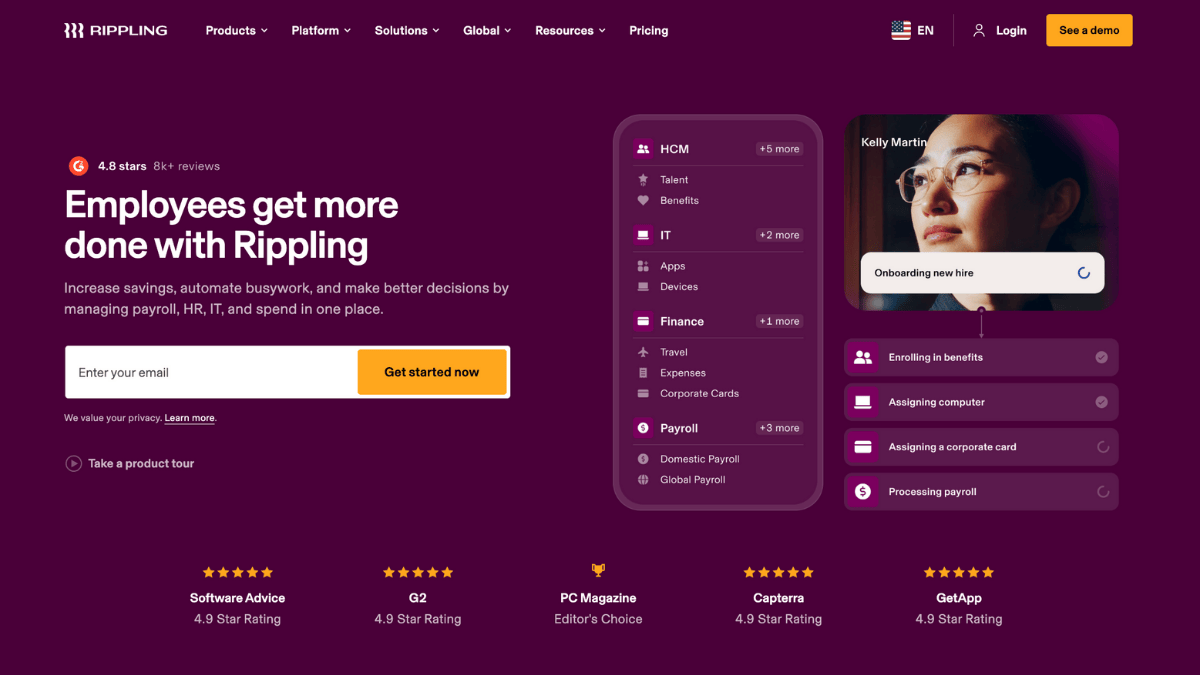
Key Services & Features of Rippling
HRIS/HCM
Rippling offers their HRIS/HCM system for companies in case they only need support wit their core employee management. Additional services like global payroll outsourcing, EOR, and IT can be added as additional modules. It acts as the central database for your employee information and makes sense in case you want your EOR employee, contractor and own employees all in one spot. Features include employee onboarding, document management, e signatures, time off tracking, or charts, HR workflows and integrations.This plan does not include payroll or benefits as it is only available for admin purposes.
Global Employer of Record (EOR)
Rippling’s Employer of Record service allows companies to hire full-time employees in countries where they do not have their own legal entity. In this model, Rippling becomes the official legal employer on paper and assumes responsibility for all local compliance requirements. This includes drafting fully compliant employment contracts, running your monthly payroll, administering statutory benefits, managing taxes and social contributions, and ensuring adherence to local labor laws.
Rippling handles your employees’ onboardings, the entire documentation management, local leave policies, mandatory benefits, and offboarding processes, ensuring each step aligns with country-specific regulations. All employment data flows into Rippling’s unified HRIS, meaning that EOR employees appear in the same system as contractors, and global payroll workers. The platform automatically updates local policies, notices, and employment terms based on changing legislation, reducing the risk of fines or non-compliance. By using Rippling, all you have to do is paying monthly invoices and they fund the employees’ payroll in the local currencies.
Global Payroll
Even if your company already owns legal entities abroad, Rippling can take over end-to-end payroll operations across all international locations from a single system. Rippling’s Global Payroll ensures all your employees are paid correctly and compliantly by managing country-specific tax filings, statutory deductions, social contributions, and required documentation on your behalf.
Their platform automatically applies local labor laws, tax rules, contribution thresholds, and reporting requirements for each jurisdiction, removing the need to work with multiple local payroll vendors. Rippling also supports multi-currency payroll, enabling you to fund payroll in one currency while employees are paid in their local currency, with automated FX handling and transparent breakdowns.
All calculations occur in real time, and payroll changes flow directly from Rippling’s core HRIS into payroll workflows, reducing manual entry and errors. This means if you have new hires, any kind of salary changes, added bonuses or your offboardings are depicted in the payroll. Rippling also consolidates all payrolls into one global dashboard, giving finance teams a unified view of payroll timelines, liabilities, employer costs, and compliance tasks across all countries.
This makes Rippling especially useful for companies operating multiple foreign entities that want to centralize payroll operations, standardize processes, and eliminate reliance on fragmented local vendors.
Global Contractor Management
Rippling offers two distinct contractor solutions depending on the level of support and legal protection a company needs: Agent of Record (AOR) and Contractor of Record (COR). Both services help companies engage international contractors compliantly, but they differ significantly in legal responsibility, risk protection, and cost.
1. Agent of Record (AOR)
AOR is Rippling’s standard contractor management solution and is available in 185+ countries. Under AOR, the contractor remains fully independent, and Rippling acts only as an administrative and compliance facilitator. This means Rippling is not the legal employer and can be compared with all standard contractor management solutions on the market. As the provider does not have real liabilities, this service comes at a low costs.
What Rippling provides under AOR:
- Contractor onboarding and document collection
- Contract generation and localized contract templates
- Global multi-currency payments
- Automated invoicing
- Built-in misclassification risk checks (ongoing monitoring)
Compliance alerts if the contractor relationship becomes “employee-like” - Easy conversion from contractor → EOR employee if needed
Who AOR is for:
Companies engaging legitimate freelancers who work autonomously, set their own hours, and work on defined deliverables. It is recommended if you do not require any additional employment protection.
2. Contractor of Record (COR)
Rippling’s COR service is used when a contractor is performing work that closely resembles that of an employee. In these cases, misclassification risk is high, so Rippling steps in as the legal employer of the contractor, similar to an EOR model but for contractor-type engagements.
What Rippling provides under COR:
- Rippling becomes the legal Contractor of Record
- The individual is employed under Rippling’s local entity
- Full compliance with local labor laws
- Payroll, taxes, social contributions, and mandatory benefits
- Reduced misclassification risk (Rippling assumes more legal responsibility)
- Same global contractor tools as AOR (invoicing, payments, system workflows)
Who COR is for:
- Work fixed hours
- Report to a manager
- Use company equipment
- Are critical to daily operations
- Have ongoing responsibilities rather than project-based deliverables
These scenarios often violate local contractor laws why COR protects companies by employing these individuals compliantly, though at a higher cost than AOR. Due to the additional liabilities from Rippling, they only offer COR for a subset of countries.
Overview of Rippling Pricing
While many providers do not charge extra for additional tech services, Deel has a modular pricing structure that means they charge extra for additional HRIS capabilities, IT management and spend management around 10 USD – 80 USD per employee per month depending on the service.
Payments & Fees:
- Service Fee: Depending on the country All service fees are exclusive of VAT or local taxes. Fees are non-refundable, except where expressively stated in a service order or refund clause. Pricing changes require at least 30 days prior notice.
- Deposits: EOR security deposit needs to be paid before onboarding and is usually 1-3 gross month salaries. Deposits are refunded once the employment relationship ends and all obligations are fulfilled (usually within 60 days)
- FX Rates: Rippling works with prevailing FX rates that include an currency exchange markup of up to 6%.
- Payment Service Provider Fees: Borne by the customer (e.g. intermediate bank fees)
Rippling Coverage: Owned Entities vs Partner Network?
Unlike pure-play EOR providers, Rippling started as an HRIS and payroll platform that later added employer of record services and that origin story shows in its entity footprint.
Rippling operates through a strategic network of owned legal entities in approximately 40 countries where it has the deepest operational presence and the most regulatory requirements. These aren’t just employment entities they include specialized subsidiaries for payments (with a hard-won EMI license in Ireland), PEO services, insurance, and money transmission. For the majority of its advertised “80+ country” EOR coverage, Rippling partners with third-party providers rather than incorporating its own entities.
We’ve mapped all of Rippling’s confirmed legal entities below.
How Rippling Is Scoring: Our Data-Driven Analysis
Rippling is a tech-first global employment platform that stands out for its unified HR, IT, and finance infrastructure. While its EOR offering is not as mature or globally uniform as enterprise-first providers, Rippling excels for companies that value automation, speed, and centralized control across people and devices.
4.0 /5.0
✓ EOR coverage across a growing number of countries
✓ Strong global HR foundation with expanding EOR footprint
✓ Broad service scope including HR, IT, payroll, benefits, and spend management
✓ Add-ons such as device provisioning, time tracking, and benefits included in ecosystem
✗ Coverage depth varies by country
✗ Some global services still rolling out or limited by entity footprint
4.0 /5.0
✓ Modular pricing allows teams to pay for what they use
✓ Clear pricing logic for platform modules
✗ No public EOR rate card
✗ EOR pricing typically ~$600–$700 per employee but requires custom quotes
✗ Total cost can become opaque as modules are added
3.0 /5.0
✓ Flexible, modular contracts
✓ Easy to add or remove services as needs evolve
✓ Clear terms for core HR and IT products
✗ Global EOR terms less transparent than domestic PEO contracts
✗ Some country-specific nuances not always visible upfront
4.0 /5.0
✓ Local advisors with 10+ years of experience
✓ Strong support responsiveness
✓ Fast payroll cycles – as quick as 5 days in supported regions
✗ Support depth varies by country
✗ More product-led than advisory-led for complex edge cases
4.0 /5.0
✓ Industry-leading unified HR, IT, and finance platform
✓ Automated device provisioning and access control
✓ Real-time compliance monitoring
✓ Best-in-class workflow automation and integrations
✗ Platform sophistication exceeds what some teams need
5.0 /5.0
Contract Terms
Rippling’s customer terms of service agreements follow standard SaaS best practices combining a robust legal framework with limited liability. Rippling states that they become the legal employer of your international worker through owned or licensed in-country entities. The customer maintains operational control of the employee while Rippling manages compliance, payroll and statutory obligations. All employment documentation is executed digitally via Rippling’s e-sign service which holds the same legal standing as handwritten signatures. This is according to local laws not always possible like in Germany or Mexico.
While Rippling provides the HR system, the customer is responsible for the accuracy of all information provided and to fund payroll on time to avoid compliance penalties and delays. Rippling states in their service contract that they do not offer tax, legal or financial advice and clients should seek independent counsel for compliance related matters. This is usually exactly the reason why customers use EOR. Further, Rippling states that any dispute shall be solved by binding, individual arbitration rather than in court. Rippling caps their total liability at the amount you paid to Rippling in the last 18 months.
Platform Deep Dive
Signing up with Rippling requires a sales call to identify the correct pricing, depending on modules that are required. For example, in addition to contractor management you may wish to sign up to the HR system, IT, finance, global payroll, or EOR solutions. Once set up, Rippling creates a unified workforce database that connects all EOR and contractors under one dashboard. You can then import existing records, define permission structures and add custom fields. For instance, you can add expiry dates of visas or certifications that trigger automatic alerts when they are about to expire and integrate with messaging tools such as Slack.
The onboarding flow of contractors is similar to EOR onboarding flow. This process includes a customized offer letter, contracts and tax documentation. You also have the option to do bulk onboardings for a large number of contractors. You can then assign devices, software access and permissions. Rippling automatically applies compliance checks depending on the country for all contractors that can include KYC, tax classifications, and maximum duration rules to ensure full compliance. If you hire contractors in various countries, they have the option to do unified onboardings to save time.
Contracts can be generated by using Rippling’s templates, customized with your own clauses or uploaded through your own drafted contract. Both parties can sign the contract digitally and the system logs those agreements with a timestamp.
Rippling integrates global payments, expense reimbursements and multi-currency payroll into one user interface. Customers can issue invoices directly on the platform, then the employer can review it and approve and pay the amount on the platform. Payments are processed via Rippling’s built-in global payroll network, supporting 100 currencies. The system can sync with accounting softwares like QuickBooks, Xero or NetSuite.
What makes Rippling stand out from other providers, is their vast amount of additional services that make it more than a contractor platform, but a full workforce operating system. This includes:
- Performance Reviews: Built-in tool to schedule reviews for contractors and employees, collect feedback and link results to pay adjustments.
- Learning Management System (LMS): Rippling built their own LMS system to create personalized training paths, compliance courses or upskilling programs.
- Pulse Surveys: Rippling’s admins and managers can also design and send internal surveys through Rippling to collect feedback like PULSE surveys and track results through extensive dashboards.
- Device Management: IT administrators can assign and track logins of devices used by contractors and employees.
Feed Function: Your own internal Twitter. A social, internal network style feed for your company allowing posts, announcements and recognition moments. - Permissions / Integrations: Rippling offers more than 500 integrations (e-g- Slack, Google Workspace, Zoom, Salesforce) with very granular access controls.
Rippling Integrations Deep Dive
Ripping integrates with more than 30 HRIS and ATS tools including BambooHR; Greenhouse, Ashby and Lever. They sync personal details, job info costs center and some documents bu-directional which means from Rippling to your system or the other way. The system is in real-time so when it is entered into either system, it is automatically synced to the other.
Rippling integrates with multiple systems in the ERP and finance space like QuickBooks, Xero, NetSuite and Sage Intacct. This can be helpful when you want your system to be updated with all payroll related information. Data that is synced is payroll journals, reimbursements, GL codes, and receipts. The offer bi-directional syncing and is instant after approval which means that once a payroll change is made in your system or in Rippling, after approval it is saved to the other system.
Rippling also offers integrations to expense softwares such as Expensify, Ramp and Brex. This includes all expense related data like expense amounts, receipts, approvals and spend category. The sync direction is bi-directional and the frequency is real-time syncing.
Rippling offers one of the most advanced HR and payroll REST API and webhook in the space. Its platform connects HRIS; payroll, IT, device management through a single dat model that enables synchronisation across all platforms. That means that you can also sync various external systems through Ripplings API to have a single source of truth. The open AI library has a list of 500 native integrations that can be done with little development effort.
Overall, Rippling definitely stands out as an integration leader in the EOR space. Its ecosystem goes beyond the standard HRIS or payroll connectors, but connects 500 systems across HR, IT, finance and security. Rippling’s integrations are directional and near real time which makes it a top choice provider in the space. Their custom API gives high flexibility for customization and is developer-friendly and well documented that makes it very easy to connect to all kinds of systems in the market. While Deel might be more simple to connect to, Rippling is quite ahead when it comes to integration depth, flexibility and automation potential.
Breadth of integration: 5/5
Depth of data sync: 5/5
Ease of setup: 4/5
Reliability: 5/5
API & Customization capabilities: 5/5
Rippling Pros & Cons
Rippling is one of the only global employment platforms that brings HR, payroll, device management, identity access, and finance controls into one centralized system. This unified architecture reduces tool fragmentation, eliminates manual data sync issues, and provides a single source of truth for global workforce operations.
Rippling has the largest integration ecosystems in the category. It connects with systems like Workday, Greenhouse, Okta, Xero, Slack, and more. This level of connectivity allows companies to automate hiring, onboarding, access control, payroll changes, and finance reconciliation with minimal manual effort.
Unlike Deel, Remote, or Oyster, Rippling includes native talent modules such as performance reviews, 1:1 tracking, employee surveys, and LMS capabilities. This gives companies an all-in-one platform for managing the full employee lifecycle without needing external HR tools like Lattice or Leapsome.
A major advantage of Rippling is its IT suite: automatic provisioning and deprovisioning, MDM, remote device controls, and SSO access management. This is especially valuable for companies with distributed teams, ensuring secure onboarding and fast offboarding with minimal IT overhead.
Rippling does not publish prices publicly. All modules — HRIS, EOR, contractor management, payroll, IT, finance — require a custom quote, making budget planning harder compared with competitors like Deel or Remote, which publish pricing online.
Rippling’s platform is built around a full workforce OS. For companies hiring only contractors, the system can feel overpowered and more complex than necessary. Contractor tools are functional but not as streamlined as Oyster or Deel’s contractor-first experience.
Unlike Deel’s compliance shield or Oyster Shell, Rippling does not advertise contractor misclassification insurance or financial guarantees. This means companies must rely on their own risk assessments, especially when using AOR. Alternatively, COR service can be used for additional protection but that comes at a higher costs than using AOR plus additional misclassification insurance.
Rippling excels as an enterprise HR system, but contractor tools are not its primary focus. Features like milestone payments, localized contractor restrictions, or advanced contractor analytics are more limited than specialized contractor platforms.
Who Is Rippling Best For
This visual highlights where this provider performs best across common buyer dimensions, based on Employsome’s independent, data-driven analysis. It reflects typical real-world usage patterns rather than marketing positioning.
Final Verdict on Rippling
Compare Rippling with Others





Written by
Courtney Pocock is a Copywriter & EOR/PEO Researcher at Employsome with 15+ years of experience writing for the HR, corporate, and financial sectors. She has a strong interest in global business expansion and Employer of Record / PEO topics, focusing on news that matters to business owners and decision-makers. Courtney covers industry updates, regulatory changes, and practical guides to help leaders navigate international hiring with confidence.
Our content is created for informational purposes only and is not intended to provide any legal, tax, accounting, or financial advice. Please obtain separate advice from industry-specific professionals who may better understand your business’s needs. Read our Editorial Guidelines for further information on how our content is created.