
Remote EOR Review (2026) – Features, Pricing & Verdict
Remote is one of the largest global EOR companies and focuses predominantly on the European market.


Table of Contents
In this expert Remote EOR review, we analyse one of the leading global Employer of Record providers in detail. Founded in 2019, Remote has quickly established itself as one of the “big three” EOR platforms alongside Deel and Papaya Global. Today, Remote operates primarily through owned legal entities and offers a flat-fee pricing model designed for fast, compliant international hiring.
Remote is especially popular with scale-ups and international tech companies hiring across multiple countries, thanks to its strong equity and stock-option support and its modern, self-service platform. Known for its clean product design and compliance-first approach, Remote combines automation with reliable local execution, making it a frequent choice for companies with straightforward global hiring needs.
To see how Remote performs in specific markets, you can explore our country-by-country EOR rankings and compare its scores, pricing, and local delivery quality across different countries.
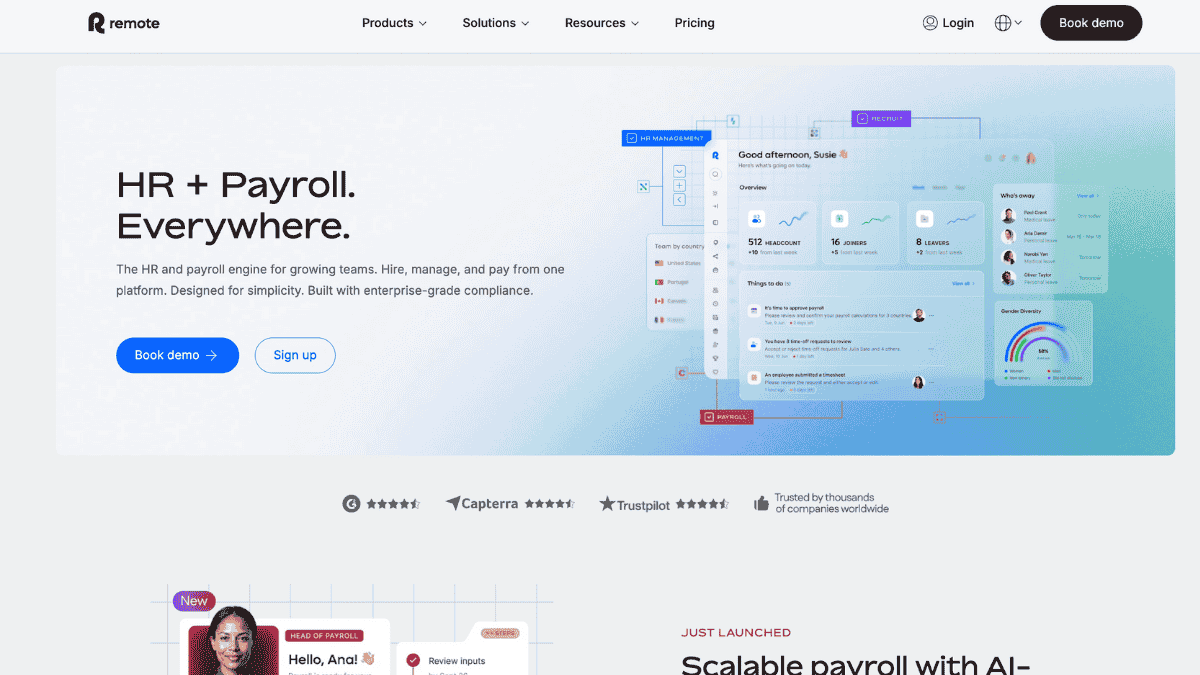
Overall impression of Remote EOR
Overall, Remote is an excellent choice if you want to work with one of the biggest providers in the market. It is best for teams that value speed and tech over heavy customization. We recommend it if you are a tech first company, startup or have straightforward EOR cases. If you require immigration support, a large set of customized integrations, and extensive legal support, you might want to consider other providers.

Key Services of Remote
Global Employer of Record (EOR)
Remote’s core offering is EOR and offers the full range of global employment. They mainly operated with their own entity.
- Automated onboarding & employment contract generation
- Local payroll, payslip creation, tax filings and statutory deductions
- IP protection
- Termination management and legal support
- Equity and stock options
Global Contractor Management
Remote also functions as a global contractor platform:
- Contract creation and onboarding
- Payment processing in multiple currencies
- Automated compliance check
- Centralised invoices and payouts
- Time tracking for independent contractors
Advanced HRIS (Remote HR)
Remote provides a well-designed HRIS so that you can use Remote not just as a EOR service or contractor management systems but as a full-fledged HR system. This system supports you managing global teams including
- Time off management
- Document storage
- Employee self onboarding
- Org Chart and reporting
- Integrations with many different applications
Remote Talent
Unusual for an EOR, Remote has its own global talent marketplace, giving businesses access to exclusive talent they may not otherwise be able to hire. Companies can discover pre-vetted international candidates. This can help startups or smaller companies to hire globally without recruiters.
Equity & Stock Options Support
Many early-stage startups can’t compete on cash salaries alone; they rely on equity and stock options to attract talent and align long-time incentives. Managing equity across multiple countries is compliance, with each jurisdiction having its own tax rules, vesting regulations and reporting requirements. This is one of Remote’s standout strengths. Remote can help you issue and administer equity grants globally.
Remote Pricing: Costs & Hidden Fees
Service Fee: Paid monthly, per EOR employee / contractor
Taxes: Fees exclude VAT, GST and withholding tax. Client must reimburse remote for any applicable taxes
Payment Terms: Invoices are due within 14 days
Late Fees: 0.1% interest per day
Deposit: EOR security deposits need to be paid before onboarding. Refunds are made 50 days after final invoices are cleared. Important: In case a client passes a credit check, no deposit is due with Remote.
FX Rates & Processing Charges: Foreign exchange and payment method fees must be paid by the client.
Contract Terms of Remote
Remote’s contract terms are similar to other EOR providers defining Remote’s responsibilities and of the client. Remote is responsible to follow all local labor, tax and employment laws, manage onboarding, payroll processing, tax remittances, benefits administration and termination on behalf of clients.
Meanwhile, clients must provide accurate information for employees and contractors, approve and fund payroll, and must pay Remote for all related costs. Remote’s liability cap per contract year is limited to the total fees paid for that year. All IP property created under EOR agreements is transferred to the client.
Remote’s contracts usually only provide limited flexibility as they issue 12 month term contracts. In case you want to test the market or want to let go of your employee, you might need to continue paying service fees to Remote.
Further, Remote’s contract automatically renews for additional 12 month periods. In case either party breaches the contract or in case of insolvency or unpaid fees, you or Remote can terminate with 30 days notice or immediately.
| Clause | Key Points |
| Billing Frequency | Monthly (per active employee or contractor) |
| Minimum Term | 12 months (auto-renewal) |
| Termination Notice | 30 days standard |
| Liability Cap | Annual service fees (5× for data/IP breaches) |
| Late Payment Penalty | 0.1% per day |
| Refund Processing Time | Up to 60 days post-termination |
| Data Governance | GDPR, CCPA, Data Privacy Framework compliant |
Remote Platform Deep Dive: Onboarding, Payroll, and Workflows
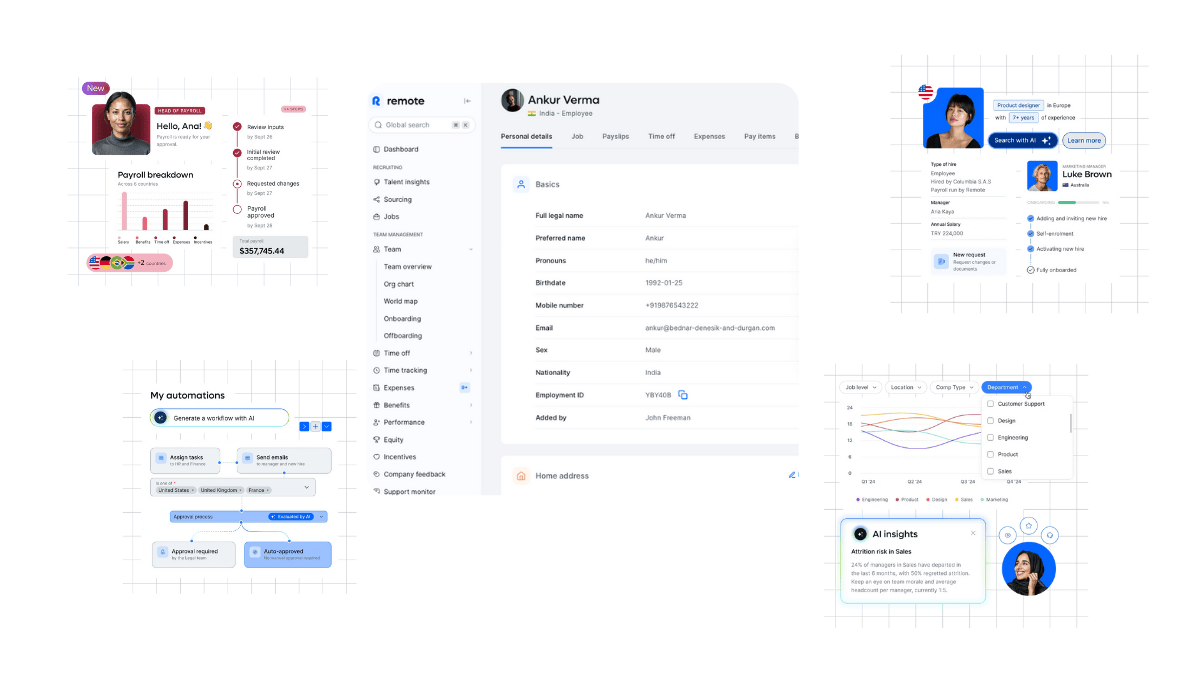

Sign Up & First Hire with Remote
Remote describes its onboarding process as a “streamlined customer process” emphasizing that account creation is simple and self-service. In practice, the process begins by account creation through their sign-up page, where you need to enter your name, company email and password.
After that, Remote, requests some additional information and agrees to terms of service. Once submitted, the user received a confirmation email that this person is the official owner of the company account.
You can then access the remote platform, but there are limitations until additional compliance and KYC/KYC processes are completed. Those checks are usually only required for EOR hiring and for contractors a lighter KYC/KYB process is done.
Although Remote offers this self-sign-up option, the option is not prominently displayed on the homepage. Unlike Deel or Multiplier, where the user is encouraged to set up their own account in a few clicks, Remote places more emphasis on you joining a sales call before signing up. This is a strategic design choice, as Remote’s core business is heavily focused on EOR, as margins are significantly higher than contractor management (often up to 10× higher per worker).

Contractor & Employee Onboarding
Once the company account is approved, Remote users can add their first EOR hires. The onboarding workflow is divided into two separate tracks: for EOR employees and contractors (contractor management and contract of record).While both share some steps, the EOR process has way more steps and is more compliance-driven.
During the new hire request the employer only adds the basic information of the employee or contractor and then sends the invoke link to the new hire. The employee or contractor logs them into the platform and adds or corrects the personal details, and for EOR add ID and tax documentation. Remote then checks if the person is eligible to follow this work relationship and does additional employment verification tests in line with local labour laws. Additionally, they enroll the person into their benefits programs if applicable.
The next step is the automated contract generation that is a localized employment contract or a contractor agreement. Depending on the country, you can define working hours, leave apologies, benefits, notice periods, area of work all in line with local laws. Employers can request custom clauses and additional non-standard benefits but remote’s legal team will review them before any contract is sent out.
Agreements for contractors are more simple: 3 types of contracts Fixed Rate, Milestone-based or Pay-as-you-go exist and can schedule either one-off or recurring payments.
For contractors, the onboarding is more or less instant, for onboarding it depends on the country but more realistically takes 7-14 days.

Payments, Payroll & Invoicing
Remote lets you consolidate all EOR and contractor transactions into a single monthly invoice making reconciliation for multiple countries easier. Invoices are broken down by employee/contractor, employer taxes/ contributions and service fees. Invoices are available in pdf, CSV and can be paid by bank transfer or ACH. If your invoice is in multiple currencies, Remote has a wallet function to allocate funds per currency.
Generally speaking, Contractor payments are way more flexible than for EOR employees as payroll cycles do not really exist.
Contractor payments must be approved and once Remote is paid, the payment is transferred to the contractor and converted into the contractor’s choice of currency. This process usually takes 2-5 days depending on the country and payment method.
The process is a bit more complicated when it comes to processing payroll for EOR employees. Payroll for most countries is processed on a monthly basis. Remote calculates salaries, benefits, taxes and employer burdens. The itemized invoice needs to be paid and once the payment is received, Remote distributes the salaries to the employees in local currencies and pays employer burdens. Depending on the the country, Remote uses the actual number of employer burdens so no invoices need to be adjusted later on, For some countries invoices need to be created earlier than Remote knows the actual costs, so Remote issues an additional reconciliation invoices including the changes that were made after cutoff (after mid month) that include for new hires, bonus and prorated adjustment.
Remote EOR Review of Integrations & Automations
With its strong software platform, Remote offers a wide range of third-party integrations to all sorts of tool. We’ve covered them in this section in detail.
HRIS & ATS Integrations
Remote integrates with leading HRIS, ATS, accounting and finance tools to sync employee data and reduce double manual entry. We want to point out that many providers in the market advertise their integrations without going into much detail.
Its around 20 integration and automation capabilities are used as a key selling point, but how deep are they really?
Remote integrates natively with major HRIS and ATS platforms. Confirmed integrations include BambooHR; HiBob, GoCo, Zelt, Personio, SAP Success Factors, Workday, Greenhouse and Level.
Remote’s HRIS integration has a clear system: HRIS is used as the source of truth, and Remote consumes the data. This one directional sync is more helpful than the other way, as many customers want to keep using their own systems. Remote pulls employee master data (like name, email, title, department, manager, start date etc) from your HRIS into Remote so you do not have to do double entries like during the onboarding process.
Furthermore, Remote enables you to sync time off data including approved future time-off from the HRIS into your system. This time-leave sync is only done one way (e.g. from Workday to Remote) and only for approved, future data requests for EOR and global payroll employees and not contractors.
During the set-up you would need to map the time of types from your system to Remote (e.g “PTO” in Workday is called “Annual leave” in Remote). Past leave, unapproved leave or mismatched policies will not be synced. This means Remote is a great “downstream employment system” but is not the place to manage the holidays and policies as data is not synced back to the HRIS.
Remote has very detailed integration manuals that make the syncing efforts fast to implement with little development effort.
ERP, Accounting & Billing
Remote connects directly with EPR and accounting systems like Xero, QuickBooks, NetSuite and Gusto. Through those integrations, Remote can automatically sync pre-funding and reconciliation invoices from Remote to systems like Xero as draft supplier bulls.
All invoice data fields like issue data, payment due, tax lines are mapped automatically to the correct fields in your billing system. A PDF copy of each invoice is attached and all tax entries are synchronized as distinct line items.
You can choose between two mapping modes:
- Standard invoice breakdown: Remote’s invoice line items like base salary, employer contributions and management fees are mirrored
- Department-based breakdown: groups costs by internal team structures enabling cleaner cost allocation
After setup, invoice data is pushed automatically from Remote to your system. Syncs typically occur monthly, when invoices are finalized between the first to 5th of the month. Alternatively, this can be triggered manually. Data does not flow back to Remote, so your accounting system acts purely as a downstream financial record.
The integrations also supports chart-of-accounts mapping allowing customers to assign e.g. Xero account codes to each invoice category. This reduces repetitive manual bookkeeping work and eliminates manual errors during journal closing. Remote’s accounting integrations ensure your finance teams get clean and ready-to-reconcile draft bills directly in their ERP.
Spend & Expense Management
Remote does not currently offer any type of expense management syncing. This means all expense exporting and management is done within Remote’s own dashboard. As Remote can integrate with Zapier there is the possibility to set this up but its not a native integration and development effort is required. Remote declared that it is part of there 2025 roadmap to offer expense management syncing but so far they are not announced any new updates.
Remote API, Automation & Productivity Tools
Remote offers a powerful public API and integration with productivity tools to help your company to streamline global workforce management across platforms.
Remote API
For deeper customization, Remote offers their own open REST API enabling your development team to connect to Remote’s data directly into their proprietary system or analytics dashboards. Available endpoints include
- Employee onboarding and profile updates
- Time-off management
- Expense creation and payroll data retrieval
A sandbox environment is provided for safe texting and no extra charge for the access.
Slack Integration
Remote’s Slack integration brings HR operation directly into your team’s favorite communication tool. Once enabled, it allows employees to
- Automate payroll and time-off approvals workflows with instant Slack notifications
- Receive personal reminders and performance alerts through private messages
- Capture Career Journal Entries directly from Slack for performance management
Setup takes only a few minutes and only requires an easy approval from your Slack workspace administrator.
Zapier Integration
Zapier allows user to automate repetitive tasks and connect Remote with over 5.000 apps including Personio, Slack, Google Calendar and Asana without any development effort.
Once connected, the team can:
- Add new hires to onboarding checklist automatically
- Sync employee data between Remote and HRIS systems
- Send notifications for upcoming performance reviews
- Sync time-off requests from Remote to shared calendars
Remote Device Management
In a partnership with Fleet, Remote simplifies global equipment logistics. Teams can
- Ship and manage devices to over 150 countries with 1-3 days
- Apply mobile device management (MDM) for compliance and data security
- Centralize device procurement, tracking and returns with Remote
Remote offers a selective but growing range of integrations. Its ecosystems include major HRIS platforms like Workday, babooHR and HiBob, and accounting tools like Xero and Quickbook, as well as productivity tools like Slack and Zapier. While these connectors cover key categories, the breath remains more limited compared to some other EOR competitors.
Remote performs extremely well when it comes to providing data accuracy and reliability as tehy provide secure one-way data syncs of different records. This sync usually only goes one way and requires some complexity.
Remote does currently not offer any kind of expense management syncs that can lead to high manual efforts. However, their API and customization capabilities are involved, giving more possibilities to developers to integrate with Remote.
Remote’s integration are reliable and secure and are best suited for mid-market and enterprise teams that are using mainstream HRIS or finance systems and want their data to be synced back to Remote. It is also suitable if you have an experienced development team that can customise your synchronizations further.
Pros & Cons of Remote EOR
Remote stands out with one of the clearest pricing models in the EOR market. Its flat US$599/employee/month rate is publicly displayed and identical for almost all countries, making budgeting predictable for finance teams. Unlike providers with variable or hidden fees, Remote’s pricing structure makes cost planning straightforward, especially useful for startups that need full visibility when scaling globally.
Remote is particularly strong for startups that rely heavily on equity-based compensation. The platform supports global equity and stock option administration, helping companies offer competitive packages without navigating country-by-country rules alone. For tech-focused teams, this makes Remote one of the easiest ways to issue and manage equity for international hires without separate systems or legal advice.
Remote’s interface is widely praised for being simple, intuitive, and consistent. The dashboard is easy to navigate for both admins and employees, reducing the time needed for onboarding, training, and daily operations. HR teams especially appreciate how clean the workflows feel making Remote one of the most user-friendly EOR platforms on the market.
Remote invests heavily in compliance, making it a safe choice for companies hiring in unfamiliar or highly regulated markets. From automated contract generation that respects local labor laws to strict employment standards, Remote reduces the risk of non-compliance, fines, or misclassification. This is ideal for companies that prioritize legal certainty and stability over speed or flexibility.
While Remote’s flat pricing model is simple, it can become expensive relative to local salaries in some markets. Regional EOR providers with country-specific pricing may offer lower rates; especially for junior or administrative roles. This can make Remote’s universal fee less competitive in certain scenarios.
Remote deliberately focuses on core global employment services. As a result, it offers fewer “extras” than providers like Deel like device management, spend cards, deeper IT integrations, or built-in recruitment tools. Companies that expect a broader all-in-one HR/finance/IT ecosystem can find Remote’s offering more limited.
How Remote Is Scoring: Our Data-Driven Analysis
Remote provides one of the strongest all-round EOR offerings on the market, known for its clean user experience, strong compliance foundations, and owned-entity infrastructure across most major hiring markets. Its predictable flat-fee pricing and outstanding equity support make it particularly attractive for startups and scaleups. While Remote is less flexible with contract terms and offers fewer add-ons compared to Deel, its reliability, transparency, and employee experience set it apart as a top-tier global employment partner.
4.6 /5.0
✓ Broad coverage in 150 countries including all major hiring markets
✓ Strong owned-entity footprint in core countries
✓ Consistent EOR, payroll, and benefits delivery
5.0 /5.0
✓ Public pricing with no salary-based commissions
✓ High transparency on employer costs
✗ Higher fees compared to other EORs
✗ High FX markups up to 8% FX rate
✗ Less flexibility for bespoke enterprise pricing
4.0 /5.0
✓ Standardised, compliant contract structure
✓ Clear IP transfer and liability terms
✓ No security deposits
✓ Predictable payroll and invoicing timelines
✗ Less contractual flexibility than advisory-led providers
Some customers report delays during complex terminations or immigration cases, but for standard global hiring needs, Remote delivers one of the most stable and trustworthy support experiences in the industry.
4.5 /5.0
✓ Strong reputation for responsiveness and reliability
✓ Clear guidance throughout onboarding and employment lifecycle
✓ Well-reviewed support across payroll and compliance topics
✗ Less personalised support for highly complex edge cases
4.5 /5.0
✓ Modern, intuitive, and easy-to-use platform
✓ Strong workflows for onboarding, payroll, benefits, and documents
✓ Minimal learning curve for HR and finance teams
✗ Integration ecosystem smaller than some enterprise suites
5.0 /5.0
Remote Ratings, Customer Reviews & User Feedback Analysis
Customer feedback for Remote is generally quite positive across the major review platforms. They like the usability of the platform and the reliability of payroll.
On Trustpilot (4.7/5), customers highlight how easy it is to onboard employees and navigate through the system. On G2 (4.6/5), businesses appreciate Remote’s clean interface, global coverage and great experience with support on payroll related questions. The sentiment is that Remote “works well” making it a quite basic and straightforward EOR solution. Critique comes from experience with slow support responses and delays in cases of terminations.
Interestingly, while customer reviews are very strong, employee reviews on Glassdoor (3.4/5) paint a different picture. Employees mention operational growing pains, internal organizational problems, and pressure from Remote’s seed. While it doesn’t directly translate into customer dissatisfaction today, it could indicate potential issues behind the scenes and can affect the customer support of the company.
Overall, Remote is well-liked by customers for its technology, ease of use, and predictable payroll performance. But you should still be aware as they are exceptions especially for more complex scenarios.
Who is Remote for and who is it not for?
This visual highlights where this provider performs best across common buyer dimensions, based on Employsome’s independent, data-driven analysis. It reflects typical real-world usage patterns rather than marketing positioning.
Final Verdict: Our Recommendation on Remote
Compare Remote with Others





Written by
Courtney Pocock is a Copywriter & EOR/PEO Researcher at Employsome with 15+ years of experience writing for the HR, corporate, and financial sectors. She has a strong interest in global business expansion and Employer of Record / PEO topics, focusing on news that matters to business owners and decision-makers. Courtney covers industry updates, regulatory changes, and practical guides to help leaders navigate international hiring with confidence.
Our content is created for informational purposes only and is not intended to provide any legal, tax, accounting, or financial advice. Please obtain separate advice from industry-specific professionals who may better understand your business’ needs. Read our Editorial Guidelines for further information on how our content is created.