
Papaya Global EOR Expert Review [2026]: Still Any Good?
Papaya Global is a global EOR and workforce payment platform that offers its EOR services solely through a third-party network.


Table of Contents
In our Papaya Global Review, we’ve taken a look at the Israeli payroll and workforce payments unicorn. Their platform is designed for mid-market and enterprise teams looking to manage teams across multiple countries at scale. It’s built around automation, workforce analytics, and payroll accuracy. We’ve tested it with a focus on Papaya Global’s partner-based EOR solutions.

Overview: Papaya Global at a Glance
Papaya Global is a global payroll and Employer of Record (EOR) platform focused on helping companies manage international payroll, employment compliance, and workforce payments at scale. The platform supports payroll, EOR, and contractor management over 100 countries, with a strong emphasis on automation, compliance controls, and centralized reporting for distributed teams.
Papaya Global is best known for its enterprise-grade payroll infrastructure, including proprietary payment rails, advanced analytics, and deep integrations with HRIS, ERP, and finance systems. Rather than operating primarily through owned entities, Papaya relies on a in-country partner based EOR model, which enables broad geographic coverage but can result in varying country-level execution.
Overall, Papaya Global is positioned as a strong fit for companies managing complex, multi-country payroll and compliance requirements, particularly those that value platform depth and global scale over localized, white-glove service.
Key Services Offered by Papaya Global
Global Employer of Record (EOR)
Papaya Global operates its EOR services only through local in-country providers (ICPs) to act as the legal employer. They do not own any legal entities themselves as they believe they’re able to provide a better service by doing so. We believe that this is debatable. Read their CEO’s memo on this topic “Why We Chose In-Country Partners Over Direct Entities for EOR” here).
Overall, their EOR services include:
- Fully compliant employment contracts
- Automated onboarding flows
- Local payroll management & statutory payments
- Benefits administration
- IP protection & confidentiality agreements
- Termination support with local legal review
Global Payroll
Papaya Global’s flagship product is its multi-country payroll outsourcing services, built for companies that need to run accurate, compliant payroll at scale. Instead of juggling dozens of local vendors, Papaya centralizes payroll operations for you into a single automated platform, giving HR and finance teams full visibility and control across every entity and workforce location.
Key facts about Papaya’s global payroll engine:
- Centralized payroll for over 100 countries (they’re marketing 160+. but we’re not a fan of mirroring a provider’s overpromised marketing language)
- Unified payroll dashboard across all global entities
- Automated calculations of tax, contributions, benefits
- Payroll approval workflows
- Payroll anomaly detection using AI
- Country-specific compliance monitoring
Global Contractor Management
For businesses working with freelancers across borders, Papaya provides a unified contractor management system designed to reduce admin load and minimize compliance risk. This module helps companies onboard, pay, and manage global contractors in a structured, compliant way.
This service includes:
- Contract templates
- Global payment processing
- Mass payouts
- Automated invoicing
- Compliance checks and misclassification insights
Global Workforce Payments
Unlike providers that rely heavily on third-party payment processors, Papaya has built its own payroll payments infrastructure. This allows companies to execute global salary disbursements faster, with higher transparency, better FX rates, and end-to-end tracking from funding to employee payout. Papaya offers mass payments to 160+ countries. Payments can be triggered in one click once payroll is approved with FX optimization in mind. Salaries transfer can be tracked in real-time tracking.
Workforce Intelligence
Papaya pairs payroll execution with advanced analytics that give leadership a real-time view of workforce spending across all countries. Their intelligence dashboard transforms raw payroll data into actionable insights, from employer cost modelling to variance monitoring, making global compensation easier to plan, forecast, and optimize.
Papaya Global Country Coverage: Owned Entities vs Partner Network
Papaya Global offers one of the broadest country coverages in the global payroll and EOR market, supporting over 100 countries across every major region. Unlike its direct competitors such as Deel, Remote or Oyster HR, who primarily operate through owned entities, Papaya Global delivers its EOR service through a network of vetted local partners.
This partner-first operating model comes with several important characteristics that we’ve summarised below.

EOR Delivered Through Trusted Local Partners
Papaya Global does not directly own legal entities in most countries. Instead, they work with established in-country experts who act as the local Employer of Record.
To ensure consistency, Papaya Global:
-
Audits partners for compliance and service standards
-
Uses unified, Papaya-standardized contracts (even with local partners)
-
Provides a clear escalation path for employment, payroll, and compliance issues
This gives clients a single global interface while still benefiting from deep local expertise.
Some of Papaya Global’s local partners include but are not limited to:
- Parakar (for Europe)
- TalentBank (for China)
- Africa Deployments (for Africa)
- AYP Group (for APAC)
- Gegidze (for Central Asia)

Strength in High-Complexity Regions
Papaya Global performs exceptionally well in jurisdictions where legislation changes frequently or labor law is highly nuanced. This includes:
-
LATAM (Brazil, Mexico, Argentina, Colombia)
-
APAC (India, Philippines, Indonesia, China)
-
Africa (Nigeria, Kenya, South Africa, Egypt)
Local partners in these regions often out-perform owned-entity models, as they already possess the legal infrastructure, compliance expertise, and cultural fluency.

Key Difference Partner Model (Papaya) Vs. Own Entity Model
| Category | Partner Model (Papaya Global) | Owned Entity Model (most other EORs) |
|---|---|---|
| Who Employs the Worker | Local in-country partner | Provider’s own local entity |
| Consistency | Can vary by partner/country | More consistent across markets |
| Onboarding Speed | Depends on partner workload | Generally faster and uniform |
| Compliance Strength | Very strong due to local specialists | Strong but centrally managed |
| Coverage | Over 100 countries | Typically 70–100 countries |
| Best For | Hard/complex markets & broad footprints incl. immigration | High-volume hiring in core markets |
| Support Escalation | Papaya Global → local partner | Direct internal escalation |
| Customisation Flexibility | Limited by partner rules | More flexible contracts & add-ons |
| Pricing Predictability | Slight variance by country | More standardised pricing |
How Papaya Global Is Scoring: Our Data-Driven Analysis
Papaya Global is one of the largest global payroll and EOR platforms, offering coverage in 160+ countries, deep automation, and enterprise-grade compliance. Its core strength lies in unified global payroll, strong data security, and proprietary payment infrastructure backed by J.P. Morgan. However, Papaya operates almost entirely through a partner-based EOR model, which introduces variability in onboarding speed, benefits, and support quality across countries.
3.9 /5.0
✔ EOR and payroll coverage in over 100 countries
✔ Global mobility and visa support available in many markets
✔ Benefits administration supported across multiple regions
✔ Contractor management and mass payments supported
✔ Strong expense and payments workflow coverage
✘ Country-level execution varies due to partner-based model
✘ Limited owned-entity footprint compared to entity-first EORs
✘ Background checks and advanced benefits depend on partners
✘ Immigration timelines vary widely by country
4.0 /5.0
✔ Publishes high-level pricing ranges on the website
✔ Clear pricing explanation for global payroll and contractor plans
✔ Sales team provides accurate quotes during the sales cycle
✘ EOR pricing sits at the very top of the market (~$650–$770 per employees
✘ EOR security deposit (1–2 months salary) significantly increase startup cost
✘ FX fees, partner fees, and payment processing charges add extra cost
✘ Final country pricing varies depending on local partner requirements
3.0 /5.0
✔ No long-term lock-ins beyond typical 30-day notice
✔ Standardized contracts and strict compliance frameworks
✔ Pre-funding and payment workflows designed for security
✔ Strong enterprise-grade liability and data security posture (SOC2, ISO27001, GDPR)
✘ Full pre-funding required before payroll execution
✘ Deposits required in many countries (1–2 months’ gross salary)
✘ Strict liability limitations, Papaya not responsible for third-party errors
✘ No credit card payment options, bank transfer only
4.0 /5.0
✔ Dedicated account manager for each customer
✔ Strong support for complex multi-country payroll environments
✔ High expertise in APAC, LATAM, and Africa via local partners
✘ Support response times inconsistent due to partner dependency
✘ Onboarding can be slower in certain regions
✘ Support escalations may require coordination between Papaya and partner entities
✘ No true self-serve onboarding; sales call required to get started
4.0 /5.0
✔ One of the strongest global payroll engines on the market
✔ Advanced analytics, workforce intelligence, and cost modeling
✔ Own global payment rails with real-time tracking
✔ Deepest HRIS, ERP, VMS, and finance integrations in the market
✔ Seven specialized automation connectors (HRIS, ERP, expenses, time tracking, etc.)
✘ No zero-touch onboarding
✘ Integrations may require minor technical configuration
✘ No self-serve trial or sandbox environment
4.5 /5.0
Papaya Global Contract Terms
Papaya Global’s Terms of Service define the legal framework for using its EOR, payroll, and workforce management platform. The terms place significant responsibility on the client to provide accurate data, fund payroll on time, and follow all legal requirements in the employee’s jurisdiction. Below is a clear summary of the most important contractual obligations based on Papaya’s official agreement.
Papaya Global acts as the intermediary providing workforce management services, including EOR (via local partners), payroll processing, payments, and compliance support. Under the terms:
- Papaya Global provides access to its SaaS platform.
- Services are delivered either by Papaya or by in-country partners (“ICPs”) who act as the legal employer.
- Papaya Global maintains the technology layer, reporting, analytics, and consolidated billing.
- Papaya Global does not assume liability for the performance of third-party partners, benefits providers, payment processors, or country partners.
Papaya Global is not responsible for verifying the accuracy of client data. In fact, Papaya Global explicitly states it relies on the customer’s inputs; if the client gives incorrect information, Papaya Global is not liable for miscalculations, tax errors, or compliance failures caused by client-provided data.
The customer must:
- Provide complete, accurate, and timely data for payroll, taxes, working hours, benefits, employment changes, and terminations.
- Review and approve payroll before processing deadlines.
- Fund payroll (including employer contributions, taxes, partner fees, benefits, and Papaya Global service fees) prior to payout.
- Ensure that its own actions do not violate local labor laws.
- Not instruct employees in a way that contradicts the local partner’s obligations.
- Maintain required insurance or coverage as necessary.
- Not use the services for unlawful or sanctioned activities.
Failure to follow these rules can immediately suspend services, increase required deposits, or terminate the agreement.
Papaya limits its liability to The total amount the customer paid to Papaya in the 12 months prior to the event
This is in line with Oyster HR’s and Deel’s limit, and slightly lower than Remote’s multi-year or 5x liability extensions on IP breaches.
In some cases of gross negligence or willful misconduct, the cap may expand, but Papaya explicitly excludes most consequential damage claims (see below).
Papaya explicitly excludes liability for:
- Loss of profits
- Revenue or business interruption
- Loss of data
- Loss of goodwill
- Indirect, incidental, or consequential damages
- Decisions made based on platform results or reporting
- Penalties or fines arising from client-supplied incorrect data
- Issues caused by third-party vendors or partners
- Employment disputes between the client and its workers
- Misclassification of contractors (Papaya is not the employer)
This structure heavily protects Papaya, similar to Oyster’s strict exclusions.
Payroll must be pre-funded. Payments are not executed until Papaya receives full cleared funds.
Papaya may require a refundable security deposit depending on:
- country
- local partner requirements
- employee risk profile
- termination cost exposure
Deposits can increase if:
- payment issues occur
- compliance problems arise
- the in-country partner requires extra security
Deposits are returned only after:
- the employment ends
- all invoices are settled
- all partner obligations have been discharged
If a client pays late:
- Papaya Global will charge interest
- services may be paused
- payroll may be delayed
- deposits may be increased
- Papaya Global may terminate the agreement
Under EOR employment:
- All IP created by employees is assigned to the client.
- For independent contractors, IP must be defined in the contractor agreement (Papaya Global does not guarantee IP for contractors unless the agreement explicitly states it).
- Papaya Global does not own or claim any IP.
This mirrors most EOR providers except Oyster HR, which has a more rigid IP template.
Either party may terminate the agreement:
- 30 days’ written notice for convenience
- Immediate termination for:
- breach
- non-payment
- illegal activity
- sanctions
- misuse of platform
- reputational or legal risk
- breach
The client remains responsible for all costs related to employee termination, including mandatory notice, severance, accrued benefits, taxes, and partner fees.
Papaya Global commits to:
- GDPR
- UK GDPZ
- CCPA
- SOC 2 Type II
- ISO 27001
- Secure data processing through sub-processors
Customers must:
- Maintain proper confidentiality
- Comply with data privacy obligations
- Ensure accuracy of all data supplied
Papaya may suspend service for security threats or improper use.
Papaya Global Platform Deep Dive: Onboarding, Payroll, and Workflows
Papaya’s platform is designed for mid-market and enterprise teams looking to manage multiple countries at scale. It’s built around automation, workforce analytics, and payroll accuracy.
Sign Up and Account Setup
Unlike most other providers that allows you to create test accounts or lets you onboard your first contractors or even EOR employees by yourself, Papaya Global does not offer that option. To get started, you must schedule a sales call with a Papaya Global representative through a general contact form. There is no option to book demos through timeslots online so you must go through an email back and forth to book. There is also no online demo or sandbox account to get any insights into the product.
This can be quite daunting in case you want to move fast and explore multiple providers simultaneously for contractors or their other services. Most competitors allow self-sign on for at least Agent of Record contractors, because they have no legal risk and therefore do not need to vet their customers beforehand. If you do not pay the contractor, they do not need to!
That said, once you have actually talked to a sales consultant and decide to onboard, you will receive a dedicated account manager and are able to access the platform.
Contractor & Employee Onboarding
Once you have gained access to the system, you can add and manage contractors using one of the following onboarding option:
- Bulk Onboard: Import a list of contractors by filling in a standardized template and upload in bulk
- Direct Entry: Add contractors manually, entering contract details, rates and payment preference through a dashboard on platform
- VMS Integrate: automatically import contractors data via an API integration with your vendor management system (VMS)
This flexibility allows your HR or finance team to onboard either manually just a few or hundreds of contractors at the same time without creating separate profiles. Thereafter, Papaya Global checks for compliance and payment readiness.
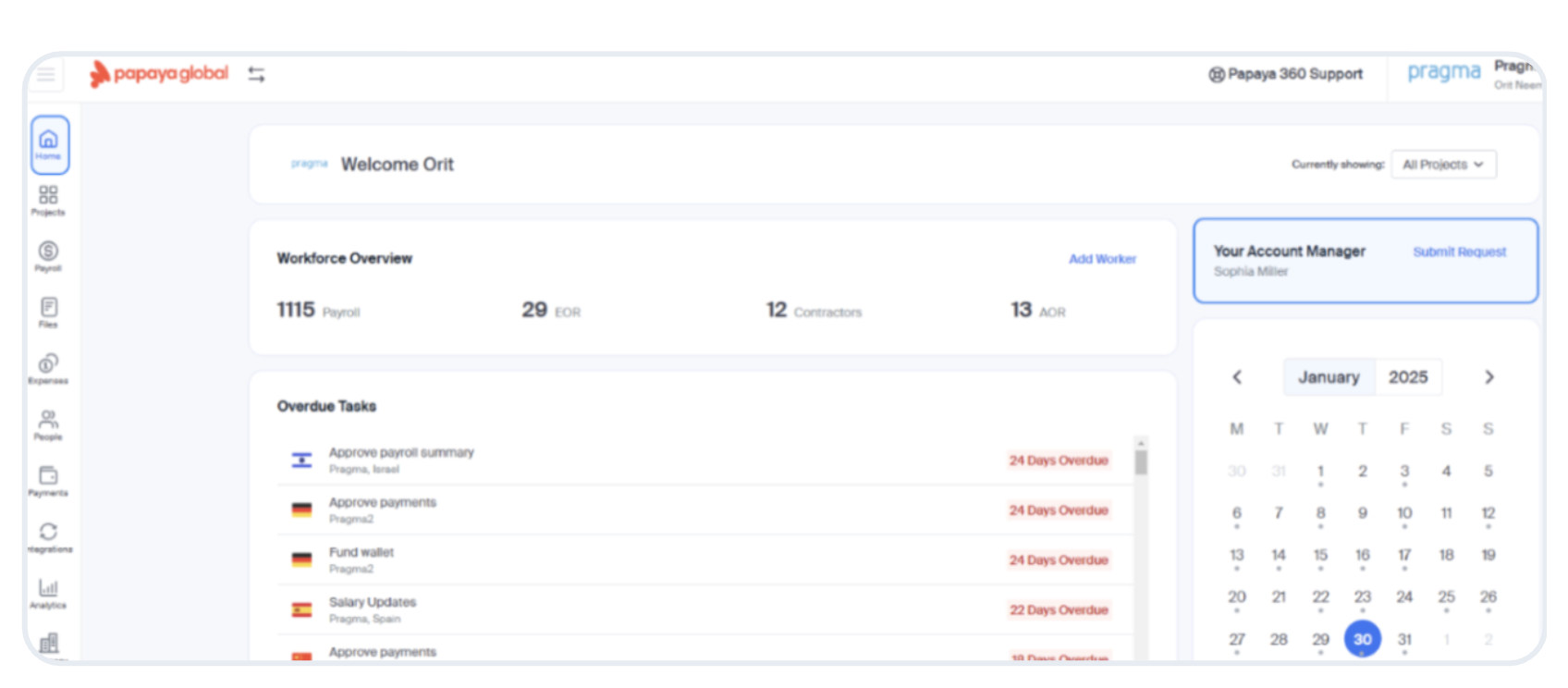
A centralized dashboard makes it easy for them to see the contractor status (active, invited, pending), country, currency and payment group of each contractor. They can also see which information is still required for the contractor to fill out.
The contractor onboarding also receives platform access as well to add and check all their personal data. They can add their bank details, payment preferences and tax information.
During the onboarding, papaya ensures the contractor meets local labour and tax laws before they pay out money to contractors.
Papaya Global also offers the setup of org charts for more complex admin structure. So if you have many employees or contractors with multiple reporting lines and levels you can set them up in a very visually pleasing org chart. Each person is tagged with their department. This setup is very important for bigger teams to for instance configure who can see whose payroll, who can accept whose expense or leave request.
The system generates localized contractor payments that can be reviewed, customised and sent to the contractor for e-signature. All signed contracts can be accessed through the platform
Payments, Payroll and Invoicing
Platform & ProcessPapaya offers a payment dashboard that allows clients with the right access rights to pre-fund digital wallets in various currencies and manage payroll approvals. A general difficulty for EOR providers is knowing how much to invoice, especially for EOR, as they only know the exact employer burdens, or even exchange rates or bank fees after they have invoiced you. Also if expenses or leave payments occur after the invoice is generated, some providers let you wait until the next invoice cycle. Therefore, they often need to correct invoices the next month with the actual amounts. This can lead to much confusion and intransparency. To bypass this problem, Papaya Global uses a wallet function instead. This means you have a wallet in each of the currencies you are invoicing. Once they correct invoices, they just load the money back on your wallet to reuse for the next month. The wallet also states the missing funds that are required for the next payment cycle. This means you are not just invoiced for each separate contractor separately but you can make one payment to papaya global for each single invoice currency.
Prior you need to approve all payments and transfer minimum 3 days before the scheduled funding date. Payments can be accepted in the “Payment Management” dashboard, where you can filter according to project, pay period, status and some other filters. You can also approve payments in bulk.
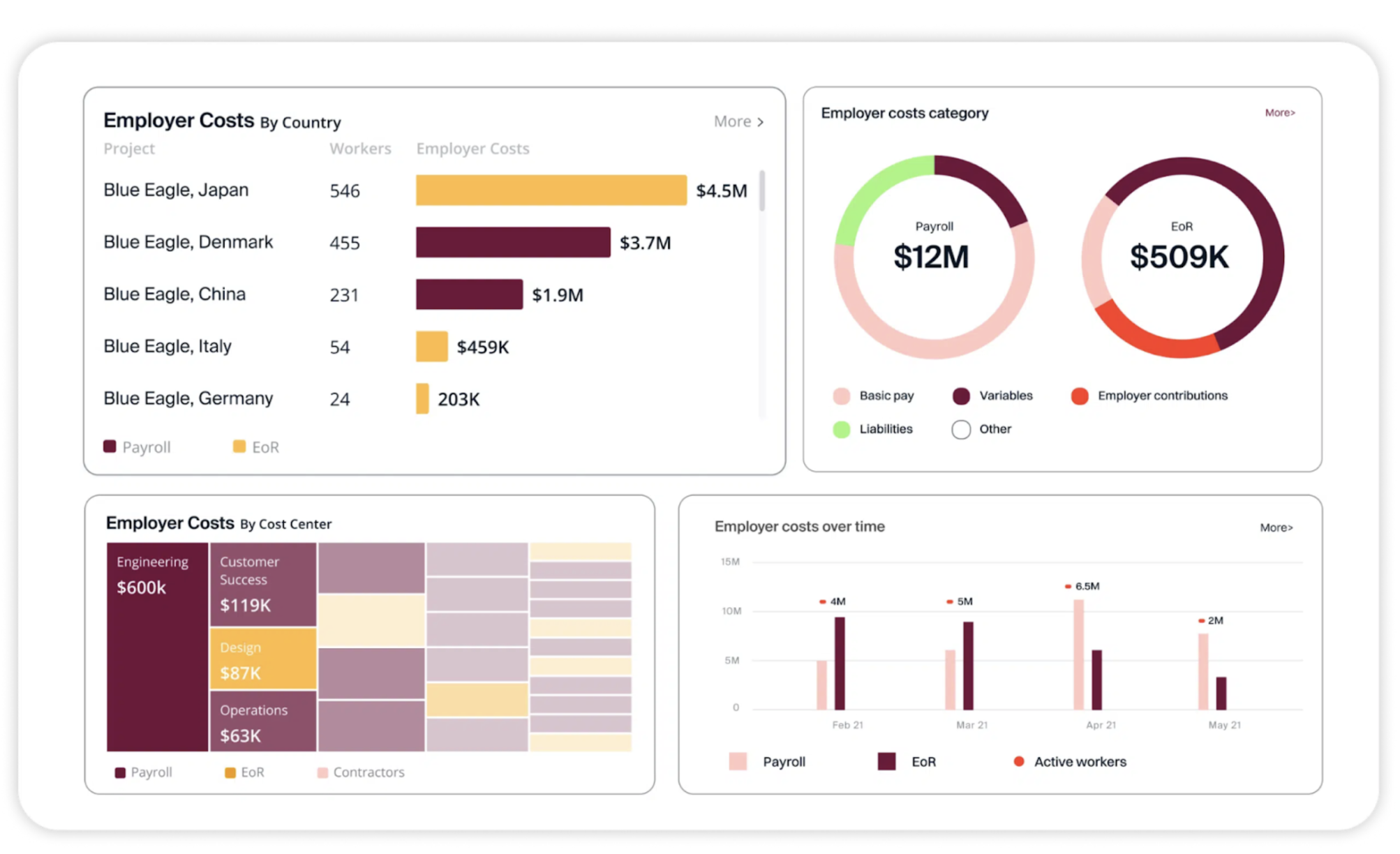
Papaya also has a very detailed Payroll Analytics dashboard that provides great transparency for payroll, EOR and contractor costs. You can filter and monitor costs by country, department, see exact employer costs fluctuations and trends. Papaya also has the option to forecast your payroll costs so you and your finance team can plan with upcoming expenses.
Pros & Cons
Exceptional payroll accuracy: One of the strongest global payroll engines in the industry, built for multi-country operations.
Deep integrations: Best-in-class HRIS & ERP connectors (Workday, SAP, Netsuite, BambooHR, etc.).
Advanced payments infrastructure: Proprietary global payment rails with fast payouts and strong FX transparency.
Enterprise-grade compliance: Robust controls, anomaly detection, and strong reporting for HR & finance teams.
Higher pricing: EOR and payroll fees sit at the top end of the market.
Reliance on in country partner: Can result in slower onboardings, less straight forward support and less flexibility.
Deposits & pre-funding required: Higher deposits can result in cash flow pressure
No misclassification insurance: Less protection for hiring contractors globally
Who Papaya Global Is For?
This visual highlights where this provider performs best across common buyer dimensions, based on Employsome’s independent, data-driven analysis. It reflects typical real-world usage patterns rather than marketing positioning.
Final Verdict on Papaya Global
Compare with Other Providers





Written by
Dane Cobain is a Copywriter at Employsome and an accomplished author whose work spans fiction, non-fiction, and professional writing. Over the past decade, he has built a strong track record creating straightforward content for the HR, payroll, and corporate sectors. Dane brings a storyteller’s eye to the evolving world of global employment, with a particular focus on Employer of Record and PEO models. His articles explore industry trends and dedicated Best Of Guides when managing an international workforce.
Our content is created for informational purposes only and is not intended to provide any legal, tax, accounting, or financial advice. Please obtain separate advice from industry-specific professionals who may better understand your business’ needs. Read our Editorial Guidelines for further information on how our content is created.