
Minimum Wage in Vietnam 2026: Regions, Decree 293 & Costs
Vietnam operates a four-region minimum wage system under Decree 293/2025/ND-CP, effective 1 January 2026. Region I (Hanoi, HCMC) is now VND 5,310,000/month (~$210), with rates dropping to VND 3,700,000 in Region IV. This guide covers every regional rate, the 23.5% employer burden, vocational training uplift, overtime premiums, 13th-month salary practice, enforcement rules, and how international employers can hire in Vietnam compliantly.


Minimum Wage vs Average Wage in Vietnam
Vietnam’s minimum wage is considerably lower than actual market salaries for most professional roles. Understanding this gap is essential for setting competitive compensation.
As of Q4 2025, the average monthly wage in Vietnam was approximately VND 8,684,000 (~$340 USD) according to ILO Vietnam labour market data and the General Statistics Office (GSO). This national average is heavily weighted down by agricultural and rural workers. In urban centres like Hanoi and Ho Chi Minh City, professional salaries run significantly higher.
|
Role Type |
Typical Monthly Salary (VND) |
Approx. USD |
|
Region I minimum wage |
5,310,000 |
~$210 |
|
Entry-level factory worker |
6,000,000 – 10,000,000 |
~$237 – $395 |
|
Customer service / call centre |
8,000,000 – 12,000,000 |
~$316 – $474 |
|
Mid-level professional (Hanoi/HCMC) |
15,000,000 – 25,000,000 |
~$593 – $988 |
|
Engineering / manufacturing supervisor |
18,000,000 – 30,000,000 |
~$711 – $1,186 |
|
Software developer (mid-level) |
25,000,000 – 40,000,000 |
~$988 – $1,581 |
|
Senior software engineer (HCMC) |
50,000,000 – 80,000,000 |
~$1,976 – $3,162 |
The gap between the minimum wage and actual market rates widens significantly for knowledge work. A senior software engineer in Ho Chi Minh City can earn 10-15x the Region I minimum wage. For manufacturing supervisors, the multiple is closer to 4-6x. This gap is essential to understand when setting compensation bands — paying at minimum wage for a skilled role will not attract quality talent in urban Vietnam.
For more detailed salary benchmarks by sector, seniority, and city, see our comprehensive average salary in Vietnam guide.
13th Month Salary, Tet Bonus, and Other Pay Premiums
While the 13th month salary is not a legal requirement in Vietnam, it is a near-universal market practice. Most employers pay it as part of the Tet bonus (Lụơng tháng 13), timed to the Lunar New Year holiday in January or February.
Typical Tet bonus structures:
- Minimum expectation: one month’s salary (the traditional 13th month)
- Market standard for professional roles: 1.5-2 months of salary
- High performers / competitive sectors: 2-3 months, occasionally more in banking, IT, and FDI companies
Employers that do not pay a Tet bonus risk significant attrition around Lunar New Year, when employees often switch jobs. The bonus is factored into total compensation expectations even when it is not written into the employment contract.
Additional statutory payments beyond minimum wage:
Vocational training premium: Employees who have completed vocational training (officially certified) must be paid at least 7% above the regional minimum wage. This applies to a broad range of roles and is enforced during labour inspections.
Hazardous / arduous work premium: Jobs classified as particularly hazardous, dangerous, or requiring especially heavy labour must be paid at least 5-7% above the base rate.
Annual leave: Minimum 12 working days per year (increasing by 1 day every 5 years of service), plus 11 public holidays.
Meal allowance: Not legally required but widely expected. Market practice is VND 30,000-50,000 per working day (~$1.20-$2.00) either as cash, meal vouchers, or canteen subsidy.
Enforcement, Penalties, and Common Compliance Mistakes
Vietnam’s minimum wage is enforced by the Ministry of Labour, Invalids and Social Affairs (MOLISA) and its provincial Departments of Labour, Invalids and Social Affairs (DOLISA). Compliance is checked during routine labour inspections and can be triggered by employee complaints.
Common compliance issues for international employers:
- Wrong regional rate: Applying Region II rates in a Region I location (e.g. assuming a Hanoi co-working address falls outside Region I when it does not)
- Missing the vocational training 7% uplift: Paying the base minimum rather than minimum + 7% for trained workers
- Incorrect overtime calculations: Paying 150% for weekend work when 200% is required, or failing to compound night overtime correctly
- Trade union fee omission: Forgetting the 2% payroll contribution to the trade union fund
- Late salary payment: Vietnamese law requires salary to be paid on the agreed date; delays beyond 15 days require interest compensation
Penalties for minimum wage violations under Decree 12/2022/ND-CP:
- Fines of VND 30-150 million (~$1,185-$5,929) depending on number of affected employees
- Mandatory back-pay of the shortfall plus interest
- Potential suspension of business operations for repeat violations
- Reputational damage from inclusion on the MOLISA public list of non-compliant employers
Vietnam operates an efficient electronic labour inspection system (Thanh tra Lao động trực tuyến), and DOLISA can cross-check payroll declarations against social insurance filings to detect underpayment patterns.
💡 Employsome Insight: Run a Regional-Rate Audit Annually
Vietnamese employees are generally well aware of their rights, and complaints to DOLISA are common — particularly in Region I where there is a strong concentration of FDI employers and local labour NGOs. Any international company hiring directly in Vietnam should run a regional-rate audit at least once a year to make sure each office or branch is applying the correct minimum wage and that the vocational training uplift is correctly applied.
How International Employers Hire in Vietnam
For international companies hiring in Vietnam, there are three practical paths — each with very different implications for minimum wage compliance and total cost.
1. Set up a local legal entity. Requires registering a Representative Office or Limited Liability Company, obtaining an Investment Registration Certificate, opening a Vietnam Dong bank account, and registering with local tax and social insurance authorities. Timeline: typically 3-6 months. Cost: $8,000-$20,000 in setup fees plus ongoing compliance costs. Makes sense when hiring 10+ employees in Vietnam long-term.
2. Hire through an Employer of Record (EOR). The EOR is the legal employer of your Vietnamese team and handles all payroll, tax, social insurance, trade union fees, and labour law compliance. You direct the day-to-day work. Timeline: typically 2-4 weeks to onboard new employees. Cost: monthly service fee per employee plus the full employer burden. Makes sense for teams of 1-10, market testing, and short-to-medium-term hires.
3. Engage contractors. Independent contractors (freelancers) are not subject to minimum wage rules, social insurance contributions, or the trade union fee. However, Vietnamese tax authorities closely scrutinise long-term contractor relationships that resemble employment. Misclassification can result in reclassification as an employee plus back-payment of all social insurance contributions, interest, and penalties.
The EOR route has become increasingly popular for global companies hiring in Vietnam because it provides full labour law compliance (including minimum wage, regional rates, vocational uplift, and trade union fees) without the multi-month entity setup. For more on how EORs handle Vietnamese employment compliance, see our best EOR in Vietnam guide.
Hiring in Vietnam without an entity?
Vietnam’s four-region minimum wage system, 23.5% employer burden, and trade union fee make in-country compliance harder than it looks. Compare the top Employer of Record providers for Vietnam to onboard your team in weeks, with full compliance built in – independent rankings, verified pricing, and local regulatory coverage from Employsome’s research team.
Frequently Asked Questions
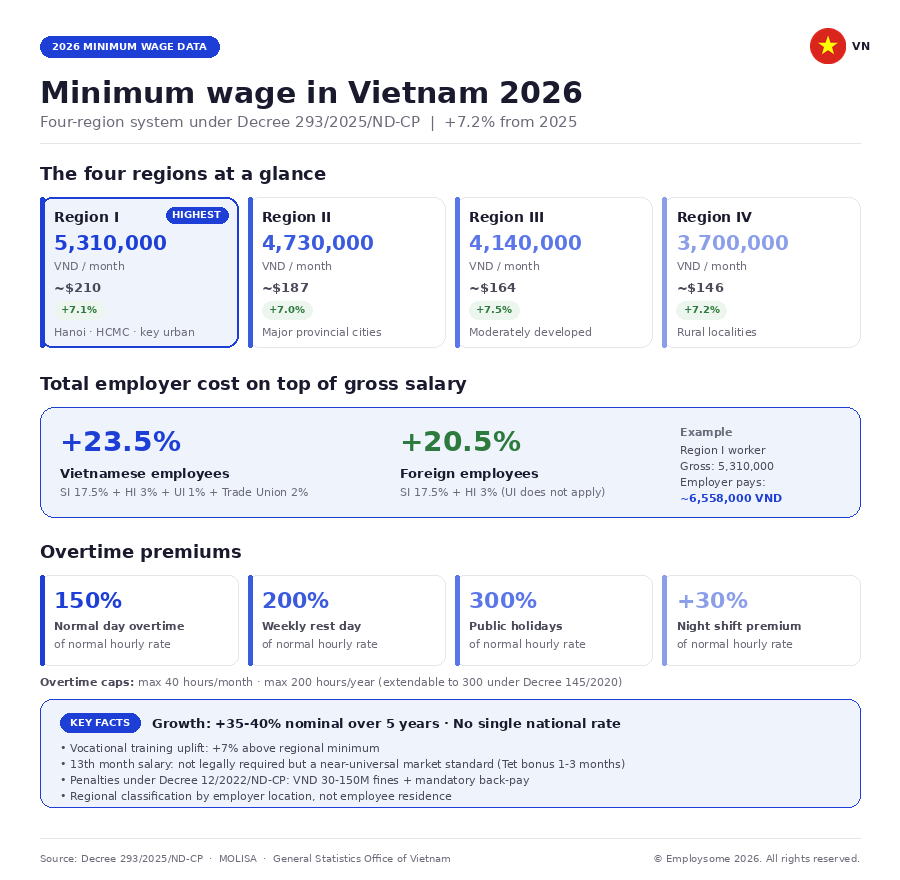
Vietnam operates a four-region minimum wage system. From 1 January 2026 under Decree 293/2025/ND-CP, the monthly minimums are: Region I (Hanoi, Ho Chi Minh City, key industrial districts) VND 5,310,000 (~$210), Region II VND 4,730,000 (~$187), Region III VND 4,140,000 (~$164), and Region IV VND 3,700,000 (~$146). Hourly rates range from VND 17,800 to VND 25,500. The 2026 increase averaged 7.2% across all regions.
The regional minimum wage is determined by where the employer operates, not where the employee lives. Region I covers the most economically developed urban areas, while Region IV covers rural and less developed areas. Employers with branches in different regions must apply the correct minimum wage for each location. If an industrial zone or high-tech park spans areas with different minimum wages, the highest applicable rate applies.
No, the 13th month salary is not legally required in Vietnam. However, it is a near-universal market practice, typically paid as the Tet bonus around the Lunar New Year in January or February. Typical amounts range from one month’s salary (traditional 13th month) to 2-3 months for professional roles in competitive sectors. Employers that do not pay a Tet bonus risk high attrition at Lunar New Year.
Employers pay approximately 23.5% on top of gross salary: Social Insurance 17.5%, Health Insurance 3%, Unemployment Insurance 1%, and Trade Union Fee 2% (mandatory even without an internal union). For an employee at the Region I minimum wage of VND 5,310,000, total employer cost is approximately VND 6,558,000 per month. For foreign employees, unemployment insurance does not apply, reducing the employer rate to 20.5%.
Employees who have completed certified vocational training must be paid at least 7% above the regional minimum wage for their area. For a Region I worker, this means VND 5,681,700 instead of VND 5,310,000. This applies to a broad range of trained positions and is checked during labour inspections. Missing this uplift is one of the most common compliance mistakes by international employers.
Vietnam’s Labour Code requires 150% of the normal hourly rate for normal working day overtime, 200% for weekly rest day overtime, and 300% for public holiday overtime. Night shift work (10pm-6am) carries an additional 30% premium, and night overtime adds another 20% on top of the overtime rate. Maximum overtime is 40 hours per month and 200 hours per year (extendable to 300 hours/year in specific industries under Decree 145/2020/ND-CP).
Vietnam has increased the minimum wage almost every year for the past decade, with exceptions during 2020-2021 when increases were deferred due to COVID-19. Typical annual increases range from 5-8%. The trend is expected to continue as the government balances worker welfare with maintaining Vietnam’s cost competitiveness in manufacturing and outsourcing. The minimum wage has risen approximately 35-40% in nominal terms over the past five years.
Yes, through an Employer of Record (EOR) provider. The EOR becomes the legal employer of your Vietnamese team, handling payroll, social insurance, health insurance, unemployment insurance, trade union fees, tax withholding, and all minimum wage and regional rate compliance. You direct day-to-day work. This approach typically onboards new employees in 2-4 weeks versus 3-6 months for entity setup, making it popular for teams of 1-10 or market-testing scenarios. See our best EOR in Vietnam guide.
Copywriter
Christa is a Copywriter at Employsome with 17 years of professional writing experience across global brands, startups, and online publications. A native English-Finnish writer, she brings strong editorial skills and a versatile background in business, SaaS, and finance. At Employsome, Christa focuses on clear, practical content about HR, payroll, and Employer of Record topics.
Our content is created for informational purposes only and is not intended to provide any legal, tax, accounting, or financial advice. Please obtain separate advice from industry-specific professionals who may better understand your business’s needs. Read our Editorial Guidelines for further information on how our content is created.