
Minimum Wage in Tunisia 2026: SMIG, SMAG & Hourly Rates
The minimum wage in Tunisia in 2026 is TND 528.32 per month (USD 168) for the 48-hour workweek and TND 448.24 (USD 142) for the 40-hour workweek under SMIG, plus TND 20.32 per day for agricultural workers under SMAG. This guide covers the dual SMIG and SMAG framework, hourly equivalents, the legal framework, recent wage history, overtime rules, and penalties for non-compliance under the Tunisian Labour Code.
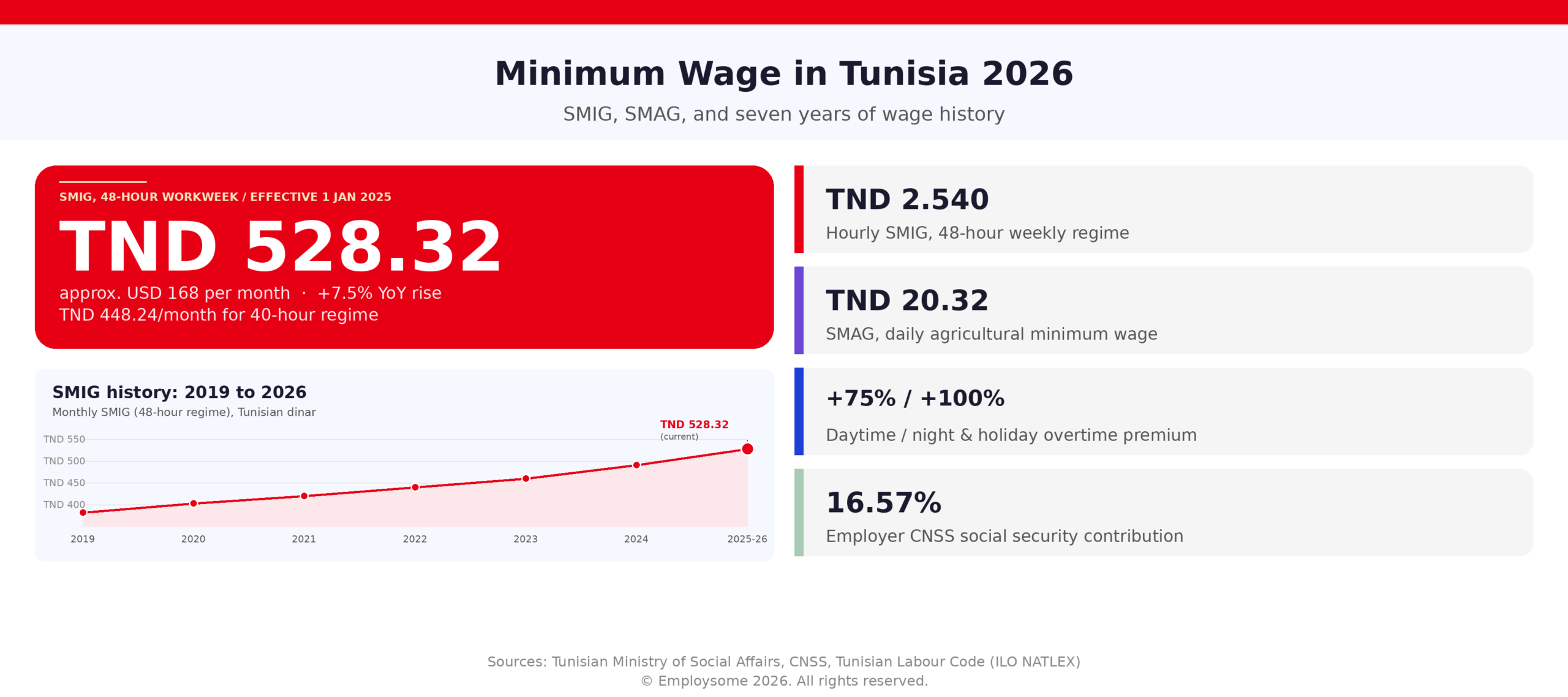
The minimum wage in Tunisia in 2026 for non-agricultural workers is TND 528.32 (USD 168) per month for the standard 48-hour workweek and TND 448.24 (USD 142) per month for the 40-hour workweek, effective from 1 January 2025 under the most recent government decree. The agricultural minimum wage (SMAG) is set at TND 20.32 per day. Tunisia operates a unique two-track system that distinguishes between industrial/service workers (SMIG) and agricultural workers (SMAG), with the SMIG itself further split into 48-hour and 40-hour weekly regimes.
The 2025 adjustment raised the 48-hour SMIG by TND 36.82 per month (a 7.5% increase from the prior TND 491.50), reflecting Tunisia’s response to persistent inflation, dinar depreciation, and rising cost-of-living pressure. Tunisia’s minimum wage is set by government decree after consultation with the Tunisian General Labour Union (UGTT) and the Tunisian Confederation of Industry, Trade, and Handicrafts (UTICA), with recommendations from the National Committee on Social Dialogue.
This 2026 guide to the minimum wage in Tunisia covers the current SMIG and SMAG rates, hourly equivalents, the difference between the 48-hour and 40-hour regimes, the legal framework set by the Tunisian Labour Code, recent year-over-year increases, the role of UGTT and UTICA in wage negotiations, sectoral collective agreements that may set higher floors, overtime rules, and penalties for non-compliance.

Tunisia Minimum Wage 2026: SMIG and SMAG Rates
Tunisia maintains two parallel minimum wage rates, both denominated in Tunisian dinar (TND) and set by government decree. The figures below reflect the rates that came into effect on 1 January 2025 and remain in force in 2026.
| Minimum Wage Type | 2026 Rate (TND) | USD Equivalent | Notes |
| SMIG (48-hour workweek), monthly | TND 528.32 | ~USD 168 | Standard regime for industry, services, manufacturing |
| SMIG (48-hour), hourly | TND 2.540 | ~USD 0.81 | Based on 208 monthly hours (48 × 52 / 12) |
| SMIG (40-hour workweek), monthly | TND 448.24 | ~USD 142 | Increasingly common in office and service roles |
| SMIG (40-hour), hourly | TND 2.586 | ~USD 0.82 | Based on 173.33 monthly hours (40 × 52 / 12) |
| SMAG (agricultural), daily | TND 20.32 | ~USD 6.45 | Per day for full-time agricultural labour |
| Effective date of current rates | 1 January 2025 | n/a | Last revision; periodically reviewed |
| Penalty for non-payment | TND 24 to 60 per worker | ~USD 8 to 19 | Doubled for repeat offences |
Why Tunisia has two SMIG rates: The Tunisian Labour Code recognises two standard working-time regimes. The 48-hour week is the historical baseline used in most industrial, manufacturing, and traditional service sectors. The 40-hour week is increasingly common in modern office environments, white-collar professions, and sectors covered by collective agreements that have shortened working hours. Both regimes have separate SMIG rates calibrated so that the hourly minimum is roughly equivalent (TND 2.540 vs TND 2.586), but the monthly totals differ because of the different number of contractual hours.
SMIG vs SMAG: SMIG (Salaire Minimum Interprofessionnel Garanti) covers industrial and service workers and is the more widely applied rate, covering the formal urban workforce. SMAG (Salaire Minimum Agricole Garanti) covers agricultural workers and is denominated as a daily rate rather than monthly, reflecting the seasonal and piece-work nature of much agricultural labour. Both rates are revised together under the same government decree.
💡 Employsome Insight: Always Confirm 48-Hour or 40-Hour Regime Before Setting Pay
When budgeting Tunisian roles, always confirm which SMIG regime applies before finalising offers. A 40-hour SMIG worker is paid TND 448.24 monthly; a 48-hour SMIG worker is paid TND 528.32 monthly, but the hourly rates are nearly identical. The difference of TND 80 per month reflects 8 fewer contractual hours per week, not a lower hourly entitlement. Misapplying the wrong regime produces both compliance risk (under-payment claims) and budgeting errors that compound over time.
Legal Framework: How Tunisia Sets Its Minimum Wage
Tunisia’s minimum wage framework sits within the Tunisian Labour Code (Code du Travail), which was originally adopted in 1966 and has been amended multiple times since. The Code grants the government authority to set and revise minimum wages by decree, after consultation with representative employer and worker organisations.
The wage-setting process:
- Recommendations are made by the National Committee on Social Dialogue, a tripartite body chaired by the Minister of Social Affairs
- The Committee consults with the Tunisian General Labour Union (UGTT, Union Générale Tunisienne du Travail), the country’s largest and most influential trade union confederation
- It also consults with the Tunisian Confederation of Industry, Trade, and Handicrafts (UTICA, Union Tunisienne de l’Industrie, du Commerce et de l’Artisanat), the leading employer association
- Once a recommended rate is agreed, the government issues a binding decree that applies across all covered sectors
- Sectoral collective bargaining agreements may set higher rates for specific industries or job categories, but cannot fall below the statutory SMIG or SMAG floor
Frequency of revision: Tunisia’s minimum wage is reviewed periodically rather than on a strictly fixed schedule, typically every 1 to 2 years. Adjustments are usually triggered by macroeconomic pressures including inflation, exchange rate movements, fiscal subsidy reform, or social dialogue commitments made under IMF or World Bank reform programmes. Recent revisions came in 2022 (TND 440), 2023 (TND 460), 2024 (TND 491.50, +7%), and 2025 (TND 528.32, +7.5%).
Sectoral collective agreements: Beyond the statutory SMIG, many industries operate under conventions collectives sectorielles (sectoral collective agreements) negotiated between UGTT-affiliated unions and employer federations. These set higher minimum wages tied to specific job categories, skill levels, and seniority bands. For example, sectoral collective agreements in banking, telecommunications, and manufacturing typically set entry-level minimums well above the statutory SMIG, sometimes 50 to 100% higher. Always check the relevant sector agreement before structuring a Tunisian salary.
Minimum Wage History: Five Years of Increases
Tunisia’s minimum wage has risen consistently over the past five years, reflecting both inflation and government policy commitments to support purchasing power. The table below shows the SMIG (48-hour workweek) trajectory.
| Year (effective from) | SMIG 48hr Monthly (TND) | YoY Change | Notes |
| 2019 | TND 382.00 | n/a | Pre-revolution baseline |
| 2020 | TND 403.00 | +5.5% | Pandemic-era adjustment |
| 2021 | TND 420.00 | +4.2% | Modest rise |
| 2022 | TND 440.00 | +4.8% | Inflation-driven increase |
| 2023 | TND 460.00 | +4.5% | Continued upward trend |
| 2024 | TND 491.50 | +7.0% | Larger increase amid high inflation |
| 2025-2026 (current) | TND 528.32 | +7.5% | Effective 1 Jan 2025; remains in force in 2026 |
Real purchasing power: Despite consecutive nominal increases, the SMIG’s real purchasing power has eroded under inflation. Tunisia’s annual inflation rate ran at 5.4% in mid-2025 (the lowest since 2021), down from peaks of 9 to 10% in 2022 and 2023. A worker on the 2026 SMIG of TND 528.32 has roughly equivalent real purchasing power to a worker earning TND 420 in 2021, when adjusted for cumulative inflation. Combined with dinar depreciation against the euro and US dollar, this makes the SMIG worker’s living standard meaningfully lower today than five years ago in foreign-currency terms.
Affordability gap: The current SMIG of TND 528.32 sits well below the cost of living for an unsupported worker in major cities. Average monthly expenses for a single person in Tunis (excluding rent) are estimated at TND 1,400 to 2,800 depending on lifestyle, while a one-bedroom apartment in central Tunis typically rents for TND 500 to 700. SMIG-level workers usually rely on multi-earner households, family support, informal income, or sectoral collective agreements that pay above the statutory minimum.
Working Hours and Overtime Rules
Tunisia’s standard working time and overtime rules are set by the Tunisian Labour Code. Both the 48-hour and 40-hour SMIG rates assume the worker is paid for the standard contractual hours of their regime; any work beyond those hours qualifies for overtime premiums.
| Working Time Rule | Detail |
| Standard workweek (industrial) | 48 hours, typically 6 days at 8 hours per day |
| Standard workweek (services / offices) | 40 hours, typically 5 days at 8 hours per day |
| Maximum legal weekly hours | 48 hours (with overtime) |
| Overtime premium (daytime) | +75% on the standard hourly rate |
| Overtime premium (night, weekly rest, public holidays) | +100% (double time) on the standard hourly rate |
| Daily rest minimum | 11 consecutive hours between shifts |
| Weekly rest minimum | 24 consecutive hours, typically Sunday |
| Annual paid leave | 1 day per month worked, minimum 12 days per year |
Calculating SMIG-aligned overtime pay: For a 48-hour SMIG worker earning TND 2.540 per hour, daytime overtime pays TND 4.445 per hour (2.540 × 1.75), while night, weekend, or holiday overtime pays TND 5.080 per hour (2.540 × 2). For a 40-hour SMIG worker at TND 2.586 per hour, daytime overtime is TND 4.526 and double-time is TND 5.172. Employers must keep accurate hour logs to substantiate overtime calculations during labour inspections.
Penalties for Non-Compliance with the Tunisian Minimum Wage
Failure to comply with the statutory SMIG or SMAG triggers fines and, in repeat cases, escalating penalties under the Tunisian Labour Code. Enforcement is carried out by labour inspectors of the Ministry of Social Affairs, either through routine audits or in response to worker complaints.
- Fine for under-payment: TND 24 to 60 per worker paid below the statutory minimum. The fine applies per affected employee, so systematic non-compliance across multiple workers compounds quickly.
- Repeat offence: The fine is doubled for repeat violations within the same enforcement period.
- Back pay: Workers paid below SMIG are entitled to retroactive compensation for the difference between the wage paid and the statutory minimum, plus interest where applicable.
- CNSS audit risk: Under-paying a worker also typically means under-declared social security contributions to the Caisse Nationale de Sécurité Sociale (CNSS), triggering separate penalties for unpaid employer contributions (16.57%) and employee contributions (9.18%).
- Business licence consequences: Persistent non-compliance can lead to administrative sanctions including business licence suspension, particularly for foreign-invested entities operating under sector-specific authorisations.
Inspection process: Labour inspectors can request payroll records, employment contracts, attendance logs, and CNSS declarations during an inspection. Tunisian employment contracts must specify the worker’s grade, monthly gross salary, working hours regime (48 or 40 hours), and applicable sectoral collective agreement (if any). Discrepancies between the contract, the payslip, and actual hours worked are common triggers for further investigation.
What Employers Need to Know
The 2026 SMIG is TND 528.32 per month for 48-hour workers
The current SMIG (Salaire Minimum Interprofessionnel Garanti) for the 48-hour workweek is TND 528.32 per month (USD 168), and TND 448.24 per month for the 40-hour workweek. The agricultural minimum (SMAG) is TND 20.32 per day. These rates have been in force since 1 January 2025.
Tunisia uses a dual SMIG and SMAG framework
SMIG covers industrial and service workers; SMAG covers agricultural workers. SMIG itself splits into 48-hour and 40-hour weekly regimes with different monthly totals but near-identical hourly rates (TND 2.540 vs TND 2.586). Always confirm which regime applies before structuring an offer.
The most recent rise was +7.5% effective 1 January 2025
The 2025 increase added TND 36.82 per month to the 48-hour SMIG and TND 30.68 to the 40-hour SMIG. This followed a +7% rise in 2024 and continues Tunisia’s pattern of inflation-tracking adjustments. The next revision is expected in 2026 or 2027 depending on macroeconomic conditions.
Sectoral collective agreements often set higher floors
Many Tunisian industries (banking, telecommunications, manufacturing, IT) operate under sectoral collective agreements between UGTT and employer federations that set entry-level minimums 50 to 100% above the statutory SMIG. Always check the relevant convention collective sectorielle for your industry before assuming SMIG is the binding floor.
Overtime is paid at +75% daytime, +100% nights and holidays
Hours worked beyond the standard 48-hour or 40-hour weekly regime qualify for overtime premiums. Daytime overtime is paid at 175% of the standard hourly rate; night, weekly rest day, and public holiday overtime at double time (200%). Accurate hour logs are essential for labour inspector audits.
Penalties apply per worker, not per employer
Under-payment carries a fine of TND 24 to 60 per affected worker, doubled for repeat offences, plus retroactive back pay obligations and potential CNSS audit exposure. Systemic non-compliance across multiple employees can quickly become expensive.
The minimum wage is set by government decree, not by Parliament
Tunisia’s SMIG and SMAG are revised by government decree following consultation with the Tunisian General Labour Union (UGTT) and the Tunisian Confederation of Industry, Trade, and Handicrafts (UTICA). Recommendations are made by the National Committee on Social Dialogue. There is no fixed annual review schedule.
Hiring in Tunisia?
Tunisian employment requires CNSS registration, monthly payroll declarations, accurate SMIG / SMAG application by working-time regime, sectoral collective agreement compliance, and overtime tracking aligned to the Tunisian Labour Code. Compare the top Employer of Record providers for Tunisia in 2026 – verified pricing, compliance scores, and expert rankings from Employsome’s independent research team.
Frequently Asked Questions
The minimum wage in Tunisia in 2026 for non-agricultural workers is TND 528.32 (USD 168) per month for the standard 48-hour workweek, and TND 448.24 (USD 142) per month for the 40-hour workweek. The hourly rates are TND 2.540 (48-hour regime) and TND 2.586 (40-hour regime). The agricultural minimum wage (SMAG) is set at TND 20.32 per day. These rates came into effect on 1 January 2025 and remain in force in 2026.
SMIG (Salaire Minimum Interprofessionnel Garanti) is the minimum wage for non-agricultural workers in industry, services, and manufacturing, expressed as a monthly rate. SMAG (Salaire Minimum Agricole Garanti) is the minimum wage for agricultural workers, expressed as a daily rate (TND 20.32 per day) reflecting the seasonal and piece-work nature of much agricultural labour. Both rates are revised together by government decree, but SMIG is the more widely applied of the two and covers the majority of the formal urban workforce.
Tunisia’s Labour Code recognises two standard working-time regimes: a 48-hour workweek (the historical baseline used in industry and traditional services) and a 40-hour workweek (increasingly common in modern offices and services covered by collective agreements). Each regime has its own SMIG monthly rate calibrated so that the hourly minimum is roughly equivalent (TND 2.540 vs TND 2.586), but the monthly totals differ because of the different number of contractual hours per week.
The most recent SMIG and SMAG increase took effect on 1 January 2025, raising the 48-hour SMIG from TND 491.50 to TND 528.32 (a 7.5% increase, or +TND 36.82 per month) and the 40-hour SMIG from TND 417.56 to TND 448.24 (+TND 30.68). This followed a 7% rise in 2024. Tunisia’s minimum wage is reviewed periodically rather than on a strict schedule, typically every 1 to 2 years.
The minimum wage in Tunisia is set by government decree, after consultation with the Tunisian General Labour Union (UGTT) and the Tunisian Confederation of Industry, Trade, and Handicrafts (UTICA). Recommendations are formulated by the National Committee on Social Dialogue, a tripartite body chaired by the Minister of Social Affairs. Sectoral collective agreements may set higher rates for specific industries but cannot fall below the statutory floor.
The 48-hour regime uses 208 monthly hours (48 hours × 52 weeks ÷ 12 months), giving an hourly SMIG of TND 2.540 (528.32 / 208). The 40-hour regime uses 173.33 monthly hours (40 × 52 / 12), giving an hourly SMIG of TND 2.586 (448.24 / 173.33). The two hourly rates are deliberately calibrated to be roughly equivalent, ensuring that workers receive comparable hourly pay regardless of which weekly regime applies to their role.
Yes, in many cases. Many Tunisian industries operate under conventions collectives sectorielles (sectoral collective agreements) negotiated between UGTT-affiliated unions and employer federations. These set entry-level minimum wages tied to job grades, skill levels, and seniority bands, often 50 to 100% above the statutory SMIG. Banking, telecommunications, IT, and manufacturing typically have higher sectoral floors. The SMIG remains the absolute legal floor; sectoral agreements cannot pay less, but commonly pay more.
Hours worked beyond the standard 48-hour or 40-hour weekly regime qualify for overtime premiums under the Tunisian Labour Code. Daytime overtime is paid at 175% of the standard hourly rate (a +75% premium). Night-time, weekly rest day, and public holiday overtime is paid at 200% (double time, +100% premium). For a 48-hour SMIG worker at TND 2.540 per hour, daytime overtime equals TND 4.445; double-time equals TND 5.080.
Under the Tunisian Labour Code, employers paying below the statutory SMIG or SMAG face a fine of TND 24 to 60 per affected worker, with the fine doubled for repeat offences. Workers are also entitled to retroactive back pay for the difference between the wage actually paid and the statutory minimum. Under-payment also typically triggers separate CNSS audit exposure for under-declared social security contributions, and persistent non-compliance can lead to business licence consequences.
Tunisia’s minimum wage of TND 528.32 (~USD 168) per month sits in the middle of the North African range. It is higher than Egypt and Algeria for general formal workers but lower than Morocco, where the SMIG-equivalent (SMIG industriel) is approximately MAD 3,422 (USD 350+) per month from January 2026. In USD purchasing power terms, Tunisia’s minimum wage is closest to Nepal, Cambodia, and Botswana globally. Real purchasing power has eroded under inflation over the past five years despite consecutive nominal increases.
Our content is created for informational purposes only and is not intended to provide any legal, tax, accounting, or financial advice. Please obtain separate advice from industry-specific professionals who may better understand your business’s needs. Read our Editorial Guidelines for further information on how our content is created.