
Notice Period in Spain 2026: Statutory, Convenio & Severance
Spain’s statutory notice period is 15 calendar days under the Workers’ Statute, but 86.7% of Spanish workers are covered by a collective bargaining agreement (convenio colectivo) that often extends notice to 30 days or more. Senior executives require 3-6 months under Royal Decree 1382/1985. This guide covers the full 2026 framework by dismissal type, employee category, payment in lieu rules, and how notice interacts with severance after the November 2024 Supreme Court ruling on disciplinary dismissals.

Table of Contents
- Spain Notice Period Framework: Where the Rules Come From
- Notice Period by Termination Type in 2026
- Notice Period by Employee Category
- Payment in Lieu of Notice and the Finiquito Settlement
- What Happens if Notice Rules Are Breached
- How Spain Compares to Other European Countries
- What International Employers Need to Know
- FAQs
The statutory notice period in Spain is 15 calendar days for both employer and employee under the Estatuto de los Trabajadores (Workers’ Statute). But treating 15 days as your actual notice obligation is a fast way to end up in Spanish labour court. The real answer depends on three variables: the reason for termination, the applicable convenio colectivo (collective bargaining agreement), and the employee’s category.
With 86.7% of Spanish workers covered by a collective agreement, sector and company-specific convenios often extend notice to 30 days, 1 month, or even 3 months. Senior executives under Royal Decree 1382/1985 require 3 to 6 months of notice. And since the Supreme Court’s 18 November 2024 ruling, disciplinary dismissals now require a prior hearing before termination. Law 2/2025 (effective 1 May 2025) changed the rules for termination due to permanent incapacity following a European Court of Justice ruling.
This guide covers the full 2026 notice period framework in Spain: statutory minimums by dismissal type, employee-initiated resignation notice, payment in lieu, what happens when notice rules are breached, how notice interacts with severance, and what international employers using an Employer of Record in Spain need to know.

Spain Notice Period Framework: Where the Rules Come From
Spain’s notice period rules sit at the intersection of three legal sources, ranked by which takes precedence:
| Source | What It Sets | Priority |
| Workers’ Statute (Estatuto de los Trabajadores) | Statutory minimum (15 days for objective dismissals) | Legal floor |
| Royal Decree 1382/1985 | Senior executive notice (3-6 months) | Applies to senior management only |
| Collective bargaining agreement (convenio colectivo) | May extend statutory minimum for the sector | Binding for covered workers |
| Individual employment contract | May extend convenio requirements (cannot reduce) | Binding if within legal limits |
The key takeaway: the statutory 15-day minimum is the floor, not the ceiling. Any applicable convenio colectivo or individual contract can extend notice. They cannot reduce it below the statutory minimum. Employers hiring in Spain must always identify the applicable convenio before drafting termination strategy.
Spain has thousands of sectoral and company-level convenios, from the national convenio for metalworking to highly specific company agreements. Each defines its own notice period rules. Employers without a local HR or legal team often miss this, defaulting to 15 days, then discover they owe an additional 15 or 45 days of salary at termination.
💡 Employsome Insight: The 15-Day Minimum Is Rarely the Right Answer
The single most common mistake international employers make in Spain is assuming the 15-day rule applies universally. In practice, 15 days is often the wrong answer. A software engineer covered by a tech-sector convenio in Madrid might have a 30-day notice requirement. An employee with 5+ years of service under the Oficinas y Despachos convenio may have 1-3 months. Before quoting notice to any Spanish employee, always confirm the applicable convenio colectivo and any contractual extensions.
Notice Period by Termination Type in 2026
Notice requirements vary significantly by termination type. The Workers’ Statute and case law establish different rules depending on whether the employer or employee initiates termination, and the grounds cited. Below is the full framework for 2026.
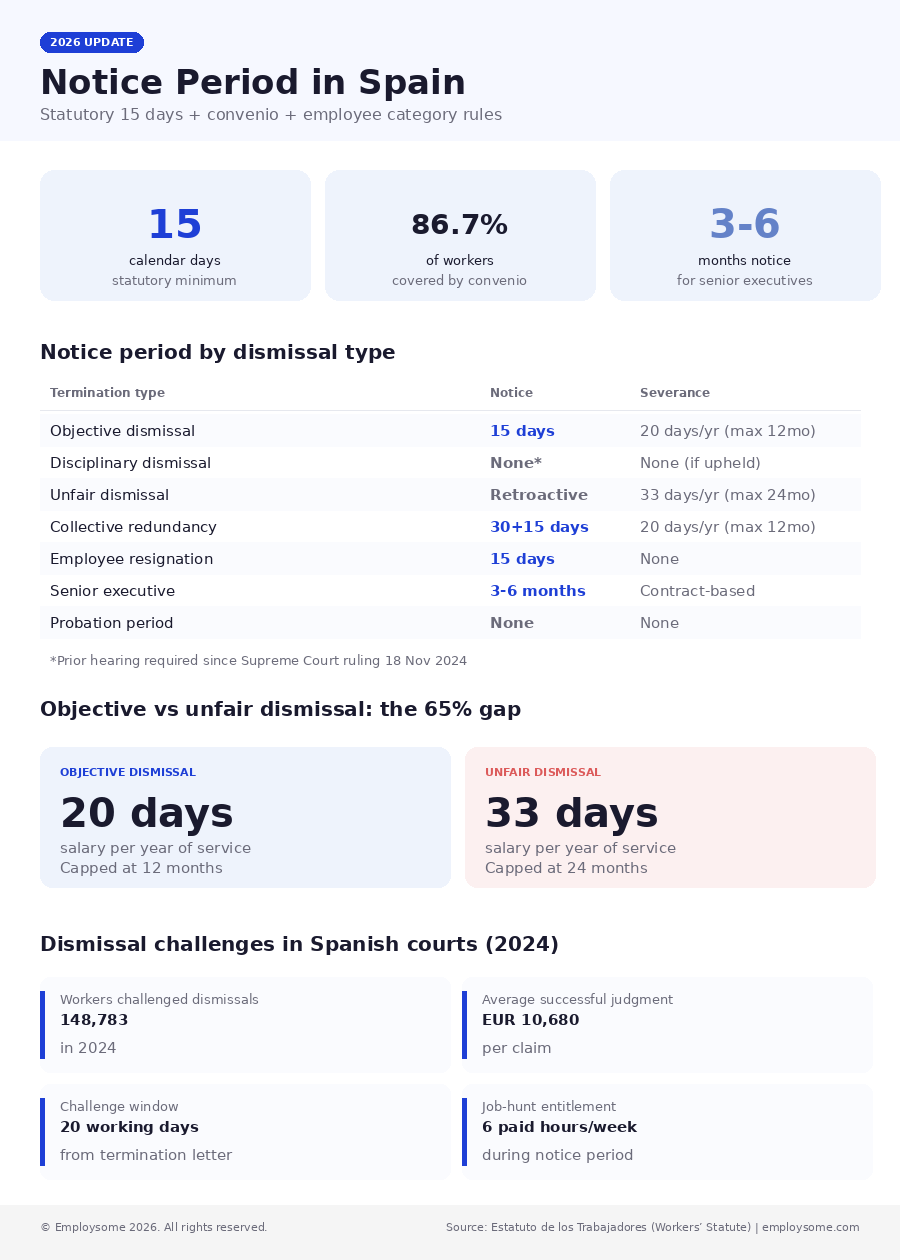
| Termination Type | Statutory Notice | Severance | Legal Basis |
| Objective dismissal | 15 calendar days | 20 days’ salary per year (max 12 months) | Art. 53.1 WS |
| Disciplinary dismissal | None (but prior hearing required) | None (if upheld) | Art. 54-55 WS |
| Unfair dismissal (declared by court) | N/A (retroactive) | 33 days’ salary per year (max 24 months) | Art. 56 WS |
| Collective redundancy (ERE) | 30 days consultation + 15 days notice | 20 days’ salary per year (max 12 months) | Art. 51 WS |
| Employee resignation (standard) | 15 days (or per convenio) | None | Art. 49 WS + convenio |
| Senior executive (Royal Decree 1382/1985) | 3-6 months | 7-20 days per year (contract-based) | RD 1382/1985 |
| Probation period termination | None (unless contract specifies) | None | Art. 14 WS |
| Fixed-term contract expiry | 15 days (if contract >1 year) | 12 days’ salary per year | Art. 49 WS |
Objective dismissal is the most common termination type used by employers who need to separate from an employee for business, economic, technical, organizational, or production reasons, or documented performance issues. It requires 15 days’ notice under Article 53.1(c) of the Workers’ Statute. The employer may either honour the notice period or pay salary in lieu.
Disciplinary dismissal (despido disciplinario) requires no notice, but since the Supreme Court ruling of 18 November 2024 (applying Article 7 of ILO Convention 158), employers must now grant a prior hearing to non-representative employees before dismissing them for disciplinary grounds. This is a procedural safeguard that allows the employee to defend themselves against the charges. Failure to grant this hearing may result in the dismissal being declared unfair.
Collective redundancy (ERE, Expediente de Regulación de Empleo) applies when dismissals reach specific thresholds within 90 days (10 employees in companies of 100-299, or 10% in companies of 100+). Employers must notify the Ministry of Labour and open a consultation period with employee representatives lasting up to 30 days (15 days for companies with fewer than 50 employees).
Notice Period by Employee Category
Notice obligations differ significantly by employee category. A graduate technician, a senior manager under special contract rules, and a probationary employee face entirely different frameworks.
| Employee Category | Notice (Employee Initiated) | Notice (Employer Initiated) |
| Standard employee (no convenio provision) | 15 days (statutory) | 15 days (objective) |
| Graduate technician (academic degree) | Up to 6 months (contractual max) | 15 days + convenio |
| Other non-technician employee | Up to 2 months (contractual max) | 15 days + convenio |
| Senior executive (RD 1382/1985) | 3 months minimum | 3-6 months (contract-based) |
| Employee with 5+ years indefinite contract | 3-6 months (common practice) | Per objective dismissal rules |
| Probationary employee | None (unless contract specifies) | None |
For employee-initiated resignation, Spanish law presumes 15 days minimum notice unless the applicable convenio specifies otherwise. Most collective agreements extend this to 1 month for office workers, or 2 months for technical roles. In practice, senior professionals and employees with long tenures commonly provide 1-3 months of notice.
Senior executives fall under a special legal regime governed by Royal Decree 1382/1985. Unless the contract specifies otherwise, senior managers must give their employer at least 3 months’ notice when resigning, extendable to 6 months where the contract is indefinite or has a duration of more than 5 years. This reflects the disruption that senior departures cause to company operations and strategic continuity.
During the probation period (período de prueba), either party may terminate the contract without prior notice, unless the employment contract or applicable convenio specifies otherwise. Standard probation durations are 6 months for graduate technicians, 2 months for other employees, and 3 months in companies with fewer than 25 employees.
💡 Employsome Insight: Employees Are Entitled to 6 Paid Hours Per Week for Job Search
Spanish employment law explicitly protects job-hunting time during notice. Employees under notice are entitled to 6 paid hours per week to search for new employment. This is often overlooked by international employers and can be a small but notable productivity cost during the notice period. The entitlement is automatic and non-negotiable under most convenios, though scheduling is generally flexible and can be agreed with the employee.
Payment in Lieu of Notice and the Finiquito Settlement
Spanish employers may substitute the notice period with a cash payment, known as pago en sustitución del preaviso (salary in lieu of notice). This is common in practice, particularly when the employer wants the employee to leave immediately to avoid workplace disruption, data security concerns, or client-relationship complications.
How payment in lieu works:
- Employer terminates effective immediately and pays the equivalent of the required notice period in salary (e.g., 15 days’ salary for an objective dismissal)
- Payment must cover the full applicable notice period, including any convenio extension
- All components of regular salary apply: base salary, prorated pagas extra, variable compensation, benefits in kind
- Payment must be included with severance and finiquito on the termination date
If the employer fails to give proper notice or pay salary in lieu, the dismissal can be challenged in court and potentially reclassified as unfair, which triggers severance of 33 days’ salary per year of service (up from 20 days for objective dismissals). The cost difference is significant: for an employee with 5 years of service earning EUR 40,000/year, this is approximately EUR 10,956 (objective) versus EUR 18,082 (unfair). That is a 65% premium for procedural failure.
The finiquito settlement is separate from notice and severance. It covers outstanding base salary, unused vacation days, prorated pagas extra (13th and 14th month payments paid monthly in some companies, lump sum in June and December in others), and any other accrued amounts. The finiquito is payable regardless of the reason for termination, including disciplinary dismissal where no severance applies.
What Happens if Notice Rules Are Breached
Employees have 20 working days from receipt of the termination letter to file a legal challenge in the labour courts (juzgado de lo social). Given how procedurally demanding Spanish dismissal law is, employee challenges are common. In 2024, 148,783 Spanish workers challenged dismissals in court, with average successful judgment awards of EUR 10,680.
The court has three possible rulings:
| Ruling | Meaning | Consequence |
| Procedente (fair) | Dismissal upheld | Employer pays stated severance only; no additional cost |
| Improcedente (unfair) | Dismissal lacks valid justification or procedural errors | Employer must either reinstate OR pay 33 days’ salary per year (max 24 months) |
| Nulo (null/void) | Dismissal breaches fundamental rights or discrimination | Mandatory reinstatement + back pay + damages |
Common procedural errors that trigger unfair dismissal rulings include: failing to give written notice with specific grounds, missing the 15-day notice period (objective dismissal), failing to deliver severance simultaneously with the termination letter, missing prior hearing for disciplinary dismissal (post-November 2024 requirement), and not identifying a specific objective reason that can be documented and proven.
For employees who joined the company before 12 February 2012, severance for unfair dismissal follows a two-scale calculation: 45 days’ salary per year for service accrued before that date (capped at 42 months), and 33 days’ salary per year for service accrued after (capped at 24 months). For long-tenure employees, this can result in severance exposure of 18-36 months’ salary if a dismissal is reclassified as unfair.
💡 Employsome Insight: Disciplinary Dismissal Documentation Is Rarely Strong Enough
The 20-working-day clock for employee challenges means your documentation must be airtight from day one. Courts do not give second chances on paperwork. If your disciplinary dismissal file is thin or you missed the prior hearing step (mandatory since November 2024), assume a court will reclassify the dismissal as unfair at 33 days per year rather than disciplinary at zero severance. Many international employers try for disciplinary without bulletproof evidence and end up paying the unfair rate plus legal fees.
How Spain Compares to Other European Countries
Spain’s notice and severance framework is one of the more protective regimes in Europe, though recent reforms have partially reduced the burden. Here is how Spain compares to major European hiring markets:
| Country | Standard Notice | Senior Executive Notice | Max Severance (Unfair) |
| Spain | 15 days | 3-6 months | 33 days/year (max 24 months) |
| Germany | 4 weeks to 7 months (tenure-based) | Same as standard | 0.5 month/year (typical settlement) |
| France | 1-3 months (by role) | 3+ months | Variable (CBA-dependent) |
| Italy | 15 days – 6 months (CCNL-based) | 6-12 months | 2-6 months minimum |
| Portugal | 15 days – 75 days (tenure-based) | 60-90 days | 20 days/year (max 12 months) |
| UK | 1 week – 12 weeks (tenure) | Contract-based | Statutory redundancy only (tenure-based) |
Spain’s 15-day statutory minimum looks short by continental European standards, but the collective agreement extensions and the 33-day unfair dismissal severance make total termination cost comparable to France and Italy. Compared to Portugal, Spain is more expensive for unfair dismissals (33 days vs 20 days per year) but similar in notice structure.
For international employers choosing between Southern European hiring destinations, Spain offers a deep talent pool, competitive salaries, and strong EU legal protections, but higher dismissal cost than Portugal or Greece. The complexity of Spanish termination law is the strongest argument for using an Employer of Record in Spain rather than setting up a local entity.
What International Employers Need to Know
Always identify the applicable convenio colectivo before quoting notice
The 15-day statutory minimum is almost never the correct answer in isolation. With 86.7% of Spanish workers covered by a sector or company convenio, you should always obtain the applicable convenio before drafting any termination letter or resignation acceptance. Your EOR should have this on file for every employee. If they cannot produce it, demand it.
Document objective dismissal grounds from day one
Spanish courts are strict about objective-dismissal evidence. Performance-based dismissals require documented warnings, measurable metrics, and a paper trail showing the employee was given a reasonable opportunity to improve. Economic dismissals require financial data. If you cannot prove the objective reason, the court will reclassify the dismissal as unfair at 33 days per year rather than upholding it at 20 days per year.
Honour the November 2024 prior hearing requirement for disciplinary dismissals
The Supreme Court’s 18 November 2024 ruling mandates a prior hearing for non-representative employees facing disciplinary dismissal. Skipping this step almost guarantees unfair dismissal reclassification. Your EOR or Spanish counsel should have a template procedure for this. If you are managing directly, ensure you send a written charge letter, give the employee 5 working days to respond, and document the response before issuing the dismissal letter.
Budget for payment in lieu rather than working notice
For most international employers, it is cleaner and safer to pay the full notice period as salary in lieu rather than have the employee work through it. This eliminates workplace disruption, data security concerns, and client-relationship risks. Factor 15 days (or the extended convenio period) plus full severance and finiquito into your termination budget.
Plan for the 20-working-day challenge window
Once you deliver the termination letter, the employee has 20 working days to challenge in court. Monitor your EOR’s response during this period and ensure all documentation is retained in case of legal proceedings. Many challenges settle out of court through conciliation, but preparation for formal proceedings should start from day one.
For minimum wage and compensation context
Notice and severance calculations depend on the employee’s daily gross salary, which includes base pay plus all variable components (bonuses, incentives, pagas extra, benefits in kind, excluding expense reimbursements). For current statutory pay floors and compensation structure, see our Minimum Wage in Spain 2026 Guide.
Hiring in Spain?
Spain’s termination framework is one of the most procedurally complex in the EU, with convenio-dependent notice periods, a 20-working-day employee challenge window, and 65% higher severance if a dismissal is reclassified as unfair. Compare the top Employer of Record providers for Spain in 2026 – verified pricing, compliance scores, and expert rankings from Employsome’s independent research team.
Frequently Asked Questions
The statutory minimum notice period in Spain is 15 calendar days, set by Article 53.1(c) of the Workers’ Statute for objective dismissals. However, 86.7% of Spanish workers are covered by a collective bargaining agreement (convenio colectivo) that may extend this to 30 days, 1 month, or longer. Senior executives under Royal Decree 1382/1985 require 3-6 months notice. Always check the applicable convenio before relying on the 15-day default.
Employees must give at least 15 calendar days of notice when resigning, under the Workers’ Statute or as extended by the applicable convenio colectivo. In practice, professionals and employees with long tenure commonly provide 1-3 months of notice. Senior executives under Royal Decree 1382/1985 must give a minimum of 3 months, up to 6 months for indefinite contracts or those of more than 5 years.
Yes. Spanish employers may substitute the notice period with a cash payment equivalent to the required notice period (pago en sustitución del preaviso). The payment must cover the full applicable notice period including any convenio extension and include all regular salary components. This is common practice when the employer wants the employee to leave immediately.
If the employer fails to give proper notice or pay salary in lieu, the dismissal can be challenged in court and potentially reclassified as unfair. This triggers severance of 33 days’ salary per year of service (capped at 24 months) instead of the standard 20 days per year for objective dismissals. The cost difference is approximately 65% higher for the employer.
No, disciplinary dismissals do not require advance notice under Article 54-55 of the Workers’ Statute. However, since the Supreme Court ruling of 18 November 2024 (applying Article 7 of ILO Convention 158), employers must grant a prior hearing to non-representative employees before disciplinary dismissal, allowing them to defend themselves against the charges. Failure to grant this hearing may result in the dismissal being declared unfair.
Senior executives are governed by a special employment relationship under Royal Decree 1382/1985. The minimum notice period is 3 months, extendable to 6 months if the contract is indefinite or has a duration of more than 5 years. These notice requirements apply both when the employer terminates and when the executive resigns, unless the contract specifies otherwise.
Generally no. During the probation period (período de prueba), either party may terminate the contract without prior notice under Article 14 of the Workers’ Statute, unless the employment contract or applicable convenio specifies otherwise. Standard probation durations are 6 months for graduate technicians, 2 months for other employees, and 3 months in companies with fewer than 25 employees.
Employees have 20 working days from receipt of the termination letter to file a legal challenge in the labour courts (juzgado de lo social). In 2024, 148,783 Spanish workers challenged dismissals with average successful judgment awards of EUR 10,680. Given this tight timeline, employer documentation must be airtight from the moment the termination letter is delivered.

Courtney Pocock is a Copywriter & EOR/PEO Researcher at Employsome with 15+ years of experience writing for the HR, corporate, and financial sectors. She has a strong interest in global business expansion and Employer of Record / PEO topics, focusing on news that matters to business owners and decision-makers. Courtney covers industry updates, regulatory changes, and practical guides to help leaders navigate international hiring with confidence.
Our content is created for informational purposes only and is not intended to provide any legal, tax, accounting, or financial advice. Please obtain separate advice from industry-specific professionals who may better understand your business’s needs. Read our Editorial Guidelines for further information on how our content is created.