
Average Salary in South Korea 2026: Complete Breakdown
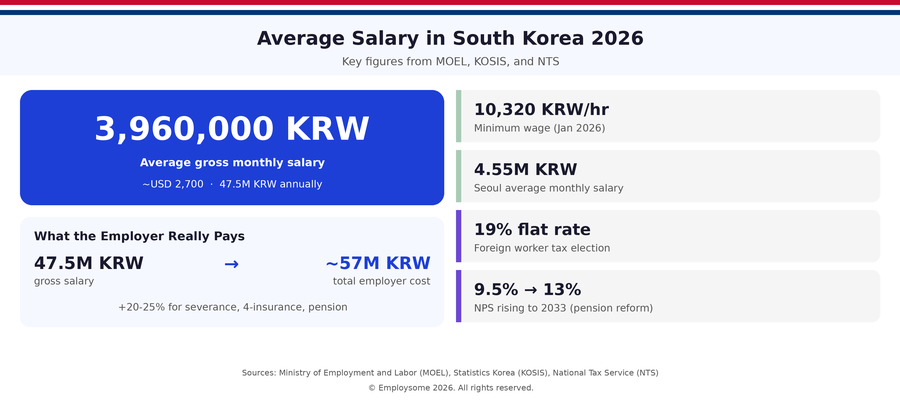
The average salary in South Korea in 2026 is 3,960,000 KRW per month ($2,700) or 47,520,000 KRW per year, with a median of 3,200,000 KRW. This complete guide breaks down Korean salaries by industry, city, age, and role, covers the 2026 income tax brackets, the 19% foreigner flat rate, pension reform, and total employer cost of hiring a Korean employee.

The average salary in South Korea is approximately 3,960,000 KRW per month (USD 2,700) in 2026, or 47,520,000 KRW per year (USD 32,400), according to the latest Ministry of Employment and Labor wage survey and KOSIS data. The median monthly income is notably lower at 3,200,000 to 3,500,000 KRW, reflecting the significant salary skew created by highly-paid professionals at chaebol groups like Samsung, Hyundai, LG, and SK Hynix.
South Korea entered 2026 with continued wage growth driven by tight labour supply, demographic pressures from an aging workforce, and ongoing competition for technology and engineering talent. The statutory minimum wage rose 2.9% to 10,320 KRW per hour on 1 January 2026. Seoul leads regional pay at an average of 4,551,791 KRW per month, followed by Gyeonggi Province, Ulsan (home to Hyundai), and Busan. For the detailed hourly breakdown, regional variations, and legal compliance rules, see our companion guide to the minimum wage in South Korea.
This 2026 guide to the average salary in South Korea covers national averages from MOEL and KOSIS, breakdowns by industry and role, salaries by city and province, the 2026 income tax system and the special 19% flat rate for foreign workers, mandatory social insurance contributions, total employer cost calculations including the 2026 pension reform, severance pay obligations, and what international companies hiring Korean workers through an Employer of Record (EOR) need to budget when expanding into South Korea.

Average Salary in South Korea 2026: The Headline Numbers
South Korean salary data comes primarily from three authoritative sources: the Ministry of Employment and Labor (MOEL) Wage Survey, Statistics Korea (KOSIS), and the National Tax Service (NTS) income data. Understanding the difference between these figures is essential when benchmarking Korean compensation.
| Salary Metric (2026) | Amount (KRW) | USD Equivalent |
| Average gross monthly salary | 3,960,000 | ~$2,700 |
| Average gross annual salary | 47,520,000 | ~$32,400 |
| Average net monthly salary | ~3,170,000 | ~$2,160 |
| Median monthly income | 3,200,000 to 3,500,000 | $2,180 to $2,390 |
| Median household income (annual) | 52,000,000 | ~$35,500 |
| Statutory minimum wage (hourly) | 10,320 KRW/hour | ~$7.04 |
| Minimum monthly wage (209 hours) | 2,156,880 | ~$1,470 |
| Average in Seoul | 4,551,791/month | ~$3,100 |
The average salary (3,960,000 KRW/month) is inflated by very high earners in finance, technology, and executive roles at the chaebol groups. The median salary (3,200,000 to 3,500,000 KRW/month) better reflects what a typical Korean worker actually earns. For most practical compensation benchmarking, including offer setting and budgeting, the median is the more useful reference point.
Korean gross-to-net conversion is relatively simple compared to European jurisdictions: social insurance contributions plus income tax typically reduce gross pay by approximately 20%, leaving a net take-home ratio of roughly 80%. On the average 3,960,000 KRW monthly gross salary, net take-home pay is approximately 3,170,000 KRW (USD 2,160) after national pension, health insurance, employment insurance, long-term care insurance, and income tax.
Korean CAO-equivalent wage growth is typically between 2.5% and 4.5% annually, with 2025 showing a 2.7% average increase over 2024. Technology and finance sectors have seen faster growth (5-8% annually) driven by talent shortages at chaebol groups and international firms with Korean offices.
💡 Employsome Insight: The Chaebol Effect Creates a Wide Average-Median Gap
The gap between Korea’s average and median salaries (roughly 3,960,000 KRW vs 3,200,000 KRW per month) is one of the largest in the OECD. This reflects Korea’s dual economic structure: a small but very highly paid workforce at the four largest chaebol groups (Samsung, Hyundai Motor, SK, LG) plus multinational firms, alongside a much larger pool of workers at small and medium enterprises (SMEs) earning substantially less. When benchmarking a Korean salary offer, the most important question is which tier of the labour market the role sits in: chaebol and large enterprise (±150% of average), medium enterprises (±100%), or small enterprises (±70-80%). Using the headline 3,960,000 KRW average as the benchmark for an SME role consistently leads to overpayment.
South Korea Salaries by Industry and Role
Industry is the largest single determinant of Korean salaries, larger than age or education once role is held constant. The gap between the highest-paying sectors (finance, IT, semiconductor) and the lowest (hospitality, retail) is approximately 2.5 to 3 times. Here is how gross monthly salaries break down by major industry in 2026:
| Industry | Average Monthly Salary (KRW) | Relative to National Average |
| Financial services and banking | 6,500,000 to 7,500,000 | +70% |
| Information technology (senior) | 5,800,000 to 6,500,000 | +55% |
| Electronics and semiconductors (chaebol) | 5,500,000 to 7,000,000 | +50% |
| Automotive manufacturing | 4,500,000 to 5,500,000 | +25% |
| Pharmaceuticals and biotech | 4,700,000 to 5,200,000 | +20% |
| Professional services and consulting | 4,500,000 to 5,000,000 | +15% |
| Healthcare (senior medical) | 4,500,000 to 6,000,000+ | +15% to +50% |
| Public administration | 3,800,000 to 4,300,000 | -5% to +10% |
| Construction and engineering | 3,700,000 to 4,300,000 | -5% to +10% |
| Education | 3,300,000 to 4,000,000 | -15% to baseline |
| Manufacturing (SME) | 3,000,000 to 3,600,000 | -25% to -10% |
| Retail and wholesale | 2,600,000 to 3,000,000 | -35% to -25% |
| Hospitality and food service | 2,300,000 to 2,800,000 | -40% to -30% |
Within the technology sector, role-level differences are significant. Here is what international and chaebol employers typically pay Korean technology professionals in 2026:
| Role | Junior | Mid-level | Senior |
| Software engineer | 45,000,000 | 65,000,000 | 90,000,000 to 130,000,000+ |
| Data scientist | 50,000,000 | 70,000,000 | 95,000,000 to 140,000,000 |
| Product manager | 50,000,000 | 75,000,000 | 100,000,000+ |
| Hardware engineer (semiconductor) | 55,000,000 | 78,000,000 | 120,000,000+ (Samsung, SK Hynix) |
| Financial analyst | 50,000,000 | 72,000,000 | 100,000,000+ |
| Marketing manager | 40,000,000 | 56,000,000 | 80,000,000 to 100,000,000 |
| HR business partner | 38,000,000 | 52,000,000 | 72,000,000 to 90,000,000 |
| Customer service representative | 30,000,000 | 40,000,000 | 52,000,000 |
| Teacher (public school) | 32,000,000 | 44,000,000 | 60,000,000 |
Salaries at chaebol groups are typically 30% to 60% higher than equivalent SME roles. Samsung Electronics pays senior software engineers 90,000,000 KRW to 130,000,000 KRW, while SK Hynix and LG Electronics fall in the same range for specialist hardware engineers. Major international firms with Korean offices (Google Korea, Microsoft Korea, Goldman Sachs Seoul) typically pay at the top end of these ranges plus equity.
Average Salary in South Korea by City and Province
Geography has a substantial effect on Korean salaries. Seoul pays the most, followed by the Gyeonggi industrial corridor, Ulsan (dominated by Hyundai), and Busan. Rural regions and smaller cities pay meaningfully less, though this is partially offset by lower housing and living costs.
| City / Province | Average Monthly Salary (KRW) | Key Industries |
| Seoul (서울특별시) | 4,551,791 | Finance, technology, professional services, corporate HQs |
| Gyeonggi Province (경기도) | 4,199,778 | Technology (Samsung Suwon, SK Hynix Icheon), manufacturing |
| Ulsan (울산광역시) | 4,179,396 | Hyundai Motor, Hyundai Heavy Industries, petrochemicals |
| Incheon (인천광역시) | 3,900,000 | Logistics, aviation, Incheon International Airport, port |
| Daegu (대구광역시) | 3,800,000 | Textiles, automotive parts, electronics manufacturing |
| Daejeon (대전광역시) | 3,800,000 | R&D, science parks, KAIST, government research institutes |
| Busan (부산광역시) | 3,700,000 | Port, shipping, logistics, film production |
| Gwangju (광주광역시) | 3,500,000 | Automotive, services, cultural content |
| Jeju Island (제주도) | 3,200,000 | Tourism, services, agriculture |
| Jeollabuk Province (전라북도) | 3,100,000 | Agriculture, food processing |
The Seoul premium of roughly 15-20% above the national average reflects the city’s concentration of chaebol headquarters, financial services, professional firms, and technology scale-ups. However, Seoul’s cost of living is also the highest in Korea: housing costs in Gangnam, Seocho, or Yongsan districts run 40-60% above equivalent housing in Busan or Daegu, which materially reduces the effective salary advantage.
The Gyeonggi Province salary advantage (4,199,778 KRW) is driven almost entirely by the semiconductor and electronics corridor: Samsung Electronics’ Suwon headquarters, the Hwaseong and Pyeongtaek fabs, SK Hynix’s Icheon campus, and Samsung Display. Ulsan’s 4,179,396 KRW figure punches above its population weight entirely because of Hyundai Motor and Hyundai Heavy Industries dominating the local economy and paying well above average.
Average Salary by Age and Education Level
Korean salary scales rise substantially with age and seniority, reflecting the country’s traditional seniority-based pay system (hobongje). The salary peak is reached in the 45-54 age band, with modest decline afterwards as workers approach the typical retirement age of 60.
| Age Group | Average Monthly Salary (KRW) |
| 20 to 29 | 2,800,000 to 3,300,000 |
| 30 to 39 | 3,800,000 to 4,500,000 |
| 40 to 49 | 4,600,000 to 5,400,000 (peak) |
| 50 to 59 | 4,500,000 to 5,200,000 |
| 60+ | 3,200,000 to 4,000,000 |
Educational attainment is the second-largest salary predictor. Korean university graduates from the “SKY” universities (Seoul National, Korea, Yonsei) and other top schools earn up to 40% more than high school diploma holders over a career. Chaebol groups particularly favour graduates from the top five universities for management-track positions.
| Education Level | Average Monthly Salary (KRW) |
| High school diploma only | 2,600,000 to 3,100,000 |
| Associate degree (2-year college) | 3,000,000 to 3,600,000 |
| Bachelor’s degree (regional universities) | 3,500,000 to 4,200,000 |
| Bachelor’s degree (SKY universities) | 4,500,000 to 5,500,000 |
| Master’s degree | 5,000,000 to 6,500,000 |
| PhD | 6,000,000 to 8,500,000+ |
A significant gender pay gap persists in Korea: men earn on average 6% more than women for performing the same job, per Statistics Korea data. The overall gender pay gap in Korea is among the highest in the OECD at approximately 30% when accounting for occupational segregation and working hours differences.
South Korea Income Tax Brackets 2026
South Korea operates a progressive eight-bracket national income tax system called Global Income Tax (Jonghap Sodeukse), with an additional mandatory 10% local income tax surtax. The effective combined rates range from 6.6% at the lowest bracket to 49.5% at the highest.
| Annual Income (KRW) | National Tax Rate | + 10% Local Surtax | Effective Rate |
| Up to 14 million | 6% | 0.6% | 6.6% |
| 14 to 50 million | 15% | 1.5% | 16.5% |
| 50 to 88 million | 24% | 2.4% | 26.4% |
| 88 to 150 million | 35% | 3.5% | 38.5% |
| 150 to 300 million | 38% | 3.8% | 41.8% |
| 300 to 500 million | 40% | 4.0% | 44.0% |
| 500 million to 1 billion | 42% | 4.2% | 46.2% |
| Above 1 billion | 45% | 4.5% | 49.5% |
The rates are progressive: you only pay the higher rate on income within that bracket, not on your total income. A worker earning 60,000,000 KRW annually pays 6.6% on the first 14 million, 16.5% on the next 36 million, and 26.4% only on the remaining 10 million. The average Korean worker earning around 47,520,000 KRW annually falls entirely in the first two brackets with an effective combined tax rate of approximately 13-14%.
Korea operates a year-end tax settlement (yeonmal jeongsan) in February for salary income from the previous calendar year. Employers withhold estimated tax monthly, and any over- or under-payment is reconciled in the year-end settlement. Most employees receive a refund because Korean tax law permits extensive deductions for dependants, credit card spending, housing expenses, insurance, donations, and retirement savings.
💡 Employsome Insight: The 19% Flat Tax Rate for Foreign Workers
Foreign workers in Korea can elect a flat 19% national tax rate (20.9% including local surtax) instead of the progressive rates, for up to 20 years from the start of employment. To qualify, the employment must begin by 31 December 2026. This is extraordinarily valuable for high earners: a foreign executive earning 200,000,000 KRW annually pays 20.9% (41,800,000 KRW) under the flat rate versus approximately 35-38% effective rate under progressive rates, saving 25-30 million KRW per year. No deductions are permitted under the flat rate, so it is generally most advantageous for income above 130 million KRW. The election is made annually by the worker and can be switched year-to-year based on which option is more favourable.
Total Employer Cost in South Korea 2026
For companies hiring in South Korea, gross salary is only part of the cost. Mandatory employer social insurance contributions, statutory severance pay (one month per year of service), holiday bonuses, and meal allowances add a meaningful overhead on top of gross. Here is the full breakdown for a worker on the 47,520,000 KRW annual average salary in 2026:
| Cost Component | Rate / Amount | Annual Cost on 47.52M KRW Gross |
| Gross salary | — | 47,520,000 |
| Severance reserve (1 month/year) | 8.33% | 3,960,000 |
| National Pension (employer 4.75%) | 4.75% | 2,257,200 (capped) |
| Health Insurance (employer 3.595%) | 3.595% | 1,708,344 |
| Long-Term Care Insurance (employer) | ~0.47% | ~223,344 |
| Employment Insurance (employer) | ~0.9% | 427,680 |
| Workers’ Compensation (industry-specific) | ~0.7% to 5% (typical office) | 332,640 to 2,376,000 |
| Total employer cost | ~20% to 25% uplift | ~56,400,000 to 59,000,000 |
For a 47,520,000 KRW annual gross salary, the true fully-loaded cost to the employer is approximately 56,400,000 to 59,000,000 KRW per year, depending on industry-specific workers’ compensation rates. That is an overhead of approximately 18% to 24% on top of gross.
Severance pay (retirement allowance, toejik-geum) is a major Korean-specific cost. Korean law requires employers to pay severance equal to at least one month of salary per year of service upon termination or resignation (with some exceptions for very short tenures). Employers must either hold reserves or contribute to a qualifying retirement pension plan (DB or DC). This effectively adds 8.33% to annual labour cost.
Many Korean employers also provide a 13th and 14th month bonus (usually in June and December), holiday allowances (Seollal and Chuseok), meal subsidies (100,000-200,000 KRW per month), and transportation allowances. These are not statutory but are widespread in larger employers and chaebol groups.
How International Companies Hire in South Korea
For international companies hiring Korean employees without a local entity, there are two practical options: establish a Korean legal entity or use an Employer of Record.
Option 1: Establish a Korean subsidiary
The two main corporate forms for foreign investors are the Yuhan Hoesa (LLC) or Chusik Hoesa (stock company). Setup requires notarial incorporation, FDI registration with KOTRA, commercial registration with the court, tax registration, mandatory 4-insurance registration, and a Korean business bank account. Minimum capital is relatively low (100 million KRW is a common threshold). Timeline is typically 8 to 14 weeks. Ongoing costs include Korean accounting (400,000 to 1,000,000 KRW per month), corporate tax filings, payroll administration, and year-end tax settlement support.
Option 2: Employer of Record (EOR)
An EOR is a Korean-registered entity that formally employs the worker on your behalf. The EOR handles Korean employment contracts (in Korean), monthly payroll, withholding of income tax, 4-insurance enrolment, severance reserves, year-end tax settlement, and ongoing compliance with Labor Standards Act requirements. Typical setup: 2 to 4 weeks. Typical cost: USD 500 to USD 900 per employee per month on top of gross salary and employer contributions.
For hiring one to five Korean employees, or for 6 to 24 month projects, an EOR is almost always the faster and cheaper option. For longer-term operations with 10+ Korean employees, incorporating a Korean subsidiary eventually becomes more cost-effective. Many companies use an EOR to enter the Korean market and transition to a subsidiary once they have a stable team.
What International Employers Need to Know
Benchmark against median, not average
The 3,960,000 KRW monthly average is pulled upward by highly-paid workers at the four major chaebol groups. For benchmarking mid-level SME roles, use the 3,200,000 to 3,500,000 KRW median as the reference. For senior technology or finance roles at Seoul-based international firms, expect salaries 40-60% above average.
Factor in the 2026 NPS rate increase
The National Pension contribution rate is rising from 9% to 9.5% on 1 January 2026, and will continue rising 0.5% annually to 13% by 2033. Multi-year compensation budgets should include this gradual cost increase.
Budget 20-25% above gross for total employer cost
Statutory severance pay (one month per year of service, effectively 8.33%), the 4-insurance contributions (approximately 10-11% employer share), and workers’ compensation (variable by industry) add 20-25% on top of gross salary. For a 47,520,000 KRW gross role, total annual cost is typically 56-59 million KRW.
Offer foreign workers the flat 19% tax election where relevant
The flat 19% tax rate (20.9% including local surtax) is extraordinarily valuable for foreign executives earning over 130 million KRW annually. The election applies for up to 20 years for workers starting employment by 31 December 2026. Highlight this in offer negotiations for international candidates.
Comply with minimum wage by hour, not monthly
The 2026 Korean minimum wage is legally set as 10,320 KRW per hour, not a monthly figure. For full-time workers (209 hours/month standard), this equals 2,156,880 KRW per month before holiday allowance. For full rules on minimum wage compliance, age-based exceptions, and industry-specific rules, see our minimum wage in South Korea guide.
Plan for severance pay from day one
Korean law requires severance equal to one month of salary per year of service upon termination or resignation. Employers must either hold cash reserves or contribute to a qualifying retirement pension plan (Defined Benefit or Defined Contribution). This is one of the most frequently overlooked costs for international companies entering Korea and typically adds 8.33% to annual labour cost.
Hiring in South Korea?
South Korean employment law includes mandatory 4-insurance enrolment, statutory severance pay equal to one month per year of service, the 2026 NPS rate increase to 9.5%, and strict Labor Standards Act compliance. Navigating chaebol-level compensation benchmarking and the 19% foreigner flat tax election requires local expertise. Compare the top Employer of Record providers for South Korea in 2026 – verified pricing, compliance scores, and expert rankings from Employsome’s independent research team.
Frequently Asked Questions
The average salary in South Korea in 2026 is approximately 3,960,000 KRW per month (USD 2,700), or 47,520,000 KRW per year (USD 32,400), according to Ministry of Employment and Labor wage survey data. The median monthly salary is lower at 3,200,000-3,500,000 KRW, reflecting Korea’s highly skewed salary distribution driven by chaebol groups and large conglomerates pulling the average upward. Net take-home pay averages approximately 3,170,000 KRW per month after taxes and social contributions.
Average monthly salary in Korea (3,960,000 KRW) is total wages divided by workers, inflated by very high earners at chaebol groups like Samsung, Hyundai, and SK. Median monthly salary (3,200,000-3,500,000 KRW) is the exact middle value and better represents what a typical Korean worker actually earns. The gap between average and median in Korea is one of the widest in the OECD, reflecting the dual structure between highly-paid chaebol employees and SME workers.
The statutory minimum wage in South Korea is 10,320 KRW per hour (approximately USD 7.04) as of 1 January 2026, a 2.9% increase from the 2025 rate of 10,030 KRW. At full-time (209 hours per month), this equals approximately 2,156,880 KRW per month. For a complete breakdown of minimum wage rules, age-based rates, industry exceptions, and compliance requirements, see our minimum wage in South Korea guide.
Seoul has the highest average gross monthly salary in South Korea at 4,551,791 KRW (approximately USD 3,100), driven by concentrations of chaebol headquarters, financial services, and technology firms. Gyeonggi Province follows at 4,199,778 KRW due to Samsung’s Suwon campus, SK Hynix in Icheon, and major manufacturing plants. Ulsan ranks third at 4,179,396 KRW, punching above its population size due to Hyundai Motor and Hyundai Heavy Industries. Busan and Daejeon average around 3,700,000-3,800,000 KRW.
On the 47,520,000 KRW average annual salary, a Korean worker pays approximately 6,500,000-7,500,000 KRW in combined income tax and social contributions, leaving net annual income of approximately 40,000,000-41,000,000 KRW (3,300,000-3,400,000 KRW per month). Korea applies a progressive 8-bracket income tax (6% to 45%) plus a mandatory 10% local income tax surtax. The effective combined rate for the average worker is approximately 13-14% for income tax, plus roughly 9.7% for social insurance contributions.
Foreign workers in South Korea can elect a flat 19% national income tax rate (20.9% including the 10% local surtax) instead of the progressive rates, for up to 20 years. To qualify, the foreign worker must begin employment in Korea by 31 December 2026. No deductions are permitted under the flat rate, so it is generally most beneficial for high earners above 130 million KRW annually. The election is made annually and can be switched year-to-year based on which option is more favourable.
Total employer cost in South Korea adds approximately 20-25% on top of gross salary. The main components are: statutory severance pay (8.33%, one month per year of service), National Pension (4.75% employer share rising to 6.5% by 2033), National Health Insurance (3.595%), Long-Term Care Insurance (~0.47%), Employment Insurance (0.9-1.65%), and Workers’ Compensation (0.7-18% varying by industry, typical office work is ~0.7%). For a 47.52 million KRW gross salary, total employer cost is approximately 56-59 million KRW per year.
South Korea enacted a major pension reform effective 1 January 2026 that gradually raises the National Pension contribution rate from 9% to 13% over 2026 to 2033. The rate increases by 0.5 percentage points annually, with employers and employees splitting the increase equally. In 2026, the employer NPS contribution rises from 4.5% to 4.75%. By 2033, employer and employee will each contribute 6.5% (13% total). For multi-year compensation budgets, international employers should build in this progressive cost increase.
Korean software engineer salaries vary significantly by company and seniority. Junior software engineers earn 45-55 million KRW per year, mid-level engineers earn 65-75 million KRW, and senior engineers routinely earn 90-130 million KRW or more. Samsung Electronics, SK Hynix, Naver, and Kakao pay at the top of the range, while international firms with Korean offices (Google Korea, Microsoft Korea) plus equity can exceed these figures. Top-tier AI and semiconductor specialists at chaebol groups can exceed 150 million KRW annually.
Quoted annual Korean salaries may or may not include the 13th and 14th month bonuses (typically paid in June and December), holiday allowances for Seollal and Chuseok, meal subsidies (100,000-200,000 KRW per month), and transportation allowances. These are common in larger employers and chaebol groups but not statutory. Severance pay (toejik-geum, one month per year of service) is always additional to quoted salary. When evaluating Korean offers, always clarify whether the headline figure includes bonuses and what the total annual compensation package looks like.
Courtney Pocock is a Copywriter at Employsome with 15+ years of experience writing for the HR, corporate, and financial sectors. She has a strong interest in global business expansion and Employer of Record / PEO topics, focusing on news that matters to business owners and decision-makers. Courtney covers industry updates, regulatory changes, and practical guides to help leaders navigate international hiring with confidence. Connect with Courtney on LinkedIn.
Our content is created for informational purposes only and is not intended to provide any legal, tax, accounting, or financial advice. Please obtain separate advice from industry-specific professionals who may better understand your business’s needs. Read our Editorial Guidelines for further information on how our content is created.
Mandatory Social Insurance Contributions in South Korea
All Korean workers are enrolled in the country’s comprehensive social insurance system, known as the four major insurances (4 dae borhŏm). These are mandatory and cover pension, health, unemployment, and workplace injury. The National Pension (NPS) rate is rising gradually from 9% to 13% over 2026 to 2033 under the April 2025 pension reform.
The 2026 NPS reform is significant. The combined NPS rate rises by 0.5 percentage points each year from 2026 to 2033, reaching 13% (6.5% employer + 6.5% employee) by 2033. The reform was approved by Korea’s National Assembly in March 2025 and is intended to address demographic pressure on the pension system. For international employers planning multi-year compensation budgets, this is a real cost increase that needs to be built into headcount planning.
National Pension contributions are capped at a monthly salary of 6,370,000 KRW, meaning the maximum monthly NPS contribution in 2026 is approximately 302,570 KRW per side. Foreign workers are generally required to participate in NPS unless their home country has a social security totalisation agreement with Korea and the worker remains under the home country scheme.