Hire compliantly in the Netherlands. Navigate layered social insurance, strict dismissal procedures and one of Europe’s most employee-protective labor markets.
Detailed guides on the employment topics that matter most when hiring in the Netherlands. Independently researched, updated for 2026.
Minimum Wage in the Netherlands (2026): Hourly Rate Guide
The Netherlands minimum wage is €14.71/hour from 1 January 2026 for employees aged 21+, a 2.15% increase. Since 2024, the Dutch system is hourly only with no fixed monthly rate. Employers must budget for the mandatory 8% holiday allowance on top (making the effective rate €15.89/hour), plus social security contributions of approximately 18 to 22%. This guide covers youth rates, employer and employee contributions, the 30% ruling, the new VBAR Act (€36/hour false self-employment presumption from July 2026), CAO obligations, income tax brackets, and an EU comparison.
EU Pay Transparency Directive: 2026 Guide for Employers
This guide explains the EU Pay Transparency Directive (EU 2023/970), the most significant piece of pay equity legislation in Europe since the 1960s. It covers the core obligations that will apply to employers across all 27 EU member states from 7 June 2026, including salary disclosure in recruitment, the ban on salary history questions, workers’ right to pay information, gender pay gap reporting requirements, the 5% pay gap threshold and joint pay assessment process, enforcement mechanisms, the current status of member state transposition, and what employers need to do now to prepare.
EU Working Time Directive : 2026 Guide for Employers
The EU Working Time Directive (2003/88/EC) sets the minimum rules for working hours, rest periods, and annual leave across all EU member states. It limits the average working week to 48 hours, guarantees 11 hours of daily rest, requires a minimum of 4 weeks’ paid annual leave, and regulates night work. However, each member state implements the directive differently through national legislation, creating significant variation in how the rules apply in practice. This guide explains what the directive requires, how key EU countries have implemented it, where the opt-out applies, and what employers hiring across Europe need to know.
We independently review and rank providers based on their actual performance in the Netherlands, covering pricing transparency, onboarding speed, in-country support and hiring compliance.
Dutch dismissal law requires either UWV approval or court authorization to terminate an employee. A provider that treats the Netherlands like an at-will market will create legal exposure from the first termination attempt.
Employer social insurance costs run 18-25% on top of gross salary. Employee insurance (WW, WIA, ZW), healthcare contribution (ZVW at 6.10%), and sectoral contributions. All capped at EUR 79,412/year. Exact rates depend on industry classification and contract type.
You cannot fire an employee without government or court approval. Dismissal for economic reasons requires UWV (employment agency) permission. Dismissal for personal reasons requires cantonal court approval. No exceptions, no shortcuts.
The 30% ruling gives expats a significant tax advantage. Highly skilled foreign employees can receive 30% of their salary tax-free for up to 5 years. The ruling remains unchanged for 2026 but partial foreign taxpayer status was abolished in 2025.
Holiday allowance of 8% is mandatory. Every employee is entitled to 8% of their annual gross salary as holiday pay (vakantiegeld), typically paid in May. This is on top of the regular salary and on top of the 20 days minimum leave.
Pay transparency requirements arrive by June 2026. The EU Pay Transparency Directive must be transposed into Dutch law, requiring salary ranges in job ads and giving employees the right to request gender-based pay comparisons.
Why hire in the Netherlands
Europe's most multilingual professional workforce
93% of the Dutch population speaks English. Add German, French and increasingly Spanish proficiency, and the Netherlands produces professionals who can serve multiple European markets from a single location without translation overhead.
Legal infrastructure built for international business
Dutch corporate law, IP protection and contract enforcement are among the most developed in Europe. The Netherlands hosts the headquarters of Unilever, Shell, ASML, Booking.com and Adyen. The legal and regulatory ecosystem is designed for companies operating across borders.
The 30% ruling makes senior hires cheaper than they look
A EUR 90,000 employee under the 30% ruling effectively earns EUR 63,000 in taxable salary. The tax saving flows to the employee, making your gross offer more attractive in take-home terms without increasing your cost. For 5 years, this is one of the strongest expat tax incentives in Europe.
Amsterdam and Eindhoven as distinct talent pools
Amsterdam dominates in finance, martech, SaaS and creative industries. Eindhoven (Brainport) is a deep-tech and semiconductor cluster anchored by ASML, NXP and Philips. Knowing which city matches your hiring profile avoids competing in the wrong talent market.
Key Employment Facts
The 8% mandatory holiday allowance and strict dismissal procedures are the two facts that most often surprise employers hiring in the Netherlands for the first time.
Key Employment Facts
Minimum Wage
EUR 14.71/hour (from January 2026)
Probation Period
1 month (fixed-term), 2 months (permanent)
Standard Working Hours
36-40 hours/week (varies by CLA/sector)
Paid Annual Leave
20 days minimum (4x weekly working days)
Notice Period
1-4 months (by tenure, employer notice is double employee notice)
Holiday Allowance
8% of annual gross salary (mandatory)
Sick Leave
2 years at 70% pay (employer obligation, min 70% year 1, 70% year 2)
Maternity Leave
16 weeks at full pay (via UWV)
The Netherlands requires employers to continue paying sick employees for 2 full years at minimum 70% of salary. Most CLAs (collective labor agreements) top this up to 100% in year 1 and 70% in year 2. This is the employer’s direct obligation, not a state benefit, and it applies from day one of employment with no minimum tenure requirement.
What to Watch When Hiring in the Netherlands
2 years of sick pay is an employer obligation, not optional
Dutch law requires you to pay a sick employee for 730 days. During that period, you must also actively manage their reintegration through a structured plan. Failure to demonstrate sufficient reintegration efforts can result in a third year of mandatory pay. Budget for sick leave insurance.
Transition payment is owed on every termination
Every employee whose contract ends, whether by dismissal, non-renewal or mutual agreement, is entitled to a transition payment of 1/3 of monthly salary per year of service. This applies from day one. There is no exemption for short-tenure employees.
CLAs override individual contracts in many sectors
If your employee's work falls under a sector with a mandatory CLA (collectieve arbeidsovereenkomst), the CLA terms apply regardless of what the individual contract says. CLAs cover salary scales, overtime, leave and pension. Ignoring an applicable CLA voids contract terms.
AWf premium differentiates permanent vs. flexible contracts
The unemployment insurance (AWf) premium rate is lower for permanent contracts than for fixed-term or on-call contracts. In 2026, the low rate is approximately 2.64% and the high rate approximately 7.64%. Contract type directly affects your payroll cost.
Employer Costs and Employee Taxes in the Netherlands
The Netherlands layers employer-paid employee insurance, healthcare contributions and sectoral premiums on top of gross salary. National insurance is paid by the employee but withheld by the employer.
Employer Contributions
Contribution
Employer Rate
ZVW (Healthcare Insurance Act)
6.10% (capped at EUR 79,412)
AWf (Unemployment Insurance, low/high)
2.64% / 7.64% (by contract type)
WIA/WAO (Disability Insurance)
6.27% or 7.63% (by employer size)
WHK (Return-to-Work Fund)
~0.38-6.08% (by employer risk)
Childcare Contribution
~0.50%
Holiday Allowance
8% of annual gross
Total Employer Cost
~18-25% + 8% holiday allowance
Employee Taxes
Tax / Contribution
Employee Rate
Box 1 (combined income tax + national insurance)
35.70% (up to EUR 38,883)
Box 1 bracket 2
37.56% (EUR 38,883 – EUR 79,137)
Box 1 bracket 3
49.50% (above EUR 79,137)
National Insurance (AOW, ANW, WLZ)
27.65% (included in bracket 1, capped at EUR 38,883)
Nominal Healthcare Premium
~EUR 1,900/year (paid directly to insurer)
The Netherlands is deceptively expensive. The headline employer contribution of 18-25% doesn’t include the mandatory 8% holiday allowance, which brings the effective multiplier to 1.26x to 1.33x of base salary. For an employee earning EUR 60,000/year, total employer cost including holiday allowance, employee insurance and healthcare contribution runs approximately EUR 75,600 to EUR 79,800 annually. Add 2 years of mandatory sick pay liability and the real cost of a Dutch hire is materially higher than Germany or Belgium at equivalent salary levels.
Public Holidays in the Netherlands (2026)
The Netherlands has no statutory public holidays in the strict legal sense. However, 8 days are widely observed and most employment contracts and CLAs include them as paid days off.
Date
Holiday
January 1
New Year’s Day (Nieuwjaarsdag)
April 3
Good Friday (Goede Vrijdag)
April 6
Easter Monday (Tweede Paasdag)
April 27
King’s Day (Koningsdag)
May 5
Liberation Day (Bevrijdingsdag)
May 14
Ascension Day (Hemelvaartsdag)
May 25
Whit Monday (Tweede Pinksterdag)
December 25
Christmas Day (Eerste Kerstdag)
December 26
Second Christmas Day (Tweede Kerstdag)
The Netherlands technically has no legally mandated public holidays. Whether employees receive paid time off on these days depends on their employment contract or the applicable CLA. In practice, virtually all employers observe these 9 days as paid holidays. Liberation Day (May 5) is observed as a paid holiday every 5 years in some CLAs, or annually in others. Good Friday is increasingly included but not universal.
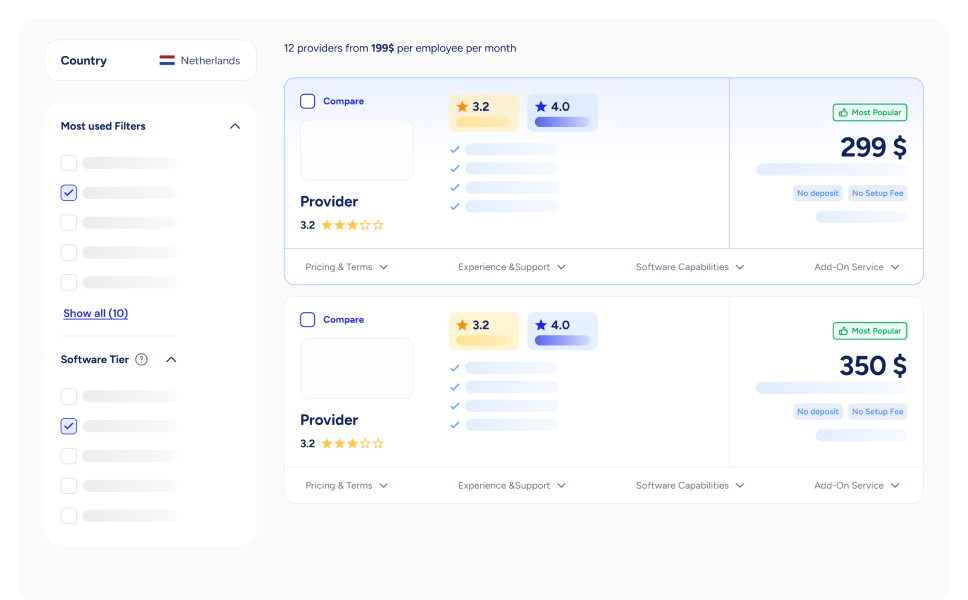
Compare All EOR Providers for the Netherlands
Use the Employsome EOR Comparison Tool to filter providers by Netherlands coverage, pricing, entity type and supported services. Over 130 EOR providers compared side by side.