
Average Salary in Japan 2026: NTA & MHLW, by City & Industry
The average salary in Japan in 2026 is approximately ¥4,775,000 (USD 32,260) per year per NTA, the highest level since 1949, with full-time workers averaging ¥5.0-5.4 million. This guide covers wages by industry, city (Tokyo, Osaka, Nagoya, Fukuoka), age and seniority (the nenkō effect), 2026 income tax brackets, social insurance, foreign worker salaries by visa category, the gender pay gap, and the shuntō wage growth.

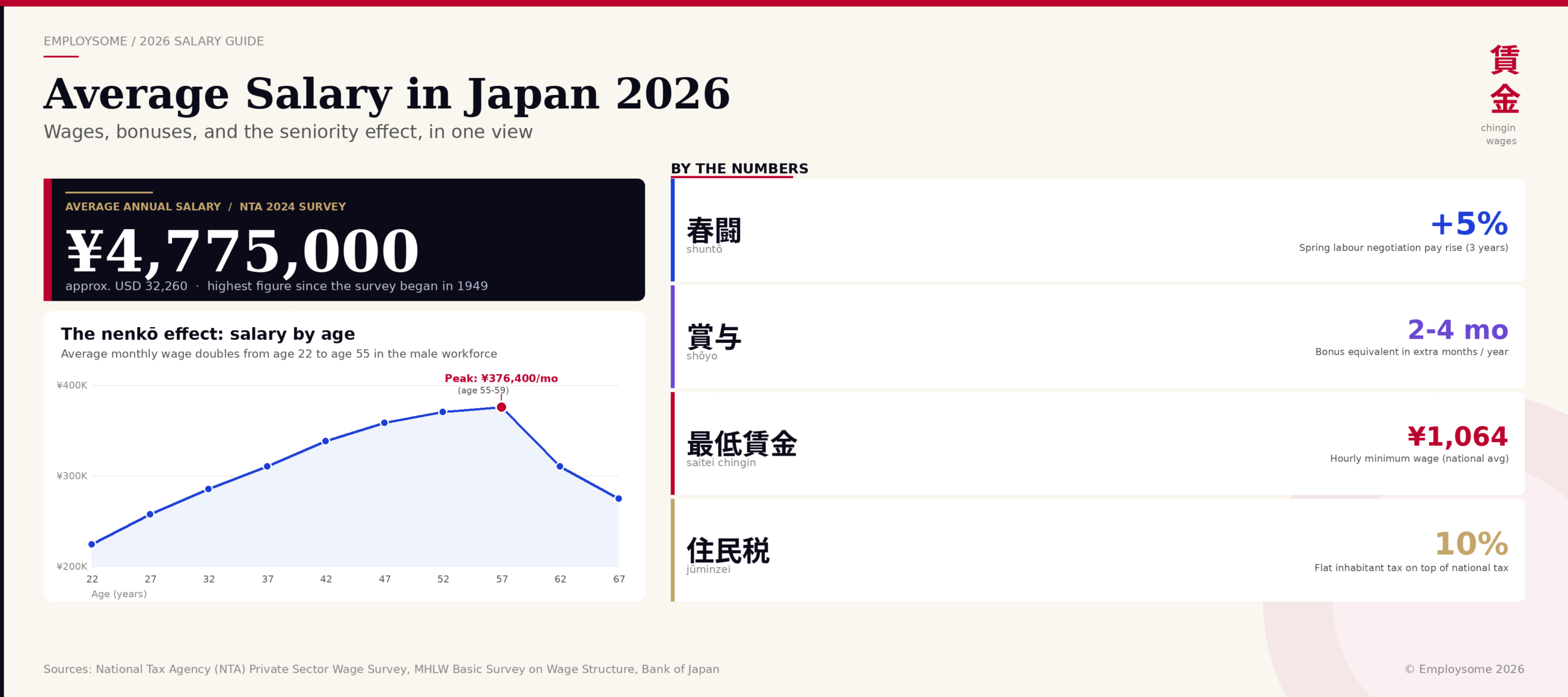
The average salary in Japan in 2026 is approximately ¥4,775,000 to ¥5,000,000 (USD 32,000 to 33,800) per year, equivalent to approximately ¥311,800 to ¥336,485 per month in gross wages, according to the latest data from Japan’s National Tax Agency (NTA) Private Sector Wage Survey and the Ministry of Health, Labour and Welfare’s Basic Survey on Wage Structure. The 2024 figure of ¥4.775 million was the highest annual average salary recorded since the survey began in 1949, reflecting Japan’s strongest wage growth in decades.
Three forces are driving the change in 2026: the shuntō (春闘) spring labour negotiations have delivered consecutive years of 5%-plus base pay increases at major corporations, prefectural minimum wages have crossed the symbolic ¥1,000 per hour threshold nationally with the weighted average reaching ¥1,064/hour, and Japan’s 2026 tax reform raised the basic deduction and minimum taxable income threshold to ¥1.78 million. For workers, that means more take-home pay; for employers, it means rising fully-loaded costs.
This 2026 guide to the average salary in Japan covers everything you need to plan, benchmark, or budget Japanese hires accurately: official NTA and MHLW wage data, salary by industry (technology, finance, manufacturing, healthcare), salary by city (Tokyo, Osaka, Yokohama, Nagoya, Fukuoka), salary by experience and age (the nenkō seniority effect), Japan’s 2026 progressive income tax brackets, the unique Japanese bonus system (賞与 shōyo), social insurance contributions (health, pension, employment, long-term care), salaries for foreign workers by visa category, the gender pay gap, and what international employers hiring through a Japanese Employer of Record (EOR) need to know.

Average Salary in Japan 2026: Latest NTA and MHLW Data
According to Japan’s National Tax Agency (NTA) and the Ministry of Health, Labour and Welfare (厚生労働省, MHLW), the most recent official wage benchmarks for Japan in 2026 are as follows:
| Wage Indicator (2026) | Value (JPY) | Approx. USD |
| Average annual salary (NTA, all private-sector workers) | ¥4,775,000 | USD 32,260 |
| Average annual salary (full-time only, MHLW) | ¥5,000,000 to 5,400,000 | USD 33,780 to 36,490 |
| Median annual salary | ¥3,500,000 to 3,600,000 | USD 23,650 to 24,330 |
| Average monthly salary (full-time, gross before bonus) | ¥311,800 to 336,485 | USD 2,107 to 2,275 |
| Average monthly salary (male, full-time) | ¥342,000 | USD 2,311 |
| Average monthly salary (female, full-time) | ¥258,900 | USD 1,749 |
| Average annual bonus (shōyo) | ¥1,000,000 to 1,400,000 | USD 6,760 to 9,460 |
| Foreign worker average monthly salary | ¥274,900 | USD 1,857 |
| National minimum wage (weighted average, hourly) | ¥1,064 | USD 7.19 |
| Tokyo minimum wage (hourly) | ¥1,226 | USD 8.28 |
Why averages and medians differ so much in Japan: Japan’s reported averages are pulled upward by senior corporate executives at major firms whose salaries can reach ¥10-30 million per year, and by the nenkō (年功) seniority pay system that rewards long tenure heavily. The median figure of ¥3.5 to 3.6 million is therefore a more realistic benchmark for what a typical worker actually earns. For non-Japanese hiring planning, always quote and budget on full-time average figures (¥5.0M to 5.4M) rather than the all-worker NTA figure that includes part-time workers.
The shuntō effect: The 2024 and 2025 spring labour negotiations (春闘 shuntō) delivered base pay increases of over 5% at major Japanese corporations, the strongest wage growth in over 30 years. The 2026 shuntō round is expected to maintain similar momentum, with the Bank of Japan, the Cabinet Office, and Keidanren all framing wage growth as central to Japan’s reflation strategy after three decades of deflation. For international employers benchmarking salaries to local talent, this means published 2024 figures may understate 2026 market wages by 5 to 10%.
The bonus system (賞与, shōyo): Most full-time Japanese workers receive two semi-annual bonuses per year, paid in summer (June or July) and winter (December). Combined, these bonuses typically add the equivalent of 2 to 4 months of base salary per year, raising effective annual gross by 16 to 33% above the simple 12-month equivalent. International employers must factor in these bonuses when benchmarking Japanese salaries against home-country offers.
💡 Employsome Insight: Always Negotiate in Nenshu (Annual Income), Not Monthly Base
When negotiating Japanese salaries, always work in nenshu (年収, total annual income) terms rather than monthly base pay. A Japanese candidate quoting “¥5 million” almost always means ¥5 million nenshu including bonuses, not 12 × ¥417,000 monthly base. Confusing the two leads to either accidental over-payment (when the employer adds a bonus on top) or rejected offers (when the employer’s 12-month figure is below the candidate’s nenshu expectation). The standard Japanese pay slip (給与明細書) breaks out base salary and bonus separately, making the distinction clear.
Average Salary in Japan by Industry and Sector
Industry differences in Japan are pronounced. The highest-paying sectors are concentrated in finance, technology, and energy, while hospitality, retail, and agriculture remain among the lowest. The data below combines MHLW Basic Survey on Wage Structure and NTA Private Sector Wage Survey figures, expressed as average annual gross salary (including bonuses) for full-time workers in 2026.
| Industry / Sector | Average Annual Gross Salary 2026 (JPY) |
| Electricity, gas, heat, and water (utilities) | ¥7,500,000 to 8,500,000 |
| Finance and insurance (banking, securities, insurance) | ¥7,000,000 to 9,500,000 |
| Information and communications (tech, IT, software) | ¥5,800,000 to 7,800,000 |
| Pharmaceuticals and life sciences | ¥5,800,000 to 7,500,000 |
| Manufacturing (automotive, electronics, machinery) | ¥5,000,000 to 6,500,000 |
| Construction and real estate | ¥4,800,000 to 6,200,000 |
| Wholesale trade and trading houses (sogo shosha) | ¥4,800,000 to 7,000,000 |
| Transportation and logistics | ¥4,400,000 to 5,500,000 |
| Healthcare and welfare | ¥4,000,000 to 5,200,000 |
| Education (private sector) | ¥3,800,000 to 5,000,000 |
| Public administration | ¥4,500,000 to 6,800,000 |
| Retail trade | ¥3,500,000 to 4,500,000 |
| Hospitality, hotels, and food service | ¥3,000,000 to 4,200,000 |
| Agriculture, forestry, and fisheries | ¥3,000,000 to 4,000,000 |
Specific role benchmarks (gross annual, 2026): a software engineer in Tokyo earns ¥5,500,000 to ¥9,000,000 depending on level and employer, with senior engineers at global firms (Google, Amazon, Indeed, Mercari, LINE Yahoo) reaching ¥10,000,000 to ¥20,000,000 including bonus and equity; a financial analyst earns ¥5,500,000 to ¥9,000,000 at major Japanese banks (MUFG, SMBC, Mizuho); a marketing manager ¥6,000,000 to ¥10,000,000; an HR business partner ¥6,500,000 to ¥10,500,000; and an English teacher (ALT or eikaiwa) ¥2,800,000 to ¥4,500,000.
Japan is particularly strong in automotive, electronics, precision machinery, robotics, gaming, anime/entertainment, and pharmaceuticals. These sectors pay competitive wages to skilled workers, although usually below equivalent roles in the United States, Singapore, or Switzerland.
Average Salary by City: Tokyo, Osaka, Nagoya, Fukuoka
Salary in Japan varies more by city than most developed economies. Tokyo commands roughly a 35% premium over the national average, driven by headquarters concentration, financial sector dominance, and intense competition for skilled workers. Other major metros pay closer to the national average, while regional cities and rural prefectures typically run 15 to 25% below.
| City / Prefecture | Average Monthly Salary 2026 (JPY) | Notes |
| Tokyo (東京) | ¥390,000 to 480,000 | Financial capital, Big Tech APAC HQs, fashion, media; highest cost of living |
| Yokohama (横浜, Kanagawa) | ¥360,000 to 420,000 | Greater Tokyo metro; Nissan HQ, port city, manufacturing |
| Osaka (大阪) | ¥330,000 to 380,000 | Western Japan business hub, manufacturing, Panasonic, Sharp |
| Nagoya (名古屋, Aichi) | ¥325,000 to 380,000 | Toyota Motor HQ, automotive supply chain, manufacturing |
| Kyoto (京都) | ¥305,000 to 360,000 | Nintendo, Kyocera, Murata Manufacturing; cultural capital |
| Kobe (神戸, Hyogo) | ¥305,000 to 360,000 | Port city, shipbuilding, pharma; lower cost than Osaka |
| Saitama / Chiba (greater Tokyo) | ¥310,000 to 370,000 | Tokyo commuter belt, logistics hubs |
| Fukuoka (福岡) | ¥290,000 to 340,000 | Growing tech and startup hub, lower cost of living |
| Sapporo (札幌, Hokkaido) | ¥280,000 to 320,000 | Northern hub, services, tourism |
| Hiroshima (広島) | ¥290,000 to 340,000 | Mazda HQ, manufacturing, services |
| Sendai (仙台, Miyagi) | ¥285,000 to 330,000 | Northeastern hub, education, services |
| Naha (那覇, Okinawa) | ¥240,000 to 280,000 | Lowest wages of major cities, tourism-dependent |
Cost of living context: In Tokyo’s 23 wards, average rent for a 1LDK apartment in central districts (Minato, Shibuya, Shinjuku) is ¥180,000 to ¥300,000 per month; mid-range districts ¥120,000 to ¥180,000. In Osaka and Nagoya, the same apartment costs ¥90,000 to ¥150,000. In Fukuoka or Sapporo, ¥70,000 to ¥110,000. Japanese landlords typically require tenants to earn at least 36 times the monthly rent in annual salary, a stricter ceiling than the 30% rule of thumb. A ¥100,000-per-month apartment therefore typically requires ¥3.6 million annual salary minimum to qualify.
Tokyo vs regional trade-off: The Tokyo premium is real but not free. A salary of ¥500,000 monthly in Tokyo provides comparable discretionary income to ¥380,000 in Fukuoka or Kyoto once housing, transport, and general cost of living are factored in. For remote roles, Fukuoka, Kyoto, and Kobe are increasingly attractive trade-offs: 30 to 40% lower living costs for a 10 to 20% salary discount.
💡 Employsome Insight: Fukuoka Is Japan’s Most Credible Remote-Work Alternative to Tokyo
Fukuoka has emerged as Japan’s most credible alternative to Tokyo for international employers building remote-first teams. The city offers a competitive engineering talent pool (Kyushu University and rapidly growing startup community), Tokyo-grade broadband, low cost of living, and salaries 15 to 25% below Tokyo levels for equivalent roles. Combined with the Japanese government’s designation of Fukuoka as a National Strategic Special Zone for startups, the Fukuoka market offers meaningful arbitrage opportunities for global tech companies hiring Japanese talent.
Average Salary by Age and the Nenkō Seniority Effect
Japan’s pay structure is heavily shaped by the nenkō (年功) seniority system, which traditionally rewards length of service over individual performance. While younger Japanese workers and international firms are increasingly moving toward performance-based compensation, the seniority effect remains visible across the country’s wage statistics in 2026.
| Age Bracket | Avg Monthly (Overall) | Avg Monthly (Male) | Avg Monthly (Female) |
| 20 to 24 | ¥224,600 | ¥229,300 | ¥219,600 |
| 25 to 29 | ¥258,000 | ¥266,500 | ¥246,500 |
| 30 to 34 | ¥286,000 | ¥302,100 | ¥259,600 |
| 35 to 39 | ¥311,000 | ¥337,500 | ¥266,500 |
| 40 to 44 | ¥338,800 | ¥371,800 | ¥276,800 |
| 45 to 49 | ¥359,000 | ¥398,000 | ¥283,500 |
| 50 to 54 | ¥371,100 | ¥417,700 | ¥285,900 |
| 55 to 59 | ¥376,400 | ¥427,400 | ¥281,700 |
| 60 to 64 | ¥311,000 | ¥348,500 | ¥252,600 |
| 65 plus | ¥275,000 | ¥294,500 | ¥235,000 |
Key observations from the age-salary curve:
- Salaries roughly double from age 22 to age 55 in the male workforce, illustrating the strength of the seniority effect
- Salaries plateau in the 50s and decline after retirement age (60 to 65), as workers shift to lower-paid post-retirement employment (shokutaku) or part-time roles
- The gender pay gap widens significantly with age: at 20 to 24 the gap is ~4%, but by 50 to 54 it has grown to over 30%, reflecting structural issues including career interruptions, part-time concentration, and limited promotion access for women
- Education has a meaningful but smaller effect than tenure: university graduates earn around 25 to 35% more than high school graduates over a career, but the gap narrows when controlling for industry and firm size
Japan Income Tax 2026: Brackets, Inhabitant Tax, Reform
Japan operates a progressive 7-bracket national income tax system administered by the National Tax Agency (NTA, 国税庁). On top of national income tax, residents also pay a flat 10% inhabitant tax (住民税 juminzei) and a 2.1% special reconstruction surtax on the national tax bill (the surtax funds reconstruction from the 2011 Tōhoku earthquake, in force until 2037).
2026 national income tax brackets (NTA):
| Annual Taxable Income (JPY) | 2026 Marginal Rate | Notes |
| Up to ¥1,950,000 | 5% | Lowest bracket |
| ¥1,950,001 to 3,300,000 | 10% | Most low-wage workers |
| ¥3,300,001 to 6,950,000 | 20% | Median worker bracket |
| ¥6,950,001 to 9,000,000 | 23% | Senior professional bracket |
| ¥9,000,001 to 18,000,000 | 33% | Manager and director bracket |
| ¥18,000,001 to 40,000,000 | 40% | Senior executive bracket |
| Above ¥40,000,000 | 45% | Top bracket plus 2.1% surtax |
Combined effective top rate: With the 45% national rate, 2.1% reconstruction surtax, and 10% inhabitant tax, the maximum combined effective marginal rate reaches approximately 55.95% on income above ¥40 million, one of the highest among OECD economies.
2026 tax reform changes: The fiscal year 2026 tax reform outline released by Japan’s Ministry of Finance on 19 December 2025 raised the basic personal deduction and lifted the minimum taxable income threshold to ¥1,780,000 (from the prior ¥1,030,000). The reform is intended to reduce the burden on low and middle-income earners and incentivise labour force participation by part-time workers (the so-called “¥1.03 million wall”). New 2026 NTA withholding tax tables took effect on 1 January 2026.
Withholding and tax filing: Most Japanese employees do not file a tax return because employers withhold tax monthly (gensen chōshū) and reconcile with a year-end adjustment (nenmatsu chōsei). Employees must file separately if they earn more than ¥20 million per year, hold income from multiple employers, or have other income sources above ¥200,000 per year. The annual filing window is 16 February to 15 March for the prior calendar year.
Average Salary for Foreign Workers in Japan by Visa
Foreign workers in Japan earn meaningfully different salaries depending on their visa category. The average monthly salary for all foreign workers in Japan was approximately ¥274,900 (USD 1,857) per month in the most recent MHLW data, with an additional ¥229,900 per year in bonuses, bringing the estimated annual income to around ¥3.5 to 3.6 million. However, this average masks dramatic differences across visa categories.
| Visa Category | Average Monthly Salary 2026 (JPY) | Approx. USD |
| Highly Skilled Professional (高度専門職) | ¥556,600 | USD 3,761 |
| Engineer / Specialist in Humanities / International Services | ¥311,200 | USD 2,103 |
| Foreign Permanent Resident or Long-Term Resident | ¥305,200 | USD 2,063 |
| Specified Skilled Worker (特定技能) | ¥250,300 | USD 1,691 |
| Technical Intern Trainee (技能実習) | ¥210,000 | USD 1,419 |
| English language teacher (ALT, eikaiwa) | ¥230,000 to 350,000 | USD 1,554 to 2,365 |
| Foreign software engineer at international firm | ¥500,000 to 1,200,000 | USD 3,378 to 8,108 |
Why the foreign worker average is below the national average: The lower aggregate figure reflects three structural factors, not discrimination. First, foreign workers in Japan skew younger than the Japanese workforce (most are in their 20s and 30s), and the nenkō seniority system means younger workers earn less by definition. Second, foreign workers are concentrated in lower-paying industries including hospitality, manufacturing, agriculture, and English language teaching. Third, Specified Skilled Worker and Technical Intern Trainee visa categories are specifically designed for entry-level roles in labour-shortage sectors at compensation aligned with statutory minimums.
Highly Skilled Professional (HSP) visa earners at ¥556,600 monthly average actually earn above the Japanese national average. Foreign software engineers, financial professionals, and consultants at global firms in Tokyo (Goldman Sachs, Morgan Stanley, Google, Amazon, Indeed) frequently command ¥10,000,000 to ¥25,000,000 per year nenshu including bonus and equity, well above Japanese sector medians.
The Gender Pay Gap in Japan
Japan retains one of the widest gender pay gaps among developed economies, at approximately 21 to 25% on a raw earnings basis, although the gap narrows to roughly 12 to 15% when controlling for industry, tenure, and full-time vs part-time status. The 2026 figures from MHLW show:
- Average monthly wage, female full-time worker: ¥258,900
- Average monthly wage, male full-time worker: ¥342,000
- Female-to-male wage ratio: approximately 75.7%
Why the gap persists: Three structural factors drive most of the difference. First, women in Japan are heavily concentrated in non-regular employment (hiseiki): part-time, contract, and dispatch worker roles which pay materially less than full-time regular employment. Second, career interruptions for childcare often mean women re-enter the workforce in junior or part-time roles that lose seniority-based pay progression under the nenkō system. Third, women remain underrepresented in the highest-paying sectors and roles: senior management positions in major Japanese corporations remain over 90% male.
Recent progress: Japan introduced mandatory pay gap disclosure rules for companies with over 300 employees in 2022, requiring them to publish their gender pay ratios annually. The Cabinet Office’s Womenomics agenda continues to target a 30% female representation in management positions by 2030, although progress has been slow. International firms operating in Japan generally report narrower pay gaps and higher female representation than Japanese-owned corporations, partly due to the application of global pay equity policies.
What Foreign Employers and HR Teams Need to Know
2026 average gross salary in Japan is around ¥4,775,000 to ¥5,000,000 per year
According to NTA and MHLW data, Japan’s 2026 average annual salary for all private-sector workers is approximately ¥4,775,000, the highest figure recorded since 1949. For full-time workers only, the average rises to ¥5,000,000 to ¥5,400,000. The median is closer to ¥3.5 million, reflecting the impact of senior executive earnings and the seniority pay system.
Always work in nenshu (annual income) terms with bonuses included
Japanese full-time workers receive two semi-annual bonuses (shōyo) totalling 2 to 4 months of base salary per year, raising effective annual gross by 16 to 33% above the simple 12-month equivalent. Always benchmark in nenshu rather than monthly base when comparing offers.
2026 tax reform raised the basic deduction
Japan’s 2026 tax reform raised the minimum taxable income threshold to ¥1,780,000 and increased the basic personal deduction. National income tax brackets remain progressive from 5% to 45%, plus a 10% inhabitant tax and a 2.1% reconstruction surtax. The combined effective top rate is approximately 55.95%.
Tokyo pays roughly 35% more than the national average
Tokyo, Yokohama, Osaka, and Nagoya command the highest wages, while Fukuoka, Sapporo, and Okinawa pay 15 to 25% below national averages. Tokyo’s wage premium is partly offset by higher cost of living. Fukuoka has emerged as a credible remote-work alternative offering 30 to 40% lower living costs for a 10 to 20% salary discount.
Total employer overhead is approximately 16 to 17% on top of gross
Mandatory employer contributions cover health insurance (~5%), welfare pension (9.15%), long-term care insurance (~0.8% for staff aged 40+), employment insurance (0.95%), and workers’ accident insurance (0.25 to 8.8% sector-dependent). Total typical employer overhead is 16 to 17% of gross, moderate by OECD standards.
Foreign worker salaries vary dramatically by visa category
The average foreign worker earns ¥274,900 monthly, but ranges from ¥210,000 (Technical Intern Trainees) to ¥556,600 (Highly Skilled Professionals). Foreign software engineers and finance professionals at global firms in Tokyo can earn ¥10 million to ¥25 million nenshu, well above Japanese sector medians.
Strong wage growth in 2024 to 2026 is changing the benchmark
The shuntō (春闘) spring labour negotiations have delivered consecutive years of 5%-plus base pay increases at major corporations, the strongest wage growth in over 30 years. Published 2024 figures may understate 2026 market wages by 5 to 10%. Always verify with current shuntō data when benchmarking offers.
Consider an EOR for compliant Japanese hiring
For international companies without a Japanese GK or KK entity, an Employer of Record handles social insurance enrolment, monthly withholding, year-end adjustment, shōyo bonus calculations, and labour standards compliance automatically. See our Best EOR in Japan guide for verified provider rankings, or read our overview of the Godo Kaisha (GK) entity structure if you are considering setting up your own Japanese subsidiary.
Hiring in Japan?
Japanese employment requires social insurance enrolment with the relevant kenpo and Pension Service, monthly gensen chōshū withholding, year-end adjustment (nenmatsu chōsei), shōyo bonus calculations aligned to company policy, and Labour Standards Act compliance. Compare the top Employer of Record providers for Japan in 2026 – verified pricing, compliance scores, and expert rankings from Employsome’s independent research team.
Frequently Asked Questions
According to Japan’s National Tax Agency Private Sector Wage Survey, the average annual salary in Japan in 2026 is approximately ¥4,775,000 (USD 32,260) per year, the highest level recorded since the survey began in 1949. For full-time workers only, the MHLW Basic Survey on Wage Structure puts the average at ¥5,000,000 to ¥5,400,000. The median is lower, around ¥3.5 to ¥3.6 million. Average monthly wage is around ¥311,800 to ¥336,485 gross before bonus, with an additional ¥1,000,000 to ¥1,400,000 in annual bonuses (shōyo) for full-time workers.
Tokyo commands roughly a 35% premium over the national average, driven by headquarters concentration, financial sector dominance, and intense competition for skilled workers. Average monthly salaries in Tokyo range from ¥390,000 to ¥480,000 gross for typical full-time roles, with senior tech, finance, and consulting roles at multinationals reaching ¥1,000,000 to ¥2,500,000 per month. Tokyo’s premium is partly offset by higher cost of living: average rent for a 1LDK in central wards is ¥180,000 to ¥300,000 per month.
Yes. The 2026 weighted average national minimum wage in Japan is ¥1,064 per hour (USD 7.19), the highest figure ever recorded after consecutive years of large prefectural increases. Tokyo has the highest rate at ¥1,226 per hour, followed by Kanagawa (¥1,225) and Osaka (¥1,177); Okinawa has the lowest at ¥1,023. Based on a 40-hour workweek, the minimum wage equates to approximately ¥184,426 per month. For more detail see our dedicated minimum wage Japan guide.
The median annual salary in Japan in 2026 is approximately ¥3,500,000 to ¥3,600,000 (USD 23,650 to 24,330), lower than the average of ¥4,775,000. The gap between average and median exists because the average is pulled upward by senior corporate executives at major firms (some earning ¥10 to 30 million per year) and by the seniority-based pay system that rewards long tenure heavily. The median is therefore a more realistic benchmark for what a typical worker actually earns, particularly when planning your career or negotiating salary.
Japan operates a progressive 7-bracket national income tax system from 5% to 45%, plus a 10% flat inhabitant tax (juminzei) and a 2.1% reconstruction surtax on the national tax bill. The 2026 brackets are: 5% up to ¥1,950,000; 10% ¥1,950,001 to 3,300,000; 20% ¥3,300,001 to 6,950,000; 23% ¥6,950,001 to 9,000,000; 33% ¥9,000,001 to 18,000,000; 40% ¥18,000,001 to 40,000,000; and 45% above ¥40,000,000. The combined effective top rate reaches approximately 55.95%. The 2026 tax reform raised the minimum taxable income threshold to ¥1,780,000.
Japanese employers contribute approximately 16% to 17% of gross salary in mandatory social insurance, covering health insurance (~5%), welfare pension (9.15%), long-term care insurance (~0.8% for staff aged 40+), employment insurance (0.95%), and workers’ accident insurance (0.25 to 8.8% sector-dependent). Employees contribute approximately 15 to 16% on their side, for a combined social insurance burden of around 32%. Welfare pension contributions are capped at ¥650,000 monthly standard remuneration (2026); above this cap no further pension contributions apply.
Shuntō (春闘, “spring offensive”) is Japan’s annual round of coordinated wage negotiations between major employers and labour unions, typically concluded in March each year. The 2024 and 2025 shuntō delivered average base pay increases of over 5% at major Japanese corporations, the strongest wage growth in more than 30 years. The 2026 round is expected to maintain similar momentum. For international employers benchmarking salaries, this means published 2024 wage figures may understate 2026 market wages by 5 to 10%; always reference current shuntō outcomes when finalising offers.
The average monthly salary for all foreign workers in Japan was approximately ¥274,900 (USD 1,857) in the most recent MHLW data, with about ¥229,900 per year in additional bonuses, totalling roughly ¥3.5 to ¥3.6 million annually. Salaries vary dramatically by visa category: Highly Skilled Professionals earn ¥556,600/month, Engineer / Specialist in Humanities / International Services workers earn ¥311,200, Specified Skilled Workers earn ¥250,300, and Technical Intern Trainees earn ¥210,000. Foreign software engineers and finance professionals at global firms in Tokyo can earn ¥10 million to ¥25 million nenshu, well above Japanese sector medians.
Japan retains one of the widest gender pay gaps among developed economies, at approximately 21 to 25% on a raw earnings basis (the female-to-male wage ratio is around 75.7%). The 2026 MHLW figures show male full-time workers earn an average ¥342,000 per month versus ¥258,900 for female full-time workers. The gap stems from structural factors: higher concentration of women in non-regular (part-time, contract, dispatch) employment, career interruptions for childcare, and underrepresentation in the highest-paying senior roles. Japan introduced mandatory pay gap disclosure for companies with 300+ employees in 2022.
International companies hiring in Japan have three options: (1) establish a Japanese legal entity (a Godo Kaisha or Kabushiki Kaisha), which provides full operational control but requires significant setup time, capital, and ongoing accounting; (2) engage Japanese workers as independent contractors, which is workable for genuine freelance arrangements but carries misclassification risk for regular ongoing roles; or (3) use a Japanese Employer of Record (EOR) that formally employs the worker on your behalf and handles social insurance, withholding, year-end adjustment, and labour compliance. For more on the GK structure see our Godo Kaisha guide; for verified EOR provider rankings see our Best EOR in Japan guide.
Copywriter
Christa is a Copywriter at Employsome with 17 years of professional writing experience across global brands, startups, and online publications. A native English-Finnish writer, she brings strong editorial skills and a versatile background in business, SaaS, and finance. At Employsome, Christa focuses on clear, practical content about HR, payroll, and Employer of Record topics.
Our content is created for informational purposes only and is not intended to provide any legal, tax, accounting, or financial advice. Please obtain separate advice from industry-specific professionals who may better understand your business’s needs. Read our Editorial Guidelines for further information on how our content is created.
Social Insurance Contributions in Japan 2026
Japanese social insurance (社会保険, shakai hoken) covers four mandatory components, all calculated as percentages of monthly gross salary up to specific thresholds. Both employer and employee contribute, with the employer typically paying slightly more than half the total.
Total mandatory employer overhead in Japan is approximately 16% to 17% of gross salary for social insurance, which is moderate by OECD standards (well below France, Italy, or Germany, but above the UK or US). There is no separate severance accrual system equivalent to Italy’s TFR, although retirement allowances (退職金, taishokukin) are common, particularly at large traditional firms, and can equal 1 to 3 years of salary after long tenure.
Social insurance ceiling: Welfare pension contributions are calculated on monthly standard remuneration capped at ¥650,000 per month (2026 figure); above this cap no further pension contributions apply. Health insurance has a higher cap of ¥1,390,000 monthly. Employment insurance applies on the full gross salary without a cap.