



Table of Contents
Hiring in the United States might at first appear intimidating, with its mix of federal and state-based laws and regulations. This is where a professional HR partner, such as a United States Employer of Record (EOR), can be useful.
In this guide, we identify the best EOR providers in the United States and set out everything you need to know in choosing a US EOR partner.
Before going further, it’s important to understand that the US does not have a single labor code because all 50 states have different regulations. This means that when hiring in the US both federal law and state and local laws must be considered. State and local laws set rules regarding minimum wage, sick leave, paid time off, data privacy and so on. Most providers offer EOR in multiple states, but still it is important to check if the provider handles hiring in your state.

EOR vs. PEO: Key Differences in the U.S.
In the US, two main concepts exist for hiring employees on behalf of a client company: Employer of Record (EOR) and Professional Employer Organization (PEO).
An EOR hires employees on your behalf by becoming their legal employer and taking care of all payroll and employment compliance. This solution is mainly useful when a foreign company does not have their own entity in the United States but still wants to hire some employees without setting up a separate subsidiary. Providers usually offer insurance and other benefits as well. For example, if you want to hire a front-end engineer in the US but you do not have your own entity in the United States, you can use EOR services. Usually you would need to pay fees around 400 – 600 USD per month per employee per month.
A PEO shares the employment responsibilities with the client company and is therefore often known as a ‘co-employer’. This would usually be used by domestic companies in the US looking to outsource payroll and employment compliance for their US operations, or for international companies that already have a subsidiary incorporated in the USA.
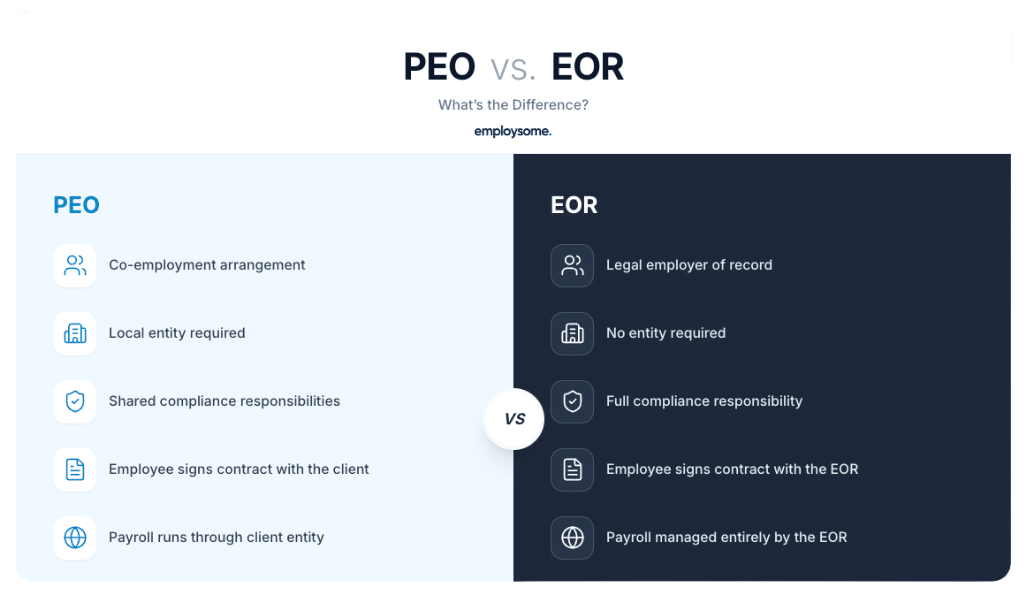
A PEO arrangement means a client company can contract a provider to manage HR and benefits of employees and outsource payroll and compliance. Also, some companies want their employees to join larger insurance plans for a lower cost, something that PEOs often specialize in. PEOs can be especially useful to US companies based in one state who seek to hire in a different state. Using a PEO service means that everything is handled for you, as usually most providers have already registered and set up employee insurance in every state they operate in. As an example, if your company is New York-based but you want to hire a Product Designer in Texas, you can employ through a PEO, saving on the time and cost it would take to set up your own entity in Texas. Costs in the PEO space are not very transparent but usually range from 2-6% of gross payroll.
Best 8 EOR Services in the U.S. – Quick Verdict

Ø price p.m.
4.5/5
4.6/5

Ø price p.m.
4.3/5
4.6/5

Ø price p.m.
4.1/5
4.5/5

Ø price p.m.
4.5/5
4.1/5

Ø price p.m.
4.3/5
4.2/5

Ø price p.m.
4.0/5
4.2/5

Ø price p.m.
3.8/5
4.3/5

Ø price p.m.
3.6/5
4.1/5
Best 8 EOR Services in the U.S. – In-Depth Review
Deel has its roots in the US as they were founded in San Francisco in 2019. It is safe to say that they are the global leader in the Employer of Record space, when considering their size and breadth of offerings. Deel has a stronger focus on global employment but has now expanded aggressively into domestic US employment through US payroll, US Contractor management and US-based EOR coverage.
Global
Ø Fee per Employee per Month, First Year
- Enterprise-grade software
- Great price-for-value
✓ Global Coverage & Services (5.0/5): Deel provides EOR services in 150+ countries, operating through 120+ wholly owned legal entities (including Germany, UK, Spain, Australia, Canada, India, and UAE). Services include compliant employment contracts, payroll, statutory filings, terminations, country-specific benefits, immigration support, background checks, equipment provisioning via Deel IT, equity & stock option administration, and access to 200+ in-house legal experts covering local employment law.
✓ Pricing & Transparency (4.1/5): Public EOR pricing starts at USD 599 per employee/month (discounted to USD 499 in the first year in some markets). Contractor management is USD 49/month, and Deel HRIS is free. Security deposits of 1–3 months of gross salary apply in most countries. FX fees are borne by the transacting party. Optional add-ons (Deel Engage, Deel IT, time tracking) increase total cost as teams scale.
✓ Payment & Contract Terms (4.5/5): Deel offers month-to-month EOR contract flexibility with no long-term minimum commitment. Deposits are required in many countries and typically refunded within 60 days after contract termination. Payments are processed via regulated PSPs in multiple currencies. Deel Shield provides contractor misclassification protection covering up to USD 25,000 in legal costs per contractor.
✓ Customer Experience & Support (4.3/5): Deel provides 24/7 in-house chat support, with a 4.8/5 Trustpilot rating across 7,000+ reviews. Dedicated customer success managers are assigned to larger accounts. Payroll and compliance guidance is supported by Deel AI, with onboarding completed in 2–3 business days in many countries. Support is efficient but less white-glove for very small teams.
✓ Platform & Integrations (4.8/5): Deel offers a modern, self-service global HR platform with 120+ native integrations (including Workday, BambooHR, Personio, Greenhouse, QuickBooks, Xero, NetSuite, Slack, and Microsoft Teams). Supports bi-directional HRIS syncing, open API, Zapier automation, and can function as a standalone global HRIS with onboarding, PTO, documents, org charts, and compliance monitoring.
4.5/5
✓ Entity ownership & compliance: Operates through a wholly owned US legal entity, enabling direct, compliant employment across all 50 states without reliance on third-party partners.
✓ Visa & work permit capability: Supports US immigration workflows (including H-1B, O-1, TN, and L-1 pathways) via in-house and partner legal teams; Deel can coordinate and manage processes but is not always the petitioning sponsor.
✓ Onboarding speed: Typically 2–5 business days depending on state, role complexity, and document readiness; standard W-2 employee onboarding can be completed faster for straightforward profiles.
✓ Local HR & payroll support: US-based HR, payroll, and compliance specialists available for multi-state payroll setup, tax registrations, benefits enrollment, and employment-law questions.
✓ Local compliance execution: Handles federal, state, and local payroll taxes, W-2 processing, at-will employment requirements, workers’ compensation, unemployment insurance, and state-specific labor rules.
✓ Local add-on services: Access to US-standard benefits including medical, dental, and vision insurance, 401(k) plans, PTO frameworks, and compliance tooling; benefits flexibility is strong but carrier choice may vary by state.
4.6/5
Velocity Global rebranded to Pebl in 2025 to emphasise a more tech-savvy look and feel. During our product demos at Pebl we were amazed by their product updates compared to their former ‘Velocity Global’ personality and their new AI functionalities. We also went through their entire sales cycle and saw that their supposed 399 USD per month per employee on their website was not accurate for most countries and additional fees beyond apply.
They are eager to close though, and were offering great migration credits. During our experience, response times were slow, and when communication did happen, the sales
Global
Ø Fee per Employee per Month, First Year
- Strong global entity infrastructure
- Transparent (but high) pricing
✓ Global Coverage & Services (4.2/5): Leading global EOR coverage across core hiring markets with consistent, high-touch onboarding support. 65 own entity worldwide and 35 local partners. Well-suited for standard international hires, though invoicing and payroll complexity has been reported once companies operate across multiple markets.
✓ Pricing & Transparency (4.5/5): Clear and predictable pricing with good upfront cost visibility. Significant migration credits when transitioning from another EOR. Only downside: 3% FX markup & high bank wire fees.
✓ Payment & Contract Terms (4.2/5): Open-ended contracts without minimum commitments. Payroll cut-off on the 10th of each month with invoice issued on the 20th, payment due in 7 days. Standard, overall. If one commits to a one-year annual contract, then monthly fee drops to $599 instead of $699,
✓ Customer Experience & Support (4.3/5): 24h SLA in response times. Solid responsiveness for day-to-day operations, handled through off-shore support teams. No support offered via WhatsApp.Teams in 65+ countries, 43 languages spoken, with local experts who help you hire and support talent.
✓ Platform & Integrations (4.3/5): Modern platform designed to handle the basic EOR workflows. However, by far not as strong as its competitors. It feels Pebl is still playing “catch-up”. Integration ecosystem is solid but not as extensive as larger enterprise HR suites.
4.3/5
✓ Entity ownership (5.0/5): Own US entity covering all 50 states for direct, compliant employment.
✓ Visa & Work Permit Support (4.0/5): Provides guidance on visa and work-permit pathways; not a formal visa sponsor but supports expat documentation and eligibility checks.
✓ Onboarding speed (4.5/5): 2–5 business days depending on state and completeness of documents; can be faster for standard profiles.
✓ Local HR support (5.0/5): US-based HR and compliance specialists available for multi-state tax, payroll, and employment-law questions.
✓ In-country compliance(4.5/5): Multi-state payroll tax handling, unemployment insurance, workers’ compensation coordination, at-will employment compliance, and W-2 processing.
✓ Local add-ons (4.5/5): Access to health insurance, dental/vision, 401(k) options, PTO frameworks, and statutory compliance tooling.
4.6/5
Strong compliance focus: Emphasizes regulatory accuracy across markets with robust contract and payroll controls.
AI-driven platform: Automation streamlines onboarding, document workflows, and cost calculations.
Over 10 years of industry experience: Backed by a leadership team with a decade of global employment and payroll expertise.
Immigration and recruiting support: Provides visa guidance, mobility advisory, and talent acquisition assistance.
Migration credits: Offers credits for companies transitioning employees from other EORs or internal entities.
Onboarding speed: Highly dependent on the region and documentation quality, with variability across markets.
High currency conversion rate: FX markup can reach up to 4%, higher than many global payroll competitors.
Limited pricing transparency: Full cost breakdowns require direct sales contact; no detailed public pricing beyond headline rates.
Pebl is best for companies that want to hire in many countries and value technology. If you require more than pure EOR but also support in finding your talents and have more complex immigration cases, Pebl might be just for you.
Justworks is another US-based player with a long history of providing HR and compliance support nationwide. They have positioned themselves as a tech-first provider in the often-traditional HR outsourcing industry. Their core focus area is PEO, but they also offer EOR and Payroll. They provide services to more than 1,.000 US companies across all industries and have a great reputation for their co-employment model.
Global
Ø Fee per Employee per Month, First Year
- End-to-end global workforce system
- Strong U.S. focus
- Owned legal entities only
✓ Global Coverage & Services (3.5/5): US-first EOR and PEO provider with expanding international coverage. Global EOR offering exists but lacks the depth, country breadth, and maturity of pure-play global EOR providers.
✓ Pricing & Transparency (4.0/5): Public EOR pricing at $599/month with no setup fees. Cost structure is clear with no hidden charges, though deposit requirements (if any) are not publicly disclosed.
✓ Payment & Contract Terms (4.0/5): Flexible contracts with no minimum employee counts and straightforward agreements. Well-suited for standard global use cases, less flexible for complex multi-country setups.
✓ Customer Experience & Support (4.5/5): 24/7 human support, dedicated customer success managers, strong ~4.6/5 ratings across G2 and Capterra, and consistently fast issue resolution.
✓ Platform & Integrations (4.5/5): Clean, intuitive platform with unified PEO/EOR experience and employee self-service. Limited mobile functionality and no advanced HR modules compared to enterprise HR suites.
4.5/5
✓ Entity Ownership (5.0/5): Operates through its own US entity as an IRS-certified PEO. Covers all 50 states with automated state tax registration and nationwide workers’ compensation.
✓ Onboarding Speed (4.5/5): Fast onboarding, typically completed within days for US employees.
✓ On-Site HR Support (5.0/5): US-based HR and payroll teams available 24/7 with dedicated account managers.
✗ Visa & Work Permit Support (3.5/5): Limited to guidance only; Justworks is not a licensed visa sponsor.
✓ In-Country Compliance (5.0/5): Strong multi-state compliance including payroll tax filings, ACA compliance, COBRA administration, unemployment insurance, workers’ compensation, and W-2/1099 reporting.
✓ Local Add-Ons (5.0/5): Comprehensive US benefits stack including major health insurers (Aetna, UnitedHealthcare, MetLife), 401(k) with employer match options, dental/vision, life & disability insurance, FSA/HSA, commuter benefits, and mental-health support.
4.7/5
Unified US PEO + Global EOR: One platform for both US PEO and international EOR, letting companies manage domestic and global teams without multiple vendors. Existing PEO users can add global hires seamlessly.
Transparent flat-rate pricing: Public pricing ($59 PEO Basic, $109 PEO Plus, $599 EOR) with no setup fees or hidden costs (rare in the EOR market).
Enterprise-level benefits for small teams: PEO pooling gives startups access to large-company benefits (health, dental, vision, 401(k)) at competitive rates.
Strong US multi-state compliance: Automated state tax registration, workers’ comp, unemployment insurance, and labor-law compliance across all 50 states.
24/7 human support: Highly rated service (4.6/5 G2 & Capterra) with round-the-clock real human support, not chatbot-first.
Premium EOR pricing: At $599/employee/month, it’s pricier than Remofirst ($199) and close to Deel’s upper range.
Limited global coverage: Owned entities in 11 countries and partner coverage in ~90, behind Deel (150+) and Remote (180+).
Newer EOR capability: Strong PEO history but EOR offering is still maturing post-2023 Via acquisition; some features feel early-stage.
Limited advanced HR modules: No performance management, LMS, or robust ATS; requires external HR tools for full talent management.
Mobile app limitations: Only basic employee functions; admin and deeper HR tasks still require desktop.
Justworks is great for start-ups or small businesses who are focused on hiring in the US only. If you want to hire across multiple states, Justworks is a great, more modern alternative to Eastridge. If your business requires a CPEO with top support, Justworks might be just right for you. It may not be the best provider for companies looking to hire in multiple overseas locations as well, due to Justworks’ limited overseas coverage.
Multiplier is a Singapore-headquartered EOR, which, while a relative newcomer, has already become one of the leading EOR providers in the market. Multiplier helps you to hire employees in 150 countries without the need for you to set up your own entity. Multiplier has more than 100 of its own entities and offers competitive flat fees of 400 USD per employee per month for most countries.
Global
Ø Fee per Employee per Month, First Year
✓ Global Coverage & Services (5.0/5): EOR services across 120+ countries, including contractor management, global payroll outsourcing, statutory compliance, benefits administration, and immigration support in selected jurisdictions.
✓ Pricing & Transparency (4.0/5): Generally clear pricing and competitive for scaleups at $505 per EOR contractor, though FX markups apply (stated ~2%, reported higher in some cases) and country-level cost breakdowns are not always fully transparent upfront.
✓ Payment & Contract Terms (4.5/5): No minimum contract commitment and flexible agreements. However, invoices are issued early and short payment windows (often ~7 days) can impact cash flow.
✓ Customer Experience & Support (4.5/5): Improved support quality in recent years with a solid self-service knowledge base. Support experience and escalation handling can vary by region.
✓ Platform & Integrations (4.5/5): Strong, modern platform with clean UX, efficient onboarding, and good multi-country reporting. Integration depth and automation are slightly behind top tech-first EORs.
4.5/5
✓ Entity Ownership (4.5/5): Operates through its own U.S. entity, enabling direct W-2 employment, federal and multi-state payroll, tax withholdings, and statutory compliance across all 50 states.
✓ Onboarding Speed (4.5/5): Fast onboarding, often within a few business days, supported by a streamlined platform and standardized U.S. employment workflows.
✓ On-Site HR Support (4.0/5): Centralized HR and payroll support with solid operational execution. Less hands-on support for complex, multi-state enterprise setups.
✗ Visa & Work Permit Support (3.0/5): Limited U.S. immigration support compared to specialist providers. Not ideal for companies hiring employees requiring visa sponsorship.
✓ In-Country Compliance (4.5/5): Strong handling of IRS filings, state tax registrations, W-2 reporting, ACA considerations, and labor law compliance across states.
✓ Local Add-Ons (4.0/5): Competitive U.S. benefits offering including health insurance, 401(k), PTO administration, and payroll reporting. Fewer advanced or customized add-ons for large enterprises.
4.1/5
Modern, intuitive platform: Real-time dashboards, automated contract generation, and clean employee self-service experience.
Transparent flat-rate pricing: Starting at $400/month with public pricing calculator and no hidden fees.
Fast onboarding: Typically 24-72 hours for standard US hires with streamlined document collection.
Strong HRIS integrations: Connects with BambooHR, Workday, and other major systems out of the box.
Competitive benefits packages: Health insurance through major carriers, 401(k) options, dental/vision, and PTO management.
Limited US immigration support: Not a licensed visa sponsor; basic guidance only compared to Deel or G-P.
Inconsistent support response times: US-specific issues can lag behind APAC coverage where their team is strongest.
Complex multi-state setups require extra diligence: Platform works best for straightforward hires; intricate scenarios need more hand-holding.
Less established US presence: Newer to the market compared to domestic PEO providers or global veterans like G-P.
Limited white-glove service: Enterprise clients with complex compliance needs may find the self-service model insufficient.
Multiplier is ideal for tech companies and startups scaling across multiple countries who want to hire 1 – 10 employees and are interested modern, self-service tooling and transparent pricing without enterprise-level costs. The US offering is competent for straightforward W-2 employment but may require additional diligence for complex multi-state setups or immigration-heavy hiring. Not ideal for enterprises needing white-glove service, companies with significant visa sponsorship needs, or organizations requiring deep US-specific HR advisory. We also recommend using Multiplier if you are already using Multiplier for other countries to consolidate all employees in one system.
Borderless AI (previously branded as “Borderless” or “Hire Borderless”) is proud to be the premier AI-powered EOR provider in the industry for 170+ countries. The platform uses AI agents to automate all aspects of an EOR like contract generation, onboarding, payroll, benefits and compliance.
Borderless AI has also invested heavily on creating an automated payment infrastructure, which is why they can receive money from a company’s bank account in 20 minutes and then pay team members within 3-5 business days in 100+ currencies.
Global
Ø Fee per Employee per Month, First Year
✓ Global Coverage & Services (4.3/5): Broad EOR and contractor coverage across global markets, with add-ons including global payroll, contractor of record, immigration support, insurance, equipment provisioning, and entity setup. Coverage depth is still developing compared to large incumbents.
✓ Pricing & Transparency (4.0/5): No security deposits and generally transparent pricing, though limited public country-level pricing reduces predictability for complex multi-country setups.
✓ Payment & Contract Terms (4.5/5): No minimum commitment, flexible payroll cut-off (26th of the month), fast payment terms (5 days from invoice), and AI-generated contracts that reduce onboarding friction.
✓ Customer Experience & Support (4.5/5): Dedicated account managers, very fast response times, strong onboarding and compliance support, and AI-assisted tools, with less emphasis on traditional phone-heavy enterprise models.
✓ Platform & Integrations (4.0/5): Advanced HR platform with zero-touch onboarding, misclassification assessments, reporting dashboards, and mobile access, but limited native HRIS, ATS, and accounting integrations.
4.3/5
✓ Entity Ownership (3.5/5): Operates through a US partner employer rather than a wholly owned US subsidiary, which introduces an additional dependency compared to owned-entity models.
✓ Work Authorization & Mobility Support (4.0/5): Provides basic visa and immigration guidance for US hires but does not act as a licensed visa sponsor.
✓ Onboarding Speed (4.5/5): Fast onboarding within days, supported by AI-driven document collection and automated contract generation.
✓ Local HR Support (4.5/5): Responsive US-focused support team with strong guidance on payroll cycles, benefits administration, and compliance requirements.
✓ In-Country Compliance (4.5/5): Robust handling of US employment compliance, including federal and state tax withholding, unemployment insurance, workers’ compensation coordination, and W-2 processing.
✓ Local Add-Ons (4.0/5): Access to US health insurance plans, 401(k) options, dental and vision coverage, PTO tracking, and statutory compliance packages via partner networks.
4.2/5
AI-Powered Efficiency: Automated contract generation, onboarding, payroll workflows, and compliance checks.
Multi-State Payroll & Payments: Automated payment infrastructure enables smooth payroll and multi-currency payouts — ideal for companies that hire teams across several U.S. states and internationally.
Compliance Tooling Across Jurisdictions: Compliance checks keep track of varied state employment laws, tax withholdings, and reporting requirements.
Immigration/Work Permit Assistance Is Basic: Work visa support (e.g., H-1B, L-1, TN) is advisory rather than end-to-end case management.
Less White-Glove Local Expertise: Focus on automation and self-serve functionality means that in highly nuanced compliance situations, clients may get lighter support than from traditional U.S. EOR providers.
If you are a start-up or tech-first company that wants to use a tech platform rather than a pure service company, Borderless AI is for you. If you need extensive visa and immigration support, you would need to choose a different provider with more expertise in that field. Borderless Ai has an impressive portfolio of tech customers but fewer enterprise-sized businesses.
RemoFirst is one of the most affordable global EOR providers in the market, offering coverage for more than 160 countries. Unlike most competitors, RemoFirst operates entirely through licensed local partners instead of owned entities, which allows it to maintain extremely competitive pricing starting at 199 USD per employee per month.
Global
Ø Fee per Employee per Month, First Year
- Low cost provider
- Extensive global coverage
✓ Global Coverage & Services (4.0/5): Broad global reach across 100+ countries delivered exclusively through a partner network rather than owned entities. Besides Papaya Global, no other EOR is operating like this. Based on our research, local partners selected by RemoFirst are strong (e.g. ThisWorks for Europe).
✓ Pricing & Transparency (4.5/5): One of the most transparent and affordable EOR pricing models on the market, with no setup or termination fees. However, pricing for mature markets such as Canada, UK, Germany or Spain are significantly higher (min. $399). Overall cost predictability remains a key strength.
✓ Payment & Contract Terms (4.0/5): Flexible contracts with no long-term commitments, fair payroll cut-off timelines, and support for multiple invoice and payout currencies (keep in mind that an FX markup may apply in this case).
✓ Customer Experience & Support (3.6/5): Startup- and SMB-friendly support model with dedicated account managers. Day-to-day support handled via ticketing system which is responsive, but complex cases and peak periods may see slower resolution since they rely on local partners’ response times.
✓ Platform & Integrations (4.0/5): Modern, intuitive platform with automated payroll workflows. However, advanced reporting, integrations to enterprise HCMs, and customization for complex organizational structures are more limited than with larger, enterprise-grade EORs.
4.0/5
✗ Entity Ownership (3.5/5): RemoFirst operates through a vetted local partner in the US rather than an owned entity. Partner navigates state-by-state employment variations with established expertise.
✓ Onboarding Speed (4.5/5): Fast onboarding through RemoFirst’s streamlined platform. Same-day onboarding available with efficient contract generation.
✓ On-Site HR Support (4.0/5): Local US partner handles employment operations across all 50 states. Dedicated account managers provide 24/5 support.
✓ Visa & Work Permit Support (4.0/5): US visa sponsorship has specific requirements and limitations. RemoFirst offers visa services but US sponsorship (H-1B, etc.) has regulatory complexities and lottery systems.
✓ In-Country Compliance (4.5/5): Strong compliance coverage for US federal and state employment laws including payroll taxes (FICA, FUTA, state taxes), workers’ compensation, state-specific requirements (California, New York, etc.), and misclassification rules.
✓ Local Add-Ons (4.5/5): Supports competitive US benefits packages including health insurance (medical, dental, vision—critical in US market), 401(k) retirement plans with employer matching options, HSA/FSA accounts (tax-advantaged health savings), life and disability insurance, PTO policies, state-mandated paid family leave (CA, NY, WA, etc.), commuter benefits (tax-free up to $315/month), and wellness stipends. Equipment provisioning available.
4.2/5
Industry-leading pricing: Starting at $199/month per employee, significantly undercutting most competitors.
Transparent cost structure: No hidden fees, no deposits, no surprise charges at offboarding.
Fast onboarding: Employees can be set up within days with streamlined document collection.
Flexible contracts: Month-to-month options available without long-term lock-ins.
Strong emerging market coverage: 180+ countries with consistent pricing across regions.
Partner-based model: Quality and responsiveness can vary market by market; less controlled than owned-entity providers.
No owned US entity: Relies on third-party partners rather than direct subsidiary for employment.
Limited local HR support: No dedicated US-based team; support handled remotely with less market-specific depth.
Basic immigration support: Guidance only; not suitable for companies with significant visa sponsorship needs.
Less feature-rich platform: Functional but trails Deel and Remote on integrations and automation.
RemoFirst is ideal for cost-conscious startups and SMEs scaling internationally who want transparent, affordable EOR services without enterprise-level complexity. Their pricing makes them particularly attractive for companies where EOR costs previously pushed them toward riskier contractor arrangements. Strong choice for distributed teams across multiple emerging markets needing a single partner with consistent pricing. Not ideal for risk-focused enterprises wanting owned-entity compliance assurance, companies with significant US visa sponsorship needs, or organizations requiring deep white-glove support for complex scenarios.
Globalization Partners (G-P) is one of the most experienced EOR providers especially in the US. Headquartered in the US, and starting in 2012, they are quite service- oriented which also means they are not as focused on technology as much as other providers. They are also highly professional which is great for full compliance but often comes with the cost of potential delay.
We went through the entire G-P sales and onboarding process in the US, so you don’t have to: What we experienced was a Sales process that took 3 sales calls to get a first price for hiring in the United States. Prices are on the higher side, and the onboarding process took us more than three weeks.
Global
Ø Fee per Employee per Month, First Year
- White-glove service
- Enterprise-grade software
✓ Global Coverage & Services (4.5/5): EOR services across 125+ countries, covering compliant employment contracts, payroll processing, statutory filings, terminations, and benefits administration. Supports contractor management (USD 39/month per contractor), global payroll, immigration and visa services, insurance and pension support, background checks, equipment procurement, and equity & stock option administration.
✓ Pricing & Transparency (3.0/5): EOR pricing typically ranges around USD 940 per employee/month plus a one-time setup fee of USD 2,820. Security deposits of 1–2.5 months of total employment cost apply depending on credit checks. FX markup estimated at ~3%. Pricing is sales-led only, with no public or self-serve country-level cost breakdowns.
✓ Payment & Contract Terms (3.0/5): Enterprise-leaning contract structures, often requiring longer minimum commitments (up to 12 months). Invoices are issued around the 15th of the month with net-7 payment terms. Late payments incur 5% interest. Offboarding fees of USD 1,000 may apply. Contracts are standardized, compliance-driven, and relatively rigid.
✓ Customer Experience & Support (4.5/5): Enterprise-grade, consultative support model with dedicated account managers, live chat (≈2-minute first response), phone support, onboarding and termination assistance, compliance alerts, and AI-supported guidance. Strong depth across HR, legal, and compliance topics.
✓ Platform & Integrations (4.0/5): Stable enterprise platform covering payroll, employment documents, time-off, expenses, reporting, and compliance workflows. Includes G-P Assist AI. SOC 2 and ISO 27001 certified. Integrations available with major HRIS/HCM systems (Workday, SAP SuccessFactors, UKG, BambooHR, HiBob). Reliable, but less automation-heavy than newer tech-first platforms.
3.8/5
✓ Entity Ownership: Own US employing entity registered in all 50 states; no outsourcing to third-party PEOs.
✓ Onboarding Speed: Typically 2–5 business days depending on state requirements and documentation completeness.
✓ On-Site HR Support: Large US-based team providing support across payroll cycles, benefits, state-level rules, and employment guidance.
✓ Visa & Work Permit Support: Provides guidance on visa paths and documentation; not a licensed visa sponsor for most categories.
✓ In-Country Compliance: Full multi-state compliance including tax withholding, unemployment insurance, workers’ compensation coordination, at-will employment handling, and W-2 processing.
✓ Local Add-Ons: Access to high-tier health insurance, dental/vision, and 401(k) contributions, plus PTO frameworks and statutory compliance support.
4.3/5
Strong US presence: Majority of staff located in the US with deep on-the-ground expertise compared to global competitors operating remotely.
Own US entity: Fully registered in all 50 states with no outsourcing to third-party PEOs.
Comprehensive benefits: Access to top-tier health insurance, dental, vision, and 401(k) plans nationwide.
Mature compliance infrastructure: Reliable handling of federal and multi-state regulations, tax withholding, unemployment insurance, and W-2 processing.
Established platform: Meridian platform automates core workflows like onboarding, payroll, and reporting.
Higher pricing: Premium rates above mid-market EOR providers more than $900 plus high onboarding and offboarding fees.
Slower response times: Support is consultative but not as fast or agile as newer tech-led competitors.
Limited pricing transparency: FX rates, fees, and cost structure require sales involvement and are not fully disclosed publicly.
G-P is best for large enterprises and established companies looking to hire in the US market. They also bring a vast amount of experience working with regulated industries like finance, healthcare and tech who are willing to pay more for more compliance and better peace of mind.
Eastride Workformance Management (EWM) is part of the Workwell group and provides EOR services and workforce services. Founded in 1972 in San Diego California, they are one of the longest-standing workforce management providers in the United States. Eastride started as a staffing company but, over time, developed into a technology company as well.
The company is not a pure EOR provider but has extensive deep expertise in US labor law, offering managed service programs (MSP) and its workforce management software, Talient.
Regional
Ø fee per employee per month, first year
Eastridge brings 50+ years of workforce management expertise but remains primarily a US-centric provider with limited global reach. Direct coverage spans the US, Canada, Mexico, Germany, and UK, with other countries served through partner networks. The February 2025 acquisition by Workwell Group adds global scale but introduces integration uncertainty. Strengths include deep contingent workforce expertise, robust Talient VMS platform, and strong multi-state US compliance. The gaps: no public pricing, limited owned entities outside North America, and a service model optimized for contingent labor rather than permanent global hiring.
✓ Pricing Transparency: No published pricing; quote-only model requiring sales engagement
✓ Contract Terms: Flexible arrangements for contingent workforce; limited public disclosure on EOR-specific terms
✓ Service Quality & Support: Dedicated account management model; high-touch service philosophy; mixed reviews on responsiveness
✓ Platform & Product Experience: Talient VMS platform with HRIS integrations (Workday, SAP, ADP); strong for workforce management; less consumer-friendly than Deel or Remote
✓ Add-On Services: MSP, VMS, recruitment, payrolling, compliance advisory; limited immigration support; no contractor management platform
3.6/5
Eastridge excels in the US market with 50+ years of experience, coverage across all 50 states, and deep expertise in contingent workforce compliance. Their employee-owned culture drives genuine service commitment, and the Talient platform handles complex multi-state payrolling and workforce management effectively. They offer ACA-compliant healthcare benefits after 59 days and can support some visa types. Particularly strong for entertainment, life sciences, manufacturing, and technology companies with project-based labor needs. The gaps: ongoing Workwell integration may cause short-term disruption, no public pricing, and the service model is less suited for companies seeking pure software-led EOR automation.
✓ Entity Ownership: Own US entity with direct operations across all 50 states; now part of Workwell Group
✓ Immigration Support: Some visa support available with exceptions; requires sales clarification on specific visa types
✓ Onboarding Speed: Fast onboarding, “as little as a day” for US workers; streamlined compliance processes
✓ Local HR Support: US-based dedicated account managers; high-touch service model with single point of contact
✓ Local Add-ons: ACA-compliant healthcare after 59 days; benefits for 30+ hour workers; MSP and VMS solutions
✓ Legal Compliance: Strong multi-state compliance; W-2 processing; tax withholding; contingent workforce classification expertise
4.1/5
50+ years of US market experience: Founded 1972 with deep expertise in American employment law, multi-state compliance, and contingent workforce management.
Strong contingent workforce specialization: Purpose-built for industries relying on project-based, temporary, and contract labor including entertainment, life sciences, and manufacturing.
Proprietary Talient platform: Robust VMS technology for requisitions, approvals, timekeeping, and workforce reporting with HRIS integrations (Workday, SAP, ADP).
Employee-owned culture: ESOP structure since 2019 drives service-first mentality and long-term client focus over short-term metrics.
Fast US onboarding: Can onboard workers “in as little as a day” with streamlined document collection and compliance processes.
Recent ownership transition: February 2025 sale to Workwell Group creates uncertainty during integration; transitioning to Workwell North America branding.
No public pricing: Quote-only model with limited transparency; requires sales engagement to understand cost structure.
Limited global coverage: Direct operations only in US, Canada, Mexico, Germany, and UK; other countries via partner network with potential quality variance.
Mixed staffing reviews: Yelp reviews (3.5/5) show inconsistent communication and responsiveness, primarily from staffing candidates rather than EOR clients.
Contingent focus may not suit all: Platform and services optimized for project-based workforce; less tailored for companies hiring permanent full-time employees globally.
Eastridge is a primarily US based provider and is therefore best if you are only planning to hire in the US. They are very experienced in hiring large, US-based teams. If you are a mid-size or enterprise-sized company with a strong focus on compliance, especially in a regulated industry, Eastridge is a great fit. Besides, they do not only employ workers but can also help you recruit experts in the life sciences, engineering, and tech/biotech industries. If you are not just looking to hire white collar but also blue collar, e.g. in the manufacturing space, Eastridge is one of the few providers that will be suited for it.
How We Score & Rank EOR in the US
Selecting the right partner for you to handle your EOR in the United States is crucial. We understand that the price is important, but it should not be the only factor when making a decision. After all, you are choosing to go with EOR because you want everything to be taken care of and not a compliance nightmare.
The key factors to consider when choosing an EOR in the US are:
- State Coverage: An EOR provider needs to be registered in the state that you want to hire in, where state registration is required. As labor laws also differ per state, it is important to check if the provider has experience where you want to hire.
- Payroll Tax Management: Provider should handle both Federal (IRS) tax withholding as well as any filings for state and local income tax.
- Benefit Coverage: Health insurance is not cheap, but you want to make sure your employees are covered. In some cases, it is even mandatory under the Affordable Care Act. Check if providers use trusted insurance providers in their offering. Also check if they provide access to 401(k) retirement, dental and vision options and worker’s compensation insurance in that specific state.
- Benefits Pricing: The bigger EORs in the industry usually have the ability to offer health insurance at a lower price than you could directly due to the ‘pooling effects’ of their multiple clients. Some smaller EORs might even use PEO partners themselves to match those prices. However, bigger is not always bigger as some national EORs might offer a great plan across all 50 states.
It is quite common for international EORs to actually use PEOs in the US themselves as an in-country partner (ICP), as even some large EORs often do not have direct employment entities in every state. They sometimes do not have separate state unemployment tax accounts and do not cover state-specific workers comp and health insurance. They therefore need to partner with US PEOs for co-employment purposes.
Hiring Employees in the US: What You Need to Know
The US has one of the greatest labour markets with great talent from the world’s best universities. Still, the US can be complex as the employment law differs from State to State. In every state, there are different rules on leave, benefits and termination. That is one more reason to use EOR so you don’t need to worry about it.
Legislation Around Employer of Record
In the US, there is no federal EOR license, EORs need to still be registered for state payroll tax carrying workers’ comp and issuing W-2s. Some EOR providers are not registered in all states and therefore use PEO themselves to offer EOR in also some less demanded regions. This is similar to the concepts of EORs using third party providers for countries they are not established in yet. If you want to hire in some less common states, it can be better to use larger providers like Deel that are in most states or local providers like Eastridge Workforce Solutions.
It is also worth keeping in mind that in California, there is an entirely different type of ‘Employer of Record’ used in the context of social service provision, which is the formal employer of caregivers. This type of EOR is regulated by California statute.
At-Will Employment and Employment Contracts
Most US employment is “at will”, which means both the employer and the employee can end the contract at any time, for any reason, as long as it is not discriminatory or otherwise a breach of certain federal and state-based provisions. In practice, this means that there are very few grounds for wrongful termination/unfair dismissal litigation.
When you use an EOR In the United States, they will ensure that any terminations are lawful. While ‘at will’ employment may be appealing to many international companies, due to the reduced potential liability (compared to, say Europe), it is worth baring in mind, this applies to employees as well. US employees can quit their employment with less notice, and are sometimes perceived as being less loyal to their employer due to the risk of being fired.
Holiday Pay, Paid Leave & Working Hours
Employers in the US are not generally mandated to offer paid leave, sick leave, public holidays, holiday pay or any other leave benefits. The federal Fair Labor Standards Act (FLSA) does mandate a rule for overtime pay, however, (1.5x regular rate for hours over 40 per week for non-exempt employees), which applies to most employees in the United States.
Note also that a separate piece of federal legislation, the Family and Medical Leave Act (FMLA), does require 12 weeks of unpaid, job-protected leave for serious health conditions.
Beyond, the law, as a matter of market standards, most international companies hiring through a US EOR should expect to pay at least two weeks annual leave, public statutory holidays and a certain amount of sick leave.
Note also that some states have applied their own minimum standards for employee paid leave.
Employer Burden and Payroll Tax in the US
Employers in the U.S. are responsible for several mandatory contributions, which make up part of the employer or payroll burden. This includes contributions to Social Security (6.2%), Medicare (1.45%), federal and state unemployment insurance (varies by state), and workers’ compensation insurance. Depending on the state, additional obligations such as disability insurance or paid family leave programs are also applicable.
A U.S. EOR will take care of all of these matters, saving client companies from multi-state tax registration, filings, and audits, while maintaining full compliance with federal and local employment laws.
FAQs About Employer of Record Services in the US
Below is a list of frequently asked questions section to answer the most frequent question people ask when hiring through EOR in the US.
PE risk is the risk that the company will be seen as having a sufficient presence in the US to be subject to corporate tax. In itself, using an EOR in the US does not automatically create a PE risk for your company. Still, it depends on certain factors and activities that you do in that country. If you use EOR but still have a physical office in the United States, or hire individuals that make key business decisions on behalf of your company, that can become a serious risk. Hiring non-commercial roles or independent, project-based work via EOR does not pose a risk for becoming a PE in the US.
It is important to understand if their setup fits your requirements. Therefore, you can ask questions like:
- Do you have your own entity in the US or do you operate through a partner?
- Do you have permanent or fixed-term contracts?
- Which collective bargaining agreements apply?
- Who manages the termination of the employee?
- When do you invoice us and when are employees paid?
- Are you GDPR compliant?
- Do you have any hidden fees? Any add-ons on exchange fees?
No, in the US, there is no federal EOR license, EORs need to still be registered for state payroll tax carrying workers’ comp and issuing W-2s.
In the US PEO is a very common concept that is widely used by American companies. PEO stands for Professional Employer Organization and is used when a company has an entity in the US but wants to outsource some compliance and HR activities to a PEO provider. It is a co-employment model that is great for companies that want to hire employees in new US states or want to benefit by larger and better insurance plans.
EOR is not a co-employment model, but the EOR provider hires your employees for you in case you do not have an entity in the United States. It is usually more expensive than PEO because the provider owns the entire legal risk of being the official employer on paper. Some EOR companies use the PEO model themselves when they want to offer EOR in new US states.
Employees are classified as W-2 employees when hired through EOR. The EOR has to issue the W-2 tax statements and withholds all social contributions and taxes.
Yes, that is a very common practice. Once you start to hire more and more employees and your costs of EORs are higher than all the admin, operating and legal costs of having your own entity, it can make sense to set up an entity. Some EOR providers also support the process of entity setup and support the transfer. Usually this can be done without major disruption of business operations.

Written by
Dane Cobain is a Copywriter at Employsome and an accomplished author whose work spans fiction, non-fiction, and professional writing. Over the past decade, he has built a strong track record creating straightforward content for the HR, payroll, and corporate sectors. Dane brings a storyteller’s eye to the evolving world of global employment, with a particular focus on Employer of Record and PEO models. His articles explore industry trends and dedicated Best Of Guides when managing an international workforce.
Our content is created for informational purposes only and is not intended to provide any legal, tax, accounting, or financial advice. Please obtain separate advice from industry-specific professionals who may better understand your business’s needs. Read our Editorial Guidelines for further information on how our content is created.