Workplace Fairness Act Singapore 2027: How to Prepare
The Workplace Fairness Act Singapore was passed in two bills in 2025 and is expected to take effect by end of 2027. It is Singapore’s first legislation specifically prohibiting workplace discrimination, covering 12 protected characteristics including age, nationality, sex, race, disability, and caregiving responsibilities. The Act applies to employers with 25 or more employees and introduces mandatory grievance handling procedures, anti-retaliation protections, and a new dispute resolution framework through the Employment Claims Tribunal with claims of up to SGD 250,000. Penalties reach SGD 250,000 for repeat offences. This guide covers every key provision, protected characteristics, employer obligations, exceptions, the dispute resolution process, and how to prepare.

The Workplace Fairness Act Singapore was passed by Parliament on 8 January 2025, with the companion Workplace Fairness (Dispute Resolution) Bill passed on 4 November 2025. Together, these two pieces of legislation create Singapore’s first legally binding anti-discrimination framework for the workplace, replacing what was previously a guidelines-based approach under the Tripartite Guidelines on Fair Employment Practices (TGFEP).
The Workplace Fairness Act Singapore is expected to come into force by the end of 2027. This is later than the initial estimate of 2026-2027, giving employers more time to prepare. But the preparation window should not be wasted. The Act introduces mandatory obligations around grievance handling, employment decision-making, and record-keeping that require genuine operational change, not just policy updates.
Previously, Singapore’s approach to workplace discrimination relied on the TGFEP, which were non-binding guidelines enforced primarily through work pass restrictions. The Ministry of Manpower could curtail or restrict work pass privileges for employers who breached the guidelines, but employees had no formal legal avenue to pursue discrimination claims. The Workplace Fairness Act Singapore replaces this with legally enforceable obligations, civil penalties, a formal dispute resolution framework, and a statutory tort of discrimination that gives employees a direct right of action. The government has described this as a paradigm shift: from encouraging fair practices to requiring them by law.
For international companies hiring in Singapore through an Employer of Record, the Workplace Fairness Act Singapore directly affects recruitment processes, employment contracts, termination practices, and ongoing HR compliance. Understanding the full scope of the Act is essential for any company employing staff in Singapore.

Who the Workplace Fairness Act Singapore Covers and What It Prohibits
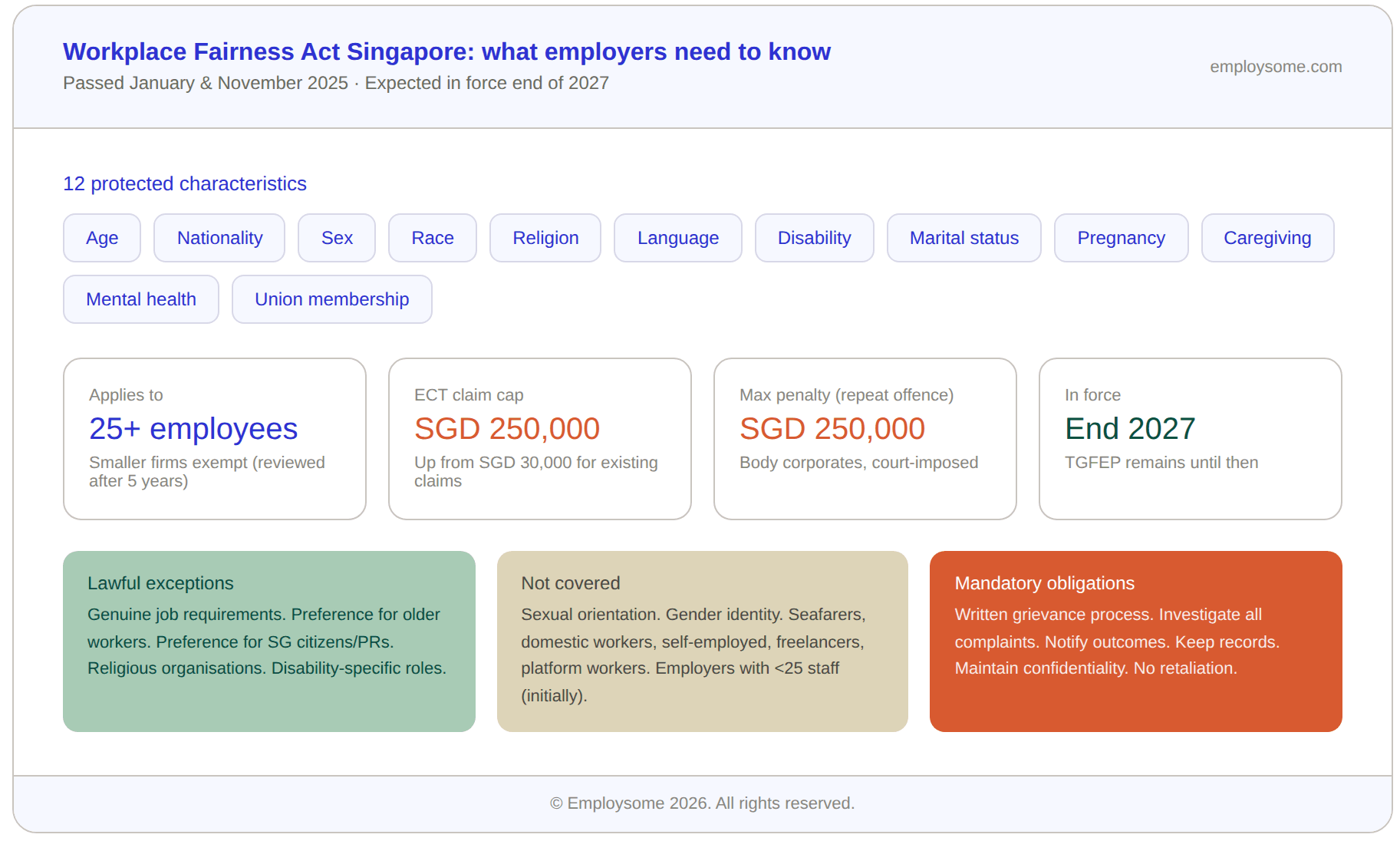
The Workplace Fairness Act Singapore applies to employers with 25 or more employees, covering both the public and private sectors. Smaller employers with fewer than 25 employees are initially exempt, though the government has indicated it will review this threshold within five years of implementation. The Act covers employees and job applicants working under a contract of service. Certain categories are excluded: seafarers, domestic workers, self-employed individuals, freelancers, and platform workers. Importantly, parties cannot contract out of the Workplace Fairness Act Singapore. Any term in an employment contract that excludes or limits the operation of the Act, or prevents anyone from making a complaint or raising a grievance under it, is void.
The Act prohibits employers from making adverse employment decisions based on any of 12 protected characteristics at any stage of the employment lifecycle. This means the protections cover job advertisements, hiring, terms and conditions of employment, training opportunities, promotion, performance reviews, transfers, and dismissal. The 12 protected characteristics are: age, nationality (citizenship of any country, including permanent resident status), sex (assigned at birth or reassigned through surgery, but not including sexual orientation or gender identity), race, religion, language, disability, marital status, pregnancy status, caregiving responsibilities, mental health condition, and union membership.
Discrimination occurs when an employer makes an adverse employment decision based, wholly or partly, on a protected characteristic. This includes direct discrimination such as treating someone less favourably because of a protected characteristic, and discrimination in job advertisements such as specifying a protected characteristic as a condition, requirement, or disqualification for employment. The Act also codifies the existing Fair Consideration Framework requirements into law, including the duty to fairly consider all candidates when applying for work passes. This means employers who do not fulfil fair consideration requirements when applying for Employment Passes or S Passes may have their applications denied or existing passes curtailed.
However, the Workplace Fairness Act Singapore recognises that certain circumstances may justify differential treatment. Lawful exceptions include genuine job requirements where a protected characteristic is essential for job performance (for example, hiring a translator based on language ability, or a female masseuse for privacy in a spa), age-based preferences where employers may favour older candidates over younger ones (aligning with national efforts to support senior employment), citizenship preferences where employers may favour Singapore citizens or permanent residents in employment decisions (this is explicitly permitted and aligns with Singapore’s broader local workforce protection policies), religious organisations restricting employment to their own members, and the provision that choosing not to hire individuals without disabilities is not considered discriminatory. These exceptions are narrowly defined, and employers relying on them must be able to demonstrate that the exception genuinely applies to the specific situation.
💡 Employsome Insight: The nationality exception is one of the most misunderstood provisions of the Workplace Fairness Act Singapore. It does not mean employers can discriminate against foreign workers generally. It means employers can prefer Singaporean citizens and PRs over non-residents in hiring decisions, which is consistent with the existing Fair Consideration Framework. However, once a foreign worker is employed (for example, on an Employment Pass), they are fully protected by all other provisions of the Act. Treating an EP holder less favourably in promotion, training, or termination because of their nationality would be unlawful discrimination.
Mandatory Grievance Handling and Anti-Retaliation Protections
One of the most significant operational requirements of the Workplace Fairness Act Singapore is the mandatory grievance handling process. This is not optional guidance. It is a legal requirement, and failing to establish or follow a compliant process is itself a civil contravention under the Act.
Every employer covered by the Act must establish a written grievance handling process that commits the employer to inquire into each grievance raised by an employee, review each grievance, inform the employee who raised the grievance of the outcome of the review, keep written records of every inquiry and review for a stated period, and not disclose to any person the identity of the employee who raised the grievance or any information about the inquiry or review unless reasonably necessary. The grievance process must be communicated in writing to all employees in Singapore. “Grievance” under the Act is specifically limited to complaints about discrimination by the employer or harassment by the employer or another employee, where harassment means any act constituting harassment under the Singapore Protection from Harassment Act 2014.
The Act makes an important distinction between “inquiry” and “review.” Employers are only required to inform the employee who raised the grievance of the outcome of a review, not an inquiry. The outcome of the review is only conveyed to the employee who raised the grievance, not to other employees involved in the allegations or other stakeholders.
Alongside the grievance handling requirements, the Workplace Fairness Act Singapore establishes strong anti-retaliation protections. Employers are prohibited from retaliating against employees who report discrimination or raise grievances. Prohibited retaliatory actions include wrongful dismissal, salary deductions, refusing re-employment or employment assistance payments, breaching the employment contract, harassment, and any other action that places the employee at a disadvantage. These protections apply broadly: they cover employees who have made a complaint, are suspected of making one, or are known to intend to make one. Retaliatory actions can escalate to serious civil contraventions with significant financial penalties.
💡 Employsome Insight: The most common gap we see among employers preparing for the Workplace Fairness Act Singapore is the absence of a documented, compliant grievance handling process. Many companies have informal complaint mechanisms but nothing that meets the Act’s mandatory standards for written procedures, inquiry, review, outcome notification, record-keeping, and confidentiality. Start here. This is the area most likely to generate early compliance issues when enforcement begins, and it is also the requirement that takes the longest to implement properly because it affects HR workflows, documentation systems, and manager training.
Dispute Resolution and Penalties
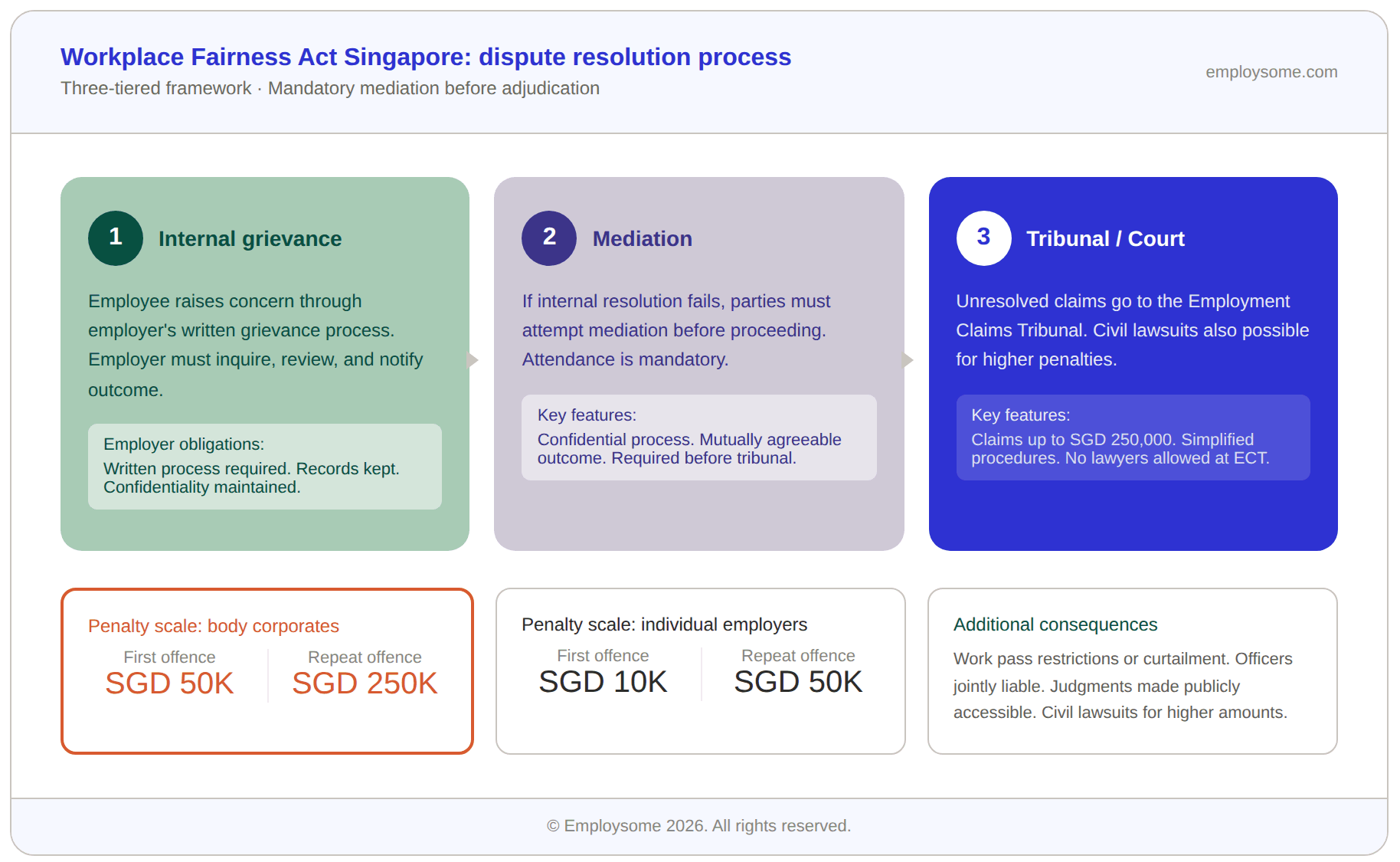
The Workplace Fairness (Dispute Resolution) Bill, passed on 4 November 2025, establishes a three-tiered approach to resolving workplace discrimination claims under the Workplace Fairness Act Singapore.
The first tier is internal grievance handling. Employees must first raise concerns through the employer’s internal grievance procedure, as outlined above. This encourages resolution within the organisation and maintains working relationships.
The second tier is mediation. If internal resolution fails, parties must attempt mediation before proceeding to adjudication. Mediation is a confidential process aimed at reaching a mutually agreeable outcome, and attendance is mandatory. This requirement ensures that both parties have genuinely attempted to resolve the matter before escalating to formal adjudication.
The third tier is the Employment Claims Tribunal (ECT). As a last resort, unresolved claims proceed to the ECT, which can hear workplace discrimination claims for amounts up to SGD 250,000. This is a dramatic increase from the previous SGD 30,000 cap for existing ECT employment claims and signals the seriousness with which the government views workplace discrimination. The ECT operates under simplified procedures, and legal representation is not permitted, making it more accessible for individuals without legal training. Employees may also choose to file a civil lawsuit against employers instead, which if successful may lead to even higher financial penalties imposed by the courts.
The penalty framework under the Workplace Fairness Act Singapore operates at two levels. Standard civil contraventions, such as publishing discriminatory job advertisements or failing to establish written grievance handling procedures, may result in a contravention notice requiring payment of an administrative penalty or remedial action directed by the Ministry of Manpower, such as removing discriminatory advertisements. Serious civil contraventions, which cover systemic or severe violations including retaliatory dismissals or discriminatory dismissals, can only be penalised by the courts. For body corporates, partnerships, or unincorporated associations, the penalty is up to SGD 50,000 for a first order and up to SGD 250,000 for subsequent orders. For individual employers, the penalty is up to SGD 10,000 for a first order and up to SGD 50,000 for subsequent orders. Both the body corporate and its officers can be jointly liable. WFA judgments are intended to be made publicly accessible, adding a reputational dimension to non-compliance.
The government has indicated it will adopt an education-first approach initially, guiding non-compliant employers towards rectification and reserving penalties for more serious cases. But the SGD 250,000 claim cap and publicly accessible judgments mean that even the education-first phase carries real financial and reputational risk for employers who are unprepared.
💡 Employsome Insight: The jump from SGD 30,000 to SGD 250,000 in maximum claim value is not just a number change. It fundamentally alters the risk calculation for employers. At SGD 30,000, many companies viewed discrimination complaints as a manageable cost. At SGD 250,000, a single claim can materially impact a business. More importantly, WFA judgments will be publicly accessible, meaning the reputational cost of a finding against your company could far exceed the financial penalty. Employers should treat the preparation period as an investment in risk prevention, not an administrative box-ticking exercise.
Implementation Timeline and What Employers Should Do Now
The Workplace Fairness Act Singapore follows a clear legislative timeline. The first bill covering substantive provisions was passed on 8 January 2025. The second bill covering the dispute resolution framework was passed on 4 November 2025. The full Act is expected to come into force by the end of 2027. Subsidiary legislation, detailed guidelines, and advisories from the Ministry of Manpower are expected before implementation. In the meantime, the TGFEP remain in force and continue to be enforced through work pass restrictions until the WFA takes effect.
Even though the Workplace Fairness Act Singapore will not take effect for over a year, employers should begin preparing now. The changes are structural and operational, not something that can be implemented in the weeks before enforcement begins.
Employers should review and update anti-discrimination and HR policies to align with the Act’s 12 protected characteristics and its specific definitions of discrimination. Written grievance handling procedures should be established or strengthened, ensuring they meet the Act’s mandatory standards for inquiry, review, outcome notification, record-keeping, and confidentiality. HR personnel and managers should be trained on the protected characteristics, what constitutes discrimination under the Act, how to handle grievances properly, and the anti-retaliation protections that apply. Hiring, promotion, and termination practices should be audited to identify potential risks, with employment decision-making criteria standardised to ensure all decisions are documented and based on objective, merit-based factors. Job advertisements should be reviewed to ensure they do not specify protected characteristics as conditions or disqualifications. And employers should prepare for the dramatically increased claim cap of SGD 250,000 by strengthening documentation and decision records across the entire employment lifecycle.
The Ministry of Manpower estimates that approximately 60% of employers currently have formal policies and procedures addressing workplace discrimination. That means 40% do not, and even among those who do, the existing processes may not meet the specific mandatory requirements of the Act. The Tripartite Alliance for Fair and Progressive Employment Practices (TAFEP) provides resources including policy templates and online courses. From 1 April 2026, TAFEP’s Employer Advisory Service transitions to the Singapore National Employers Federation (SNEF), which will provide advisory services for both members and non-members.
What This Means for International Employers
For companies hiring in Singapore without a local entity, an Employer of Record assumes legal employer responsibility and must ensure compliance with the Workplace Fairness Act Singapore once it takes effect. This includes establishing compliant grievance handling procedures, ensuring non-discriminatory employment practices across all stages of the employment lifecycle, and managing dispute resolution if claims arise.
International employers should pay particular attention to the nationality exception, which explicitly allows employers to prefer Singapore citizens and permanent residents. This aligns with Singapore’s broader employment framework and the Fair Consideration Framework, which requires genuine local candidate consideration before hiring foreign workers. The work pass implications are significant: employers who do not comply with fair consideration requirements risk having Employment Pass and S Pass applications denied or existing passes curtailed, even before the WFA formally takes effect.
Singapore’s employment landscape is changing rapidly alongside the Workplace Fairness Act. The CPF Ordinary Wage ceiling has reached SGD 8,000 per month, the new Shared Parental Leave scheme provides up to 10 weeks from April 2026, the minimum retirement age rises to 64 from July 2026 (with re-employment age rising to 69), and Employment Pass minimum salaries stand at SGD 5,600 (rising to SGD 6,000 in 2027). All of these changes interact with the WFA to create a significantly more complex compliance environment for employers.
For a broader overview of how to structure international hiring across complex employment frameworks, see our international hiring guide.
Hiring in Singapore?
If you are looking to hire in Singapore without setting up a local entity, an Employer of Record handles employment contracts, CPF contributions, work pass compliance, and statutory obligations on your behalf. The Workplace Fairness Act Singapore will add significant new compliance requirements from end of 2027. See our Best Employer of Record comparison for providers ranked on compliance execution and in-country infrastructure.
Frequently Asked Questions
The Act is expected to come into force by the end of 2027. The first bill was passed in January 2025 and the second (dispute resolution) in November 2025.
Employers with 25 or more employees. Smaller employers are initially exempt, but the threshold will be reviewed within five years.
Age, nationality, sex, race, religion, language, disability, marital status, pregnancy status, caregiving responsibilities, mental health condition, and union membership.
Up to SGD 250,000 for repeat serious contraventions by body corporates. Claims through the Employment Claims Tribunal can also reach SGD 250,000.
Yes. The Workplace Fairness Act Singapore mandates a written grievance handling process that must be communicated to all employees. This is a legal requirement, not optional.
Yes. The Act explicitly allows employers to favour Singapore citizens and permanent residents in employment decisions. However, once a foreign worker is employed, they are fully protected by all other provisions of the Act.
No. The protected characteristic of “sex” refers to sex assigned at birth or reassigned through surgery. Sexual orientation and gender identity are not covered.
Yes. Employees can bring claims to the Employment Claims Tribunal (up to SGD 250,000) or file a civil lawsuit for potentially higher amounts. Mediation is mandatory before proceeding to the tribunal.
Establish or update written grievance handling procedures, train HR and managers on the 12 protected characteristics, audit hiring and termination practices, review job advertisements, standardise decision-making documentation, and prepare for the SGD 250,000 claim cap by strengthening records across the employment lifecycle.

Written by
Courtney Pocock is a Copywriter & EOR/PEO Researcher at Employsome with 15+ years of experience writing for the HR, corporate, and financial sectors. She has a strong interest in global business expansion and Employer of Record / PEO topics, focusing on news that matters to business owners and decision-makers. Courtney covers industry updates, regulatory changes, and practical guides to help leaders navigate international hiring with confidence.
Our content is created for informational purposes only and is not intended to provide any legal, tax, accounting, or financial advice. Please obtain separate advice from industry-specific professionals who may better understand your business’s needs. Read our Editorial Guidelines for further information on how our content is created.
Other posts
Review other blog posts