Working Visa Australia: The Complete 2026 Guide
Australia has overhauled its working visa system. This guide covers every working visa Australia offers in 2026, from employer-sponsored and points-based skilled visas to Working Holiday programs, the proposed EU-Australia labour mobility deal, and how an Employer of Record can help you move to Australia even if you have not found a local job yet.

Table of Contents
- Overview: Working Visa Australia in 2026
- All Your Options at a Glance
- Skills in Demand Visa (Subclass 482)
- Salary Thresholds for Working Visa
- Points-Based Skilled Visas (Subclass 189, 190, 491)
- National Innovation Visa (Subclass 858)
- From Working Visa to Permanent Residency
- Working Holiday Visas (Subclass 417 & 462)
- NEW EU-Australia Labour Mobility Scheme
- Temporary Graduate Visa (Subclass 485)
- Visa Hopping Crackdown
- Moving to Australia Through an Employer of Record
- Key Dates for 2026
- Final Takeaway
Australia’s migration system is undergoing one of its most significant structural reforms in over a decade. The 2025-26 program year has introduced a new employer-sponsored working visa framework, higher salary thresholds, tighter integrity measures, expanded points-based skilled migration, and a proposed EU-Australia mobility deal that could reshape how Europeans access the Australian labour market.
Whether you are a skilled worker researching which working visa Australia has available for your situation, an employer hiring international talent, or someone exploring how to relocate to Australia without a local job offer, this guide breaks down every pathway, requirement, and deadline you need to know.


Overview: Working Visa Australia in 2026
The Australian Government has set the permanent migration cap at 185,000 places for the 2025-26 program year, with 71% of places reserved for skilled migrants. The allocation includes 16,900 places for Skilled Independent visas (Subclass 189), 33,000 for state-nominated visas (Subclass 190), 33,000 for regional visas (Subclass 491/191), and 44,000 for employer-sponsored permanent residence (Subclass 186).
Key structural changes shaping the working visa Australia landscape in 2026 include:
The replacement of the Temporary Skill Shortage (TSS) visa with the Skills in Demand (SID) visa, effective December 7, 2024, consolidating multiple occupation lists into a single framework with three salary-based streams.
Annual indexation of salary thresholds, with the Core Skills Income Threshold (CSIT) increasing to AUD 79,499 and the Specialist Skills Income Threshold (SSIT) increasing to AUD 146,717 from July 1, 2026.
A crackdown on visa hopping, effective February 2, 2026, restricting onshore switching between visitor, student, and temporary work visas.
Tighter Temporary Graduate (Subclass 485) visa settings, including reduced age limits, shorter post-study work rights, and higher English language requirements.
A proposed EU-Australia labour mobility scheme, currently under negotiation as part of a broader free trade agreement, which could allow EU citizens and Australians to live and work in each other’s territories for up to four years.
A new four-tier invitation system for points-based skilled migration, prioritising critical sectors like healthcare, education, and engineering.
💡 Employsome Insight: Australia’s Shift to a Skills-First Visa System
Australia’s migration reforms are moving toward what the government calls a “skills-first” model. For workers considering a working visa Australia pathway, this means your occupation, salary level, English proficiency, and willingness to work in regional areas matter more than ever. The system is faster and more flexible than before, with reduced experience requirements and greater portability between sponsors, but less tolerant of visa misuse or pathway manipulation.
All Your Options at a Glance: Working Visa Australia Comparison Table
Before diving into each pathway, here is a side-by-side comparison of every major option for living and working in Australia in 2026.
|
Pathway |
Visa Type |
Duration |
Job Offer Required? |
|
SID Visa – Core Skills (Subclass 482) |
Employer-sponsored, temporary |
Up to 4 years |
Yes (from approved sponsor) |
|
SID Visa – Specialist Skills (Subclass 482) |
Employer-sponsored, temporary |
Up to 4 years |
Yes (from approved sponsor) |
|
SID Visa – Labour Agreement (Subclass 482) |
Employer-sponsored, temporary |
Up to 4 years |
Yes (Labour Agreement employer) |
|
Skilled Independent (Subclass 189) |
Points-based, permanent |
Permanent |
No |
|
Skilled Nominated (Subclass 190) |
Points-based + state nomination, permanent |
Permanent |
No (but state nomination required) |
|
Skilled Regional (Subclass 491) |
Points-based + state/family sponsorship, provisional |
5 years (provisional) |
No (but state nomination or family sponsor required) |
|
National Innovation Visa (Subclass 858) |
Invitation-only, permanent |
Permanent |
No |
|
Working Holiday (Subclass 417) |
Temporary |
12 months (extendable to 3 years) |
No |
|
Work and Holiday (Subclass 462) |
Temporary |
12 months (extendable to 3 years) |
No |
|
Temporary Graduate (Subclass 485) |
Temporary |
2-4 years (by qualification) |
No |
|
Employer of Record |
Not a visa (employment arrangement) |
Ongoing |
Yes (your current or new employer uses EOR) |
If you already have a job offer from an Australian employer, the SID visa (Subclass 482) is the most direct working visa Australia pathway. If you do not have a job offer but score well on the points test, the Subclass 189, 190, or 491 visas offer independent routes to permanent residency. If you are under 35 and want to explore Australia before committing, a Working Holiday visa lets you work and travel for up to three years. And if your current overseas employer is willing to keep you employed while you relocate to Australia, an Employer of Record arrangement can get you working in Australia without either of you needing a local entity or a traditional visa sponsorship process.
Skills in Demand Visa (Subclass 482): Employer-Sponsored Working Visa Australia
The Skills in Demand (SID) visa replaced the former Temporary Skill Shortage (TSS) visa on December 7, 2024. It remains under subclass 482 but operates under an entirely new policy framework. The SID visa is the primary working visa Australia offers for employer-sponsored skilled migration.
The SID visa is structured into three streams:
Specialist Skills Stream
For high-earning professionals in any occupation (except trades workers and labourers). No occupation list applies. The minimum salary threshold is the Specialist Skills Income Threshold (SSIT), currently AUD 141,210 for nominations lodged between July 1, 2025 and June 30, 2026, increasing to AUD 146,717 from July 1, 2026. This stream provides a direct pathway to permanent residency.
Core Skills Stream
For occupations listed on the Core Skills Occupation List (CSOL), a dynamic list of over 450 occupations maintained by Jobs and Skills Australia based on labour market analysis. The CSOL includes roles such as software engineers, civil engineers, registered nurses, electricians, data analysts, and child care workers. Over 70 new occupations were added when the list launched, including data analyst, supply chain analyst, tour guide, and child care worker, while some roles such as cafe and restaurant manager, ICT support engineer, and graphic designer were removed. The minimum salary threshold is the Core Skills Income Threshold (CSIT), currently AUD 76,515, increasing to AUD 79,499 from July 1, 2026. A positive skills assessment from the relevant assessing authority is required. This stream also provides a pathway to permanent residency.
Labour Agreement Stream
For employers with a formal Labour Agreement with the Department of Home Affairs, typically used in regional areas, aged care, or industries with unique workforce needs not covered by the standard streams. Terms, salary thresholds, and permanent residency pathways vary by agreement. This stream is expected to be rebranded as the “Essential Skills” pathway during 2026, with specific sector caps and union oversight.
Quick Reference: SID Visa (Subclass 482) at a Glance
Visa duration: Up to 4 years (all streams) Work experience: 1 year minimum (reduced from 2 years under old TSS) English language: IELTS 5.0 overall (minimum 5.0 in each band) or equivalent Portability: 180 days to find a new sponsor if employment ends (up from 60 days) Total portability window: 365 days maximum during the visa period PR pathway: Yes, via Subclass 186 after 2 years (down from 3 years) Median processing time: 21 days Application charge: AUD 3,210 (main applicant, from July 2025) Family: Partner and dependents receive full work and study rights Skilling Australians Fund levy: AUD 1,200/year (turnover under AUD 10M) or AUD 1,800/year (turnover AUD 10M+)
Key improvements over the former TSS visa include reduced work experience requirements (one year instead of two), greater worker portability with a 180-day grace period to find a new sponsor if employment ends, and streamlined labour market testing requirements (the obligation to advertise on Workforce Australia has been removed).
However, compliance settings have tightened. The Australian Taxation Office now cross-matches payroll data to detect underpayment of sponsored workers, and sponsors face heavier penalties for non-compliance with salary and working condition obligations.
💡 Employsome Insight: The SID Visa’s 180-Day Portability Rule
The SID visa’s 180-day portability rule is a major shift for workers holding an Australian working visa. You are no longer locked into a single employer under the same pressure as before. If your employment ends, you have six full months to find a new approved sponsor and retain full work rights during that period, meaning you can take any job to support yourself while searching. Time with multiple sponsors can also count toward permanent residency, so changing employers does not reset your PR clock.
Salary Thresholds for Working Visa Australia (Employer-Sponsored)
Salary thresholds for employer-sponsored working visas in Australia are indexed annually on July 1, based on the Australian Bureau of Statistics’ Average Weekly Ordinary Time Earnings (AWOTE) data. This indexation is built into legislation and takes effect automatically.
|
Threshold |
2025-26 (Current) |
2026-27 (From July 1, 2026) |
Change |
|
Core Skills Income Threshold (CSIT) |
AUD 76,515 |
AUD 79,499 |
+3.9% |
|
Specialist Skills Income Threshold (SSIT) |
AUD 141,210 |
AUD 146,717 |
+3.9% |
The offered salary must also meet or exceed the prevailing market rate for the occupation in the relevant location. Offering exactly the threshold amount is not sufficient if market data shows higher rates for equivalent roles.
Compliance Warning: Salary Threshold Indexation
Because thresholds are indexed every July, a role that qualifies for a working visa Australia today may fall below the threshold at visa renewal if salary growth is not built into the employment contract. If you are being sponsored, ensure your contract includes an annual salary review clause. A salary that drops below the applicable threshold at renewal will not meet visa requirements, regardless of whether the original nomination was approved at the previous rate. This is one of the most common reasons for working visa complications in Australia.
🚨 Employsome Compliance Warning: Salary Threshold Indexation
Because thresholds are indexed every July, a role that qualifies for a working visa Australia today may fall below the threshold at visa renewal if salary growth is not built into the employment contract. If you are being sponsored, ensure your contract includes an annual salary review clause. A salary that drops below the applicable threshold at renewal will not meet visa requirements, regardless of whether the original nomination was approved at the previous rate. This is one of the most common reasons for working visa complications in Australia.
Points-Based Skilled Visas: Subclass 189, 190, and 491
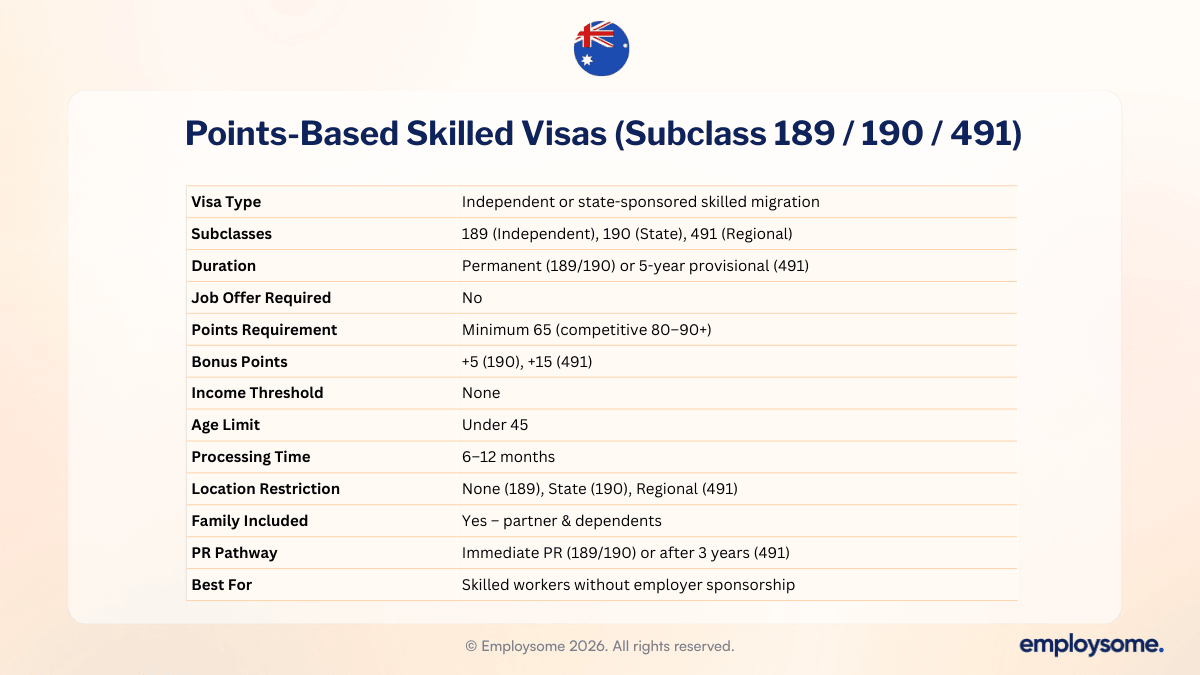
If you do not have an employer sponsor, Australia’s points-based skilled migration program offers three working visa pathways to permanent residency based on your skills, qualifications, and experience. All three require a minimum of 65 points on the SkillSelect points test, though competitive invitation scores in 2026 are typically 85 or higher for the Subclass 189, and 70 to 85 for the Subclass 190 and 491.
Points are awarded for age (maximum at 25-32), English proficiency, skilled work experience (both in Australia and overseas), educational qualifications, Australian study, partner skills, and state/regional nomination.
Subclass 189: Skilled Independent Visa
This is a permanent residence visa that does not require employer sponsorship or state nomination. You must have an occupation on the Medium and Long-term Strategic Skills List (MLTSSL). It offers full independence with no location restrictions, but invitation rounds are small and highly competitive. The 2025-26 program has allocated 16,900 places, with a new four-tier invitation system that prioritises healthcare, education, and engineering occupations.
Subclass 190: Skilled Nominated Visa
This permanent residence visa requires nomination by an Australian state or territory government, which adds 5 bonus points to your score. You must commit to living and working in the nominating state for approximately two years. Each state sets its own nomination criteria and occupation lists, and some states (such as Tasmania and South Australia) are generally more accessible than New South Wales or Victoria.
Subclass 491: Skilled Work Regional (Provisional) Visa
This is a five-year provisional visa that requires either state/territory nomination or sponsorship by an eligible family member living in a designated regional area. It adds 15 bonus points, making it the most accessible option for workers with lower base scores. After three years of living and working in regional Australia (and meeting income requirements), you can transition to permanent residency through the Subclass 191 visa. The government has allocated 33,000 places for regional visas in 2025-26.
|
Feature |
Subclass 189 |
Subclass 190 |
Subclass 491 |
|---|---|---|---|
|
Visa Type |
Skilled Independent |
Skilled Nominated (State) |
Skilled Regional (Provisional) |
|
Job Offer Required |
No |
No |
No |
|
Nomination Required |
No |
State/Territory nomination |
State/Territory or eligible family sponsor |
|
Points Test |
Minimum 65 (85+ competitive) |
65 + 5 bonus points |
65 + 15 bonus points |
|
Visa Duration |
Permanent |
Permanent |
5 years (provisional) |
|
Location Restriction |
None |
Must live in nominating state |
Must live in regional area |
|
PR Status |
Immediate PR |
Immediate PR |
PR after 3 years (Subclass 191) |
|
Age Limit |
Under 45 |
Under 45 |
Under 45 |
|
Processing Time |
6–12 months |
6–12 months |
6–12 months |
|
Best For |
High-scoring independent applicants |
Skilled workers open to state commitment |
Applicants needing points boost & regional flexibility |
💡 Employsome Insight: Why the Subclass 491 Can Be the Smartest Entry Strategy
For many skilled workers, the Subclass 491 regional visa is the most realistic entry point into Australia’s working visa system. The 15-point bonus can turn a borderline score of 65 into a competitive 80, and regional Australia increasingly offers strong job markets in healthcare, education, construction, and technology. Cities like Newcastle, Wollongong, Geelong, the Gold Coast, and Hobart are all classified as regional for immigration purposes while still offering genuine urban amenities. If you are flexible on location, this pathway often leads to permanent residency faster than waiting for a Subclass 189 invitation.
National Innovation Visa (Subclass 858): Global Talent Pathway
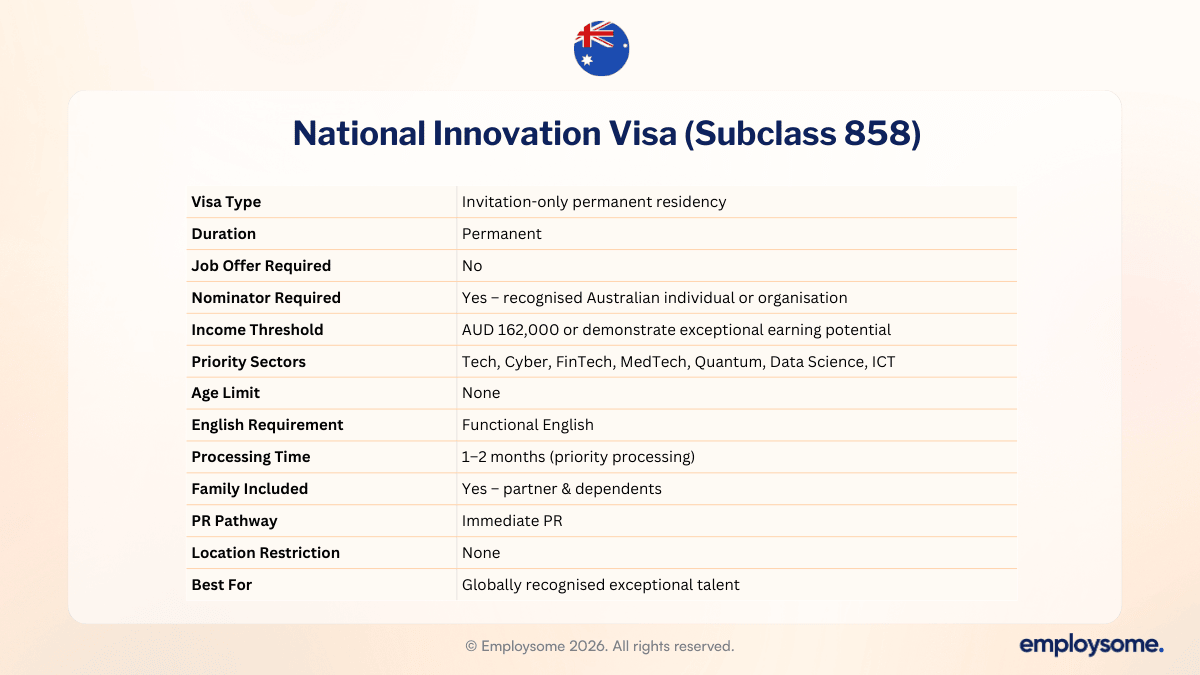
The National Innovation Visa (formerly the Global Talent Visa) is Australia’s invitation-only permanent residency visa for exceptionally talented individuals. Unlike points-based or employer-sponsored working visas, this pathway is designed for people who are internationally recognised leaders in their field.
To be eligible, you must demonstrate outstanding achievement in one of Australia’s priority sectors: AgTech, FinTech, MedTech, Cyber Security, Quantum Information, Advanced Digital, Data Science, and ICT. You need a nomination from an Australian citizen, permanent resident, or organisation with a national reputation in your field.
The income threshold is currently AUD 162,000 per year, though PhD graduates and students nearing completion may be eligible if they can demonstrate exceptional talent and international recognition. The visa grants immediate permanent residency with no location restrictions, priority processing (typically one to two months), and full work, study, and business rights from day one.
Pathways from Working Visa to Permanent Residency
One of the strongest features of Australia’s working visa system is the clarity of its permanent residency pathways. Here is how each temporary working visa connects to PR:
From SID Visa (Subclass 482) to Permanent Residency
The 2025-26 Migration Program has allocated 44,000 places for employer-sponsored permanent residence through the Subclass 186 Employer Nomination Scheme. Under the Temporary Residence Transition (TRT) stream, SID visa holders can apply for permanent residency after two years of full-time employment in their nominated occupation (reduced from three years in November 2023). This time is portable: you can count employment with multiple approved sponsors toward the two-year requirement, provided the work was in the same occupation or occupational group.
From Subclass 491 to Permanent Residency
After three years of living, working, and earning a minimum taxable income in a designated regional area, Subclass 491 holders can apply for the Subclass 191 (Permanent Residence Skilled Regional) visa.
From Subclass 485 to Permanent Residency
The Temporary Graduate visa does not lead directly to PR, but it provides time to gain Australian work experience, improve English scores, and secure employer sponsorship for a SID visa or build points for a 189/190 application.
From Working Holiday to Permanent Residency
Working Holiday visas (417/462) do not have a direct PR pathway, but time spent in Australia can help you build professional networks, gain local experience, and identify sponsorship opportunities.
💡 Employsome Insight: Australia’s Most PR-Friendly Employer Visa in Years
The shortened two-year permanent residency pathway and portable work history under the SID visa represent some of the most worker-friendly PR settings Australia has introduced in years. For professionals planning a long-term move, employer sponsorship through the SID visa currently offers one of the fastest and most predictable routes to permanent residency, particularly compared to the highly competitive Subclass 189 invitation rounds.
With a four-year visa, 180-day portability between sponsors, and a two-year PR eligibility clock, Australia’s employer-sponsored working visa is now one of the most attractive skilled migration pathways in the developed world.
Working Holiday Visa Australia (Subclass 417 and 462)
Australia’s Working Holiday Maker (WHM) program allows young adults from partner countries to travel and work in Australia for up to 12 months, with the possibility of second and third year extensions if specified work requirements are met. While not a traditional working visa, the Working Holiday visa Australia program is one of the most popular entry points for people exploring life in the country.
There are two subclasses:
Working Holiday Visa: Subclass 417
For citizens of countries with reciprocal arrangements, including the United Kingdom, Canada, France, Germany, Ireland, Italy, the Netherlands, Japan, South Korea, and others. The age limit is generally 18 to 30, extended to 35 for UK, Canadian, French, and Irish citizens under bilateral agreements.
Working Holiday Visa: Subclass 462
For citizens of countries with bilateral agreements, including India (added in September 2024 as the 50th partner country), China, Vietnam, and others. The age limit is generally 18 to 30. A ballot system applies for high-demand countries (India, China, Vietnam), with registration for the 2025-26 program year running from June 24 to July 15, 2025.
Key 2026 updates to the WHM program:
Expanded specified work postcodes for second and third year visa eligibility, now including additional areas affected by bushfires, floods, and other natural disasters (effective April 5, 2025). UK citizens no longer need to meet the specified work requirement for second or third year visas (under the Australia-UK Free Trade Agreement). India’s annual cap remains at 1,000 first-time Subclass 462 places. The six-month employer limitation (visa condition 8547) remains in effect, restricting employment with any single employer to six months unless an exemption is granted. Sufficient funds of approximately AUD 5,000 are required upon arrival.
Working Holiday Visa Australia Comparison
|
Feature |
Subclass 417 |
Subclass 462 |
|
Age limit |
18-30 (up to 35 for UK/Canada/France/Ireland) |
18-30 |
|
Job offer required |
No |
No |
|
Ballot system |
No |
Yes (India, China, Vietnam) |
|
Extensions possible |
Yes (2nd and 3rd year) |
Yes (2nd and 3rd year) |
|
Specified work for extension |
Yes (88 days for 2nd year, 176 days for 3rd), except UK |
Yes |
|
Visa duration |
12 months per grant |
12 months per grant |
|
Application fee |
AUD 640 |
AUD 640 |
|
PR pathway |
No direct pathway |
No direct pathway |
The Proposed EU-Australia Labour Mobility Scheme
In January 2026, reports emerged that the European Union has proposed a reciprocal labour mobility scheme to Australia as part of renewed negotiations toward a long-stalled EU-Australia Free Trade Agreement (FTA). The two blocs have been negotiating the FTA since 2018, with talks coming close to a breakthrough in 2023 before stalling over agricultural issues and geographical indication protections (including disputes over terms like “feta” and “prosecco”).
According to reporting by NewsWire and confirmed by multiple European sources, the proposed scheme would allow Australians to live and work across EU member states, including France, Germany, Italy, the Netherlands, and Spain, for up to four years without needing to secure a job offer beforehand. EU citizens would gain reciprocal rights to live and work in Australia under comparable terms.
The scheme is described as broader and more flexible than existing Working Holiday visa arrangements, which are typically limited to 12 months, capped by age, and restricted to bilateral country agreements. If agreed, it would represent one of the most significant expansions of mobility rights for both Australians and Europeans in decades. EU sources have described the mobility scheme as a “sweetener” to encourage Australia to finalise the broader trade agreement, and Brussels has reportedly made it an absolute priority following the closure of the EU-Mercosur agreement in January 2026.
As of March 2026, no final deal has been signed. Negotiations are ongoing, and specific eligibility criteria, implementation timelines, and legal mechanisms have not been finalised.
Separately, from late 2026, Australians and other visa-exempt visitors will be required to apply for the European Travel Information and Authorisation System (ETIAS) travel permit for short stays in the Schengen Area, with biometric data collection (fingerprints and facial image) now required at Schengen entry points.
💡 Employsome Insight: Planning Ahead Under the Shortened Subclass 485 Timeline
If you are an international student approaching graduation, the shortened Subclass 485 duration means you have less time to secure employer sponsorship or build points for a skilled visa. Start your job search and skills assessment process early. The reduction from the previous two-year experience requirement to one year under the SID visa actually works in your favour here: you now need only 12 months of full-time skilled work to be eligible for employer sponsorship, which fits within even a shortened two-year post-study visa window, if you move quickly.
Temporary Graduate Visa (Subclass 485): Tighter Rules
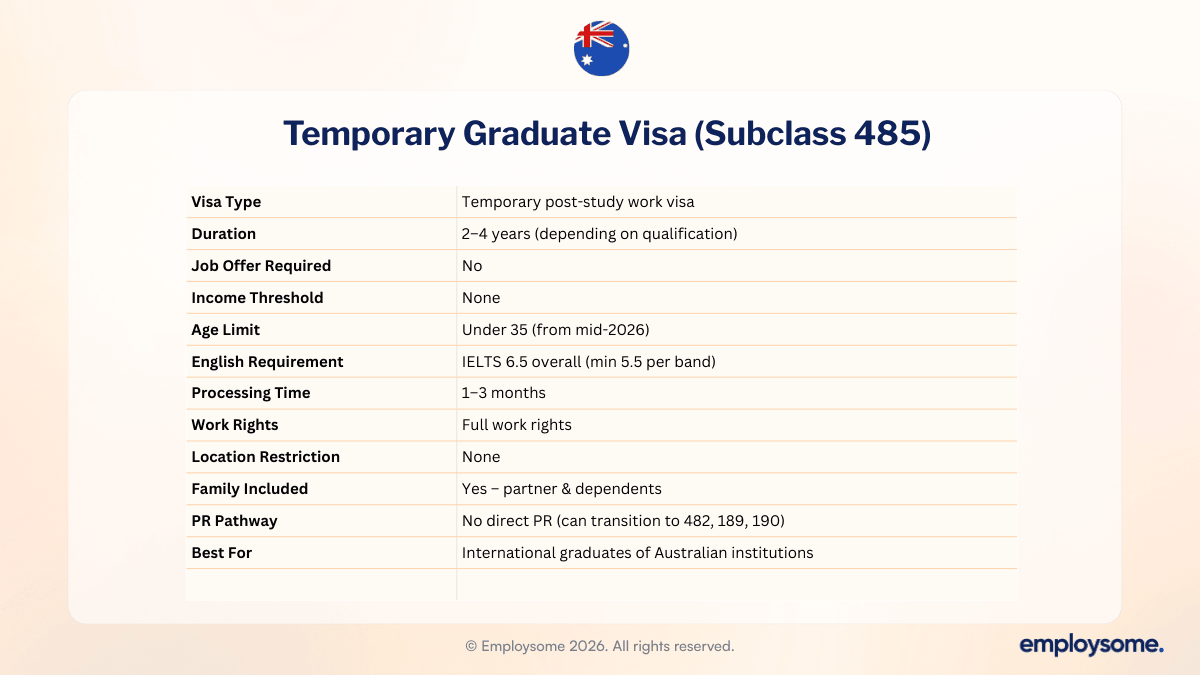
The Temporary Graduate (Subclass 485) visa allows international graduates to remain in Australia and work after completing their studies. While not strictly a “working visa” in the employer-sponsored sense, it is one of the most common stepping stones to longer-term working visa Australia pathways.
Key changes taking effect from mid-2026:
Post-study work rights are being shortened. Bachelor degree holders will be limited to approximately two years, master’s graduates to three years, and PhD graduates to four years. The pandemic-era “bonus years” that allowed some graduates to stay up to six years have been scrapped. The age limit has been reduced from 50 to 35. English language requirements have increased to IELTS 6.5 overall (with a minimum of 5.5 in each component) or equivalent. Extensions will be linked to whether a graduate’s discipline aligns with occupations on national or state shortage lists, reflecting the government’s “skills-first” approach. The 48-hour-per-fortnight work cap during study terms has been restored, with the Australian Taxation Office stepping up data-matching to detect breaches. Regional study incentives (additional post-study years for graduates who remain outside major cities) have been retained.
💡 Employsome Insight: EU–Australia Mobility Proposal – Proceed With Caution
The EU-Australia mobility proposal is still at the negotiation stage and should not be relied on for working visa Australia planning or relocation decisions. However, if finalised, it could fundamentally change how EU citizens access Australia and vice versa. For EU nationals currently considering a working visa Australia pathway, the established routes (SID visa, points-based visas, Working Holiday visas) remain the only confirmed options. Monitor the FTA negotiations closely, but do not delay applications in expectation of a deal that may take months or years to implement.
Visa Hopping Crackdown: What Changed on 2 February 2026
On February 2, 2026, the Australian Government implemented a suite of regulatory changes restricting onshore switching between temporary visa categories. These reforms target what the government calls “visa hopping,” the practice of repeatedly switching between visitor, student, and temporary work visas to extend stays in Australia indefinitely.
Key restrictions include:
Visitor visa holders can no longer apply for student visas onshore. Applications must be lodged from outside Australia. Temporary Graduate (Subclass 485) visa holders can no longer switch to student visas onshore to extend their stay. Switching from an employer-sponsored visa to a student visa onshore is also significantly restricted. Multiple re-applications for visitor visas may now result in refusal. Overstaying a visa by more than 28 days triggers a three-year re-entry ban. English language thresholds have been raised, and tolerance periods for overstays have been shortened.
The government estimates these changes will reduce temporary visa numbers by approximately 85,000 within 12 months and that up to 180,000 temporary visa holders may need to leave Australia by July 2026.
Employer sponsors will also face more frequent compliance audits and must meet higher salary benchmarks for new nominations. Recruiters will need to demonstrate deeper labour market testing and skills matches when lodging SID visa and Subclass 186 nominations.
Compliance Warning: Onshore Visa Switching
The February 2026 reforms significantly affect anyone on a temporary working visa in Australia who was planning to transition between visa categories onshore. If you are on a visitor visa or a Subclass 485 and were planning to switch to a student visa or employer-sponsored visa without leaving Australia, check whether your planned pathway is still available. Onshore switching between unrelated visa subclasses is now heavily restricted, and getting it wrong can result in a three-year re-entry ban. The 180-day portability window under the SID visa is not affected by these changes, but switching between different visa types (such as visitor to student, or student to employer-sponsored) now often requires an offshore application.
🚨Employsome Compliance Warning: Onshore Visa Switching
The February 2026 reforms significantly affect anyone on a temporary working visa in Australia who was planning to transition between visa categories onshore. If you are on a visitor visa or a Subclass 485 and were planning to switch to a student visa or employer-sponsored visa without leaving Australia, check whether your planned pathway is still available. Onshore switching between unrelated visa subclasses is now heavily restricted, and getting it wrong can result in a three-year re-entry ban. The 180-day portability window under the SID visa is not affected by these changes, but switching between different visa types (such as visitor to student, or student to employer-sponsored) now often requires an offshore application.
Moving to Australia Through an Employer of Record
Not every path to working in Australia starts with a job offer from an Australian company. If you want to move to Australia but have not yet secured a local position, or if you are already employed by an overseas company that is willing to keep you on while you relocate, an Employer of Record (EOR) can be the bridge that gets you there.
What is an Employer of Record, and how does it help you move to Australia?
An Employer of Record is a company that has a legal entity in Australia and can formally employ you on behalf of your actual employer. Your overseas company pays the EOR, the EOR pays you as a local Australian employee, and you receive all the protections, benefits, and entitlements of Australian employment law, including superannuation, leave entitlements, and Fair Work Act coverage.
This matters because Australian employment law requires that anyone working in Australia is employed through an entity that is compliant with local regulations. If your employer does not have an Australian entity (and most overseas companies do not), they cannot legally employ you in Australia. An EOR solves this problem without your employer needing to set up a subsidiary, register for payroll tax across multiple states, or navigate Australia’s complex Modern Award system.
When does an EOR make sense for you as a worker?
An EOR is worth considering if you are in any of these situations:
You want to move to Australia, but your current employer is based overseas and does not have an Australian office. Rather than quitting your job and starting from scratch, you can ask your employer to hire you through an EOR. Your salary, role, and reporting lines stay the same. The EOR handles the legal and payroll side. You get to live and work in Australia.
You have not found a job with an Australian employer but have a strong relationship with your current company. Many workers use the EOR route as a “try before you commit” approach. You relocate to Australia under your existing employment, explore the market, build a local network, and then decide whether to stay with your current employer long-term or transition to a local role.
You are a freelancer or contractor whose main client is willing to formalise the relationship. Australia has strict rules around contractor misclassification, and working as an independent contractor while living in Australia can create compliance risks. An EOR converts the arrangement into proper employment, protecting both you and your client.
You want to relocate for personal reasons (partner, family, lifestyle) and need a way to keep your income while you settle in. The EOR route means you do not need to be unemployed during the transition period.
How to have the conversation with your employer
If you are considering the EOR route, the pitch to your employer is straightforward: “I want to relocate to Australia, but I also want to keep working for you. An Employer of Record would handle all the legal and payroll compliance on your behalf, so you do not need to set up an Australian entity. The cost is typically AUD 400 to AUD 1,500 per month for the EOR service fee, plus my salary and employer contributions.” For most companies, this is significantly cheaper than recruiting and training a replacement, and it keeps a proven employee on the team. Many European and North American employers are already familiar with EOR services from their own international expansion.
How it works in practice
Your employer signs an agreement with an EOR provider that has a local Australian entity. The EOR drafts a locally compliant employment contract for you, covering salary, leave, superannuation (currently 11.5%, increasing to 12% from July 1, 2026), and all National Employment Standards entitlements. You are formally employed by the EOR’s Australian entity. Your employer reimburses the EOR for your salary, employer contributions (superannuation, payroll tax of 4.85% to 6.85% depending on state, workers’ compensation insurance), and the service fee. Onboarding typically takes one to five business days.
From your perspective, your day-to-day work does not change. You report to the same manager, work on the same projects, and keep your role. But legally, you are an Australian employee with full local protections, including four weeks of paid annual leave, ten days of personal/carer’s leave, and access to the Australian superannuation system.
Can an EOR sponsor a working visa Australia?
This depends on the EOR provider and your situation. Some EOR providers are approved Standard Business Sponsors under the SID visa framework and can nominate and sponsor overseas workers for a Subclass 482 working visa. However, not all EOR providers offer visa sponsorship, and eligibility depends on whether your role and salary meet the CSIT or SSIT thresholds.
If you are already in Australia on a valid visa with work rights (such as a Working Holiday visa, a partner visa, or a Subclass 485), you can be employed by an EOR immediately without additional visa sponsorship. If you are outside Australia and need a working visa, confirm with the EOR provider whether they offer sponsorship before committing.
What an EOR does not do
An EOR does not find you a job. It is not a recruitment agency. You need to bring your own employer (or convince your current one). An EOR also does not automatically provide a pathway to permanent residency, though if the EOR acts as your visa sponsor, time spent under that sponsorship can count toward PR eligibility.
For a detailed comparison of EOR providers operating in Australia, see our guide: Best Employer of Record in Australia.
💡 Employsome Insight: Why the EOR Route Is Gaining Momentum
The EOR route is increasingly popular among tech workers, digital marketers, designers, and other knowledge workers whose jobs can be performed remotely from anywhere. If your role does not require physical presence in a specific office, you likely have more leverage than you think. Many companies would rather pay a modest EOR fee than lose a strong performer. And from your side, the EOR arrangement gives you the security of continuous employment, full Australian workplace rights, and time to explore whether Australia is where you want to build your long-term future, all without the risk of being unemployed in a new country.
How an EOR Compares to Visa Pathways for Workers
|
Factor |
SID Visa (Employer-Sponsored) |
Points-Based Visa (189/190/491) |
Working Holiday Visa |
Employer of Record |
|
Need Australian job offer? |
Yes |
No |
No |
No (keep current overseas employer) |
|
Need to quit current job? |
Usually yes |
No |
No |
No |
|
Salary requirement |
AUD 76,515+ or AUD 141,210+ |
None (points-based) |
None |
Must meet Fair Work minimums (AUD 24.10/hr) |
|
Processing time |
~21 days (median) |
6-12 months |
1-4 weeks |
1-5 days (onboarding) |
|
PR pathway |
Yes, after 2 years |
Immediate (189/190) or after 3 years (491) |
No |
Only if EOR sponsors visa |
|
Age limit |
Under 45 for PR |
Under 45 |
18-30 (or 35) |
None |
|
Best for |
Workers with an Australian job offer |
High-scoring independent applicants |
Young travellers exploring Australia |
Remote workers relocating with current employer |
Working Visas in Australia – Key Dates for 2026
Key Dates for Workers and Employers
- February 2, 2026: Visa hopping restrictions took effect (onshore switching restricted)
- June 24 to July 15, 2025: Subclass 462 ballot registration for India, China, Vietnam (2025-26 program year)
- July 1, 2026: CSIT increases to AUD 79,499; SSIT increases to AUD 146,717
- July 1, 2026: Superannuation increases to 12% of ordinary time earnings
- Mid-2026: Shortened post-study work rights take effect for Subclass 485
- Late 2026: ETIAS travel authorisation expected for visa-exempt visitors to the Schengen Area
- Ongoing: EU-Australia FTA negotiations (labour mobility scheme status TBC)
- Ongoing: Core Skills Occupation List (CSOL) updated regularly by Jobs and Skills Australia
Final Takeaway: Working Visa Australia in 2026
Australia’s working visa system in 2026 is faster, more flexible, and more compliance-intensive than at any point in the last decade. The Skills in Demand visa has replaced the TSS framework with a clearer structure, reduced experience requirements, greater worker portability, and a shortened pathway to permanent residency. Points-based visas continue to offer independent pathways for high-scoring applicants, with regional options providing accessible entry points. And for workers who do not fit neatly into traditional visa categories, the Employer of Record route offers a practical way to relocate to Australia while keeping your current job.
For skilled workers considering a working visa Australia pathway, the 2026 settings offer genuine advantages: a one-year experience requirement for employer sponsorship, 180-day portability between sponsors, a two-year PR pathway, and a four-year visa duration across all SID streams. The system rewards workers who align their skills with occupations in demand and who are prepared to meet rising salary thresholds and tighter compliance requirements.
The proposed EU-Australia labour mobility scheme, if finalised, could significantly expand access for European citizens, but it remains at the negotiation stage and should not yet factor into relocation decisions.
Whether you are pursuing employer sponsorship, building points for a skilled visa, exploring a Working Holiday, or asking your current employer to hire you through an Employer of Record in Australia, the key is to start planning early, understand which pathway fits your situation, and stay ahead of the July 1 threshold changes and ongoing policy shifts.

Written by
Christa is a Copywriter at Employsome with 17 years of professional writing experience across global brands, startups, and online publications. A native English-Finnish writer, she brings strong editorial skills and a versatile background in business, SaaS, and finance. At Employsome, Christa focuses on clear, practical content about HR, payroll, and Employer of Record topics.
Our content is created for informational purposes only and is not intended to provide any legal, tax, accounting, or financial advice. Please obtain separate advice from industry-specific professionals who may better understand your business’s needs. Read our Editorial Guidelines for further information on how our content is created.
Other posts
Check out other blog post by Employsome