ITES Explained: What IT-Enabled Services Actually Means
ITES stands for Information Technology Enabled Services. It is the umbrella term for any business process delivered remotely using IT infrastructure, from call centres and payroll processing to financial modelling and AI-powered automation. BPO and KPO are both subsets of ITES, not the same thing. This guide covers what ITES actually means, how it differs from IT, EOR, and BPO, the real pros and cons (including the cost savings providers overstate), which industries use it most, a decision framework for whether ITES fits your business, and how to evaluate providers.

Table of Contents
- What Is ITES Actually?
- ITES Providers
- ITES vs IT vs BPO vs KPO
- Which Industries Use ITES
- Where ITES Happens: The Global Delivery Map
- Benefits and Risks
- ITES by Industry
- Do You Actually Need ITES? A Decision Framework
- How ITES Connects to Global Hiring, EOR, and International Expansion
- How to Evaluate an ITES Provider
- Where ITES Is Heading: AI, Automation, and What Stays Human

What does ITES mean?
ITES is one of those acronyms that sounds like it should be straightforward but somehow manages to confuse everyone who encounters it for the first time. It stands for Information Technology Enabled Services. That is the textbook answer. But if you read that and thought “so… it is IT?” you are not alone, and you are not wrong to be confused, because the term is genuinely poorly defined across the industry.
Here is the simplest way to think about it: IT is the technology itself (the software, the servers, the code, the infrastructure). ITES is business services that could not exist without that technology. A software engineer writing code is IT. A customer service agent using a cloud-based CRM to handle tickets from three continents is ITES. A payroll specialist in Manila processing monthly salary calculations for a company in London through a SaaS platform is ITES. The technology is not the product; the technology is the pipe through which the service flows.
The reason this term keeps appearing in conversations about global hiring, outsourcing, and international expansion is that ITES is essentially the category that covers most of what companies outsource across borders: call centres, back-office operations, payroll processing, data entry, financial analysis, HR administration, legal process outsourcing, and much more. If you have ever used a BPO provider, a KPO firm, or even an Employer of Record, you have interacted with ITES whether you knew the term or not.
This guide explains what ITES actually includes, how it differs from the alphabet soup of related models (BPO, KPO, EOR, PEO, RPO), where the industry is headed, and how to figure out whether an ITES approach makes sense for your business.
What Is ITES Actually?
ITES is an umbrella term. It does not describe a single service but rather an entire category of services that share one characteristic: they use information technology as the backbone of delivery. The range is enormous, from low-skill data entry to high-value financial modelling.
|
ITES Category |
What It Includes |
Examples |
|
Business Process Outsourcing (BPO) |
Outsourcing routine, rules-based business functions to a third-party provider |
Customer support call centres, payroll processing, invoice handling, claims processing, order fulfilment |
|
Knowledge Process Outsourcing (KPO) |
Outsourcing knowledge-intensive, analytical tasks that require domain expertise |
Financial research and modelling, market analysis, legal process outsourcing (LPO), patent research, actuarial analysis |
|
Data Management |
Collection, entry, storage, processing, and analysis of structured and unstructured data |
Data entry, data cleansing, database management, data analytics, business intelligence dashboards |
|
Customer Relationship Management (CRM) |
Managing customer interactions and engagement through technology platforms |
AI chatbots, sentiment analysis, ticketing systems, omnichannel support, loyalty programme management |
|
IT Help Desk & Infrastructure Support |
Remote technical support and infrastructure management |
L1/L2/L3 tech support, remote desktop assistance, network monitoring, cloud management |
|
HR & Recruitment Process Outsourcing |
Outsourcing HR operations and talent acquisition |
Payroll administration, benefits enrolment, applicant tracking, background checks, onboarding workflows |
|
Finance & Accounting |
Outsourcing financial operations and reporting |
Accounts payable/receivable, tax preparation, management reporting, audit support, expense management |
The common thread across all of these is that the service is delivered remotely (or at least could be), it relies on IT systems for execution, and it is typically performed by a specialised provider rather than the company’s own employees. That last point is important: ITES is fundamentally about outsourcing. If your in-house team processes payroll using software, that is just payroll. If a third-party provider in Bangalore or Krakow processes your payroll through the same software, that is ITES.
Looking for a provider that offer both EOR and ITES?




ITES vs IT vs BPO vs KPO: Clearing Up the Confusion
The alphabet soup around ITES confuses even people who work in the industry. Here is how the terms actually relate to each other:
|
Term |
What It Means |
Relationship to ITES |
|
IT |
Information Technology. The creation and management of technology itself: software development, system administration, network engineering, cybersecurity, hardware. |
IT is the enabler. ITES uses IT to deliver services, but ITES is not IT itself. |
|
ITES |
IT-Enabled Services. Business services delivered through or powered by IT, typically outsourced to a specialised provider. |
The umbrella category. BPO and KPO are subsets of ITES. |
|
Business Process Outsourcing. Outsourcing routine, process-driven business functions. The “volume” end of the spectrum. |
BPO is a subset of ITES. All BPO is ITES, but not all ITES is BPO. |
|
|
KPO |
Knowledge Process Outsourcing. Outsourcing knowledge-intensive, analytical, or specialised tasks. The “value” end of the spectrum. |
KPO is a subset of ITES, focused on higher-skill, domain-expert work. |
|
Employer of Record. A company that becomes the legal employer of your workers in a foreign country, handling payroll, taxes, compliance, and contracts. |
An EOR uses ITES infrastructure (payroll platforms, HRIS, compliance tools) but is a distinct model: the EOR is the employer, not just the service provider. |
|
|
Professional Employer Organisation. A co-employment model where the PEO shares employer responsibilities with your company. |
PEO is an HR outsourcing model that overlaps with ITES in scope but is structurally different (co-employment vs outsourcing). |
|
|
RPO |
Recruitment Process Outsourcing. Outsourcing all or part of your recruitment function to a specialised provider. |
RPO is a form of ITES focused specifically on talent acquisition. |
The easiest way to remember the hierarchy: ITES is the big tent. BPO and KPO sit inside it as the two main types (volume vs value). EOR, PEO, and RPO are related but structurally distinct models that use ITES infrastructure without being “ITES” in the traditional sense. If someone says “we are an ITES company,” they almost certainly mean they are a BPO or KPO provider. If someone says “we are an EOR,” they are describing a different business model even though they use much of the same technology.
💡 Employsome Insight: EOR Is Not ITES, Even Though It Looks Like It
This distinction matters commercially. An ITES/BPO provider processes work on your behalf but does not employ anyone for you. An Employer of Record becomes the legal employer, takes on statutory obligations, files taxes, pays social security, and carries employment liability. If you are looking to hire a full-time employee in another country who reports to you, works on your product, and is integrated into your team, you need an EOR, not an ITES provider. If you need 50 people in a call centre handling customer tickets according to your scripts, you need a BPO provider (which is ITES). The models solve different problems.
Which Industries Use ITES (and What They Actually Outsource)
Every major industry uses ITES in some form. But the specific services outsourced vary dramatically by sector. Here is what actual ITES engagement looks like across the industries where it is most prevalent:
Financial Services & Banking
Banks and insurance companies were among the earliest and heaviest adopters of ITES. The typical outsourced functions include: transaction processing and reconciliation, fraud detection and anti-money-laundering (AML) screening, mortgage and loan processing, claims adjudication, KYC (Know Your Customer) checks, and financial reporting. The regulatory complexity of financial services means that ITES providers in this space need genuine domain expertise, not just processing capacity. This is where the line between BPO and KPO blurs: a KYC analyst in Manila running AML checks on behalf of a London bank is doing knowledge work, not data entry.
Healthcare & Life Sciences
Healthcare ITES is a large and fast-growing segment. Common outsourced services include: medical billing and coding, claims processing and adjudication, clinical data management for drug trials, remote patient monitoring support, appointment scheduling and patient communications, and medical transcription (though this is rapidly being replaced by AI). Data security is the critical concern here. Any ITES provider handling healthcare data must comply with HIPAA (US), GDPR (EU), or equivalent local regulations. Breaches in healthcare ITES have resulted in some of the largest regulatory fines globally.
Retail & E-Commerce
Retail companies outsource heavily to ITES providers for: omnichannel customer support (chat, email, phone, social media), order management and returns processing, inventory and supply chain analytics, personalisation and recommendation engine management, and loyalty programme administration. The rise of e-commerce has made ITES indispensable for retailers who need 24/7 customer support across time zones without building internal teams in every market.
Technology & SaaS
Tech companies, somewhat ironically, are major ITES buyers. They outsource: L1 and L2 technical support, QA and software testing, data annotation and labelling (critical for AI/ML model training), content moderation, and customer success operations. A SaaS company with 10,000 users in 30 countries cannot realistically staff in-house support for every time zone and language. ITES fills that gap.
Legal
Legal process outsourcing (LPO) is one of the highest-value segments of ITES. Law firms and corporate legal departments outsource: contract review and management, patent and IP research, litigation support and e-discovery, regulatory compliance research, and legal transcription. LPO is squarely in the KPO bucket: it requires trained professionals (often lawyers or paralegals) working with specialised legal technology platforms.
Where ITES Happens: The Global Delivery Map
ITES is a global industry, but delivery is heavily concentrated in a handful of countries. India remains the dominant ITES hub by a wide margin, but the landscape is diversifying.
|
Region / Country |
ITES Strengths |
Typical Services |
|
India |
Largest ITES workforce globally. Strong in IT, finance, and analytics. English proficiency. Cost advantage of 60-70% vs Western markets. |
BPO, KPO, IT help desk, financial processing, data analytics, software testing |
|
Philippines |
Second-largest BPO market. Neutral English accent. Strong cultural alignment with US businesses. |
Voice-based customer support, healthcare BPO, back-office processing, content moderation |
|
Poland / Eastern Europe |
High education levels. EU membership (data protection). Strong in finance and IT. Nearshore to Western Europe. |
Finance & accounting, IT support, software development, legal process outsourcing |
|
Mexico / Latin America |
Nearshore to the US. Bilingual (English/Spanish). Growing tech talent pool. Similar time zones to US clients. |
Customer support, HR administration, software development, data processing |
|
South Africa |
English-speaking. Time zone overlap with Europe. Strong in financial services. Government incentives for BPO. |
Voice and non-voice customer support, financial BPO, legal process outsourcing |
|
Malaysia / Southeast Asia |
Multilingual (English, Malay, Mandarin). Competitive costs. Growing shared services hub. |
Shared service centres, finance BPO, IT infrastructure support, customer service |
The choice of delivery location depends on your priorities: if cost is the primary driver, India and the Philippines dominate. If time zone alignment matters (for real-time collaboration or voice support), nearshore options like Poland (for Europe) or Mexico (for the US) make more sense. If data protection regulation is a concern, EU-based delivery (Poland, Romania, Ireland) gives you GDPR compliance by default.
The Real Benefits and Risks of ITES (Without the Sales Pitch)
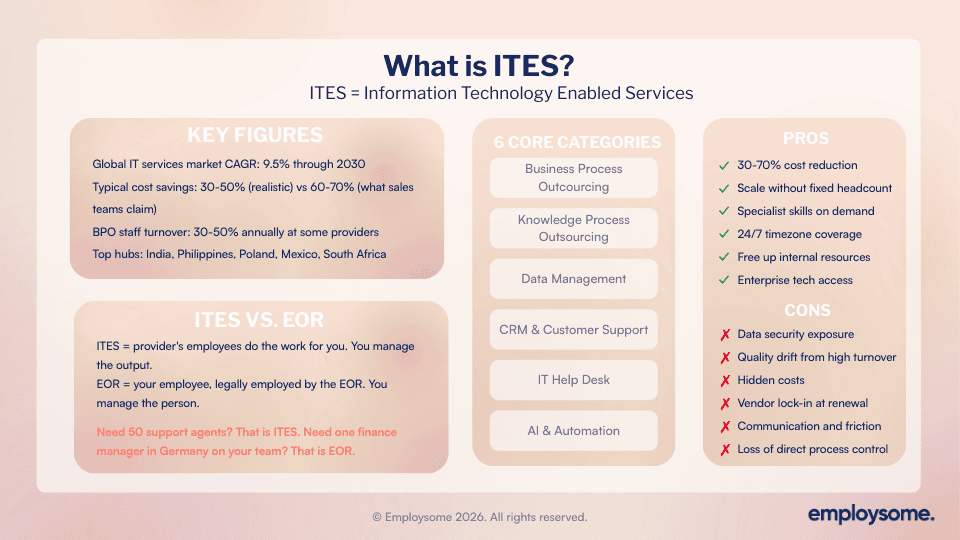
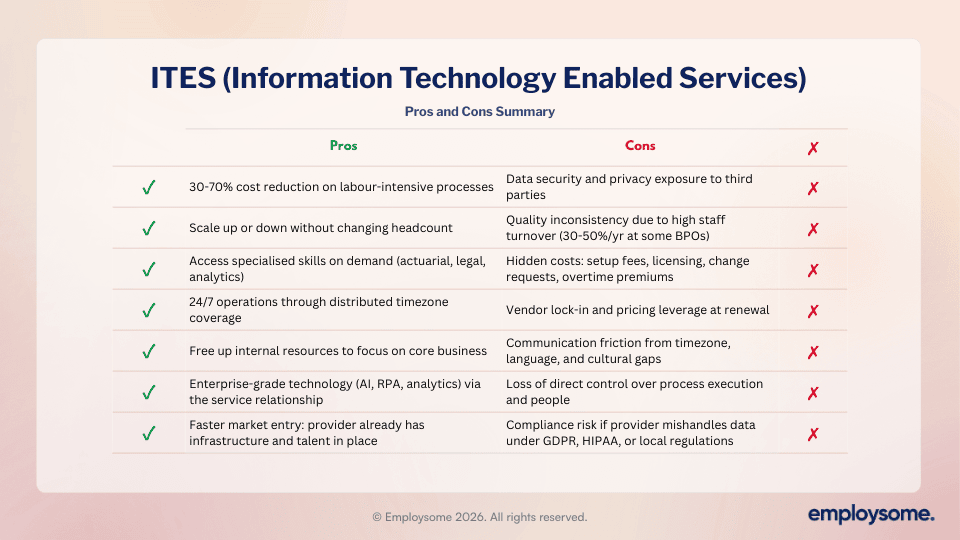
Cost reduction of 30 to 70%.Ccompared to performing the same functions in-house in a high-cost market. This is the core value proposition and it is real. A customer support agent in Manila costs a fraction of an equivalent role in London or New York, and the quality of service (when the provider is competent) is comparable.
Scalability without fixed cost. ITES lets you scale up or down without hiring or firing your own employees. Need 20 extra agents for the holiday season? An ITES provider can staff that in weeks. Need to cut back in Q1? You adjust the contract, not your headcount.
Access to specialised skills that you cannot easily build in-house. A mid-sized company does not need a full-time actuarial analyst or a patent research team. ITES gives you access to those skills on demand, shared across multiple clients, at a fraction of the cost of hiring directly.
24/7 coverage through distributed teams. By placing support or operations teams in different time zones (India, Philippines, Eastern Europe), you get round-the-clock coverage without anyone working a night shift.
Data security. You are sending sensitive information (customer data, financial records, employee PII, proprietary IP) to a third party. If the provider’s security is weak, or if an individual employee is careless, you face a breach that your company is ultimately responsible for. This is not theoretical: major ITES data breaches have resulted in eight-figure fines under GDPR and HIPAA.
Quality inconsistency. ITES providers staff your account with available agents, not necessarily the best ones. Turnover in BPO centres is notoriously high (30 to 50% annually in some markets). The team that starts your account may look very different six months later. Without strong governance and quality monitoring on your side, service levels drift.
Hidden costs. The headline per-seat or per-transaction price rarely tells the full story. Setup fees, technology licensing, change request charges, overtime premiums, and management overhead add up. Companies that switch to ITES expecting a 60% cost saving often realise 30 to 40% once all costs are accounted for. That is still significant, but it is not what the sales deck promised.
Vendor dependency. Once a provider is deeply embedded in your operations, switching is painful and expensive. This gives the provider leverage on pricing at renewal. Include exit terms, data portability clauses, and knowledge transfer obligations in every ITES contract.
Communication and cultural gaps. Time zone differences, language nuances, and cultural differences in communication style (directness, escalation norms, conflict resolution) create friction. This is manageable but requires deliberate investment in onboarding, regular check-ins, and feedback loops. It does not fix itself.
💡 Employsome Insight: ITES Cost Savings Are Real, But Always Model the Total Cost
When evaluating an ITES engagement, do not compare the provider’s per-seat rate to your in-house salary cost. Compare total cost: the ITES fee plus your internal management overhead (someone needs to manage the vendor), plus technology costs (licensing, integration), plus quality assurance (audits, monitoring), plus the cost of rework when things go wrong. Most companies find that the realistic saving is 30 to 50%, not the 60 to 70% that sales teams quote. That is still a strong business case, but you need to go in with accurate numbers.
ITES Pros and Cons: Summary
ITES by Industry: What Companies Actually Outsource
Every major industry uses ITES differently. Here is what actual outsourcing looks like across the seven sectors where ITES has the deepest penetration:
Financial Services & Banking
Banks and insurance companies were among the first heavy adopters. Transaction processing and reconciliation, fraud detection and AML screening, mortgage and loan processing, claims adjudication, KYC checks, and financial reporting are all routinely outsourced. The regulatory complexity means providers need genuine domain expertise, not just processing capacity. A KYC analyst in Manila running AML checks for a London bank is doing knowledge work, not data entry.
Healthcare & Life Sciences
Medical billing and coding, claims processing, clinical data management for drug trials, remote patient monitoring support, appointment scheduling, and medical transcription (though AI is rapidly replacing the last one). Data security is the critical concern: any ITES provider handling healthcare data must comply with HIPAA (US), GDPR (EU), or equivalent local regulations. Breaches in healthcare ITES have produced some of the largest regulatory fines globally.
Retail & E-Commerce
Omnichannel customer support (chat, email, phone, social media), order management and returns processing, inventory and supply chain analytics, personalisation and recommendation engine management, and loyalty programme administration. E-commerce has made ITES indispensable for retailers who need 24/7 support across time zones without building teams in every market.
Technology & SaaS
Tech companies are, ironically, major ITES buyers. They outsource L1 and L2 technical support, QA and software testing, data annotation and labelling for AI/ML model training, content moderation, and customer success operations. A SaaS company with 10,000 users in 30 countries cannot realistically staff in-house support for every time zone and language.
Education
Virtual classroom platform support, learning management system (LMS) administration, content development and localisation for remote learning, student enrolment processing, and EdTech customer support. The post-COVID shift to online learning massively expanded ITES demand in education.
Manufacturing
Production schedule optimisation, predictive maintenance analytics, real-time quality monitoring, supply chain management, and ERP system support. Manufacturing ITES is increasingly about feeding IoT sensor data into analytics platforms that flag problems before they cause downtime. It is KPO-level work dressed in factory clothes.
Telecommunications
Network monitoring and fault management, billing and revenue assurance, customer support and retention, predictive analytics for bandwidth optimisation, and field service scheduling. Telecoms were early ITES adopters because their operations generate enormous data volumes that only make sense to process with dedicated teams and purpose-built technology.
💡 Employsome Insight: The Industry Determines the ITES Model
A retail company outsourcing customer chat support is a straightforward BPO engagement. A pharmaceutical company outsourcing clinical data management for a drug trial is a KPO engagement that requires domain-specific compliance, validated systems, and trained analysts. The service category (BPO vs KPO), the security requirements, and the price point are all driven by the industry, not the ITES provider. Choose your provider based on their track record in your specific sector, not their generic capabilities.
Do You Actually Need ITES? A Decision Framework
Not every company needs ITES. Not every process should be outsourced. Here is a practical framework for deciding:
|
Situation |
ITES is probably the right call |
|
You are spending more than 20% of management time on a non-core function (support, data entry, payroll, accounting) |
Yes. Outsource it and redirect that time to product, sales, or growth. |
|
You need 24/7 coverage but your team is in one time zone |
Yes. Distributed ITES teams solve this without night shifts. |
|
You need specialist skills for a temporary or part-time need (actuarial analysis, patent research, financial modelling) |
Yes. KPO gives you access without a full-time hire. |
|
You are scaling rapidly and cannot hire fast enough to keep up |
Yes. ITES providers can staff up in weeks, not months. |
|
You need a specific person integrated into your team, reporting to your managers, working on your product |
No. You need an EOR or direct hire, not ITES. |
|
The process involves highly sensitive IP or trade secrets that cannot leave your organisation |
No. Keep it in-house or use a highly vetted, NDA-bound provider with strict access controls. |
|
You have fewer than 5 employees and the volume of work is too small to justify a provider relationship |
Probably not yet. Freelancers or part-time hires may be more practical at this stage. |
|
You want to outsource a process but do not have clear documentation of how it works today |
Not yet. Document and standardise the process first. Outsourcing chaos produces more chaos. |
How ITES Connects to Global Hiring, EOR, and International Expansion
If you are reading this on Employsome, you are probably not looking for a generic ITES explainer. You want to know how ITES fits into the broader picture of hiring and operating internationally. Here is how the models connect:
ITES/BPO is the right model when you want a provider to deliver a defined business process or service on your behalf. The provider’s employees do the work. They are not your employees. You manage the output, not the people. Think: a customer support operation, a data processing centre, a finance back-office.
An Employer of Record (EOR) is the right model when you want to hire a specific person who works for you, reports to your managers, uses your tools, and is integrated into your team, but you need a legal employer in their country because you do not have an entity there. The EOR handles payroll, contracts, taxes, and compliance. The employee is yours in every practical sense except the legal one.
A Professional Employer Organisation (PEO) is the right model when you have a local entity but want to outsource HR administration, benefits, and compliance. The PEO co-employs the worker alongside your company.
Recruitment Process Outsourcing (RPO) is the right model when you want to outsource the hiring process itself: sourcing, screening, interviewing, and offer management. RPO providers find the candidates. How you employ them (directly, through an EOR, or through an ITES/BPO model) is a separate question.
The mistake companies make is conflating these models. Asking an ITES/BPO provider to act like an EOR (or vice versa) creates compliance risk and operational confusion. If you need a developer in Poland who is part of your engineering team, use an EOR. If you need 15 support agents in Poland handling tickets according to your playbook, use a BPO. Different problems, different solutions.
How to Evaluate an ITES Provider
If you have decided that an ITES/BPO/KPO model is the right fit (as opposed to an EOR or direct hiring), here is what to assess before signing a contract:
|
Evaluation Criterion |
What to Look For |
|
Data security and compliance |
ISO 27001 certification, SOC 2 Type II audit, GDPR compliance (if handling EU data), HIPAA compliance (if handling healthcare data). Ask for their last audit report, not just a logo on their website. |
|
Agent/analyst turnover rate |
Ask for the actual number. If it is above 35% annually, expect frequent quality dips and ramp-up periods. Below 20% is strong. |
|
Pricing transparency |
Get a total cost model including setup, licensing, management fees, overtime, and exit costs. If they cannot provide this, they are hiding something. |
|
Scalability |
Can they scale from 5 to 50 agents in your sector within 4 to 6 weeks? What is the ramp-up time and cost for new hires? |
|
Industry expertise |
A generic BPO centre is fine for basic data entry. For finance, healthcare, or legal, you need domain experts. Ask for client references in your sector. |
|
Technology stack |
Do they use your tools (Zendesk, Salesforce, SAP, etc.) or force you onto their platform? Integration flexibility matters. |
|
Exit terms |
Minimum contract term, notice period, data portability, knowledge transfer timeline. If the exit clause is punitive, negotiate before signing. |
|
Business continuity / disaster recovery |
What happens if their primary site goes down? Do they have backup delivery centres? What is their tested RTO (recovery time objective)? |
Where ITES Is Heading Beyond 2026: AI, Automation, and What Stays Human
The ITES industry is undergoing the most significant structural change in its history. AI and automation are not just improving ITES; they are replacing large chunks of it.
What AI is already replacing: basic customer service chatbots (L1 queries), data entry and extraction, simple document review, standard transaction processing, scheduling, and template-based communications. If the task follows a fixed set of rules and does not require judgement, AI can do it cheaper and faster than a human BPO team.
What AI is augmenting (but not replacing): complex customer interactions that require empathy or context-switching, financial analysis and modelling, legal research and contract review, fraud investigation, and quality assurance. In these areas, AI tools make human analysts faster and more accurate, but the human is still essential.
What remains firmly human: relationship management, negotiation, strategic advisory, creative work, and any task where cultural nuance, ethical judgement, or complex stakeholder management is required.
For companies buying ITES services, this means two things. First, the cost of basic BPO services will continue to fall as AI handles more of the volume. Second, the value of KPO services (knowledge work, analysis, expert judgement) will hold steady or increase, because those tasks are harder to automate and the demand for them is growing. The ITES providers that will thrive are the ones investing in AI-augmented human work, not the ones still selling seats in a call centre.
Frequently Asked Questions
ITES stands for Information Technology Enabled Services. It refers to business processes and services that are delivered through or powered by information technology, typically outsourced to a specialised third-party provider.
The full form of ITES is Information Technology Enabled Services. It covers any business process that uses IT infrastructure as the primary delivery mechanism, including BPO (Business Process Outsourcing), KPO (Knowledge Process Outsourcing), data processing, customer support, payroll outsourcing, financial analysis, legal process outsourcing, and more. The term originated in the Indian IT industry in the late 1990s and is now used globally to describe the broader outsourcing and services ecosystem beyond traditional software development.
Common ITES examples include: customer support call centres handling inquiries via phone, chat, and email; payroll processing for companies across multiple countries; data entry, cleansing, and analytics; financial modelling and equity research (KPO); legal contract review and patent research (LPO); IT help desk and remote technical support; medical billing and coding for healthcare providers; AI-driven chatbots and robotic process automation (RPA); recruitment process outsourcing (RPO) including sourcing and screening candidates; and supply chain management and inventory optimisation. Any business process delivered remotely through IT infrastructure qualifies as ITES.
No, but they overlap. BPO (Business Process Outsourcing) is a subset of ITES. ITES is the broader umbrella category that includes BPO, KPO (Knowledge Process Outsourcing), data management, CRM services, IT help desk support, and more. All BPO is ITES, but not all ITES is BPO.
An ITES/BPO provider delivers a service on your behalf using their own employees. An Employer of Record (EOR) becomes the legal employer of a specific person who works for you, handling their payroll, taxes, and compliance. ITES is outsourcing a process. EOR is outsourcing the employment relationship. If you want a team that processes invoices for you, that is ITES. If you want to hire a specific finance manager in Germany who reports to your CFO, that is EOR.
India is by far the largest, followed by the Philippines. Other major hubs include Poland and Eastern Europe (for finance and IT BPO serving European clients), Mexico and Latin America (nearshore to the US), South Africa (English-speaking, EU-friendly time zone), and Malaysia/Southeast Asia (multilingual, cost-competitive).
No. Small and mid-sized companies use ITES extensively, particularly for customer support, payroll processing, data management, and recruitment. Many ITES providers offer flexible pricing models (per-transaction, per-hour, or per-seat) that work for companies of any size. A 20-person startup using a BPO for customer support and a KPO firm for financial modelling is a perfectly standard ITES engagement.
It depends entirely on the provider. The best ITES providers maintain ISO 27001 certification, undergo SOC 2 Type II audits, comply with GDPR and HIPAA where applicable, and implement encryption, access controls, and regular penetration testing. The worst ones do none of this. Security should be your first evaluation criterion, not an afterthought.

Written by
Christa is a Copywriter at Employsome with 17 years of professional writing experience across global brands, startups, and online publications. A native English-Finnish writer, she brings strong editorial skills and a versatile background in business, SaaS, and finance. At Employsome, Christa focuses on clear, practical content about HR, payroll, and Employer of Record topics.
Our content is created for informational purposes only and is not intended to provide any legal, tax, accounting, or financial advice. Please obtain separate advice from industry-specific professionals who may better understand your business’s needs. Read our Editorial Guidelines for further information on how our content is created.
Other posts
Review other blog posts