Sick Leave in Germany: How It Works & Who Pays
In Germany, employers pay 100% of salary for the first 6 weeks of sick leave, per illness, with no vacation days consumed. After 6 weeks, statutory health insurance pays Krankengeld at roughly 70% of gross for up to 78 weeks. This guide covers the Entgeltfortzahlungsgesetz rules, the same-illness aggregation trap, the electronic sick note system (eAU), what happens when employees get sick during vacation (those days revert from holiday to sick leave), the near-impossibility of firing a long-term sick employee, child sick leave entitlements, the Umlage 2 reimbursement that most EOR clients do not know about, and what companies hiring through an EOR need to verify.

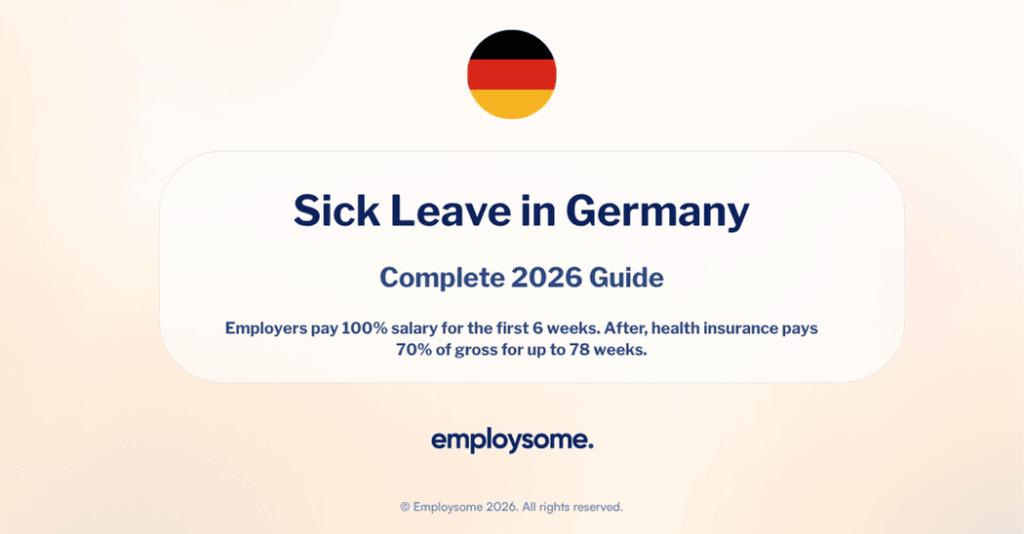
Table of Contents
- Sick Leave at a Glance
- The First 6 Weeks: Employer Pays 100%
- After 6 Weeks: Krankengeld From Health Insurance
- The Doctor's Note (Arbeitsunfähigkeitsbescheinigung)
- What Happens If an Employee Gets Sick During Vacation
- Can You Terminate a Long-Term Sick Employee?
- Sick Leave for Children (Kinderkrankengeld)
- The Real Cost of Sick Leave for German Employers
- Sick Leave and Employer of Record Arrangements
- FAQs
Germany has one of the most generous sick leave systems in the world, and Germans certainly make use of it. The average employee takes 20 sick days per year, nearly double the UK average and roughly four times the US figure. If you are an international company hiring German employees for the first time, it will probably shock you. The employer pays 100% of the employee’s salary for the first 6 weeks of any illness. Not 80%. Not a reduced rate. Full salary, as if the person were at work. After 6 weeks, the statutory health insurance fund takes over and pays roughly 70% of gross salary for up to 78 weeks. The employee does not use a single vacation day. And you cannot fire someone simply because they are sick.
For companies coming from the US, the UK, or most of Asia, this is a fundamentally different model. There is no “sick day allowance” that runs out after 5 or 10 days. There is no distinction between short-term and long-term disability insurance that the employee has to purchase separately. The system is built into employment law (the Entgeltfortzahlungsgesetz, or Continued Remuneration Act) and into the statutory health insurance system, and it applies to every employee from their first month of employment.
This guide explains how sick leave works in Germany from the employer’s perspective: what you pay, when health insurance takes over, how the doctor’s note system works, what happens when an employee is sick for months, whether you can terminate a long-term sick employee, and what all of this means if you are hiring through an EOR.

Sick Leave at a Glance
|
Rule |
Detail |
|
Weeks 1 to 6 |
Employer pays 100% of gross salary (Entgeltfortzahlung) |
|
Weeks 7 to 78 |
Statutory health insurance pays ~70% of gross, capped at 90% of net (Krankengeld) |
|
Maximum Krankengeld duration |
78 weeks per illness within a 3-year block |
|
Daily Krankengeld cap (2026) |
EUR 135.63 per day (based on Beitragsbemessungsgrenze of EUR 5,812.50/month) |
|
Qualifying period for employer-paid sick leave |
4 weeks of continuous employment |
|
Doctor’s note required |
After 3 calendar days of absence (employer can require it from day 1) |
|
Electronic sick note (eAU) |
Mandatory since 2023. Doctor transmits to health insurer; employer retrieves digitally. |
|
Vacation days affected |
None. Sick leave does not consume vacation. If you fall sick during vacation, those days are restored. |
|
Applies to |
All employees including part-time, mini-job, and temporary workers. Not freelancers. |
The First 6 Weeks: Employer Pays 100%
Under the Entgeltfortzahlungsgesetz (EFZG), employers must continue paying an employee’s full gross salary for the first 42 calendar days (6 weeks) of sick leave. This is not a benefit the employer can choose to offer or withhold. It is a statutory obligation that applies to every employment relationship where the employee has completed at least 4 continuous weeks of service.
The payment must reflect the employee’s regular earnings, including any regular allowances, shift premiums, or other recurring components of compensation. It is calculated as if the employee had worked their normal schedule. Overtime is included only if it was regular and predictable.
The 6-week clock runs per illness, not per calendar year. If an employee is sick with a back injury for 4 weeks, recovers and returns to work, then falls sick with the flu two months later, the 6-week clock resets for the new illness. However, if the employee falls sick again with the same illness (or a related condition) within 6 months of returning, the previous sick days count toward the same 6-week period. This is the rule that catches many employers out: recurring episodes of the same illness are aggregated.
There is one exception. If the employee gets sick within their first 4 weeks of employment, the employer does not pay. Instead, the employee’s statutory health insurance pays Krankengeld from day one. This is a narrow window, and after the 4-week qualifying period is complete, the full 6-week employer obligation applies.
💡 Employsome Insight: The 6-Week Rule Creates a Real Cost for Employers
For an employee earning EUR 5,000/month gross, 6 weeks of full continued pay costs the employer roughly EUR 7,500 in salary alone, plus employer social security contributions of approximately EUR 1,050 per month. Total cost for 6 weeks of sick leave: approximately EUR 9,075. And this is before the employee returns. If the employee has a recurring condition that triggers multiple 6-week periods across different illnesses in the same year, the annual cost can be substantial. German employers factor this into their overall employment cost planning, and so should international companies hiring here.
After 6 Weeks: Krankengeld From Health Insurance
If the employee is still unable to work after 6 weeks, statutory health insurance (gesetzliche Krankenversicherung) takes over with Krankengeld. The employer’s payment obligation ends, and the health insurance fund pays directly to the employee.
Krankengeld is 70% of the employee’s regular gross salary, capped at 90% of their previous net salary. There is also an absolute daily cap tied to the contribution assessment ceiling (Beitragsbemessungsgrenze), which in 2026 is EUR 5,812.50/month. This means the maximum Krankengeld is 70% of EUR 5,812.50 = approximately EUR 4,068.75/month gross. After social security deductions from the Krankengeld itself, the net amount is lower.
Krankengeld can be paid for up to 78 weeks within a 3-year block for the same illness. Combined with the initial 6 weeks of employer-paid sick leave, this means an employee can be off sick for the same condition for up to 84 weeks (roughly 19 months) while still receiving income. If the employee recovers and returns to work for at least 6 months, and then falls sick again with the same condition, the 78-week clock resets.
Employees who are privately insured (privat krankenversichert) do not receive Krankengeld from the statutory system. They must have a separate Krankentagegeld (daily sickness allowance) policy as part of their private insurance. This is an important distinction for high earners and executives who opt out of the statutory system.
The Doctor’s Note (Arbeitsunfähigkeitsbescheinigung)
German employees must notify their employer of their inability to work on the first day of illness, typically by phone or email before the workday starts. A doctor’s certificate (Arbeitsunfähigkeitsbescheinigung, or AU) is required by law after 3 calendar days of absence. This means if you call in sick on Monday, you need a doctor’s note by Thursday. However, employers can contractually require a doctor’s note from day one, and many do.
Since January 2023, the sick note system has been digitised through the eAU (elektronische Arbeitsunfähigkeitsbescheinigung). The doctor transmits the sick note electronically to the employee’s health insurer. The employer then retrieves the information digitally from the insurer. The employee no longer needs to physically deliver a paper certificate, although they still receive a patient copy for their records.
The doctor’s note specifies the expected duration of the inability to work but does not disclose the diagnosis to the employer. The employer knows that the employee is sick and how long they are expected to be absent, but not why. The diagnosis is shared only with the health insurer. This is a privacy protection that international employers sometimes find frustrating, but it is a firm legal boundary.
What Happens If an Employee Gets Sick During Vacation
This is the rule that genuinely surprises most international employers: if a German employee falls sick during their approved vacation and obtains a doctor’s certificate, those sick days are not counted as vacation days. They are converted back to sick leave, and the vacation days are restored for the employee to use later.
This comes from Section 9 of the Federal Leave Act (Bundesurlaubsgesetz) and it means exactly what it sounds like. An employee books two weeks of vacation in August. On day 3, they get a sore throat, visit a doctor, and get a sick note for 5 days. Those 5 days revert from vacation to sick leave, and the employee has 5 unused vacation days to take at another time. The employer pays for the vacation days as normal and also bears the cost of the sick leave period.
For employers, the practical implication is that you cannot rely on vacation periods to reduce potential sick leave liability. The two systems run independently of each other.
Can You Terminate a Long-Term Sick Employee?
In theory, yes. In practice, it is extremely difficult. German employment law does not prohibit termination due to illness, but the Kündigungsschutzgesetz (Protection Against Unfair Dismissal Act) sets such a high bar that illness-related dismissals are among the hardest to execute.
To dismiss an employee for long-term illness, the employer generally needs to show three things: a negative health prognosis (the employee is unlikely to recover or will continue to have frequent absences), significant operational or financial disruption to the business caused by the absences, and that there is no reasonable alternative (such as reassigning the employee to a different role or adjusting working conditions).
Before any dismissal, the employer must also conduct a BEM (Betriebliches Eingliederungsmanagement), which is a formal reintegration management process required whenever an employee has been sick for more than 6 weeks in a 12-month period. The BEM is a structured conversation between the employer and employee to identify ways to support the employee’s return to work or prevent future absences. Skipping the BEM makes a subsequent dismissal almost certainly unfair in the eyes of a labour court.
For international companies, the message is clear: you cannot terminate a German employee because they have been sick for a long time. You can only terminate if the prognosis is permanently negative, the disruption is severe, and you have exhausted all alternatives including the BEM process. This typically takes months of documentation and process.
Sick Leave for Children (Kinderkrankengeld)
German employees are also entitled to paid time off to care for a sick child under 12 years old (or a child with a disability requiring care). Each parent can take up to 15 working days per child per year for this purpose. Single parents get 30 days per child. The total is capped at 35 days per parent (or 70 for single parents) if there are multiple children.
During these days, the employee does not receive their salary from the employer. Instead, the statutory health insurance pays Kinderkrankengeld directly. The amount is calculated similarly to regular Krankengeld (70% of gross, capped at 90% of net). A doctor’s certificate confirming the child’s illness and the need for parental care is required.
This entitlement is separate from the employee’s own sick leave. An employee could use their full Kinderkrankengeld allowance and still be entitled to their own 6 weeks of employer-paid sick leave if they fall ill themselves.
The Real Cost of Sick Leave for German Employers
Germany has one of the highest average sick day rates in Europe. In recent years, the average has been around 15 to 20 sick days per employee per year, with some sectors (public administration, healthcare, logistics) significantly higher. For an employer, this translates to real cost:
|
Cost Component |
Estimate (EUR 5,000/month gross employee) |
|
6 weeks of continued pay (worst case per illness) |
~EUR 7,500 salary + ~EUR 1,575 employer social contributions = ~EUR 9,075 |
|
Average annual sick leave cost (15 days) |
~EUR 3,750 salary + ~EUR 788 employer contributions = ~EUR 4,538 |
|
U2 reimbursement insurance (Umlage 2) |
Partially reimburses continued pay. Rate varies by insurer (~0.4-1.5% of gross payroll). Available to all employers. |
The Umlage 2 (U2) is a mandatory insurance that all German employers pay into. It reimburses a significant portion (typically 80%) of the employer’s continued pay during sick leave. This softens the blow, but it does not eliminate it. The U2 contribution is a payroll cost in itself (roughly 0.4% to 1.5% of gross payroll depending on the health insurance fund), and the reimbursement process requires proper documentation and timely filing.
💡 Employsome Insight: EOR Clients Pay Sick Leave Costs but Often Do Not Know About U2 Reimbursement
When you hire through an EOR in Germany, you fund the employee’s salary during sick leave. What many EOR clients do not realise is that the EOR entity should be claiming U2 reimbursement from the health insurance fund, which returns roughly 80% of the continued pay cost. Ask your EOR whether they claim U2 and whether the reimbursement is passed back to you. If it is not, you are overpaying for sick leave by a significant margin.
Sick Leave and Employer of Record Arrangements
When you hire a German employee through an EOR, the EOR is the legal employer and bears the statutory obligation to pay continued remuneration during the first 6 weeks of sick leave. In practice, the client funds this through the regular payroll invoice. The key questions to clarify with your EOR:
Does the EOR claim U2 reimbursement, and is the reimbursement credited back to the client? How does the EOR handle electronic sick notes (eAU) retrieval? Will the EOR initiate the BEM process if an employee exceeds 6 weeks of sick leave in 12 months? How does the EOR handle the transition from employer-paid sick leave to Krankengeld at the 6-week mark?
German sick leave is one of the areas where EOR quality matters most. A good EOR will manage the entire process seamlessly, from eAU retrieval to U2 reimbursement to BEM compliance. A weak EOR will pass you the cost without claiming reimbursement and will not flag when the BEM obligation is triggered.
Hiring in Germany?
Germany’s sick leave system, combined with dismissal protection and works council rules, makes it one of the most employee-protective markets in Europe. Compare the best EOR providers for Germany on Employsome. We score each provider on payroll accuracy, social security compliance, and local expertise. Visit our guide to see the full comparison.
Frequently Asked Questions
The employer pays 100% of salary for up to 6 weeks per illness. After that, statutory health insurance pays Krankengeld (roughly 70% of gross) for up to 78 additional weeks. Total coverage for a single illness: up to 84 weeks.
No. Sick leave and vacation are completely separate entitlements. If an employee falls sick during vacation and gets a doctor’s note, those days revert to sick leave and the vacation days are restored.
By law, after 3 calendar days of absence. The employer can contractually require one from day one. Since 2023, doctor’s notes are transmitted electronically (eAU) to the health insurer, and the employer retrieves them digitally.
No. The doctor’s note tells the employer how long the employee is expected to be absent, but not the reason. The diagnosis is shared only with the health insurer.
Only under very strict conditions: negative health prognosis, significant operational disruption, no reasonable alternative, and completion of the BEM reintegration process. Illness-related dismissals are among the hardest to execute in German employment law.
70% of gross salary, capped at 90% of net salary. The absolute daily maximum is EUR 135.63 (based on the 2026 contribution assessment ceiling of EUR 5,812.50/month). After social security deductions from the Krankengeld, the net amount is lower.
Yes, after the first 4 weeks of employment. If the employee falls sick in the first 4 weeks, the health insurer pays Krankengeld directly instead of the employer.

Written by
Courtney Pocock is a Copywriter & EOR/PEO Researcher at Employsome with 15+ years of experience writing for the HR, corporate, and financial sectors. She has a strong interest in global business expansion and Employer of Record / PEO topics, focusing on news that matters to business owners and decision-makers. Courtney covers industry updates, regulatory changes, and practical guides to help leaders navigate international hiring with confidence.
Our content is created for informational purposes only and is not intended to provide any legal, tax, accounting, or financial advice. Please obtain separate advice from industry-specific professionals who may better understand your business’s needs. Read our Editorial Guidelines for further information on how our content is created.
Other posts
Review other blog posts