Minimum Wage in Portugal: The Complete 2026 Guide
Portugal’s minimum wage increased to €920 per month on January 1, 2026, with a government roadmap targeting €1,020 by 2028. However, mandatory 13th and 14th month payments bring the true annual minimum to €12,880 – not €11,040. Employer social security contributions add 23.75% on top of gross salary, and Madeira and the Azores apply higher regional rates. This guide explains the current minimum wage in Portugal, employer obligations, regional differences, compliance risks, and how an Employer of Record can support compliant hiring.

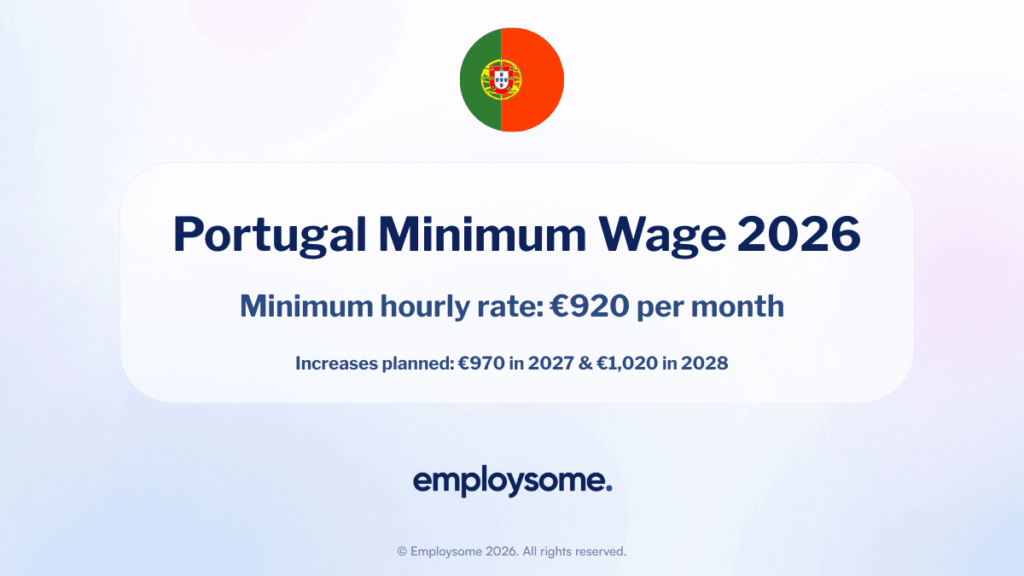
Table of Contents

How Minimum Wage in Portugal Is Regulated
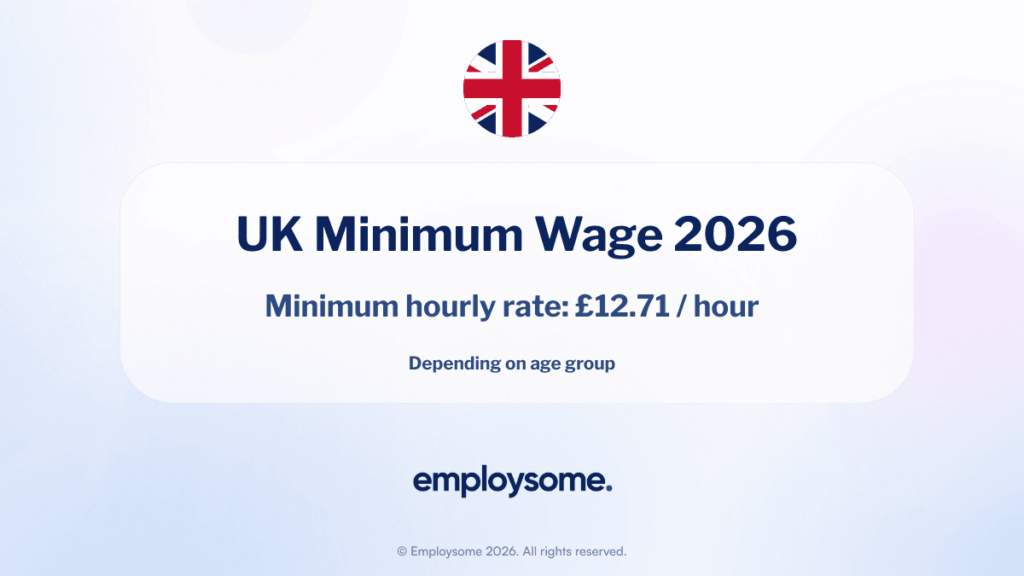
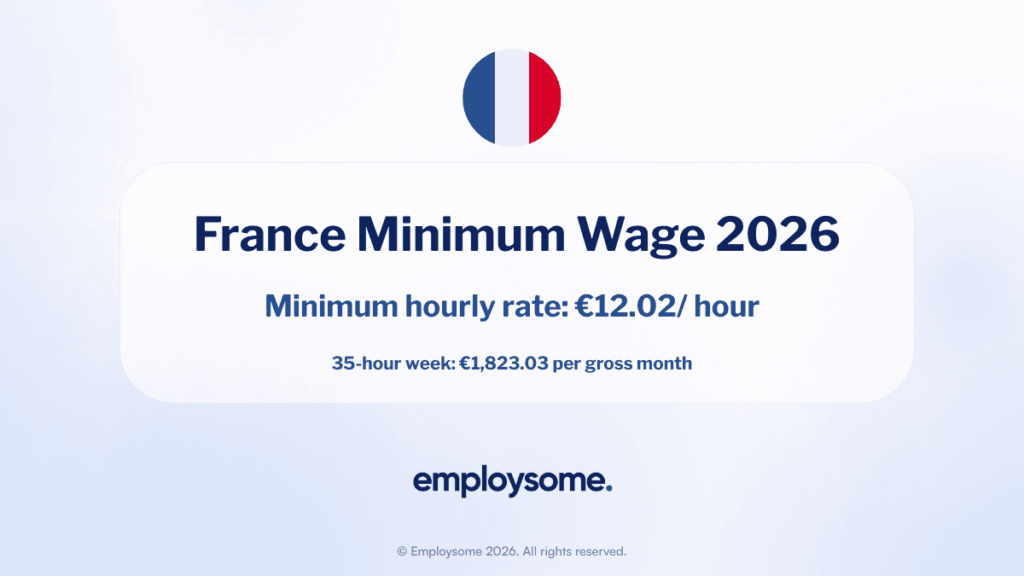
Portugal sets a single national minimum wage, known officially as the Retribuição Mínima Mensal Garantida (RMMG), that applies across mainland Portugal. The government reviews and updates it annually, typically through a Decree-Law published in December that takes effect on January 1 of the following year. Unlike France, where the SMIC is indexed to inflation by formula and can be triggered mid-year, or Spain, where the Salario Mínimo Interprofesional is negotiated annually between the government, unions, and employer confederations, Portugal’s minimum wage follows a political commitment set out in multi-year tripartite agreements.
The current trajectory was established by the Acordo Tripartido sobre Valorização Salarial e Crescimento Económico 2025-2028, signed on October 1, 2024, between the government of Prime Minister Luís Montenegro, four business confederations, and the UGT (General Union of Workers). The CGTP, Portugal’s other major trade union, did not sign. This agreement commits the government to annual increases of €50 per year from 2025 through 2028, creating a predictable path:
- €870 in 2025
- €920 in 2026
- €970 in 2027
- €1,020 in 2028
The legal basis for the minimum wage sits in the Portuguese Constitution itself. Article 59(2)(a) establishes the state’s obligation to set and update a national minimum wage, taking into account worker needs, cost of living increases, productivity levels, and economic stability. The Labour Code (Código do Trabalho, Law 7/2009) provides the detailed framework, with Articles 273 and 274 governing how the minimum wage is defined and applied.

The autonomous regions of Madeira and the Azores have the constitutional authority to set their own minimum wages, typically higher than the mainland rate, reflecting the additional costs of insularity. These regional supplements are enacted through separate regional legislative decrees.
Portugal vs. Spain vs. France: How Minimum Wage Regulation Differs
|
Feature |
Portugal |
Spain |
France |
|
Official name |
RMMG |
SMI (Salario Mínimo Interprofesional) |
SMIC (Salaire Minimum Interprofessionnel de Croissance) |
|
Rate structure |
National + 2 regional supplements (Madeira, Azores) |
Single national rate |
Single national rate (separate rate for Mayotte) |
|
Payment structure |
14 monthly payments (12 + Christmas + holiday bonus) |
14 payments (12 + 2 extra pays) or 12 prorated |
12 monthly payments |
|
Review cycle |
Annual, January 1 |
Annual, typically January (delayed to February in 2026) |
Annual, January 1 + mid-year trigger if inflation exceeds 2% |
|
Indexation |
Political commitment (€50/year through 2028) |
Government decision after social dialogue, targeting 60% of average wage |
Formula-based: CPI for lowest 20% of households + half of real wage growth |
|
Standard workweek |
40 hours |
40 hours |
35 hours |
Minimum Wage Portugal 2026: Current Rate
The national minimum wage in Portugal is €920 per month as of January 1, 2026, established by Decree-Law No. 139/2025. This represents a €50 increase from the 2025 rate of €870, a rise of approximately 5.7%.
The critical detail that distinguishes Portugal from most other European countries is the 14-payment structure. Portuguese labour law entitles all employees to receive not 12 but 14 monthly salary payments per year: the regular 12 months of wages, plus a 13th month payment (Christmas bonus, paid in December) and a 14th month payment (holiday bonus, paid before the employee’s main holiday period, typically June or July). Each of these extra payments equals one full month’s salary.
This means the annual gross minimum salary in Portugal is not €920 multiplied by 12 (€11,040), but €920 multiplied by 14, totalling €12,880 per year.
For employers budgeting on a 12-month cycle, the effective monthly minimum wage cost (before employer contributions) is €1,073.33 when the 13th and 14th month payments are spread evenly across the year.
Portugal does not set an official hourly minimum wage. However, based on a standard 40-hour workweek and approximately 174 working hours per month (52 weeks times 40 hours, divided by 12), the indicative hourly rate is approximately €5.75 per hour on the base monthly wage, or roughly €6.17 per hour when the 13th and 14th payments are included.
Reduced rates and exceptions
Portuguese labour law permits limited reductions to the minimum wage in specific circumstances. Apprentices and trainees enrolled in certified training programmes may receive a minimum wage reduced by up to 20%, for a maximum period of one year (six months if the worker holds a relevant technical or professional qualification). Part-time employees are entitled to the minimum wage calculated proportionally based on their hours worked. There is no separate youth rate, student rate, or tipped-worker rate under Portuguese law.
Minimum Wages: Madeira and the Azores
The autonomous regions of Madeira and the Azores set their own minimum wages through regional legislative decrees. These rates are higher than the mainland rate to account for the additional costs of living on islands, including higher transportation, energy, and import costs.
|
Region |
2025 Rate (€/month) |
2026 Rate (€/month) |
Increase |
Annual Gross (14 payments) |
|
Mainland Portugal |
€870.00 |
€920.00 |
+€50.00 (+5.7%) |
€12,880.00 |
|
Azores |
€913.50 |
€966.00 |
+€52.50 (+5.7%) |
€13,524.00 |
|
Madeira |
€915.00 |
€980.00 |
+€65.00 (+7.1%) |
€13,720.00 |
Madeira has the highest minimum wage of any region in Portugal at €980 per month, which is €60 more than the mainland rate. The Azores sits between the two at €966 per month. Employers hiring in these regions must apply the regional rate, not the mainland rate.
💡 Employsome Insight: Madeira’s Regional Minimum Wage Premium
Madeira’s minimum wage is now 6.5% above the mainland rate, and the gap is widening. For companies using an Employer of Record to hire in Portugal, confirm whether your EOR applies the correct regional rate for employees based in Madeira or the Azores. Applying the mainland rate to an island-based employee is a compliance violation.
Portugal vs. Spain vs. France: How Minimum Wage Compares
Portugal’s minimum wage sits below both Spain and France in absolute terms, though the gap narrows considerably when adjusted for cost of living and the 14-payment structure.
|
Country |
Monthly Minimum Wage (Gross) |
Annual Gross |
Payments Per Year |
Approx. Hourly Rate |
Standard Workweek |
Approx. USD Equivalent (Annual) |
|
Portugal |
€920 |
€12,880 |
14 |
~€5.75 |
40 hours |
~$13,910 |
|
Spain |
€1,221 |
€17,094 |
14 |
~€7.63 |
40 hours |
~$18,460 |
|
France |
€1,823.03 |
€21,876.36 |
12 |
€12.02 |
35 hours |
~$23,630 |
France’s SMIC is nearly double Portugal’s monthly rate, but France also uses a 35-hour workweek and a 12-payment structure. Spain’s SMI increased to €1,221 in February 2026 (backdated to January 1), a 3.1% rise that benefits approximately 2.5 million workers. Like Portugal, Spain uses a 14-payment system.
When comparing employer costs, the picture shifts further. France’s employer social security contributions can exceed 40% of gross salary before reductions (the Fillon reduction significantly lowers this for SMIC-level workers), while Portugal’s employer TSU rate of 23.75% is more moderate, and Spain’s employer social security sits at approximately 29.9%.
💡 Employsome Insight: Portugal vs Spain – The Wage Gap Is Narrowing
The gap between Portugal and Spain has been narrowing. In 2018, Portugal’s minimum wage was €580 and Spain’s was €735.90. Since then, Portugal has increased its rate by 58.6% while Spain has risen by 66%. Both governments have committed to continued above-inflation increases, with Portugal targeting €1,020 by 2028 and Spain aiming for 60% of the average national wage. For companies deciding where to establish their Iberian operations, the wage cost differential is shrinking, but Portugal still offers a meaningful advantage at the minimum wage level. An Employer of Record can model the total cost of employment in both countries before you commit.
Employer Costs in Portugal: TSU and Beyond
The minimum wage Portugal figure of €920 per month is only the starting point for calculating the true cost of employing someone. Portuguese employers face several mandatory contributions on top of the gross salary.
Social Security (TSU – Taxa Social Única)
The combined social security contribution rate in Portugal is 34.75% of gross salary, split between employer and employee. The employer pays 23.75% and the employee pays 11%. The employer deducts the employee’s 11% from gross pay and remits the total 34.75% to the Instituto da Segurança Social by the 20th of the following month.
Social security contributions in Portugal are uncapped. There is no maximum earnings ceiling above which contributions stop, unlike in France or Germany. Every euro of cash compensation, including base salary, regular bonuses, and most allowances, is subject to the full 34.75% rate. The only common exception is the meal allowance (subsídio de refeição): when paid via meal card and within the exempt limit (currently €10.20 per day), it is not subject to social security or income tax.
Labour Accident Insurance
Portuguese employers must purchase mandatory labour accident insurance (seguro de acidentes de trabalho). The premium varies by industry and risk classification but typically runs between 1% and 2% of gross salary for office-based roles, and higher for construction, manufacturing, or other high-risk sectors. The average across all sectors is approximately 1.75%.
Working Compensation Funds
Portugal introduced two compensation funds to protect employees in cases of employer insolvency. Contributions to the Fundo de Compensação do Trabalho (FCT) are currently suspended, but contributions to the Fundo de Garantia de Compensação do Trabalho (FGCT) remain mandatory at 0.075% of gross salary.
13th and 14th Month Payments
The Christmas bonus (13th month) and holiday bonus (14th month) are mandatory and each equal one full month’s salary. These are subject to social security contributions and income tax. For budgeting purposes, this means the employer pays TSU of 23.75% not on 12 months of salary but on 14 months.
Total Employer Cost: Minimum Wage Worker in Portugal
For a full-time minimum wage employee on mainland Portugal (€920/month, 40 hours/week):
Annual gross salary (14 payments): €12,880 Employer TSU (23.75% on €12,880): €3,059 Labour accident insurance (~1.75%): €225 FGCT (0.075%): €10 Estimated total annual employer cost: ~€16,174 Effective monthly employer cost (spread over 12 months): ~€1,348 Effective hourly employer cost: ~€7.75
This represents a payroll burden of approximately 25.5% to 26% on top of total gross compensation, placing Portugal between France (40-45% before reductions) and Spain (~30% employer social security rate).
Legal Framework Governing Minimum Wage in Portugal
Minimum wage in Portugal is governed by a layered legal framework:
The Portuguese Constitution (Constituição da República Portuguesa) establishes the fundamental right to fair remuneration in Article 59 and the state’s obligation to maintain a national minimum wage in Article 59(2)(a). This constitutional grounding means the minimum wage cannot simply be abolished or frozen indefinitely without constitutional challenge.
The Labour Code (Código do Trabalho, Law 7/2009, as amended) provides the detailed employment framework. Articles 273 and 274 govern the composition of the minimum wage, specifying what counts toward it: base salary, the value of benefits in kind (such as food or accommodation), sales commissions, productivity bonuses, and regular allowances classified as remuneration. Importantly, the 13th and 14th month payments are additional to the minimum wage, meaning they cannot be used to artificially inflate the base monthly pay to meet the RMMG threshold.
Individual Decree-Laws set the specific rate each year. For 2026, Decree-Law No. 139/2025, published on December 29, 2025, established the €920 rate. This decree applies only to mainland Portugal; the autonomous regions enact separate regional legislative decrees.
Collective Bargaining Agreements (Instrumentos de Regulamentação Coletiva de Trabalho) can and frequently do set sector-specific minimum wages above the national RMMG. Where a collective agreement applies, the employer must pay whichever rate is higher: the national minimum or the collective agreement rate.
The minimum wage prevails over any inferior wages in individual employment contracts or collective agreements. From January 1, 2026, any employee receiving less than €920 per month is entitled to an immediate increase to at least that amount.
Employer Obligations Under Portuguese Law
Employers in Portugal must meet several specific obligations related to minimum wage compliance:
Pay at least the applicable minimum wage for every hour worked. This means the national RMMG, the relevant regional rate (Madeira or Azores), or the rate in an applicable collective bargaining agreement, whichever is highest. Part-time employees must receive the minimum wage calculated proportionally.
Pay the 13th and 14th month salaries. The Christmas bonus is typically paid in December and the holiday bonus before the employee’s main vacation period. These are mandatory, non-negotiable payments equal to one full month’s salary each. Some employers split these into monthly instalments by agreement with the employee, but the full annual amount must still be paid.
Register with Social Security and remit contributions monthly. The employer must register with the Segurança Social, obtain a Social Security Identification Number (NISS), and remit combined employer and employee contributions (34.75% of gross salary) between the 10th and 20th of the month following the pay period. Late payments incur immediate penalties of 10% of the outstanding amount plus interest.
Maintain labour accident insurance. Coverage must be in place from the first day of employment. Operating without labour accident insurance is an administrative offence.
Provide detailed pay slips. Every employee must receive a monthly pay slip showing gross salary, all deductions (social security, income tax), and net pay. Pay slips must be retained for record-keeping purposes.
Pay salaries by the last working day of each month. Consistent late payment is an administrative offence and can trigger investigation by the Autoridade para as Condições do Trabalho (ACT), Portugal’s labour inspectorate.
Comply with working time limits. Standard working hours are 40 hours per week and 8 hours per day. Overtime is permitted up to 2 hours per day and 150 hours per year (175 hours for companies with fewer than 50 employees). Overtime rates are 125% for the first hour and 137.5% for subsequent hours on weekdays, and 150% on rest days and public holidays.
Compliance Warning: The Meal Allowance Trap
Many employers in Portugal supplement salaries with a daily meal allowance (subsídio de refeição). When paid via meal card and within the tax-exempt limit of €10.20 per day, this allowance is not subject to social security contributions or income tax, making it an efficient compensation tool. However, the meal allowance cannot count toward the minimum wage. An employer paying €850 base salary plus a €70 monthly meal allowance is still violating the minimum wage if the base falls below €920. The base monthly salary itself must meet or exceed the RMMG.
Penalties for Violating Minimum Wage in Portugal
Portugal enforces minimum wage compliance through the Autoridade para as Condições do Trabalho (ACT), which has the authority to conduct inspections, investigate complaints, and impose penalties.
Administrative fines for labour law violations in Portugal are scaled by company size and severity. Small companies face minimum fines of approximately €510 per violation, while larger corporations can be fined up to €25,000 per breach. For severe violations, including systematic underpayment of wages, fines can reach €44,890 or more. Non-payment of minimum wage or social security contributions can constitute a criminal offence, exposing company directors to personal liability.
Late social security payments incur an immediate surcharge of 10% of the outstanding amount, plus daily interest. The Segurança Social conducts audits covering up to three years of payroll records and employment contracts.
Misclassification of employees as independent contractors, a common compliance risk for international companies, carries specific penalties including retroactive social security contributions, back payment of holiday and Christmas allowances, compliance with labour accident insurance requirements, retroactive severance entitlements, and fines of up to €9,690.
From 2025-2026, the ACT has intensified enforcement with audits of over 4,000 companies for gender pay gaps exceeding 5%, requiring corrective action plans. Proactive compliance is not optional.
Employee remedies include the right to file complaints with the ACT, bring claims before the Portuguese labour courts within one year of employment termination, and recover unpaid wages plus interest. Labour courts in Portugal are specialised courts dedicated to employment disputes.
Compliance Warning: Social Security Audits
The Segurança Social has the authority to audit three years of payroll records. Errors in calculating employer contributions of 23.75%, missed employee deductions of 11%, or late remittances are among the most common compliance failures. For international companies operating without a Portuguese entity, using an Employer of Record eliminates this risk by ensuring contributions are calculated, deducted, and remitted correctly each month.
Minimum Wage Portugal vs. Cost of Living
Portugal remains one of the most affordable countries in Western Europe, but the gap between minimum wage and housing costs has widened sharply, particularly in Lisbon and Porto.
The following table compares the minimum wage against average one-bedroom rent in Portugal’s major cities to illustrate affordability. The rent-to-income ratio uses the effective monthly income including the 13th and 14th payments spread over 12 months (€1,073/month gross, approximately €870-€900/month net after social security and income tax deductions).
|
City |
Avg. 1-Bed Rent (City Centre) |
Avg. 1-Bed Rent (Outside Centre) |
Net Minimum Wage (~€885/month) |
Rent as % of Net Income (City Centre) |
|
Lisbon |
~€1,350 |
~€1,050 |
€885 |
153% |
|
Porto |
~€950 |
~€750 |
€885 |
107% |
|
Braga |
~€700 |
~€550 |
€885 |
79% |
|
Coimbra |
~€650 |
~€500 |
€885 |
73% |
|
Faro (Algarve) |
~€850 |
~€700 |
€885 |
96% |
|
Aveiro |
~€650 |
~€500 |
€885 |
73% |
|
Évora |
~€600 |
~€450 |
€885 |
68% |
|
Viseu |
~€550 |
~€400 |
€885 |
62% |
The data reveals a stark reality: in Lisbon, the average city-centre one-bedroom rent exceeds the entire net minimum wage income. Even outside the city centre, rent consumes virtually all of a minimum wage worker’s take-home pay. Porto is similarly challenging. Only in smaller cities like Viseu, Évora, and Aveiro does rent drop below 75% of net income, approaching the level where minimum wage employment becomes financially viable without additional household income.
This housing affordability crisis is driven in part by the influx of digital nomads and foreign retirees using Portugal’s D7 visa, whose income thresholds are pegged to the minimum wage (€920/month for a single applicant). The surge in short-term rental platforms has further tightened housing supply in urban areas, though government measures since 2023 have begun curtailing new Airbnb licenses.
💡 Employsome Insight: Consider Lower-Cost Cities Outside Lisbon & Porto
For international companies hiring in Portugal, the cost-of-living data matters for two reasons. First, attracting and retaining talent at or near the minimum wage is difficult in Lisbon and Porto; competitive offers typically need to exceed €1,200-€1,500/month to be viable. Second, Portugal’s lower wage levels compared to Spain and France make it an attractive nearshore option for roles that can be based outside the two largest cities. An Employer of Record can help you hire in lower-cost cities like Braga, Coimbra, or Aveiro where minimum wage employment remains sustainable.
Portugal vs. Spain vs. France: Cost of Living Comparison
|
City |
Country |
Avg. 1-Bed Rent (Centre) |
Monthly Groceries (1 person) |
Monthly Transport Pass |
Minimum Wage (Gross Monthly, 12-month equivalent) |
|
Lisbon |
Portugal |
~€1,350 |
~€250 |
€45 |
€1,073 |
|
Porto |
Portugal |
~€950 |
~€230 |
€40 |
€1,073 |
|
Madrid |
Spain |
~€1,200 |
~€280 |
€55 |
€1,424 |
|
Barcelona |
Spain |
~€1,150 |
~€270 |
€45 |
€1,424 |
|
Paris |
France |
~€1,300 |
~€350 |
€84 |
€1,823 |
|
Lyon |
France |
~€750 |
~€300 |
€70 |
€1,823 |
Portugal’s grocery costs are among the lowest in Western Europe, and public transport is significantly cheaper than in France. However, Lisbon’s rent has converged with Madrid and even Paris for comparable properties, while wages remain well below those cities.
Hiring in Portugal Through an Employer of Record
An Employer of Record (EOR) is a third-party organisation that becomes the legal employer of your workers in Portugal, handling payroll, social security contributions, employment contracts, and compliance with Portuguese labour law on your behalf. The worker reports to you and performs work for your company, but the EOR manages all statutory obligations.
When an EOR makes sense for employers
An EOR is the most practical option when you want to hire in Portugal without establishing a Portuguese legal entity. Setting up a subsidiary (Sociedade por Quotas or Sociedade Anónima) involves registration with the Registo Comercial, tax authority, and Segurança Social, and typically takes several weeks to months with significant ongoing compliance costs. An EOR lets you hire immediately.
Common scenarios include testing the Portuguese market before committing to a full entity, hiring a small team (one to ten employees) where entity setup costs are disproportionate, employing Portuguese nationals who work remotely from Portugal for your company headquartered elsewhere, and relocating existing employees to Portugal.
What the EOR handles
A compliant Portugal EOR manages employment contracts under Portuguese law (including mandatory clauses on working hours, probation period, and termination terms), monthly payroll including the 13th and 14th month salary payments, employer TSU contributions (23.75%) and employee social security deductions (11%), income tax withholding and monthly reporting to the Autoridade Tributária e Aduaneira, labour accident insurance, FGCT contributions, leave management (22 days annual leave plus 13 public holidays), and termination procedures in compliance with the Labour Code’s strict dismissal protections.
EOR costs
EOR fees in Portugal typically range from €400 to €1,200 per employee per month, depending on the provider, the number of employees, and the complexity of the engagement. For a single minimum wage employee, the EOR fee may represent a significant percentage of the total cost. For higher-salaried employees, the fee becomes proportionally smaller.
What the EOR does not do
An EOR is not a recruitment agency and will not find candidates for you. It is not a pathway to permanent residency or citizenship for the employee. The EOR does not provide work permits or visas; the employee must already have the right to work in Portugal (EU/EEA citizenship, valid work visa, or residence permit). The EOR is your legal employer in Portugal, but the day-to-day working relationship, including assignments, performance management, and career development, remains between you and the worker.
For a detailed comparison of Portugal EOR providers, see our guide to the best EOR providers in Portugal.
Minimum Wage Portugal 2026-2028 Outlook
The path forward for minimum wage Portugal is more predictable than in most countries, thanks to the 2024 tripartite agreement.
Confirmed trajectory
The Acordo Tripartido sobre Valorização Salarial e Crescimento Económico 2025-2028 commits to annual increases of €50:
|
Year |
Minimum Wage (Mainland) |
Annual Gross (14 payments) |
|
2025 |
€870 |
€12,180 |
|
2026 |
€920 |
€12,880 |
|
2027 |
€970 (projected) |
€13,580 |
|
2028 |
€1,020 (projected) |
€14,280 |
By 2028, Portugal’s minimum wage will have increased by 47.1% from its 2020 level of €635, representing one of the fastest sustained minimum wage increases in Europe.
Risks to the trajectory
The tripartite agreement is a political commitment, not legislation. A change of government, an economic downturn, or a sharp rise in unemployment could lead to adjustments. However, all major Portuguese political parties have supported minimum wage increases in recent years, and the trajectory has survived a change of government (from António Costa’s Socialist Party to Luís Montenegro’s centre-right PSD) without disruption.
The UGT trade union has already argued that the €50 annual increases should be revised upward, noting that previous agreements were exceeded in practice. Whether the 2027 increase will be €50 as planned or more depends on economic conditions and political dynamics.
EU context
The EU Adequate Minimum Wages Directive (2022/2041), which member states must transpose by November 2024, requires countries with statutory minimum wages to establish clear criteria for setting and updating them, promote collective bargaining coverage, and ensure minimum wages are adequate relative to median and average wages. Portugal’s systematic approach to minimum wage increases and its tripartite agreement structure align well with the directive’s requirements.
Key Dates for Employers
- January 1, 2026: Current minimum wage of €920 took effect (mainland)
- January 1, 2026: Azores rate of €966 and Madeira rate of €980 took effect
- July 1, 2026: 14th month (holiday bonus) payment due before main vacation period
- December 2026: 13th month (Christmas bonus) payment due
- January 1, 2027: Projected increase to €970 (mainland)
- January 1, 2028: Projected increase to €1,020 (mainland)
Final Takeaway on Minimum Wage in Portugal
Minimum wage Portugal at €920 per month looks low compared to Spain (€1,221) and France (€1,823.03), but the comparison is misleading without accounting for Portugal’s 14-payment structure, lower employer social security burden, and significantly lower cost of living outside Lisbon and Porto. The total annual minimum compensation of €12,880 gross, combined with employer TSU of 23.75% and mandatory insurance, puts the real employer cost at approximately €16,174 per year, or around €1,348 per month on a 12-month basis.
For international companies, Portugal offers a compelling combination: access to a well-educated, multilingual workforce at wage levels below Western European averages, in a country with strong rule of law, EU membership, and a regulatory environment that, while protective of employees, is navigable with proper guidance. The predictable minimum wage trajectory through 2028 gives employers rare cost certainty for multi-year planning.
The challenge is housing affordability in Lisbon and Porto, which makes minimum wage employment unviable in the capital without additional household income. Companies hiring in Portugal should consider locating roles in secondary cities where the cost-of-living equation works, or budgeting salaries above the minimum to attract talent in competitive urban markets.

Written by
Courtney Pocock is a Copywriter & EOR/PEO Researcher at Employsome with 15+ years of experience writing for the HR, corporate, and financial sectors. She has a strong interest in global business expansion and Employer of Record / PEO topics, focusing on news that matters to business owners and decision-makers. Courtney covers industry updates, regulatory changes, and practical guides to help leaders navigate international hiring with confidence.
Our content is created for informational purposes only and is not intended to provide any legal, tax, accounting, or financial advice. Please obtain separate advice from industry-specific professionals who may better understand your business’s needs. Read our Editorial Guidelines for further information on how our content is created.
Other posts
Along with our standard maps we offer highly customizable maps.