Minimum Wage in UAE: The Complete 2026 Guide
The minimum wage in UAE does not exist as a universal figure. From 1 January 2026, Emirati nationals in the private sector must earn at least AED 6,000 per month under Emiratisation policy, up from AED 5,000. For expatriate workers, who make up roughly 90% of the private sector workforce, there is no statutory minimum wage in UAE at all. This guide covers the full picture: the new Emirati minimum, expatriate salary benchmarks, GPSSA pension contributions, end-of-service gratuity, the Wage Protection System, working hours, and what it means for companies hiring through an EOR.

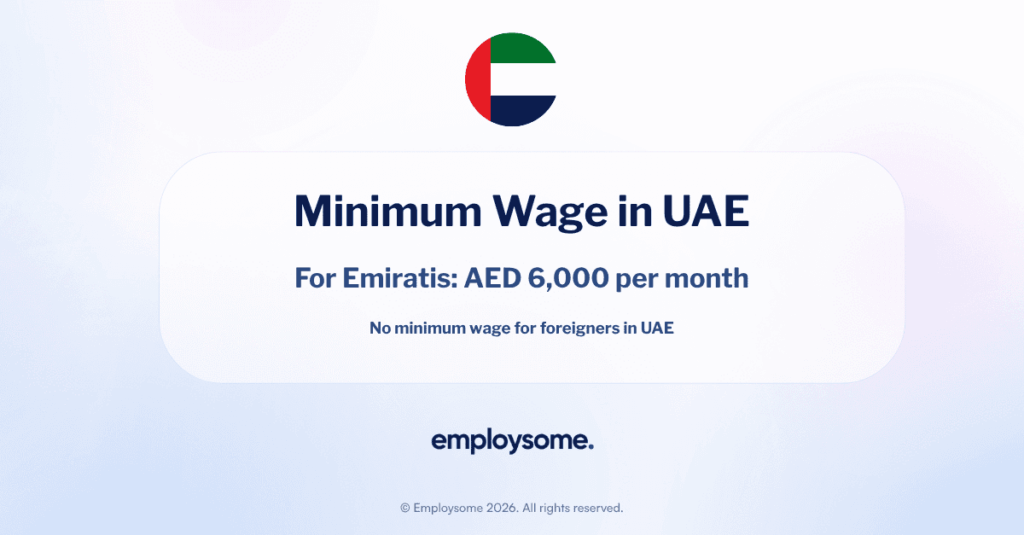
Table of Contents
- Minimum Wage in UAE for Emirati Nationals: AED 6,000 from 2026
- Minimum Wage in UAE for Expatriates: No Statutory Floor
- Employer Costs Beyond the Minimum Wage in UAE
- The Wage Protection System
- Working Hours and Overtime
- How the Minimum Wage in UAE Compares Across the Gulf
- What This Means for Companies Hiring Through an EOR
- FAQs
The minimum wage in UAE does not exist as a universal figure. Unlike most countries, the UAE has no single statutory minimum that applies to all workers. Instead, the country operates a segmented system: from 1 January 2026, Emirati nationals in the private sector must earn at least AED 6,000 per month under Emiratisation policy, while expatriate workers have no statutory minimum wage at all.
This makes the minimum wage in UAE one of the most commonly misunderstood topics for international employers. The country operates a free-market wage system where expatriate salaries are determined by employment contracts, market forces, and the negotiating position of the employer and employee. The UAE Labour Law (Federal Decree-Law No. 33 of 2021) requires that wages be “sufficient to meet the basic needs of employees,” but does not define a specific amount for non-Emirati workers.
The AED 6,000 Emirati minimum is the latest step in a phased Emiratisation strategy that has progressively increased the floor from AED 4,000 to AED 5,000 and now to AED 6,000. For expatriate workers, who make up approximately 90% of the private sector workforce, compensation is governed entirely by the employment contract and enforced through the Wage Protection System (WPS), which ensures timely payment of agreed wages but does not set a floor.
Understanding the minimum wage in UAE requires looking beyond the headline number to the full employer cost structure. The Emiratisation quota system, mandatory health insurance, end-of-service gratuity provisions, the GPSSA pension scheme for Emirati employees, and visa sponsorship costs all create employer obligations that significantly exceed the contract salary.
💡 Employsome Insight: The UAE’s wage system is deceptively simple on the surface. No personal income tax. No universal minimum wage. But the real employer costs are buried in gratuity provisions, mandatory health insurance, visa fees, and for Emirati employees, GPSSA pension contributions at 12.5% to 15% of salary. If your EOR quotes only the salary and management fee, you are missing 15 to 25% of the actual cost.

Minimum Wage in UAE for Emirati Nationals: AED 6,000 from 2026
The AED 6,000 per month minimum wage applies exclusively to UAE national (Emirati) employees working in the private sector. It was announced by MoHRE on 31 December 2025 and took effect on 1 January 2026. The increase is part of the UAE’s Emiratisation strategy, which aims to increase the proportion of Emirati nationals employed in the private sector to approximately 10% by the end of 2026.
The minimum applies to all new, renewed, and amended work permits for Emirati employees from 1 January 2026. Any permit application listing a salary below AED 6,000 will not be processed. Employers with existing Emirati staff earning below the new threshold have been given until 30 June 2026 to adjust salaries and amend employment contracts.
From 1 July 2026, enforcement measures take effect. Emirati employees whose salaries remain below AED 6,000 will be excluded from the employer’s Emiratisation quota calculations, effectively making them invisible for compliance purposes. Employers that are non-compliant will also face suspension of new work permit issuance until salaries are brought into line.
The minimum wage in UAE for Emiratis has increased in three phases: AED 4,000 (initial threshold), AED 5,000 (2024-2025), and AED 6,000 (from January 2026). MoHRE has indicated that the strategy is designed to reflect prevailing market wages and make private sector employment genuinely competitive for Emirati citizens compared to public sector roles, which have historically offered higher pay and benefits.
💡 Employsome Insight: The AED 6,000 Emirati minimum is not just a wage floor. It is an Emiratisation compliance mechanism. If your company is subject to Emiratisation quotas (companies with 50+ employees in designated sectors must achieve 2% annual growth in Emirati hires), paying below this threshold means those employees do not count toward your targets. Your EOR must track both the salary requirement and the quota implications together.
Minimum Wage in UAE for Expatriates: No Statutory Floor
There is no statutory minimum wage in UAE for expatriate (non-Emirati) workers. Compensation is determined entirely by the employment contract, which must be registered with MoHRE. The UAE Labour Law requires that wages be “sufficient to meet the basic needs of employees,” but does not define a specific amount.
In practice, expatriate wages vary enormously depending on skill level, nationality, sector, and emirate. MoHRE introduced non-binding salary guidelines in 2013 that provide reference points for different qualification levels: approximately AED 12,000 per month for university graduates, AED 7,000 for skilled technicians, and AED 5,000 for skilled labourers with secondary education. These are not enforceable minimums but serve as benchmarks that inform visa processing and compensation expectations.
At the lower end of the market, unskilled and semi-skilled expatriate workers in construction, cleaning, hospitality, and domestic services commonly earn AED 1,500 to AED 5,000 per month. Skilled professionals in technology, finance, engineering, and healthcare typically earn AED 15,000 to AED 45,000 per month or more.
The absence of a statutory minimum wage in UAE for expatriates means that market dynamics, visa category requirements, and the WPS enforcement framework serve as the practical safeguards rather than a legislated floor. The WPS ensures that whatever salary is agreed in the employment contract is paid in full and on time through authorised banking channels, but it does not set a wage level.
Employer Costs Beyond the Minimum Wage in UAE
The UAE has no personal income tax, which is one of its primary attractions for employees. However, employers face several mandatory costs beyond the contract salary that must be built into the total employment budget.
GPSSA pension contributions (Emirati employees only)
Under Federal Law No. 7 of 1999 and the updated Federal Decree-Law No. 57 of 2023, Emirati employees must be registered with the General Pension and Social Security Authority (GPSSA). In the private sector, the total contribution rate under the 1999 law is 20% of the contribution account salary: 5% from the employee, 12.5% from the employer, and 2.5% from the government. Under the 2023 law (applicable to those joining the workforce from 31 October 2023), the total is 26% in the private sector: 11% from the employee, 12.5% from the employer, and 2.5% from the government. The maximum pensionable salary has been raised from AED 50,000 to AED 70,000 per month under the 2023 law.
Abu Dhabi operates a separate pension fund (Abu Dhabi Retirement Pension & Benefits Fund) with its own contribution rates. Sharjah also has separate arrangements. Employers must verify which pension regime applies based on the emirate and the employee’s date of entry into the workforce.
For expatriate employees, there are no pension contributions. Instead, employers must provide end-of-service gratuity upon termination.
End-of-service gratuity (expatriate employees)
This is the UAE’s equivalent of severance and is one of the most significant employer costs beyond the minimum wage in UAE. Under the Labour Law, expatriate employees who complete at least one year of service are entitled to a gratuity calculated on their basic salary: 21 days of basic salary for each of the first five years, and 30 days for each additional year. The total gratuity is capped at two years’ total salary. The gratuity is payable upon termination regardless of who initiates the end of employment, though reductions apply if the employee resigns before completing five years.
The UAE has also introduced an Alternative End-of-Service Benefits Scheme for private sector employees, which replaces the traditional lump-sum gratuity with a monthly savings model. Employers contribute 5.83% of basic salary for the first five years and 8.33% thereafter to regulated savings schemes. This is currently voluntary for most employers but is expected to become more widespread. In the DIFC (Dubai International Financial Centre), a similar scheme called DEWS has been mandatory since 2020.
Mandatory health insurance
Employers must provide health insurance for all employees. In Abu Dhabi, this has been mandatory since 2006. In Dubai, it became mandatory in 2014. Other emirates have progressively adopted similar requirements. The cost varies by coverage level, number of dependents, and insurer, but basic plans typically cost AED 2,500 to AED 7,000 per employee per year. Many employers provide enhanced coverage as a competitive benefit.
Visa and work permit costs
Employers sponsor work visas for expatriate employees and bear the associated costs, including visa application fees, Emirates ID, medical fitness testing, and labour card issuance. Typical visa costs range from AED 5,000 to AED 10,000 per employee for initial setup, with renewal costs of AED 3,000 to AED 5,000 every two years.
Involuntary Loss of Employment (ILOE) insurance
Since 2023, all employees in the UAE (both Emirati and expatriate) must subscribe to the ILOE scheme, which provides income protection for workers who lose their jobs involuntarily. The monthly premium is AED 5 for workers earning AED 16,000 or less, and AED 10 for those earning above AED 16,000. While the premium is technically the employee’s responsibility, many employers facilitate the payment through payroll.
💡 Employsome Insight: The cost gap between employing an Emirati and an expatriate in the same role is substantial. An Emirati employee triggers GPSSA contributions of 12.5% to 15% of salary plus government co-contributions. An expatriate employee triggers end-of-service gratuity accrual (effectively 5.83 to 8.33% of basic salary per year) plus visa costs. For Emiratisation planning, model both cost structures side by side before committing to headcount targets.
The Wage Protection System
The UAE’s Wage Protection System (WPS) is an electronic salary transfer system that requires all employers to pay wages through authorised banks and exchange houses. MoHRE monitors WPS data in real time to ensure timely and complete salary payments. The WPS does not set the minimum wage in UAE, but it enforces payment of whatever salary is agreed in the employment contract.
Non-compliance triggers escalating enforcement. After a missed payday, MoHRE issues reminders. From day 16, new work permit issuance is suspended. After 30 days, the matter is referred to public prosecution. At 60 days, fines of AED 5,000 per affected worker apply, capped at AED 50,000. Intentional manipulation of WPS data also carries penalties of AED 5,000 per worker.
The WPS applies to all employees regardless of nationality. For international employers using an EOR, WPS compliance is the EOR’s responsibility, and any payment delays or reporting errors fall on the EOR entity.
Working Hours and Overtime
Standard working hours in the UAE are 8 hours per day and 48 hours per week, which may be reduced to 6 hours per day during Ramadan. The standard work week is Monday to Friday for most private sector companies, following the government’s shift to a 4.5-day work week in January 2022 (though private sector adoption varies).
Overtime must be compensated at a premium. Daytime overtime is paid at 125% of the regular hourly rate. Overtime performed between 9pm and 4am, or on Fridays and rest days, is paid at 150% of the regular rate. Maximum overtime is 2 hours per day, and the employee must consent to working overtime.
Employees are entitled to 30 calendar days of paid annual leave after completing one year of service (2 days per month during the first year). The UAE observes approximately 10 to 14 public holidays per year, during which employees are entitled to full pay.
How the Minimum Wage in UAE Compares Across the Gulf
|
Country |
Min. Wage (Nationals) |
Min. Wage (Expats) |
Employer Pension (Nationals) |
Employer Pension (Expats) |
Income Tax |
|
UAE |
AED 6,000 (~$1,634) |
None |
12.5-15% GPSSA |
Gratuity accrual (~5.8-8.3%) |
0% personal |
|
Saudi Arabia |
SAR 4,000 (~$1,067) |
None |
12% GOSI + SANED |
2% GOSI |
0% personal |
|
Qatar |
QAR 1,000 (~$275) universal |
QAR 1,000 |
None mandatory |
None mandatory |
0% personal |
|
Bahrain |
BHD 300 (~$796) nationals |
None |
12% SIO |
3% SIO |
0% personal |
|
Kuwait |
KWD 75 (~$245) nationals |
None |
~11.5% |
None |
0% personal |
|
Oman |
None |
None |
~11.5% |
None |
0% personal |
The minimum wage in UAE for Emiratis at AED 6,000 is the highest national minimum in the GCC. Qatar is the only GCC country with a universal minimum covering all workers regardless of nationality. The absence of personal income tax across all GCC states means gross salary closely approximates take-home pay, making the region attractive for employees despite the lack of comprehensive social protections for expatriates.
What This Means for Companies Hiring Through an EOR
For international companies, the minimum wage in UAE is only the starting point. Total employer cost, Emiratisation quota compliance, and WPS enforcement define the real cost of hiring. If you are hiring employees in the UAE through an Employer of Record, the EOR is the legal employer and visa sponsor, responsible for paying at least AED 6,000 to any Emirati employees and ensuring compliance with Emiratisation quotas, sponsoring work visas for expatriate employees and bearing associated costs, registering Emirati employees with GPSSA and calculating pension contributions correctly based on the applicable law (1999 or 2023) and emirate, accruing and paying end-of-service gratuity for expatriate employees upon termination, processing all salary payments through the Wage Protection System via authorised banking channels, providing mandatory health insurance for all employees, and managing overtime compensation, leave entitlements, and public holiday pay in accordance with the Labour Law.
The UAE’s dual system, where Emirati and expatriate employees have fundamentally different cost structures, compliance obligations, and regulatory frameworks, makes it one of the more complex GCC markets for EOR execution. Providers must handle both tracks accurately within the same payroll operation. For a broader overview of how to structure international hiring compliantly, see our international hiring guide.
Hiring in the UAE?
If you are looking to hire employees in the UAE without setting up a local entity, an Employer of Record handles employment contracts, visa sponsorship, WPS payroll, health insurance, GPSSA registration (for Emiratis), and gratuity compliance on your behalf. See our Best Employer of Record in the UAE guide for pricing, entity ownership, and compliance depth.
Frequently Asked Questions
There is no universal minimum wage in UAE. Emirati nationals in the private sector must earn at least AED 6,000 per month from January 2026. Expatriate wages are determined by employment contracts with no statutory floor.
No. The AED 6,000 minimum applies only to Emirati nationals. Expatriate compensation is governed by the employment contract. The law requires wages to be “sufficient to meet basic needs” but does not specify an amount.
From 1 July 2026, affected Emirati employees will be excluded from Emiratisation quota calculations, and the employer’s ability to issue new work permits will be suspended until salaries comply.
For Emirati employees: GPSSA pension (12.5-15% of salary), mandatory health insurance, and visa costs. For expatriate employees: end-of-service gratuity accrual (21 days per year for first 5 years, 30 days thereafter), mandatory health insurance, visa and work permit costs (AED 5,000-10,000 initial), and ILOE insurance facilitation.
An electronic salary transfer system that requires all employers to pay wages through authorised banking channels. MoHRE monitors payments in real time. Non-compliance from day 16 triggers work permit suspension, and from day 60, fines of AED 5,000 per worker. The WPS enforces payment of the agreed wage but does not set the minimum wage in UAE.
No. The UAE has no personal income tax. A 9% corporate income tax was introduced from June 2023, but this does not apply to individual employment income. Employees receive their full gross salary without tax deductions.
A mandatory severance-like payment for expatriate employees who complete at least one year of service. Calculated at 21 days of basic salary per year for the first 5 years and 30 days per year thereafter, capped at 2 years’ total salary.
The Emirati private sector minimum has increased in three phases: AED 4,000 initially, AED 5,000 in 2024-2025, and AED 6,000 from January 2026. No universal minimum for expatriates has been introduced.

Written by
Dane Cobain is a Copywriter at Employsome and an accomplished author whose work spans fiction, non-fiction, and professional writing. Over the past decade, he has built a strong track record creating straightforward content for the HR, payroll, and corporate sectors. Dane brings a storyteller’s eye to the evolving world of global employment, with a particular focus on Employer of Record and PEO models. His articles explore industry trends and dedicated Best Of Guides when managing an international workforce.
Our content is created for informational purposes only and is not intended to provide any legal, tax, accounting, or financial advice. Please obtain separate advice from industry-specific professionals who may better understand your business’ needs. Read our Editorial Guidelines for further information on how our content is created.
Other posts
Along with our standard maps we offer highly customizable maps.