Minimum Wage in Spain: The Complete 2026 Guide
This guide covers Spain’s minimum wage system for 2026, including the current statutory rate set by Royal Decree 126/2026, how the SMI is structured across 14 monthly payments, employer social security contributions (approximately 30–32% of gross salary), collective bargaining agreements that may override the statutory floor, compliance requirements under the Workers’ Statute, penalties for underpayment, how minimum wage compares to living costs across major Spanish cities, and the 2026–2027 outlook for employers and workers.


How Minimum Wage in Spain Is Regulated
Spain’s minimum wage is known as the Salario Mínimo Interprofesional (SMI) and is governed by Article 27 of the Workers’ Statute (Royal Legislative Decree 2/2015). The SMI is set annually by the government through a Royal Decree, following consultation with the most representative trade unions (UGT, CCOO) and employer organisations (CEOE, CEPYME).
The government considers several factors when setting the annual SMI:
- Consumer Price Index (CPI) and inflation trends
- National productivity indices
- The share of labour income in national GDP
- The overall economic situation and employment levels
- Alignment with the European Social Charter target of 60% of the average national wage
For 2026, negotiations between the government, unions, and employers produced different positions: unions demanded a 7.5% increase, employers countered with a maximum 1.5%, and an expert advisory committee recommended 3.1–4.7%. The government initially extended the 2025 rate through a Royal-Decree-Law in December 2025, then approved the final increase by Royal Decree 126/2026, published on 18 February 2026 with retroactive effect from 1 January 2026.
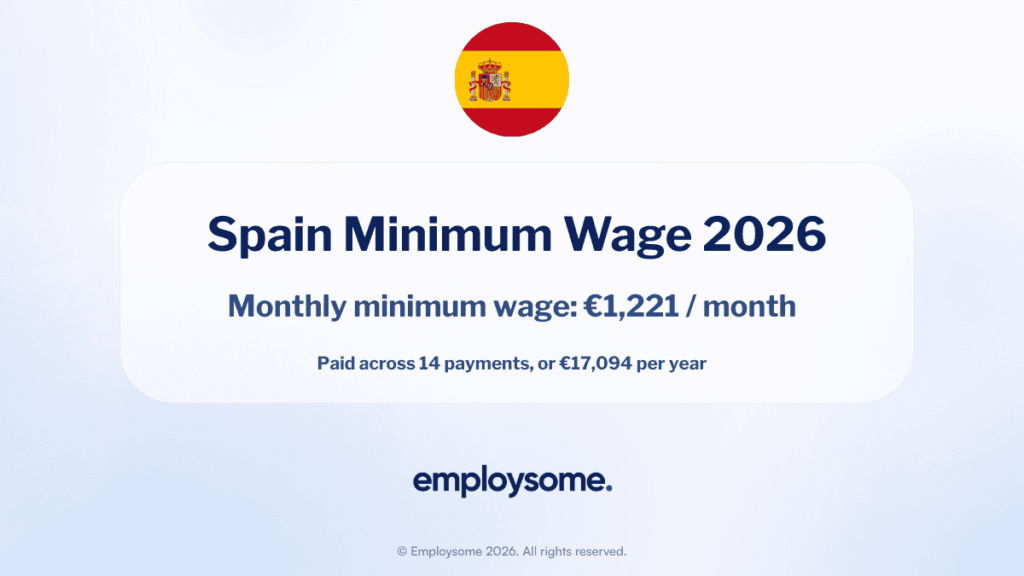
Spain’s minimum wage (SMI) for 2026 is €1,221 gross per month across 14 payments, or €17,094 per year, effective from 1 January 2026.
Enforcement is handled by the Labour and Social Security Inspectorate (Inspección de Trabajo y Seguridad Social, ITSS), which conducts workplace inspections, investigates complaints, and imposes sanctions for non-compliance. Whistleblower protections are in place for employees who report wage violations.
The SMI applies to all workers in Spain, regardless of nationality, visa status, or industry. It is the statutory floor below which no worker may be paid for full-time employment
💡 Employsome Insight: Spain’s SMI Negotiation Process Is Uniquely Political
Unlike countries where an independent commission sets the minimum wage based on economic data (such as the UK’s Low Pay Commission), Spain’s SMI is determined through a political tripartite process involving the government, unions, and employers. In practice, the government has overridden employer opposition in every year since 2018, resulting in six consecutive above-inflation increases. International companies should expect the SMI to continue rising at CPI-plus rates as the government pursues its 60%-of-average-wage target.
Minimum Wage Spain 2026: Current Rates
From 1 January 2026 (retroactive, published 18 February 2026), the SMI rates are:
|
Category |
2026 Rate |
|
Monthly (14 payments) |
€1,221 gross |
|
Monthly (12 payments, prorated) |
€1,424.50 gross |
|
Annual total |
€17,094 gross |
|
Daily (for day-rate workers) |
€40.72 |
|
Domestic workers (hourly) |
€9.55/hour |
|
Temporary workers (≤20 days) |
€57.82/working day |
The €37/month increase represents a 3.1% rise from the 2025 rate of €1,184/month. The government estimates approximately 2.5 million workers will benefit directly, of whom roughly two in three are women and a disproportionate share are under 25.
Spain’s salary structure is unique in that most workers receive 14 payments per year: 12 monthly salaries plus two additional payments, typically in July (summer bonus) and December (Christmas bonus). Some employers prorate these extra payments across 12 months, resulting in a higher monthly amount (€1,424.50) but the same annual total (€17,094).
The standard working week in Spain is 40 hours. There is ongoing legislation to reduce this to 37.5 hours per week, which if enacted would increase the effective hourly rate of the SMI without changing the monthly amount.
💡 Employsome Insight: 14 Payments Catch International Companies Off Guard
The 14-payment structure is one of the most common compliance surprises for international companies hiring in Spain for the first time. If you budget for 12 monthly payments and miss the July and December extra payments, you will underpay employees and face enforcement action. When using an EOR or setting up payroll in Spain, always confirm whether the 14-payment model or 12-payment prorated model applies to your contracts.
Collective Bargaining Agreements and Sectoral Minimums
While the SMI sets the national floor, the majority of Spanish workers are covered by collective bargaining agreements (convenios colectivos) that set higher minimum wages for specific sectors, regions, and job categories. Spain has one of the highest collective bargaining coverage rates in Europe.
Key points about collective bargaining in Spain:
- Many CBAs are declared “generally binding” (de obligado cumplimiento), meaning even non-union employers in the covered sector must comply
- CBAs typically set wages by job category (grupo profesional), seniority, and region, often well above the SMI
- In construction, national CBAs may push entry-level wages above €1,500/month; in technology and finance, starting wages are typically 2–3x the SMI
- If the SMI rises above a CBA’s minimum for a particular category, the SMI prevails automatically and the employer must adjust upward
- Some CBAs allow certain wage supplements to be absorbed to meet the SMI, while others explicitly prohibit absorption
Employers must identify the applicable CBA for their sector and region. Failing to apply the correct CBA can result in enforcement action even if the employer is paying above the SMI, because the CBA may require higher rates for specific job classifications.
💡 Employsome Insight: CBAs Are the Real Wage Floor in Spain, Not Just the SMI
For most skilled roles, the SMI is irrelevant because the applicable collective bargaining agreement sets a significantly higher minimum. International companies often focus on SMI compliance but overlook the CBA requirement, which can result in underpayment even when paying above the national minimum. Always identify the applicable convenio colectivo before finalising compensation packages in Spain.
How Minimum Wage in Spain Is Calculated
The SMI applies to basic pay (salario base) and does not include bonuses, overtime payments, or other allowances. It is the floor for gross remuneration before social security contributions and income tax deductions.
Key calculation principles:
- The SMI covers basic pay only. Overtime premiums, travel allowances, tips, and benefits in kind cannot be counted toward meeting the minimum wage
- Overtime in Spain is paid at the rate agreed in the CBA or employment contract, but must be at least equal to the normal hourly rate. Maximum overtime is 80 hours per year
- Night work (10pm to 6am) attracts a premium defined by the applicable CBA
- Workers are entitled to 30 calendar days (22 working days) of paid annual leave, plus 14 public holidays per year
- Employers must maintain mandatory time-recording systems for all employees. Non-compliance carries fines of €1,000–€10,000 per affected worker
After social security deductions (approximately 6.35–6.48% for employees) and IRPF income tax withholding, a minimum wage worker in Spain typically takes home between €1,080 and €1,170 per month, depending on personal circumstances, number of dependants, and autonomous community of residence.
For 2026, the government has updated IRPF tax tables so that minimum wage earners are fully exempt from income tax, meaning their take-home pay is closer to the gross amount minus social security contributions only.
Employer Statutory Contributions in Spain
Spain has one of the higher employer social security contribution rates in Europe. Employers must budget for approximately 30–32% of gross salary in mandatory contributions on top of the employee’s gross pay.
|
Contribution |
Employer Rate |
Employee Rate |
|
Common contingencies (healthcare, pensions, maternity/paternity, disability) |
23.60% |
4.70% |
|
Unemployment insurance |
5.50% |
1.55% |
|
Wage Guarantee Fund (FOGASA) |
0.20% |
0% |
|
Professional training |
0.60% |
0.10% |
|
Intergenerational Equity Mechanism (MEI) |
0.75% |
0.15% |
|
Occupational accident insurance (variable) |
~1.50% |
0% |
|
Total (approximate) |
~30.65–32.15% |
~6.35–6.50% |
For a minimum wage employee earning €1,221/month (14 payments), the employer’s monthly social security cost is approximately €374–€392, bringing the total monthly employment cost to approximately €1,595–€1,613 before any CBA-mandated supplements or benefits.
Contributions are calculated on a capped base. The maximum monthly contribution base for 2026 is approximately €5,101.20, meaning employer contributions do not increase beyond this ceiling. A solidarity contribution of 0.92% applies to salaries exceeding the maximum base.
The MEI (Mecanismo de Equidad Intergeneracional) is a relatively new contribution introduced to strengthen pension sustainability. It was 0.60% in 2023, 0.70% in 2024, 0.80% in 2025, and rises to 0.90% in 2026 (0.75% employer, 0.15% employee). It will continue increasing annually until reaching 1.2% in 2029.
💡 Employsome Insight: Spain’s Employer Contributions Are Among the Highest in Europe
At approximately 30–32% of gross salary, Spain’s employer social security burden is significantly higher than the UK (~15%), the Netherlands (~18–20%), or Germany (~20–21%), though lower than France (~40–45%) or Italy (~30–35%). International companies expanding into Spain should budget for total employment costs of approximately 130–135% of the advertised gross salary. This is one of the most common budgeting surprises for companies hiring their first employee in Spain.
Legal Framework Governing Minimum Wage
The principal legislation governing Spain’s minimum wage and employment conditions includes:
- Workers’ Statute (Royal Legislative Decree 2/2015): The core employment law framework. Article 27 governs the SMI. Covers contracts, working conditions, dismissal, and worker rights.
- Royal Decree 126/2026: Sets the 2026 SMI at €1,221/month (14 payments), effective from 1 January 2026.
- General Social Security Act (Royal Legislative Decree 8/2015): Governs the social security system, contribution obligations, and pension framework.
- Law on Infringements and Sanctions in the Social Order (LISOS, Royal Legislative Decree 5/2000): Defines labour offences and penalties, including fines for underpayment and non-compliance.
- Collective Bargaining Agreements (Convenios Colectivos): Sector and regional agreements that may set higher minimum wages and additional employment conditions beyond the Workers’ Statute.
- Prevention of Occupational Risks Act (Law 31/1995): Governs workplace health and safety obligations.
The minimum wage cannot be reduced by contract or collective agreement. It is a statutory floor that overrides any agreement to pay less. Collective agreements may only set rates equal to or higher than the SMI.
Employer Obligations Under Spanish Law
To remain compliant with Spanish minimum wage and employment regulations, employers must:
- Pay at least the SMI (€1,221/month in 14 payments or €1,424.50/month in 12 payments) for full-time employees from 1 January 2026
- Apply the correct collective bargaining agreement for the sector and region, which may require higher wages than the SMI for specific job categories
- Issue payslips (nóminas) for every pay period, clearly showing gross salary, social security deductions, IRPF withholding, and net pay
- Register with the Social Security Treasury (TGSS) and pay employer and employee contributions monthly by the last calendar day of the following month
- Withhold and remit IRPF income tax to the Agencia Tributaria, filing quarterly (Form 111) and annually
- Maintain mandatory time-recording systems for all employees, accessible to the Labour Inspectorate and worker representatives
- Pay the two extra payments (pagas extraordinarias) in July and December, or prorate them across 12 months if agreed in the contract or CBA
- Provide 30 calendar days of paid annual leave plus 14 public holidays per year
💡 Employsome Insight: Time Recording Is a Major Compliance Risk in Spain
Since 2019, all employers in Spain must maintain a mandatory daily time-recording system for every employee. The upcoming working hours reduction legislation proposes increasing fines for non-compliance to €1,000 – €10,000 per affected worker, and records must be digitally accessible to inspectors. International companies often overlook this requirement, creating significant exposure during Labour Inspectorate audits.
For international companies without a Spanish legal entity, an Employer of Record (EOR) can handle all of these obligations on your behalf, including compliant employment contracts, social security registration, payroll processing, IRPF withholding, CBA compliance, and ongoing minimum wage adjustments. The EOR acts as the legal employer in Spain, assuming full responsibility for labour law compliance while you retain day-to-day management of the employee.
For a detailed comparison of providers in Spain, see our Best Employer of Record in Spain guide.
Penalties for Violating Minimum Wage in Spain
Enforcement is handled by the Labour and Social Security Inspectorate (ITSS), which conducts both routine and complaint-driven workplace inspections. The ITSS has broad powers to investigate records, interview employees, and impose sanctions.
If an employer is found to have underpaid workers or otherwise violated labour regulations, the consequences include:
- Minor infractions: Fines of €60–€625 for administrative or procedural violations
- Serious infractions: Fines of €751–€7,500 for substantive wage violations, including paying below the SMI or failing to apply the correct CBA rate
- Very serious infractions: Fines of up to €225,018 for systematic or aggravated violations, including repeated underpayment, exploitation of vulnerable workers, or falsification of records
- Social security penalties: Failure to register employees or remit contributions can result in additional fines, interest charges, and back-payment of contributions with surcharges
- Back-payment orders: Employers may be required to pay wage arrears retroactively for the full period of underpayment
- Occupational safety fines: Up to €983,736 for serious violations of workplace health and safety regulations
Spain’s labour courts generally favour employee claims. Foreign companies often underestimate the strength of worker protections in Spain, including the presumption of indefinite contracts, mandatory severance (20–33 days per year of service), and the active role of unions and works councils.
Minimum Wage Spain vs. Cost of Living
Spain applies a single national minimum wage with no regional variation. However, the real purchasing power of SMI earnings differs significantly across cities, driven primarily by housing costs.
For a full-time minimum wage worker on 14 payments (€1,221 gross/month), after social security deductions (~6.35%) and with the 2026 IRPF exemption for minimum wage earners, net take-home pay is approximately:
€1,140–€1,170 per month (14-payment structure, including extra payments in July and December)
|
City |
Region |
Est. Net Pay |
Studio Rent |
Rent ÷ Income |
|
Barcelona |
Catalonia |
~€1,150 |
~€900–€1,200 |
78–104% |
|
Madrid |
Community of Madrid |
~€1,150 |
~€850–€1,100 |
74–96% |
|
Palma de Mallorca |
Balearic Islands |
~€1,150 |
~€800–€1,050 |
70–91% |
|
Valencia |
Valencian Community |
~€1,150 |
~€600–€850 |
52–74% |
|
Seville |
Andalusia |
~€1,150 |
~€550–€750 |
48–65% |
|
Zaragoza |
Aragon |
~€1,150 |
~€450–€650 |
39–57% |
In Barcelona and Madrid, a minimum wage worker would need to spend 74–104% of their net income on a studio apartment alone, making independent living on the SMI effectively impossible in Spain’s two largest cities. In mid-sized cities like Valencia and Seville, the ratio improves to 48–74%, though it still leaves minimal room for other expenses. Only in smaller cities like Zaragoza does the SMI begin to approach a more manageable rent-to-income ratio.
Labour unions and civil society organisations estimate that a living wage in Madrid or Barcelona is approximately €1,400–€1,600 net per month, meaning the SMI falls 20–40% short of what is considered necessary for a decent standard of living in major urban centres.
💡 Employsome Insight: The SMI Is a Floor, Not a Competitive Salary in Spain
If you are hiring skilled workers in Spain, the SMI is largely irrelevant to your compensation planning. Average salaries in technology, finance, and professional services are typically 2–4x the SMI. The SMI matters most for hospitality, agriculture, domestic work, and entry-level retail roles. For skilled hiring, focus on the applicable collective bargaining agreement and local market benchmarks rather than the SMI.
Minimum Wage Spain 2026–2027 Outlook
Spain’s SMI has followed a trajectory of dramatic growth since 2018:
|
Year |
Monthly (14 pay) |
Annual |
Increase |
|
2018 |
€735.90 |
€10,303 |
— |
|
2019 |
€900.00 |
€12,600 |
22.3% |
|
2020 |
€950.00 |
€13,300 |
5.6% |
|
2021 |
€965.00 |
€13,510 |
1.6% |
|
2022 |
€1,000 |
€14,000 |
3.6% |
|
2023 |
€1,080 |
€15,120 |
8.0% |
|
2024 |
€1,134 |
€15,876 |
5.0% |
|
2025 |
€1,184 |
€16,576 |
4.4% |
|
2026 |
€1,221 |
€17,094 |
3.1% |
Since 2018, the SMI has increased by 61%, representing an average annual increase of approximately 7%. This is one of the most aggressive minimum wage growth trajectories in the EU.
Looking ahead, several developments will shape the 2027 SMI:
- 60% of average wage target: The government has committed to reaching 60% of the average national wage, in line with the European Social Charter. The SMI currently represents approximately 50% of the average wage, meaning further above-inflation increases are likely for several more years.
- Working hours reduction: The proposed reduction from 40 to 37.5 hours per week, if enacted, would effectively increase the hourly rate of the SMI by approximately 6.7% without changing the monthly amount.
- EU Minimum Wage Directive: EU Directive 2022/2041 on adequate minimum wages requires member states to ensure their minimum wages are adequate relative to the cost of living and general wage levels. Spain is consulting on implementation.
- Rising social security contributions: The MEI will increase from 0.90% in 2026 to 1.2% by 2029, and the solidarity contribution for high earners is also rising. Employers should factor these into long-term cost projections.
- Dismissal reform: The Ministry of Labour has announced plans to increase dismissal compensation to comply with the European Social Charter, which could raise total employment costs beyond wages and contributions.
💡 Employsome Insight: Spain’s Employment Cost Trajectory Is Upward Across All Dimensions
Between the rising SMI, increasing social security contributions (MEI, solidarity contribution), potential working hours reduction, and planned dismissal compensation reform, Spain’s total employment costs are on an upward trajectory across every dimension. International companies building long-term cost models for Spanish operations should factor in 3–5% annual increases in total employment cost, not just the headline SMI figure.
Final Takeaway – Minimum Wage Compliance in Spain
Spain’s minimum wage system is straightforward in principle but complex in practice. The SMI of €1,221/month (14 payments) from 1 January 2026 is the statutory floor, but the real compliance challenge lies in correctly identifying and applying the applicable collective bargaining agreement, managing the 14-payment structure, maintaining mandatory time-recording systems, and budgeting for employer social security contributions of approximately 30–32% of gross salary.
Enforcement is active. The Labour and Social Security Inspectorate conducts both routine and complaint-driven inspections, and Spain’s labour courts generally favour employee claims. Fines for serious wage violations range from €751 to €7,500, with very serious infractions attracting penalties up to €225,018. Social security non-compliance carries additional fines, interest, and surcharges.
For international companies hiring in Spain, the minimum wage is only one layer of a multi-layered employment cost structure that includes social security contributions (~30–32%), mandatory extra payments (July/December), paid leave (30 calendar days + 14 public holidays), and potentially complex CBA-mandated supplements. Total employment costs for a minimum wage worker are approximately €22,200–€23,200/year when all employer contributions are included, around 130–135% of the gross salary.
Whether hiring directly or through an Employer of Record, minimum wage and CBA compliance in Spain requires accurate payroll systems, up-to-date knowledge of sectoral agreements, and robust record-keeping. With the SMI having risen 61% since 2018 and further increases expected, wage compliance is not a static obligation but an evolving one that demands ongoing attention.

Written by
Christa is a Copywriter at Employsome with 17 years of professional writing experience across global brands, startups, and online publications. A native English-Finnish writer, she brings strong editorial skills and a versatile background in business, SaaS, and finance. At Employsome, Christa focuses on clear, practical content about HR, payroll, and Employer of Record topics.
Our content is created for informational purposes only and is not intended to provide any legal, tax, accounting, or financial advice. Please obtain separate advice from industry-specific professionals who may better understand your business’s needs. Read our Editorial Guidelines for further information on how our content is created.
Other posts
Check out Other Posts