Minimum Wage in South Africa: The Complete 2026 Guide
This guide covers South Africa’s national minimum wage system for 2026, including the current statutory hourly rate, sectoral wage determinations, employer contributions (UIF, SDL, COIDA), compliance requirements under South African labour law, penalties for underpayment, how minimum wage compares to the cost of living across major cities, and what the 2026–2027 outlook holds for employers and workers.

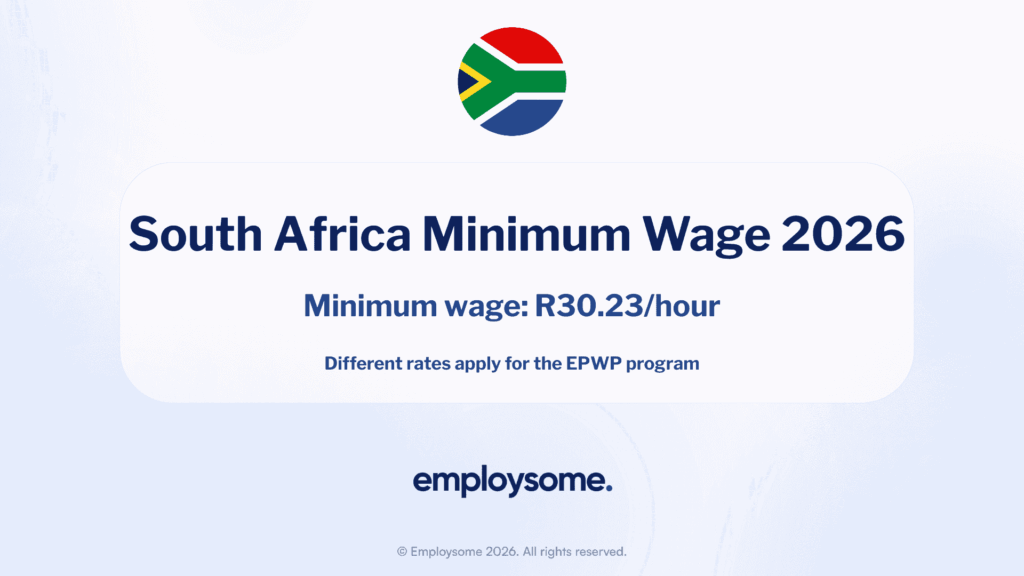
Table of Contents
- How Minimum Wage in South Africa Is Regulated
- Current Rates
- How Minimum Wage in South Africa Is Calculated
- Employer Statutory Contributions in South Africa
- Legal Framework Governing Minimum Wage
- Employer Obligations
- Penalties for Violating Minimum Wage
- Minimum Wage South Africa vs. Cost of Living
- 2026–2027 Outlook
- Final Takeaway

How Minimum Wage in South Africa Is Regulated
South Africa’s minimum wage framework is governed by the National Minimum Wage Act, No. 9 of 2018, which came into effect on 1 January 2019. The Act established a single national wage floor for the first time in South Africa’s history, replacing a fragmented system of sectoral determinations that previously set different minimum rates for different industries.
The minimum wage is reviewed annually by the National Minimum Wage Commission, an independent body chaired by Professor Imraan Valodia. The Commission is composed of representatives from government, organised labour, organised business, and community organisations. Its mandate includes evaluating economic conditions, inflation trends, cost-of-living pressures, employment data, wage inequality, and stakeholder submissions before recommending an annual adjustment to the Minister of Employment and Labour.
The Commission’s annual review considers:
- Consumer Price Index (CPI) trends and the real purchasing power of the minimum wage
- Employment levels and the potential impact of wage increases on job creation and job losses
- Collective bargaining outcomes across sectors
- Non-compliance rates and enforcement challenges, particularly in informal sectors such as agriculture and domestic work
- Public submissions from workers, employers, trade unions, and civil society organisations
For 2026, the Commission recommended an adjustment of CPI plus 1.5%, resulting in an approximately 5% increase. The Minister of Employment and Labour, Nomakhosazana Meth, accepted this recommendation and gazetted the new rate on 3 February 2026, with effect from 1 March 2026.
Enforcement is handled by the Department of Employment and Labour through labour inspectors, with the Commission for Conciliation, Mediation and Arbitration (CCMA) available to resolve disputes. The government announced plans in 2026 to appoint an additional 10,000 labour inspectors, signalling a decisive shift toward active compliance monitoring and enforcement.
The Act applies to all workers and their employers in South Africa, with limited exceptions for members of the South African National Defence Force, the National Intelligence Agency, and the South African Secret Service.
Minimum Wage South Africa 2026: Current Rates
From 1 March 2026, the statutory minimum wage rates in South Africa are:
|
Category |
2025 Rate |
2026 Rate |
|
National Minimum Wage (all workers) |
R28.79/hour |
R30.23/hour |
|
Domestic workers |
R28.79/hour |
R30.23/hour |
|
Farm workers |
R28.79/hour |
R30.23/hour |
|
Expanded Public Works Programme (EPWP) |
R15.83/hour |
R16.62/hour |
The R1.44 per hour increase represents an approximately 5% rise from the 2025 rate of R28.79. Notably, domestic workers and farm workers now receive the same rate as all other workers, eliminating the historical differential that existed when the NMW was first introduced in 2019. EPWP workers remain on a separate, lower rate under a special dispensation.
For workers on standard working arrangements, the monthly equivalents are:
- 45-hour week: R1,360.35/week or approximately R5,890.32/month
- 38-hour week: R1,148.74/week or approximately R4,974.04/month
- Minimum daily rate: R120.92 per day for employees working four hours or less
The minimum wage is an hourly rate. Calculating monthly pay depends on the employee’s ordinary hours of work as defined in their employment contract or applicable sectoral determination. The standard working week under the Basic Conditions of Employment Act (BCEA) is a maximum of 45 hours.
💡Employsome Insight: South Africa’s Minimum Wage Is High Relative to Median Income
South Africa’s national minimum wage now exceeds 80% of the country’s median wage, placing it among the highest minimum-to-median wage ratios globally. While this helps reduce income inequality, economists note that wage floors above 70–75% of median wages often increase compliance challenges in informal sectors such as agriculture, domestic work, and small retail businesses.
Sectoral Wage Determinations
In addition to the national minimum wage, certain sectors have specific wage determinations that set higher rates based on job category and geographic area. The most significant are:
Contract Cleaning Sector
Minimum wages vary by geographic location. Cleaners in metropolitan areas (Area A) receive higher rates than those in smaller municipalities (Area B and C). The 2026 gazette updated these rates alongside the national minimum wage.
Wholesale and Retail Sector
Wages vary by both job category and geographic area. For example, a general assistant in Area A (major metropolitan municipalities such as the City of Tshwane, City of Johannesburg, or City of Cape Town) earns R30.23–R35.53 per hour depending on classification, while cashiers, drivers, clerks, supervisors, and managers each have progressively higher minimum rates. Area B (all municipalities not in Area A) has slightly lower rates.
Learnership Allowances
Workers who have concluded learnership agreements under section 17 of the Skills Development Act receive allowances based on NQF level and credits earned, ranging from R455.00 to R2,654.04 per week. These are published in Schedule 2 of the gazette.
Employers in sectors covered by these determinations must ensure they are paying the applicable rate, which may be higher than the national minimum wage for certain job categories.
How Minimum Wage in South Africa Is Calculated
The national minimum wage applies to the ordinary hours actually worked by an employee. It is an hourly rate, and compliance is assessed by calculating the effective hourly pay for each ordinary hour worked.
Key calculation principles:
- The minimum wage applies to base pay for ordinary hours only. Overtime, allowances, tips, bonuses, and benefits in kind (such as food or accommodation) cannot be counted toward meeting the minimum wage unless specifically recognised as remuneration under law
- Under Sectoral Determination 7 (Domestic Workers), an employer may deduct a limited amount for accommodation provided, but food may not be deducted
- An employee must be paid at least R120.92 per day even if they work four hours or less
- The minimum wage cannot be varied by contract, collective agreement, or internal policy. It is a statutory floor that overrides any agreement to pay less
- It is an unfair labour practice for an employer to unilaterally reduce working hours or alter conditions of employment in order to circumvent the minimum wage
Overtime pay in South Africa is regulated by the BCEA. Overtime is paid at 1.5 times the normal wage rate, and work on Sundays at double the normal rate for employees who do not ordinarily work on Sundays. Public holiday work is paid at double the normal daily wage. The standard working week is a maximum of 45 hours (9 hours per day for a 5-day week, or 8 hours per day for a longer work week).
💡Employsome Insight: How South Africa Compares Globally
At roughly $1.60 per hour, South Africa’s minimum wage sits above many emerging markets but below most developed economies. For comparison, the Philippines averages around $1.30 per hour, India typically ranges between $0.90 and $1.20 per hour depending on the state, while Mexico’s minimum wage is roughly $2.20 per hour. In contrast, developed economies such as the United Kingdom exceed $14 per hour. This positioning places South Africa in the middle of the global wage spectrum and helps explain why the country is frequently used for English-speaking customer support, back-office services, and remote operations.
Employer Statutory Contributions in South Africa
Beyond the minimum wage, employers in South Africa must budget for several mandatory contributions that increase the total cost of employment.
Unemployment Insurance Fund (UIF)
Both employer and employee contribute 1% each of the employee’s monthly remuneration, for a total of 2%. The UIF earnings ceiling is R17,712 per month (R212,544 per year), meaning the maximum employer contribution is R177.12 per month per employee. UIF provides short-term financial relief for unemployment, maternity, adoption, parental leave, or illness. Contributions are remitted monthly to SARS via the EMP201 declaration.
Skills Development Levy (SDL)
Employers with annual payroll exceeding R500,000 must pay the SDL at 1% of total remuneration. This is an employer-only contribution and cannot be deducted from the employee’s salary. SDL funds are distributed to Sector Education and Training Authorities (SETAs) to support workforce skills development across South Africa.
Compensation for Occupational Injuries and Diseases (COIDA)
All employers must register with the Department of Labour’s Compensation Fund and pay an annual assessment. The rate varies by industry risk classification. The COIDA earnings threshold is R633,168 per year (2025/2026). All employers pay a baseline annual fee (R1,621 for 2025), with additional risk-based tariffs on top. This is an employer-only cost.
Total Employer Cost
For a minimum wage worker on a 45-hour week (R5,890.32/month gross), the approximate additional employer costs are:
|
Contribution |
Employer Cost |
|
UIF (1%) |
~R58.90/month |
|
SDL (1%, if applicable) |
~R58.90/month |
|
COIDA (varies by industry) |
~R30–R100+/month (estimated) |
|
Total employer add-on |
~R150–R220/month (2.5–3.5% above gross) |
South Africa’s employer statutory contributions are relatively low compared to many European or Latin American countries. The total employer cost premium above gross salary is typically 2.5–3.5% for minimum wage workers, though it can be higher for employers in high-risk COIDA categories. This does not include income tax (PAYE), which is the employee’s obligation but must be withheld and remitted by the employer.
💡 Employsome Insight: South Africa Is a Low Payroll Tax Jurisdiction
Compared to many European countries where employer payroll taxes often exceed 20–30% of gross salary, South Africa’s mandatory employer contributions typically fall between 2.5% and 3.5% for minimum wage workers. This relatively low payroll burden is one reason international companies often view South Africa as an attractive market for hiring remote support, customer service, and back-office roles.
Legal Framework Governing Minimum Wage
The principal legislation governing South Africa’s minimum wage and employment conditions includes:
- National Minimum Wage Act, No. 9 of 2018: Establishes the national wage floor, creates the National Minimum Wage Commission, and sets out the annual review process, exemption procedures, and enforcement mechanisms.
- Basic Conditions of Employment Act, No. 75 of 1997 (BCEA): Regulates working hours, overtime, leave entitlements, notice periods, and conditions of employment. Labour inspectors issue compliance orders under section 69(1) of the BCEA.
- Labour Relations Act, No. 66 of 1995: Governs the employment relationship, collective bargaining, unfair dismissal, and dispute resolution through the CCMA and Labour Court.
- Unemployment Insurance Act, No. 63 of 2001: Establishes the UIF and governs contributions and benefits.
- Skills Development Act, No. 97 of 1998: Establishes the SDL and governs learnership agreements and allowances.
- Compensation for Occupational Injuries and Diseases Act, No. 130 of 1993 (COIDA): Requires employer registration with the Compensation Fund and governs workplace injury compensation.
- Sectoral Determinations: Industry-specific wage and conditions regulations for sectors including domestic work (SD 7), contract cleaning, wholesale and retail, and others.
The minimum wage cannot be waived by contract or collective agreement. If an employment agreement specifies pay below the statutory minimum, the legal rate prevails automatically.
Employer Obligations Under South African Law
To remain compliant with South Africa’s minimum wage and employment regulations, employers must:
- Pay at least R30.23 per ordinary hour worked from 1 March 2026, or the applicable higher sectoral rate if covered by a sectoral determination
- Maintain accurate time and wage records for compliance verification and retain payroll records for at least five years
- Register with SARS for PAYE, UIF, and SDL, and submit monthly EMP201 declarations by the 7th of the following month
- Register with the Compensation Fund under COIDA and submit annual Returns of Earnings
- Issue compliant payslips detailing earnings, deductions, and net pay for every pay period
- Submit bi-annual EMP501 reconciliations and issue IRP5/IT3(a) certificates to employees
- Ensure no deductions reduce pay below the minimum wage unless specifically authorised by law (e.g., limited accommodation deductions for domestic workers)
- Check sectoral determinations for contract cleaning, wholesale and retail, and other covered sectors to confirm the applicable rate
For international companies without a South African legal entity, an Employer of Record (EOR) can handle all of these obligations on your behalf, including compliant employment contracts, payroll processing, SARS registration, UIF/SDL/COIDA contributions, PAYE withholding, and ongoing minimum wage compliance. The EOR acts as the legal employer in South Africa, assuming full responsibility for labour law compliance while you retain day-to-day management of the employee.
For a detailed comparison of providers, see our Best Employer of Record in South Africa guide, which reviews pricing, entity ownership, and service quality across the leading EOR providers operating in the South African market.
Penalties for Violating Minimum Wage in South Africa
Enforcement of the national minimum wage is handled by labour inspectors from the Department of Employment and Labour, with the CCMA available for dispute resolution. The government’s 2026 State of the Nation Address announced plans to appoint 10,000 additional labour inspectors, signalling a significant intensification of enforcement activity.
If an employer is found to have paid below the minimum wage, the consequences include:
- Compliance orders: Following an inspection, a labour inspector may issue a compliance order under section 69(1) of the BCEA, requiring the employer to pay the shortfall and come into compliance immediately.
- Retrospective back-payment: Employers may be compelled to reimburse employees for the full period during which the minimum wage was not paid, potentially covering months or years of underpayment.
- Fines and administrative penalties: Non-compliance with the NMW Act and BCEA carries financial penalties enforced by labour inspectors. The Minister has warned that employers who fail to comply will face fines.
- CCMA referral: Employees and their representatives may lodge complaints with the Department of Employment and Labour or refer disputes to the CCMA for conciliation and arbitration.
- Criminal sanctions: In serious cases, non-compliance with labour legislation can result in criminal charges and civil liability.
- Reputational consequences: Labour compliance is increasingly linked to B-BBEE certification and access to state contracts, meaning non-compliant employers may face procurement exclusion.
The Commission has noted that compliance remains a major challenge, particularly in agriculture and domestic work. Approximately 5.5 million workers are paid at or below the minimum wage, and the NMW now exceeds 80% of the median wage in South Africa, making enforcement critical. A Non-Compliance Workshop is scheduled for 2026 to deepen analytical work on enforcement.
Minimum Wage South Africa vs. Cost of Living
South Africa applies a single national minimum wage with no geographic variation. However, the real purchasing power of minimum wage earnings differs significantly across cities, driven primarily by housing costs and transport expenses.
For a full-time worker on a 45-hour week at R30.23/hour, gross monthly pay is approximately R5,890. After PAYE income tax and UIF deductions (workers earning below R95,750/year pay no income tax), a minimum wage worker’s take-home pay is approximately:
R5,700–R5,830 per month (after 1% UIF deduction; most minimum wage workers fall below the income tax threshold)
|
City |
Province |
Est. Net Pay |
Studio Rent |
Rent ÷ Income |
|
Cape Town |
Western Cape |
~R5,770 |
~R7,000–R10,000 |
121–173% |
|
Johannesburg |
Gauteng |
~R5,770 |
~R5,000–R8,000 |
87–139% |
|
Pretoria |
Gauteng |
~R5,770 |
~R4,500–R7,000 |
78–121% |
|
Durban |
KwaZulu-Natal |
~R5,770 |
~R4,000–R6,500 |
69–113% |
|
Port Elizabeth |
Eastern Cape |
~R5,770 |
~R4,000–R6,000 |
69–104% |
|
Bloemfontein |
Free State |
~R5,770 |
~R3,500–R5,000 |
61–87% |
The numbers tell a stark story. In Cape Town, a minimum wage worker earning R5,770/month after deductions would need to spend 121–173% of their entire income on studio rent alone, making independent living in the city effectively impossible on the minimum wage. Even in more affordable cities like Bloemfontein or Port Elizabeth, rent-to-income ratios of 61–104% leave very little for food, transport, utilities, and other essentials.
According to Statistics South Africa, the average monthly household budget is approximately R13,327, more than double the minimum wage. The average after-tax salary in Johannesburg is around R24,100/month, meaning a minimum wage worker earns approximately 24% of the average wage earner’s take-home pay. This gap highlights the extreme income inequality that characterises the South African labour market and explains why the NMW Commission has consistently recommended above-inflation adjustments.
💡Employsome Insight: Minimum Wage Does Not Cover Independent Living in Major Cities
Our analysis shows that a full-time minimum wage worker earning roughly R5,770 per month after deductions cannot afford average studio rent in any major South African city. Even in Johannesburg or Durban, housing costs consume between 70% and 140% of minimum wage income, meaning most workers rely on shared housing, family support, or employer-provided accommodation.
Minimum Wage South Africa 2026–2027 Outlook
South Africa’s minimum wage has followed a trajectory of steady above-inflation increases since its introduction in 2019:
|
Year |
Rate (R/hour) |
Increase |
|
2019 (introduction) |
R20.00 |
— |
|
2020 |
R20.76 |
3.8% |
|
2021 |
R21.69 |
4.5% |
|
2022 |
R23.19 |
6.9% |
|
2023 |
R25.42 |
9.6% |
|
2024 |
R27.58 |
8.5% |
|
2025 |
R28.79 |
4.4% |
|
2026 |
R30.23 |
5.0% |
Looking ahead, several developments will shape the minimum wage trajectory in 2027 and beyond:
- CPI-plus formula: The Commission’s consistent approach of CPI plus 1–1.5% ensures the minimum wage grows in real terms. If CPI averages 3.5–4.5% in 2026, the 2027 rate could reach approximately R31.50–R32.00/hour.
- Non-compliance enforcement: A Non-Compliance Workshop is scheduled for 2026 to investigate why the 2025 increase did not translate into measurable wage gains for low-paid workers. Enhanced enforcement, including 10,000 additional labour inspectors, is the government’s primary response.
- Labour Law Amendment Bill 2026: Published on 26 February 2026, this Bill proposes the most comprehensive review of South Africa’s employment legislation in over a decade, with amendments to the Labour Relations Act and BCEA that may affect enforcement mechanisms and employer obligations.
- 80% of median wage threshold: The NMW now exceeds 80% of the median wage, which the Commission acknowledges is approaching the upper bounds of international experience. Further above-inflation increases may heighten non-compliance if not accompanied by enforcement improvements.
- EPWP wage debate: There are ongoing calls for EPWP wages to be aligned with the full national minimum wage, eliminating the current lower rate for public works programme employees.
💡Employsome Insight: Expect Continued Above-Inflation Wage Growth
Since its introduction in 2019, South Africa’s minimum wage has increased by over 50%, significantly outpacing inflation. Given the government’s commitment to narrowing income inequality and the Commission’s CPI-plus adjustment formula, the minimum wage is likely to continue rising in real terms through the remainder of the decade.
Final Takeaway – Minimum Wage Compliance in South Africa
South Africa operates a single national minimum wage system that applies uniformly across all regions, with limited sectoral variations for contract cleaning, wholesale and retail, and learnership allowances. The minimum wage of R30.23/hour from 1 March 2026 represents a 51% cumulative increase since the NMW’s introduction in 2019, reflecting the government’s commitment to above-inflation adjustments.
Compliance requirements are straightforward but must be managed rigorously. Employers must pay at least the applicable rate for every ordinary hour worked, maintain accurate payroll records, register with SARS for PAYE/UIF/SDL, register with the Compensation Fund under COIDA, issue compliant payslips, and submit monthly and annual reconciliations on schedule.
Enforcement is intensifying. The appointment of 10,000 additional labour inspectors, the scheduled Non-Compliance Workshop, and the Labour Law Amendment Bill 2026 signal that the government’s focus has shifted decisively from reform to implementation. Employers should assume that compliance will be actively tested through inspections, audits, and CCMA referrals. Non-compliance can result in compliance orders, retrospective back-payment, fines, criminal sanctions, and reputational damage linked to B-BBEE certification and state procurement.
For international companies hiring in South Africa, whether directly or through an Employer of Record, minimum wage compliance forms the foundation of lawful employment. With approximately 5.5 million workers earning at or below the minimum wage, the stakes for both workers and employers are high. Proper wage compliance is not an administrative detail; it is a core element of employment risk management in the South African market.

Written by
Courtney Pocock is a Copywriter & EOR/PEO Researcher at Employsome with 15+ years of experience writing for the HR, corporate, and financial sectors. She has a strong interest in global business expansion and Employer of Record / PEO topics, focusing on news that matters to business owners and decision-makers. Courtney covers industry updates, regulatory changes, and practical guides to help leaders navigate international hiring with confidence.
Our content is created for informational purposes only and is not intended to provide any legal, tax, accounting, or financial advice. Please obtain separate advice from industry-specific professionals who may better understand your business’ needs. Read our Editorial Guidelines for further information on how our content is created.
Other posts
Check out Employsome's blog posts on global payroll